

The B2B Content Marketing Funnel: How to Build One That Actually Converts in 2026
86% of B2B purchases stall during the buying process. Not because the product was wrong, but because the content - the thing supposed to move buyers from curiosity to conviction - failed somewhere between awareness and decision. Meanwhile, 42% of B2B marketers can't consistently measure content ROI. A funnel that leaks and a team that can't tell where. That's the problem we're solving here.
What a B2B Content Funnel Actually Is
The textbook version is simple: top-of-funnel (TOFU) content attracts strangers, middle-of-funnel (MOFU) content nurtures them into leads, and bottom-of-funnel (BOFU) content converts them into customers. Awareness, consideration, decision. Clean, linear, easy to diagram on a whiteboard.
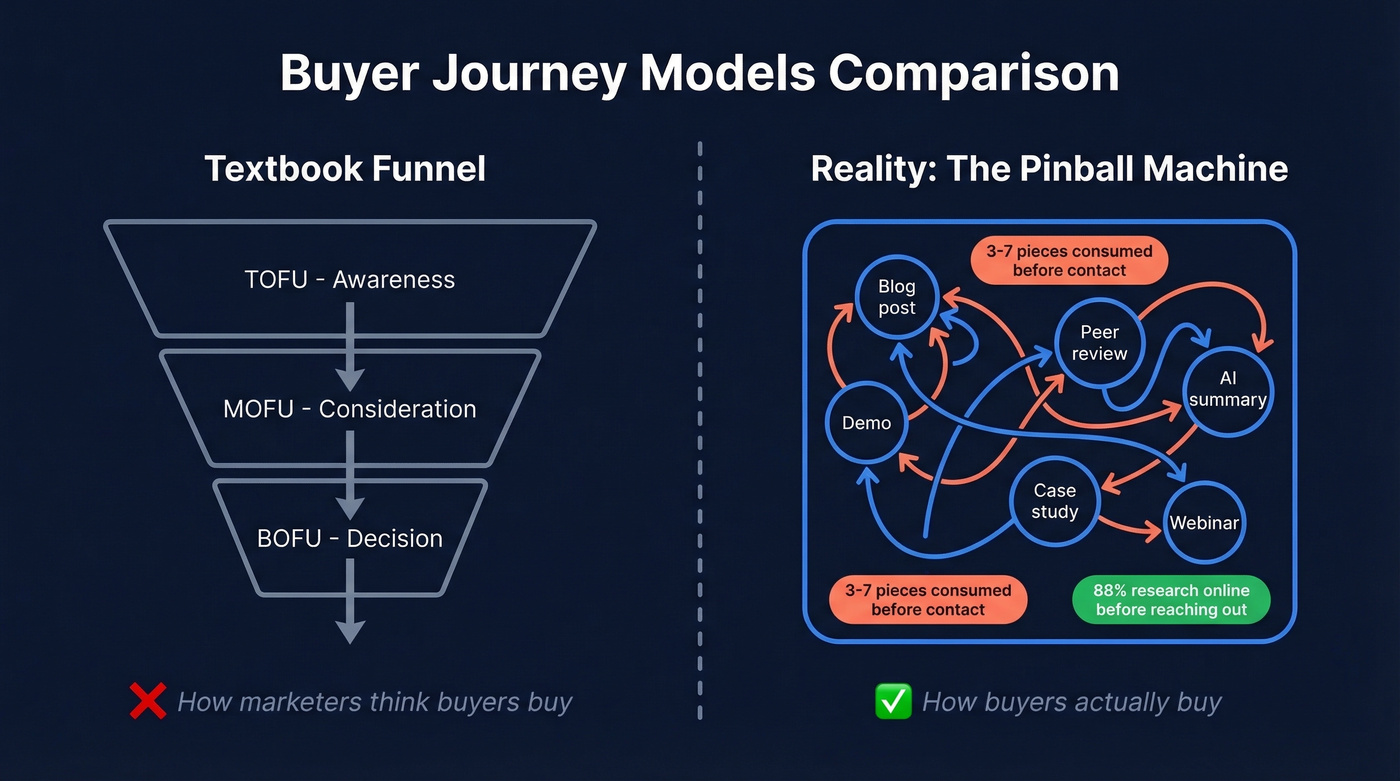
Here's the thing: the funnel is a useful mental model and a terrible operating plan.
88% of buyers research your company through online content before they ever reach out, but they don't do it in order. Gartner's research shows buyers loop backward, skip stages, and revisit content they've already consumed. Prospects consume 3-7 content pieces before making contact, and they do it in no particular sequence. Most B2B content funnels fail because they're designed for a buyer who doesn't exist anymore - one who reads your blog post, downloads your whitepaper, books a demo, and signs a contract in a tidy progression. Real buying looks more like a pinball machine than a slide.
That doesn't mean the framework is useless. It means you should treat it as a diagnostic tool - a way to identify where content is missing or underperforming - not as a literal path your buyers walk.
What Changed in 2026
How buyers buy changed fast.
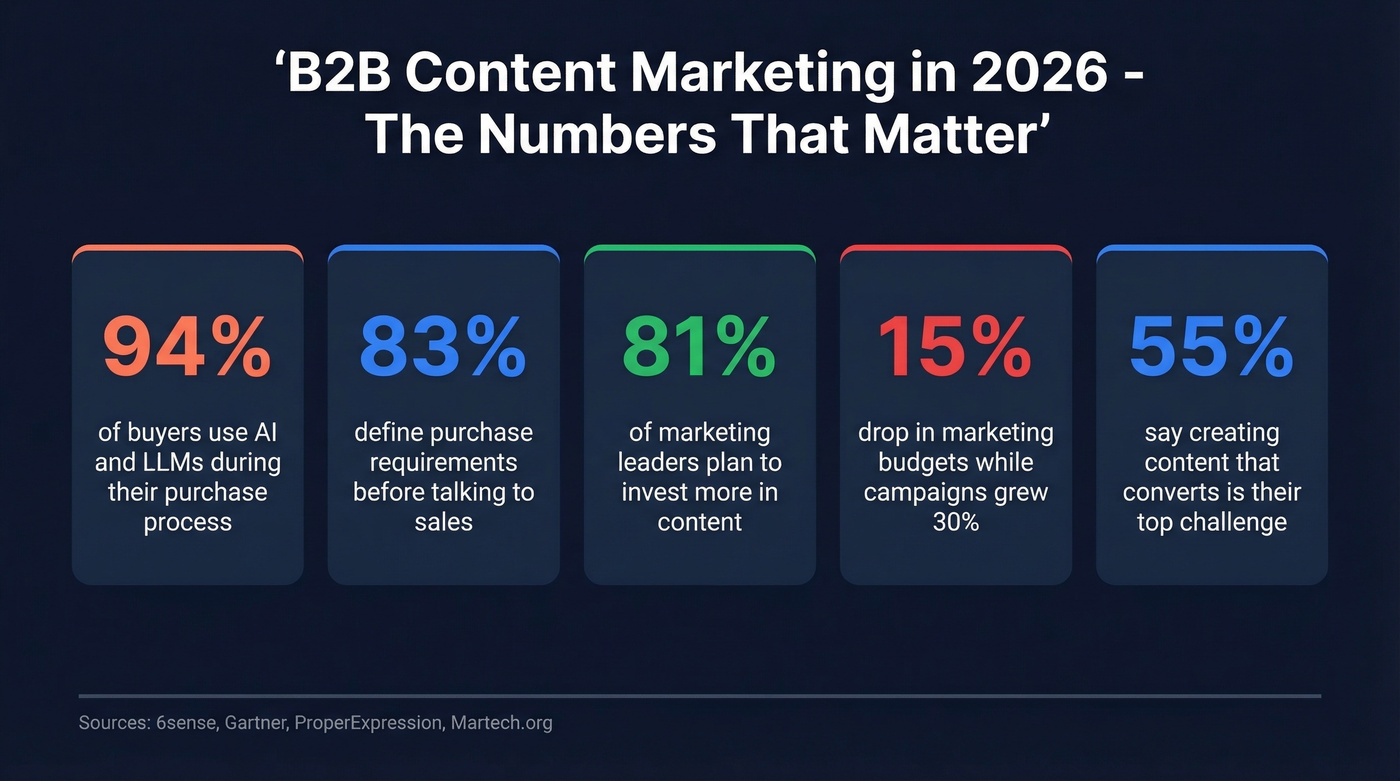
Cycles compressed, but engagement moved earlier. According to 6sense's Buyer Experience Report, average B2B sales cycles dropped from 11.3 months to 10.1 months. First contact with sellers moved from 69% to 61% of the journey - roughly 6-7 weeks earlier. Buyers are engaging sooner, but they're also arriving more informed: 83% define purchase requirements before speaking with sales.
AI is everywhere in buying. 94% of buyers now use LLMs during their purchasing process. Your content isn't just competing with competitors' content - it's competing with AI-generated summaries of everyone's content.
Budgets shrank while expectations grew. Marketing budgets dropped 15% while teams executed an average of 209 campaigns, a 30% increase year-over-year. Only 34% of CEOs and CFOs say they're aligned with their CMO on marketing strategy, which means content teams are fighting for resources with executives who don't understand what they do. Separately, 81% of marketing leaders plan to invest more in content marketing over the next year - a bet that content is the one channel worth protecting.
Content differentiation is the top challenge. A ProperExpression poll found 55% of marketers say their biggest challenge is creating content that converts B2B prospects into pipeline, while 43% struggle to differentiate their content at all. When every competitor publishes the same AI-assisted thought leadership, standing out requires genuine expertise and decision-support content - not more volume.
Content by Funnel Stage
Awareness (TOFU)
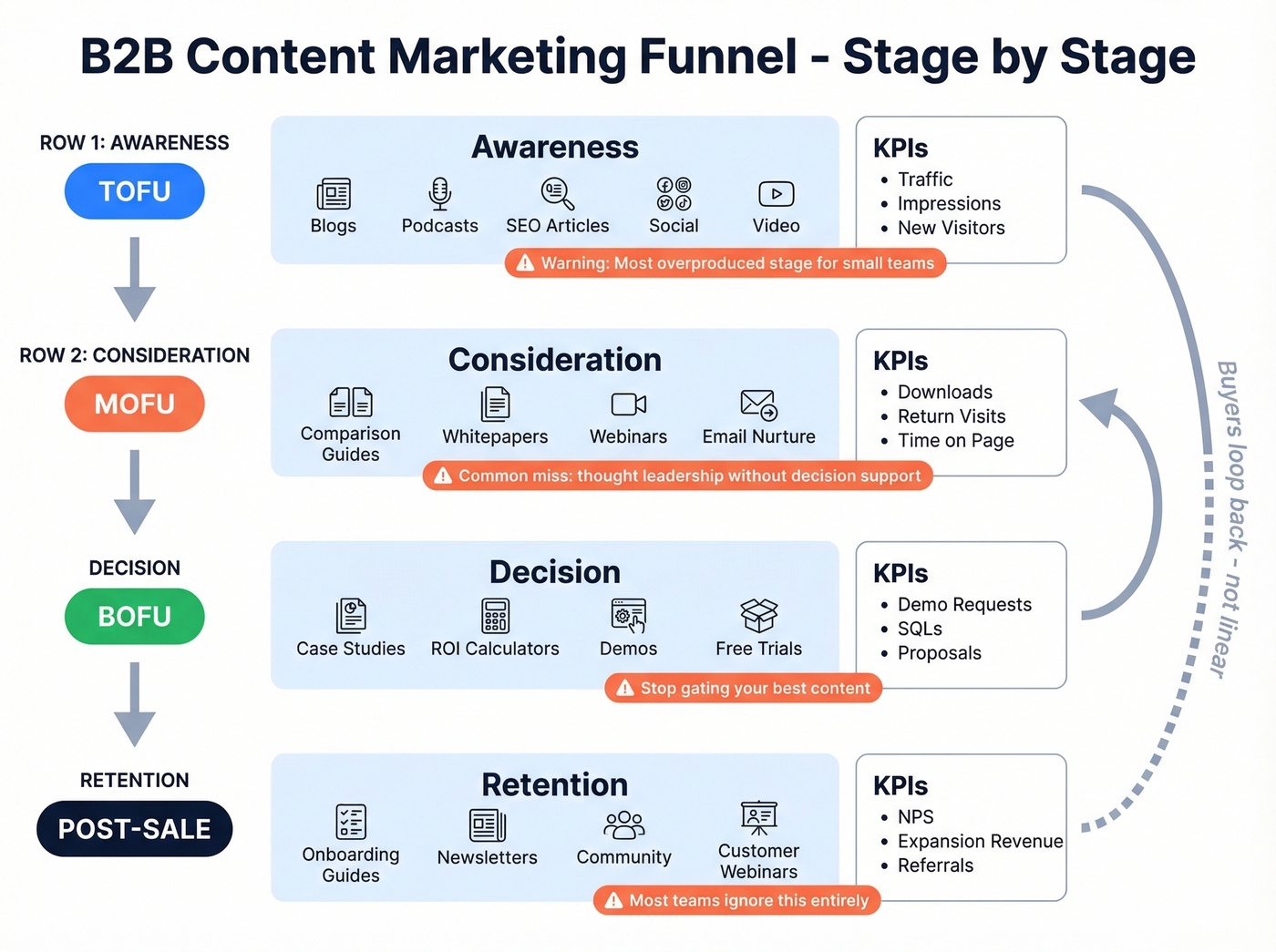
Blog posts, podcasts, social content, SEO-driven articles, videos, and PR. The metrics here are traffic, impressions, new visitors, and social shares.
Hot take: TOFU is the most overproduced, least valuable stage for small teams. Reddit practitioners consistently report that skipping awareness content entirely and focusing on consideration and decision conversations drives dramatically higher conversion - one thread cited 10x higher conversion rates from high-intent content versus broad awareness posts. If you've got a team of 50 and a content engine, invest in TOFU. If you're a team of two, skip it and start at MOFU.
When you do invest in TOFU, content syndication platforms let you target by job title, industry, and company size - reaching the full buying committee rather than relying on organic discovery alone. That precision makes syndication one of the few demand generation tactics worth the spend at the top of the funnel.
Consideration (MOFU)
Most teams get this stage wrong by producing thought leadership without decision support. A well-written industry trends piece gets attention, but it doesn't help a buying committee compare options, estimate ROI, or build an internal business case.
Comparison guides, whitepapers, webinars, and email nurture sequences belong here - tracked by email signups, content downloads, return visits, and time on page. Add comparison tables, TCO ranges, implementation timelines, and risk assessments. That's what moves people from "interesting" to "let's evaluate this."
Decision (BOFU)
Case studies, ROI calculators, product demos, vendor comparisons, and free trials. The KPIs that matter are demo requests, trial signups, SQL creation, and proposal requests.
Let's be honest: gating your best content in 2026 is a trust tax. Buying committees share content internally - if you gate your ROI analysis, the CFO who needs to see it never will. Gate the lead magnet (the checklist, the template). Ungate the substance. Forrester found that 81% of B2B buyers end up dissatisfied with their chosen provider, often because they lacked the comparison content to make a confident choice. Your ungated case study might be the thing that prevents buyer's remorse and wins the deal.
Retention and Advocacy
A single customer advocate generates more pipeline than ten blog posts. Yet most content teams ignore this stage entirely.
Onboarding guides, newsletters, community content, and customer webinars all belong here. Measure NPS, expansion revenue, referral rate, and churn. This is where compounding value lives.
| Stage | Content Types | Primary KPIs | Common Mistake |
|---|---|---|---|
| Awareness | Blogs, podcasts, SEO, video | Traffic, impressions | Overproduction by small teams |
| Consideration | Comparisons, webinars, nurture | Downloads, return visits | No decision support |
| Decision | Case studies, demos, trials | Demo requests, SQLs | Gating substance |
| Retention | Onboarding, newsletters | NPS, expansion revenue | Ignoring it entirely |
Designing for the Buying Committee
A typical B2B purchase involves 6-10 stakeholders. They consume different content, at different times, for different reasons. The VP of Engineering wants technical architecture docs. The CFO wants ROI projections. The end user wants a product demo. And buyers can go dark for 4-8 months while building an internal business case.
This means a lot of conventional advice backfires in practice. "Create content for each funnel stage" assumes buyers move linearly - they loop. "Gate your best content" assumes one person downloads it - committees share internally, and gates block the people who matter most. "Measure success by MQLs" doesn't reflect deal influence across a 10-person buying group.
Content's real job in long sales cycles is to hold the narrative together when sales isn't in the room - reinforcing urgency, re-aligning stakeholders, and maintaining momentum across months of silence.

Your content funnel generates interest - but 86% of B2B deals stall because teams can't connect with the right buyers. Prospeo gives you 300M+ profiles with 30+ filters including buyer intent, job changes, and technographics so your BOFU content reaches the decision-makers who are actually in-market.
Stop losing pipeline between content engagement and first contact.
Funnel Benchmarks That Matter
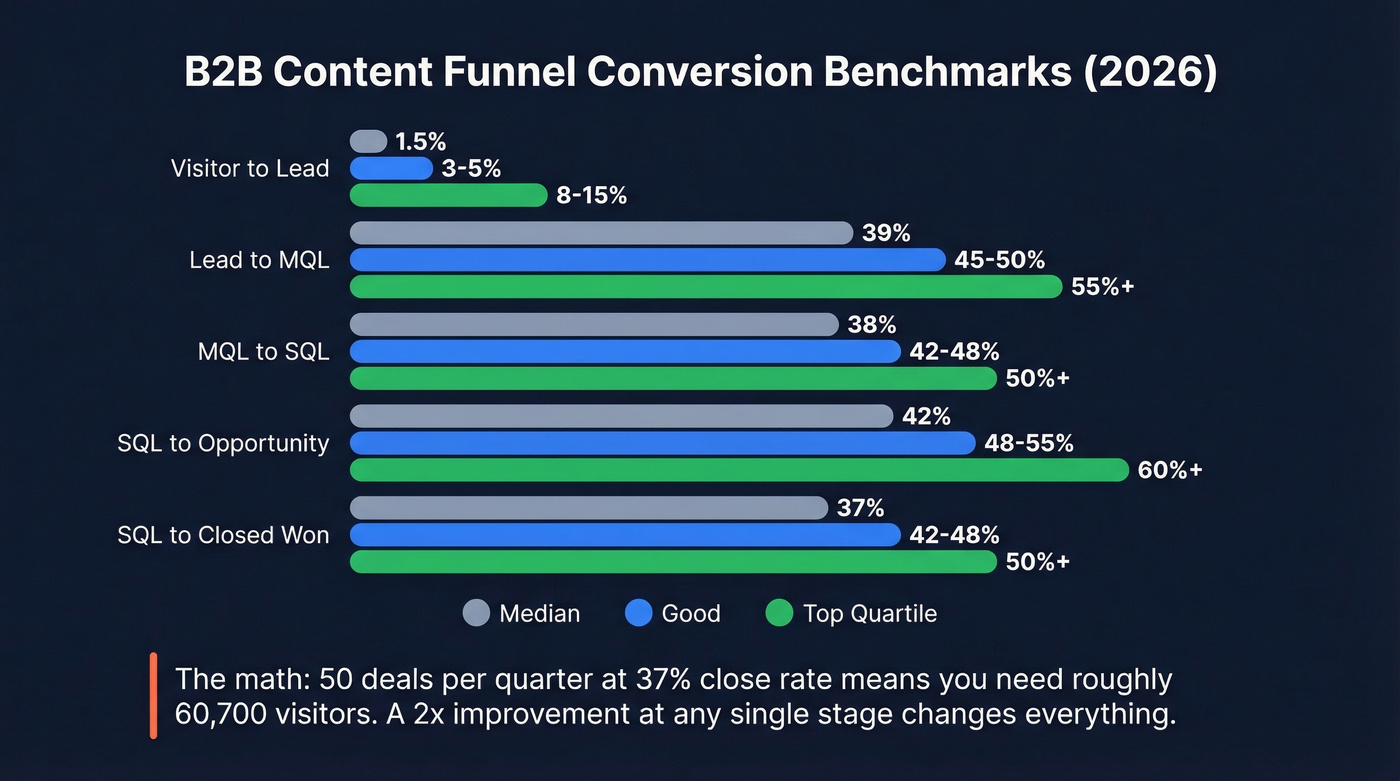
Let's put numbers on what "good" looks like. These benchmarks come from First Page Sage's analysis of B2B SaaS companies and ConversionXperts' 2026 guide.
| Stage Transition | Median | Good | Top Quartile |
|---|---|---|---|
| Visitor to Lead | 1.5% | 3-5% | 8-15% |
| Lead to MQL | 39% | 45-50% | 55%+ |
| MQL to SQL | 38% | 42-48% | 50%+ |
| SQL to Opportunity | 42% | 48-55% | 60%+ |
| SQL to Closed Won | 37% | 42-48% | 50%+ |
For SaaS-specific motions: free trial conversion runs 2-5% median (top quartile hits 10-15%), demo requests land at 1-3% median, trial-to-paid converts at 15-20%, and demo-to-close runs 20-30%.
The funnel math exercise every team should run: If you need 50 closed deals per quarter and your SQL-to-close rate is 37%, you need ~135 SQLs. At 38% MQL-to-SQL, that's ~355 MQLs. At 39% lead-to-MQL, that's ~910 leads. At 1.5% visitor-to-lead, that's ~60,700 visitors. Now you know what your content needs to produce - and where a 2x improvement at any single stage changes everything.
Diagnose Your Weak Stage
If your numbers fall below the medians above, here's where to look.
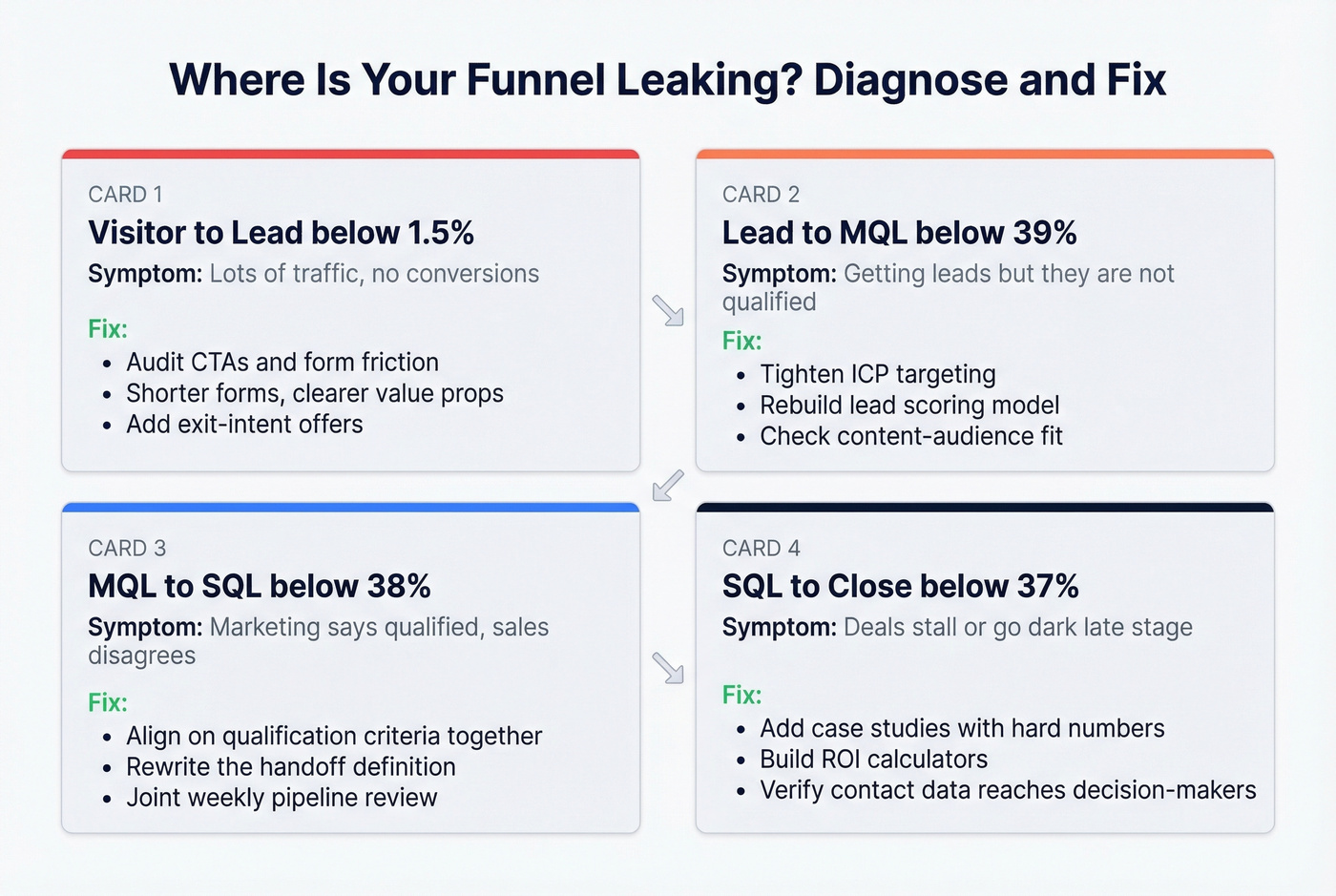
Visitor to Lead below 1.5%: Audit your CTAs and form friction. Most conversion rate optimization wins live here - shorter forms, clearer value propositions on landing pages, and exit-intent offers.
Lead to MQL below 39%: Tighten ICP targeting and lead scoring. You're attracting the wrong people or scoring them poorly.
MQL to SQL below 38%: Sales and marketing aren't aligned on qualification criteria. We've seen teams double their SQL rate just by rewriting the handoff definition together.
SQL to Closed Won below 37%: Your BOFU content isn't doing its job. Add case studies with hard numbers, ROI calculators, and vendor comparison pages. Also check that your contact data is actually reaching the right people - bounced emails kill deals that content already won.
Five Mistakes That Kill Your Funnel
Content marketing delivers an estimated 844% ROI over three years, but only if you avoid the mistakes that drain that return to zero.
No Documented Strategy
Only 37% of B2B marketers have a documented content marketing strategy. The other 63% are publishing and hoping. Without documented goals, content production becomes reactive and reporting devolves into traffic screenshots rather than decisions. A content strategy pipeline - one that maps every asset to a funnel stage, an audience segment, and a measurable outcome - is the difference between a content program and a content hobby.
Thought Leadership Without Decision Support
Your industry trends report gets shared on social. Great. But when the buying committee sits down to evaluate vendors, they need comparison tables, ROI ranges, implementation timelines, and risk assessments. If your content doesn't help them build the internal business case, you lose to the competitor whose content does.
Audience and Journey Mismatch
Content written for "everyone" converts no one. You're writing for a single persona when the actual buying group includes technical evaluators, financial decision-makers, and end users with completely different questions. Map content to roles, not just stages.
Vanity Metrics Over Pipeline Metrics
"Traffic is up 40% quarter-over-quarter!" Meanwhile, sales is asking where the quality leads are. If you can't measure it by stage, you don't have a funnel - you have a blog. Shift measurement to pipeline-influenced revenue, content-attributed deals, and cost per SQL.
Stale Data at BOFU
This one's the most frustrating because everything else worked. Your content did its job - the prospect hit the scoring threshold, sales picked up the lead - and then the outreach email bounces. 30-40% of B2B contact databases go stale within months. Your content investment evaporates at the last mile.
The fix is straightforward: verify before you send. Prospeo verifies emails in real time with 98% accuracy on a 7-day refresh cycle, so SDRs aren't burning sequences on dead addresses. Snyk dropped bounce rates from 35-40% to under 5% after implementing it. There's a free tier if you want to test before committing.
The Minimum Viable Funnel
If you're a team of one to three, don't start with a 47-piece content calendar. Start with three assets:
- One MOFU comparison guide that helps prospects evaluate options in your category. This is the highest-leverage content that converts B2B buyers from passive researchers into active evaluators.
- One BOFU case study with real numbers - revenue impact, time saved, implementation timeline.
- One email nurture sequence (5-7 emails) that moves leads from download to demo request.
Skip TOFU entirely until you've nailed consideration and decision content. In our experience, teams that start with MOFU see pipeline impact 2-3x faster than those who build awareness-first. The consensus on r/sales and r/digital_marketing backs this up - practitioners consistently report that high-intent content outperforms awareness content by an order of magnitude for small teams.
For repurposing, follow the ElevationB2B framework: take one whitepaper or pillar guide and extract insights into checklists, add visuals for social, SEO-optimize for organic, and gate strategically. Keep the whitepaper gated, make the derivative content free. One pillar asset becomes five or six pieces without starting from scratch.
How to Measure Your Funnel
42% of B2B marketers struggle to measure content ROI. The core problem is that most teams default to last-touch attribution in a buying cycle that spans 6-18 months and dozens of touchpoints. Last-touch gives all the credit to the final interaction before conversion - usually a demo request page - and ignores the case study, comparison guide, and three emails that actually built conviction.
| Model | Weighting | Best For | Limitation |
|---|---|---|---|
| First-touch | 100% first interaction | Measuring awareness | Ignores nurture |
| Last-touch | 100% final interaction | Short cycles | Ignores everything else |
| Linear | Equal across all | Simplicity | Overweights noise |
| Time-decay | More to recent touches | Late-stage analysis | Undervalues TOFU |
| U-shaped | 40/40/20 | Most B2B teams | Misses mid-funnel |
| W-shaped | 30/30/30/10 | Complex funnels | Requires clean data |
We recommend U-shaped as the default for most B2B teams. It gives proper credit to the first touch that created the lead and the last touch that converted it, while distributing 20% across the middle interactions. It's not perfect, but it's the best balance of accuracy and simplicity we've found.
The metrics that matter: pipeline influenced by content, content-attributed revenue, cost per SQL, LTV:CAC ratio, and deal velocity. Track these inside your CRM - Salesforce and HubSpot both support multi-touch attribution reporting. Everything else is a vanity metric dressed up in a dashboard.
If you want a clean tracking setup, start with funnel metrics and then pressure-test your sales conversion rate stage by stage.
Designing content for 6-10 stakeholders means nothing if you can't reach them directly. Prospeo's 143M+ verified emails at 98% accuracy and 125M+ mobile numbers let you deliver the right content to the right buyer - VP, CFO, or end user - without waiting for them to find you organically.
Reach every stakeholder on the buying committee for $0.01 per email.
FAQ
How long before a B2B content marketing funnel produces results?
Most funnels take 6-12 months to show pipeline impact, given average sales cycles of 10-12 months. You'll see early traffic and engagement signals within 90 days, but revenue attribution takes longer. Plan for two full quarters before judging ROI.
Should I gate my B2B content?
Gate lead magnets like checklists and templates, but ungate substantive content like guides and case studies. Buying committees share content internally - a gate means the CFO who needs your ROI analysis never sees it. Forrester data shows 81% of buyers end up dissatisfied partly due to limited access to comparison content during their evaluation.
What's the single highest-leverage content piece for a small team?
A MOFU comparison guide that helps prospects evaluate options in your category. Practitioners consistently report 10x higher conversion rates from high-intent comparison content versus broad awareness blog posts. One comparison guide outperforms ten TOFU articles for teams under five people.
How do I keep BOFU outreach from bouncing?
Verify contact data before every campaign using a tool with a short refresh cycle. Snyk cut bounce rates from 35-40% to under 5% by switching to real-time verification. Bad data is the most common and most fixable source of last-mile funnel leakage.