

B2B Customer Profiling: Build Profiles That Drive Revenue
Most B2B teams have a customer profile document somewhere. It was built in a workshop, probably involved sticky notes, and it describes a fictional "VP Sarah" who reads Harvard Business Review and cares about "digital transformation." Nobody on the sales floor has opened it since. These fairytale personas cost real money - poor data quality drains the average organization $12.9M per year, and a profile that doesn't match reality is just a prettier version of bad data.
Here's the thing: a B2B customer profiling framework that actually works requires three things most guides skip. A numeric scoring rubric so "good fit" isn't subjective. Interviews with your best customers instead of a brainstorming session with marketing. And an enrichment workflow that keeps profile data fresh as contacts change jobs and companies grow.
What Is B2B Customer Profiling?
B2B customer profiling is the process of defining the characteristics of the companies and buyers most likely to purchase, stay loyal, and become profitable. That last word matters. Gartner's framework emphasizes that an ICP isn't just "who buys" - it's "who buys and generates long-term value." The distinction filters out high-churn, low-margin accounts that look great in the pipeline but destroy unit economics.
Gartner breaks ICP data into three types: quantitative (CRM and ERP history, ACV, CLTV), qualitative (sales and CS insights, customer interviews), and predictive (analytics that surface new high-value attributes). Most teams stop at quantitative. They pull a revenue report, pick a headcount range, and call it a day. That's a third of the picture.
One benchmark worth memorizing: the average B2B software buying committee involves five decision-makers. Your profile needs to account for all of them, not just the person who fills out the demo form.
ICP vs. Buyer Persona vs. Customer Profile
The confusion here causes constant misalignment between sales and marketing.
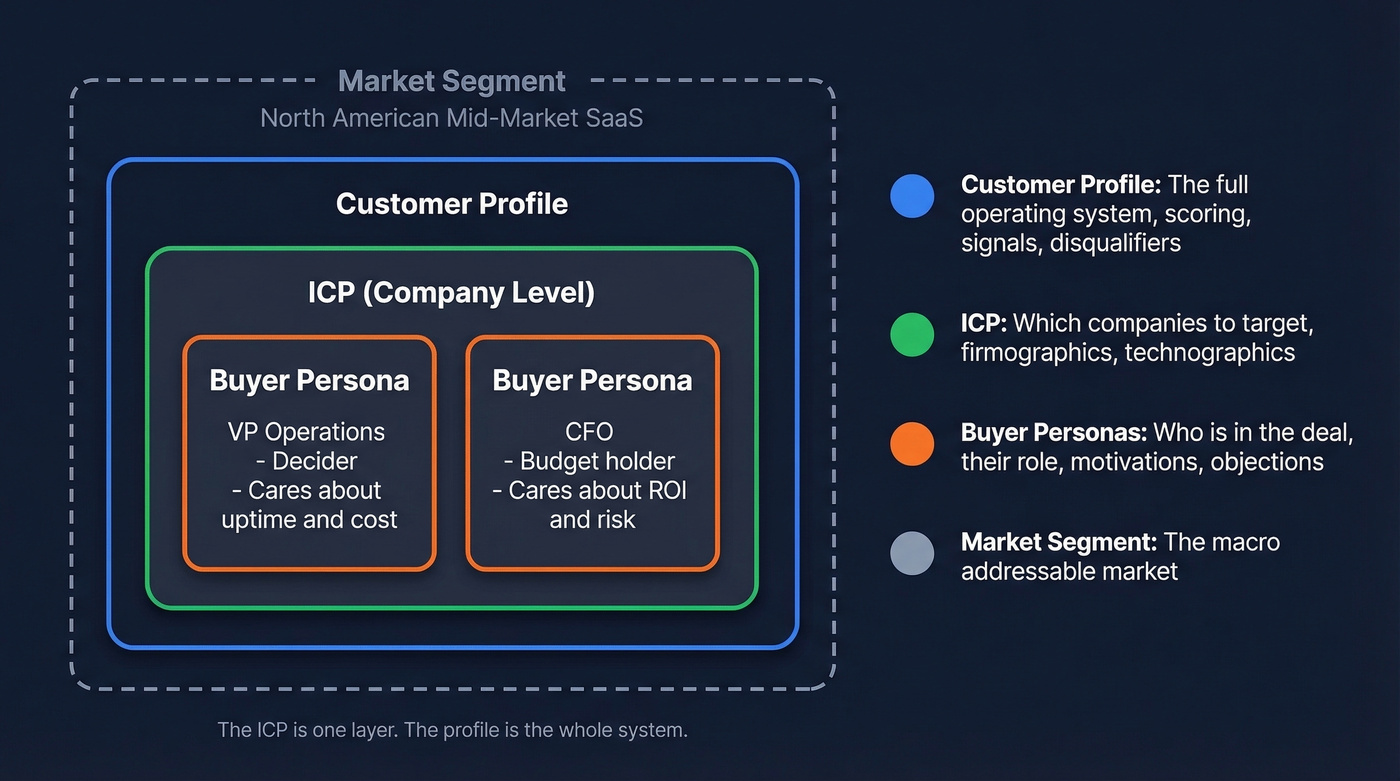
| Concept | Scope | Answers | Example |
|---|---|---|---|
| ICP | Company-level | Which orgs to target? | SaaS, 200-1K emp, Series B+ |
| Buyer Persona | Individual-level | Who's in the deal? | VP Ops, reports to COO, cares about uptime |
| Market Segment | Macro-level | What's the addressable market? | North American mid-market e-commerce |
| Customer Profile | All of the above | Full targeting doc | ICP + personas + scoring + signals |
Personas tell you who you're speaking to. An ICP tells you which companies are worth speaking to. As HubSpot frames it, teams can nail the individual but miss the organization - targeting the right VP at a startup that can't afford the product, or the right title at an enterprise that doesn't have the problem you solve.
A customer profile is the full document: ICP criteria, buyer personas, lead scoring rubric, behavioral signals, and disqualification criteria. The ICP is one layer. The profile is the operating system.
Why Profiling Drives Revenue
Let's put numbers on this. We've seen teams that use a scored ICP rubric and tier their accounts achieve Tier A win rates 1.5-2x higher than Tier B, with 15-20% shorter sales cycles. That's not marginal.
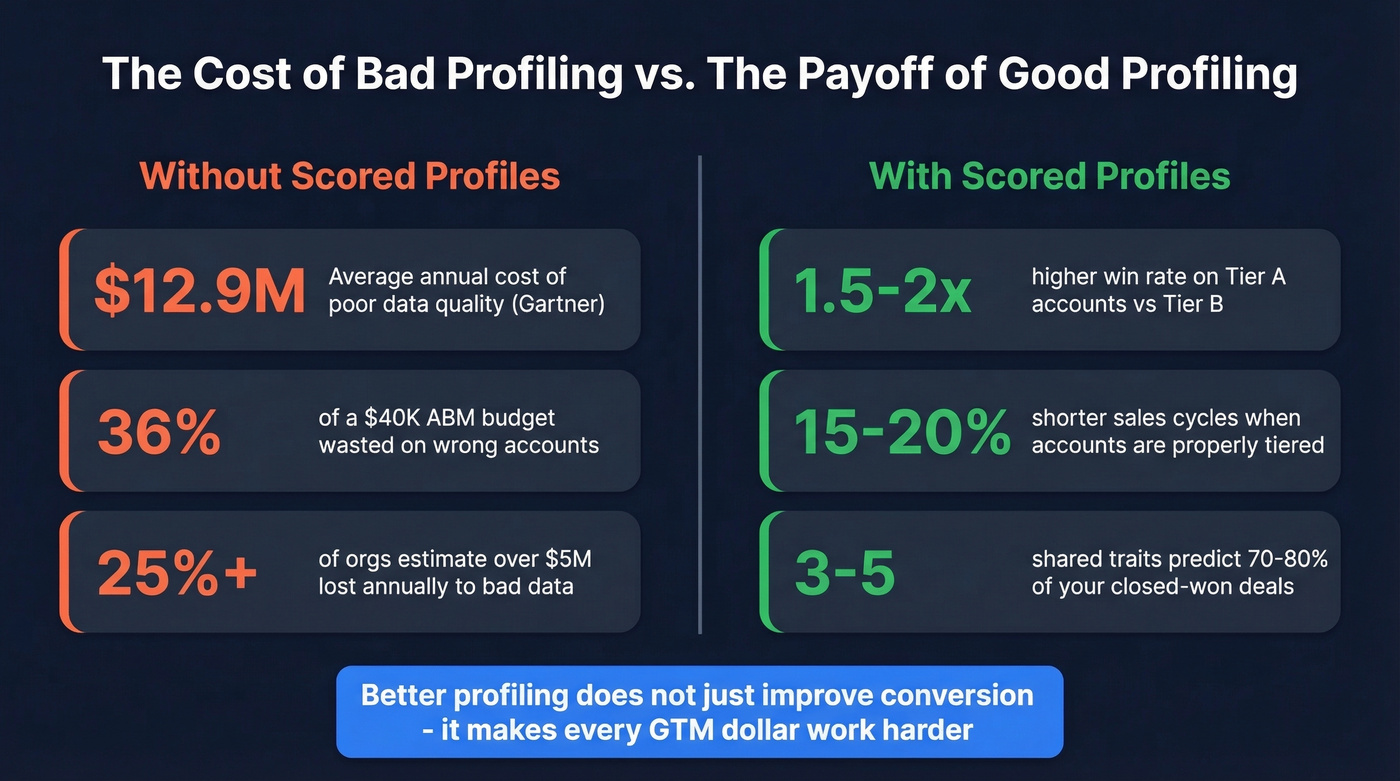
Here's the pattern: 70-80% of closed-won deals share just 3-5 traits. Industry, company size, tech stack, a specific pain point, and maybe a trigger event. Everything else is noise. Most teams spread their outbound and ad spend evenly across accounts that look nothing like their best customers - and then wonder why conversion rates are flat.
Run the math on a real scenario. You launch a $40K ABM campaign targeting 500 accounts. If your profiling is sloppy and 180 of those accounts were never going to buy, you just lit $14,400 on fire. That's over a third of your budget, not a rounding error. Better profiling doesn't just improve conversion rates; it makes every dollar in your GTM budget work harder. LinkedIn ads already run $5.58 per click - you can't afford to send that traffic to the wrong accounts. Over 25% of organizations estimate more than $5M in annual losses from poor data quality alone.
If your average deal size is under $10K, you probably don't need ZoomInfo-level data infrastructure. But you absolutely need a scored profile. The profile tells you where to aim. The data tools are just how you pull the trigger.
What to Include in Your Profile
Most profile templates are too thin. They capture industry and company size, then jump straight to persona details. Here's the full field checklist:
| Category | Fields |
|---|---|
| Firmographics | Industry, sub-industry, employees, revenue, HQ location, funding stage |
| Technographics | Tech stack, maturity level, key dependencies |
| Business Context | Core challenges, strategic goals, budget cycle |
| Buying Committee | Title, role type (decider/payer/user), reporting line, decision influences |
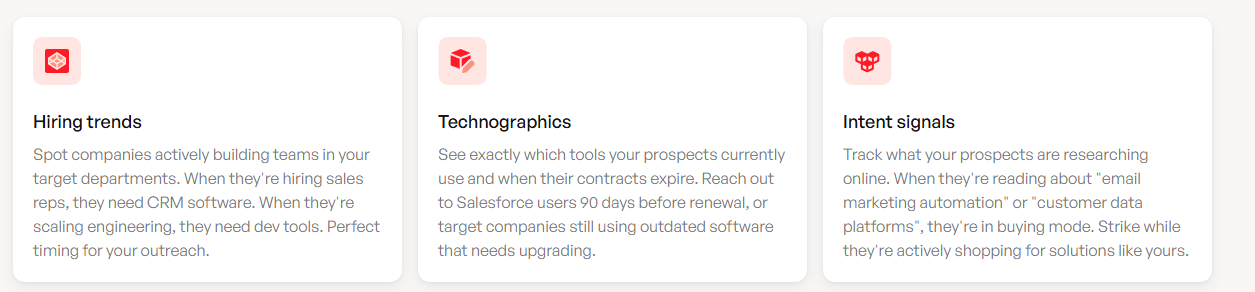
| Behavioral Signals | Intent data, job changes, hiring patterns, content engagement |
| Buying Triggers | New funding, leadership change, expansion, compliance deadline |
| Disqualification | Revenue floor, missing tech dependency, no dedicated team |
The disqualification criteria row is arguably the most valuable. Knowing who not to pursue saves more pipeline time than knowing who to pursue. If your product requires a dedicated ops team and the prospect doesn't have one, that's a disqualifier - no matter how good the firmographic fit looks.
Practitioners on r/b2bmarketing consistently flag this problem: profiles get built like B2C personas, heavy on demographics, light on firmographics and buying committee dynamics. Skip demographic-only profiles entirely. They're a B2C artifact that has no place in B2B. Technographics and infrastructure dependencies are often more predictive than company size.

You just mapped the fields your customer profile needs - firmographics, technographics, intent signals, buying triggers. Prospeo fills every one of them. 30+ search filters, 15,000 intent topics, and CRM enrichment that returns 50+ data points per contact at a 92% match rate. No more half-built profiles.
Turn your profiling framework into enriched, scored accounts in minutes.
How to Build a B2B Customer Profile
Step 1: Analyze Your Best Customers
Start with data, not opinions. Pull 50-100 closed-won deals from the last 12 months and look for the 3-5 traits they share - industry, headcount range, tech stack, deal trigger. The patterns emerge fast.
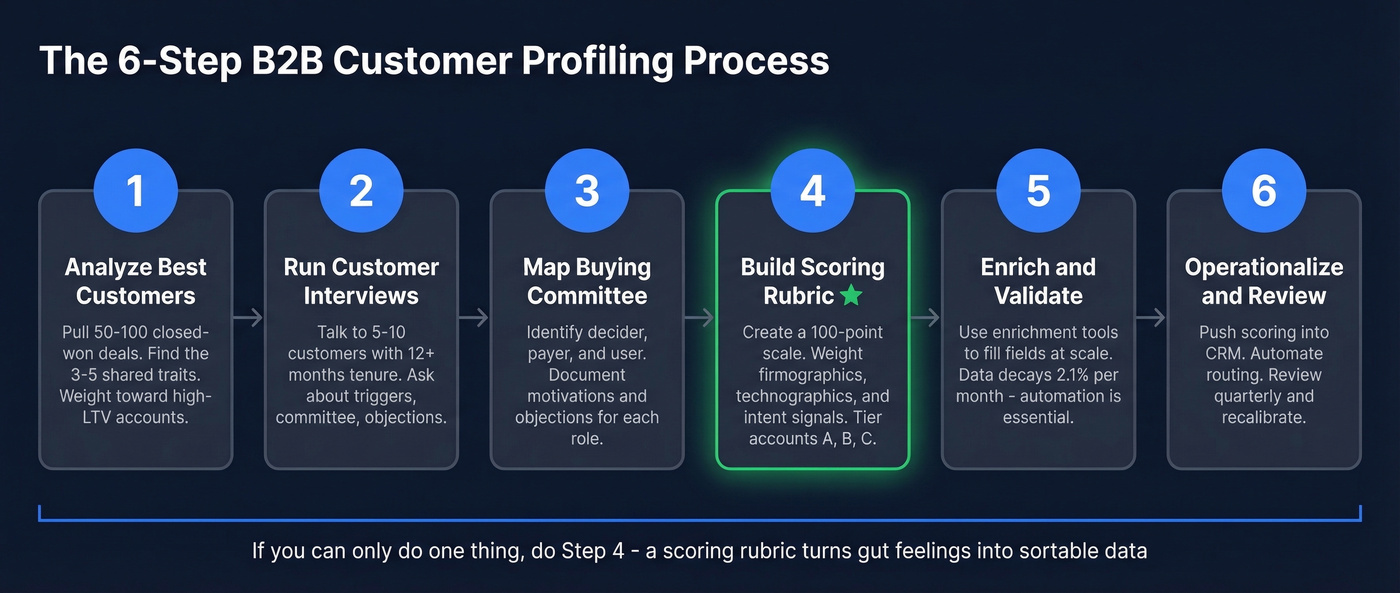
Don't just look at who buys. Look at who's profitable. The 80/20 rule applies aggressively in B2B: a small slice of your customers drives most of your margin. A customer who buys but churns in 4 months isn't a good-fit account, even if they converted quickly. Weight your analysis toward high-LTV accounts.
Step 2: Run Customer Interviews
Surveys won't cut it yet. If you can't write clear survey questions, you don't know enough - start with conversations.
Interview customers with 12+ months tenure and above-average spend. Target 5 interviews to start seeing patterns, 8-10 for real confidence. Ask about what triggered the search for a solution, who was involved in the buying decision, what nearly stopped the purchase, how they measure success with the product, and where they learn about new tools. The buying process questions are gold - they reveal the actual committee structure, the real objections, and the timeline dynamics that no CRM field captures.
Step 3: Map the Buying Committee
Every deal has a decider, a payer, and a user - and they're rarely the same person. Gartner's five-decision-maker benchmark means you need to map at least three to five roles per target account. Document each role's motivations, objections, and information sources separately.
Step 4: Build Your Scoring Rubric
If you can only do one thing from this guide, do this. A numeric scoring rubric turns "good fit" from a gut feeling into a sortable, automatable data point.
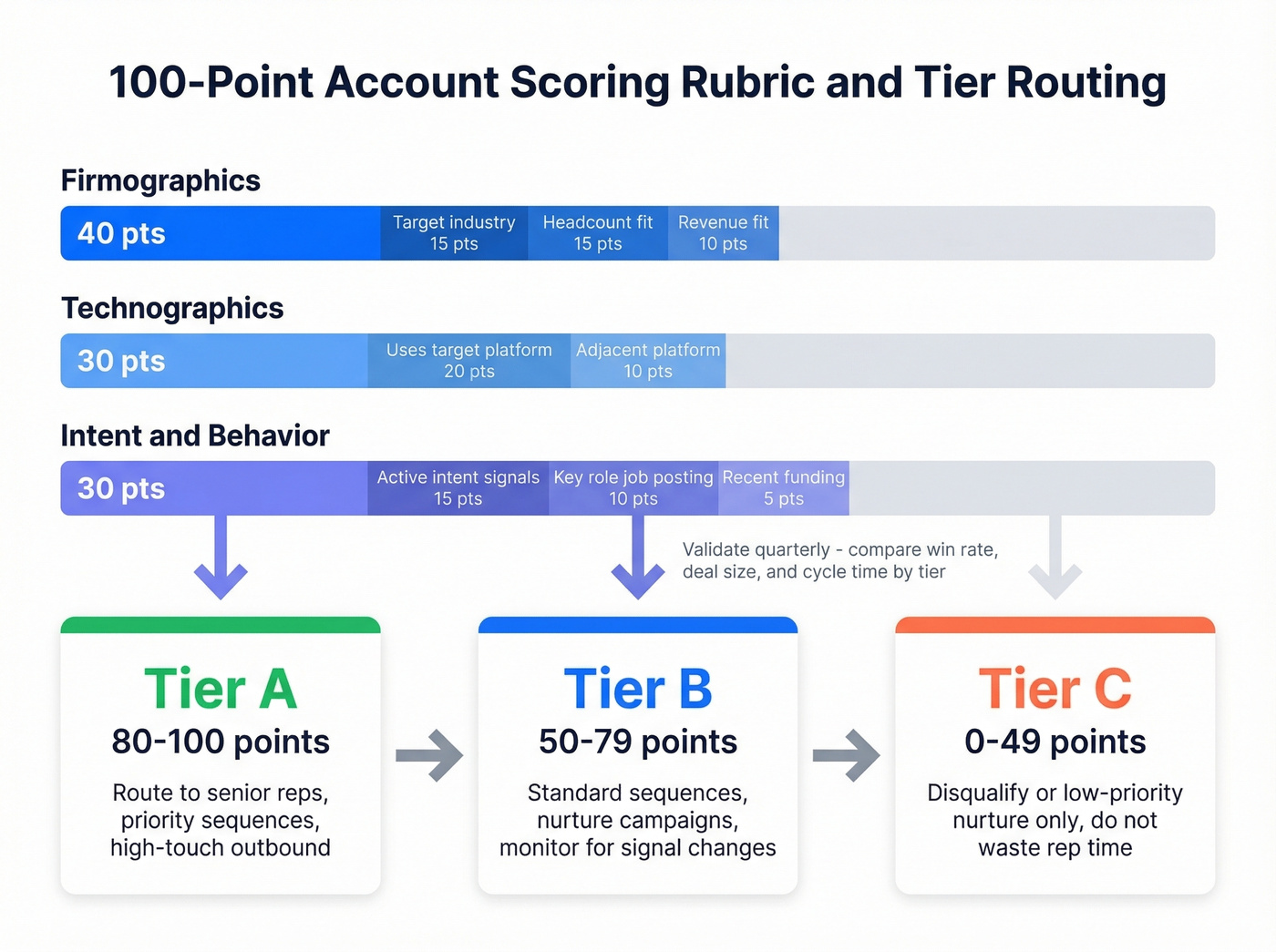
Use a 100-point scale with weighted categories:
| Category | Weight | Example Criteria | Points |
|---|---|---|---|
| Firmographics | 40 pts | Target industry | 15 |
| Adjacent industry | 8 | ||
| 200-1K employees | 15 | ||
| 50-199 employees | 8 | ||
| Revenue $20M-$150M | 10 | ||
| Technographics | 30 pts | Uses target platform | 20 |
| Uses adjacent platform | 10 | ||
| Intent/Behavior | 30 pts | Active intent signals | 15 |
| Job posting for key role | 10 | ||
| Recent funding round | 5 |
Tier your accounts: A (80-100), B (50-79), C (0-49). Route Tier A to your best reps. Put Tier C into nurture sequences or disqualify entirely.
Then validate quarterly - compare win rate, deal size, and cycle time by tier. If Tier B is outperforming Tier A, your rubric needs recalibration.
Step 5: Enrich and Validate
A profile framework is only useful if you can populate the fields at scale. Manual research doesn't work past 50 accounts. You need enrichment tooling that fills in firmographics, technographics, contact details, and intent signals automatically.
The data decay problem is real: B2B contact data decays at roughly 2.1% per month - about 25% annually. A profile built on stale data is just a more structured version of guessing.
Step 6: Operationalize and Review
Push your scoring rubric into your CRM - HubSpot lead scoring, Salesforce account fields, or a custom property. Automate routing so Tier A accounts get prioritized in sequences and assigned to senior reps.
Review quarterly. When patterns shift - and they will, especially after product launches or market changes - update the profile. A static profile is a decaying profile.
Filled-In Profile Example
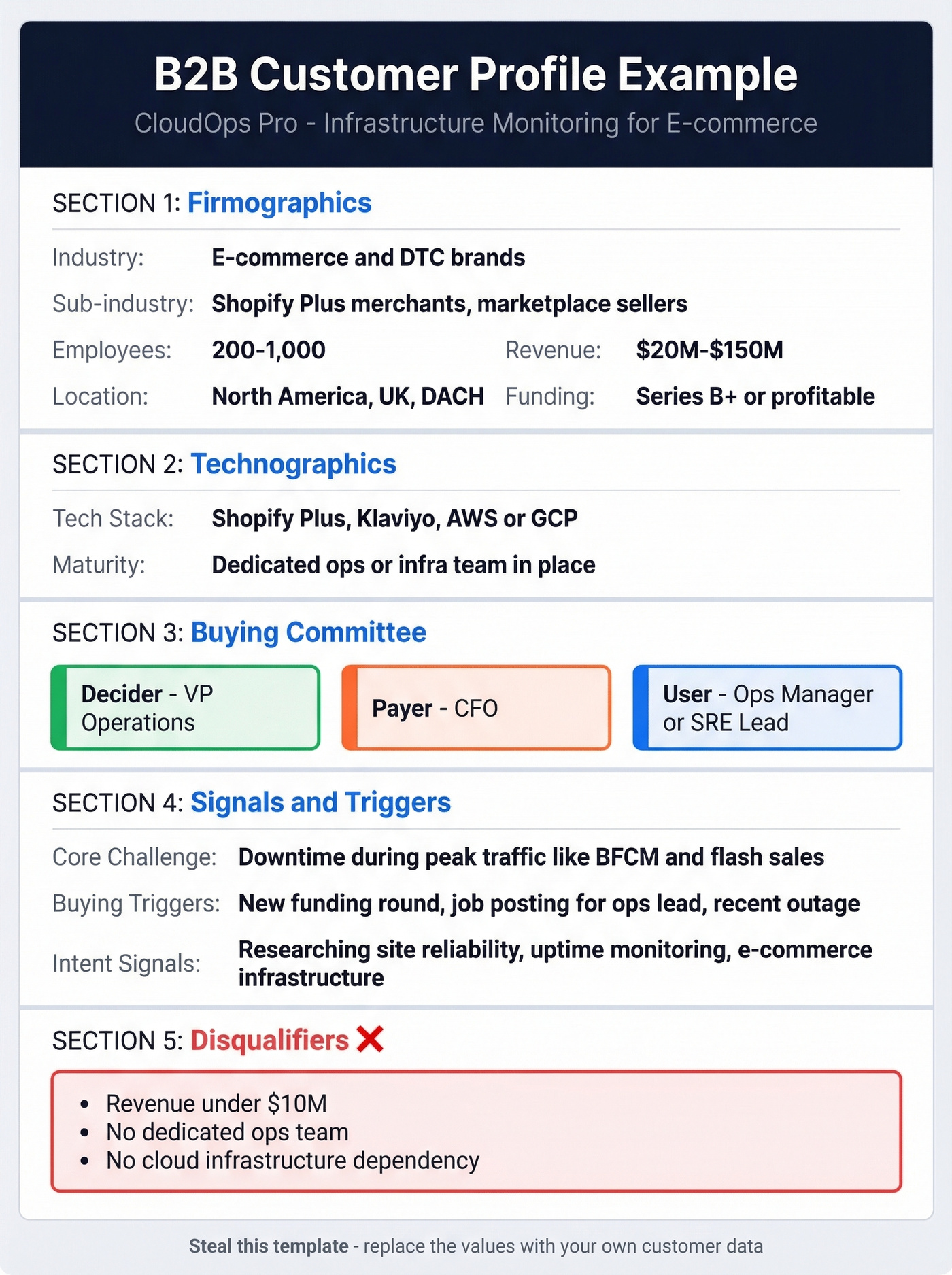
Here's a complete profile for a fictional mid-market SaaS company called "CloudOps Pro" that sells infrastructure monitoring to e-commerce companies:
| Field | Value |
|---|---|
| Target Industry | E-commerce / DTC brands |
| Sub-Industry | Shopify Plus merchants, marketplace sellers |
| Employees | 200-1,000 |
| Revenue | $20M-$150M |
| Location | North America, UK, DACH |
| Funding Stage | Series B+ or profitable |
| Tech Stack | Shopify Plus, Klaviyo, AWS or GCP |
| Maturity | Dedicated ops/infra team in place |
| Core Challenge | Downtime during peak traffic (BFCM, flash sales) |
| Decider | VP Operations |
| Payer | CFO |
| User | Ops Manager / SRE Lead |
| Buying Trigger | New funding round, job posting for ops lead, recent outage |
| Intent Signals | Researching "site reliability," "uptime monitoring," "e-commerce infrastructure" |
| Disqualifiers | Revenue under $10M, no dedicated ops team, on-prem only infrastructure |
| Negative ICP | Agencies, consulting firms, pre-revenue startups |
| Score Threshold | Tier A: 80+ = direct outbound; Tier B: 50-79 = nurture |
This isn't a template to fill in during a workshop. It's a living document that gets validated against closed-won data every quarter and enriched with fresh data continuously.
How to Enrich Profiles at Scale
In our experience, single-source enrichment consistently leaves 40-60% of qualified prospects unreachable. That's why waterfall enrichment - querying multiple providers sequentially until you get verified contact info - has become the standard approach for serious outbound teams.
The enrichment tool you pick matters more than most teams realize. Data accuracy directly impacts deliverability, connect rates, and pipeline.
| Tool | Database Size | Email Accuracy | Data Refresh | Starting Price |
|---|---|---|---|---|
| Prospeo | 300M+ profiles | 98% | 7 days | Free tier available; ~$0.01/lead |
| Apollo.io | 275M+ contacts | ~79% | 4-6 weeks | Free (100 credits/mo), $49/user/mo |
| ZoomInfo | 260M+ profiles | ~87% | ~6 weeks | ~$14,995/yr (3 users) |
| Cognism | Large database | Varies | Varies | ~$1,000-$3,000/mo |
| Clay | Aggregator/workflow | Depends on source | Varies | $149/mo |
A note on Cognism: North American coverage is weaker than European coverage. For US-focused ICPs, factor that in. Also worth knowing - Clearbit was renamed to HubSpot's Breeze Intelligence. If you're already on HubSpot, it's worth evaluating as a native enrichment layer, though it's no longer a standalone option.

The 7-day data refresh cycle is the detail that matters most for profiling. When B2B data decays at 2.1% per month, a tool refreshing weekly versus the ~6-week industry average means your profile fields stay accurate between quarterly reviews. That's the difference between outreach that lands and emails that bounce.
If you want to compare options before you commit, start with a shortlist of data enrichment services and then map them to your outbound workflow.
Bad data costs $12.9M a year. Stale data is even worse - it makes your scored profiles decay the moment you build them. Prospeo refreshes every record on a 7-day cycle, so the firmographic and technographic data powering your ICP stays accurate. 300M+ profiles, 98% email accuracy, $0.01 per lead.
Stop building customer profiles on data that's already six weeks old.
Mistakes That Kill B2B Profiles
Building profiles like it's B2C. Job titles and seniority without firmographics or technographics. As one practitioner on r/b2bmarketing put it, these "fairytale personas" get built in workshops, collect dust, and never touch the sales floor. Start with company-level criteria, then layer in persona details.
Ignoring profitability. Optimizing for volume of closed deals instead of margin. Your top 20% of customers likely drive 80% of profit. Weight your scoring rubric toward traits shared by high-LTV accounts, not just high-volume ones.
No disqualification criteria. Every profile should define who you won't sell to. Without negative criteria, reps waste cycles on accounts that were never going to work. Add a "disqualifiers" section and enforce it in routing rules.
Single-source data enrichment. Relying on one provider leaves gaps. Waterfall enrichment across multiple sources catches what any single tool misses. Use at least two enrichment sources, or pick a platform that aggregates multiple data providers.
No maintenance cadence. A profile built in January is 25% stale by December. Schedule quarterly reviews comparing win rates by tier, and run continuous enrichment to keep contact data fresh. Teams that treat their customer profiles as a one-time project instead of an ongoing discipline inevitably watch their targeting accuracy erode.
If you’re building outbound around these profiles, it helps to standardize your sales prospecting techniques and your lead generation workflow so scoring and routing actually get used.
FAQ
What's the difference between an ICP and a customer profile?
An ICP defines company-level fit criteria - industry, size, tech stack, revenue range. A customer profile is the broader document that includes the ICP plus buyer personas, behavioral signals, scoring rubrics, and disqualification criteria. Think of the ICP as one layer inside the full profile.
How often should I update my B2B customer profiles?
Review scoring tiers against win rate and cycle time data every quarter. Run continuous enrichment to combat the ~2.1% monthly data decay that erodes contact accuracy. Do a major profile refresh annually, or immediately after significant product launches or market shifts.
What's the fastest way to build a profile from scratch?
Pull 50 closed-won deals, identify the 3-5 traits they share, then run 5 customer interviews to validate and add qualitative depth. Use an enrichment tool to populate fields at scale - firmographics, technographics, emails, and mobiles across your target accounts. You can have a working scored profile within two weeks.
What free tools help with B2B customer profiling?
Prospeo offers a free tier with 75 email credits and 100 Chrome extension credits per month - enough to enrich a starter list and validate your initial profile criteria. Apollo.io also has a free plan at 100 credits per month, though email accuracy is lower at ~79%. Pair either with your CRM's native reporting to analyze closed-won patterns at zero cost.