

The Best B2B Databases in 2026 (Tested Accuracy, Real Pricing, Honest Picks)
Every B2B database claims "95% accuracy." Then you export 1,000 contacts and 200 bounce. Your sender reputation tanks, your sequences stall, and you've just paid good money to damage your own domain.
The gap between claimed and tested accuracy is the most expensive lie in sales tech - and it's why we compared 15 providers against tested benchmarks instead of trusting marketing pages.
B2B contact data decays at 22.5% per year - roughly 2.1% every month. That rate varies wildly by industry: tech contacts churn at 25-35% annually, startups churn at 30-40%, while manufacturing holds steadier at 10-15%. Gartner pegs the annual cost of bad data at $12.9M per organization. And Dun & Bradstreet found that 50% of sales time gets wasted on unproductive prospecting, much of it driven by stale contacts that never should've made it into a sequence.
So the question isn't whether you need a business contact database. It's whether the one you're paying for actually delivers usable data - or just a big number on the homepage.
Our Picks (TL;DR)
Prospeo - Best for email accuracy and data freshness. 98% email accuracy, 7-day refresh cycle, 300M+ professional profiles. Teams book 26% more meetings than ZoomInfo users and 35% more than Apollo users. Free tier available, paid plans from ~$0.01/email.
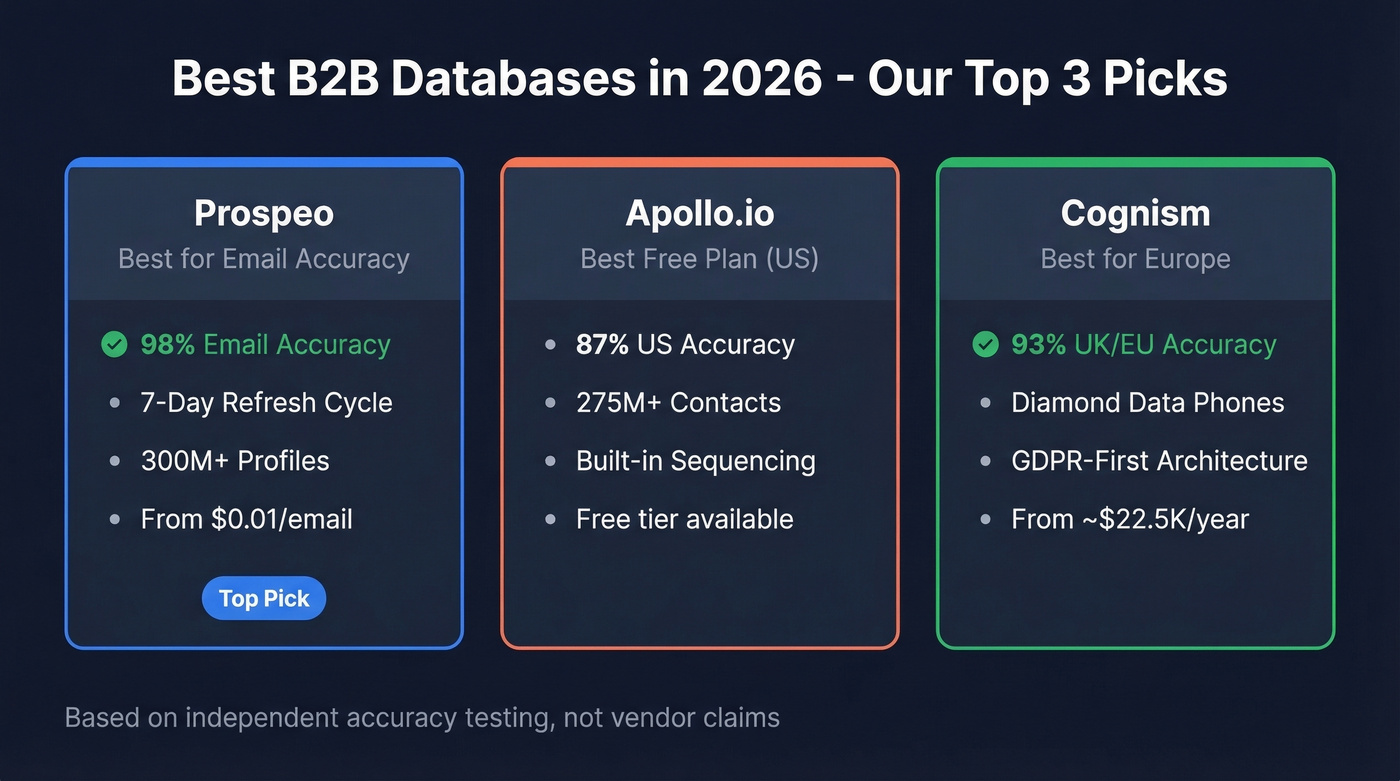
Apollo.io - Best free plan for US-focused teams. 275M+ contacts, built-in sequencing, and a genuinely useful free tier. Accuracy drops hard outside North America, but for US prospecting on a budget, it's the obvious starting point.
Cognism - Best for teams selling into Europe. 93% UK/EU accuracy in testing, Diamond Data phone-verified mobile numbers, and GDPR-first architecture. Not cheap, but if you're building pipeline in EMEA, nothing else comes close.
What Makes a B2B Database Worth It
These six criteria separate databases that generate pipeline from ones that generate bounces.
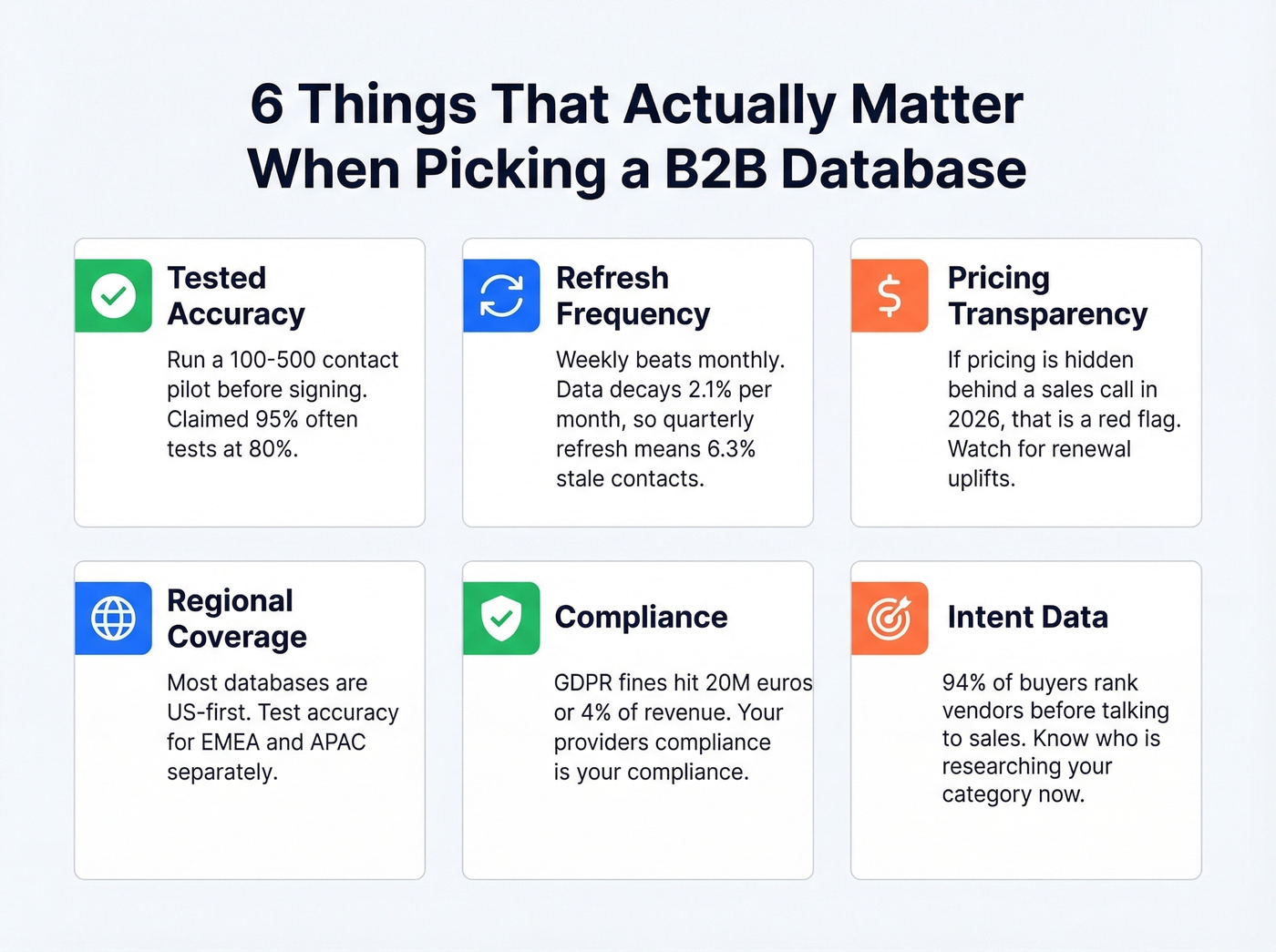
Tested accuracy, not claimed accuracy. Every vendor says "95%+." Independent benchmarks routinely show wide variance by region. Run your own pilot with 100-500 contacts before signing anything.
Refresh frequency. A 300M-contact database refreshed weekly beats 500M refreshed monthly. Data decays at 2.1%/month - if your provider refreshes quarterly, you're prospecting with ~6.3% stale contacts before you even export.
Pricing transparency. If a vendor hides pricing behind a sales call in 2026, that's a red flag. Credit models, seat minimums, and renewal uplifts all matter more than the headline number.
Regional coverage matters just as much. Most databases are US-first. If you're selling into EMEA or APAC, you need tested accuracy numbers for those regions specifically - not a global average that masks weak spots.
Compliance is non-negotiable. GDPR fines can hit euro20M or 4% of global revenue. California's B2B exemption expired in January 2023. Your data provider's compliance posture is now your compliance posture. (For a deeper audit checklist, see our B2B compliance guide.)
And then there's intent data, which is quickly becoming table stakes. The intent data market is projected to hit $20.89B by 2035, and 6sense found that 94% of buying groups rank preferred vendors before ever talking to sales. Knowing who's actively researching your category right now - that's the difference between cold outreach and warm timing.

B2B Database Comparison
We split the main table into two views so it doesn't break on mobile.
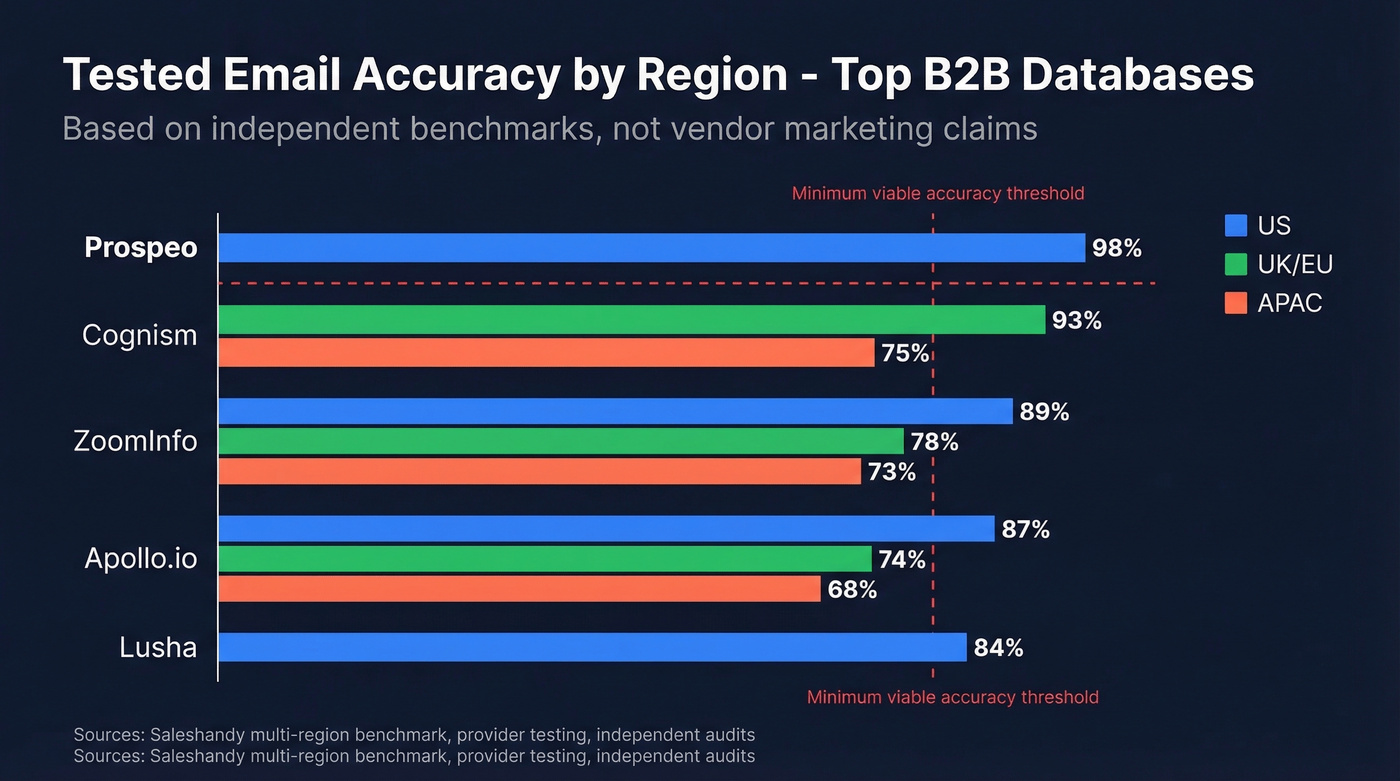
Table 1: Data Quality
| Tool | Email Acc. (tested) | Phone Data | Refresh |
|---|---|---|---|
| Apollo.io | 87% (US) | Yes | Varies |
| ZoomInfo | 89% (US) | Yes | Varies |
| Cognism | 93% (UK/EU) | Diamond Data | Varies |
| Lusha | 84% (US) | Yes | Varies |
| UpLead | 93% (US) | Yes | Varies |
| Saleshandy Lead Finder | 95% (US)* | Limited | Varies |
| Instantly | Varies | Limited | Varies |
| RocketReach | Varies | Limited | Varies |
| Hunter.io | Varies | No | N/A |
| Lead411 | 86% (US) | Yes | Varies |
| Seamless.AI | 80% (US) | Yes | Varies |
| Kaspr | Varies | Yes | Varies |
| D&B Hoovers | N/A | Limited | Varies |
| Clay | Varies | Varies | Varies |
Table 2: Pricing & Compliance
| Tool | Free Tier | Pricing Model | Compliance | Intent |
|---|---|---|---|---|
| Prospeo | Yes | Credit-based | GDPR, CCPA | Bombora |
| Apollo.io | Yes | Per-seat + credits | GDPR, CCPA | Yes |
| ZoomInfo | No | Annual platform | GDPR, CCPA | Add-on |
| Cognism | No | Annual platform | GDPR-first | Limited |
| Lusha | Yes | Per-seat + credits | GDPR, CCPA | No |
| UpLead | Yes | Tiered monthly | GDPR, CCPA | Limited |
| Saleshandy | No | Tiered monthly | GDPR | No |
| Instantly | No | Tiered monthly | GDPR | No |
| RocketReach | Yes | Tiered monthly | GDPR | No |
| Hunter.io | Yes | Tiered monthly | GDPR | No |
| Lead411 | Trial | Tiered monthly | GDPR, CCPA | Triggers |
| Seamless.AI | Yes | Per-seat | GDPR | No |
| Kaspr | Yes | Per-seat | GDPR-first | No |
| D&B Hoovers | No | Annual contract | GDPR, CCPA | Yes |
| Clay | Yes | Credit-based | Via providers | Via integrations |
*Saleshandy accuracy is vendor-tested. Other accuracy figures from Saleshandy's multi-region benchmark or provider positioning.
The 15 Best B2B Data Providers in 2026
Prospeo
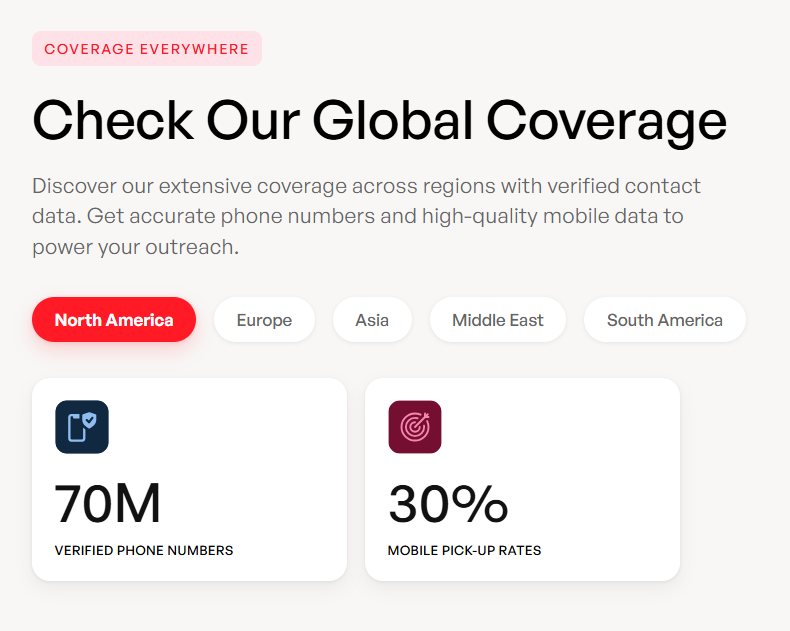
Prospeo's core advantage is simple: the data actually works. 98% email accuracy across 143M+ verified emails within a database of 300M+ professional profiles, 125M+ verified mobile numbers with a 30% pickup rate, and a 7-day refresh cycle versus a 6-week industry average. The platform includes 30+ search filters - buyer intent, technographics, job changes, headcount growth, funding, revenue - plus intent data across 15,000 Bombora topics.
Here's what that looks like in practice. Snyk's team of 50 AEs was bouncing 35-40% of their emails before switching. After moving, bounce rates dropped under 5%, AE-sourced pipeline jumped 180%, and they were generating 200+ new opportunities per month. Meritt tripled their weekly pipeline from $100K to $300K, with bounce rates dropping from 35% to under 4%. That's a fundamentally different outbound motion.
The accuracy comes from a proprietary email-finding infrastructure with 5-step verification - catch-all handling, spam-trap removal, and honeypot filtering - rather than relying on third-party email providers. In head-to-head comparisons, teams book 26% more meetings than ZoomInfo users and 35% more than Apollo users.
Pricing is self-serve and transparent. ~$0.01 per email, 10 credits per mobile number, and a free tier with 75 emails plus 100 Chrome extension credits every month. No annual contracts, no sales calls required. Compared to enterprise platforms, you're getting higher email accuracy, faster refresh, and about 100x cheaper cost per lead.


Every database on this list claims high accuracy. We tested at 98% across 143M+ verified emails with a 7-day refresh cycle - not 6 weeks. At $0.01/email, one pilot will show you the difference between claimed and tested accuracy.
Run your own 75-email accuracy test. Zero cost, zero contract.
Apollo.io
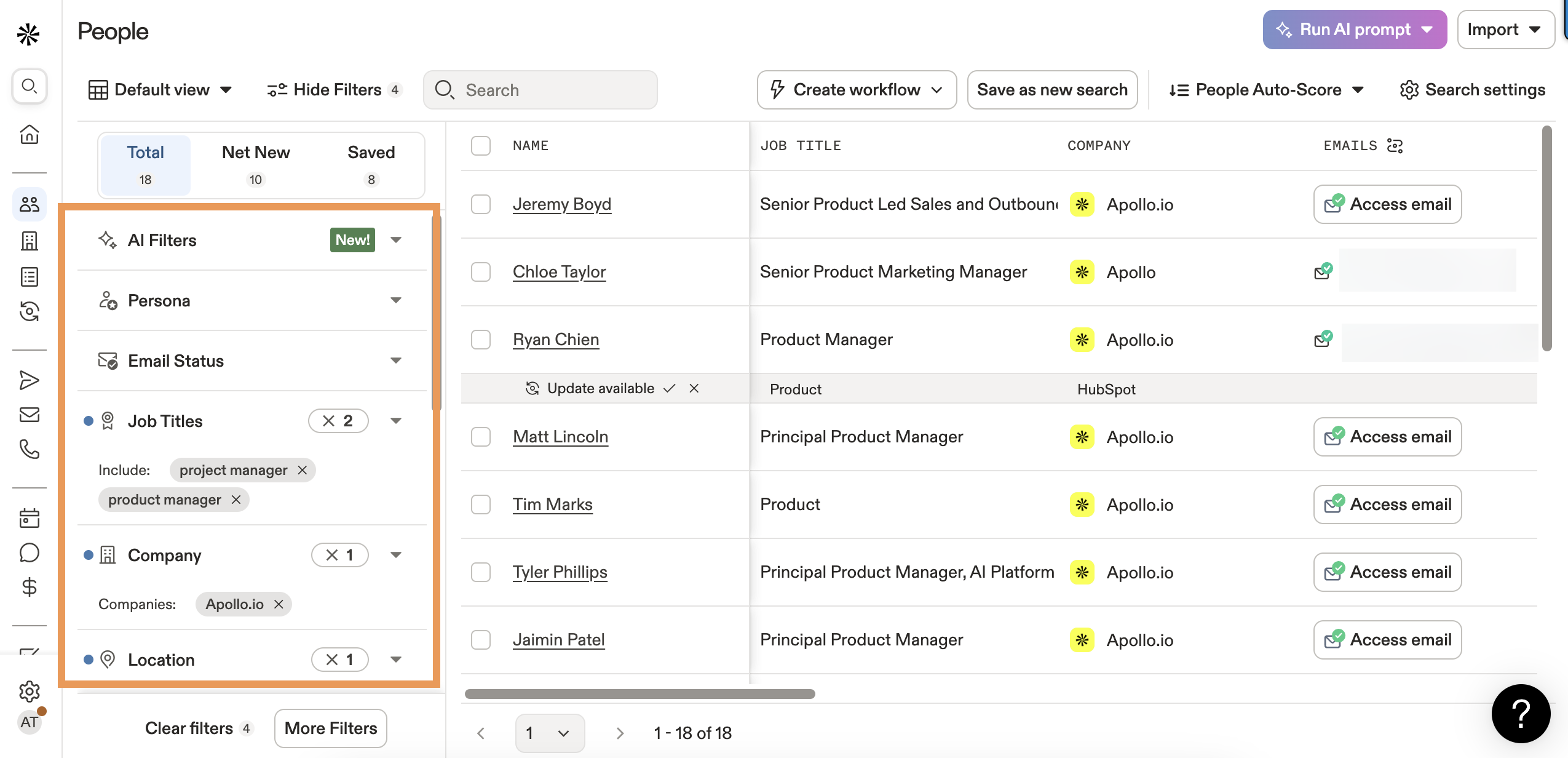
Apollo is the default recommendation for teams that want a free contact database with built-in sequencing - and for US-focused prospecting, it earns that spot. The free plan includes limited credits and up to 2 sequences, enough to validate whether outbound works for your ICP before spending anything. Paid plans run from $49/user/mo to $119/user/mo for the Organization tier with a minimum of 3 seats, covering 275M+ contacts.
Apollo's US accuracy tested at 87%, which is solid. Outside the US, things fall apart: 74% in UK/EU and 68% in APAC per Saleshandy's regional benchmark. If you're selling internationally, that 68% means a third of your APAC list is dead on arrival. The other gotcha: credits don't roll over between billing cycles, so you're paying for capacity whether you use it or not.
There's also the overuse problem. When everyone prospects from the same source, response rates drop because prospects get identical emails from 10 vendors. A Reddit post argued big databases are "broken" - overused lists, stale contacts, generic emails. The consensus on r/sales echoes this: diversify your data sources or watch your reply rates crater. That said, for a Series A team running US outbound, Apollo is the right call. For anything more complex, you'll outgrow it.
ZoomInfo
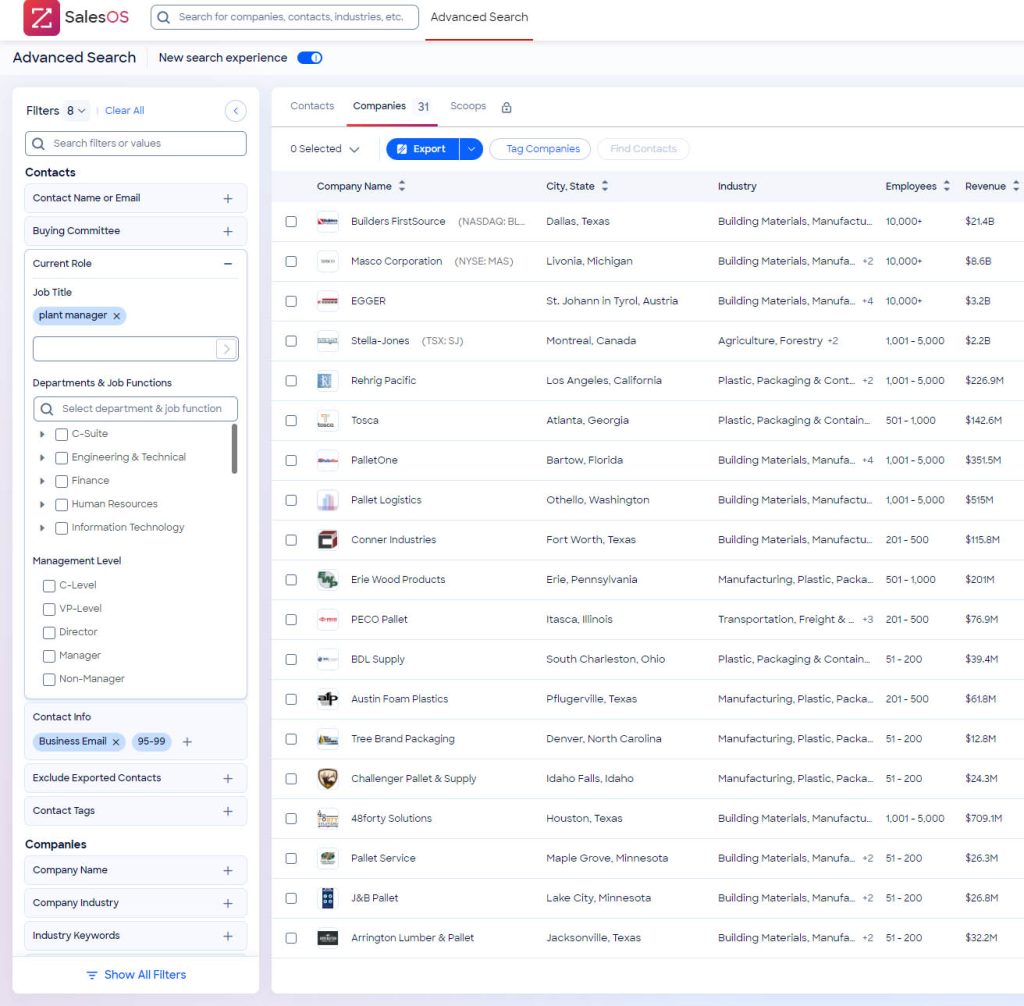
ZoomInfo is the enterprise default. It's also the tool most teams realize they're overpaying for within the first year.
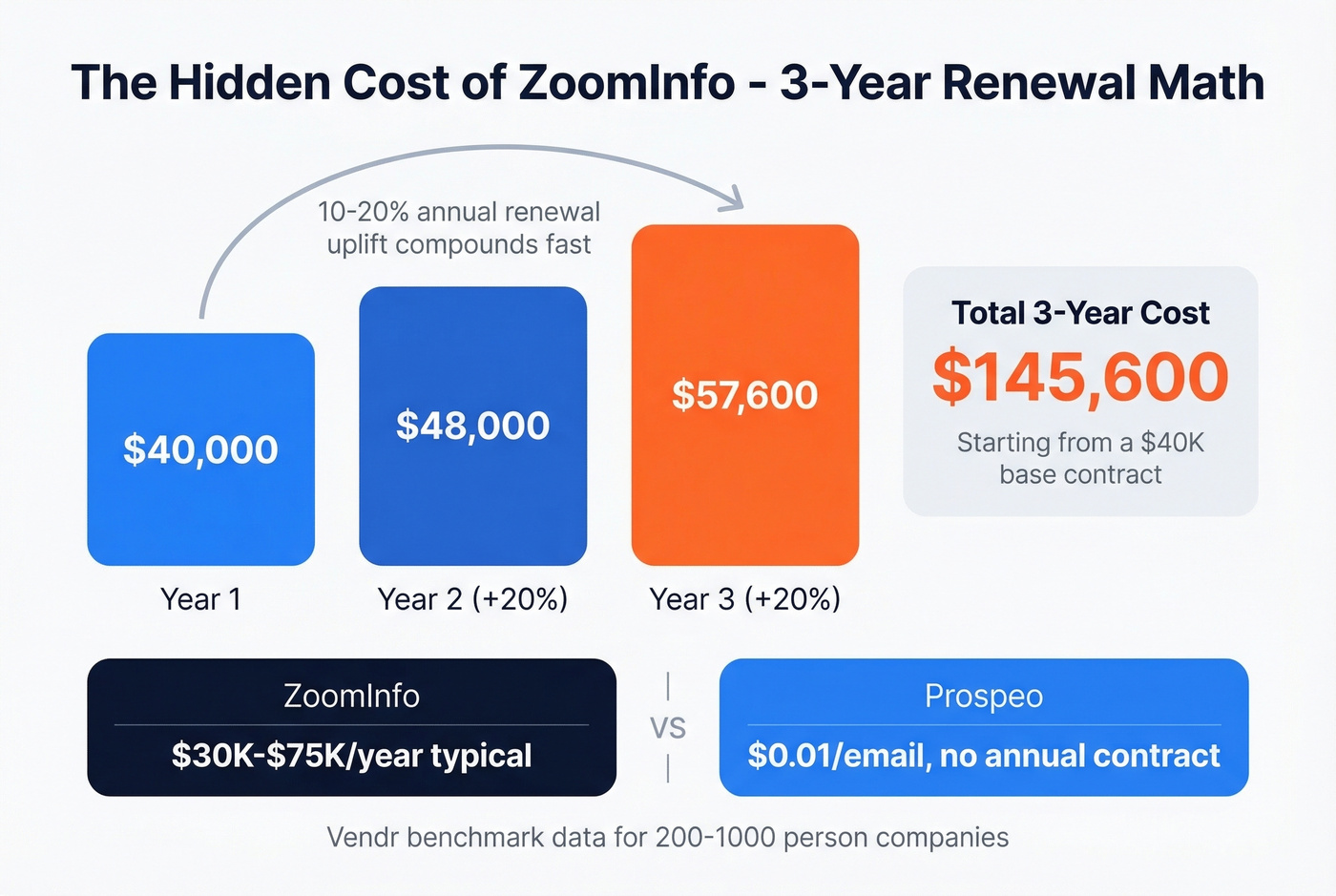
US accuracy tested at 89%, and the platform does everything - intent, workflow automation, org charts, technographics. The problem is you're paying for all of it whether you use it or not. Vendr benchmarks put ZoomInfo SalesOS at $24,800-$44,200/year for a ~200-person company, $50,200-$113,800 for ~1,000 headcount, and $83,200-$161,900 for enterprise. Most teams land in the $30K-$75K range. Annual contracts only, with 10-20% renewal uplifts that compound fast. A $40K contract becomes $48K in year two and $57K in year three.
The accuracy story is regional: 89% in the US is competitive, but it drops to 78% in UK/EU and 73% in APAC. The #1 complaint on Reddit? Price - specifically paying for modules you never activate.
Here's the thing: ZoomInfo is still the best all-in-one platform. But most teams don't need all-in-one. If your deal sizes are under $15K, you almost certainly don't need ZoomInfo-level infrastructure - and you'll get better unit economics from a focused provider at a fraction of the cost.
Cognism
We watched a RevOps team spend six months trying to make Apollo work for UK prospecting before switching to Cognism and immediately seeing results. That's the Cognism story in a nutshell: if you're selling into Europe, it's the best B2B data provider available.
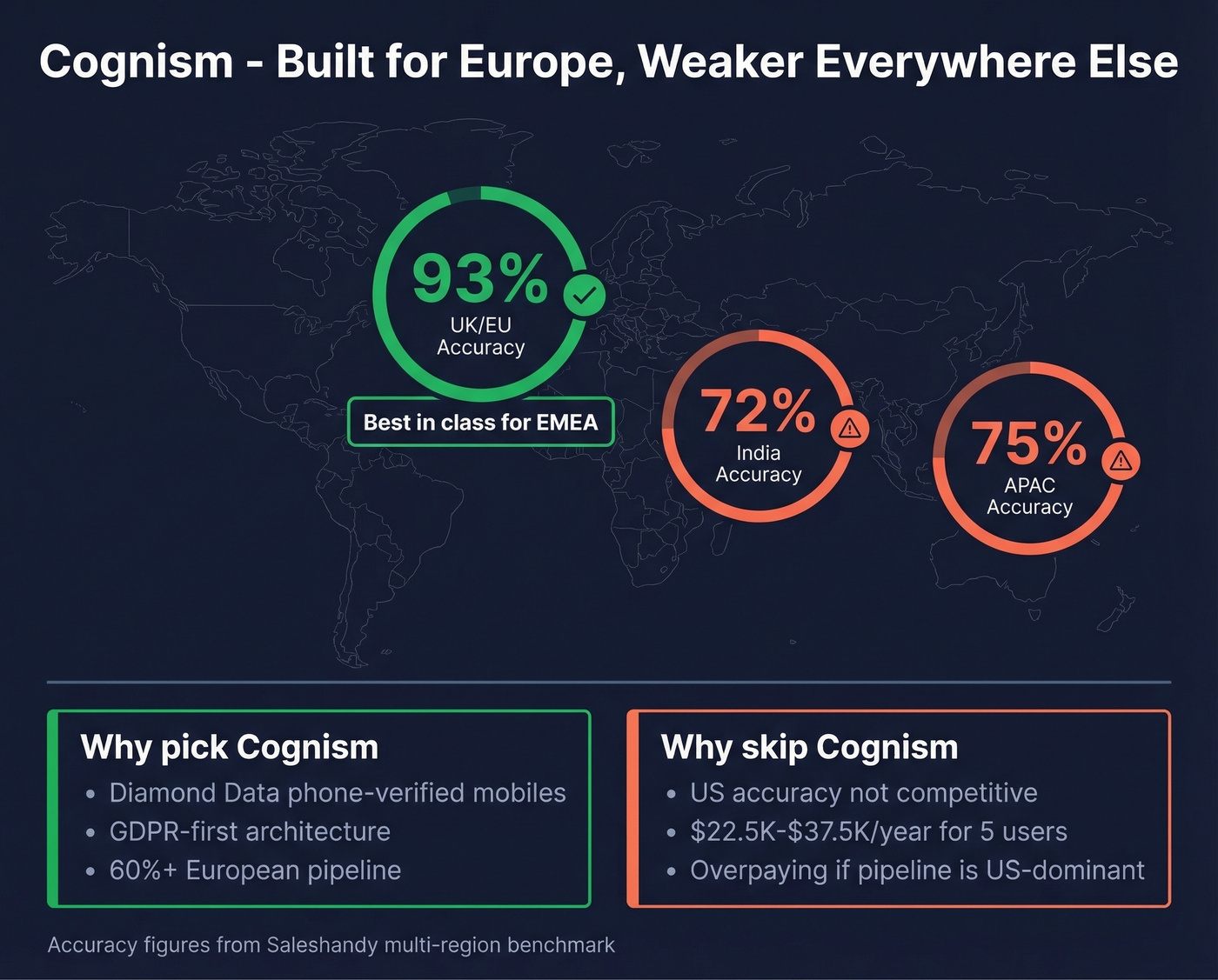
UK/EU accuracy tested at 93% - the highest of any provider in Saleshandy's benchmark. Diamond Data phone verification means their mobile numbers are phone-verified, not just algorithmically guessed. GDPR compliance isn't an afterthought; it's the foundation of the product.
The tradeoff is cost and geography. Cognism typically runs around $22.5K-$37.5K/year for a 5-user team, putting it in ZoomInfo territory. And outside Europe, accuracy drops to 72% in India and 75% in APAC. If your pipeline is 60%+ European, Cognism is the clear pick. If it's US-dominant, you're overpaying for geography you don't need.
Lusha
Use this if: You need quick phone lookups for US contacts and want a low entry price.
Skip this if: You're prospecting outside the US or need more than a few hundred contacts per month.
Lusha Pro runs $22.45/user/month on an annual plan with a minimum of 3 seats, giving you 3,000 credits per user per year. That's roughly 1,000 contacts if you're pulling phone numbers at 5 credits each. US accuracy tested at 84% - decent but not exceptional. APAC drops to 63%. On annual plans, Apollo gives you 10x the credits at a little over 2x the price, which means Lusha's effective cost-per-contact is higher for heavy users.
UpLead
Use this if: Accuracy matters more than volume and you're US-focused.
Skip this if: You need deep international coverage.
UpLead's 95% accuracy guarantee - they'll refund credits for bad data - is backed by US accuracy testing at 93%. Essentials starts at $99/mo, Plus at $199/mo. The database is smaller than the biggest platforms, which can mean coverage gaps for niche industries. But for US-focused teams who'd rather have 1,000 accurate contacts than 5,000 questionable ones, UpLead punches above its weight.
Saleshandy Lead Finder
Saleshandy tested its own database at 95% US accuracy - vendor-run, but the methodology was unusually transparent. Starter plan runs $49/mo with 30K credits/year. The real appeal is that Lead Finder is built directly into Saleshandy's cold email platform, so you go from search to sequence without exporting anything. Worth testing if you're already on Saleshandy for outreach. (If you're building a repeatable outbound motion, see our B2B prospecting strategies playbook.)
Instantly vs. Apollo: The Bundled Approach
Instantly bundles database access with its outreach platform, and the pay-for-verified-leads model means you aren't burning credits on bad data. Outreach plans start around $30/mo, with database access layered on top. Where Apollo gives you a bigger, more mature database and better free tier, Instantly gives you tighter integration between data and sending. Apollo wins for teams that want data flexibility; Instantly wins for teams that want one tool and don't mind a newer database.
RocketReach
A contact search engine, not a prospecting database. Built for lookups - finding a specific VP's email before a conference, not building lists of 500+ contacts. Free plan gives you 5 searches/month, Basic starts at $39/mo.
Hunter.io
Email-focused domain search. Free plan available, paid from $49/mo. Best for finding email patterns at a specific company. No phone numbers, no intent data.
Lead411
US-focused with trigger-based signals like funding, hiring, and expansion. Free 7-day trial, Basic ~$99/mo. US accuracy 86%, but drops to 62% in India and 60% in APAC.
Seamless.AI
AI-driven contact search. Free plan available, Pro ~$147/mo. US accuracy tested at 80% - the lowest of the major providers in Saleshandy's benchmark. We've seen teams burn through credit allocations faster than expected. Hard to recommend over Apollo at similar price points.
Kaspr
Cognism's lighter, cheaper sibling for individual contributors who need European mobile numbers. Free tier available, Starter at $49/user/mo. Limited database outside Europe.
D&B Hoovers
Enterprise firmographic data powerhouse. Custom annual contracts, typically $10K-$50K+/year. Best for company-level research - industry codes, revenue estimates, org hierarchies - not individual contact prospecting. Among commercial business databases, D&B Hoovers stands out for depth of firmographic coverage rather than contact-level accuracy.
Clay
Clay isn't a database - it's a waterfall enrichment orchestrator. It runs your contacts through multiple data providers in sequence, filling gaps that no single source covers. Credit-based pricing, typically $150-$500/mo. It pairs well with a primary data source as the first enrichment layer. (More options: our tested list of data enrichment tools.)
Bad data costs $12.9M per year on average. Snyk cut bounce rates from 35-40% to under 5% and added 200+ opportunities per month. Meritt tripled pipeline to $300K/week. The difference was 98% email accuracy and a 7-day refresh cycle.
Stop paying to damage your domain. Switch to data that actually connects.
Accuracy by Region: Where Providers Fall Short
This is where most "best database" articles fall apart. They quote a single global accuracy number and call it a day. Real accuracy varies dramatically by geography.
Saleshandy's multi-region test across 50-100 contacts per provider found:
| Provider | US | UK/EU | India | APAC |
|---|---|---|---|---|
| Saleshandy | 95%* | 91% | 89% | 88% |
| UpLead | 93% | 85% | 78% | 80% |
| ZoomInfo | 89% | 78% | 71% | 73% |
| Cognism | 88% | 93% | 72% | 75% |
| Apollo.io | 87% | 74% | 70% | 68% |
| Lead411 | 86% | 70% | 62% | 60% |
| Lusha | 84% | 80% | 65% | 63% |
| Seamless.AI | 80% | 66% | 61% | 58% |
*Vendor-tested. Prospeo reports 98% email accuracy maintained by its 7-day refresh cycle across all regions.
But email accuracy is only half the story. A Salesfinity benchmark-accuracy-coverage-real-results) across 307 verified contacts and 9 providers found phone data accuracy ranging from 63% to 91%, with coverage spanning 26% to 92%. The key insight: true effectiveness equals accuracy multiplied by coverage. A provider with 90% accuracy but 30% coverage only gives you usable data on 27% of your list. That's why combining 2-3 sources in a waterfall approach consistently outperforms any single provider.
The takeaway: if you're selling into APAC with Apollo, a third of your list won't connect. If you're selling into the UK with ZoomInfo, you're leaving 22% of contacts on the table versus Cognism. Always pilot-test 100-500 contacts in your actual target geography before committing to an annual contract.
What You'll Actually Pay
Here's what each tool actually costs when you factor in seats, credits, and the modules you'll realistically need:
| Tool | Entry Price | Mid-Market | Enterprise | Contract |
|---|---|---|---|---|
| Prospeo | Free tier | ~$39-99/mo | Custom | Monthly |
| Apollo.io | Free tier | $49-119/mo/user | Custom | Monthly/Annual |
| ZoomInfo | ~$15K/yr | $30-75K/yr | $80-160K/yr | Annual only |
| Cognism | ~$22.5K/yr | $22.5-37.5K/yr | Custom | Annual |
| Lusha | $22.45/user/mo | ~$70-90/user/mo | Custom | Annual |
| UpLead | $99/mo | $199/mo | Custom | Monthly/Annual |
| Saleshandy | $49/mo | $99-199/mo | Custom | Monthly/Annual |
| Instantly | ~$30/mo | ~$80-180/mo | Custom | Monthly |
| RocketReach | Free (5/mo) | $39-99/mo | Custom | Monthly/Annual |
| Hunter.io | Free tier | $49-149/mo | $299/mo | Monthly/Annual |
| Lead411 | ~$99/mo | ~$199/mo | Custom | Monthly/Annual |
| Seamless.AI | Free (limited) | ~$147/mo | Custom | Annual |
| Kaspr | Free tier | $49/user/mo | Custom | Monthly/Annual |
| D&B Hoovers | ~$10K/yr | $20-50K/yr | $50K+/yr | Annual |
| Clay | Free tier | $150-500/mo | Custom | Monthly |
The cost-per-usable-contact math is what really matters. Credit-based models run ~$0.01 per lead. ZoomInfo, when you factor in the platform fee divided by actual exports, lands closer to ~$1 per lead. That's a 100x difference in unit economics.
One trap to watch: Apollo's credits don't roll over. If you buy the annual plan and have a slow quarter, those unused credits evaporate. Lusha's credit allocation is even tighter at 3,000 credits per user per year on Pro versus Apollo's 30,000 per user per year on Basic - a 10x difference that makes Lusha's per-contact cost surprisingly high for heavy users.
Five Mistakes That Waste Your Database Budget
1. Not testing before an annual commitment. Run a 100-500 contact pilot in your actual ICP and geography. Measure bounce rates and phone connect rates. Two weeks of testing saves twelve months of regret.
2. Ignoring refresh frequency. A database that refreshes quarterly has 6%+ stale contacts built in before you even export. Weekly refresh cycles minimize this decay. Ask every vendor: how often do you re-verify?
3. Buying static lists instead of verified data. Static CSV lists from brokers are the junk food of B2B data. They're cheap, they feel productive, and they'll wreck your sender reputation. Companies with accurate contact data see 66% higher conversion rates versus those working with outdated information.
4. Not deduplicating across sources. If you're using 2-3 providers - and you should be - you'll create duplicates in your CRM unless you have a dedup workflow. This isn't optional. It's the difference between organized outbound and rep confusion. (If you're tightening ops, our CRM automation software guide covers common workflows.)
5. Prospecting from overused lists. When 10 vendors pull the same contacts from the same source, response rates crater. Reddit threads on r/sales echo this frustration constantly. The fix: diversify your data sources, and layer in intent signals so you aren't blasting the same stale list as everyone else.
How to Choose the Right Provider
Let's be honest: most teams need 2-3 data providers, not one platform. No single B2B database has 100% coverage for every geography and seniority level. Here's a quick decision framework:
Budget under $1K/month - Start with a free tier or low-cost credit-based plan. Apollo's free plan wins on built-in sequencing. Test accuracy in your specific Ideal Customer Profile before scaling spend.
Selling into Europe - Cognism for phone-verified mobiles and GDPR compliance. Layer an email verification tool on top to keep bounce rates minimal.
Enterprise with 50+ reps - ZoomInfo for platform breadth, but layer a verification tool on top. ZoomInfo's data isn't bad - it's just not fresh enough to send raw at scale.
Want intent data included - Standalone intent from 6sense starts around $35K/year, Demandbase around $40K/year. Bundled intent from providers that include Bombora data is dramatically cheaper and sufficient for most teams.
Multi-provider waterfall strategy - Clay as the orchestrator, with a high-accuracy primary source and secondary providers filling coverage gaps. In our experience, this approach consistently outperforms any single-provider strategy. (If you're building lists at scale, see our cold email lead list building guide.)
FAQ
What is a B2B database?
A B2B database is a searchable collection of business contact and company information - verified emails, phone numbers, job titles, firmographics, and technographics - used for sales prospecting and outbound campaigns. It's the foundation layer for any outbound sales motion, and quality varies dramatically by provider and region.
How often should you refresh B2B contact data?
Weekly is the gold standard; quarterly is the bare minimum. Contact data decays at roughly 2.1% per month - that's 22.5% annually. Faster refresh directly protects your sender reputation and keeps your sequences hitting real inboxes.
Is buying B2B contact data legal?
Yes, provided your provider complies with GDPR and CCPA/CPRA. California's B2B exemption expired January 2023, so business contacts now receive full privacy protections. Always verify compliance certifications, opt-out mechanisms, and data processing agreements before purchasing.
What's the difference between a database and an enrichment tool?
A database lets you search and discover new contacts you didn't have before. An enrichment tool fills in missing data - phone numbers, technographics, firmographics - on contacts already in your CRM. Some tools do both, combining search with API-based enrichment for a single workflow.
How many data providers do most teams need?
Most mid-market outbound teams benefit from 2-3 providers in a waterfall approach. No single source covers every geography and seniority level at high accuracy. The Salesfinity benchmark-accuracy-coverage-real-results) across 9 providers showed accuracy ranging from 63% to 91% - combining sources fills the gaps no single tool can.