

The B2B Events Strategy That Actually Generates Pipeline
86% of B2B marketers expect their event budgets to increase this year. Only 6% are confident they can convert those leads into revenue. That's not a strategy problem - it's an execution crisis hiding behind catering invoices and badge scanners.
The B2B Event Paradox
The U.S. B2B event market sits at $15.78B and is climbing toward $17.3B by 2028](https://www.momencio.com/guide-book/state-of-b2b-events/us-b2b-event-market-baseline/). Money's flowing in. Results aren't flowing out.
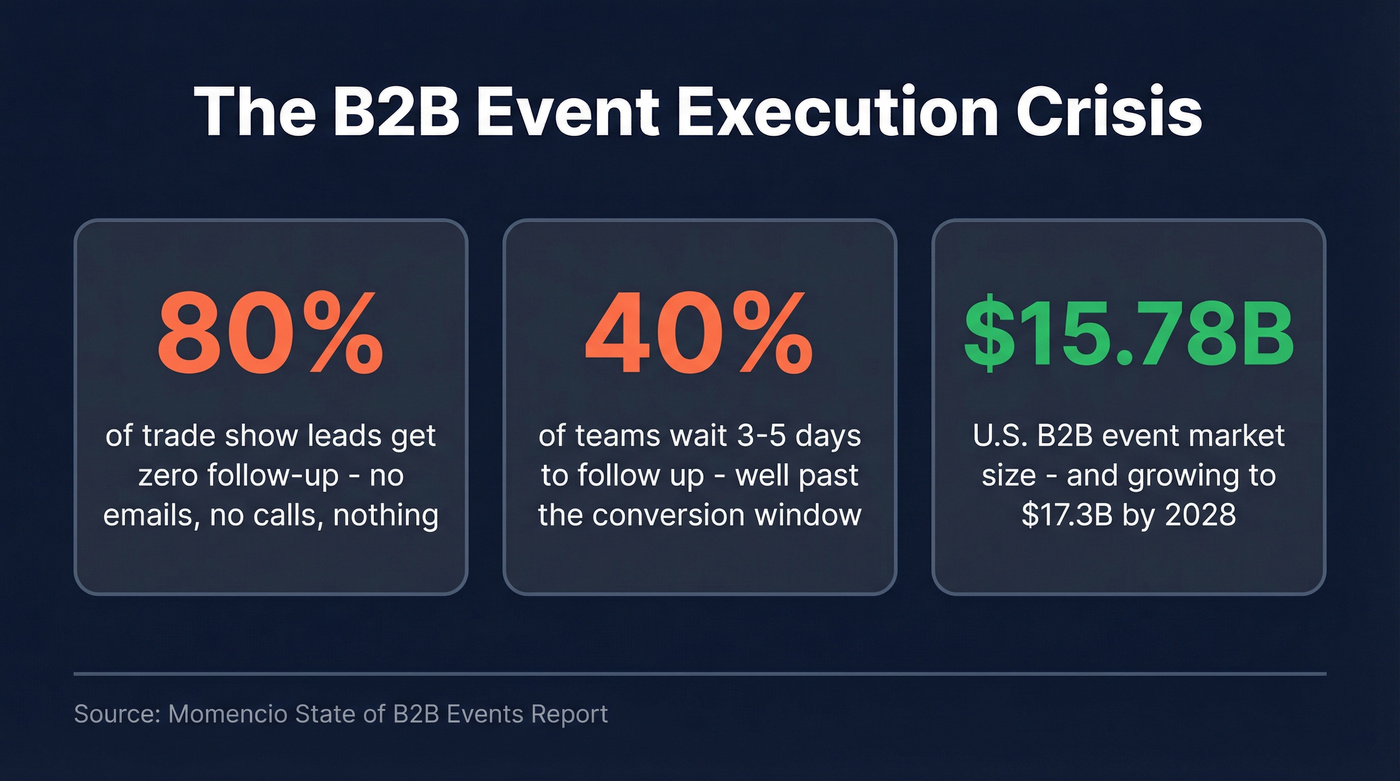
80% of trade show leads never receive any follow-up - zero emails, zero calls. And when teams do follow up, 40% wait three to five days, well past the window where conversion hasn't already cratered. Events don't fail on stage. They fail in the CRM and in the 72 hours after everyone flies home.
The field marketing resurgence we're seeing in 2026 budgets means more dollars at risk if execution doesn't improve.
What High-Performers Look Like
Bizzabo's 2026 platform data gives us clear benchmarks:
| Metric | Benchmark |
|---|---|
| Events per year | 25 |
| Registrations per event | 412 |
| Attendees per event | 269 |
| Attendance rate | 52% |
| Dynamic reg conversion | 24.4% |
| Static reg conversion | 11.6% |
| Format mix | 63% in-person, 33% virtual, 4% hybrid |
Dynamic registration flows convert at more than double the rate of static forms. If you're still using a basic form page, that's the easiest win available.

Your event invite list is decaying right now. Prospeo enriches CRM lists with 98% email accuracy and a 7-day refresh cycle - so invitations land with decision-makers, not former employees. 83% of leads come back with verified contact data, at roughly $0.01 per email.
Fix your event data before you fix your event budget.
The 5-Step Framework
Step 1: Start With Pipeline Math
Most teams plan events around attendance targets. High-performers plan around revenue.
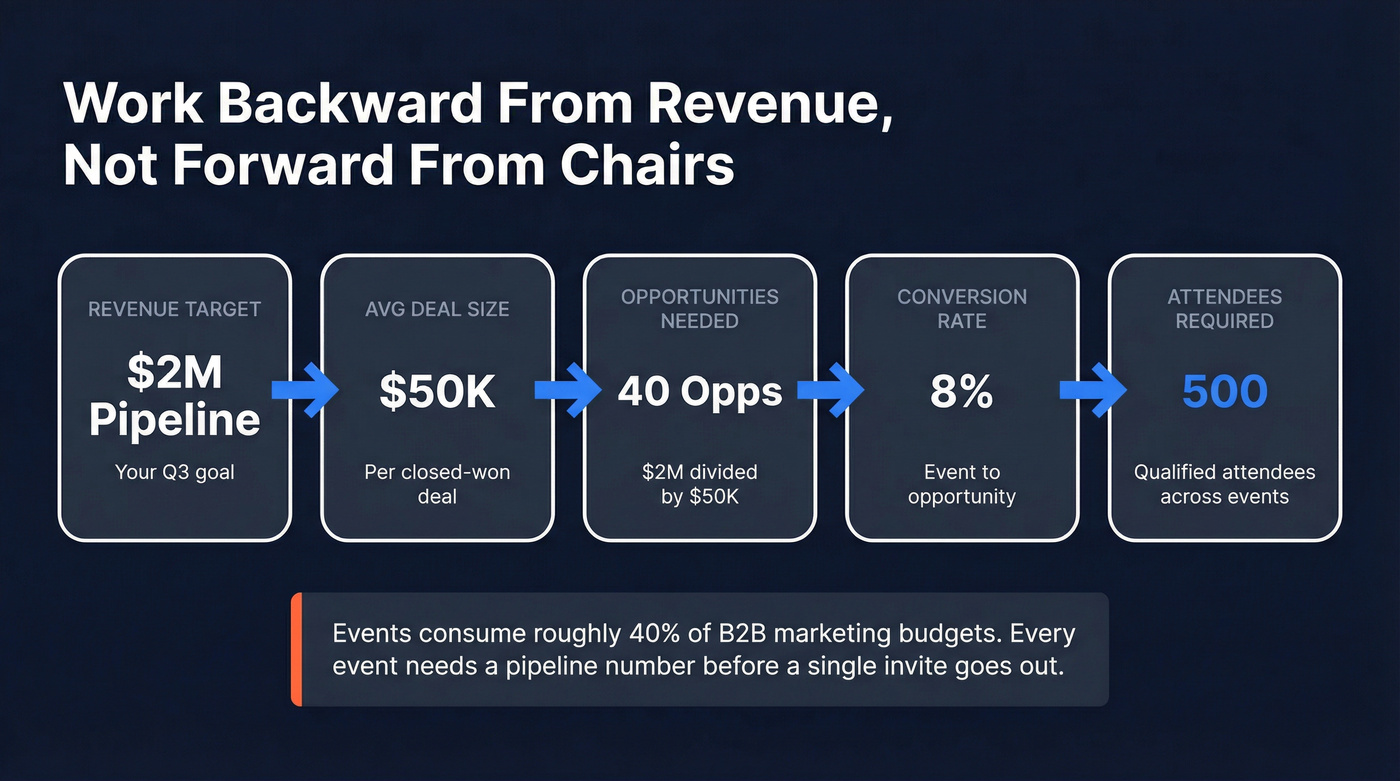
If you need $2M in pipeline from Q3 events and your average deal is $50K, you need 40 qualified opportunities. At an 8% event-to-opportunity rate, that's 500 qualified attendees across your portfolio. Work backward from the number that matters, not forward from how many chairs you can fill.
Events consume roughly 40% of B2B marketing budgets. At that spend level, every event needs a pipeline number before a single invite goes out. If you can't tie an event to a revenue target, you're planning a party.
Step 2: Fix Your Data First
Here's the thing: most teams export a CRM list, blast 500 invitations, watch 180 bounce, and shrug.
High-performers run the invite list through an enrichment platform before sending anything. B2B contact data decays fast - people change roles, companies, and email patterns constantly. If your CRM hasn't been enriched in six months, a significant chunk of your list points at people who no longer work there.
We've burned budget on this ourselves. Prospeo's 83% enrichment match rate and 98% email accuracy catch job changes and verify contacts so invitations actually land. With a 7-day data refresh cycle compared to the six-week industry average, you're working with current records, not stale ones. Beyond deliverability, enrichment lets you segment by seniority, department, and company size - so you're inviting decision-makers, not the entire database. This matters whether you're running demand generation webinars or hosting a 30-person executive dinner.

Step 3: Choose Format by Conversion Rate
Virtual events convert better than live events at the top of the funnel. HockeyStack analyzed 2,642,337 deals from Jan 2024 through Sep 2025 across 198 B2B SaaS companies and found:
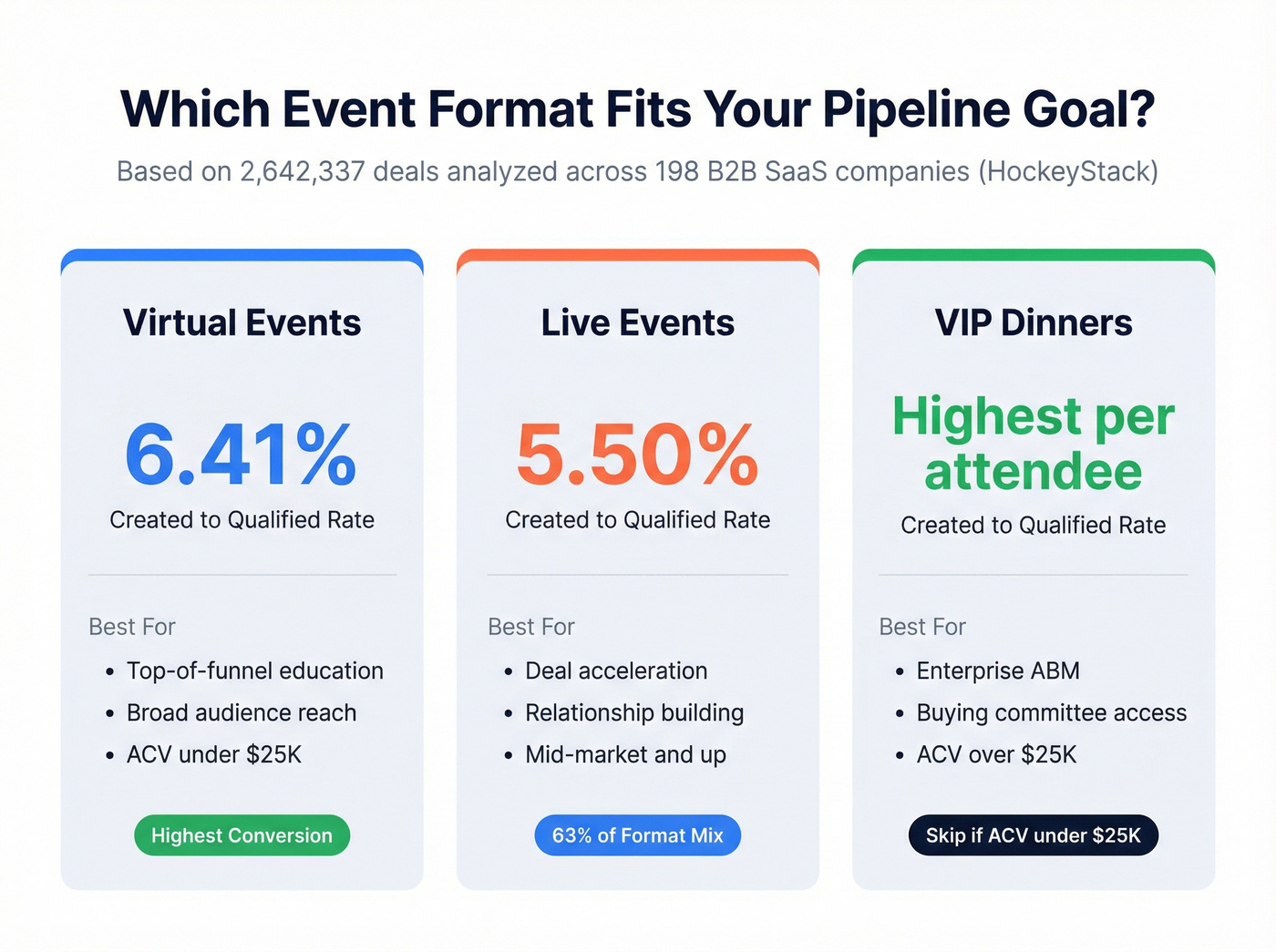
| Format | Created-to-Qualified Rate | Best For |
|---|---|---|
| Virtual | 6.41% | Top-of-funnel education, broad reach |
| Live | 5.50% | Deal acceleration, relationship building |
| VIP dinner | Highest per-attendee | Enterprise ABM, buying committee access |
Stop defaulting to "we always do a booth at [industry conference]." Match format to the deals you need to close. In-person events still dominate the format mix at 63%, but that doesn't mean they're the right default for every pipeline goal. For teams with average contract values under $25K, a well-executed virtual series with airtight follow-up will generate more pipeline at a fraction of the cost.
Step 4: Build a 48-Hour Follow-Up SLA
Conversion probability decays roughly 20% per day after the first 24-48 hours. By day five, you've lost the majority of your conversion potential. And yet most event teams still export a badge-scan CSV, dump it into a shared drive, and call it "lead capture."
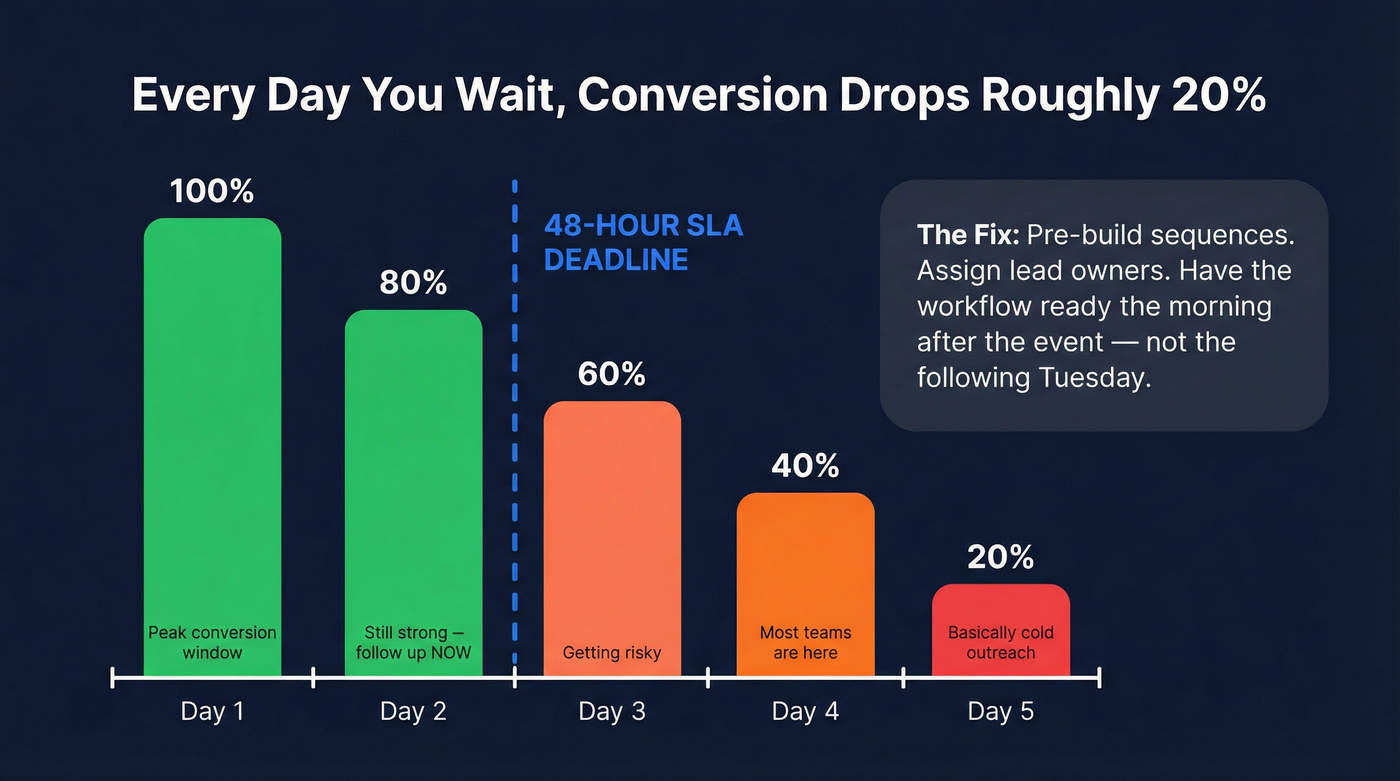
This failure mode is maddeningly consistent. Sales teams treat event leads like any other inbound list, letting them sit for days. The fix is structural, not motivational. Build the SLA before the event. Assign owners. Pre-write sequence templates. The follow-up workflow should be ready to execute the morning after the event ends, not designed from scratch the following Tuesday.
Step 5: Measure With Account-Level Attribution
Here's your attribution checklist:
- Switch from 30-day to 90-day minimum influence windows (180-365 for enterprise)
- Use W-shaped attribution weighting first touch, lead creation, and opportunity creation
- Measure at the account level, not the individual level - five attendees from one company equals one opportunity, not five leads
- Calculate ROI as (Revenue - Costs) / Costs x 100, connecting touches to revenue at the account level
Standard 30-day windows are built for B2C. In B2B, where sales cycles run 6-9 months with roughly 14 touchpoints](https://www.hockeystack.com/blog-posts/how-to-measure-marketing-attribution), they miss every early-stage interaction that made the deal possible. I've seen teams attribute a closed deal entirely to a case study download in September when it was a dinner event in March that started the relationship.
Budget Priorities for Field Marketing
One pattern we see repeatedly: teams spend 60% of their budget on the venue, get 50% attendance, and close zero deals.
| Revenue Drivers (Invest Here First) | Nice-to-Haves (Upgrade Later) |
|---|---|
| Data-driven guest selection | Fancy venue and decor |
| Sales-marketing follow-up SLAs | Premium swag |
| Attribution tracking | Elaborate AV production |
| Invite and RSVP automation | Gourmet catering |
Let's be honest: every dollar spent on a nicer venue is a dollar not spent on enriching your invite list or building follow-up sequences. The consensus on r/sales threads about event ROI backs this up - reps consistently say the problem isn't the event itself, it's what happens (or doesn't happen) afterward.
Skip the $30K dinner event entirely if your average contract value is under $25K. You'll get more pipeline from a virtual series with clean data and fast follow-up.
The Bottom Line
Most failures in a B2B events strategy trace back to data quality and follow-up - not the event itself. If you can't tell your CFO exactly how many pipeline dollars your last event generated, you don't have a strategy. You have a tradition.
The 48-hour follow-up SLA only works if you have verified contacts to follow up with. Prospeo returns 50+ data points per enriched contact - seniority, department, direct dial - so reps reach the right person the morning after the event, not a dead inbox five days later.
Turn badge scans into verified contacts before conversion decays.
FAQ
What's a good ROI for B2B events?
High-performing B2B SaaS teams target 3-5x return on event spend, measured with account-level attribution and 90-day influence windows. Anything below 2x after a full sales cycle signals a format or targeting problem, not an event problem.
Virtual or in-person - which converts better?
Virtual converts at 6.41% (created to qualified) versus 5.50% for live events, based on 2,642,337 deals analyzed by HockeyStack. But in-person excels at deal acceleration and relationship-building with enterprise buyers. Match format to your pipeline objective.
How fast should you follow up after an event?
Within 48 hours - conversion probability drops roughly 20% per day after that window. Pre-build sequences and assign lead owners before the event starts, not after.
How do you keep event invite lists accurate?
Run your CRM list through an enrichment tool before sending invitations. Prospeo returns 50+ data points per contact at an 83% match rate, catching job changes and verifying emails so invites reach current decision-makers instead of bouncing.