

B2B Information Services: What the Category Actually Includes (and What It Costs)
Your VP asked you to "evaluate b2b information services" and you got back ten listicles about contact databases, a McKinsey PDF, and market sizing estimates that range from $900 million to $105 billion depending on who's counting. The category is genuinely poorly defined - and that's the first thing worth understanding before you spend any money.
What You Need (Quick Version)
The term covers everything from credit bureaus to sales intelligence platforms. Most B2B teams searching this phrase need contact data, enrichment, or intent signals - not a Dun & Bradstreet subscription. If that's you, start with a provider that offers verified emails, transparent pricing, and a free trial you can test before signing anything.
What Are B2B Information Services?
The term is a catch-all, and that's why market sizing estimates are all over the map. One research firm pegs the market at $105 billion in 2024, projected to hit $215 billion by 2033 at a 7.5% CAGR. Another scopes it at $900 million using a narrower definition. The broader information services market - including B2C - runs $177.26 billion. The discrepancy comes down to what you include:
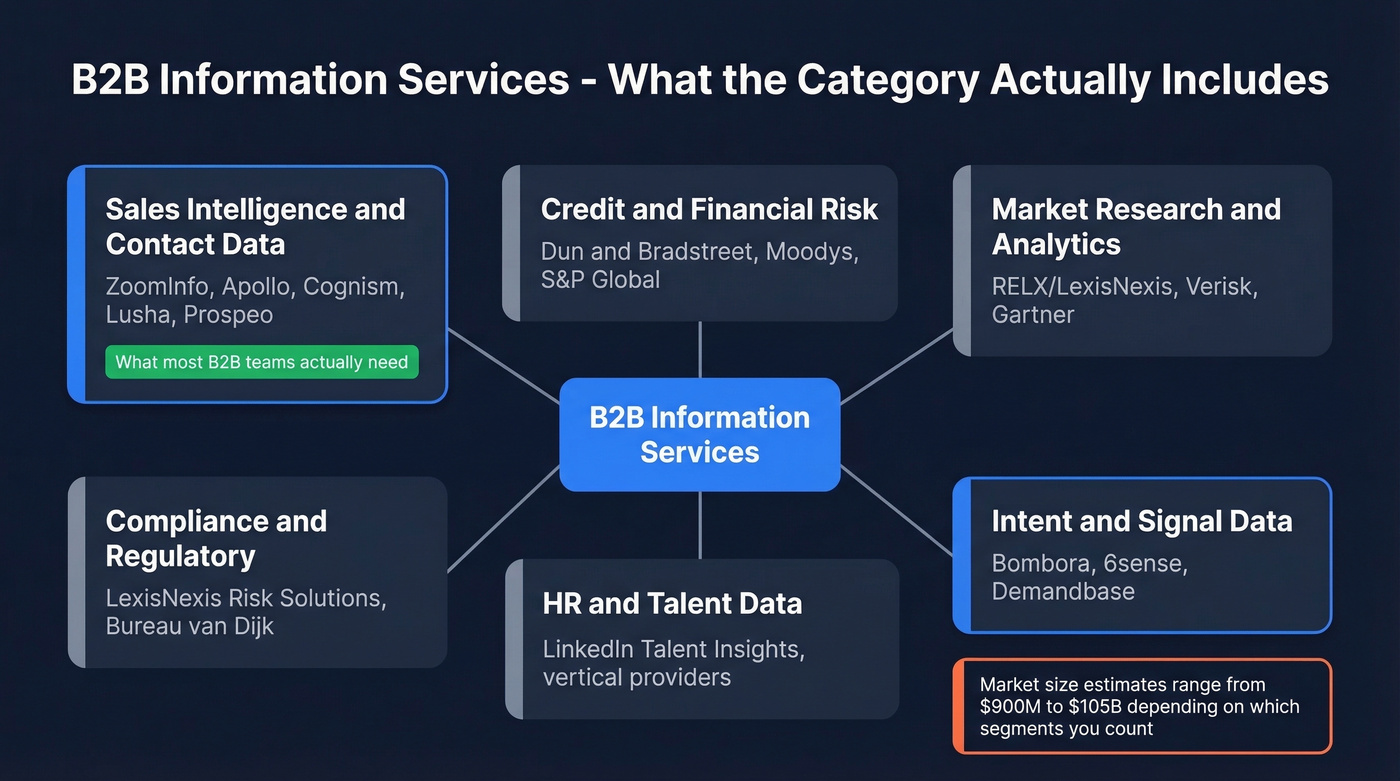
- Sales intelligence & contact data - firmographic, technographic data, and buyer intent data from providers like ZoomInfo, Apollo, Cognism, Lusha
- Credit & financial risk - Dun & Bradstreet, Moody's, S&P Global
- Market research & analytics - RELX/LexisNexis, Verisk, Gartner
- Compliance & regulatory - LexisNexis Risk Solutions, Bureau van Dijk
- HR & talent data - LinkedIn Talent Insights, specialized vertical providers
- Intent & signal data - Bombora, 6sense, Demandbase
The multi-billion-dollar conglomerates like RELX, S&P Global, and Verisk dominate the traditional end. But the segment most B2B revenue teams actually care about is sales intelligence and data enrichment.
What Most Teams Actually Need
Look, you're probably not shopping for a LexisNexis compliance subscription. You need contact data, enrichment, or intent signals to feed your pipeline.
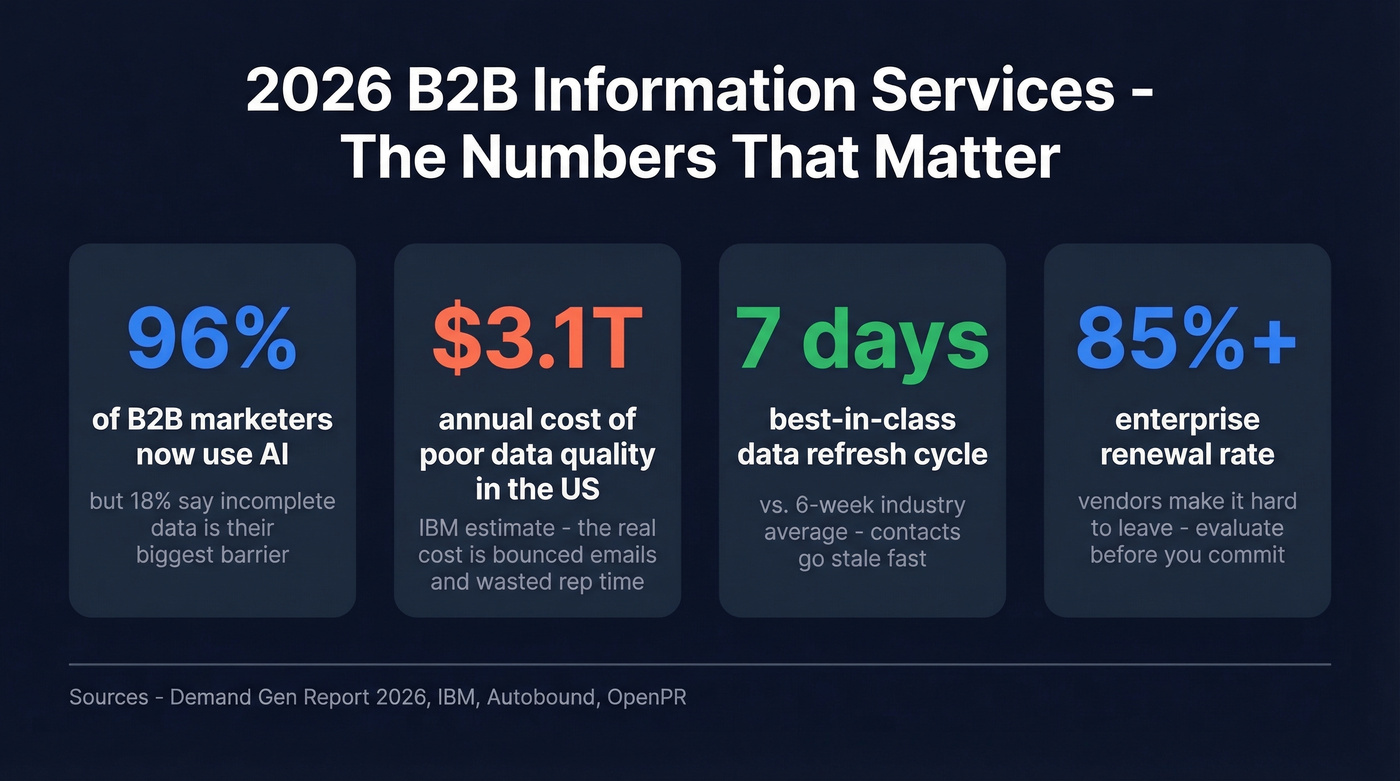
The stakes are higher than they look. IBM estimates poor data quality costs the US economy $3.1 trillion annually. A Demand Gen Report survey found that 96% of B2B marketers are using AI - but 18% cite incomplete data as their single biggest barrier to confident decisions. The tools are getting smarter. The data underneath them often isn't.
In our experience, the real cost isn't the platform fee - it's the bounced emails and wasted rep time from bad data. You buy a platform, feed it stale contacts, and wonder why sequences bounce at 15%. We've watched teams burn through entire domain reputations in a single quarter because they trusted a database that hadn't been refreshed in six weeks.
If your average deal size sits below $10K, you almost certainly don't need a $40K/year ZoomInfo contract. A credit-based provider with high accuracy will outperform an enterprise platform you're only using at 20% capacity.

You just read that poor data quality costs the US economy $3.1 trillion a year. Prospeo's 5-step verification delivers 98% email accuracy on a 7-day refresh cycle - not the 6-week industry average. At ~$0.01 per email with no annual contract, you get enterprise-grade B2B information services without enterprise pricing.
Test 75 emails free and see the accuracy difference yourself.
What B2B Data Providers Cost
Pricing in this space is deliberately opaque. Average contract values range from $15,000/year for SMBs to $500,000+ for enterprise-wide licenses, and renewal rates exceed 85% for enterprise accounts - which tells you vendors are very good at making it hard to leave.
If you're trying to avoid lock-in, pay-as-you-go pricing is usually the cleanest baseline to compare against.
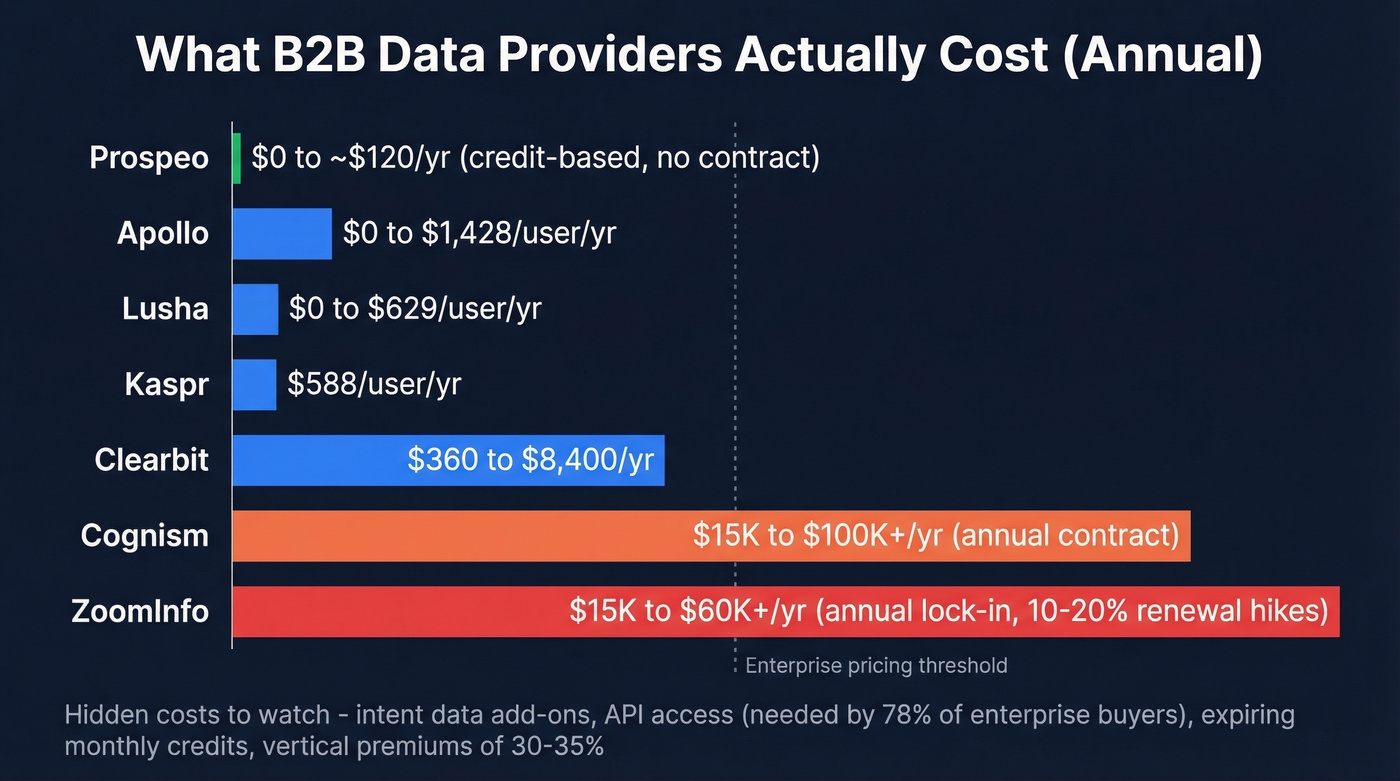
| Provider | Starting Price | Model | Contract | Best For |
|---|---|---|---|---|
| Prospeo | Free - ~$0.01/email | Credit-based | No contract | Accuracy-first outbound |
| Apollo | Free - $119/user/mo (annual) | Per-seat, self-serve | Monthly available | Startups, self-serve teams |
| Lusha | Free - $52.45/user/mo (annual) | Per-seat, self-serve | Monthly available | Quick lookups |
| Kaspr | $49/user/mo | Per-seat | Monthly available | European contacts |
| Clearbit | $30 - $700/mo | Credit packs | Monthly available | Marketing enrichment |
| Cognism | ~$15K - $100K+/yr | Platform fee + per-seat | Annual | EMEA compliance |
| ZoomInfo | ~$15K - $45K+/yr | Annual, quote-based | Annual lock-in | Enterprise, full-stack |
Watch for hidden costs. ZoomInfo renewals typically jump 10-20% year over year. Credits at most platforms expire monthly. Intent data and API access are add-ons that inflate your total well beyond the base price, and 78% of enterprise buyers require API access, so that "add-on" is really a core cost.
Vertical specialization in healthcare or financial services commands 30-35% pricing premiums on top of list prices. The #1 complaint buyers raise about ZoomInfo is price - specifically, paying for modules they don't use. A 10-seat ZoomInfo setup with add-ons like intent data and mobile numbers commonly lands in the $40-60K/year range. That's switching-cost math worth doing before you sign.
How to Evaluate a Provider
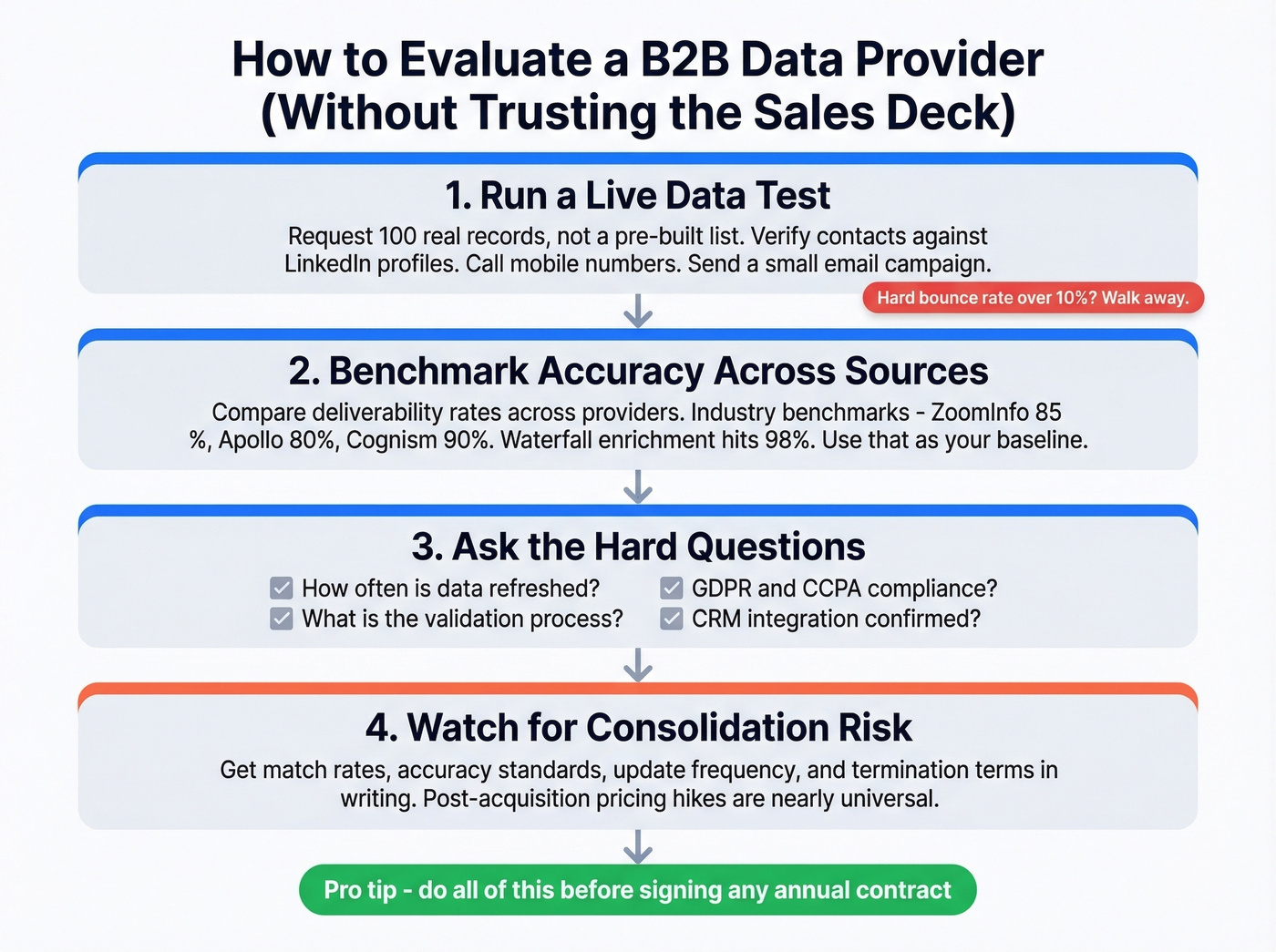
Don't trust vendor demos with cherry-picked data. Run this evaluation instead.
Run a Live Data Test
Request a real-time sample of 100 records - not a pre-built list. Verify contacts against professional profiles. Call the mobile numbers. Run a small email campaign and measure bounce rates. If your hard bounce rate exceeds 10%, walk away. This single test will tell you more than any sales deck or G2 review ever will, because vendors curate their demo data the way restaurants curate their Instagram photos.
Benchmark Accuracy Across Sources
A 1,000-record enrichment test across major providers found ZoomInfo at 85% email deliverability, Apollo at 80%, and Cognism at 90%. Waterfall enrichment - querying multiple sources - pushed accuracy to 98%. Prospeo's 5-step verification process with proprietary email-finding infrastructure hits 98% email accuracy natively, without requiring a multi-vendor waterfall setup. Use that as your baseline.

Ask the Hard Questions
How often is data refreshed? What's the validation process? How do you handle international contacts? Confirm GDPR and CCPA compliance, especially if you're prospecting in the EU or California. Check that the platform integrates with your CRM - whether that's Salesforce, HubSpot, or something else. Per Martech.org's evaluation framework, these are the points vendors will try to leave vague.
Watch for Consolidation Risk
Demandbase acquired InsideView. 6sense acquired Slintel. ZoomInfo acquired RingLead. HubSpot acquired Clearbit. When your vendor gets acquired, data quality and pricing often shift - we've seen it happen repeatedly where the product you bought isn't the product you're using 18 months later. Get minimum match rates, accuracy standards, update frequency, and termination terms into the contract before you sign.
Skip this step at your own risk. The consensus on r/sales is that post-acquisition pricing hikes are nearly universal, and the teams that locked in contractual guarantees beforehand are the ones who didn't get burned.
Trends Reshaping the Market in 2026
AI adoption is near-universal, but data quality remains the bottleneck. Data decay is the silent killer: contacts go stale faster than most platforms refresh them, which is why a 7-day refresh cycle catches job changes and company moves that a 6-week cycle misses entirely.
If you're scaling outbound, pair data freshness with outbound email spam prevention so accuracy gains don't get wasted in deliverability issues.
Waterfall enrichment is outperforming single-source databases on both fill rate and accuracy, making multi-provider strategies standard for serious revenue teams. M&A consolidation is accelerating too, which means fewer independent providers and more pressure to define your TAM and lock in favorable terms now - before your vendor gets swallowed.
Let's be honest about what this means for buyers: the window for getting good deals from mid-market providers is shrinking. As the big players absorb smaller competitors, pricing leverage shifts away from you.
For teams evaluating B2B information services in 2026, the playbook is straightforward. Test accuracy with real data. Avoid annual lock-ins until you've validated fit. Prioritize providers whose refresh cycles actually keep pace with how fast your contacts change roles.
The evaluation framework above recommends a 100-record live test. Prospeo makes that easy: sign up, search with 30+ filters including intent data and technographics, and verify the results against your own CRM. No sales call. No annual lock-in. 15,000+ companies already made the switch.
Run your own accuracy benchmark - zero commitment, zero cost to start.