

The 9 Best B2B Lead Generation Databases - With Real Pricing and Accuracy Data
You pulled 5,000 contacts from your B2B lead generation database, loaded them into a sequence, and watched 1,600 bounce. Your domain reputation tanks, deliverability craters, and the VP of Sales wants to know why reply rates dropped 40%. The database wasn't broken - it was never accurate to begin with.
The industry average cold email bounce rate sits around 7-8%. Anything above that signals a data quality problem. Here are nine lead generation databases that actually hold up, ranked by what matters most: data that doesn't bounce.
Why Big Databases Are Failing
B2B contact data decays at 2.1% per month - roughly 23% of your database goes stale every year. Poor data quality costs organizations $12.9M annually on average. The take in this r/b2bmarketing thread is blunt: giant static databases are overused, full of generic emails, and loaded with dead phone numbers. Volume doesn't matter if accuracy is garbage. A 300M-record database at 98% accuracy beats a 500M-record database at 70% every single time.
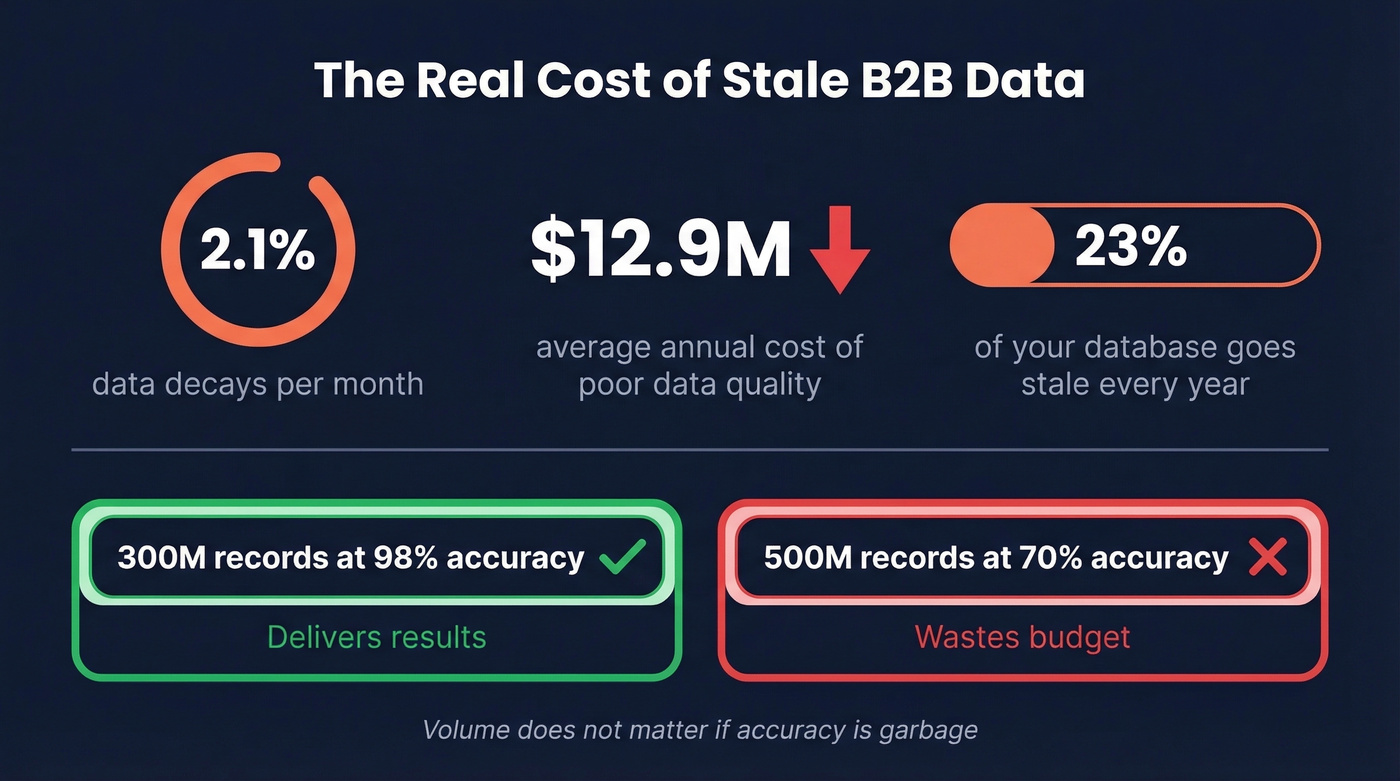
Here's the thing: if your average deal size is under $15k, you almost certainly don't need a $25,000/year data platform. Start with something that nails accuracy and scale up from there.
Our Picks (TL;DR)
| Use Case | Pick |
|---|---|
| Best for email accuracy + self-serve | Prospeo |
| Best free tier for volume | Apollo.io |
| Best for enterprise depth | ZoomInfo |
| Best for EU/GDPR compliance | Cognism |
| Best for waterfall enrichment | Clay |

You just read that B2B contact data decays 2.1% per month. Prospeo refreshes every 7 days - not 6 weeks like the industry average. 300M+ profiles, 98% email accuracy, 30+ filters including Bombora intent data across 15,000 topics. At ~$0.01 per email, you stop paying enterprise prices for data that bounces.
Stop bleeding pipeline to stale data. Start with 75 free emails.
The 9 Best B2B Lead Generation Databases
Prospeo
Prospeo's database covers 300M+ professional profiles (filtered from 800M+ collected records through a 5-step verification process), 143M+ verified emails, and 125M+ verified mobile numbers with a 30% pickup rate - all refreshed on a 7-day cycle. Most providers take 4-6 weeks.

Use this if you're an outbound team or agency that lives and dies by deliverability. The 98% email accuracy is backed by results: Snyk's 50-person AE team dropped bounce rates from 35-40% to under 5% after switching, and AE-sourced pipeline jumped 180%. The 30+ search filters include Bombora intent data across 15,000 topics, so you're finding buyers who are actually in-market. The Chrome extension with 40K+ users works across company websites and professional profiles for one-click prospecting.
Pricing is dead simple: ~$0.01 per email, 10 credits per mobile number. Free tier gives you 75 emails and 100 Chrome credits per month. No contracts, no annual lock-in, no sales call required. Prospeo pairs naturally with Instantly, Lemlist, or Smartlead for sequencing - it's built to be the data layer, not the sending engine.
If you're comparing options, start with this broader list of B2B databases ranked by accuracy.
Apollo.io
Apollo is the obvious starting point for SMB teams with more ambition than budget. The free tier includes 60 mobile credits (email credits are technically unlimited under a fair-use policy), and the feature set at $49/user/month annual is genuinely impressive - especially if you want prospecting plus engagement in one place.
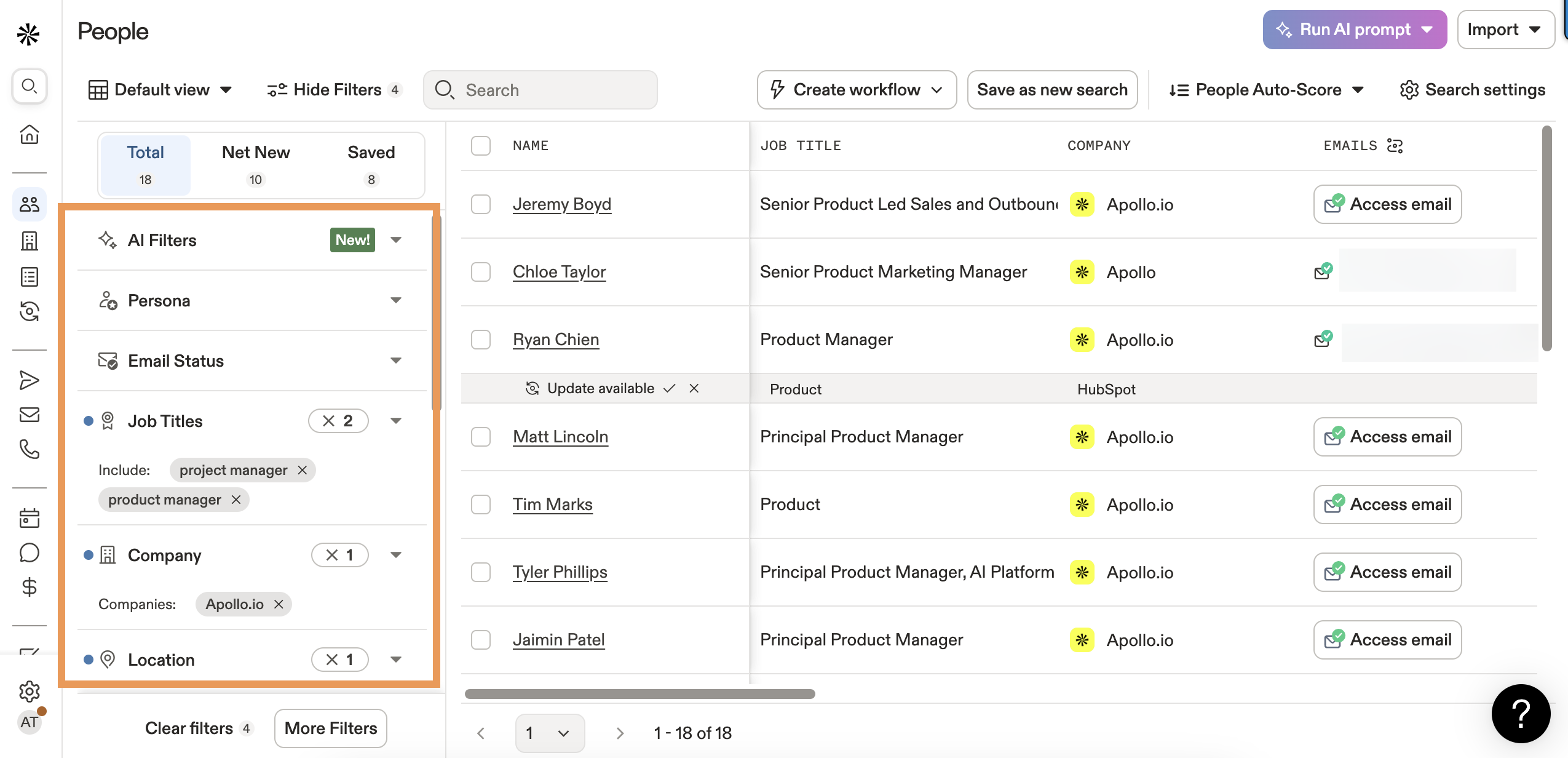
Use this if you need an all-in-one prospecting and engagement platform and you're willing to accept accuracy trade-offs. Apollo packs more features per dollar than anything else on this list.
Skip this if deliverability is your top priority. A Reddit bake-off testing 500-1,000 leads per tool found Apollo exports bouncing at 32-38% - the highest of any tool tested. Mobile reveals burn credits fast, you can't reduce seats mid-term, and advanced filters are gated to higher tiers at $79-$119/user/month.
If you're running sequences at scale, pair your data choice with the right outbound email automation setup.
ZoomInfo
ZoomInfo is the incumbent for a reason: deepest US database, the most workflow integrations, and intent plus technographic data that enterprise teams actually use. If you need advanced firmographic and technographic filters to build account lists, ZoomInfo's search capabilities are the benchmark.
Use this if you're enterprise, US-focused, and have the budget. The data depth for North American director+ contacts is unmatched, and the platform breadth - chat, intent, org charts, workflow automation - justifies the cost at scale.
Skip this if you're a team under 20 reps. ZoomInfo is overkill for 80% of teams. Professional plans start at $15,000-$18,000/year for 1-3 seats. Advanced runs $22,000-$28,000. Elite hits $35,000-$45,000+. Annual contracts only, with 10-20% renewal uplifts that catch teams off guard. The #1 complaint on Reddit? Paying for modules you never activate. ZoomInfo still won't publish pricing - that tells you something about who their buyer is.
If you're building account lists, it helps to understand technographics and how teams actually use them.
Cognism
Cognism's Diamond Data phone verification is the real differentiator - phone-verified mobile numbers for key contacts, which matters when you're cold-calling across EU markets where data regulations are strict. We've seen teams selling into EMEA cut their compliance overhead in half by consolidating on Cognism instead of juggling multiple regional providers.
Where ZoomInfo still wins: US database depth and workflow breadth. Where Cognism wins: EMEA compliance and mobile verification. Grow plans land around $22,500/year for 5 users; Elevate jumps to ~$37,500/year. Intent topics run $200-$400 per topic annually.
If you're selling into Europe, use a GDPR compliant database checklist before you sign anything.
Lusha
The Reddit bake-off data tells the Lusha story clearly. Against Apollo's 32-38% bounce rate, Lusha came in at 22-28% - meaningfully better for teams that care about deliverability but don't need enterprise-grade tooling. Lusha excels at surfacing direct contact details for individual decision-makers rather than broad company-level records.
Starting at $36-37/user/month with a free trial that includes 5 free phone credits, Lusha is affordable to test. The catch: credits run out fast at scale. For teams pulling thousands of contacts weekly, the credit model becomes a bottleneck. It works best for targeted prospecting into specific segments, not bulk list building.
Lead411
At $49/month with a 7-day free trial offering 50 leads, Lead411 is the mid-market sleeper that doesn't get enough attention. The standout: intent data included on Pro, without paying Cognism or ZoomInfo prices. Select plans even include unlimited exports - a genuine rarity.
You're trading database scale for dramatically lower cost and simpler onboarding. For teams between 5-50 reps who need intent signals without a five-figure annual commitment, Lead411 is the obvious first call.
If you want more options in this category, compare other B2B list providers before committing.
Hunter.io
A domain-level email search tool, not a full prospecting database. Free plan available, paid plans from $34/month. Reddit tests showed 28-35% bounce with "lots of guessed emails" - fine for finding a specific person's email, risky for scaled outreach.
If you're using a finder, add a dedicated email verifier step before you send.
UpLead
Real-time verification on export is UpLead's standout feature. Plans start at $99/month for 170 credits. Reddit tests showed ~20% bounce - respectable. The high per-credit cost makes it better for targeted prospecting than bulk list building.
Clay
Clay isn't a database - it's an orchestration layer that waterfalls across multiple data sources to find the best contact info available. That Reddit bake-off found Clay's waterfall approach produced the lowest effective bounce rate at 10-14%. Expect $150-500/month depending on volume. If you're already running multi-source enrichment workflows manually, Clay automates the pain away - but it assumes you know what you're doing with data orchestration in the first place.
If you're considering this approach, start with a practical overview of data enrichment tools.
Bounce Rate Comparison
| Tool | Bounce Rate (Reddit Tests) |
|---|---|
| Clay (waterfall) | 10-14% |
| UpLead | ~20% |
| Lusha | 22-28% |
| Hunter.io | 28-35% |
| Apollo.io | 32-38% |
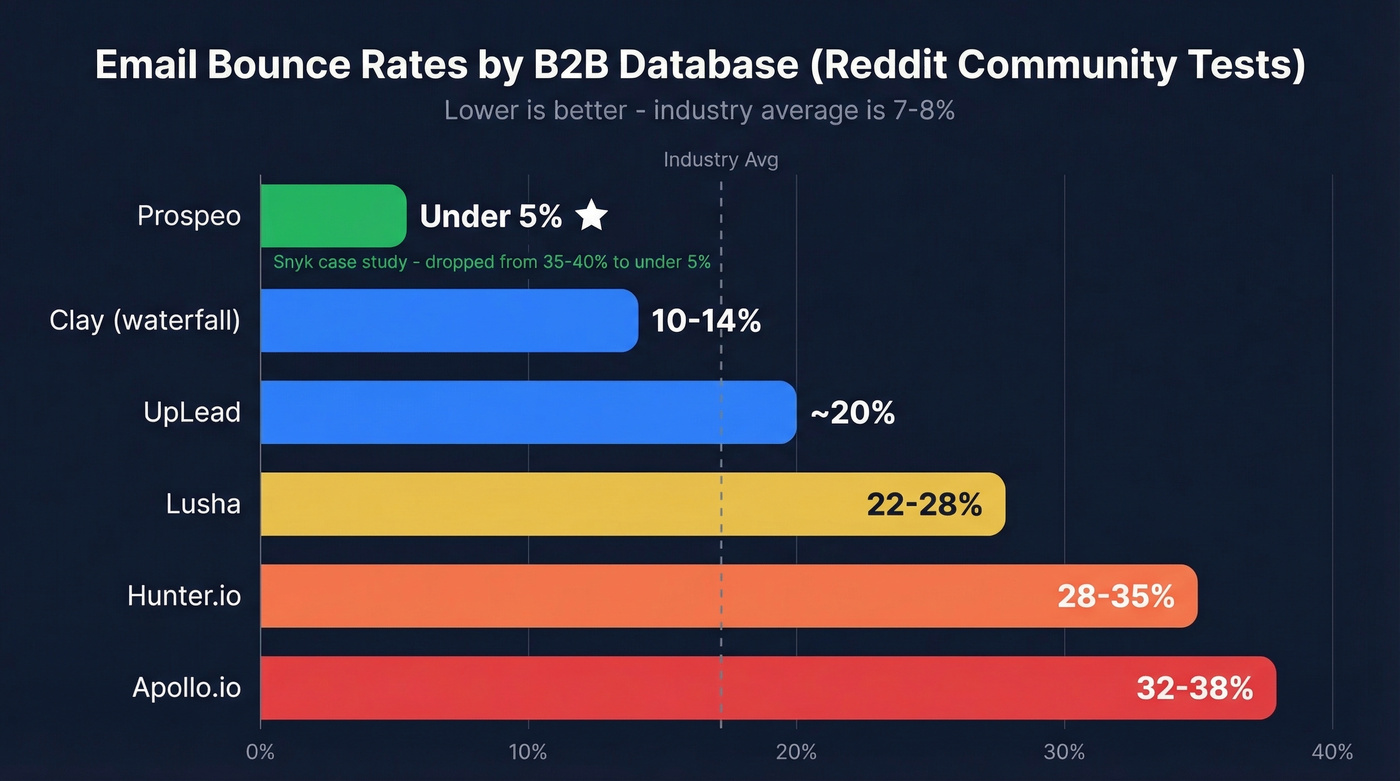
Snyk's 50 AEs dropped bounce rates from 35-40% to under 5% and grew AE-sourced pipeline 180% - because the database behind their outbound actually verified every record. Prospeo's 5-step verification, catch-all handling, and spam-trap removal exist so your sequences hit real inboxes, not dead ends.
Test 98% accuracy against your current provider. No contract, no sales call.
Pricing Comparison
| Tool | Starting Price | Free Tier | Contract | Credit Model |
|---|---|---|---|---|
| Prospeo | ~$0.01/email | 75 emails + 100 Chrome credits/mo | None | Pay per verified lead |
| Apollo.io | $49/user/mo | Yes (60 mobile) | Annual/monthly | Credit-based |
| ZoomInfo | ~$15,000/yr | 14-day trial | Annual only | Bulk credits |
| Cognism | ~$22,500/yr | Demo only | Annual | Seat + credit |
| Lusha | $36/user/mo | Free plan + free trial | Monthly OK | Credit-based |
| Lead411 | $49/mo | 7-day trial | Monthly OK | Unlimited (select) |
| Hunter.io | $34/mo | Yes | Monthly OK | Credit-based |
| UpLead | $99/mo | Free trial | Monthly OK | 170/mo |
| Clay | ~$150-500/mo | Limited free | Monthly OK | Usage-based |
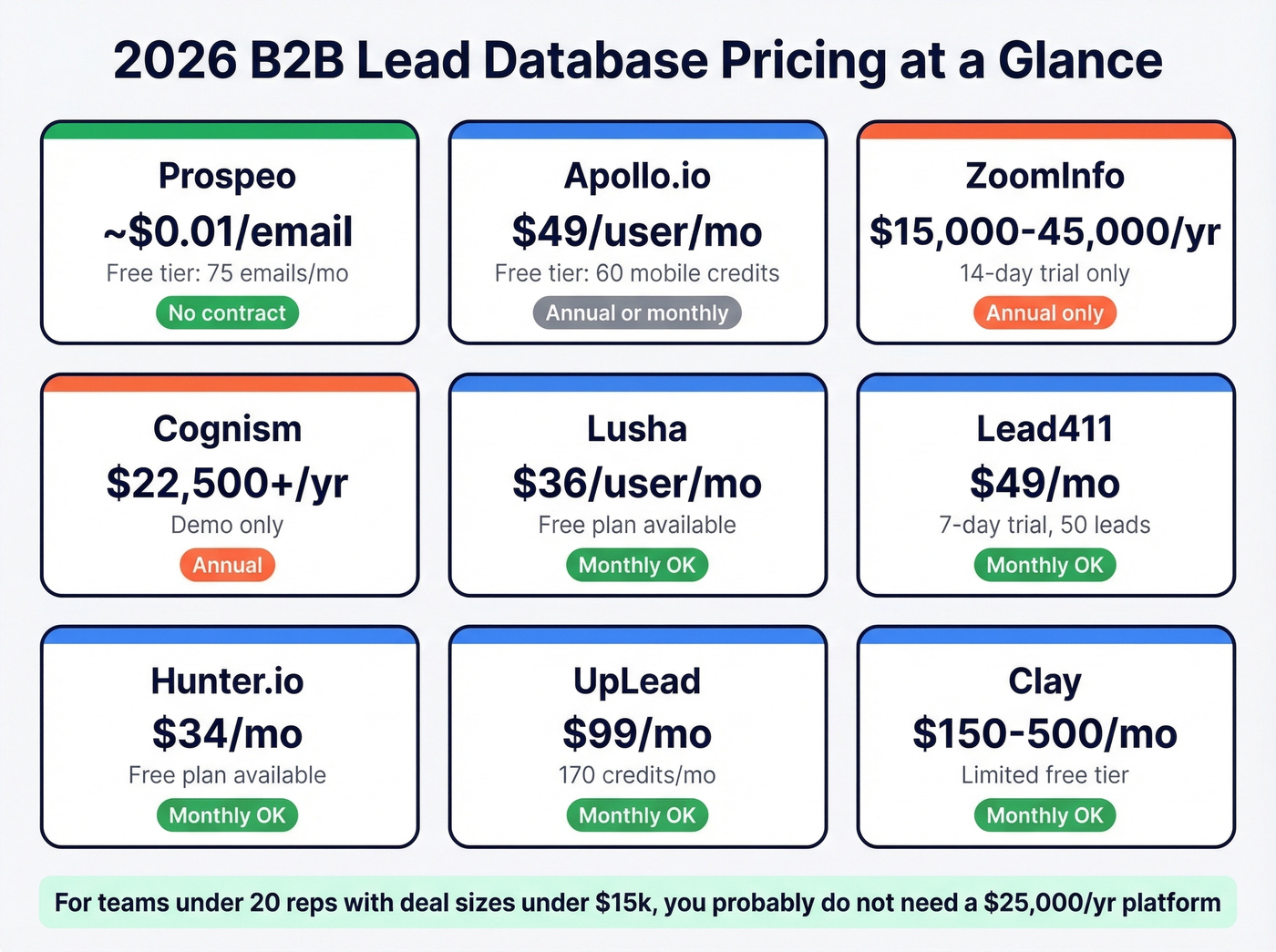
ZoomInfo's ranges above come from negotiated deal data since they still don't publish pricing publicly.
How to Choose the Right Database
Stop comparing databases by record count. Here's what actually determines whether a tool works for your team.
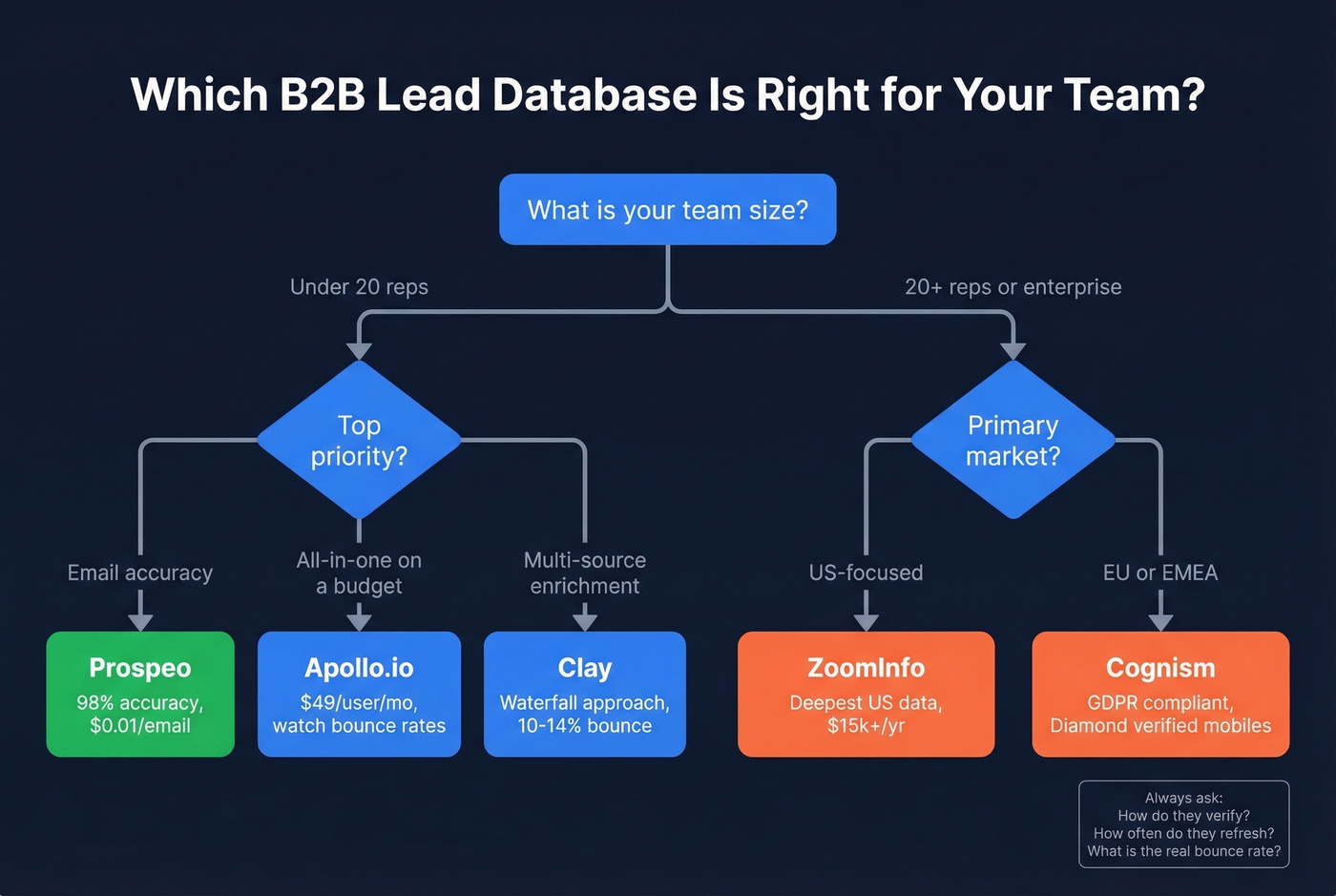
Data accuracy and verification method. Ask how they verify. Pattern-matching and hoping isn't verification. Look for multi-step processes with catch-all handling and spam-trap removal. If a vendor can't explain their verification pipeline in plain English, that's a red flag. (If you want a deeper dive, start with spam trap removal.)
Refresh frequency. With data decaying at 2.1% monthly, a 6-week refresh means you're always behind. Weekly refresh is the gold standard.
Intent data availability. Knowing someone's job title is table stakes. Knowing they're actively researching your category changes the conversation entirely - and it's the difference between a cold email and a warm one.
Credit mechanics and hidden costs. Some tools advertise low per-seat pricing, then gate mobile numbers, exports, and filters behind credit walls. Read the fine print. We've watched teams sign a $49/seat deal only to discover they need $200/month in add-ons to actually use the product.
CRM integrations. If the database doesn't push cleanly into Salesforce or HubSpot, your reps won't use it. Native integrations beat CSV exports every time. If you're trying to reduce manual work, look at CRM automation software.
Compliance. GDPR and CCPA aren't optional. If you're selling into Europe, verify that your provider handles opt-outs and DPAs properly. For a broader view, see B2B compliance.
Company vs. people data. Some tools are strongest on firmographics, org charts, and technographics, while others focus on individual contact records. The right B2B lead generation database for your team depends on whether you're running account-based plays or individual outreach - and those are fundamentally different workflows that reward different data architectures.
FAQ
What is a B2B lead generation database?
It's a searchable platform of verified business contact data - emails, phone numbers, job titles, and company information - used by sales teams to find and reach prospects. Most offer filters by industry, company size, seniority, and location, with top-tier tools adding buyer intent signals and technographic data.
How often should contact data be refreshed?
Weekly is the gold standard; monthly is the bare minimum. B2B data decays at 2.1% per month, meaning roughly 23% of records go stale each year. Prospeo refreshes on a 7-day cycle; most competitors take 4-6 weeks.
Are free B2B databases accurate enough for outreach?
Free tiers from Apollo and Lusha are useful for testing workflows, but credit limits and accuracy trade-offs make them risky at scale. Reddit tests show 30%+ bounce rates on some free exports. For teams running real campaigns without budget yet, look for free tiers that include full verification rather than just pattern-matched guesses.
How do I find companies using a lead database?
Most platforms let you filter by firmographic criteria - industry, employee count, revenue range, technology stack, and headquarters location. Tools with advanced boolean search and technographic filters let you build highly targeted company lists before drilling down to individual contacts.