

B2B Market Segmentation: Why Yours Keeps Breaking (And How to Fix It)
Your SDR team has 5,000 "enterprise" accounts in their territory. They're blasting sequences. Reply rate: 0.3%. Marketing says the segmentation is solid - it's firmographic, it's documented, it's in a slide deck somewhere. But the contacts are wrong, the intent data is stale, and half the accounts don't even match your ICP anymore. The segmentation didn't fail strategically. It failed operationally.
B2B market segmentation isn't a strategy problem - it's a data operations problem. Most guides stop at firmographics. That's table stakes. You need four layers working together: firmographic, technographic, intent, and behavioral. You need a data source that refreshes weekly, not every 4-6 weeks. And you need 3-4 segments you can actually activate with distinct messaging and resources.
What Is B2B Market Segmentation?
It's the process of dividing your total addressable market into distinct groups of companies and the people inside them that share characteristics relevant to how they buy. Simple concept. The execution is where everyone gets stuck.
The B2C version is straightforward - you're segmenting individual consumers by demographics, behavior, and preferences. B2B is messier because you're dealing with buying committees of 6-10 stakeholders, each with different priorities, and purchase cycles that stretch months. You're segmenting companies and the decision-makers inside them at the same time.
Here's the part most guides skip: segmentation is as much about where you don't sell as where you do. Deselection - deliberately excluding segments that waste your team's time - is the discipline that separates good segmentation from a taxonomy exercise that lives in a spreadsheet and dies in a CRM.
If your average deal size is under $10k, you probably don't need 6-layer segmentation. Firmographics plus intent will get you 80% of the way there. Don't over-engineer what a tighter ideal customer profile would solve.
Why Segmentation Matters (With Numbers)
The business case isn't theoretical. McKinsey's personalization report found that 71% of buyers expect personalized interactions, and 76% get frustrated when it doesn't happen. That frustration translates directly into lost pipeline.
Personalization - which requires segmentation as its foundation - drives 10-15% revenue lift, with company-specific results spanning 5-25%. Faster-growing companies drive 40% more of their revenue from personalization than their slower-growing counterparts. That's not a marginal advantage. That's a structural one.
The baseline B2B benchmarks tell the "before" story. Average B2B website conversion sits at 2-5%, with a cost per lead around $200. WordStream's B2B Services benchmarks show a 3.04% conversion rate and $116 CPA on Google Ads. Even a 2-point conversion rate improvement on a $200 CPL compounds fast across thousands of leads. Proper segmentation is what moves those numbers.
The 6 Types of B2B Segmentation
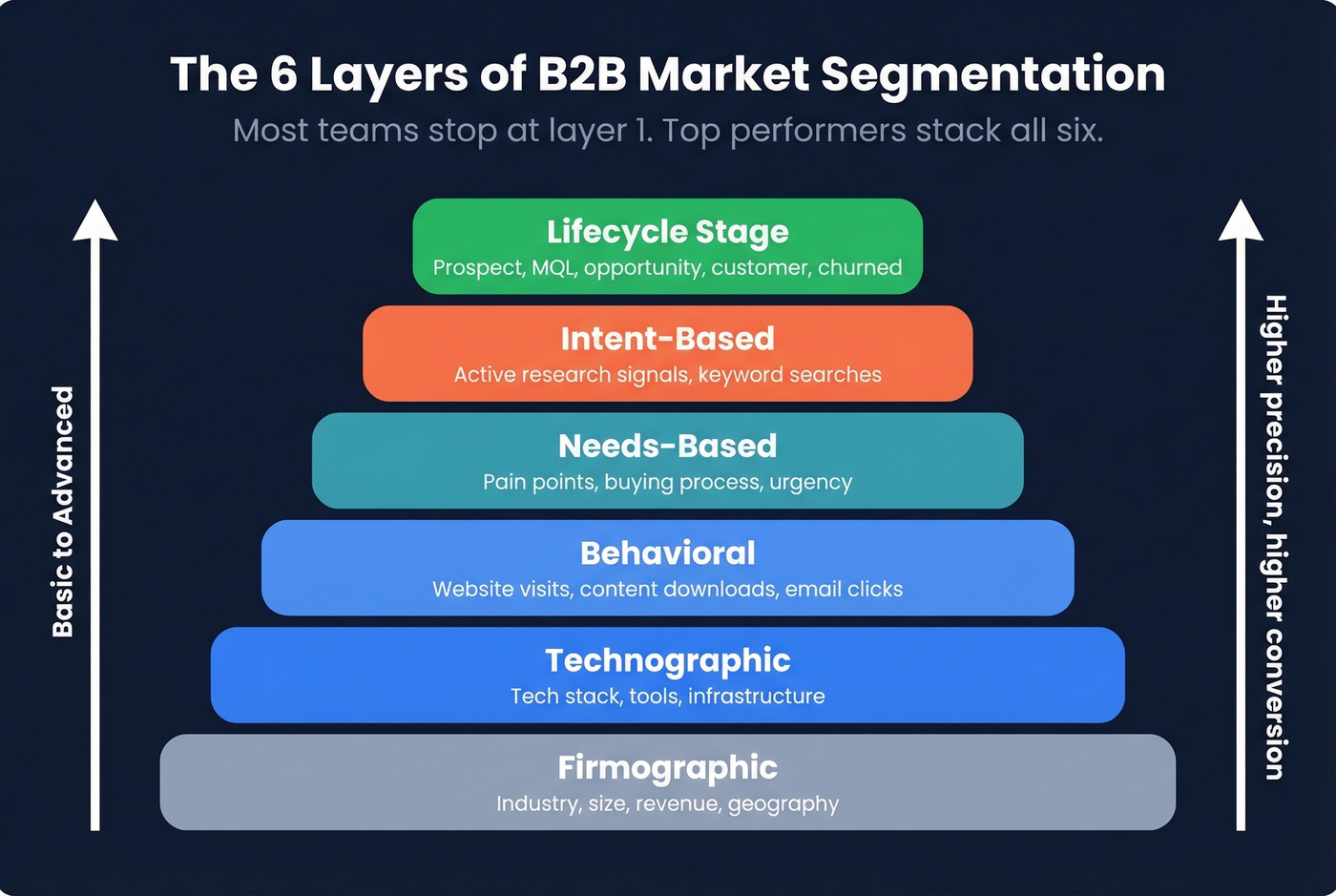
Most guides stop at firmographics. That's the equivalent of qualifying leads by company name alone. Here are the six layers that actually matter, stacked from basic to advanced.
Firmographic Segmentation
This is the baseline: industry, company size, revenue, geography, and ownership structure. If you're selling project management software, you might segment by "SaaS companies, 50-500 employees, $5M-$50M revenue, North America." Every B2B team does this. It's necessary but nowhere near sufficient. Firmographics tell you who a company is, not whether they're ready to buy.
Technographic Segmentation
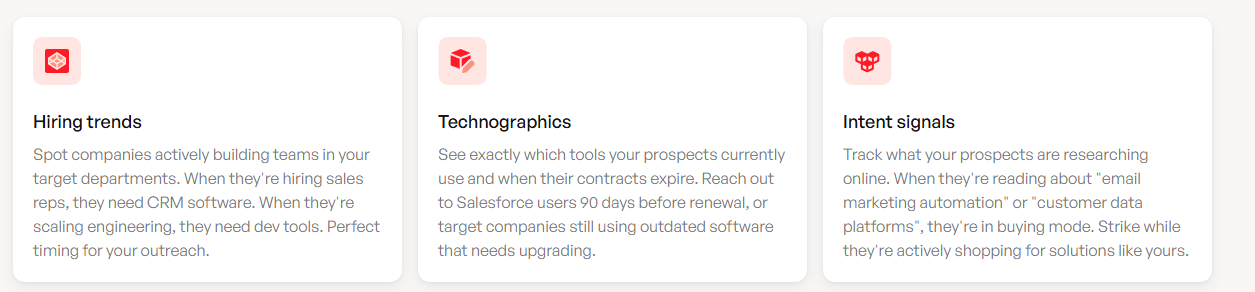
Your prospect just posted a job for a Snowflake engineer. That tells you more about their buying readiness than their industry code ever will.
Technographics reveal what software and infrastructure a company already uses. If you sell a Salesforce integration, knowing which companies run Salesforce versus HubSpot or Dynamics immediately narrows your TAM to accounts that are technically primed to adopt. You can also spot companies using competitor products or companies with gaps in their stack that your product fills. In practice, technographic signals come from web technology scanners, enrichment platforms that track technology installations across millions of domains, and signals like job postings that hint at upcoming tech decisions.
Behavioral Segmentation
How many times has that VP of Marketing visited your pricing page this week? Behavioral segmentation groups accounts by what they do: website visits, content downloads, email engagement, product usage patterns, event attendance. A company that's hit your pricing page three times and downloaded a competitive comparison guide is in a fundamentally different segment than one that read a blog post six months ago. This is the bridge between "who they are" and "what they want right now."
Needs-Based Segmentation
A 200-person fintech and a 200-person healthcare company look identical firmographically but have completely different pain points, buying processes, and urgency levels. Needs-based segmentation groups accounts by the problem they're trying to solve. B2B International argues that B2B buyers are generally more rational than B2C consumers, and their needs can often be predicted by identifiers like company size, purchase volume, or job function. Some teams further segment by buyer sophistication - whether the prospect is an expert, intermediate, or novice in the problem space - which directly affects messaging complexity and sales cycle length.
Intent-Based Segmentation
What if you could see which companies are actively researching solutions in your category before they fill out a form? That's intent data. Providers compile signals from content consumption, keyword searches, competitor comparisons, and third-party review site activity across thousands of B2B publications.
The operational value is clear: you're prioritizing accounts that are in-market right now, not accounts that merely fit your ICP on paper. The caveat is that IP-to-company mapping accuracy is where most intent providers fall short. If the mapping is wrong, you're routing "high-intent" accounts to reps who then discover the signal was noise. This is why layering matters - combining intent signals with firmographic and technographic filters means you're seeing intent in context, not isolation.
Lifecycle Stage Segmentation
Not every account in your CRM is at the same stage. Prospects, MQLs, active opportunities, customers, and churned accounts all need different treatment. Lifecycle segmentation ensures your marketing automation and sales plays match where the account actually sits - not where your last campaign assumed they were.
How to Build Your Segmentation Model
Here's the thing: most segmentation projects fail not because the framework is wrong, but because teams try to boil the ocean. Let's break this into phases that actually ship.
Phase 1: Define Market Boundaries
Start with your total addressable market, narrow to your serviceable addressable market, then define your ideal customer profile. From the ICP, build a target account list. This isn't a one-afternoon exercise, but it shouldn't take a quarter either. If you can't articulate your ICP in two sentences - industry, size, pain point, buying trigger - you're not ready to segment.
Phase 2: Layer Your Data
This is where most teams stall. You need four data types working together: firmographic, technographic, intent, and behavioral. The practical question everyone asks: "Where do I actually get this data?"
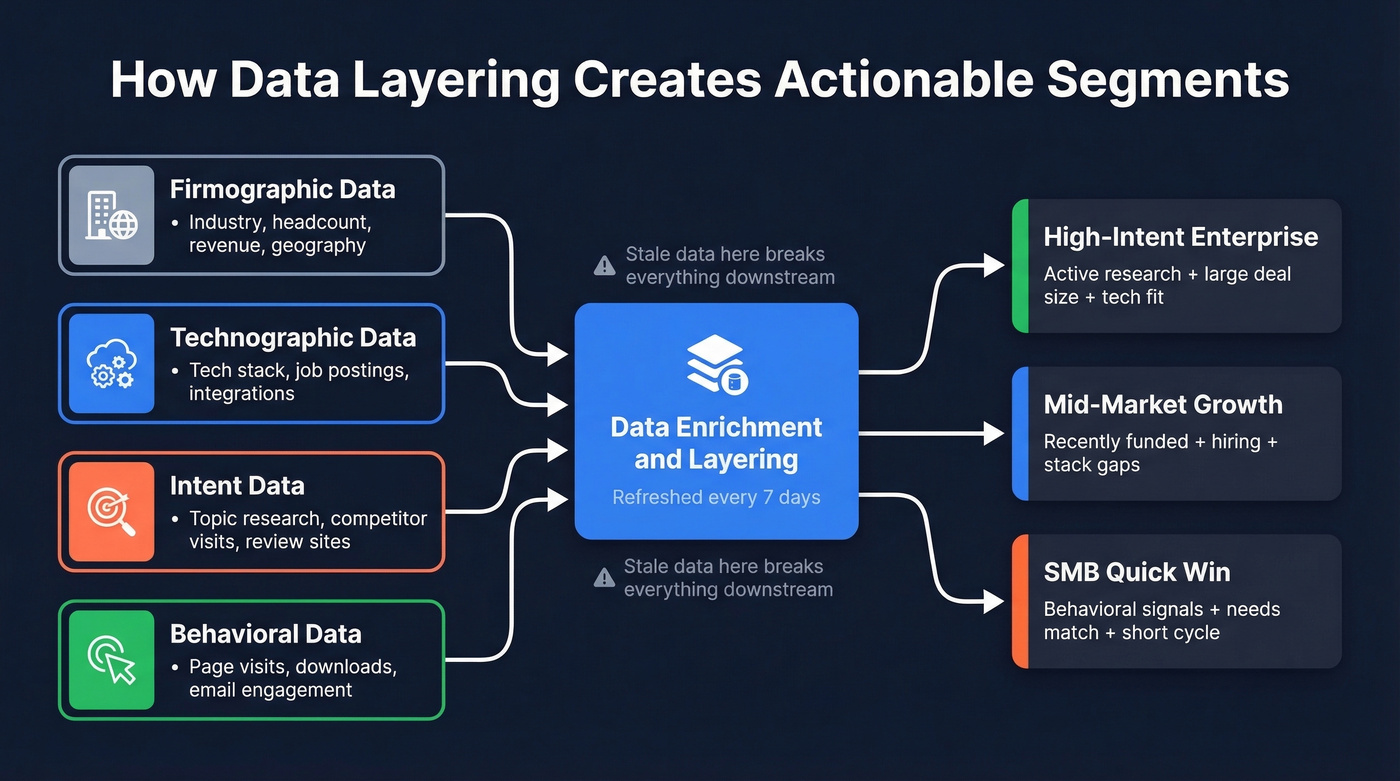
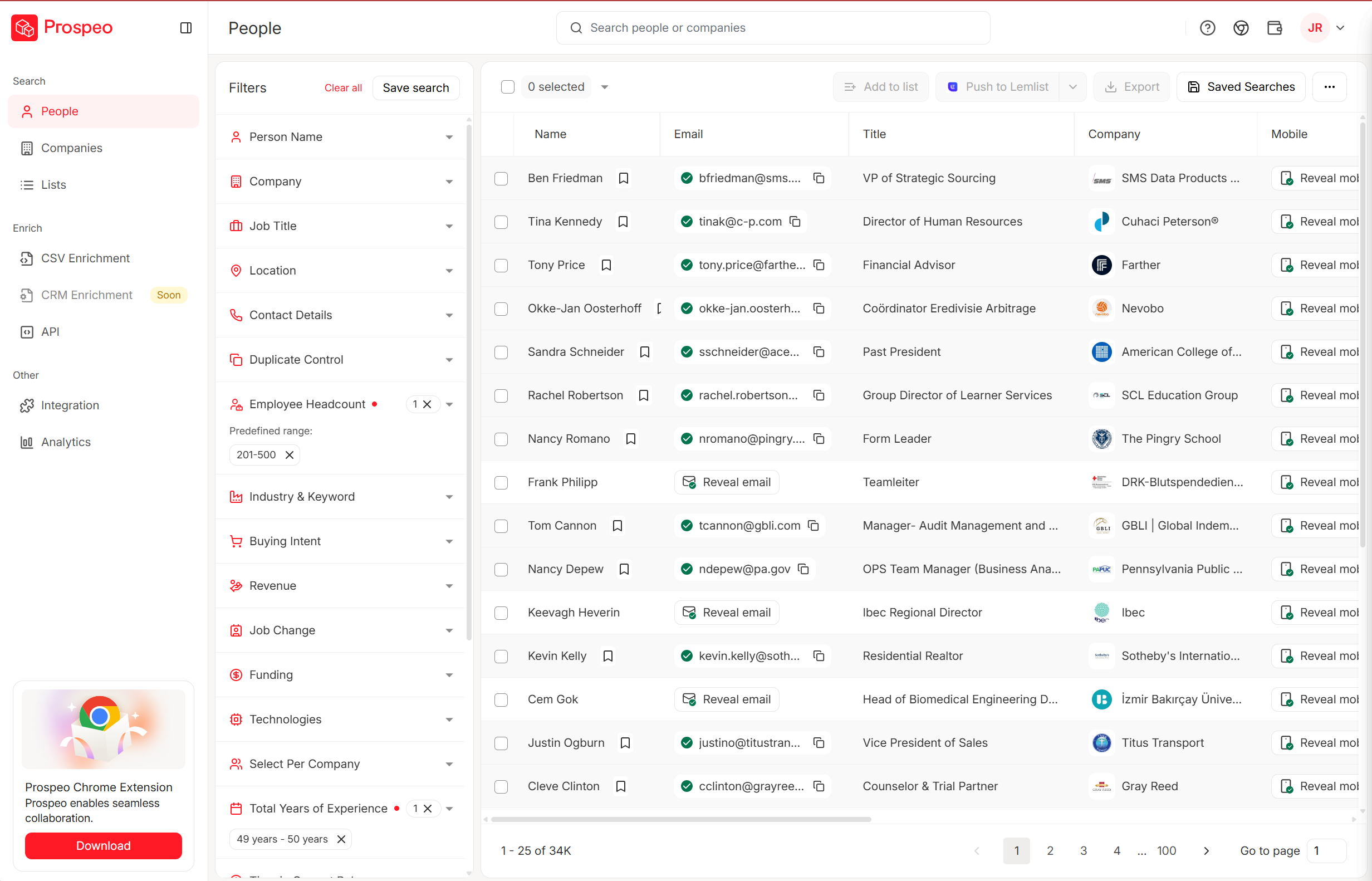
Prospeo's B2B database lets you filter 300M+ professional profiles by buyer intent across 15,000 topics, technographics, headcount growth, funding, and revenue - all refreshed every 7 days. You can build a segment like "Series B SaaS companies with 50-200 employees actively researching your category" in minutes, then export verified contacts directly into your sequencer or CRM.

Phase 3: Create 3-4 Actionable Segments
You don't need 10 segments. You need 3-4 you can actually activate with distinct messaging, offers, and sales plays. Most B2B markets yield this many natural groupings. More than that and your SDRs end up running five different playbooks badly instead of three well.
If you're using intent signals to prioritize accounts, make sure your segments can actually be worked by the team and routed cleanly in your CRM.
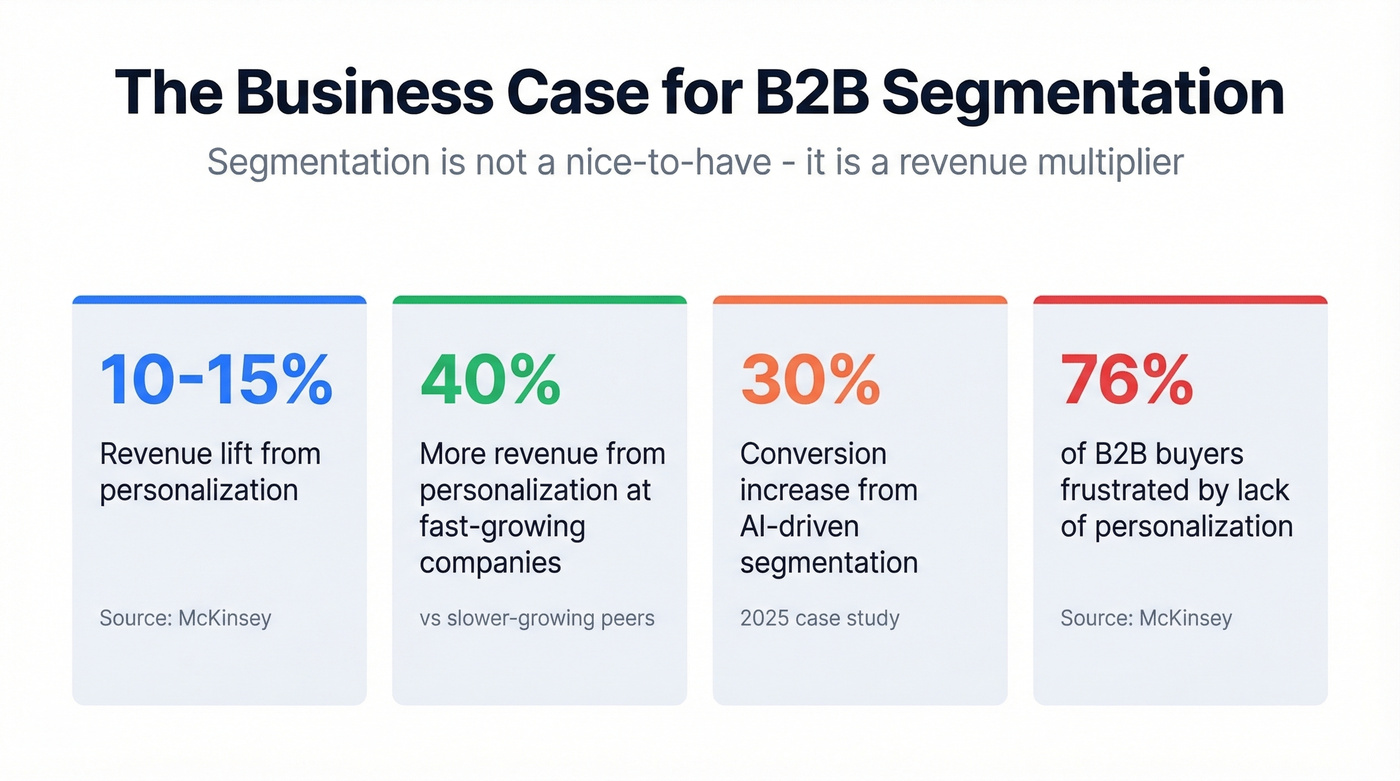
AI-driven propensity scoring is making this step faster. Teams using machine learning to cluster accounts and dynamically reassign segments are seeing real conversion lifts - one 2025 case study reported a 30% increase in conversions after switching to AI-driven segmentation. The mechanics matter more than the brand: propensity scoring, real-time segment migration, and automated trigger-based reclassification.
Phase 4: Activate and Measure
Each segment needs a distinct outbound sequence, ad creative, or nurture track. If two segments get the same email, they're not really two segments.
Map each segment to a specific campaign, track conversion rates independently, and compare against your baseline benchmarks. This is where targeting and segmentation converge - your segment definitions should directly inform which accounts receive which plays.
Phase 5: Refresh Continuously
Segmentation isn't a project. It's a process. Review segment definitions every 6-12 months. But the underlying data - contact info, intent signals, company attributes - should refresh weekly. We've seen teams build beautiful segments in Q1 that are completely stale by Q3 because nobody updated the inputs.
If your segments are built on enrichment, treat refresh cadence like a core requirement, not a nice-to-have. (More on vendor selection in our guide to data enrichment services.)

You just read about stacking firmographic, technographic, and intent layers. Prospeo lets you do exactly that - 30+ filters including buyer intent across 15,000 topics, technographics, headcount growth, funding, and job changes, all on 300M+ profiles refreshed every 7 days. No stale segments.
Build segments that actually convert - starting at $0.01 per email.
Why Segmentation Fails
The most common complaint about B2B segmentation on r/sales and r/b2bmarketing isn't "we picked the wrong framework." It's that the plumbing broke. Practitioners consistently describe segmentation as a plumbing problem, not a strategy problem. Here are the failure modes that actually kill pipeline.
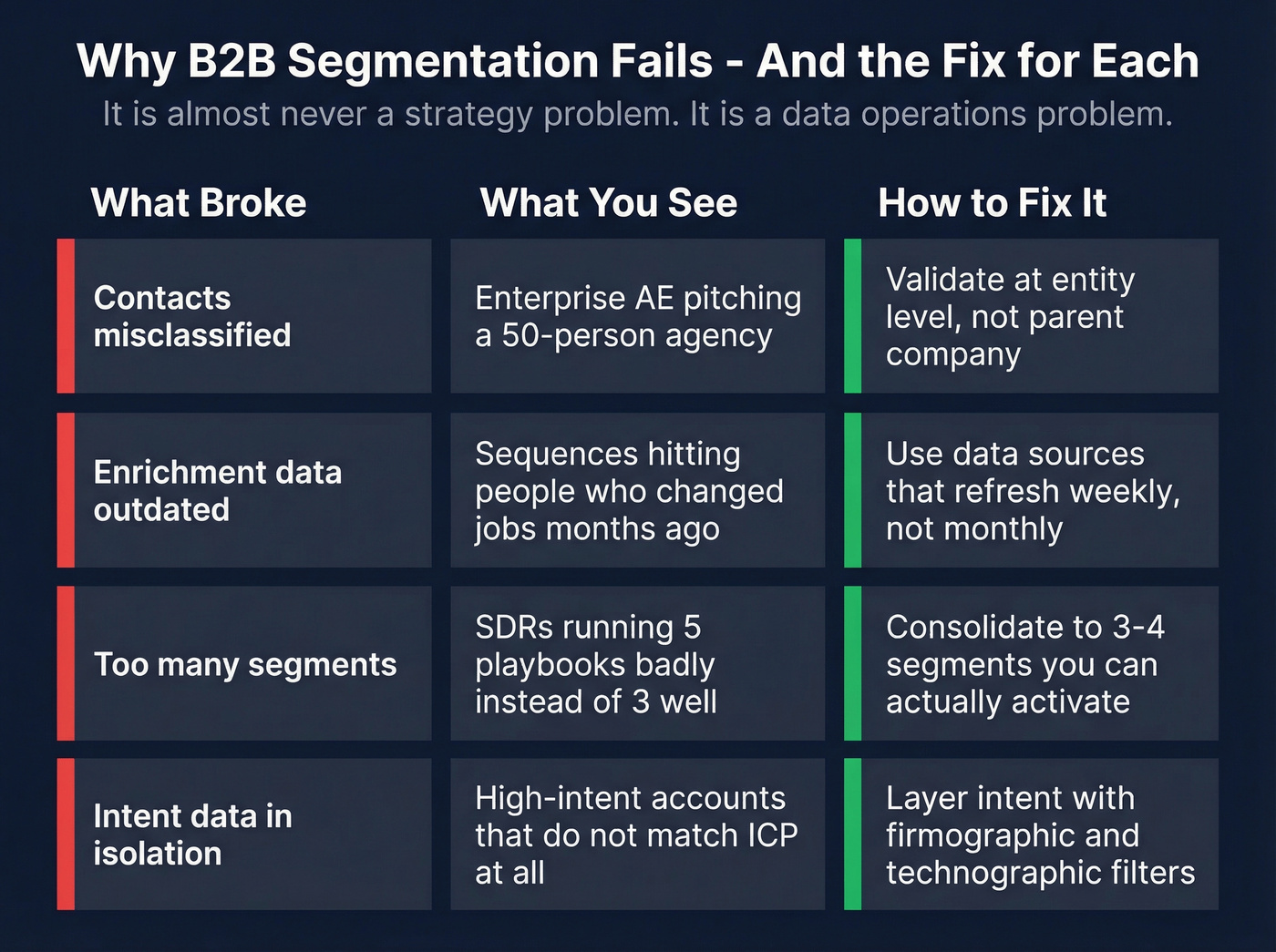
Contacts were misclassified. Your enrichment tool tagged a 50-person agency as "enterprise" because the parent company has 10,000 employees. Now your enterprise AE is pitching a company that should've gone to the SMB team. The fix isn't better segmentation logic - it's better data. Validate company size at the entity level, not the parent level, and use multiple data points like headcount, revenue, and funding to triangulate.
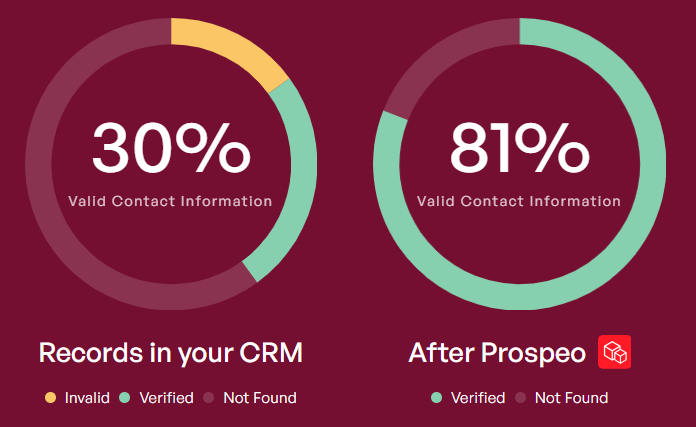
Enrichment data was outdated. If your data provider refreshes every 6 weeks, your segments are already drifting by the time reps start working them. Look for weekly refresh cycles so the segment you built on Monday is still accurate on Friday.
Segmentation logic didn't match buyer behavior. You segmented by industry and company size. But your buyers don't buy based on industry and company size - they buy based on a triggering event like new funding, a leadership change, or a tech migration combined with a pain point. If your segments don't incorporate behavioral and intent signals, you're grouping accounts by what they are instead of what they need.
Marketing hands sales a list nobody can reach. This is the most demoralizing failure. The segmentation was right. The intent signals were real. But the contact data was wrong - bounced emails, disconnected phones, people who changed jobs three months ago. Segmentation without verified contact data is a strategy document, not a pipeline engine.
If you're seeing bounces, fix the list before you fix the copy. Start with email bounce rate benchmarks and remediation, then tighten your data inputs.
Mistakes That Kill Pipeline
Three mistakes show up more than any others, and they're worth calling out individually.
Relying only on firmographics is the most common. Industry and company size are necessary but not sufficient. Without technographic, intent, and behavioral layers, you're guessing. Closely related: creating too many segments. If you have more segments than you have distinct campaigns, you have too many. Prioritize the 3-4 highest-value groupings. And ignoring the 80/20 rule will sink even well-structured segments. In most B2B markets, a small share of customers drives the majority of revenue - your segmentation should identify and prioritize that group, not treat every segment equally.
Beyond those three:
- Not connecting segmentation to activation. A segment that doesn't map to a specific campaign, sequence, or ABM play is just a list.
- Treating it as a one-time project. We've run into teams that did a segmentation exercise in 2024 and haven't touched it since. Markets move. Your segments should too.
- Using bad data as the foundation. If your enrichment data is more than 30 days old, your segments are already wrong. Garbage in, garbage segments out.
Real Examples That Worked
SAP's "Inspire the Future" campaign is the clearest named-brand example of segmentation driving measurable results. SAP segmented their audience by six industries and tailored content, messaging, and creative to each. The results: 48% higher engagement than all other SAP social campaigns that year, EUR924.4M in pipeline, and EUR266.15M in projected revenue. The key wasn't a revolutionary framework - it was industry-specific segmentation executed with discipline across channels.
McKinsey's North American retailer case study documented a company that used propensity modeling combined with A/B testing in two-week sprints. After three months, they saw a boost of about 3% in annualized margins. That's a retail example, but the mechanics - micro-segmentation, rapid experimentation, offer frequency optimization - translate directly to B2B lifecycle segmentation and go-to-market strategy.
Toggl's persona-based segmentation is a useful smaller-scale lesson: build distinct buyer personas for each segment and tailor the funnel from ad creative to onboarding flows so the segment definition actually changes the experience. Segmentation that stops at the top of funnel and doesn't carry through to product experience leaves money on the table.
What made all three work? None relied on static segments. They treated segmentation as an operational system that ingested fresh data, tested hypotheses, and iterated.
Tools for B2B Market Segmentation
You don't need a 12-tool stack to segment well. Start with three layers: a CRM for activation, a data enrichment platform for building and refreshing segments, and marketing automation for executing against them.
| Category | Tool | Starting Price | Best For |
|---|---|---|---|
| Data Enrichment | ZoomInfo | ~$15k/yr | Enterprise workflow breadth |
| Data Enrichment | Apollo | Free; paid from $49/mo | Early-stage basic enrichment |
| Intent Data | Bombora | ~$2k-5k/mo | Standalone intent layer |
| ABM Platform | 6sense | ~$30k+/yr | Enterprise ABM orchestration |
| ABM Platform | Demandbase | ~$25k+/yr | Account-based segmentation |
| CRM | HubSpot | Free CRM; Marketing Hub ~$800+/mo | Mid-market activation |
| CRM | Salesforce | From $25/user/mo | Enterprise sales enablement |
| CDP | Twilio Segment | Free tier; paid varies | Behavioral segmentation |
| Analytics | Amplitude | From $49/mo (billed annually) | Product-led segmentation |
For most teams under 500 employees, Prospeo plus your existing CRM plus a sequencer like Instantly or Lemlist covers 90% of what you need. If you're evaluating your outbound stack end-to-end, start with a shortlist of SDR tools that support segmentation-based routing and reporting. Skip ZoomInfo at ~$15k/year unless you genuinely need the workflow breadth for a large org - you're paying for a lot of features that have nothing to do with segmentation.
Your segmentation model is only as good as the data underneath it. While competitors refresh every 6 weeks, Prospeo's 7-day cycle means your intent signals, technographic filters, and contact data stay current. 98% email accuracy. 92% API match rate. Segments that don't decay.
Stop feeding your SDRs dead data - activate segments with contacts that connect.
Measuring Segmentation Impact
The baseline B2B benchmarks are your "before" picture: 2-5% website conversion, ~$200 CPL, $36-$40 email ROI per dollar spent. After implementing layered segmentation, even a 2-point improvement in conversion rate changes your unit economics dramatically.
Let's say you're generating 1,000 leads per month. Going from 3% to 5% conversion means 20 additional opportunities - without spending an extra dollar on acquisition. Multiply that by your average deal size and the ROI case makes itself.
Track conversion rates, reply rates, and pipeline contribution by segment - not in aggregate. If one segment converts at 8% and another at 1.5%, you don't have a "4.75% average." You have one segment that works and one that needs to be reworked or deselected entirely.
If you want to pressure-test your baselines, compare against current average B2B lead conversion rate benchmarks before you declare a segment "bad."
FAQ
What's the difference between market segmentation and customer segmentation?
Market segmentation divides your total addressable market into targetable groups before they buy. Customer segmentation groups existing customers for retention and upsell. Different data inputs, different teams owning the process - both necessary for a complete go-to-market strategy.
How many segments should a B2B company have?
Three to four actionable segments is the sweet spot for most teams. Each needs distinct messaging, campaigns, and sales plays. Start narrow and expand only when you can genuinely activate each new segment with dedicated resources.
What data do I need to start segmenting?
At minimum: industry, company size, and revenue for firmographic grouping. To compete, layer in technographics, buyer intent signals, and behavioral data. Tools like Prospeo with 30+ filters - including intent across 15,000 topics and technographic signals - let you build multi-layered segments without stitching together separate tools.
How often should I update my segments?
Review segment definitions every 6-12 months. Refresh the underlying data - contacts, intent signals, company attributes - weekly. Stale data is the number-one reason segments break, and providers with 7-day refresh cycles prevent drift before it compounds.
Is segmentation worth it for small companies?
Absolutely - arguably more so. Small companies can't afford to waste outreach on bad-fit accounts. Even basic firmographic plus intent segmentation dramatically improves reply rates and pipeline quality without requiring enterprise-grade budgets.
B2B market segmentation is a data operations discipline, not a strategy exercise. Get the data right, keep it fresh, and activate against 3-4 segments you can actually resource. Everything else is a slide deck.