

B2B Marketing Goals: The Only 3 That Matter in 2026
A VP on r/b2bmarketing described their CEO's 2026 planning ask: detail every asset, every campaign, every month - down to whether it launches morning or afternoon. The team was four people juggling 20 emails per month, 12 social posts, 20 trade shows, and 4-7 product launches per year. That's not setting B2B marketing goals. That's a panic attack disguised as a spreadsheet.
Here's the thing: 55% of companies don't even know their CAC. You can't set meaningful marketing objectives if you don't know what a customer costs you. (If you need a clean definition of CAC, start there.)
We've watched teams burn entire quarters chasing ten goals at once, hitting none of them, then blaming "alignment issues" in the post-mortem. The fix is brutal in its simplicity: three goals, one per funnel stage, with revenue-backward math to set targets and funnel stage OKRs to track them.
You Need 3 Goals, Not 10
Most B2B marketing teams confuse activity with progress. They track pageviews, email opens, and raw MQL counts - then wonder why the board isn't impressed.
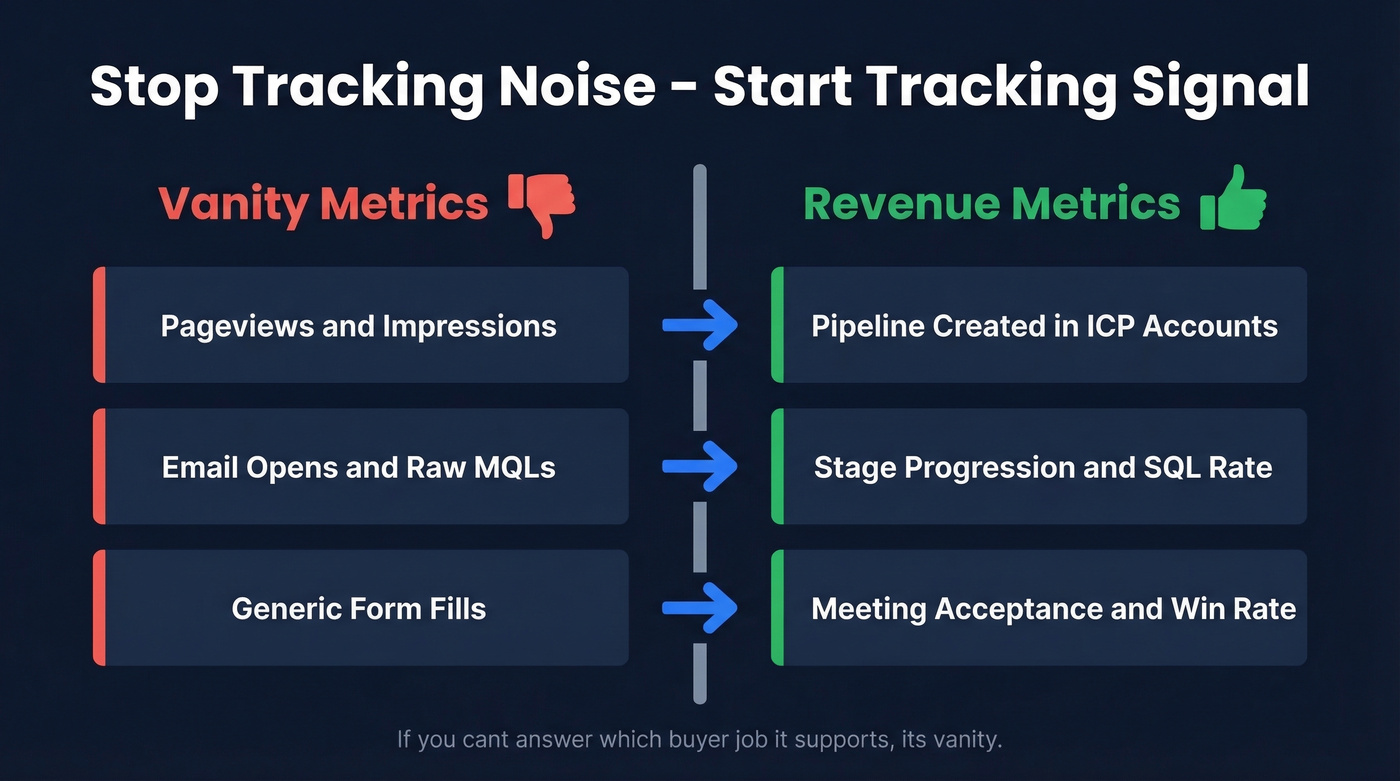
Buyers are nearly 70% through their purchasing process before they ever talk to sales. That means the metrics you obsess over in your Monday standup are measuring noise, not signal.
Before you commit to any goal, run it through two gating questions: Which buyer job or objection does this support? and What do we want the prospect to do next? If you can't answer both, it's vanity.
| Vanity Metric | Revenue Metric |
|---|---|
| Pageviews / impressions | Pipeline created in ICP accounts |
| Email opens / raw MQLs | Stage progression / SQL rate |
| Generic form fills | Meeting acceptance / win rate |
Three B2B Marketing Goals That Drive Revenue
Brand Awareness & Pipeline Creation
94% of senior B2B marketers agree trust is the key driver in B2B purchasing, and 42% say increasing brand awareness among decision-makers is their top priority. That's not soft. That's the top of your pipeline.
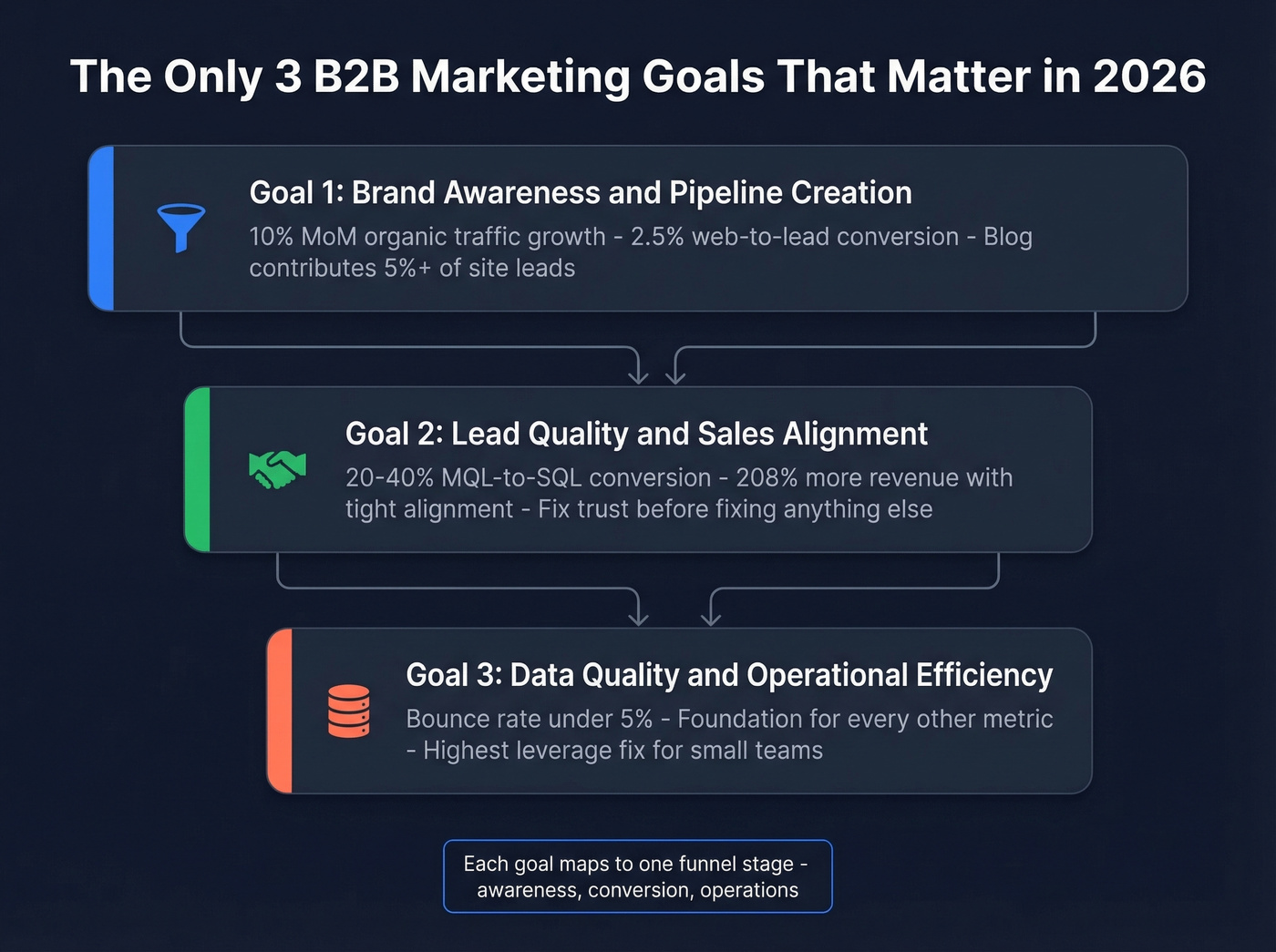
Target 10% month-over-month organic traffic growth. Aim for a 2.5% web-to-lead conversion rate as your stretch benchmark - the average hovers around 1.25%, so doubling it is ambitious but achievable with tight targeting and real content. If your blog isn't contributing at least 5% of total site leads, your content strategy needs surgery, not more posts.
Lead Quality & Sales Alignment
The MQL-to-SQL handoff is where most marketing objectives quietly die. A healthy conversion rate typically runs 20-40%, depending on how tightly marketing and sales agree on what "qualified" actually means.
Companies with tight sales-marketing coordination see up to 208% more revenue and 36% higher customer retention. Misalignment wastes roughly $1 trillion per year across US teams. Let's be honest - if your sales team doesn't trust your MQLs, fix that before you fix anything else. Regular analysis of your handoff data (lead source, time-to-contact, objection patterns) is the fastest way to rebuild that trust.
If you want a practical way to operationalize "qualified," start with lead scoring and a shared definition of lead status.
Data Quality & Operational Efficiency
This is the goal nobody puts on their OKR doc, and it wrecks every other metric. If your email bounce rate is 35%, your lead gen numbers are inflated, nurture sequences hit dead ends, and pipeline reporting is fiction.
We've seen this play out directly: one team using Prospeo dropped bounce rates from 35% to under 4% and tripled pipeline from $100K to $300K per week. Treat "bounce rate under 5%" as a foundational KPI. Everything else sits on top of it.

If your average deal size is under $25K and your team is under ten people, data quality will move your pipeline faster than any brand campaign. Fix the foundation first.

You just backward-mathed your way to 160 leads per month. Now ask: how many of those leads have verified contact data? Teams using Prospeo cut bounce rates from 35% to under 4% and tripled weekly pipeline to $300K - because every lead actually reaches a real inbox.
Hit your pipeline goal with 98% accurate emails at $0.01 each.
Work Backward from Revenue
Every goal needs a number, and that number should trace back to revenue. This is where B2B marketing goals become concrete instead of aspirational.
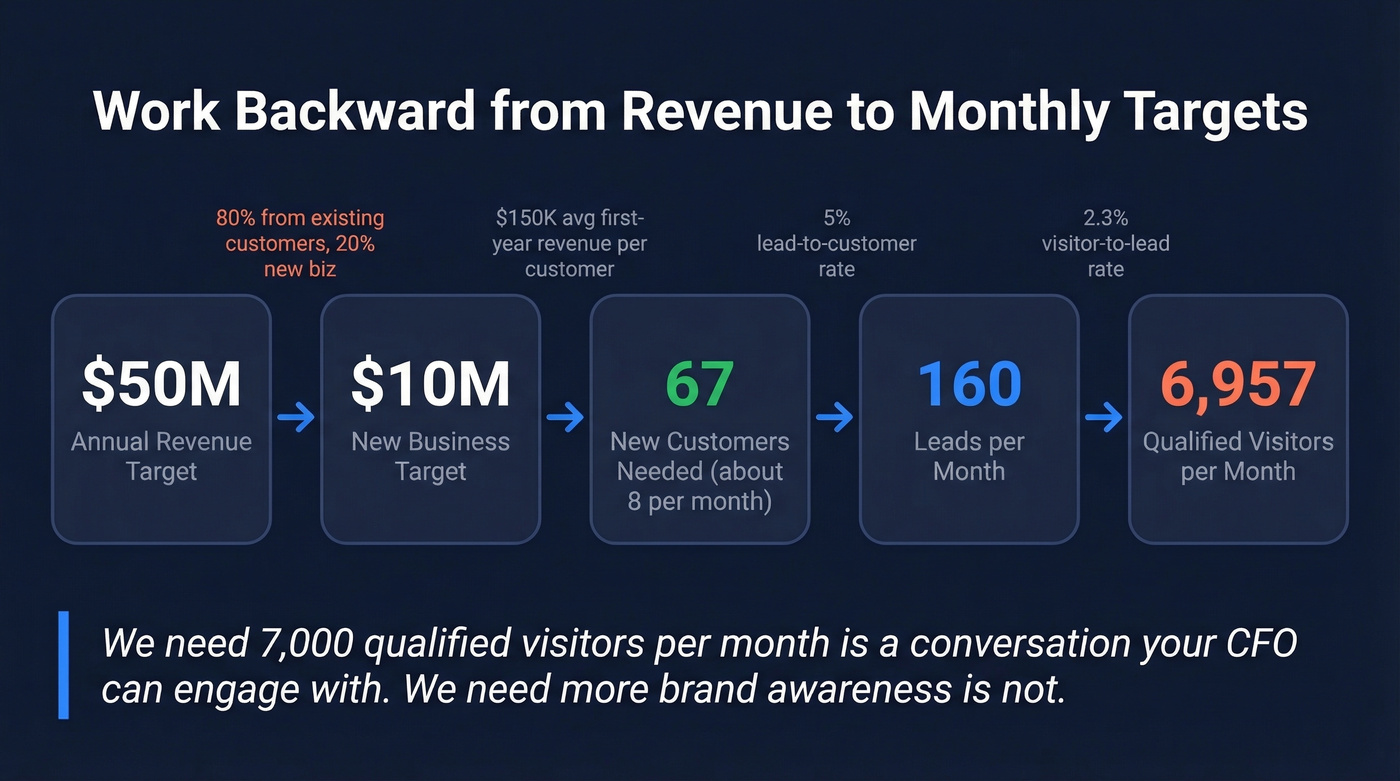
Say your target is $50M. Assume 80% comes from existing customers - that leaves $10M from new business. At $150K first-year revenue per customer, you need roughly 67 new customers, or about 8 per month. Now work backward through your funnel:
| Step | Metric | Number |
|---|---|---|
| New customers/mo | Target | 8 |
| Leads/mo | 5% lead-to-customer | 160 |
| Visitors/mo | 2.3% visitor-to-lead | 6,957 |
"We need 7,000 qualified visitors per month" is a conversation your CFO can engage with. "We need more brand awareness" isn't.
If you want to pressure-test the math, compare it to average B2B lead conversion rate benchmarks and sanity-check your pipeline health before you lock targets.
OKR Templates You Can Steal
OKRs beat SMART goals because they separate ambition from measurement. Here are four templates you can adapt today:
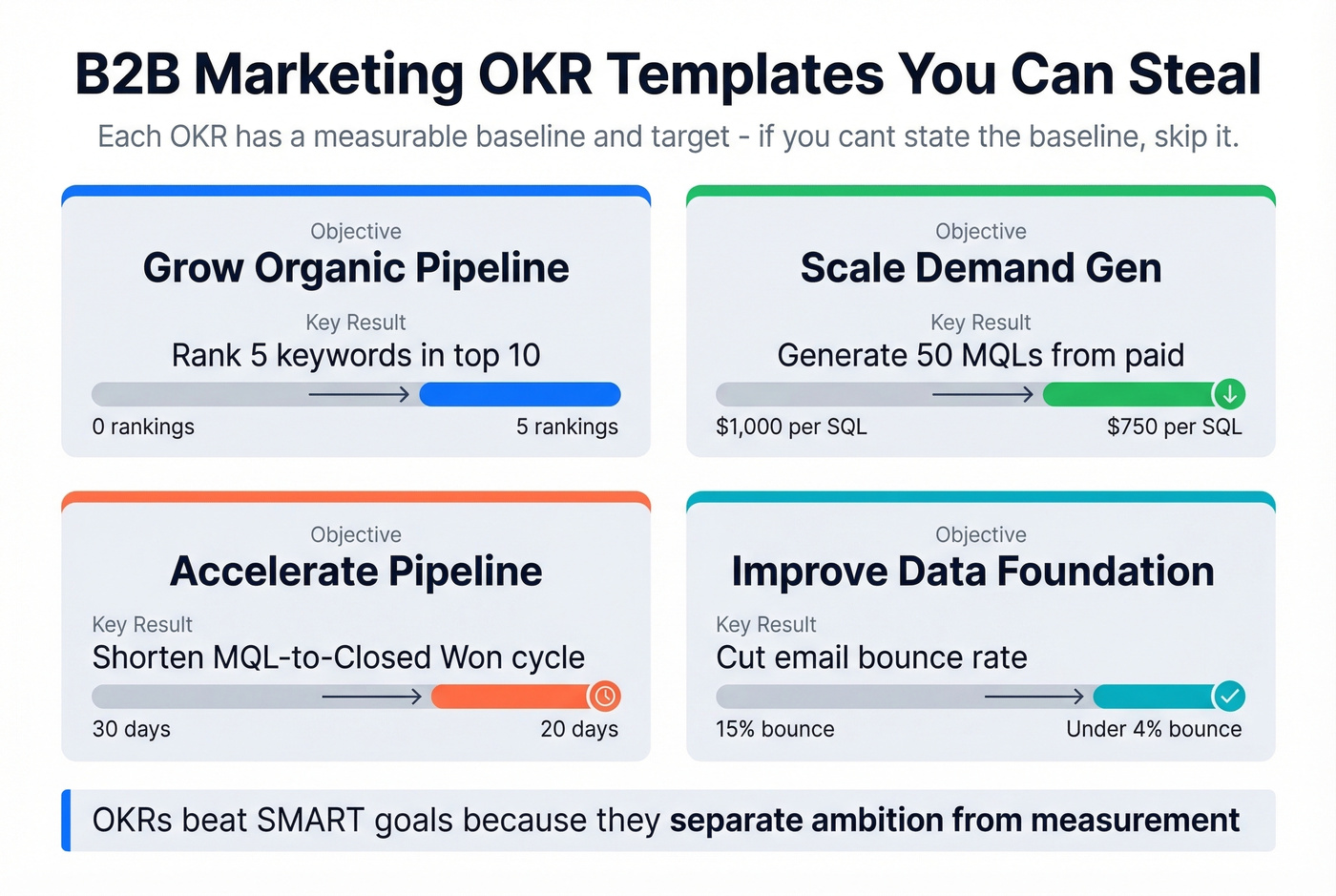
| Objective | Key Result | Baseline -> Target |
|---|---|---|
| Grow organic pipeline | Rank 5 keywords in top 10 | 0 -> 5 rankings |
| Scale demand gen | Generate 50 MQLs from paid | $1,000 -> $750/SQL |
| Accelerate pipeline | Shorten MQL-to-Closed Won cycle | 30 -> 20 days |
| Improve data foundation | Cut email bounce rate | 15% -> <4% bounce |
If you can't state the baseline, you're not ready to set the goal. Skip it until you can measure where you are right now - otherwise you're just guessing at progress.
Measuring Against Industry Benchmarks
83% of B2B SaaS companies can't accurately answer basic attribution questions. The typical B2B buyer touches your brand 8-12 times before converting. Last-click attribution in that environment is a lie - it over-credits retargeting and starves the awareness content that actually started the relationship.
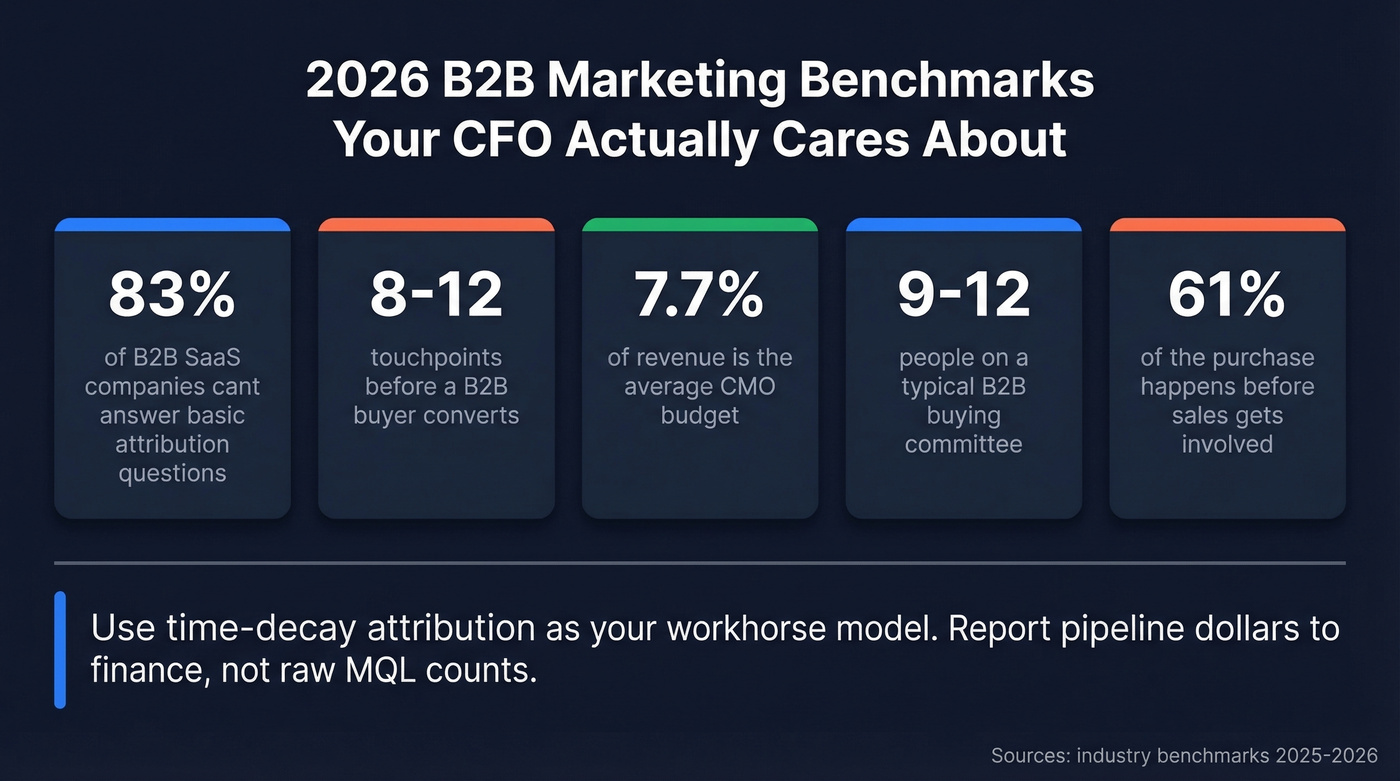
Use time-decay attribution as your workhorse model. It gives more credit to recent touches without zeroing out the blog post that opened the door six weeks ago.
When you report to finance, frame metrics around qualified accounts and pipeline dollars. CMO budgets sit at 7.7% of revenue, buying committees run 9-12 people, and 61% of the purchase happens before sales gets involved. Raw MQL counts mean nothing to a CFO. Pipeline dollars do. Benchmarking your conversion rates and cost-per-SQL against industry standards is the only way to know whether your numbers are healthy or just familiar - and if you're not doing this quarterly, you're flying blind with a dashboard that only tells you what you want to hear.
Data quality is the goal nobody puts on the OKR doc - and it wrecks every other metric. Prospeo's 7-day data refresh cycle and 5-step verification give you a foundation that makes your MQL-to-SQL rate, attribution model, and revenue math actually trustworthy.
Stop building revenue targets on top of bad data.
FAQ
What's the difference between a marketing goal and a KPI?
A goal is the outcome you want - "increase pipeline by 30%." A KPI is the metric you track to measure progress, like MQL-to-SQL conversion rate. Goals set direction; KPIs tell you if you're getting there. Don't confuse the two or you'll optimize for metrics that don't move revenue.
How many goals should a B2B team set?
Three - one per funnel stage: awareness and pipeline creation, lead quality and sales alignment, and data quality and operational efficiency. More than three and a small team spreads too thin to move any needle meaningfully. If net revenue retention is below 100%, a fourth goal around expansion revenue deserves a seat at the table.
How does contact data quality affect pipeline targets?
A 35% bounce rate inflates lead gen numbers, kills nurture sequences, and makes pipeline reporting fiction. Fixing email verification is the highest-leverage operational change most teams can make. Teams that get bounce rates below 4% turn every downstream metric from guesswork into something actionable - and in our experience, that single fix often has a bigger pipeline impact than launching a new campaign.
Which attribution model works best for B2B?
Time-decay attribution is the best default for most B2B teams. It credits recent touches more heavily without zeroing out the awareness content that started the relationship 6-8 weeks earlier. Avoid last-click - it over-credits retargeting and starves top-of-funnel programs that actually fill your pipeline.