

B2B Marketing Research: Costs, Methods, and What Most Guides Won't Tell You
You sent 200 survey invitations to VP-level buyers. Eleven responded. Four were interns who'd been forwarded the link. Every guide on B2B marketing research tells you to "survey your target market" - none of them mention that business respondents cost 10x more to recruit than consumers, or that business owners are too busy to care about your Google Form.
The cost of getting this wrong is real: 13% of marketing spend is wasted when research is insufficient, and researched campaigns achieve up to 2.6x more success than those without structured research. Yet 23% of organizations have no clear research strategy at all.
Quick version: If you've got budget, a B2B survey project runs $15K-$35K+ and in-depth interviews run $40K+. If you don't, 15 well-recruited qualitative interviews with the right decision-makers will teach you more than a 500-person survey with a 3% completion rate.
What B2B Marketing Research Actually Is
A typical B2B purchase involves [6-10 stakeholders] across multiple departments. Cycles stretch 3-9 months, and 80% of sales interactions now happen in digital channels. You're not surveying one person who buys shampoo - you're trying to understand a committee that takes half a year to sign a contract.
That's why B2B customer insights demand fundamentally different methods than consumer research. You need to capture the motivations, fears, and internal politics of an entire buying group, not just one end user's preferences.
How Much B2B Research Actually Costs
This is the section every other guide skips.
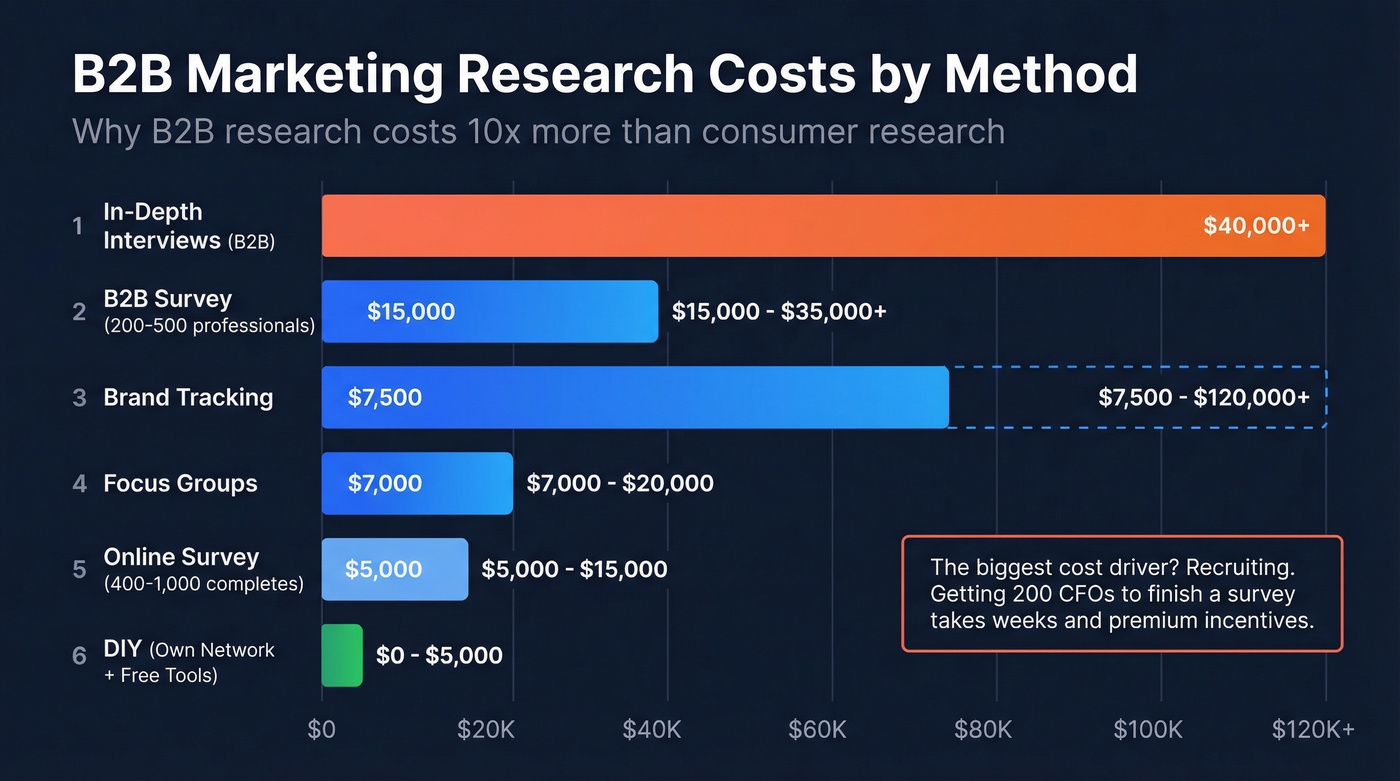
| Method | Typical Cost Range |
|---|---|
| Online survey (400-1,000 completes) | $5,000-$15,000 |
| B2B survey (200-500 professionals) | $15,000-$35,000+ |
| In-depth interviews (B2B) | $40,000+ per project |
| Focus groups | $7,000-$20,000/group |
| Brand tracking | $7,500-$120,000+/yr |
| DIY (own network + free tools) | $0-$5,000 |
Why are B2B numbers so much higher? Recruiting. A consumer panel can fill 1,000 completes quickly. Getting 200 CFOs to finish a 10-minute survey takes weeks and usually requires meaningful incentives - the more senior the target, the steeper the cost. European benchmarks tell a similar story: a single B2B interview averages EUR 750, while B2C interviews run closer to EUR 600.
The DIY approach ($0-$5K) is real, but it demands your time instead of your budget. For early-stage teams, that's often the right call. For teams with revenue, the $15K-$35K range gets you professional recruiting, cleaner data, and analysis you can actually present to leadership without caveats.
Methods That Deliver Results
You don't need a $50K research project to make better decisions. You need 15 good interviews. We've seen this play out repeatedly - 15 well-recruited interviews consistently outperform large-scale surveys with poor targeting.
Qualitative Interviews
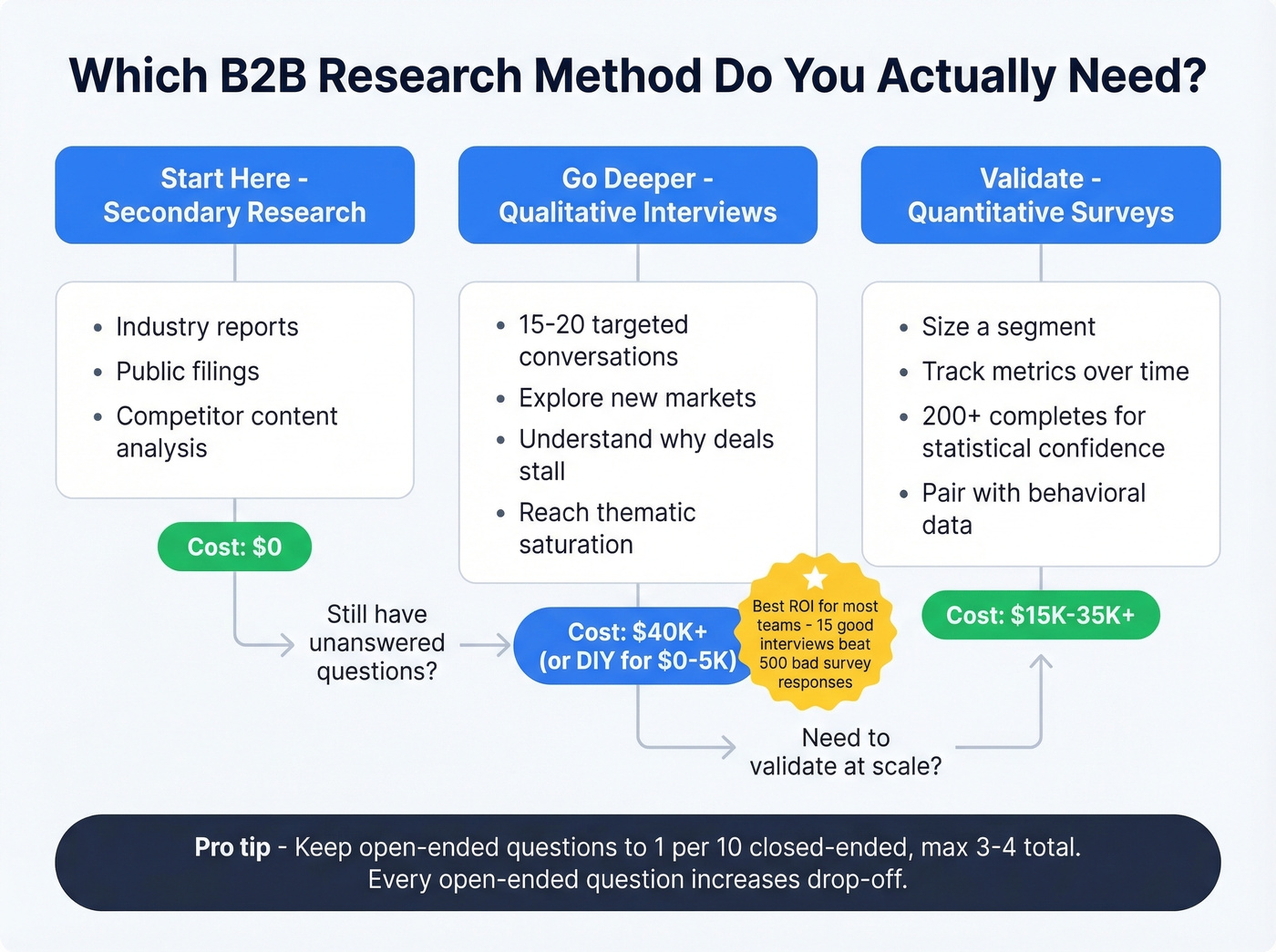
Your best tool when you're exploring a new market, validating positioning, or trying to understand why deals stall. Fifteen to twenty well-targeted conversations often [reach thematic saturation] - the point where new interviews stop revealing new patterns.
Here's the thing: the consensus on r/Marketresearch is that business owners "tend to be quite busy," which is a polite way of saying your survey is the last thing on their priority list. That's why fewer, deeper conversations beat mass distribution every time. These interviews are also the fastest path to psychographic insights for sales teams - uncovering the values, risk tolerances, and decision-making styles that quantitative surveys rarely capture.
Quantitative Surveys
Surveys earn their place when you need to size a segment, validate qualitative findings with statistical confidence, or track metrics over time. Aim for 200+ completes to enable meaningful cuts by industry or company size. Pairing survey results with audience behavior data - how prospects actually engage with content, attend webinars, interact with sales touchpoints - gives you a far richer picture than responses alone.
Secondary Research
This should come before any primary data collection. Industry reports, public filings, and competitor content analysis cost nothing and often answer half your questions before you recruit a single respondent.
Skip NPS in B2B unless you've thought hard about what the score means. A single number can't capture customer sentiment sales teams actually need to act on - not when the relationship involves 6-10 stakeholders across procurement, IT, and the business unit.
Some agencies argue you should never DIY buyer research. That's self-serving advice. BT Enterprise saw GBP 13.52 in long-term ROMI for every GBP 1 spent on insight-led campaigns - but the insight quality mattered far more than the budget behind it.
One practical rule for survey design: keep open-ended questions to [1 per 10 closed-ended questions], with a max of 3-4 total. Every open-ended question increases drop-off.
For a tighter targeting foundation, start with your ideal customer profile before you write a single question.

Recruiting B2B research respondents is the most expensive part of any project. Prospeo gives you verified emails for 300M+ professionals - filtered by job title, seniority, industry, and company size - so you can recruit interview and survey participants directly instead of paying $15K+ to a panel provider.
Stop paying per respondent. Build your own research panel in minutes.
Essential Tools for B2B Research
You don't need a $100K tech stack. Here's what matters:
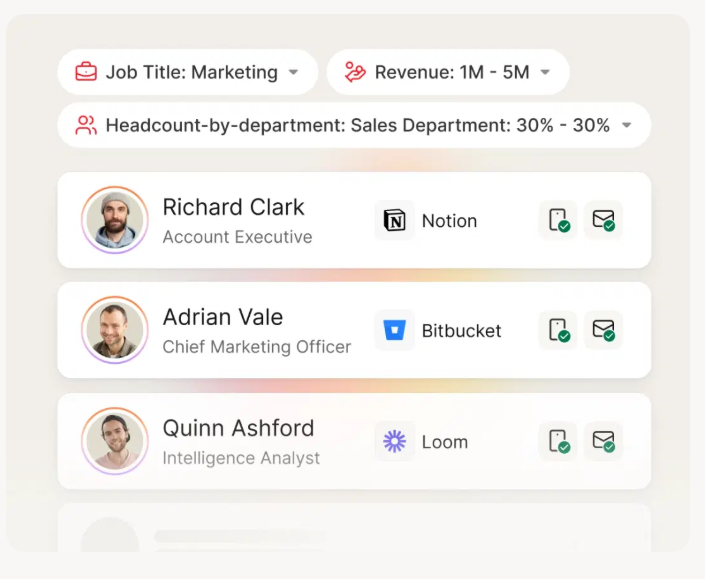
Contact sourcing. Before you can survey decision-makers, you need their contact information. Prospeo gives you verified emails for specific job titles, industries, and company sizes - 300M+ professional profiles with 98% email accuracy. Use 30+ search filters to narrow by role, seniority, and buyer intent signals across 15,000 topics. Export a shortlist and start outreach the same day. If you're comparing providers, see our roundup of the best B2B databases.
Surveys. Qualtrics for enterprise-grade logic and conjoint analysis. SurveyMonkey for mid-market. Google Forms if you're bootstrapping - no shame in it.
Interviews. itracks handles virtual focus groups and IDIs with built-in recording and analysis.
Data and sentiment. Statista for secondary research and market sizing. BrandMentions for social listening. BuzzSumo for competitive content analysis.
Visualization. Tableau if you've got the budget. Google Charts if you don't.
7 Mistakes That Waste Your Budget
We've seen teams spend $30K on research that never left the slide deck. Don't repeat their errors.
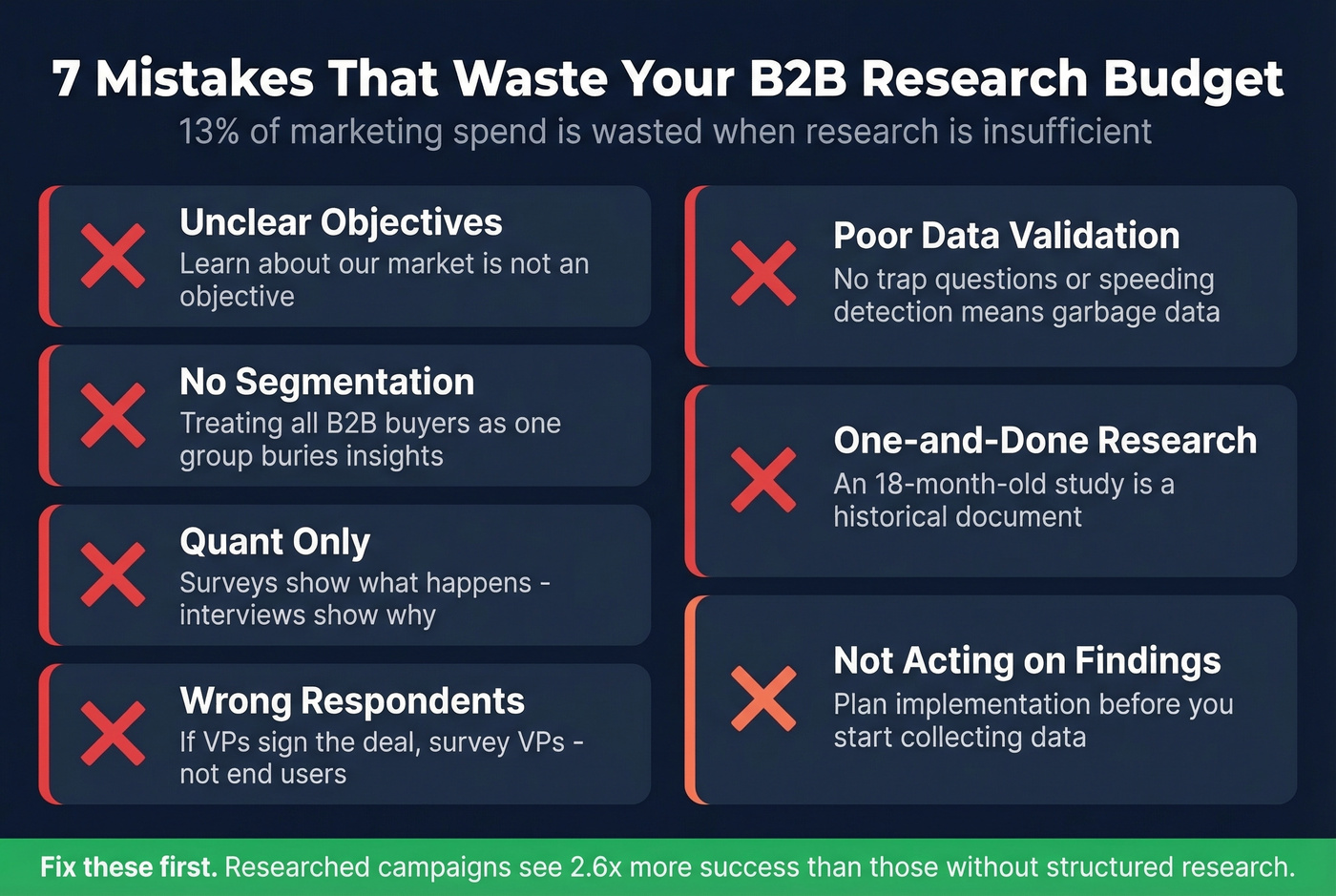
- Unclear objectives. "Learn about our market" isn't an objective. "Identify the top 3 purchase criteria for mid-market CFOs evaluating AP automation" is. If you need a planning baseline, use a simple go-to-market strategy timeline.
- No segmentation. Treating all B2B buyers as one group buries the insights. The differences between segments are where the value lives - and layering in psychographic intelligence makes those segments actionable for both marketing and sales. (If you’re sizing segments, revisit TAM, SAM, SOM.)
- Relying only on quantitative data. Surveys tell you what's happening. Interviews tell you why.
- Surveying the wrong people. End users and economic buyers have completely different priorities. If your deal depends on a VP's signature, survey VPs. This is where buyer journey touchpoints help you map who influences what.
- Poor data validation. Look for platforms with trap questions, speeding detection, and anti-VPN measures. Bad data in, bad decisions out. The same principle applies to your outreach list quality - use data validation automation to reduce bad inputs.
- Treating research as a one-off. A study from 18 months ago is a historical document, not a strategy input. Markets shift. Run lightweight pulse checks quarterly.
- Not acting on findings. Plan your implementation before you start collecting data. The entire point of B2B buyer research is to produce insights that flow directly into messaging, positioning, and rep enablement - not to produce a report that gathers dust. To operationalize it, align with your RevOps tech stack.
How AI Changes B2B Research in 2026
96% of B2B marketers now use AI in their roles, and 45% cite efficiency as its main contribution.
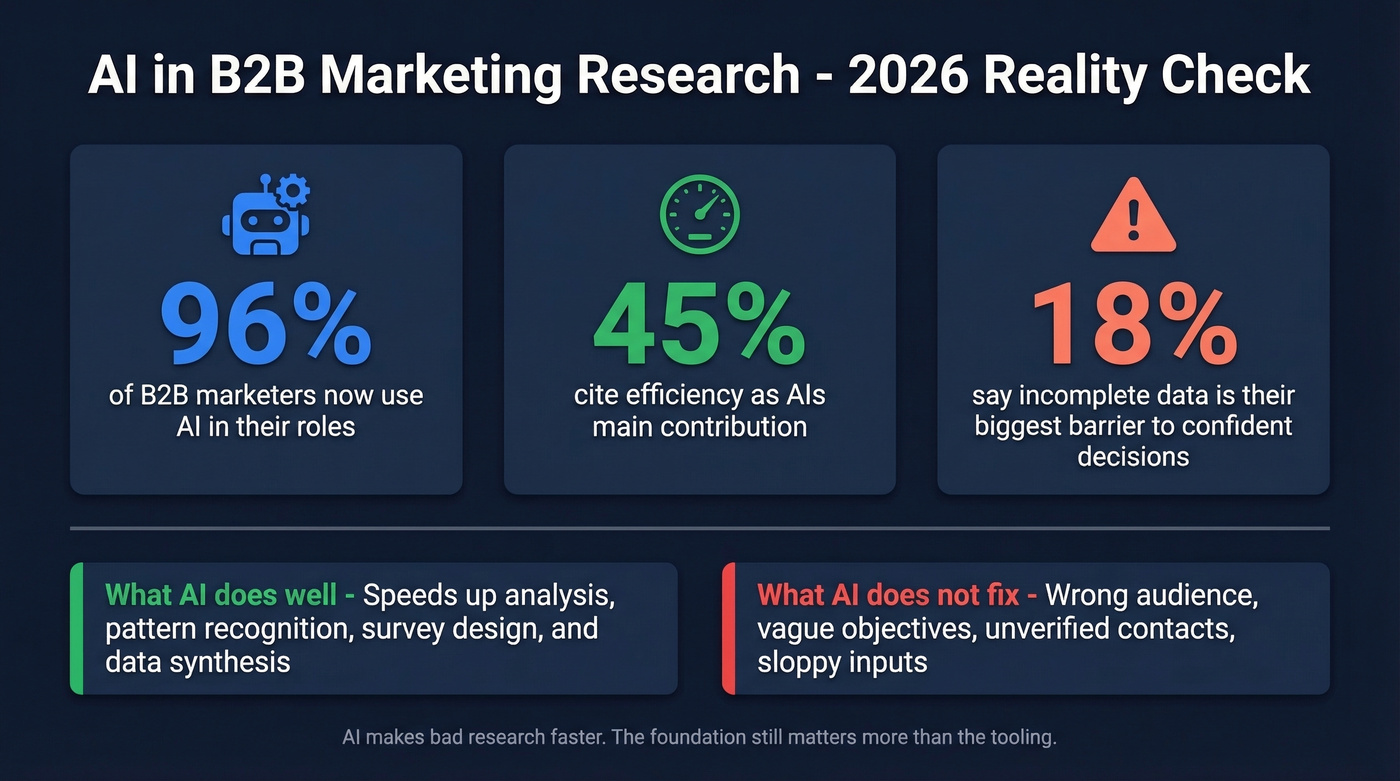
Let's be honest: AI doesn't replace rigorous B2B marketing research. It makes bad research faster. If your inputs are sloppy - wrong audience, vague objectives, unverified contacts - AI will help you scale those mistakes more efficiently. And 18% of marketers say incomplete data is their single biggest barrier to confident decisions, which tells you the foundation still matters more than the tooling. (If you’re applying AI to pipeline, start with AI for demand generation.)
There's also a security risk most teams ignore. Free AI tools trained on your sensitive company data create exposure you can't undo. If you're feeding proprietary research findings into consumer AI tools without an enterprise agreement, you're trading convenience for risk. Use enterprise-grade solutions for anything involving competitive intelligence or customer data.
The best B2B marketing research combines qualitative depth with real buyer signals. Prospeo tracks intent data across 15,000 topics so you can identify which companies are actively researching your category - then reach verified contacts at those companies for under $0.01 per email.
Layer intent data on top of your research to find in-market buyers now.
FAQ
What's a realistic B2B survey response rate?
Expect 5-15% for B2B surveys. Email surveys to cold lists often drop below 5%, while warm lists with prior brand contact perform better. Plan for low response and over-recruit by 3-5x your target sample size to hit statistical significance.
How many interviews do I need for qualitative research?
For qualitative B2B studies, 15-20 well-targeted interviews typically reach thematic saturation - the point where new conversations stop revealing new patterns. For quantitative surveys, aim for 200+ completes to enable meaningful segmentation by industry or company size.
How do I find decision-makers to survey?
Start with existing customer and prospect lists. For cold outreach, use a contact-sourcing tool like Prospeo to find verified emails for specific job titles and industries - its 30+ filters let you target by seniority, department headcount, and funding stage. Over-recruit by 3-5x because most people won't respond.
Is DIY B2B research reliable?
DIY research works well for early-stage teams with deals under $50K ACV. Fifteen well-recruited qualitative interviews using your own network can surface actionable insights without the $15K-$35K agency price tag. The tradeoff is your time - expect 20-30 hours of recruiting, interviewing, and synthesis.