

AI for Demand Generation: What Actually Works, What Doesn't, and What It Costs
Companies spent an average of $1.9M on GenAI initiatives in 2024. Fewer than 30% of CEOs were satisfied with the return. Gartner placed generative AI in the Trough of Disillusionment the following year, and most demand gen teams are still feeling it. AI for demand generation does work - but the use cases that deliver aren't the ones getting keynote slots. The boring stuff is what's moving pipeline.
Start Here (Quick Version)
Where AI Demand Generation Actually Delivers
A SAS study tracked by Chiefmartec surveyed 300 marketers in back-to-back years and found three use cases pulling away from the pack. Chatbots lead at 62% adoption, up 44.2% year over year. Text generation sits at 45%, up 32.4%. Trends analysis hit 36% with the fastest growth rate - up 56.5%.
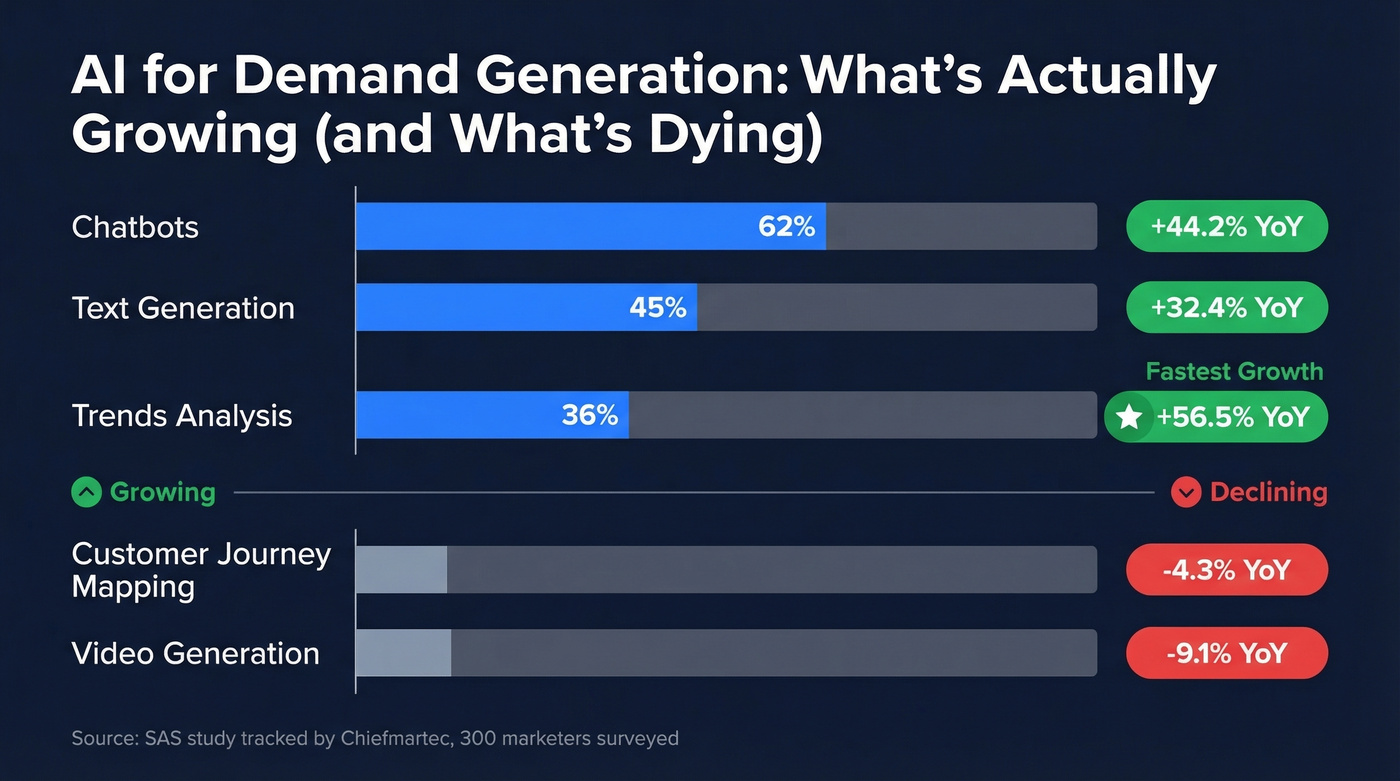
What's dying? Video generation dropped 9.1%. Customer journey mapping fell 4.3%. The flashy use cases are losing steam while the practical ones accelerate. This pattern tells you something important about how AI changes B2B pipeline creation: not through spectacle, but through operational efficiency in the workflows teams already run every day.
AI SDRs are the newest entrant worth watching. Tools like Qualified's Piper handle real-time website engagement, but they require clean CRM data and defined qualification criteria to function well. Without both, they waste rep time on junk leads. Think of AI SDRs as a force multiplier, not a replacement - they amplify good data and amplify bad data equally. If you’re evaluating vendors, start with a shortlist of AI SDRs built for B2B qualification.
Here's the personalization gap that should worry you. According to Demand Gen Report's surveys, 45% of B2B marketers see AI's promise for personalization, but nearly 70% find current effectiveness limited. The technology isn't the bottleneck. The data feeding it is. If you want this to work in outbound, focus on AI email personalization that’s grounded in real account signals.
AI Search - The New Demand Channel
Most demand gen teams aren't tracking this yet: AI search is becoming a real pipeline source. Companies showing up in ChatGPT, Perplexity, and Google's AI Overviews are seeing measurable inbound from it.
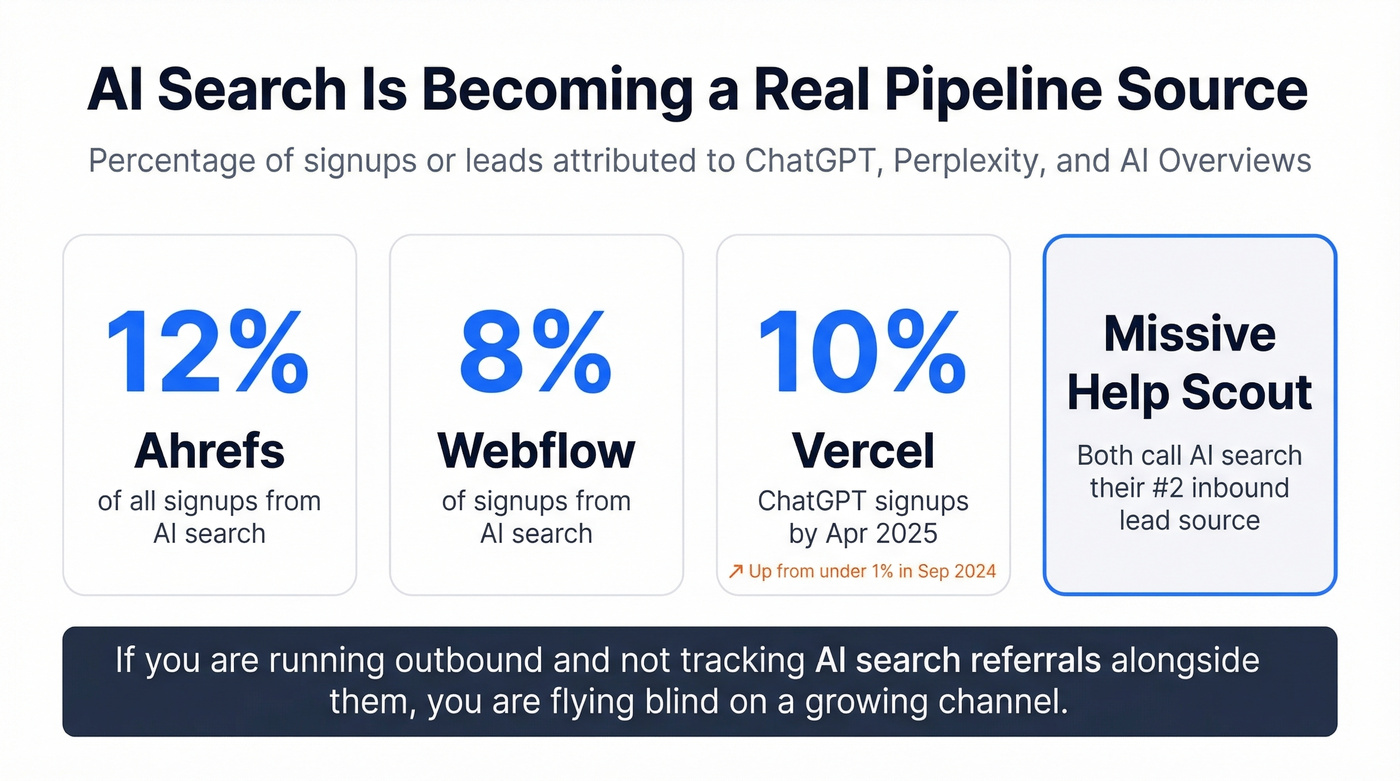
In a widely shared B2B marketing breakdown, Ahrefs attributes 12% of all signups to AI search. Webflow attributes 8%. Vercel went from under 1% of ChatGPT-driven signups in September 2024 to 10% by April 2025. Both Missive and Help Scout now call AI search their #2 inbound lead source. If you're running outbound campaigns and not tracking AI search referrals alongside them, you're flying blind on a growing channel. This is also where a tighter B2B demand generation funnel view helps you attribute “new” channels correctly.
Intent Data + Predictive Scoring
The intent data market hit $4.49B in 2026, projected to reach $20.89B by 2035. Ninety-one percent of B2B marketers use intent data to prioritize accounts. It's not a solved problem, though - only 24% of teams report exceptional ROI from their investment. The gap usually comes down to data quality going in and the inability to act on signals fast enough. If you’re trying to operationalize this, start by learning how to identify buyer intent signals your team can actually route and work.
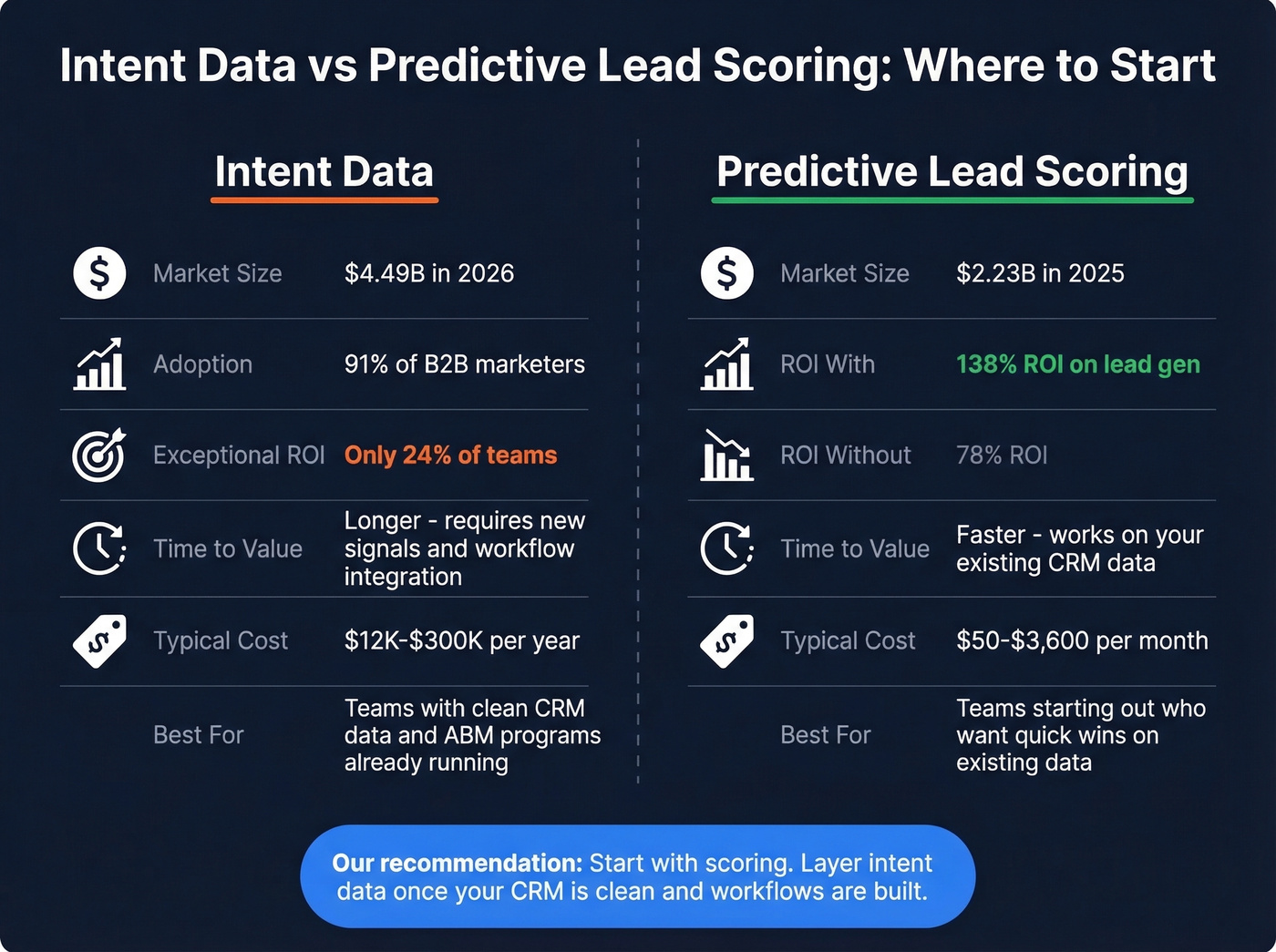
Why is adoption so high despite mixed results? Buying groups rank preferred vendors before ever talking to sales, consuming 13+ content pieces anonymously. Intent data is the only way to see that invisible activity. And 71% of B2B teams now run ABM programs, with 40% integrating them directly into demand gen workflows. Intent data is the connective layer between those two motions, because scoring and targeting happen in a single loop when the integration is tight. Benchmarks can help set expectations for this motion - see account based marketing benchmarks.
Lead scoring tells a more encouraging story. The market reached $2.23B in 2025, and organizations using predictive analytics achieve 138% ROI on lead generation versus 78% without. Scoring works on your existing data. Intent data requires buying new signals and integrating them into workflows most teams haven't built yet - which is why we'd recommend starting with scoring if you're choosing between the two. If your handoffs are messy, fix the MQL to SQL handoff before you add more signals.

The article says it plainly: if your CRM bounce rate is above 10%, no AI tool will save you. Prospeo delivers 98% email accuracy on a 7-day refresh cycle - not the 6-week industry average. Snyk's 50 AEs dropped bounce rates from 35% to under 5% and added 200+ new opportunities per month.
Fix the data layer before you stack AI on top of it.
Data Quality Makes or Breaks Everything
Let's be honest about the real problem. Most demand gen teams run 6-8 disconnected tools. Every one ingests contact data, enriches it differently, and syncs it back to a CRM already full of duplicates and stale records. Then they layer AI on top and wonder why the output is garbage. This is exactly why data validation automation matters more than “smarter prompts.”

We've seen this pattern repeatedly: a team buys an intent platform, feeds it CRM data with a 35% bounce rate, and concludes "intent data doesn't work." The intent data was fine. The contact data was poison. Prospeo solves this upstream - 98% email accuracy on a 7-day data refresh cycle versus the 6-week industry average. Snyk's team of 50 AEs dropped their bounce rate from 35-40% to under 5% after switching, and AE-sourced pipeline jumped 180% with 200+ new opportunities per month. That's a data quality story, and it's the foundation that makes AI-powered pipeline generation possible in the first place. If you’re diagnosing deliverability, start with what a check bounce audit actually tells you.
If your average deal size is under $15K and your CRM bounce rate is above 10%, skip the $60K intent platform. Spend $500/month on verified data and enrichment workflows. You'll see faster pipeline impact than any enterprise AI tool can deliver on dirty data. If you need a broader vendor shortlist, compare options in the best data enrichment tools roundup.
AI Tools for Demand Gen: What It Costs
| Tool | What It Does | Starting Price |
|---|---|---|
| Prospeo | Verification + enrichment (98% accuracy) | Free tier; ~$0.01/email |
| Clay | Enrichment workflows | $134-$149/mo |
| Apollo.io | Database + sequences | Free; $49/user/mo |
| Bombora | Intent data | $12K-$40K/yr |
| 6sense | Intent + ABM platform | $60K-$300K/yr |
| HubSpot Marketing Hub Enterprise | Predictive scoring | $3,600/mo (10 seats) |
| Salesforce Einstein | AI lead scoring | $165 + $50/user/mo |
You can build a functional AI demand gen stack for under $500/month with verified data, Clay, and Apollo. Enterprise platforms are powerful, but they aren't required to see results. Start with tools that automate enrichment and verification before investing in heavier platforms. If you’re consolidating systems, a RevOps tech stack approach usually beats adding yet another point solution.
Four Mistakes That Kill Results
Building custom before testing off-the-shelf. Spend 20 minutes with ChatGPT or Claude before commissioning a custom model. Most use cases are already solved by general-purpose tools, and you'll learn what prompts actually move the needle before writing a single line of code.
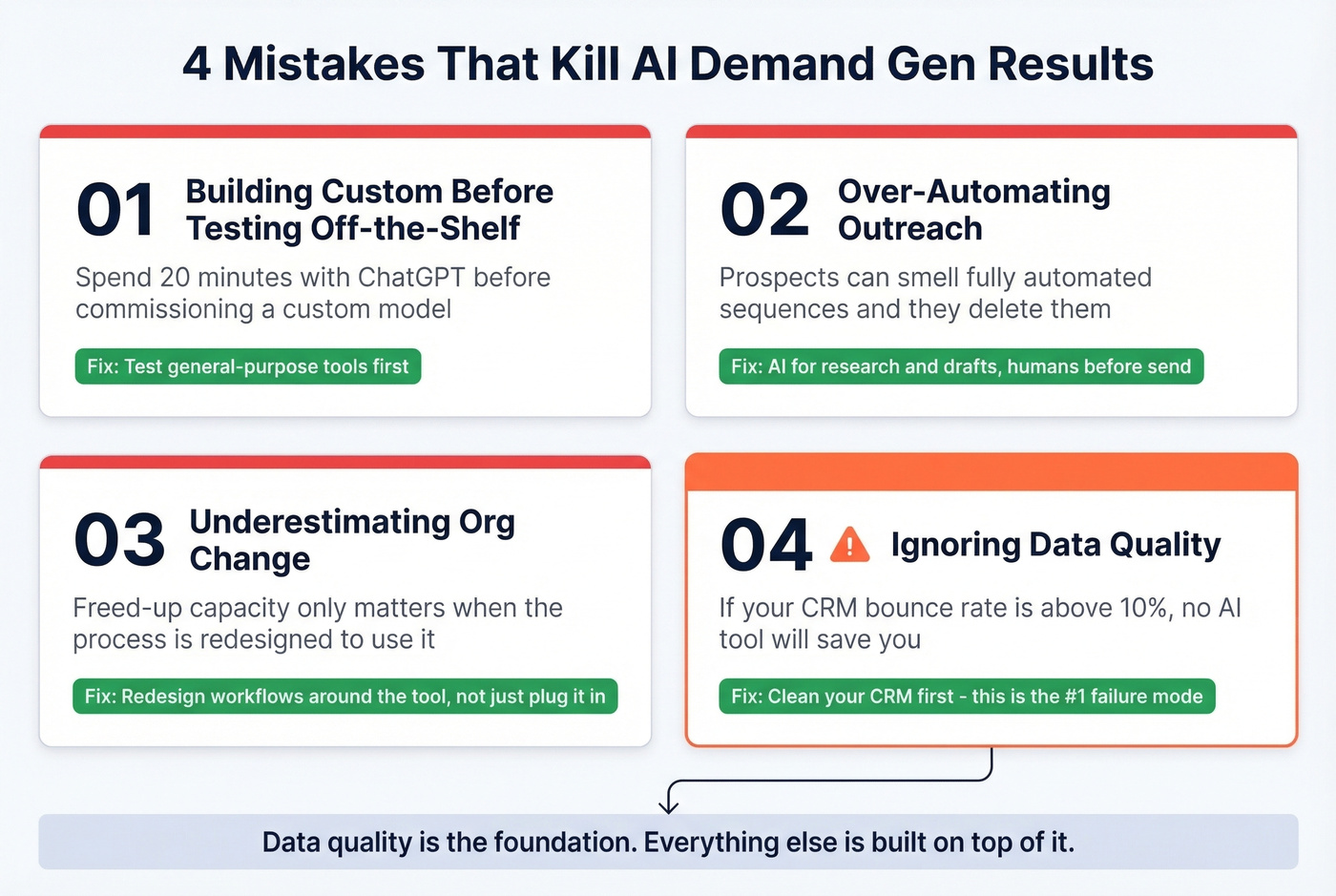
Over-automating outreach. AI-generated emails that read like AI-generated emails tank reply rates. Use AI for research and drafting, then add a human layer before anything goes out. The consensus on r/sales is pretty clear: prospects can smell fully automated sequences from a mile away, and they delete them. If you want a safer baseline, start with proven outbound email automation patterns and add AI only where it improves quality.
Underestimating org change. AI tools don't fail because the technology is bad. They fail because nobody changed the workflow around them. Freed-up capacity only matters when the surrounding process is redesigned to use it - otherwise reps just fill the time with low-value tasks.
Ignoring data quality. This is the #1 failure mode, and it's frustrating how many teams skip it. If your CRM bounce rate is above 10%, no AI tool will save you. Fix the foundation first.
What to Do Monday Morning
Audit your CRM. Pull a random sample of 500 contacts and check bounce rates. If you're above 5%, clean before you build anything else. Then pick one AI use case - chatbot or content generation - and run it for 90 days with clear metrics. Most teams that fail tried to do everything at once. If you need more plays to test, pull from these pipeline generation ideas.
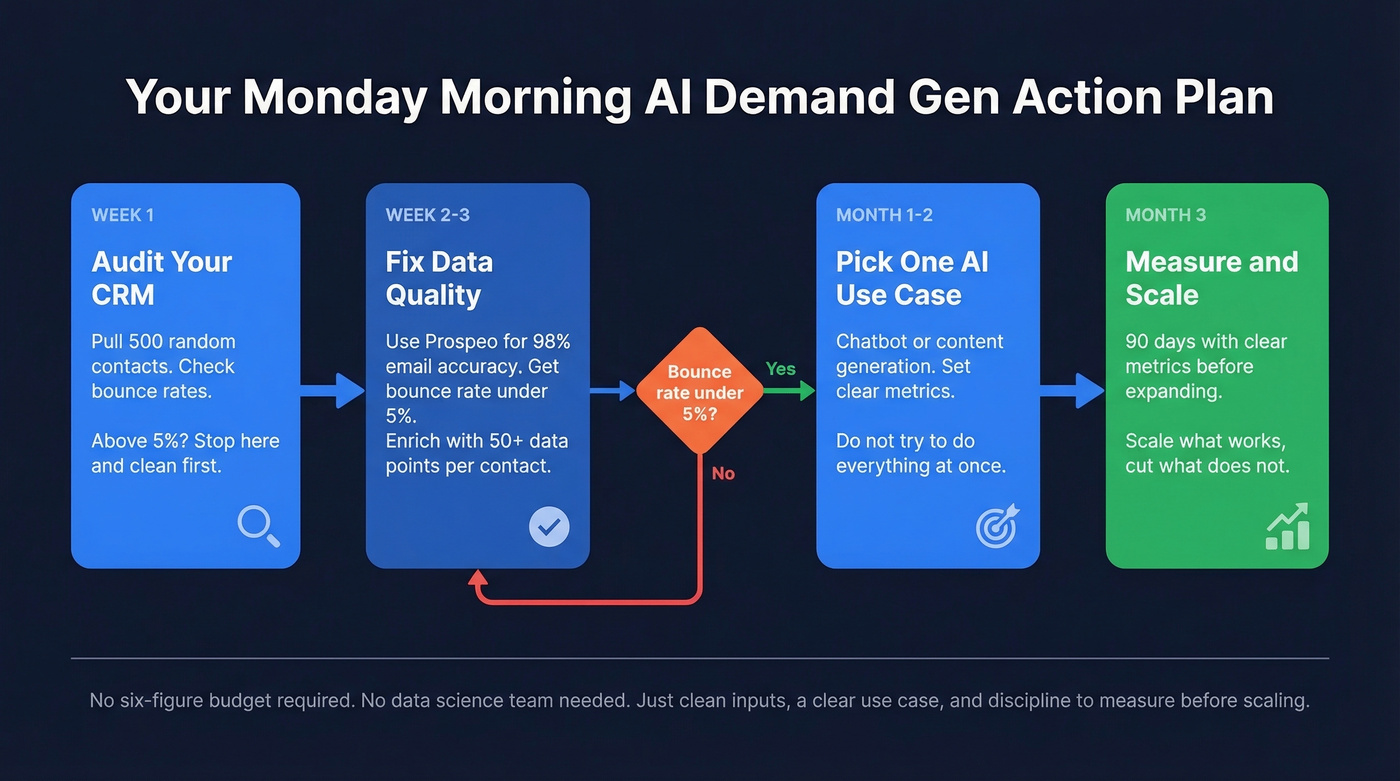
Using AI for demand generation doesn't require a six-figure budget or a dedicated data science team. It requires clean inputs, a clear use case, and the discipline to measure before scaling.
You don't need a $60K intent platform to build a working AI demand gen stack. Prospeo starts free, costs ~$0.01 per verified email, and returns 50+ data points per enrichment at a 92% match rate. That's the foundation layer every AI workflow in your stack depends on.
Build your AI demand gen stack on data that actually works.
FAQ
What's the difference between AI for demand gen and AI for lead gen?
Demand gen covers the full funnel - awareness, education, and pipeline creation. Lead gen is one tactic within it. AI for demand generation includes content strategy, intent-based targeting, and channel optimization across the entire buyer journey, not just identifying contacts.
How long before AI demand gen tools show ROI?
Most teams need 90-180 days for measurable pipeline impact. The first 30 days should focus on data cleanup and integration. Teams that skip data quality work see zero improvement even after six months, because the models only improve as your data gets cleaner and feedback loops tighten.
Can small teams afford AI-powered demand generation?
Yes. A functional stack - Prospeo for verified data at roughly $0.01/email, Clay for enrichment, and Apollo for sequences - costs under $500/month. Enterprise platforms like 6sense start at $60K/year, but they aren't required. Start small, measure results, scale what works.
Can AI help find leads in niche industries?
Vertical-specific applications are growing fast. Healthcare, for example, uses compliance-aware enrichment to find decision-makers in hospital systems. The key is pairing AI with industry-specific data sources and platforms offering granular search filters - buyer intent, technographic signals, headcount growth - so results are both accurate and reachable.
What does the future of AI demand generation look like?
The trajectory points toward tighter integration between intent signals, predictive scoring, and automated outreach, all running on continuously verified data. Expect tools to consolidate, with platforms handling enrichment, scoring, and activation in a single workflow. Teams investing in data infrastructure now will compound their advantage over those chasing point solutions later.