

7 B2B Referral Email Templates (Plus the System That Makes Them Work)
Referred opportunities close in roughly 20 days. Non-referred deals drag to 100. That gap alone justifies building a real referral system - yet most sales teams treat the ask like an afterthought, lobbing a vague "know anyone?" into the void.
Here's the thing: a good B2B referral email template isn't about clever copy. It's about timing, incentives, and follow-up. Templates are maybe 20% of the problem.
Start here: Use the Specific Intro Request (#2) and the Incentive-Driven Ask (#3). Pair them with a concrete reward ($500/meeting or 10% of the closed deal), a 3-touch follow-up sequence, and verified contact data for the referred prospect. As one founder shared on r/Entrepreneur, turning ad-hoc asks into a system with defined rewards and follow-up 3x'd their customer base.
Warm referral emails typically see 40-60% open rates - far above cold outreach averages of around 23.9% - but only 1-5% convert to a qualified intro without follow-up. The templates below get you started. The system after them is what actually moves the number.
7 Sales Referral Email Templates
All subject lines below aim for 3-7 words - short enough for mobile, specific enough to open.
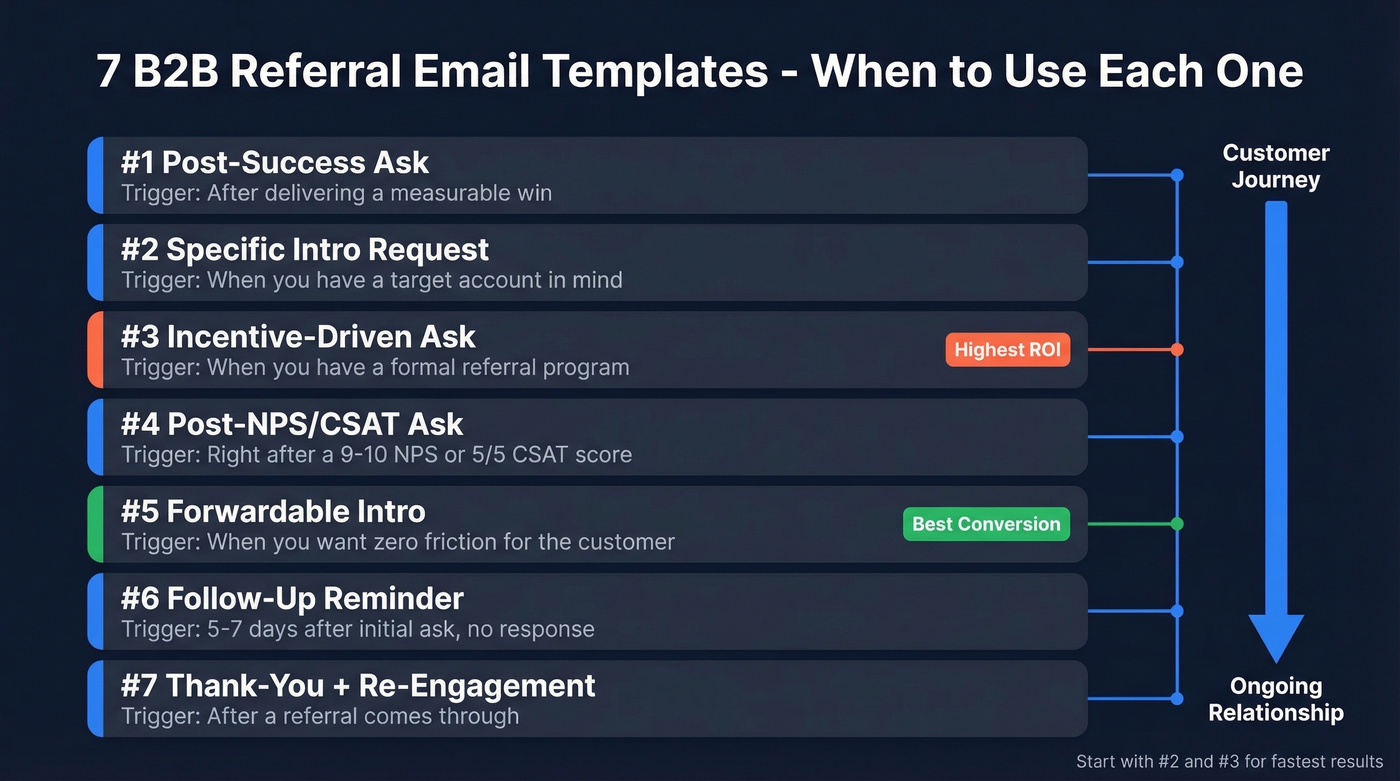
1. The Post-Success Ask
When to use: Right after delivering a measurable win.
Subject: Quick favor - know anyone facing [challenge]?
Hi [Name],
Really glad we hit [specific result] together this quarter. It's the kind of outcome I wish more [industry] teams knew was possible.
Do you know one or two people dealing with [same challenge]? Happy to keep it low-key - just an intro over email.
[Your name]
Specificity does the selling. "We cut your churn by 18%" beats "we've been working well together." This is the simplest template to deploy because the results speak for themselves.
2. The Specific Intro Request
When to use: When you have a target account or role in mind, especially when you need a referral to decision makers who are otherwise hard to reach.
Subject: Do you know anyone at [Company]?
Hi [Name],
We're expanding into [industry/region] and [Company] keeps coming up as a great fit. Do you happen to know anyone on their [department] team?
If so, I'd love a quick intro. If not, no worries at all.
[Your name]
Naming a company or title gives your customer something concrete to act on instead of mentally scanning their entire network. This eliminates the "know anyone?" paralysis - and in our experience, it doubles the response rate compared to open-ended asks.
3. The Incentive-Driven Ask
When to use: When you have a formal referral program.
Subject: $500 for a warm intro - details inside
Hi [Name],
We just launched a referral program: $500 for every intro that turns into a meeting, plus 10% of the closed deal if they sign.
Anyone come to mind? Just reply with a name and I'll take it from there.
[Your name]
Lead with the number. Double-sided referral programs appear in over 78% of top-performing programs because both parties benefit - and they convert measurably better than one-sided rewards.
4. The Post-NPS/CSAT Ask
When to use: Immediately after a 9-10 NPS or 5/5 CSAT score.
Subject: Thanks for the kind words - one ask
Hi [Name],
You just rated us a [score] - that genuinely made our day. Would you be open to sharing that experience with a peer dealing with [problem your product solves]?
I can draft something you just forward.
[Your name]
The window after a high satisfaction score is the single best moment to ask. Your customer just told you they're happy. Let them tell someone else.
5. The Forwardable Intro
When to use: When you want to remove every ounce of friction.
This is the highest-conversion format we've tested - and it doubles as a champion referral email when your internal advocate wants to loop in a colleague at another company. Instead of asking your customer to write something, you write the email they'll forward. They hit "forward," add a one-line note, done.
Subject: [Customer name] - intro to [Your company]
Hi [Referred contact name],
[Customer name] here. I've been working with [Your company] on [use case] and thought you'd find it relevant given [their challenge]. I'll let [Your name] take it from here.
[Customer name]
Send this to your customer with: "Feel free to tweak and forward to [contact name]." The less work they do, the more likely they do it.

6. The Follow-Up Reminder
When to use: 5-7 days after the initial ask, no response.
Subject: Re: [original subject line]
Hi [Name],
Just bumping this - totally understand if the timing isn't right. If anyone comes to mind later, always happy to chat with them.
[Your name]
Short. Light. Easy to answer. Don't overthink follow-ups on referral asks - they aren't cold emails. One gentle nudge is enough.
7. The Thank-You + Re-Engagement
When to use: After a referral comes through, regardless of outcome.
Subject: Thank you - [referred contact] was a great intro
Hi [Name],
Your intro to [referred contact] was incredibly helpful - we've [had a great conversation / started working together]. Your $500 reward is on its way.
If anyone else comes to mind down the road, I'm always grateful.
[Your name]
Most teams get the referral and go silent. That silence kills future referrals. Close the loop every time.
Incentive Structures That Work
Without a concrete incentive, you're asking customers to do free sales work. Let's be honest - nobody's excited about that.
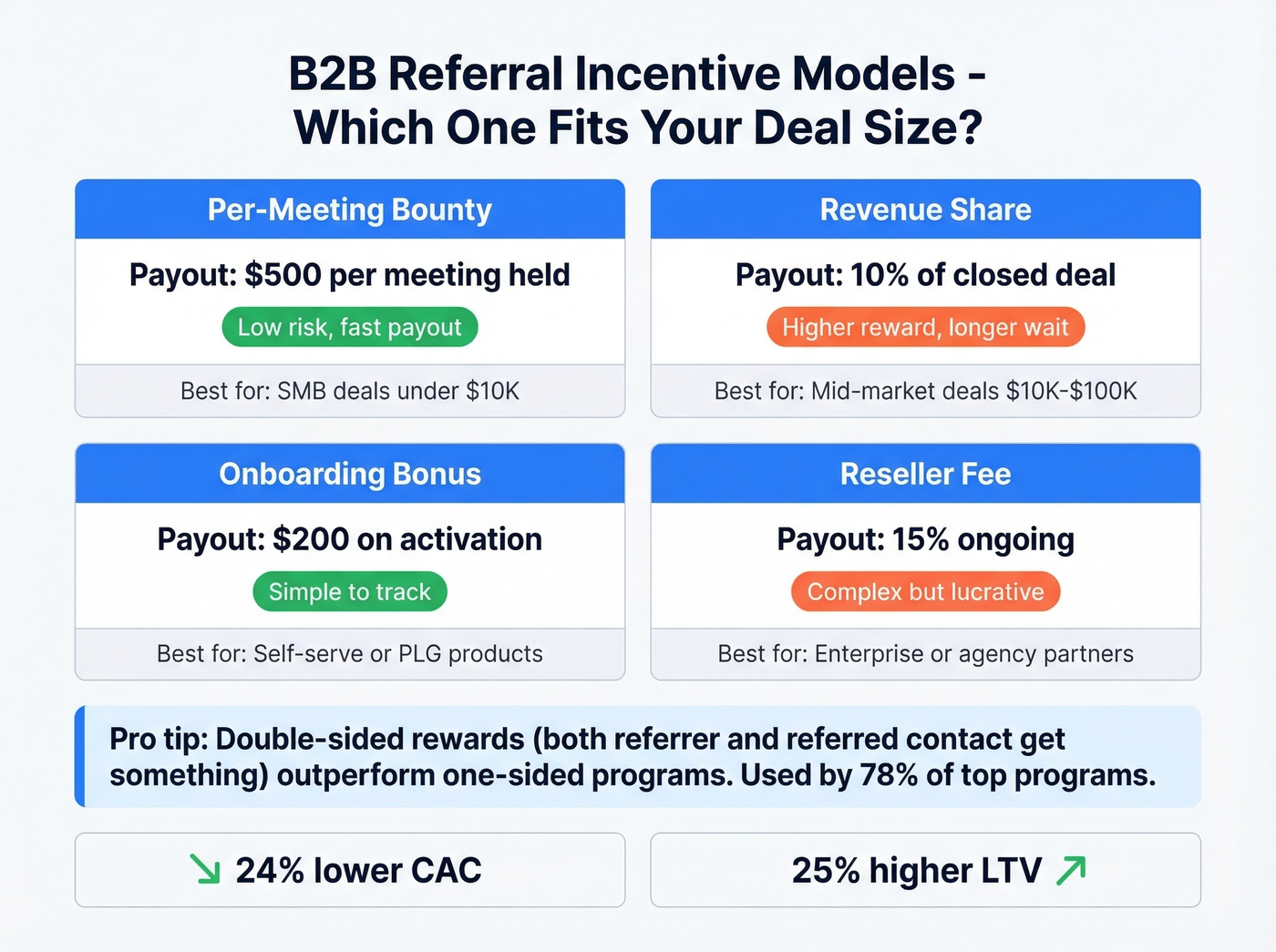
In B2B, the cleanest incentives are simple and outcome-based: $500 per meeting held, 10% of the closed deal, or a reseller-style 15% fee when it makes sense.
| Model | Payout | When It Triggers |
|---|---|---|
| Per-meeting | $500 | Meeting held |
| Revenue share | 10% of closed deal | Deal closes |
| Onboarding bonus | $200 | Referred customer activates |
| Reseller fee | 15% of deal | Ongoing |
We've tested both one-sided and double-sided rewards. Double-sided wins every time. One concept worth stealing: the intro bounty board. Publish a list of target accounts and ask your network for specific intros. It's more proactive than waiting for customers to remember you exist, and the consensus on r/sales is that named-account bounty boards outperform generic "refer a friend" programs by a wide margin.
Referral programs lower CAC by roughly 24% and produce customers with 25% higher LTV, so the math works in your favor. (If you want to pressure-test the economics, start with your CAC math.)

Your referral templates are ready. Now make sure the referred contact's email actually works. Prospeo verifies emails at 98% accuracy - so your warm intro doesn't die in a spam folder or bounce back.
A bounced referral follow-up kills the deal and the relationship.
Build a Multi-Touch Sequence
One email isn't a referral program. It's a wish.
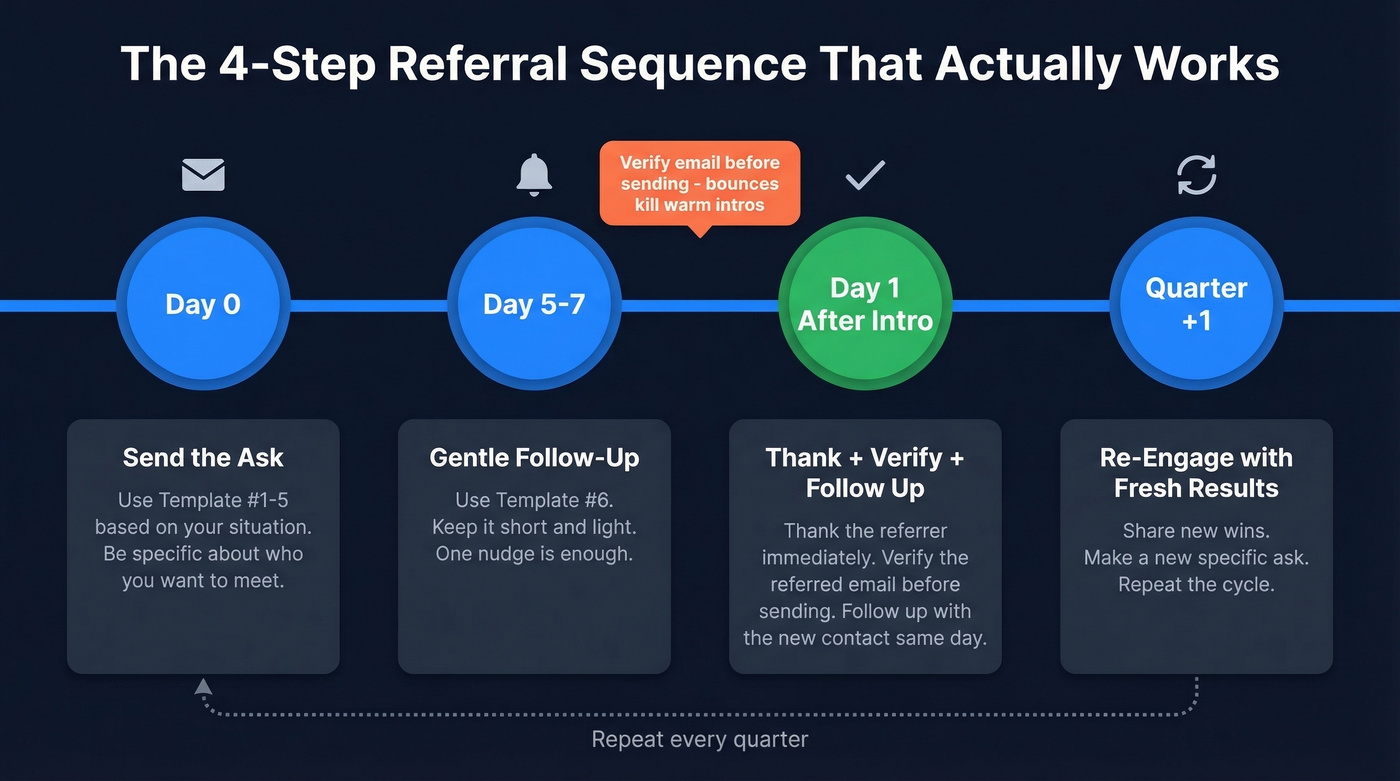
Most B2B deals require 5-12 touchpoints, and referral asks are no different. Here's the cadence that's worked for our team:
- Day 0: Send the referral ask (templates above)
- Day 5-7: Follow-up reminder (template #6)
- Day 1 after intro: Thank the referrer, follow up with the referred contact
- Quarter +1: Re-engage with a fresh ask tied to new results
Before step 3, verify the referred contact's email. A bounced follow-up on a warm intro is embarrassing and kills momentum - we've seen it happen more times than we'd like to admit. Prospeo's real-time verification catches bad addresses before you send, so your warm intro actually lands. (If you need a deeper deliverability checklist, use this email deliverability guide.)
If your deal sizes sit below five figures, skip the complex referral platforms. A spreadsheet, these templates, and verified contact data will outperform most referral software. If you're missing the data layer, start with data enrichment.
Compliance Guardrails
Most referral guides skip this entirely, and it's where teams get burned.
Under GDPR, B2B outreach to a referred contact can fall under legitimate interest - the outreach is relevant to their role and not unexpected. But HubSpot's Acceptable Use Policy prohibits emailing non-permission-based contacts, and most ESPs have similar restrictions. You can be legally compliant and still get your account suspended.
The safest approach: have your customer make the intro using the forwardable template above. Once the referred contact responds or opts in, you're clear to follow up through any platform. This protects your domain reputation and your ESP account simultaneously. (If you're tightening process, add sequence management so nothing slips.)
Mistakes That Kill Referral Programs
Vague asks force your customer to do all the thinking, so they do nothing. No incentive means you're requesting free labor from people who already have full calendars. Asking too early - before delivering results - means you haven't earned the ask yet. No tracking means you can't optimize or pay out rewards. Emailing referred contacts without consent gets your domain flagged.
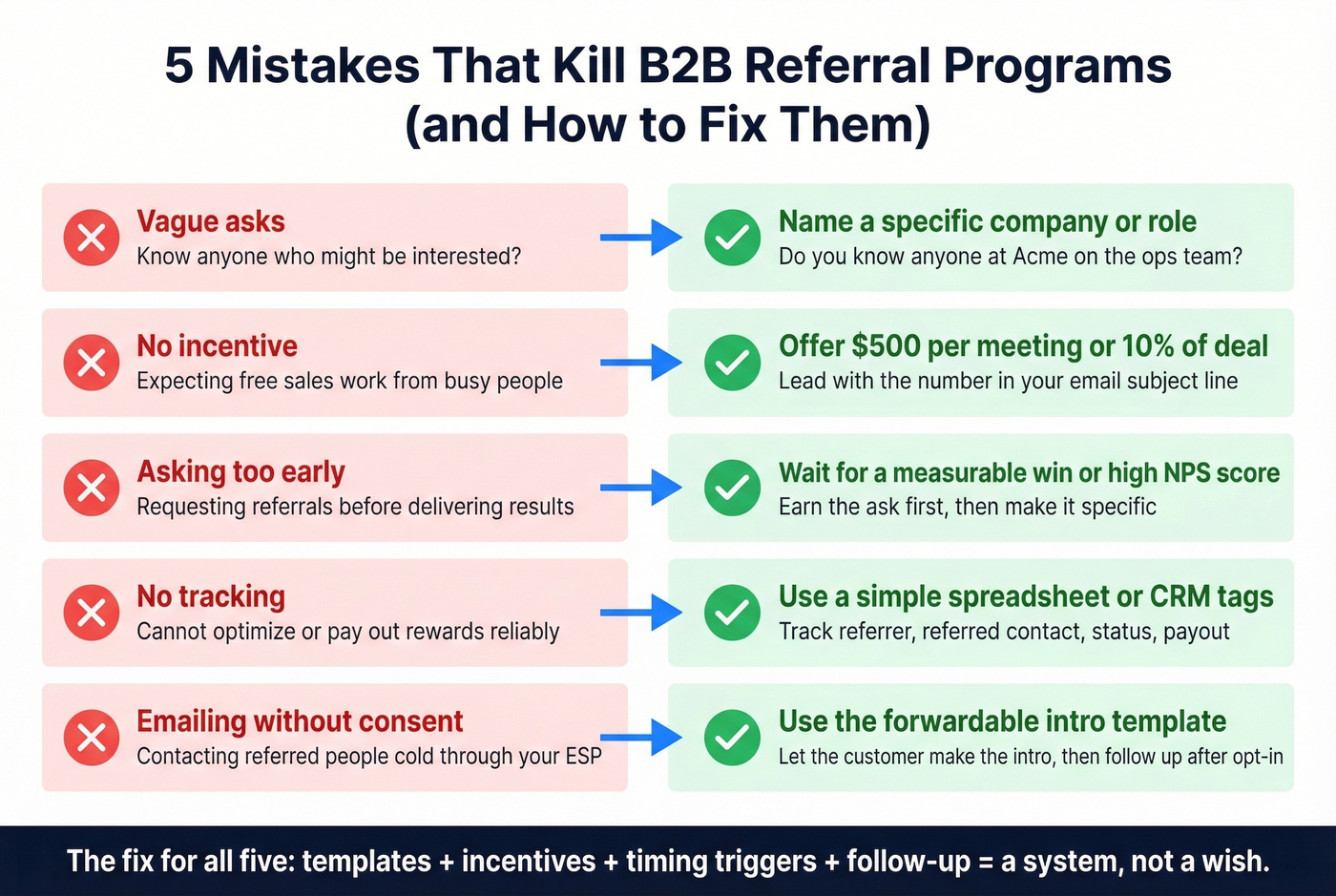
The fix for all five: a system with templates, incentives, timing triggers, and follow-up.
Word-of-mouth referral conversion rates climb dramatically once you treat referrals as a repeatable process instead of a one-off favor. Even a simple sales referral script - a few sentences your reps can adapt to email or phone - helps standardize the ask so no one defaults to the dreaded "know anyone?" (For more follow-up language you can reuse, see these sales follow-up templates.)
The biggest mindset shift is this: reps asking for referrals should be a routine part of every account review, not an awkward conversation saved for the end of a quarter. A well-timed B2B referral email template paired with a real incentive turns happy customers into your best pipeline source. (If you're building a broader outbound motion, these sales prospecting techniques help round it out.)
Before you send that follow-up to a referred prospect, run their details through Prospeo. Get verified emails, direct dials, and 50+ data points per contact - so you walk into the intro fully prepared, not guessing.
Turn every warm intro into a meeting-ready contact in one click.
FAQ
When's the best time to ask for a B2B referral?
Right after a measurable win - a successful launch, a strong quarter, or a high NPS score. The customer's goodwill is highest and results are fresh enough to reference. Waiting more than two weeks after a milestone cuts response rates significantly.
Should you offer referral incentives in B2B?
Yes. $500 per qualified meeting or 10% of the closed deal are proven starting points. Double-sided rewards, where both referrer and referred contact benefit, outperform one-sided programs by a wide margin. Over 78% of top-performing programs use this model.
How do you follow up with a referred prospect?
Ask your customer to make the intro directly using a forwardable template. Once the referred contact responds, verify their email before sending your follow-up. A warm intro that bounces is worse than no intro at all.
What's the difference between an inside referral and an external one?
An inside referral uses a contact within the same company - for example, asking your marketing champion to introduce you to the VP of Sales. An external referral crosses company lines. The forwardable intro template (#5) works for both; just adjust the context line to reflect whether the referral is internal or cross-company.