

B2B Relationship Marketing: What Actually Works (and What Doesn't)
Last quarter, a sales team we work with sent 12,000 "personalized" emails. Bounce rate: 23%. Half the delivered ones went to people who'd changed jobs months ago. That's not outreach - that's noise.
Practitioners on r/smallbusiness keep asking the same question: do cold emails and generic inbound forms even start B2B relationships anymore? They do. But only when you treat B2B relationship marketing as a system, not a vibe.
Fix Three Things First
Clean your data, sharpen your targeting, and build content that earns trust before you ask for a meeting. Layer intent signals so you reach buyers when they're actually in-market.
If you only do one thing today, clean your contact database. Everything else falls apart without it.
What B2B Relationship Marketing Actually Is
Transactional marketing optimizes for the point of sale - volume, discounts, one-time conversions. Relationship marketing plays a longer game: repeat business, trust, loyalty, and referrals built over months and years.
In B2B, this distinction hits harder. You're not selling a $30 subscription. You're often selling a five-figure annual contract to a buying committee that spends just 17% of its time meeting with any supplier, which means the vendor who's already earned trust through content, warm introductions, and relevant outreach wins that deal before the formal evaluation even starts. The one blasting cold templates doesn't make the shortlist.
Why It Matters More Than Ever in 2026
Retaining a customer costs 5-25x less than acquiring a new one, and a 5% increase in retention lifts profits 25-95%, per Reichheld and Bain's research. That alone should reframe how you allocate budget.
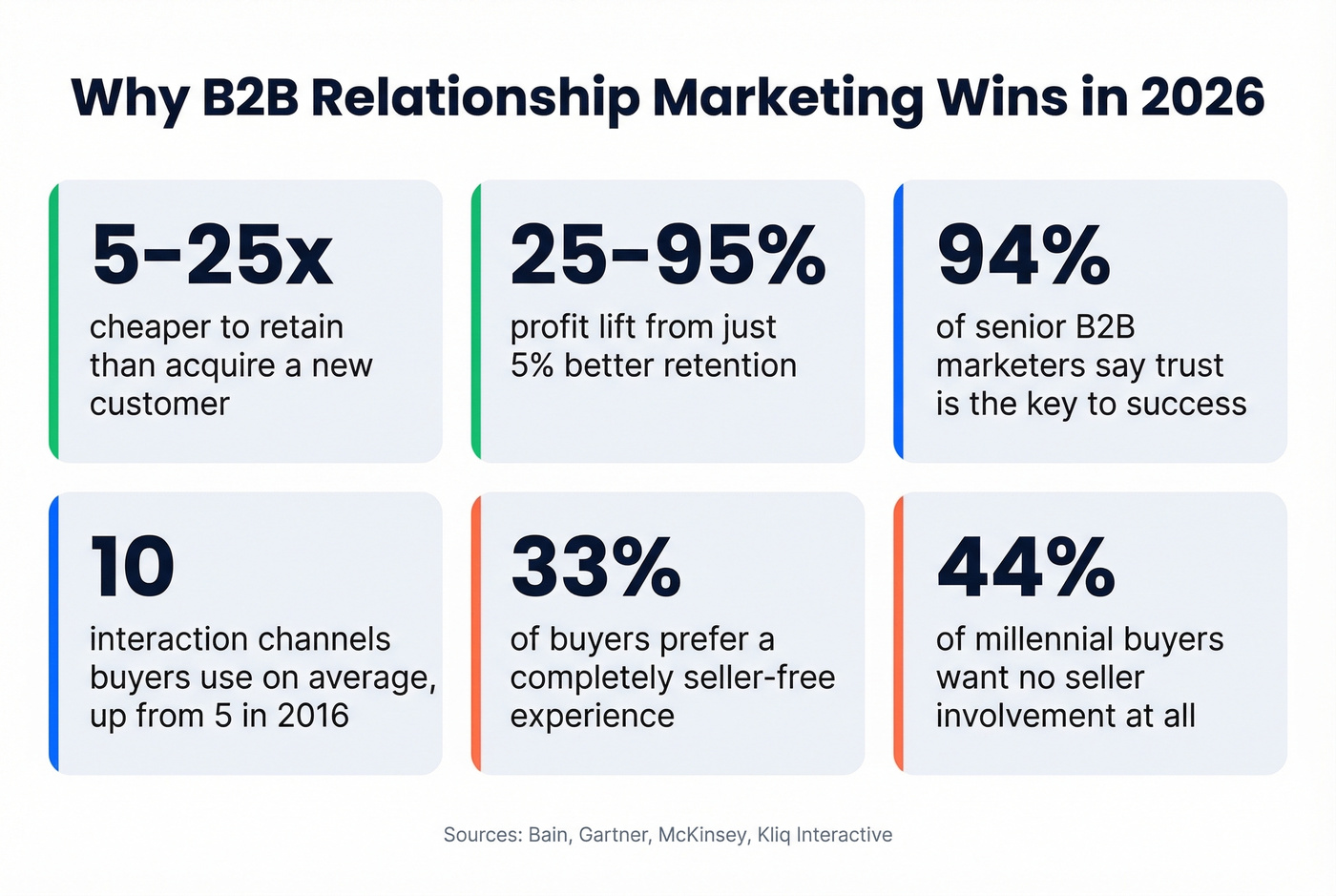
The buyer landscape reinforces it. 94% of senior B2B marketers agree trust is the key to success. Buyers now use 10 interaction channels on average - up from 5 in 2016. Gartner projects 80% of B2B sales interactions will happen in digital channels. And McKinsey's rule of thirds holds: at any buying stage, a third of buyers prefer in-person, a third remote, and a third digital self-serve. Your relationship strategy has to work across all three.
Here's the thing: 33% of buyers prefer a completely seller-free experience, and that number jumps to 44% among millennials. Over half will switch suppliers if the cross-channel experience isn't smooth. They don't want your demo. They want to trust you before you ever get on a call.
Relationship-first marketing isn't a nice-to-have philosophy. It's the highest-ROI motion most B2B teams aren't running properly.

You can't build B2B relationships on bad data. Prospeo's 7-day refresh cycle and 98% email accuracy mean your outreach reaches real people in real roles - not job-changers and dead inboxes that tank your domain reputation.
Clean data is the foundation of every relationship. Start with 75 free emails.
The 4-Pillar Execution Framework
"Build relationships" isn't a strategy. You need a system. The most effective B2B teams we've seen run four pillars simultaneously.
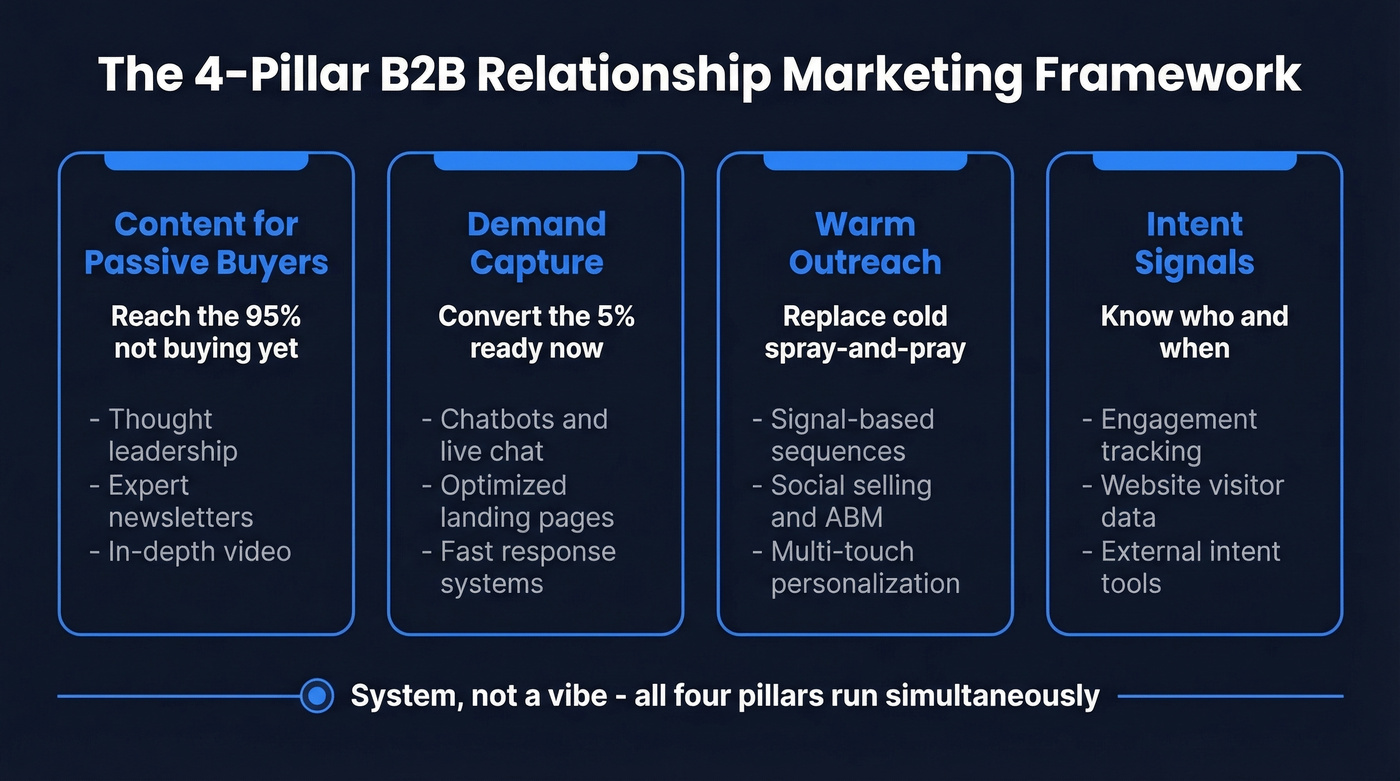
Pillar 1: Content for Passive Buyers
95% of B2B buyers are out of market at any given time. You can't sell to them, but you can earn their attention. Thought leadership, expert newsletters, and in-depth video build trust that converts when they're finally ready - brands combining video and industry voices are 2.2x more likely to be trusted. B2B buyers are still humans, and emotional resonance in content builds trust faster than feature lists ever will. Strong content also generates social proof: when prospects see peers engaging with your insights, sharing your research, and citing your data, it validates your credibility before a sales conversation ever happens.
Pillar 2: Demand Capture
What about the 5% who are ready now? Speed wins. Fast response systems - chatbots, optimized profiles, dynamic forms - ensure you capture demand the moment it appears. If your response time is measured in days, you've already lost.
Pillar 3: Warm Outreach
A common theme on r/b2bmarketing lands hard here. Teams shifting from blasting lists to tighter ICP targeting with signal-based, multi-touch sequences get dramatically better conversation quality. Social selling, ABM, and warm emails outperform cold spray-and-pray every time.
This is also where long-term customer engagement creates real switching costs. The vendor embedded in a client's workflow and trusted by the buying committee becomes nearly impossible to displace.
Pillar 4: Intent Signals
This is the layer that ties everything together. Engagement metrics, website visitor tracking, and external intent tools tell you who to prioritize and when. RepTrak's 6sense program cut their sales cycle by 22 days and increased contract value by 64%. Without intent data, you're guessing. With it, you're showing up at the right moment with the right message.
Mistakes That Kill B2B Relationships
Let's be honest - we've seen every one of these destroy pipeline:
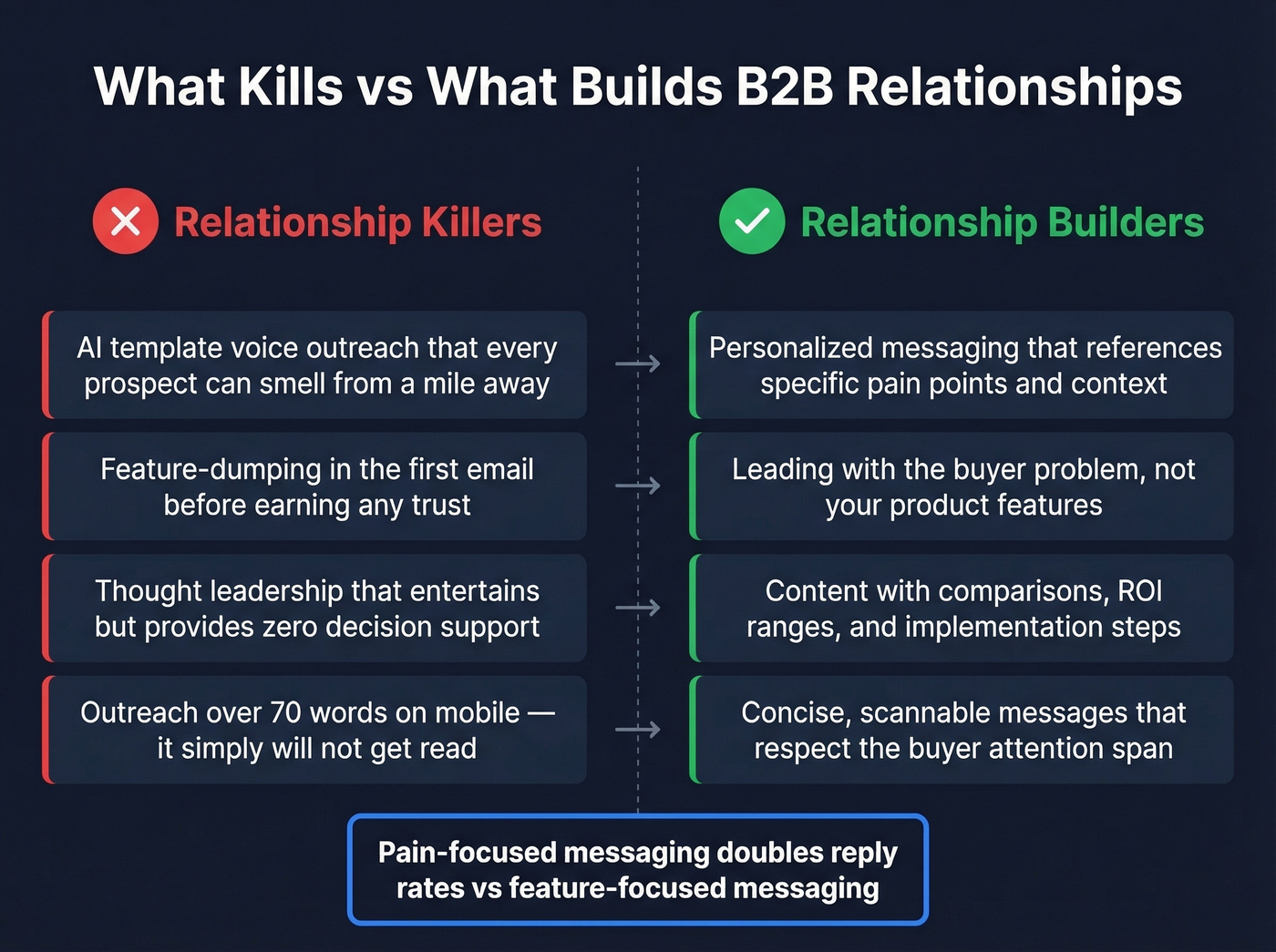
- Sending AI-generated "template voice" outreach. Everyone writes with AI now, and prospects smell it instantly. (If you're using AI, at least follow a real email copywriting structure.)
- Feature-dumping in the first email. Nobody cares about your product until they trust you understand their problem.
- Publishing thought leadership that earns attention but provides zero decision support during evaluation. If your content doesn't help buyers make decisions, it's just entertainment.
- Writing outreach over 70 words on mobile. It won't get read.
Frame around pain, not features. Switching from feature-focused to pain-focused messaging doubles reply rates, per practitioners on r/b2bmarketing. Add comparisons, ROI ranges, and implementation steps to your content so it helps buyers make decisions, not just think about them.
Real Results From Relationship-First B2B Teams
BT Enterprise ran a brand trust campaign that delivered £13.52 in long-term ROMI for every £1 spent, with an 11-point lift in brand trust and a 7-point increase in consideration.
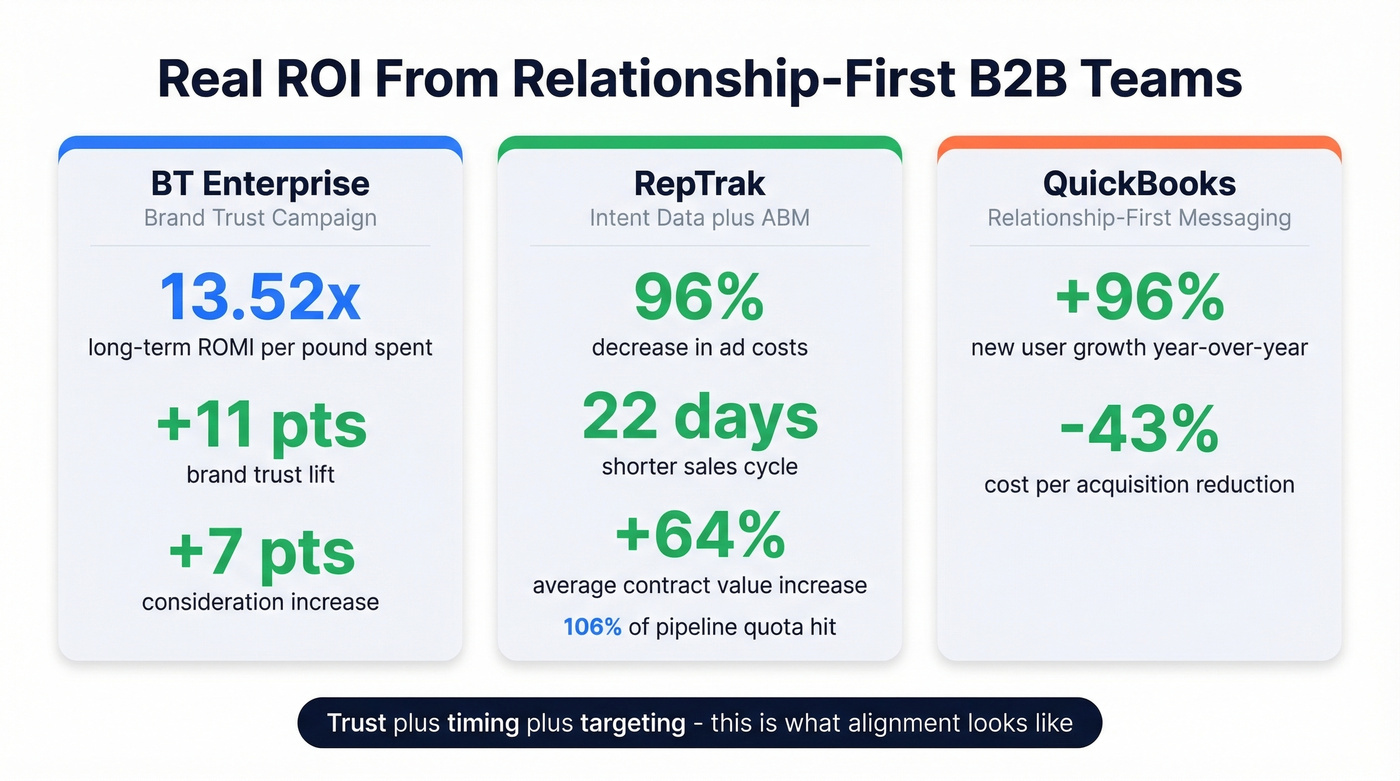
RepTrak layered intent data with ABM and saw a 96% decrease in ad costs, a 22-day reduction in sales cycle, and a 64% increase in average contract value. They hit 106% of pipeline quota.
QuickBooks targeted a specific audience segment with relationship-first messaging and grew new users 96% year-over-year while cutting CPA by 43%.
These aren't flukes. They're what happens when trust, timing, and targeting align. Satisfied customers become your most powerful channel - word-of-mouth referrals consistently outperform paid acquisition because a recommendation from a trusted peer carries more weight than any ad.
Tools That Make It Work
You need three layers, and you don't need six figures to get them.
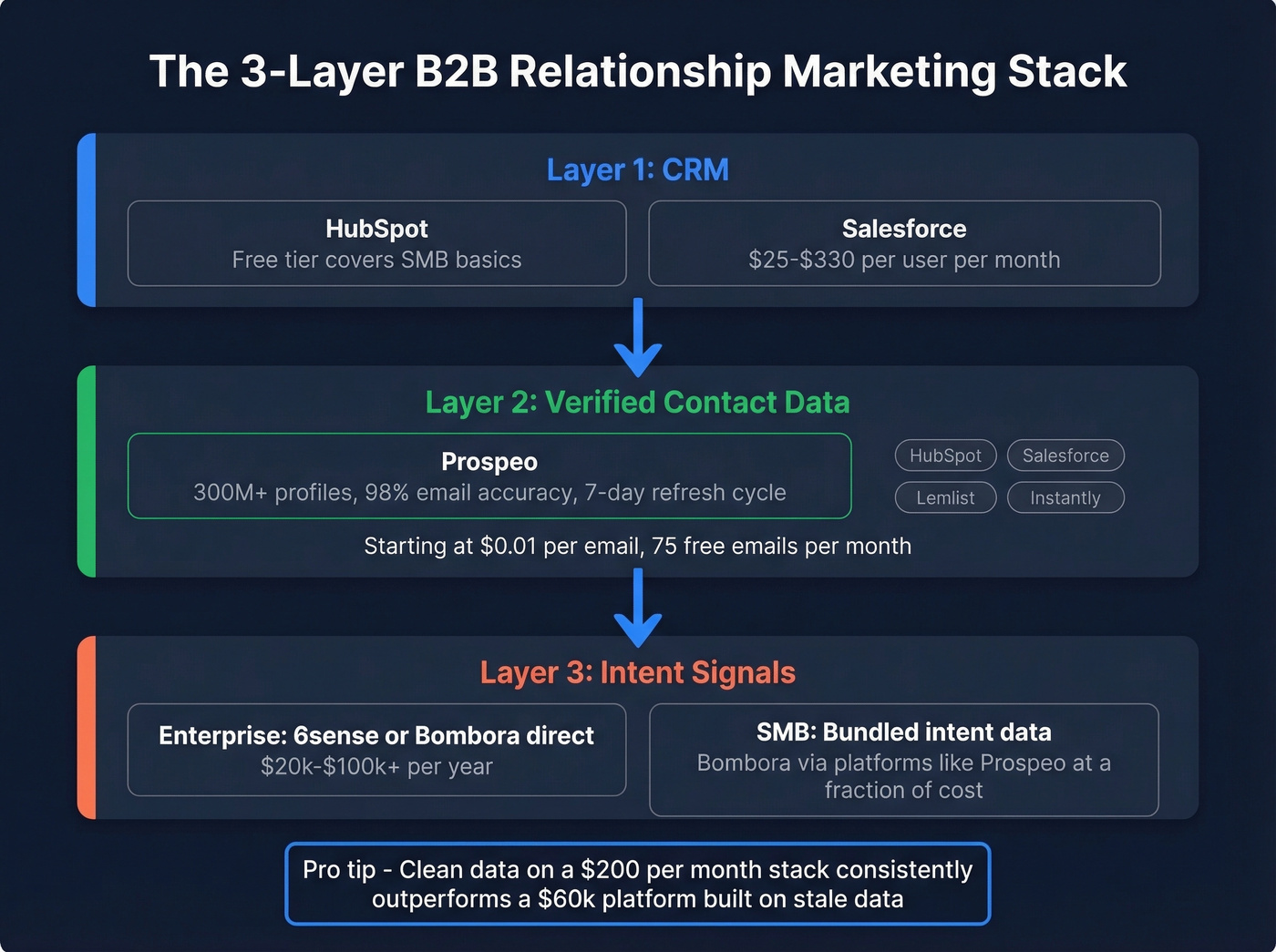
CRM: HubSpot offers a free tier that covers core CRM basics for many SMB teams. Salesforce typically runs $25-$330/user/month depending on edition. (If you're still evaluating, start with a few examples of a CRM to map fit.)
Verified contact data: You can't nurture relationships with people you can't reach. Prospeo covers 300M+ professional profiles with 98% email accuracy and a 7-day refresh cycle - while the industry average sits at six weeks. It integrates natively with HubSpot, Salesforce, Lemlist, and Instantly. Self-serve pricing starts at $0.01 per email, with a free tier offering 75 verified emails per month. If you're comparing vendors, use this data enrichment lens, not feature checklists.
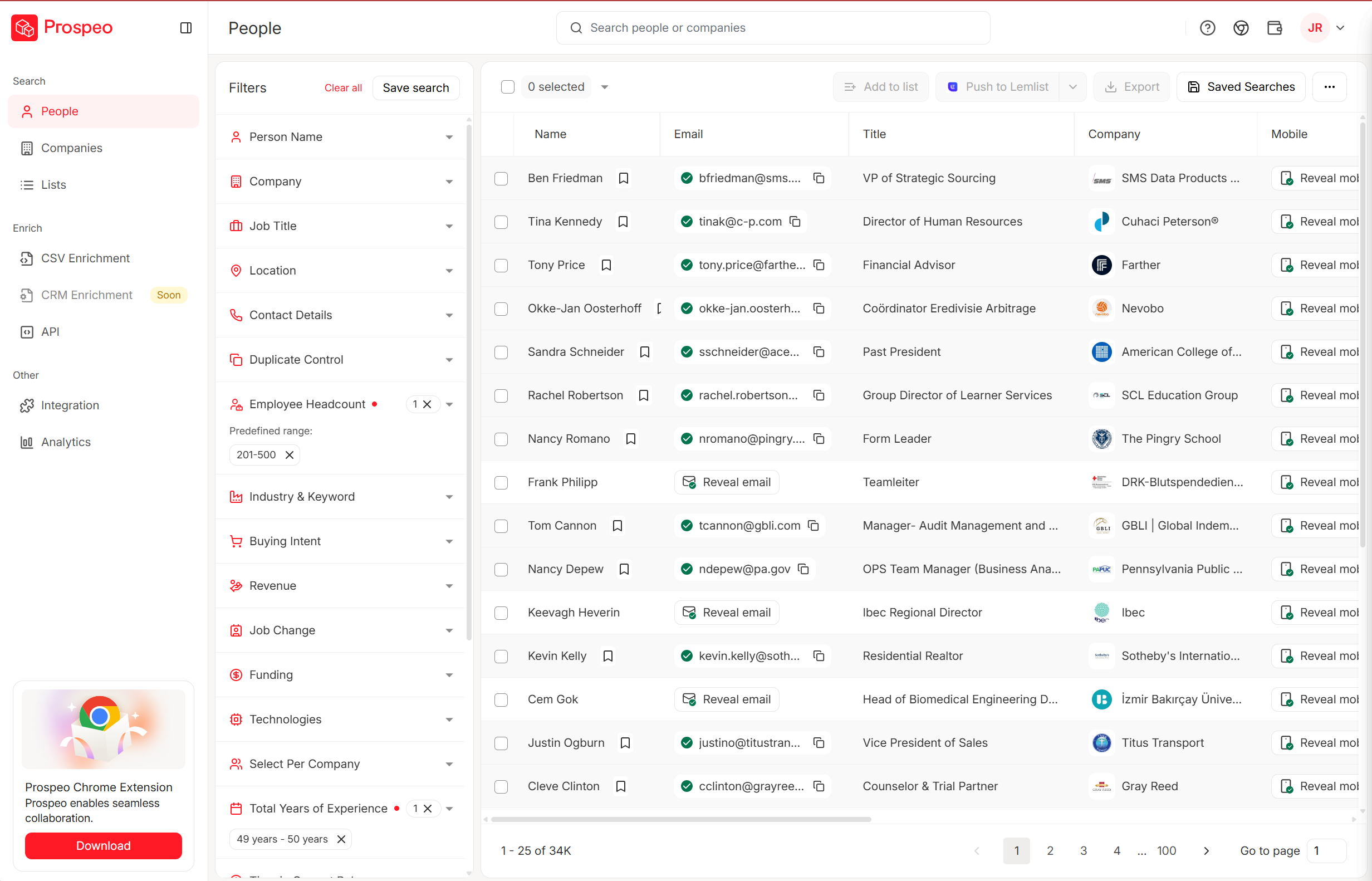
Intent signals: Enterprise teams typically run 6sense or Bombora directly at $20k-$80k/year for mid-market packages, with enterprise programs reaching $100k+/year. Smaller teams can access Bombora intent data across 15,000 topics at a fraction of that cost through platforms that bundle it with contact data.
Skip the six-figure intent platform if your average deal size is under $20k. Clean, verified contact data paired with basic intent signals will outperform an expensive stack built on dirty data every time. We've seen it play out dozens of times - the team with accurate emails and a $200/month tool stack consistently outbooks the team running a $60k platform on stale data. If bounces are hurting you, fix email bounce rate before you scale volume.
Intent signals without verified contact data is like knowing who's buying but having no way to reach them. Prospeo layers 15,000 Bombora intent topics with 300M+ verified profiles so your warm outreach actually connects.
Reach in-market buyers at the right moment with data that's never more than 7 days old.
FAQ
How do you measure B2B relationship marketing?
Track pipeline attribution, customer lifetime value, retention rate, and referral revenue. Open rates and impressions tell you almost nothing - focus on metrics that tie relationship depth to actual closed-won deals and expansion revenue.
Does relationship marketing work for SMBs?
Yes. SMBs typically see the fastest ROI because tighter ICP targeting and personal outreach compensate for smaller budgets. Enterprise layers ABM and intent data on top. The four-pillar framework scales in both directions.
What's the fastest way to start?
Audit your contact data first. If emails bounce above 4% and phone numbers are outdated, no nurture strategy saves you. A free tier like Prospeo's 75 verified emails/month lets you clean a starter list in minutes, then build sequences on data you can trust.