

B2B Sales Closing Techniques That Actually Work in 2026
You nailed the demo. The champion loved it. Then three weeks of silence. You check your CRM and realize the only email you have is a generic info@ address - and the CFO you've never spoken to just killed the deal in a meeting you didn't know was happening.
84% of reps missed quota last year. 67% of B2B buyers prefer a rep-free experience, and 45% used AI during a recent purchase. The B2B sales closing techniques that worked five years ago - memorized scripts, manufactured urgency - don't survive a buying committee armed with ChatGPT and six competing vendor reports. Techniques still matter, but they're the last 10%. The other 90% is data quality, stakeholder mapping, and structured follow-up.
Three Moves That Lift Close Rates
If you're short on time:
- Use Mutual Action Plans for every deal over $25K. They replace vague "next steps" with a shared roadmap that keeps buying committees aligned.
- Send 5 pre-demo discovery questions. A practitioner playbook on r/sales pegs completion at 60-75%, which means your demo actually addresses what matters.
- Build a one-pager your champion can circulate internally. They're tired of being your unpaid internal salesperson - arm them.
One prerequisite underpins all three: verified direct contact info for every stakeholder in the deal. If you're emailing dead addresses or missing the CFO entirely, no technique saves you.
B2B Sales Closing Benchmarks
| Metric | Benchmark |
|---|---|
| Avg close rate | ~29% |
| Win rate | ~21% |
| Median conversion (lead to customer) | 2.9% |
| Avg touches to close | 62 across 3+ channels |
| Buying committee size | 6-10 (up to 13 for enterprise) |
| Deals stalling from misalignment | ~40% |
The biggest takeaway here isn't about competitors. Your deal is competing against indecision. When 6-10 stakeholders each consult 4-5 pieces of content before joining a group discussion, the default outcome is "no decision." Every technique below exists to fight that inertia.
8 Closing Techniques by Deal Type
The right technique depends entirely on deal size and stakeholder count. Here's what actually works, broken into two tiers.
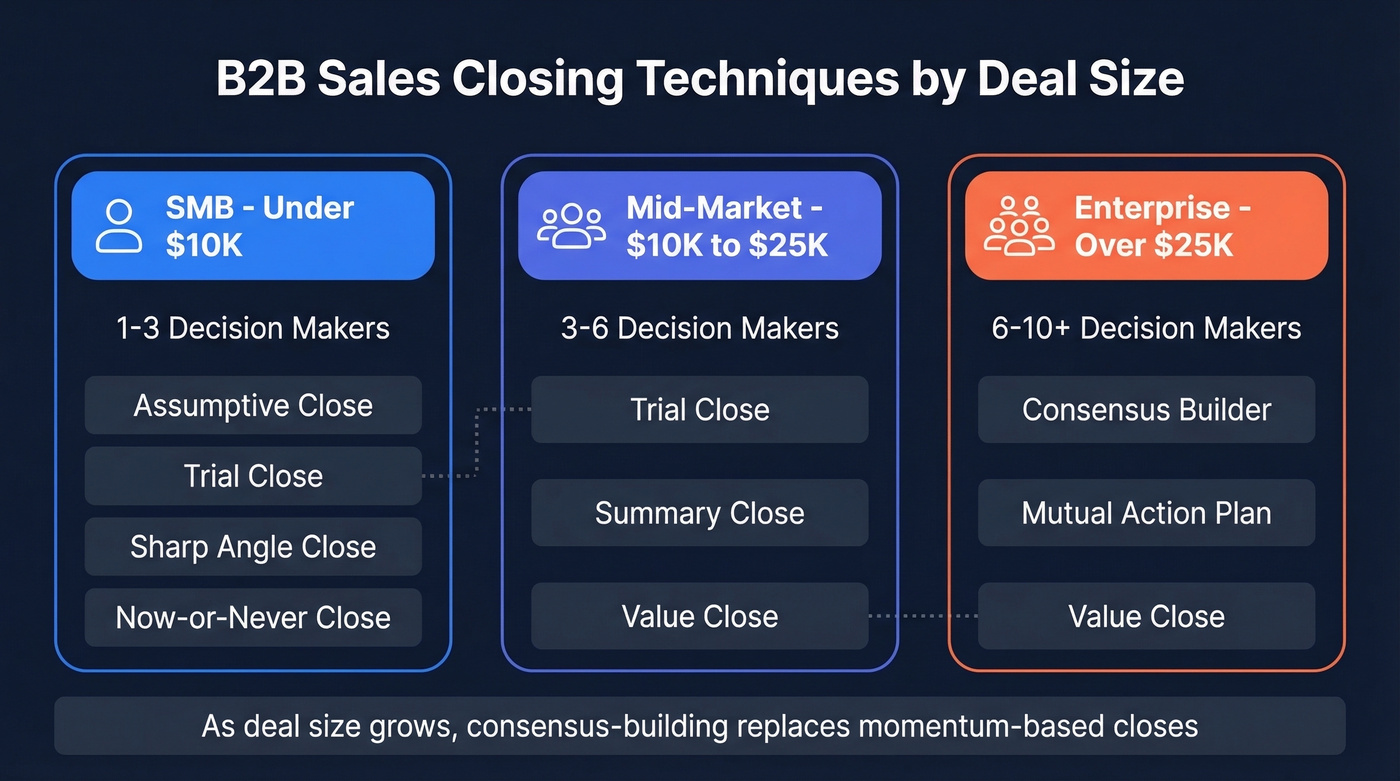
SMB Closes (Under $10K, 1-3 Decision-Makers)
SMB deals close in days to weeks. Momentum matters more than persuasion.
Assumptive close: "Should we start onboarding next Monday or Wednesday?" Act as if the decision's already made. Works when discovery confirmed strong fit and there's no committee to consult.
Trial close: "If we could solve the reporting gap you mentioned, would that be enough to move forward?" Test readiness without forcing commitment. I use this mid-demo to gauge temperature before pushing toward a decision.
Two tactics that r/sales sellers swear by at this deal size: connect with your prospect on a professional network before the demo so they see you as a person, not a pitch. And after the demo, send a customer-specific visual - a mock dashboard with their data, a workflow diagram with their team names - instead of a generic deck. These small moves build trust faster than any script, and they cost nothing but 20 minutes of prep.
Sharp angle close: When the prospect asks for a concession, trade it for commitment. "I can do quarterly billing - if we can sign this week, does that work?" Only pull this when you have real leverage to offer.
Now-or-never close (legitimate version): "Our implementation team has two slots open this month. After that, onboarding pushes to March." Tie urgency to a real constraint. If the constraint isn't real, don't use it - buyers see through manufactured urgency instantly, and you'll torch the relationship.
Enterprise Closes ($25K+, 6-10 Decision-Makers)
Enterprise deals run 6-18 months. Customer acquisition costs hit $50K-$100K. At this level, consensus-building is the entire game.
Skip the summary close if your champion can already articulate the value story back to you. Go straight to the consensus builder instead.
Summary close: Restate every agreed-upon pain point and solution before asking for commitment. "We've aligned on pipeline visibility, forecast accuracy, and rep onboarding. Here's how we address each. Ready to move to legal?" Enterprise buyers need the full picture restated for their internal narrative - they're not just convincing themselves, they're building the case they'll present to their boss's boss.
Consensus builder close: Map each stakeholder's "yes" criteria and address them individually. "Sarah needs the SOC 2 cert, James needs the ROI model, and your team needs the sandbox. Let's check those boxes this week." Multi-threading is the technique. The close is just the final confirmation.
Value close vs. consensus builder - when to use which: The value close quantifies the cost of inaction: "Every month without this costs 40 hours of manual reporting - roughly $180K/year in loaded salary." Use it when the CFO is the primary blocker. Use the consensus builder when the deal's stalling because multiple stakeholders have unaddressed concerns. In practice, enterprise deals usually need both - and knowing how to layer these approaches throughout the cycle is what separates reps who close from reps who forecast.
Mutual Action Plan close: Build a shared roadmap with milestones, owners, and deadlines. This one deserves its own section.
| Deal Size | Stakeholders | Best Techniques |
|---|---|---|
| Under $10K | 1-3 | Assumptive, trial, sharp angle |
| $10K-$25K | 3-6 | Trial, summary, value |
| Over $25K | 6-10+ | Consensus builder, MAP, value |
Mutual Action Plans - The Underrated Close
A Mutual Action Plan is a shared document between buyer and seller outlining milestones, owners, success criteria, and timelines from evaluation through go-live. It replaces "let's circle back next week" with a concrete roadmap both sides commit to.
If you want to operationalize this across your pipeline, start with a consistent sales process and clear sales stages so MAP milestones match your exit criteria.
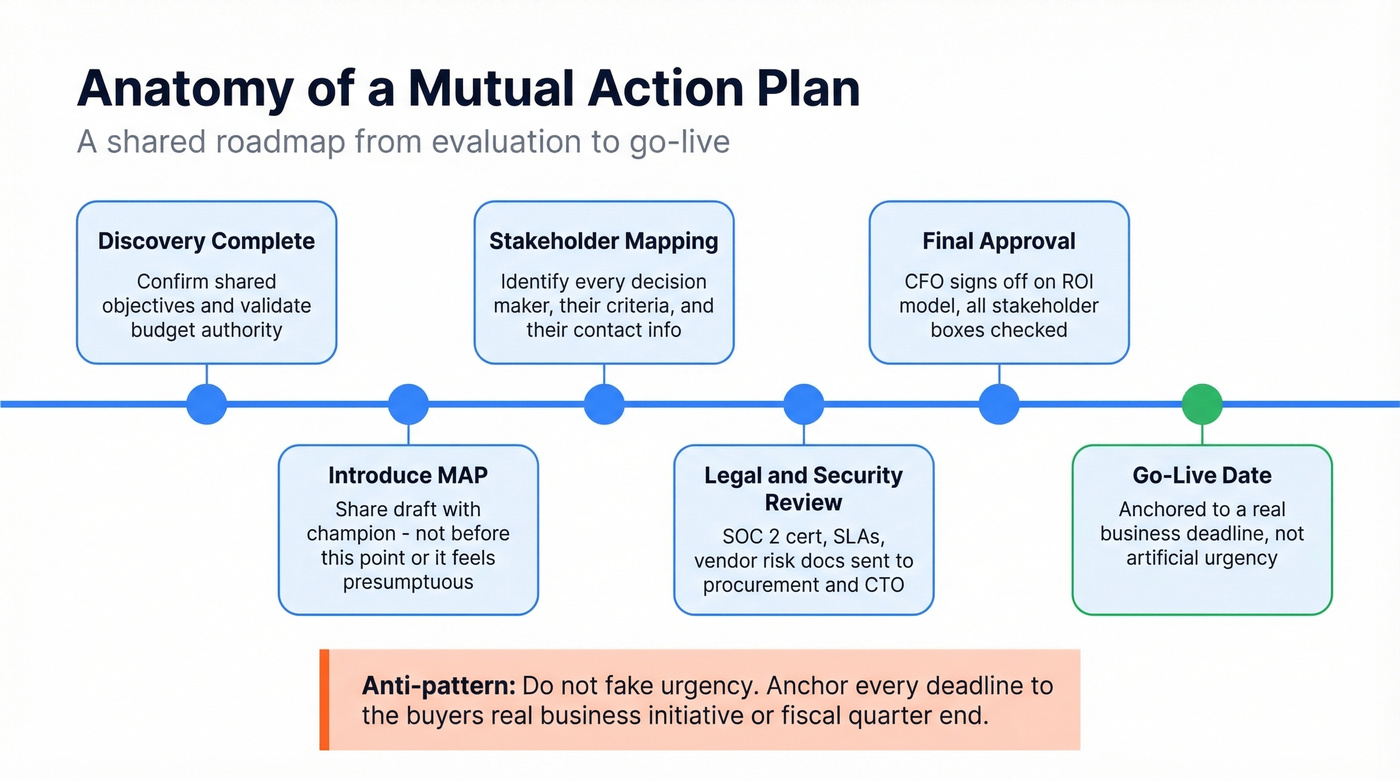
What goes in a MAP: approval checkpoints and owners, legal review timing, close and go-live dates anchored to the buyer's real deadlines, stakeholder roles, and success criteria both sides agree on.
Introduce a MAP after you've confirmed shared objectives and validated budget authority with your champion. Not before - premature MAPs feel presumptuous. Gartner found that confident buyers are twice as likely to report a high-quality deal, and MAPs build exactly that confidence by removing ambiguity from the process.
Here's the critical anti-pattern: don't fake urgency. Dock.us frames this well - MAP urgency should anchor to the buyer's real deadlines, like a fiscal quarter end or a go-live date tied to a business initiative. Bryan Vasquez, Head of Sales at LinkBuilder.io, reported a 20% win rate lift after replacing urgency manipulation with data-backed proposals. That tracks with everything we've seen.

Every closing technique above assumes one thing: you have direct contact info for every stakeholder in the deal. Prospeo gives you 98% accurate emails and 125M+ verified mobile numbers so you can multi-thread across the entire buying committee - not just your champion.
Stop losing deals to stakeholders you never reached.
Selling to the Buying Committee
Your champion is tired of being your internal salesperson. Give them materials that sell for them.
This is where B2B decision making and stakeholder mapping matter more than any single closing line.
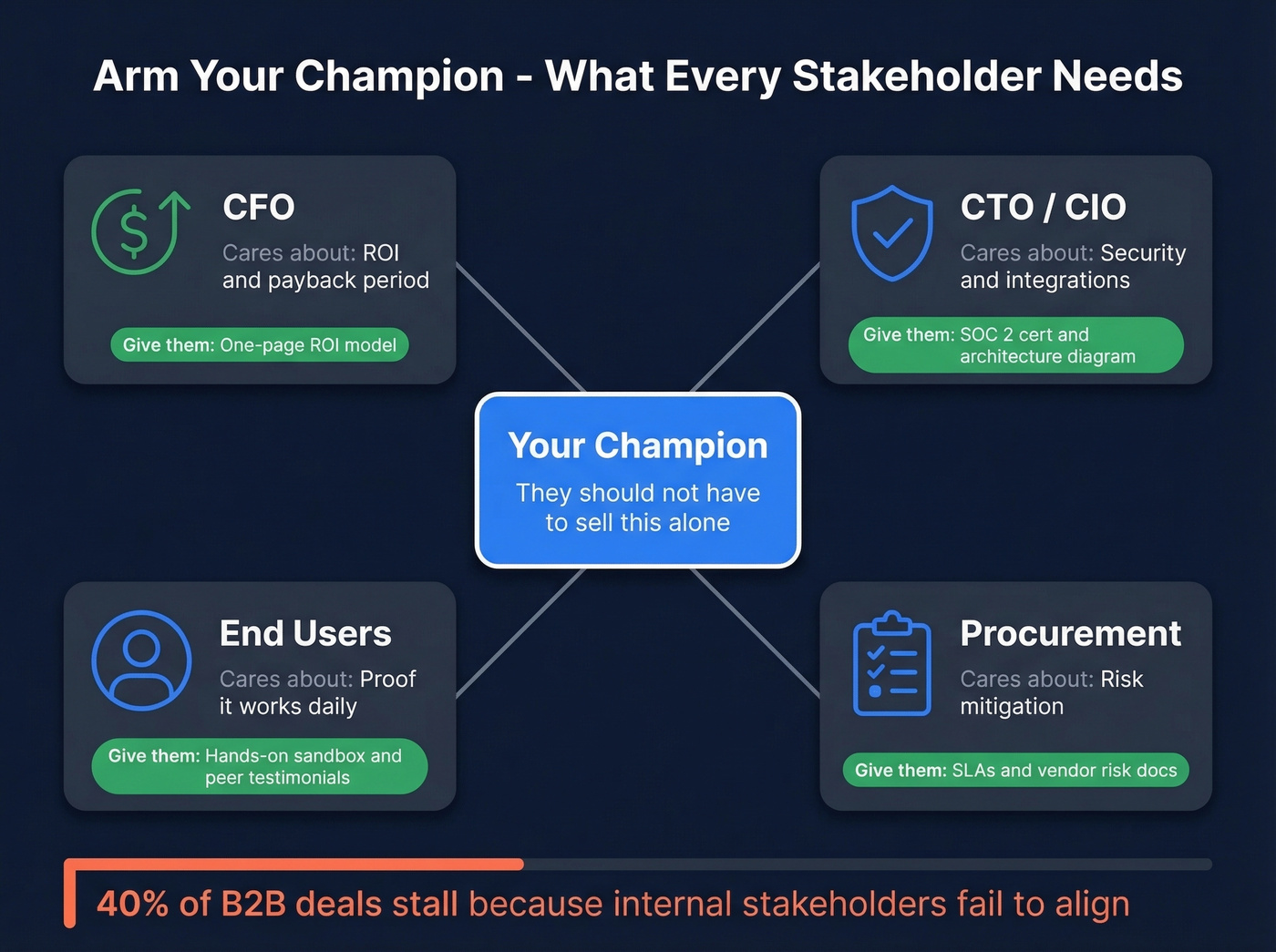
| Stakeholder | What They Need | Give Them |
|---|---|---|
| CFO | ROI, payback period | One-page ROI model |
| CTO / CIO | Security, integrations | SOC 2 cert, architecture diagram |
| End users | Proof it works daily | Hands-on sandbox, peer testimonials |
| Procurement | Risk mitigation | SLAs, vendor risk docs |
40% of B2B deals stall because internal stakeholders fail to align. The fix isn't a better pitch - it's better enablement materials tailored to each role. Map every person involved, find their direct contact info, and send role-specific content directly. We've found that multi-threading with verified emails and direct dials - rather than hoping your champion forwards your PDF - cuts stall rates dramatically. Prospeo's 98% email accuracy across 300M+ profiles makes the stakeholder discovery piece fast so you can focus on the actual selling.
If you're missing the economic buyer, use a checklist of common decision maker job titles to make sure you’re multi-threading the right people.
Objection Handling Scripts
First, distinguish between real objections and obstructions. Objections are genuine uncertainty about fit. Obstructions are excuses to avoid action. The framework below handles objections. Obstructions require a different conversation entirely.
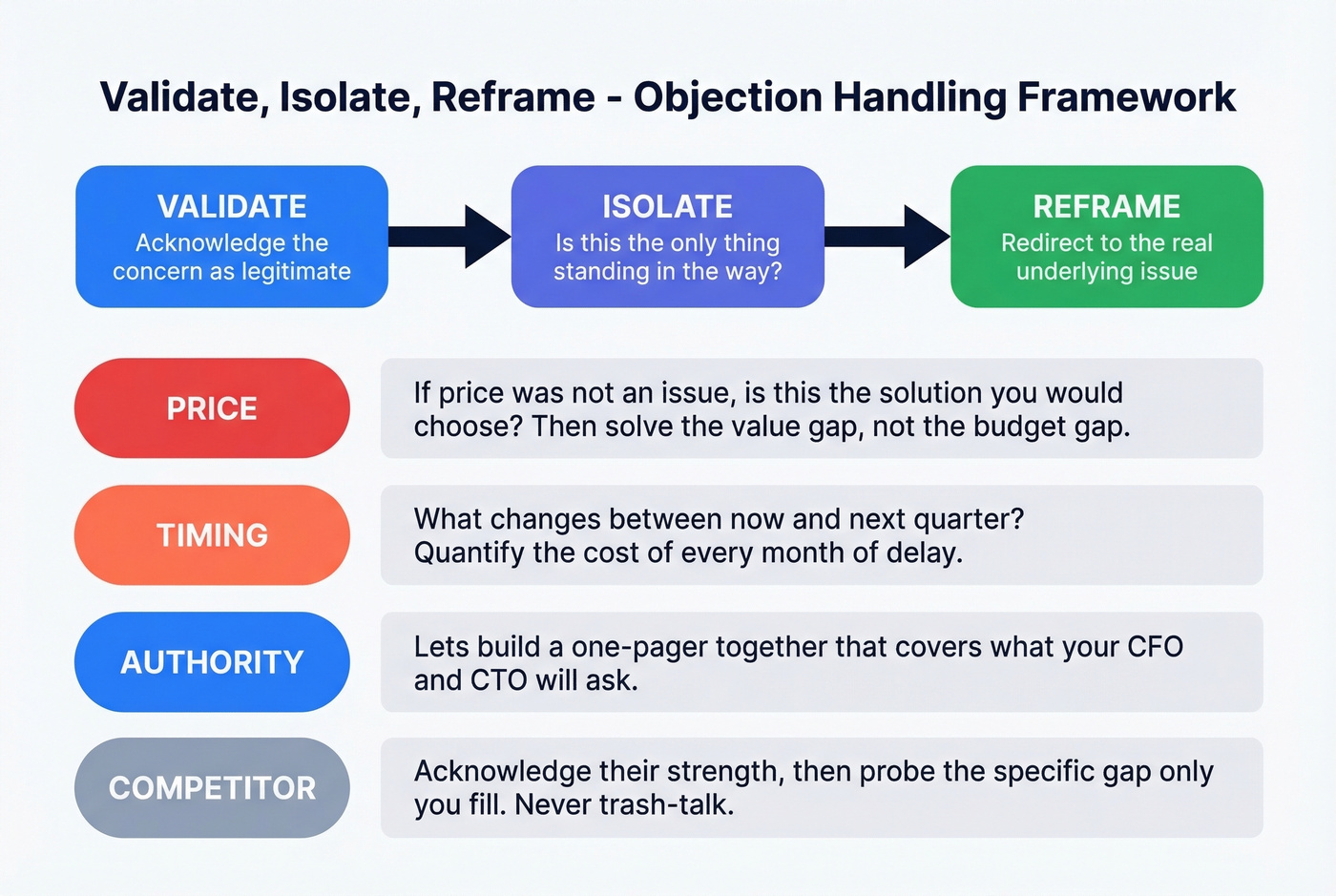
Use Validate, Isolate, Reframe.
Price: "That's a fair concern. If price wasn't an issue, is this the solution you'd choose?" If yes, you have a value problem to solve, not a budget problem. Walk through the ROI model.
Timing: "What changes between now and next quarter that makes this easier?" Usually nothing. Quantify the cost of waiting - every month of delay has a dollar figure. Strong deal closing strategies always include a cost-of-inaction calculation ready to go.
Authority: "You shouldn't have to sell this alone internally. Let's build a one-pager together that covers what your CFO and CTO will ask."
Competitor: "[Competitor] is solid at X. How are you handling [specific gap they don't cover]?" Acknowledge the strength, then probe the gap only you fill. Never trash-talk - it makes you look insecure.
Mistakes That Kill Deals
Here's the thing: the biggest deal-killer isn't a bad close. It's a good demo followed by zero enablement. We've watched deals die because the champion walked into an internal meeting with nothing but a memory of the product and a vague promise to "send over some info."
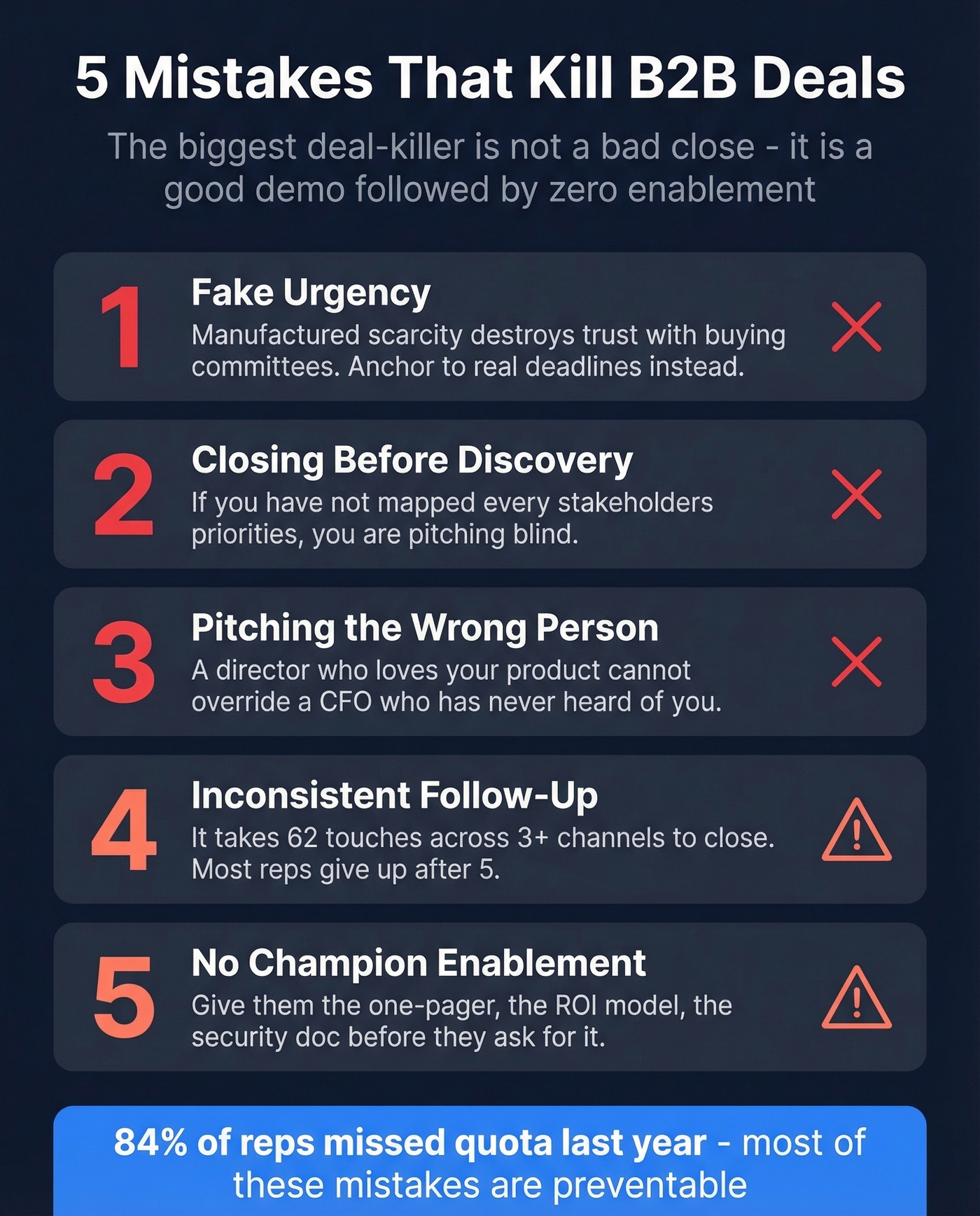
- Fake urgency. Manufactured scarcity destroys trust with buying committees. Anchor to real deadlines instead.
- Closing before discovery is complete. If you haven't mapped every stakeholder's priorities, you're pitching blind.
- Pitching the wrong person. No access to the economic buyer means no deal. A director who loves your product can't override a CFO who's never heard of you.
- Inconsistent follow-up. It takes an average of 62 touches across 3+ channels to close a B2B deal. Most reps give up after 5. Cadence discipline matters more than charisma. (If you need a system, steal these sales follow-up templates.)
- No champion enablement. Give them the one-pager, the ROI model, the security doc - before they ask. If they have to request it, you're already behind.
Start with Better Data
Every technique above assumes one thing: you can actually reach the people who matter. The best MAP in the world fails if you're emailing a dead address or missing the VP of Finance entirely.
Let's be honest - we've all been there. You spend weeks building a deal, only to realize you never had a real line to the economic buyer. That's a data problem, not a sales problem. Prospeo covers 300M+ professional profiles with 98% email accuracy and 125M+ verified mobile numbers, refreshed every 7 days. There's a free tier - 75 verified emails/month - so you can test it without a contract. Snyk's 50 AEs saw AE-sourced pipeline jump 180% after switching. That's not a closing technique - it's the foundation every closing technique depends on.
To pressure-test your list quality, run a quick audit against prospect data accuracy benchmarks before you scale outreach.

Mutual Action Plans only work when you can reach the CFO, the legal lead, and the end users directly. Prospeo's 300M+ profiles with 30+ filters - including job title, department, and company size - let you map and contact every decision-maker before the deal stalls.
Build your MAP with verified contacts for every seat at the table.
FAQ
What's the average B2B close rate?
The average B2B close rate is approximately 29%, with win rates around 21%. SMB inbound deals close at higher rates than enterprise outbound. The median overall conversion rate from lead to customer is just 2.9%.
How many touches does it take to close a B2B deal?
Research shows an average of 62 touches across 3+ channels. Enterprise deals with 6-10 stakeholders require even more. Consistent multi-channel follow-up - not a single email - separates reps who hit quota from those who get ghosted.
What's a Mutual Action Plan in sales?
A Mutual Action Plan is a shared buyer-seller document outlining milestones, owners, success criteria, and timelines through close and go-live. It replaces vague "next steps" with a concrete roadmap. MAPs are especially effective for enterprise deals over $25K with multiple stakeholders.
How do you close when multiple stakeholders are involved?
Map every role - CFO, CTO, end users, procurement - and get verified direct contact info for each. Multi-threading across the full committee prevents deals from stalling when a single champion goes dark. Pair verified contact data with the consensus builder close and role-specific enablement materials to keep everyone aligned through the finish line.