

Decision Maker Job Titles: The Complete B2B Directory for 2026
A RevOps lead we know built an outbound list last quarter. Every contact had "Director" or "VP" in their title. The campaign tanked - not because the messaging was off, but because the decision maker job titles on his list were either inflated or irrelevant to the product being sold.
The average B2B purchase now involves 7-8 decision-makers, and 86% of B2B purchases stall before they close. If you're targeting the wrong titles - or only one person per account - you're feeding both of those statistics.
This is the directory we wish existed when we started running outbound. Every department, every seniority level, every industry vertical that matters, plus the framework for figuring out who actually controls budget versus who just thinks they do.
The Three-Tier Targeting Model
For every account, target three people:
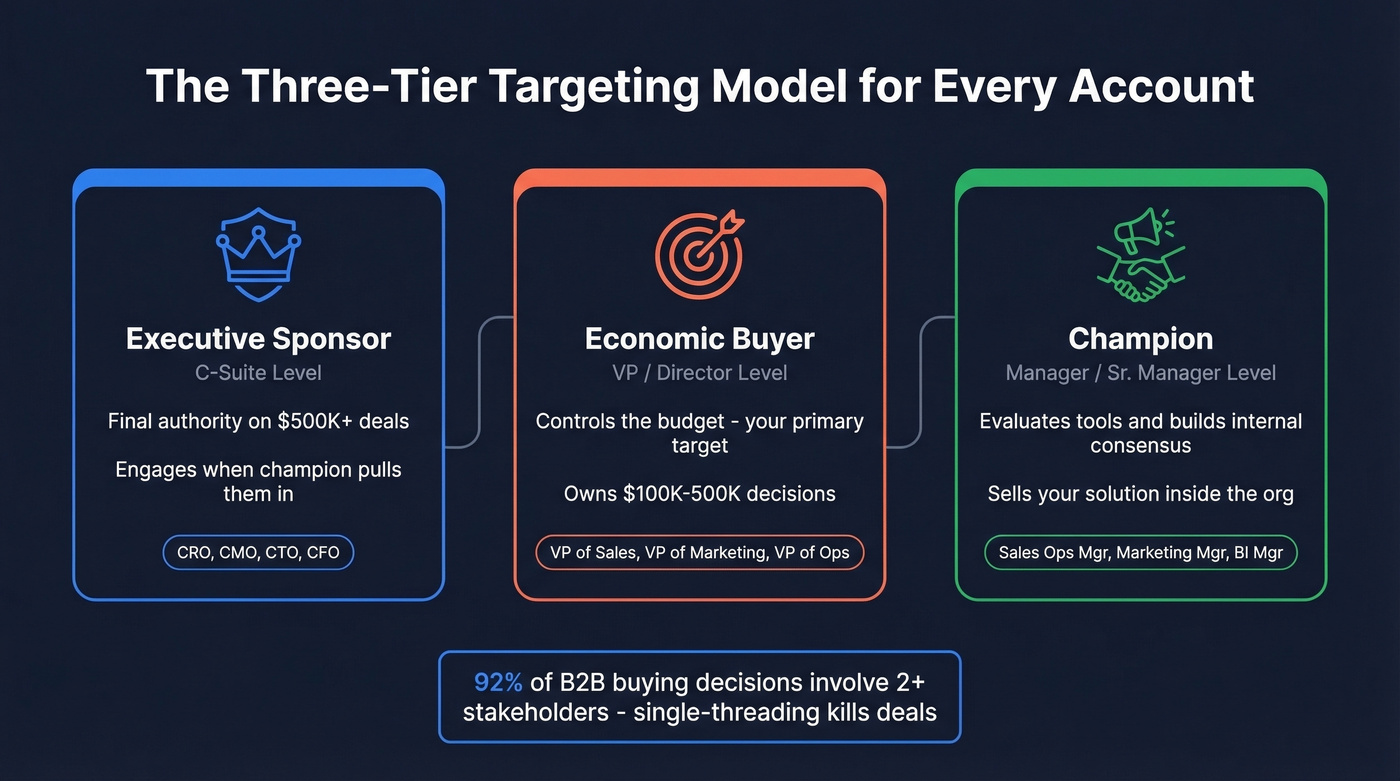
- Economic buyer (VP/Director level): Controls budget. Primary target for most mid-market deals.
- Champion (Manager/Senior Manager): Evaluates tools, builds internal consensus, and sells your solution internally.
- Executive sponsor (C-suite): Typically engages directly for $500K+ deals or when the champion pulls them in.
92% of B2B buying decisions involve two or more stakeholders. Single-threading is how deals die quietly.
Why Targeting the Right Titles Matters
Here's the thing: 61% of B2B buyers prefer a rep-free experience, and 73% actively avoid vendors whose outreach feels irrelevant. Emailing the wrong person with the wrong message doesn't just waste your time - it can hurt deliverability and make it harder to get replies from the account later.
Buyers define their purchase requirements 83% of the time before they ever talk to a salesperson. Each stakeholder brings 4-5 pieces of independent research to the table, meaning your outreach competes with content they've already consumed. Gartner's data shows buyers spend just 17% of their purchasing time meeting with vendors - all vendors combined. The window is small.
And 53% of buying groups include at least one C-suite executive, which means your outreach needs to land at the right level. Not too high and you'll get ignored. Not too low and you'll get stuck with someone who can't sign anything.
B2B Decision Maker Titles by Department
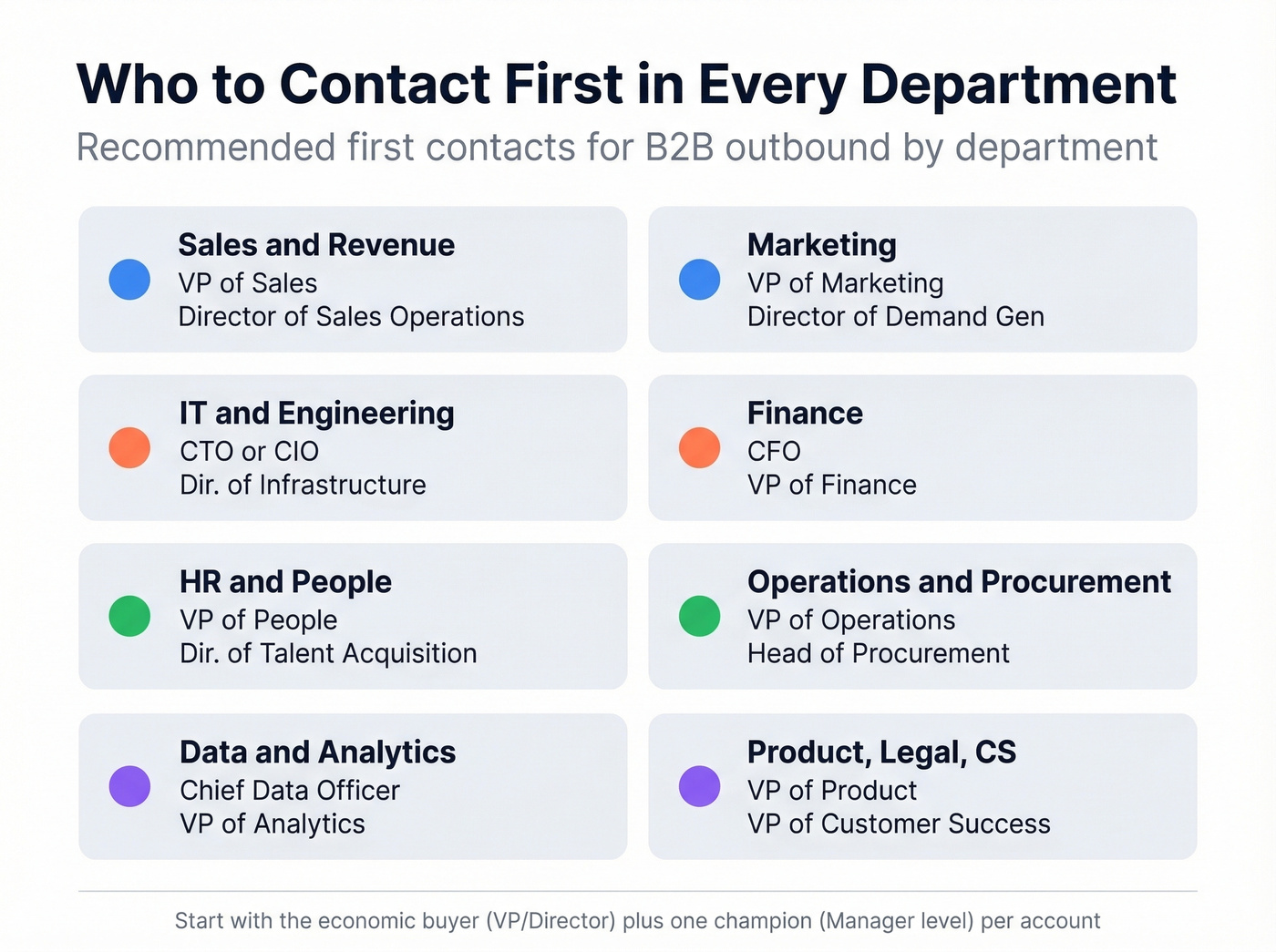
Each table below maps titles to seniority level and typical buying authority. Start with the "recommended first contacts" - these are the titles most likely to be your economic buyer or champion.
Sales & Revenue
Start here: VP of Sales + Director of Sales Operations
| Title | Seniority | Buying Authority |
|---|---|---|
| Chief Revenue Officer | C-suite | Final authority, $500K+ |
| VP of Sales | VP | Budget owner, $100-500K |
| Director of Sales Ops | Director | Evaluator + recommender |
| Head of Business Dev | Director | Budget for BD tools |
| Sales Operations Mgr | Manager | Champion, $5-25K |
Marketing
Start here: VP of Marketing + Director of Demand Gen
| Title | Seniority | Buying Authority |
|---|---|---|
| CMO | C-suite | Final authority, $500K+ |
| VP of Marketing | VP | Budget owner, $100-500K |
| Dir. of Demand Gen | Director | Owns pipeline tools |
| Dir. of Marketing Ops | Director | Owns martech stack |
| Marketing Manager | Manager | Evaluator, $5-25K |
IT & Engineering
Start here: CTO/CIO + Director of Infrastructure or Security
| Title | Seniority | Buying Authority |
|---|---|---|
| CTO / CIO | C-suite | Final authority |
| VP of Engineering | VP | Budget owner, $100-500K |
| Dir. of Cybersecurity | Director | Security tool budget |
| Dir. of IT Infrastructure | Director | Infra tool budget |
| Enterprise Architect | Senior IC | Technical buyer |
Finance
Start here: CFO + VP of Finance
| Title | Seniority | Buying Authority |
|---|---|---|
| CFO | C-suite | Final authority on spend |
| VP of Finance | VP | Budget owner, $100-500K |
| Controller | Director | Approves finance tools |
| Dir. of FP&A | Director | Owns planning stack |
HR & People
Start here: VP of People + Director of Talent Acquisition
| Title | Seniority | Buying Authority |
|---|---|---|
| CHRO / CPO | C-suite | Final authority |
| VP of People | VP | Budget owner |
| Dir. of Talent Acq. | Director | Owns recruiting tools |
| Dir. of L&D | Director | Owns training budget |
| Head of Total Rewards | Director | Comp/benefits tools |
Operations & Procurement
Start here: VP of Operations + Head of Procurement
| Title | Seniority | Buying Authority |
|---|---|---|
| COO | C-suite | Final authority |
| VP of Operations | VP | Budget owner |
| Head of Procurement | Director | Gatekeeper for vendors |
| Dir. of Supply Chain | Director | Owns logistics tools |
| Purchasing Manager | Manager | Evaluator, $5-50K |
Real talk: Procurement titles are tricky. The Head of Procurement often isn't the decision-maker - they're the gatekeeper who enforces process after someone else has already decided. Don't skip them, but don't treat them as your champion either.
Data & Analytics
Start here: Chief Data Officer + VP of Analytics
| Title | Seniority | Buying Authority |
|---|---|---|
| Chief Data Officer | C-suite | Final authority |
| VP of Analytics / BI | VP | Budget owner, $100-500K |
| Dir. of Data Engineering | Director | Owns data infra tools |
| BI Manager | Manager | Champion, evaluator |
Product, Legal & Customer Success
Start here: VP of Product, General Counsel, or VP of Customer Success - depends on what you sell.
| Title | Seniority | Buying Authority |
|---|---|---|
| CPO / VP of Product | VP/C-suite | Product tool budget |
| General Counsel | C-suite equiv. | Legal/compliance tools |
| VP of Customer Success | VP | CS platform budget |
| Dir. of CS Ops | Director | Owns CS tech stack |
| Dir. of Compliance | Director | Compliance tool budget |
Modern Titles You're Missing
Title inflation has made prospecting harder. When every startup founder is "Chief Everything Officer" and every bank employee is a "Vice President," titles alone become unreliable signals.
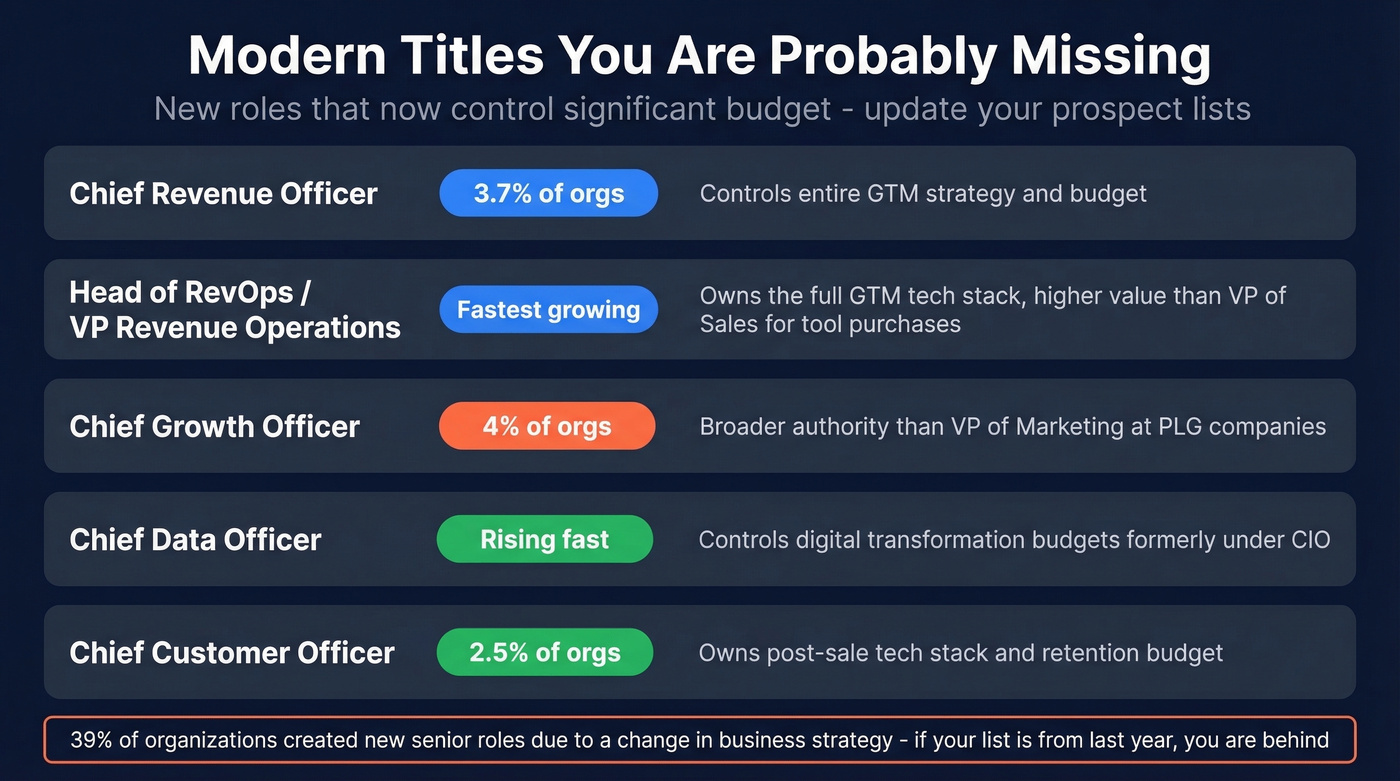
But there's a different trend worth tracking: genuinely new roles that didn't exist five years ago and now control significant budget. A Marketing Week survey of 450 B2B marketers found Chief Revenue Officer appearing in 3.7% of organizations, Chief Growth Officer in 4%, and Chief Customer Officer in 2.5%. These aren't vanity titles - they represent structural shifts in how companies organize go-to-market.
The Head of RevOps or VP of Revenue Operations now owns the entire GTM tech stack at many mid-market companies, making them a higher-value target than the VP of Sales for tool purchases. Chief Digital Officers and Chief Data Officers control digital transformation budgets that used to sit with the CIO. The VP of Growth often has broader authority than the VP of Marketing - particularly at product-led companies where growth sits at the intersection of product, marketing, and engineering.
The driver? 39% of organizations cite a change in business strategy as the reason for creating new senior roles. If your prospect list hasn't been updated since last year, you're missing the people who now hold the checkbook.

You've mapped the buying committee - now you need their contact data. Prospeo gives you 98% accurate emails and 125M+ verified mobile numbers for every decision maker title on your list, from VP of Sales to Chief Data Officer.
Stop targeting the right titles with the wrong contact data.
Titles by Industry Vertical
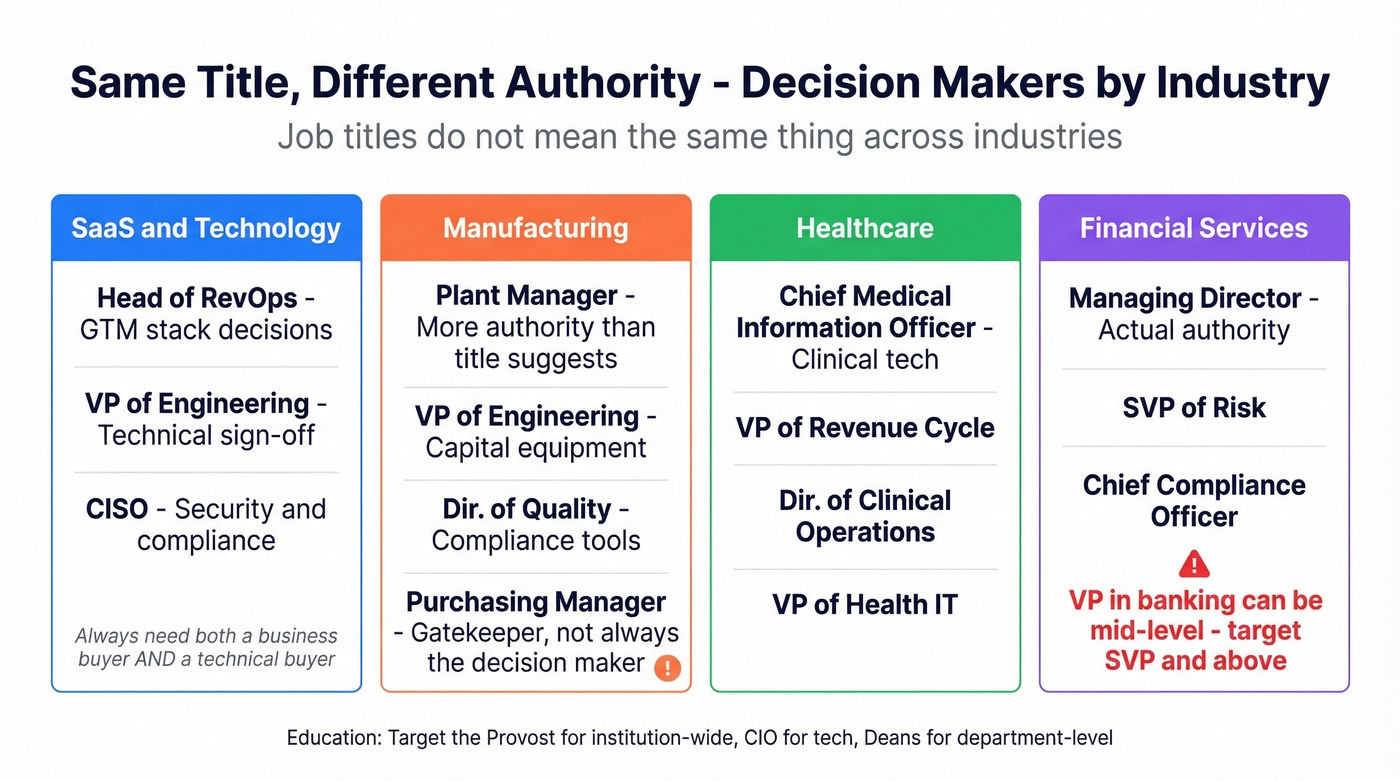
Job titles don't mean the same thing across industries. A "Vice President" at a bank might manage three people. A "Plant Manager" at a manufacturer might control a seven-figure operating budget.
SaaS & Technology
The buying committee here skews technical. You'll almost always need both a business buyer and a technical buyer. Target the VP of Engineering or CTO for technical sign-off, the Head of RevOps for GTM stack decisions, and the CISO for anything touching security or compliance. Managers and directors run evaluation, VPs own the budget, and C-suite steps in when the deal is strategic or large.
Manufacturing & Industrial
Most SaaS-centric title lists fall apart here. Manufacturing orgs have different power structures entirely. IndustrySelect's database of 360,000+ U.S. manufacturers maps the titles that matter across functions like Plant Management, Purchasing, Quality Control, Engineering, and Facilities & Maintenance.
Plant Managers often have more buying authority than their titles suggest. VPs of Engineering and R&D Directors own capital equipment decisions. Directors of Quality handle compliance tool budgets. The Purchasing Manager is the procurement gatekeeper - but not always the decision-maker. Don't underestimate Plant Managers.
Healthcare, Finance & Education
In healthcare, the Chief Medical Information Officer is often a key decision-maker for clinical technology. Also target the VP of Revenue Cycle, Director of Clinical Operations, and VP of Health IT.
Financial services is where title inflation hits hardest. In banking, "Vice President" can be a mid-level title. Target SVP and above for actual authority: Managing Director, SVP of Risk, Chief Compliance Officer, and senior leaders in digital banking.
For education, the power centers are the Provost or VP of Academic Affairs for institution-wide tools, the CIO for technology, and individual Deans for department-level purchases. The Chief Enrollment Officer is a newer title worth adding to your list.
Decision-Maker vs. Influencer vs. Blocker
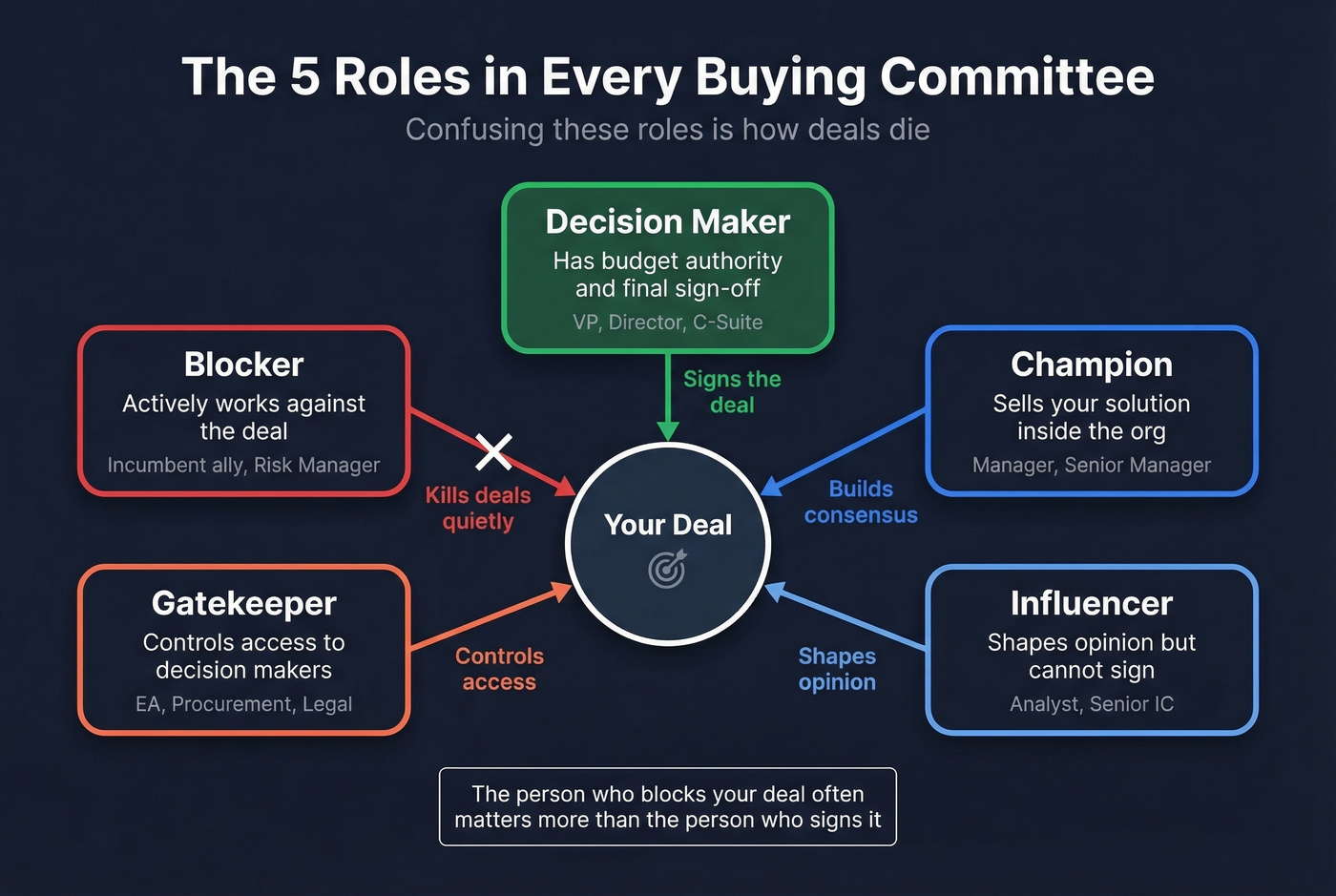
Not everyone in the buying committee has the same role. Confusing these roles is how deals die.
| Role | Definition | Typical Titles |
|---|---|---|
| Decision-Maker | Budget authority, final sign-off | VP, Director, C-suite |
| Champion | Sells your solution internally | Manager, Senior Manager |
| Influencer | Shapes opinion, can't sign | Analyst, Senior IC |
| Gatekeeper | Controls access to DMs | EA, Procurement, Legal |
| Blocker | Actively works against the deal | Incumbent ally, Risk Mgr |
Expanded frameworks like MEDDIC map up to 10 roles including Technical Buyer, Legal Reviewer, End User, Financial Approver, and Project Sponsor. For most deals, the five above are the ones that make or break you.
The person who blocks your deal often matters more than the person who signs it. We've seen deals killed by a "Senior Manager of Vendor Risk" who never appeared on any org chart - they weren't the decision-maker, weren't even the gatekeeper, but they had the ear of the CFO and didn't like the vendor's security posture. Deal dead.
74% of buying teams experience unhealthy internal conflict, which is why multi-threading matters. If your only contact loses the internal debate, your deal dies with them.
What a Mapped Buying Committee Looks Like
Say you're selling a $150K security awareness platform to a 2,000-person company. Your champion is the Director of Security, your economic buyer is the CISO, your technical buyer is the IT Ops Manager running the POC, and the blocker is the VP of Procurement who just renewed a competing contract. If you're only talking to the Director of Security, you're one internal meeting away from losing the deal.
Watch for the "self-proclaimed decision-maker" - someone who tells you they have authority but actually doesn't. Walnut's research recommends three validation questions:
- "Who else needs to weigh in before this moves forward?"
- "What's the approval process for a purchase of this size?"
- "Have you bought something similar before? Walk me through how that went."
If they can't answer question two with specifics, they're not the economic buyer.
Buying Authority by Seniority
These thresholds vary by company size, but they're directionally useful for prioritizing outreach:
| Seniority | Typical Approval Range | When to Target |
|---|---|---|
| Manager | $5-25K | Champion / evaluator |
| Director | $25-100K | Economic buyer, mid-deals |
| VP | $100-500K | Primary target, most B2B |
| C-suite | $500K+ | Enterprise deals only |
The best decision-maker to target isn't the one with the biggest budget - it's the one who just started the job. New executives decide where to spend 70% of their budget within their first 100 days. A freshly hired VP of Marketing is a better prospect than a CMO who's been in seat for three years with a locked-in stack.
Skip the CEO for anything under $100K. They don't care about your $30K platform - they've delegated that decision down the org chart. Context matters.
How to Find and Verify Decision-Makers
You've got the title list. Now you need the actual people.
Step 1: Define your ICP. Industry, company size, revenue range, geography. Without this, you're just building a list of random VPs. Use an Ideal Customer Profile template to keep targeting consistent across reps.
Step 2: Filter by title + department + seniority. This is where a B2B data platform earns its keep. Prospeo's 30+ search filters - job title, department, seniority, buyer intent, technographics, headcount growth, and funding signals - let you go from "VP of Marketing at SaaS companies with 50-200 employees" to a verified contact list in minutes.

Step 3: Layer intent signals and job-change triggers. This is how you catch new VPs and Directors during that critical first-100-days window when they're actively evaluating vendors and building their stack. Intent data tracking 15,000 topics via Bombora lets you combine the right title with in-market buying signals - so you're not just reaching the right person, you're reaching them at the right time. If you want a tighter system, build an intent based segmentation model.
Step 4: Verify contact data. A list of names and titles is worthless if the emails bounce. Look for 98%+ email accuracy with a data refresh cycle measured in days, not weeks. The industry average sits around six weeks, which means a lot of "verified" contacts have already changed jobs by the time you email them. If you're seeing issues, start with email bounce rate benchmarks and fixes.
Step 5: Map the full buying committee. Don't stop at one contact. For every account, identify the economic buyer, the champion, and at least one influencer. Multi-threading across 2-3 contacts per account is how you avoid the single-thread death spiral. The consensus on r/sales is pretty clear on this: reps who multi-thread close at roughly 2x the rate of those who don't. This is also a core account-based selling best practice.
Multi-threading across 7-8 stakeholders means you need verified contacts for every seniority level. Prospeo's 30+ search filters let you target by job title, department, seniority, and buyer intent - then returns direct dials and emails refreshed every 7 days.
Reach the economic buyer, the champion, and the exec sponsor in one search.
FAQ
What are decision maker job titles in B2B?
They're the roles with budget authority and final sign-off power for a specific purchase - typically VPs and Directors who own the relevant budget line, not necessarily the most senior person in the room. Common examples include VP of Sales, Director of Marketing Ops, CTO, CFO, and Head of Procurement. The key distinction is between someone who can approve spend versus someone who can only recommend it.
How many stakeholders are in a typical B2B deal?
The average B2B purchase involves 7-8 decision-makers, though Forrester puts the number at up to 13 stakeholders for complex enterprise deals. 92% of buying decisions involve two or more stakeholders, making single-threaded outreach a losing strategy.
How do I find verified contact info for decision-makers?
Define your ICP first, then filter by job title, department, and seniority using a B2B data platform. Layer in intent data and job-change triggers to prioritize accounts where buyers are actively evaluating solutions. Always verify emails before sending - a bounce rate above 5% damages domain reputation and tanks future deliverability.
What's the difference between a decision-maker and a gatekeeper?
A decision-maker holds budget authority and can approve a purchase. A gatekeeper controls access to that person without having signing power themselves. Executive assistants, procurement managers, and legal reviewers are common gatekeepers. Build relationships with gatekeepers, but don't mistake their involvement for buying authority.