

Building Relationships in Sales: A Framework That Replaces the Platitudes
You send 200 emails a week. Twelve bounce. Thirty hit the wrong person entirely. The rest land in inboxes belonging to people who've already researched your category, formed an opinion, and decided they don't want to talk to a rep.
Your manager's advice? "Just build more relationships." Cool. With whom? And how, exactly, in the next 10 calls?
Building relationships in sales isn't the problem - the advice about how to do it is. Most of it's vague, sentimental, and completely disconnected from modern outbound. Let's fix that.
The Short Version
If you're pressed for time, here's the framework:
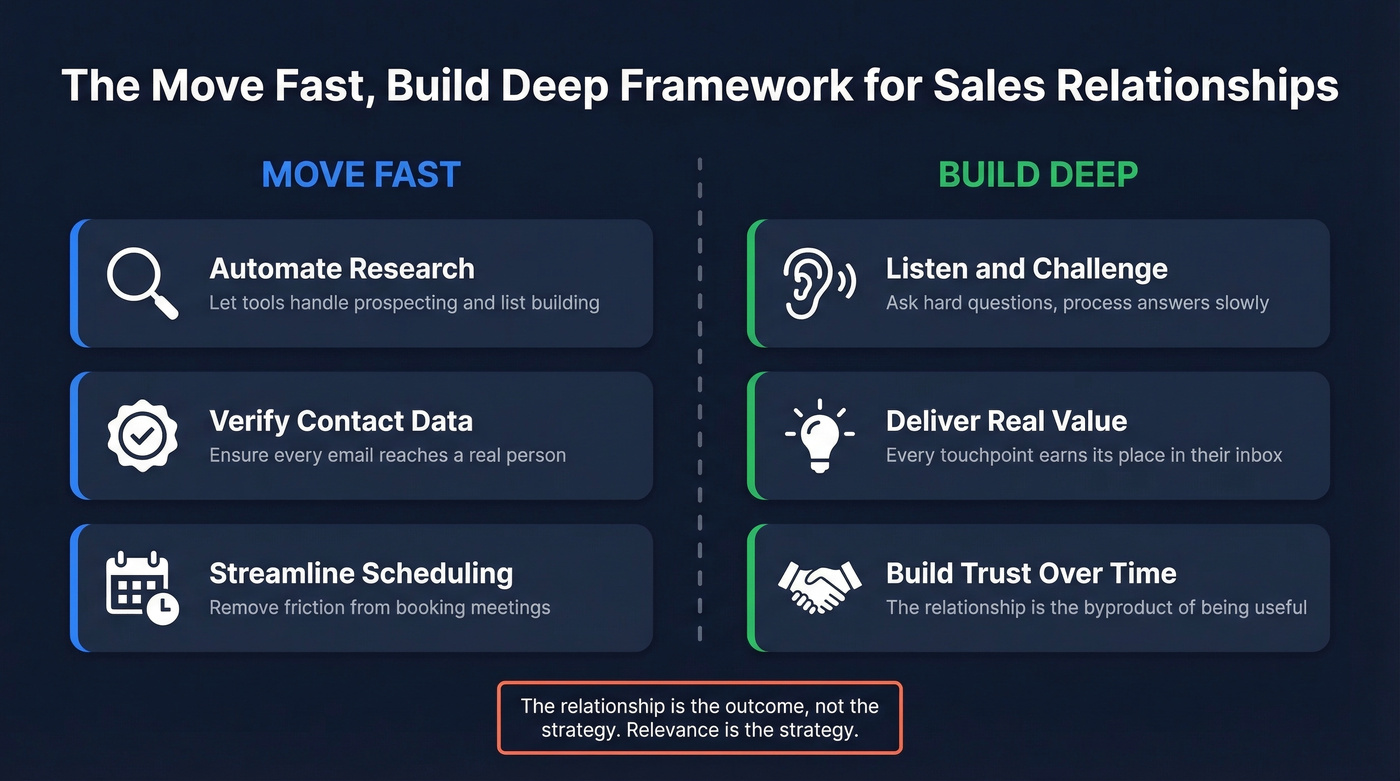
- Stop trying to "build relationships" - try to solve problems. The relationship is the byproduct of being genuinely useful. Nobody wants a new friend who happens to sell software.
- Move fast on logistics, go deep on conversations. Automate research, verification, and scheduling. Spend your human energy on listening, challenging assumptions, and delivering value.
- Systematize it. A CRM for tracking context. Verified contact data so your outreach actually reaches the right person. A sequencing tool for consistent, value-led follow-up.
That's the skeleton. The rest of this article puts muscle on it.
Why "Build Relationships" Is Terrible Advice
When someone on r/sales says relationship selling feels disingenuous, they're not wrong. The "I'm not trying to sell you anything, let's just have a chat" approach is transparent to every buyer who's been through it. They know your goal is revenue. You know your goal is revenue. Pretending otherwise doesn't build trust - it erodes it.
The Sandler crowd has this right. A senior buyer in that Reddit thread put it bluntly: "Tell me what problems you fix." That's more respectful than a gift card for a "value chat" that's really a discovery call in disguise.
73% of B2B buyers actively avoid sellers who send irrelevant outreach. That stat should terrify anyone whose relationship-building strategy is "send more emails and be friendly." Buyers aren't avoiding you because you're not likable enough. They're avoiding you because you're not relevant enough.
Here's the thing: "build relationships" describes an outcome, not a process. It's like telling someone to "be healthy" without mentioning diet, exercise, or sleep. What sellers actually need is a repeatable framework for being relevant, honest, and useful - consistently, at scale. (If you want scripts and patterns, start with sales techniques that hold up in modern outbound.)
Why It Matters More Than Ever
If relationship selling is so misunderstood, why bother? Because the alternative - pure transactional selling - is getting crushed by market dynamics.
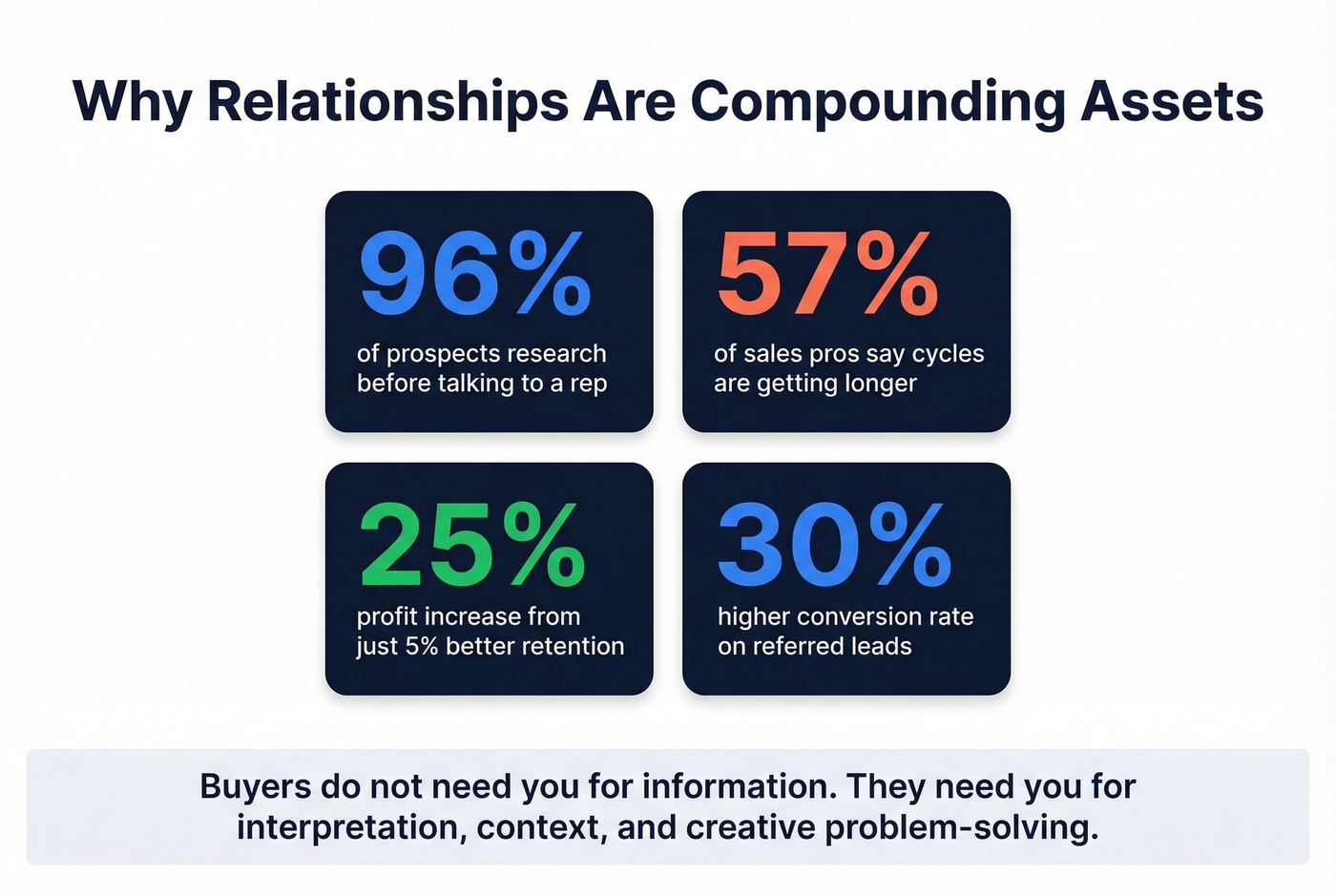
96% of prospects research companies and products before engaging a sales rep. 71% prefer independent research over talking to a rep at all. Buyers don't need you for information anymore. They need you for interpretation, context, and creative problem-solving. That's relationship territory.
Meanwhile, 57% of sales professionals say the sales cycle is getting longer. Longer cycles mean more touchpoints, more stakeholders, and more opportunities for a deal to die quietly in someone's inbox. The sellers who maintain trust across a 6-month enterprise cycle aren't the ones with the best pitch decks - they're the ones who've built enough relational equity that the champion keeps fighting internally on their behalf. In B2B, where buying committees can include six or more stakeholders with competing priorities, that internal advocacy is everything.
The business case is real. A 5% increase in customer retention increases profits by around 25%. Referred leads convert 30% better than cold leads. Returning customers spend 33% more. Relationships aren't soft skills - they're compounding assets.
We'll say it plainly: if you're in a market with commoditized products and transparent pricing, the buyer-seller relationship is the differentiation. It's the only thing your competitor can't copy.
How to Build Sales Relationships That Last
The framework we keep coming back to is simple: move fast, build deep. Automate everything that doesn't require human judgment. Then invest that freed-up time in conversations that actually matter. (For more concrete talk tracks, see these relationship selling strategies.)
Lead With the Problem, Not the Friendship
The best relationship sellers don't open with rapport. They open with relevance. Instead of "Hey, saw you went to Michigan - Go Blue!" try "Your team posted three data engineering roles last month. That usually means your pipeline infrastructure is under stress. Here's how we've helped similar teams."
This is Sandler-style directness applied to outbound. Be honest about what you sell and why you're reaching out. As one Forbes contributor noted, one of the most trust-building things you can do early is be honest about what your solution doesn't do. That kind of candor is rare enough to be memorable.
Rapport-building isn't about forced small talk - it's about bringing value to every interaction. Trust and active listening matter, and matching a buyer's communication style creates a more natural personal connection that doesn't feel manufactured.
Before and After: What Good Outreach Looks Like
Generic (before):
"Hi Sarah, I'd love to connect and learn more about your business. We help companies like yours grow revenue. Do you have 15 minutes this week?"
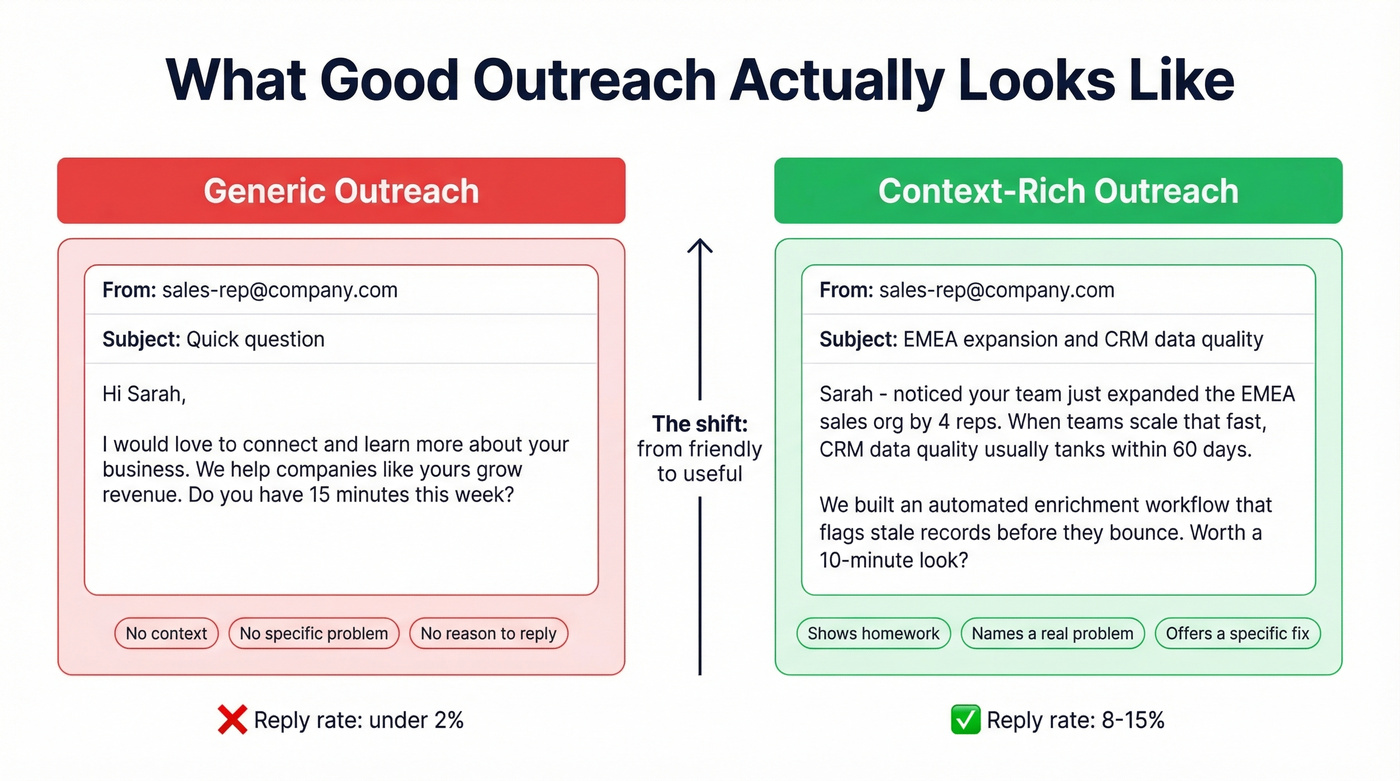
Context-rich (after):
"Sarah - noticed your team just expanded the EMEA sales org by 4 reps. When teams scale that fast, CRM data quality usually tanks within 60 days. We built an automated enrichment workflow that flags stale records before they bounce. Worth a 10-minute look?"
The second email isn't "warmer." It's more useful. It demonstrates homework, a specific problem, and a specific solution. The relationship starts because you were relevant - not because you were friendly. (If you need a tighter structure for these conversations, use a B2B discovery call framework.)
Follow Up With Value, Not "Just Checking In"
"Just checking in" is the three worst words in sales.
Every follow-up should deliver something: a relevant case study, a benchmark the prospect hasn't seen, a connection to someone in their space, or a specific insight about their market. We've watched teams transform their reply rates by replacing "bumping this to the top of your inbox" with a one-paragraph analysis of the prospect's competitive landscape. Five extra minutes of work. Completely different dynamic. Every touchpoint needs to earn its place in the prospect's inbox if you want trust to compound over time. (More templates: follow-up email.)

You can't build relationships with people you never reach. 12 bounced emails and 30 wrong contacts per 200 sends means your relationship-building strategy dies before it starts. Prospeo's 98% email accuracy and 7-day data refresh ensure every outreach hits a real person - so you can invest your energy in conversations, not cleanup.
Stop wasting rapport on wrong inboxes. Start with verified data.
Mistakes That Kill Sales Relationships
These eight mistakes show up constantly, and most sellers commit at least three regularly:
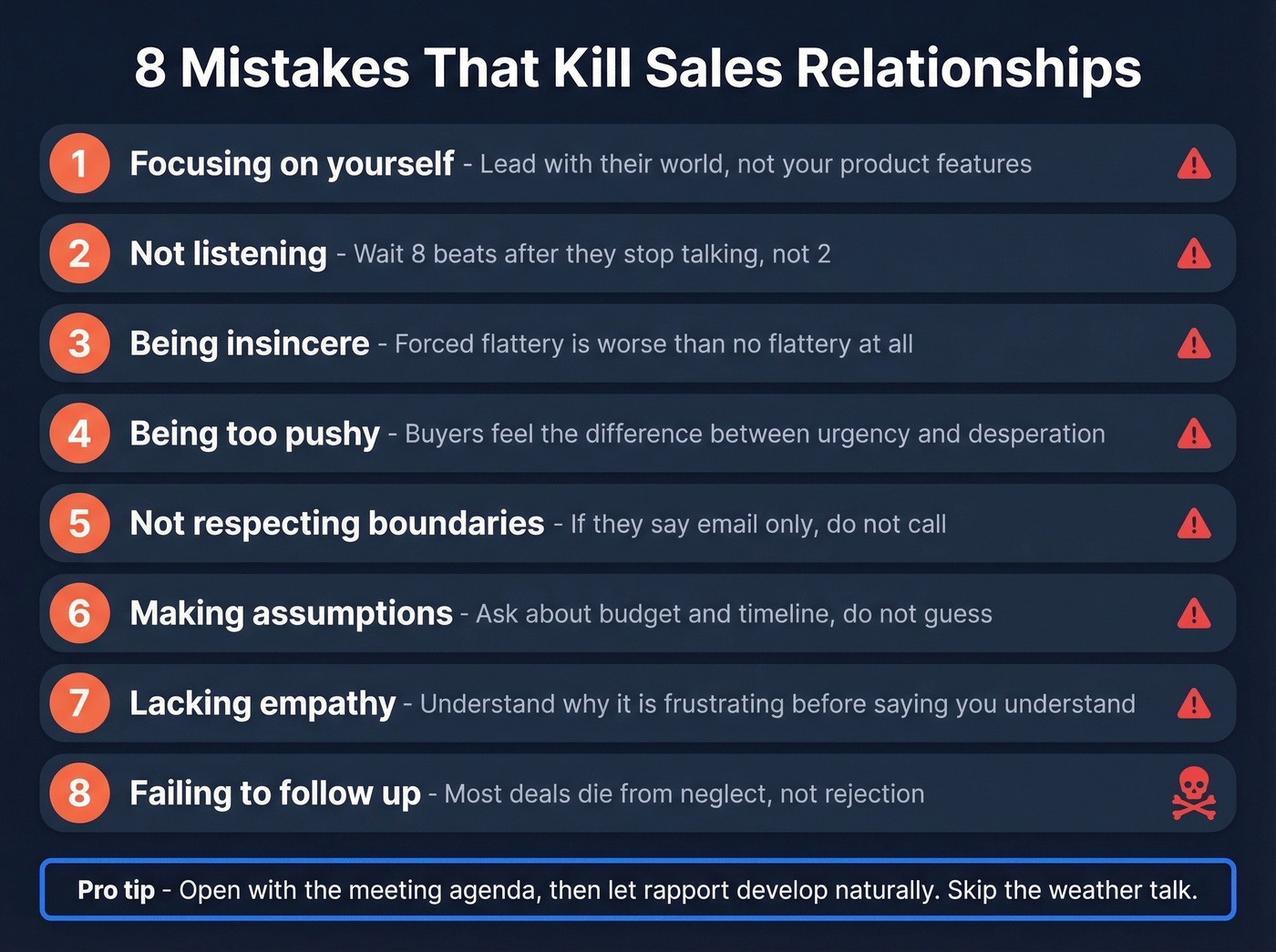
- Focusing too much on yourself. Your product features aren't interesting until the prospect believes you understand their problem. Lead with their world, not yours.
- Not listening. After the prospect stops speaking, wait eight beats before responding. Most sellers jump in after two. The silence feels uncomfortable, but it signals you're actually processing what they said.
- Being insincere. Forced flattery is worse than no flattery. "I love what you're doing at [Company]" means nothing if you can't name what they're doing.
- Being too pushy. There's a line between "this pricing expires Friday" and "I really need to close this by end of quarter." Buyers feel the difference instantly. (If this is a recurring issue, read up on high pressure sales.)
- Not respecting boundaries. If someone says "email only," don't call. Boundaries are instructions, not obstacles.
- Making assumptions. Don't assume budget, timeline, or decision process. Ask. The question itself builds trust. (A set of open-ended questions for sales calls helps here.)
- Lacking empathy. "I understand that's frustrating" only works if you actually understand why it's frustrating.
- Failing to follow up. Most deals don't die from rejection - they die from neglect.
One pattern worth calling out: building rapport before the meeting agenda makes you look like a time-waster. Open with the agenda, then let rapport develop naturally through the conversation. Skip the weather talk.
Personalizing Without Being Creepy
70% of B2B customers expect in-depth personalization. But there's a line between "personalized" and "I've been reading your entire digital footprint."
The Zendesk framework breaks this into three boundary types: legal (what you're allowed to track), company (what your org's policies permit), and personal (what the individual prospect is comfortable with). The third one matters most, and you can only learn it by paying attention.
Worth tracking: career milestones, professional goals, industry interests, and relevant hobbies they've mentioned in conversation. These create natural touchpoints - a congratulatory note on a promotion, a relevant article about their industry, a heads-up about a conference they'd enjoy.
Not worth tracking or mentioning: family details they haven't volunteered, personal social media activity, anything that makes the sentence "I noticed that you..." sound like surveillance. When in doubt, stick to professional context.
Scaling Relationship Selling With Better Data
Here's the tension: sales reps spend 60% of their time on non-selling tasks. Research, data entry, list building, email verification - all the logistics that eat into the time you could spend actually talking to people. Relationship selling at scale requires eliminating that friction. (If you're rebuilding the stack, compare sales outreach tools by workflow fit.)
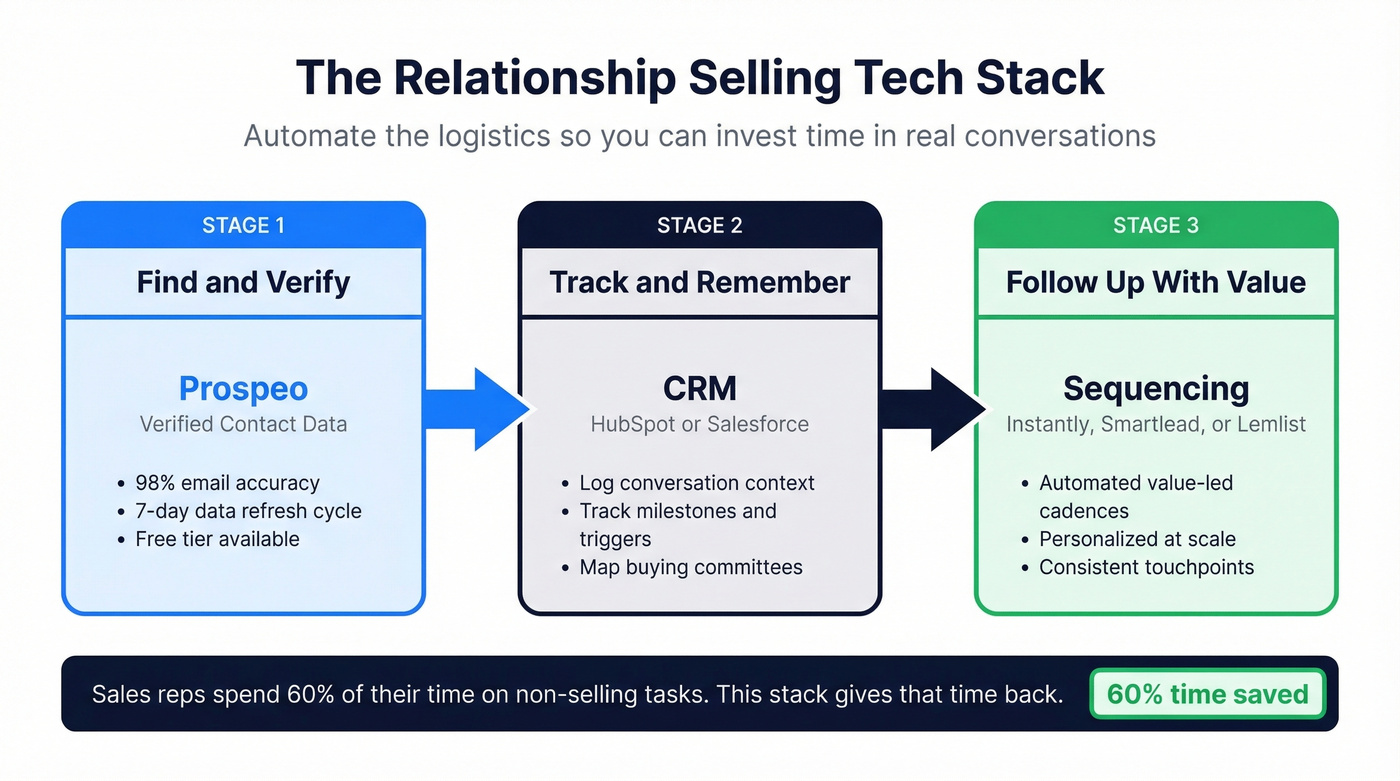
Think about the barriers between you and every prospect: social, cultural, technological, geographic. Your tech stack's job is to reduce those barriers so the human work - the actual relationship building - can happen.
| Tool Category | Recommended | Starting Price | Role in Relationship Selling |
|---|---|---|---|
| Verified Contact Data | Prospeo | Free tier available; ~$0.01/email on paid plans | Ensures outreach reaches verified contacts so the relationship can start |
| CRM | HubSpot / Salesforce | Free tier / ~$25-$100+/user/mo | Tracks relationship context, milestones, and conversation history |
| Sequencing | Instantly / Smartlead / Lemlist | ~$30-$150+/mo | Automates value-led follow-up cadence at scale |
The Data Quality Problem Nobody Talks About
You can't build a relationship with someone you can't reach. If emails bounce and phone numbers are dead, you're burning domain reputation before the relationship even starts. In our experience, most teams that blame their messaging or offer are actually sitting on lists where 15% of contacts are invalid. (If you're seeing deliverability issues, this guide on email deliverability & bad data is the fastest fix.)

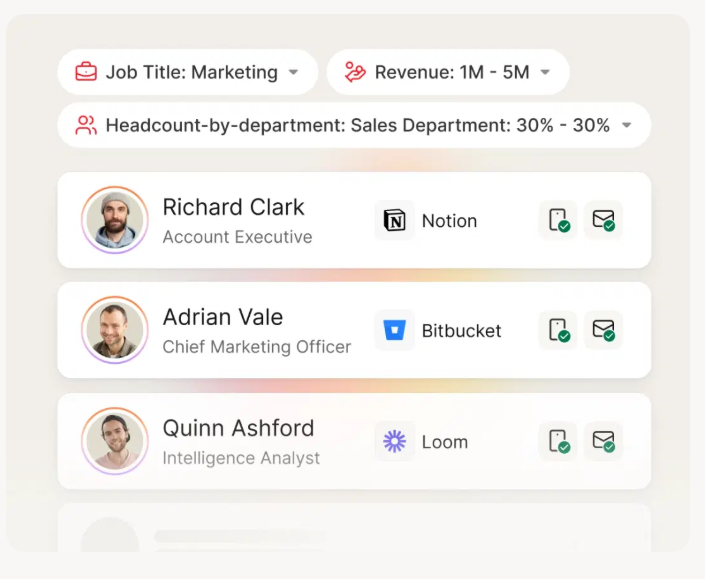
Prospeo handles this at the foundation level: 98% email accuracy, 143M+ verified emails, 125M+ verified mobile numbers with a 30% pickup rate, and a 7-day data refresh cycle while the industry average sits at six weeks. When your data's fresh, your first touchpoint actually lands. That's where every relationship starts.
Using Intent Data to Show Up Relevant
The difference between a cold email and a warm one isn't tone - it's timing. When a VP of Engineering is actively researching Kubernetes migration, your email about infrastructure tooling isn't cold anymore. It's contextual.
Intent data turns "I'm reaching out because you fit our ICP" into "I'm reaching out because you're evaluating solutions in this space right now." That relevance is the foundation of every strong buyer-seller relationship, and it's the fastest way to earn a reply from someone who ignores 95% of their inbox. (More on operationalizing this: contact-level ABM.)
Relationship Selling in the AI Era
The argument gaining traction on r/sales: AI systems will build closer relationships than humans - they can remember every preference, deliver tailored information instantly, and never have a bad day. It's a provocative take, and it's partially right.
AI handles personalization logistics brilliantly. It can draft context-rich emails, surface relevant talking points, and keep CRM data current without manual entry. Sellers who partner with AI tools are 3.7x more likely to meet quota. That's not a marginal improvement - it's a category shift.
But AI can't exercise judgment about when to push and when to back off. It can't be vulnerable about a product limitation in a way that builds trust. It can't read the room in a tense negotiation. The tools handle the data work - finding verified contacts, surfacing buying signals - so reps can focus on the human work that AI genuinely can't replicate.
AI won't replace relationship sellers. But it will replace sellers who think "being nice" is a strategy.
Context-rich outreach like the example above requires knowing who just hired, who expanded, and who's in-market. Prospeo's 30+ search filters - including headcount growth, job changes, and buyer intent across 15,000 topics - give you the research ammunition to lead with relevance instead of rapport tricks.
Turn five minutes of Prospeo research into outreach that earns replies.
FAQ
What is relationship selling vs. transactional selling?
Relationship selling prioritizes long-term trust and repeat business over closing a single deal, while transactional selling optimizes for the immediate conversion. Most B2B sales with deal sizes above $15K benefit from a relationship approach because longer cycles and multiple stakeholders demand sustained trust.
How long does it take to build a sales relationship?
It's not about calendar time - it's about value delivered per interaction. Some relationships solidify in two calls because you nailed the problem diagnosis. Others never develop despite months of generic touchpoints. Focus on solving real problems, not logging more activities.
Does relationship selling work in outbound?
Yes, but only if your first touchpoint is relevant and reaches the right person. A context-rich cold email to a verified contact beats a hundred generic messages to stale lists. Fresh, accurate data ensures your outreach actually lands before the relationship-building can begin.
What's the biggest mistake in relationship selling?
Treating it as a personality trait instead of a repeatable process. The sellers who consistently build strong connections have systems: research before every call, context tracked in CRM, and value-led follow-up sequences that deliver insights - not "just checking in" messages.
Is relationship selling dead because of AI?
No - AI makes it more efficient, not obsolete. AI handles data enrichment, personalization drafts, and CRM hygiene at scale. Humans handle judgment, trust, and creative problem-solving. Sellers using AI tools effectively are 3.7x more likely to hit quota.