

How to Write a Follow-Up Email That Actually Gets Replies
55% of cold email replies come from follow-ups, not the initial message. Meanwhile, response rates sit at just 0.12%, and 58% of consumers say they're overwhelmed by digital messages. Every follow up email you send is fighting for attention in a brutally crowded inbox, which means the ones you do send need to work harder than anything else in your outbox.
Most reps treat the follow-up as an afterthought - a quick "just checking in" dashed off between meetings. Stop that forever.
What You Need (Quick Version)
Three things separate follow-ups that get replies from follow-ups that get archived:
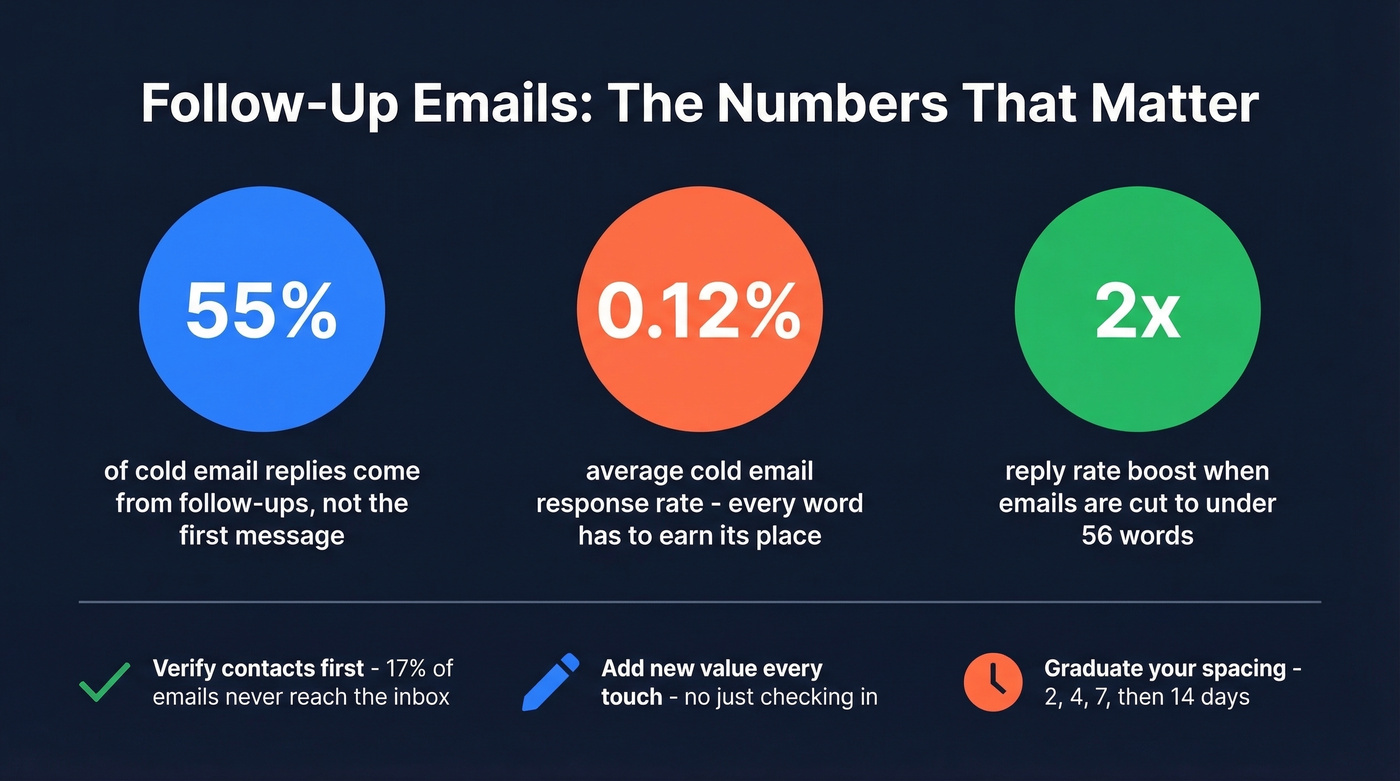
- Verify your contact data first. About 17% of emails never reach the inbox. Run your list through a verification tool before you send a single message.
- Write under 56 words. Add new value every touch. One clear CTA per email.
- Use graduated spacing - 2 days, then 4, then 7, then 14. The templates below handle the rest.
Why Most Follow-Ups Fail
The biggest follow-up killer isn't bad copy. It's bad infrastructure.
We've seen teams rewrite their sequences five times before realizing the real problem was that roughly 1 in 6 emails never reached the inbox. Email deliverability averaged around 83% as of recent data, which means if you're following up with unverified addresses, you're not just wasting time - you're actively damaging your sender reputation. High bounce rates trigger spam filters, which tank deliverability for every email you send after that, including the good ones.
Then there's the measurement problem. Apple Mail Privacy Protection inflates open rates with phantom opens. Gmail and Yahoo's bulk-sender authentication requirements (SPF, DKIM, DMARC) mean unauthenticated mail gets buried. If you're tracking opens as your primary metric, you're flying blind.
And the copy problem? "Just checking in" adds zero value. It tells the recipient nothing new and gives them no reason to reply. Every follow-up that doesn't introduce a fresh angle is a wasted touch.
Before you optimize a single subject line, verify your list. Prospeo's 5-step verification process catches invalid addresses, spam traps, and honeypots - delivering 98% email accuracy. Snyk's team of 50 AEs saw bounce rates drop from 35-40% to under 5% after switching their verification workflow, and AE-sourced pipeline jumped 180%.


Every follow-up you send to a bad address tanks your sender reputation and buries your next email in spam. Prospeo's 5-step verification catches invalid addresses, spam traps, and honeypots - delivering 98% email accuracy at $0.01 per email. Snyk's 50 AEs dropped bounce rates from 35-40% to under 5% and grew pipeline 180%.
Fix your deliverability before you rewrite a single follow-up.
What Is a Follow-Up Email?
A follow-up email is any message you send after an initial outreach or interaction that hasn't received a response - or that requires a next step. Whether you're nudging a prospect after a cold pitch or thanking an interviewer after a meeting, the purpose is the same: keep the thread alive without being annoying. Re-engaging a contact with new context, value, or a specific ask is what moves conversations forward.
How to Write a Follow-Up Email
Here's the process that actually moves reply rates.
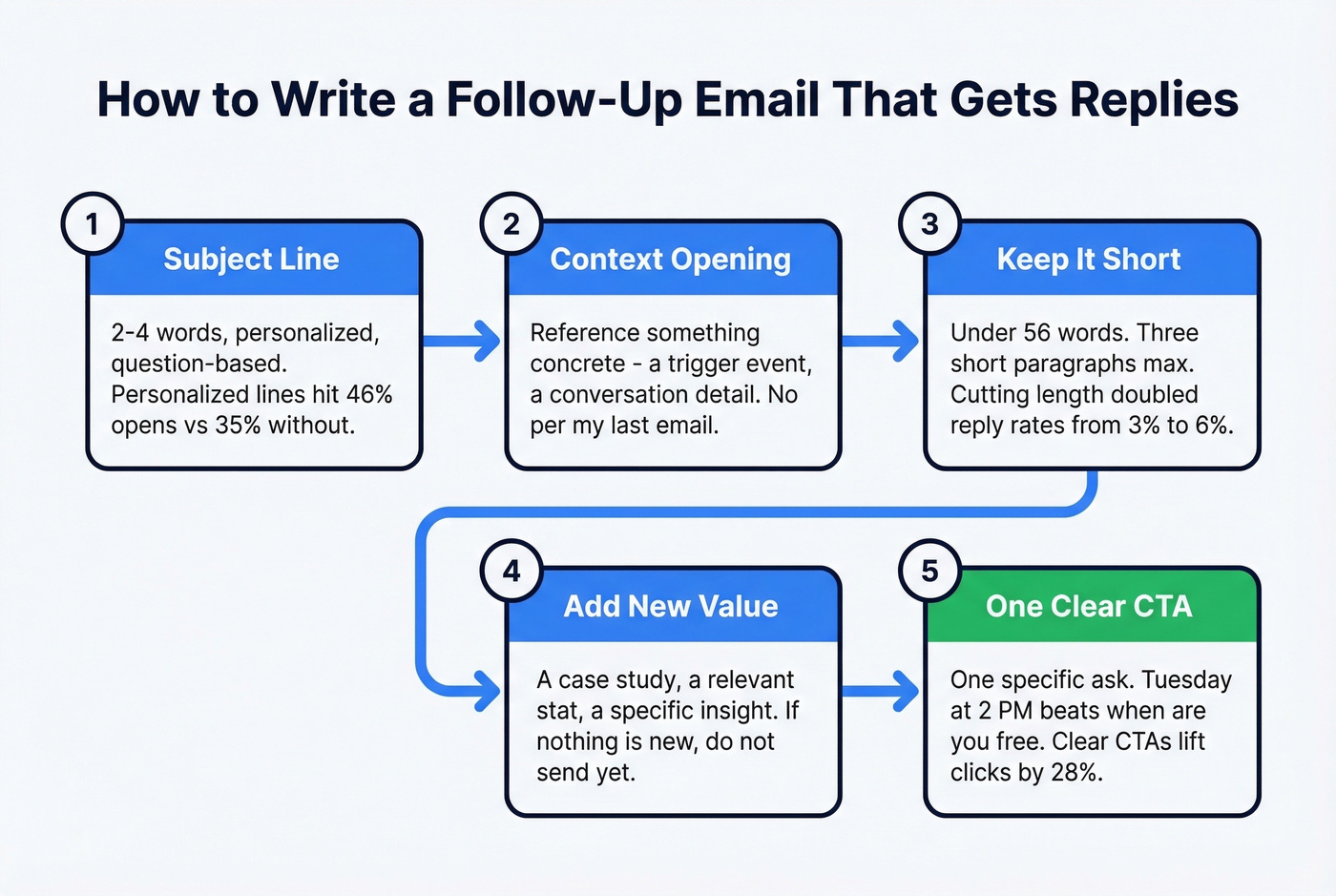
Start with the subject line. A Belkins study of 5.5 million emails found personalized subject lines hit 46% open rates versus 35% without. Reply rates doubled - 7% versus 3%. The sweet spot is 2-4 words, and question-based lines performed best. In one real-world cold email turnaround, a practitioner saw "Partnership opportunity" tank at under 19% opens.
Open with context, not "per my last email." Reference something concrete - a conversation detail, a trigger event at their company. The reader should know within five words why you're writing and why it matters to them.
Keep it brutally short. One Reddit practitioner documented cutting email length from 141 words to under 56 and watching reply rates double from 3% to 6%. Three short paragraphs max.
Add new value every touch. A case study, a relevant stat, a specific insight about their business. If you can't articulate what's new, don't send it yet. (If you need a framework, start with how to add value in sales.)
End with one clear CTA. Not two options. Not "let me know your thoughts." One specific ask - a 15-minute call on Tuesday, a yes/no on a proposal. Clear CTAs lift click-through rates by roughly 28% compared to ambiguous closes.
Great follow-up copy means nothing if you're emailing the wrong person. Prospeo's database of 300M+ profiles with 30+ filters - including job changes, buyer intent, and department headcount - lets you find the right decision-maker before you write a word. Data refreshes every 7 days, not 6 weeks.
Start every follow-up sequence with contacts that are actually reachable.
The Psychology Behind Replies
Templates get you started. Understanding why people respond gets you results that compound.
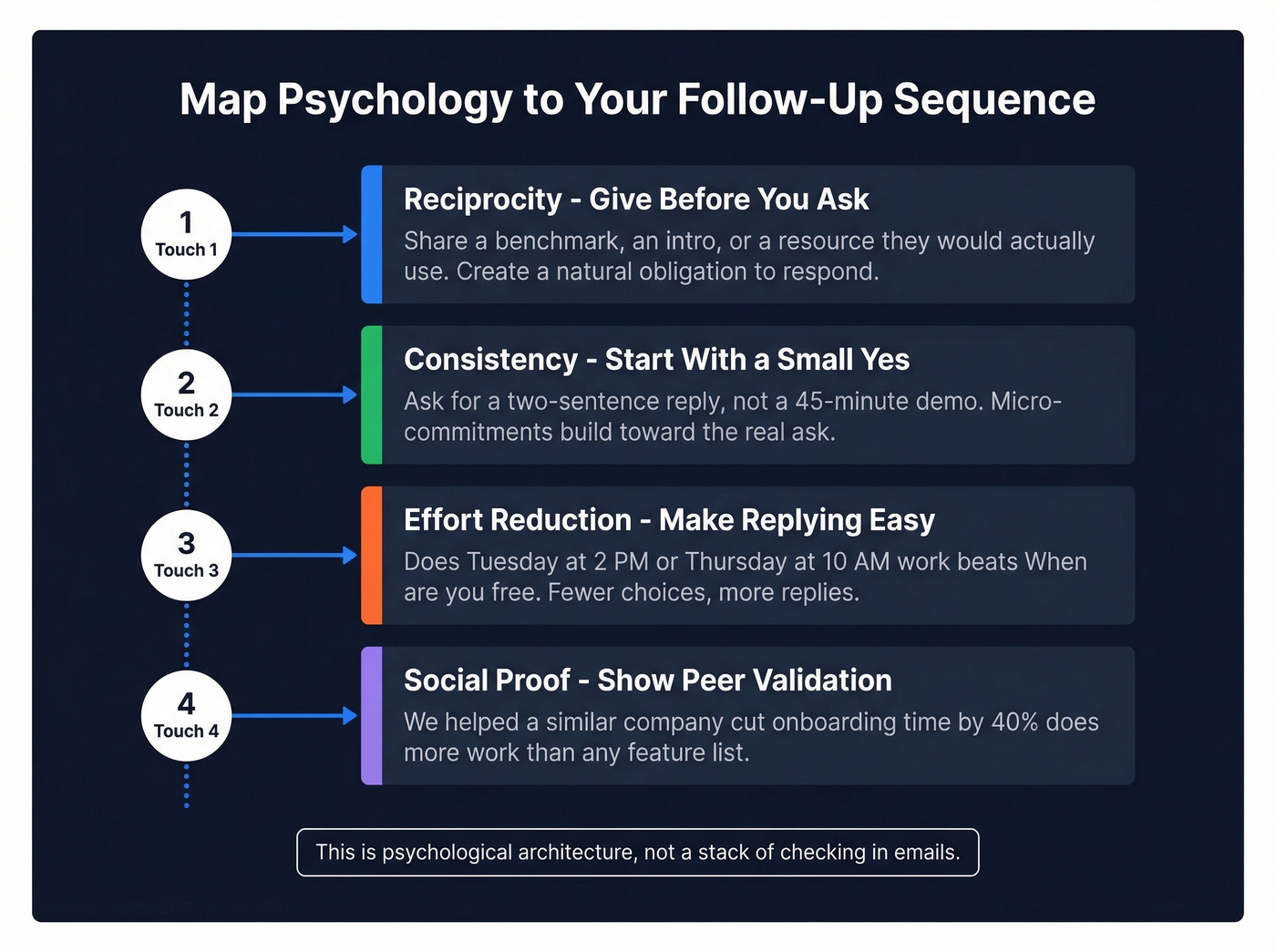
Reciprocity. Give something before you ask. Share a relevant benchmark, an intro, a resource they'd actually use. "I pulled together three case studies from companies in your space - happy to send them over" creates a natural obligation to respond.
Consistency. People who've said a small yes are far more likely to say a bigger yes. Your first follow-up shouldn't ask for a 45-minute demo. Ask for a two-sentence reply. Get micro-commitments that build toward the real ask.
Effort reduction. The easier you make it to reply, the more replies you get. "Does Tuesday at 2 PM or Thursday at 10 AM work?" beats "When are you free?" Fewer choices, lower cognitive load, higher response rate.
Social proof. "We helped [similar company] cut their onboarding time by 40%" does more work than any feature list. People trust what their peers have already validated, especially when the proof is specific to their situation.
Map each lever to a different touch in your sequence. Touch one gives value. Touch two asks a small question. Touch three makes responding effortless. Touch four drops a proof point. Now you've got a sequence with psychological architecture, not just a stack of "checking in" emails.
Follow-Up Email Templates
After No Response (Cold Sales)
Here's the thing: framing your message as a scheduling decision - not a sales pitch - gives the recipient a concrete, low-stakes reason to reply now. (For more options, see these sales follow-up templates.)
Subject: Quick question about [specific initiative]
Hi [Name],
I'm finalizing my schedule for next week and wanted to see if [Tuesday or Thursday] works for a quick call about [specific value prop].
If the timing's off, no worries - just let me know and I'll circle back when it makes sense.
After a Meeting or Demo
Subject: Next steps from our call
Hi [Name],
Great talking through [specific topic]. Two things stood out: [key pain point] and [their stated priority].
I'll send over [deliverable] by Friday. On your end, [their next step]. Does that track?
Referencing specific conversation details proves you were listening. Recapping next steps creates accountability on both sides.
After a Job Interview
Most candidates get this wrong: they send a generic thank-you that reads like every other candidate's. The fix is dead simple - reference one specific moment from the conversation that stuck with you.
Subject: Thanks - [specific topic from interview]
Hi [Name],
Your point about [specific challenge they mentioned] stuck with me - it's exactly the kind of problem I tackled at [previous role]. Looking forward to the next step.
Send within 24 hours. No exceptions.
After Networking or a Conference
Subject: Good meeting you at [event]
Hi [Name],
Enjoyed our conversation about [shared topic] at [event]. Would love to continue it - coffee or a quick call next week?
The 24-48 hour window keeps you fresh. The specific callback separates you from the 30 other "great to meet you" emails they'll get.
After Sending a Proposal
Subject: Related - [new value-add]
Hi [Name],
While you're reviewing the proposal, thought this might be useful: [relevant case study or resource]. [Similar company] saw [specific result] after implementing a similar approach.
Happy to walk through questions this week.
Adding new value beats "did you see my proposal?" every time. The case study gives them ammunition to sell internally.
The Break-Up Email (Last Touch)
Break-up emails often generate the highest reply rates in a sequence because they trigger loss aversion. Knowing that:
Subject: Closing the loop
Hi [Name],
I've reached out a few times and haven't heard back - totally understand if the timing isn't right. I'll close out my notes for now. If things change, I'm easy to find.
Skip the guilt trip. Skip the passive aggression. This template works because it's genuinely low-pressure, and that's exactly what makes people respond.
Follow-Up Cadence and Timing
The general consensus points to Tuesday through Thursday, 9-11 AM in the recipient's timezone, as the strongest window for B2B email. One practitioner reported a 16% lift in opens just from shifting sends to Tue-Thu mornings. But Twilio SendGrid's data scientists analyzed one dataset and couldn't find a statistically significant "best open time." The real answer: test your own data (or start with these benchmarks on the best time to send cold emails).
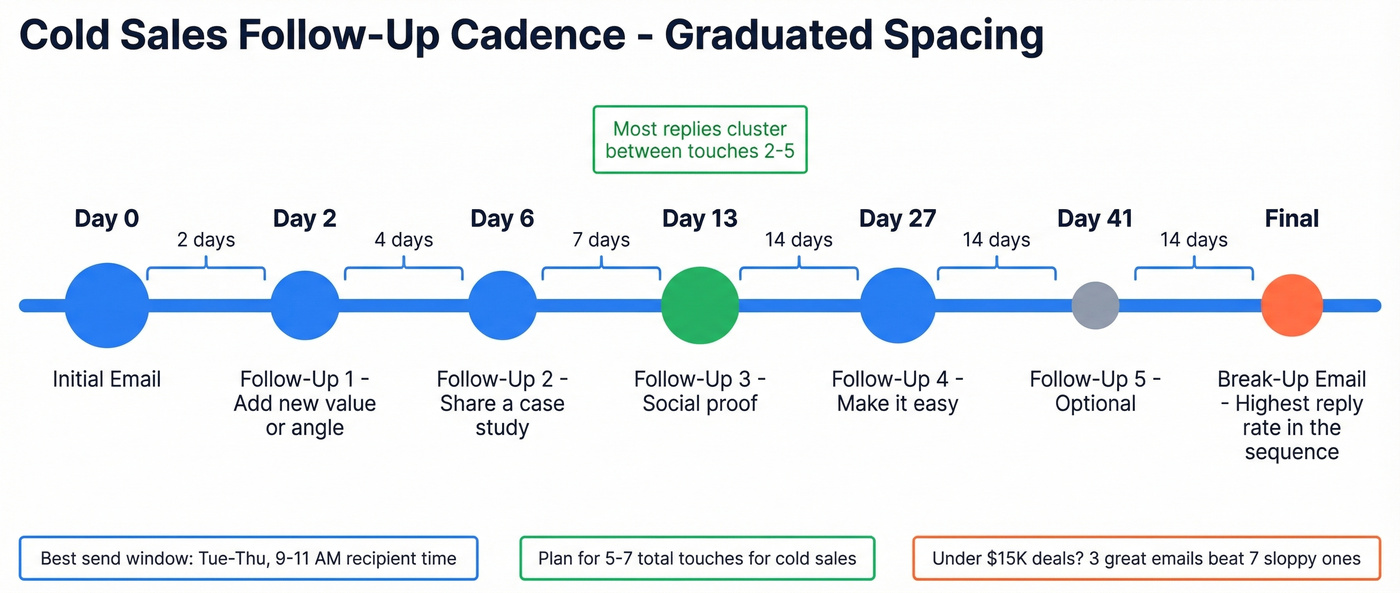
What doesn't vary is spacing. Static intervals look robotic. Graduated spacing mimics how a real human would follow up - more frequently at first, then backing off.
| Context | First Follow-Up | Spacing | Total Touches |
|---|---|---|---|
| Cold sales | 2-3 days | 2 > 4 > 7 > 14 days | 5-7 |
| Job application | 3-5 biz days | 7-10 days | 2-3 |
| Networking | 24-48 hours | 5-7 days | 2-3 |
| Post-meeting/demo | 24 hours | 3 > 7 days | 3-4 |
For cold sales, plan for 5-7 total touches. Most replies cluster between touches two and five. Stopping after one email leaves more than half your potential replies on the table. (If you want a full structure, build a B2B cold email sequence first.)
Let's be honest: if your deal size is under $15K, you probably don't need a 7-touch sequence. Three well-crafted messages with verified data will outperform seven sloppy ones sent to bad addresses. Match your cadence to the contract value.
Mistakes That Kill Your Reply Rate
"Just checking in" / "Touching base" / "Circling back." These phrases signal you have nothing new to say. They're the follow-up equivalent of dead air. If you need alternatives, use this guide on how to say just checking in professionally.
Bad: "Just wanted to touch base and see if you had any thoughts on my last email."
Better: "Saw [their company] just [trigger event]. Here's how that connects to what we discussed - [one sentence of value]."
Following up to unverified addresses. Every bounce chips away at your domain reputation. We've watched teams drop bounce rates from 11% to under 2% by verifying contacts, and reply rates doubled as a direct result. If your bounce rate is above 3%, pause and clean your list before sending another message. (More on benchmarks and fixes: email bounce rate.)
Same angle every email. If someone didn't reply to your value prop the first time, sending it again won't help. Map your sequence to the five core objections: no need, value isn't worth the cost, no urgency, don't want it, don't trust you. Five follow-ups, five objections.
Emails that don't look real. HTML templates with headers, footers, and tracking pixels scream "mass email." For cold follow-ups, plain text wins. Shortened links like bit.ly, image-heavy layouts, and broken merge tags ("Hey [FIRSTNAME]") all trigger spam filters too. (If you're troubleshooting placement, start with an email deliverability guide.)
Emails that are too long. That Reddit case study bears repeating: 141 words down to 56, reply rate from 3% to 6%. If your follow-up has more than three short paragraphs, cut it in half.
Tools That Improve Results
The right stack handles verification, sequencing, and tracking without breaking the bank. One cold email operator on Reddit reported running their entire outreach infrastructure for about $420/month.
| Category | Tool | Starting Price | Best For |
|---|---|---|---|
| Verification | Prospeo | Free (75/mo); ~$0.01/email paid | Verifying contact data before sending |
| Sequencing | Instantly | ~$30/mo | Cold email automation |
| Sequencing | Lemlist | ~$39/mo/user | Multi-channel sequences |
| CRM | HubSpot Sales Hub | Free; paid plans available | Follow-up tracking |
| CRM | Pipedrive | ~$15-25/user/mo | Lightweight pipeline |
| Email finding | Hunter | Free tier; paid from ~$49/mo | Domain email search |
For teams that want to consolidate verification and prospecting, Prospeo's Email Finder covers 300M+ professional profiles at 98% accuracy - so you aren't juggling separate tools for finding and verifying contacts. If you're comparing options, start with follow up email software and a dedicated email reputation tools checklist.
FAQ
How many follow-up emails should I send?
Plan for 3-7 touches depending on context. Cold sales sequences typically run 5-7 emails; job applications warrant 2-3. Since 55% of cold email replies come from follow-ups, stopping after one message leaves most potential responses on the table.
How long should I wait before following up?
Use graduated spacing: 2 days, then 4, then 7, then 14. For sales, send the first follow-up within 2-3 days. After meetings or interviews, follow up within 24 hours. Networking contacts get a 24-48 hour window.
What's a good reply rate for follow-up emails?
For cold outbound, 3-6% is realistic. The Reddit case study hit 6% after fixing deliverability, shortening copy, and optimizing timing. Warm follow-ups - post-meeting, post-demo - should run 10-30% depending on prior engagement.
How do I know my follow-ups are reaching the inbox?
Track reply rates, not open rates - Apple MPP inflates opens with phantom data. If your bounce rate exceeds 3%, pause and verify your list. A 5-step verification process that catches spam traps and honeypots is the foundation for reliable inbox placement.
What's the best subject line for a follow-up email?
Keep it 2-4 words, personalized, and question-based. A Belkins study of 5.5M emails found personalized subject lines hit 46% open rates vs. 35% generic. "Quick question about [initiative]" consistently outperforms vague lines like "Following up" or "Checking in."
The best follow up email is the one that actually reaches the inbox. Verify first, write short, add value every touch - and your reply rates will reflect the effort.