

Transactional Selling: When It Works, When It Fails, and How to Do It Right
Your manager pulls you aside after a deal review. "You're being too transactional." You closed the deal. The customer's happy. But somehow you're getting coached on it like it's a problem.
Transactional selling isn't inferior to consultative selling - it's a different tool for a different job. The problem is most reps don't know when to reach for which one, and most advice on the topic stops at "create urgency" and "build rapport" without telling you how to actually execute. Let's fix that.
What Is Transactional Selling?
A transactional sale is one where the buyer has enough information to decide with minimal conversation. The downside of a wrong choice is low, the product is well-understood, and the rep's job is to remove friction - not uncover hidden pain.
Efficiency is the lever, not discovery depth. Consultative selling is the opposite motion: deep discovery, multi-stakeholder alignment, longer cycles. Both work. Neither is universally better. The mistake is treating them as a hierarchy instead of a toolkit.
Why This Approach Matters More Now
Buyers don't need you the way they used to. By 2026, 80% of B2B sales interactions happen in digital channels, and buyers spend just 17% of their buying time meeting with suppliers. A 6sense study found 69% of decisions are effectively made before a buyer ever talks to a rep - and 81% already have a preferred vendor at first contact. McKinsey's "rule of thirds" confirms it: at every buying stage, a third of buyers prefer in-person, a third prefer remote, and a third prefer fully digital self-serve.
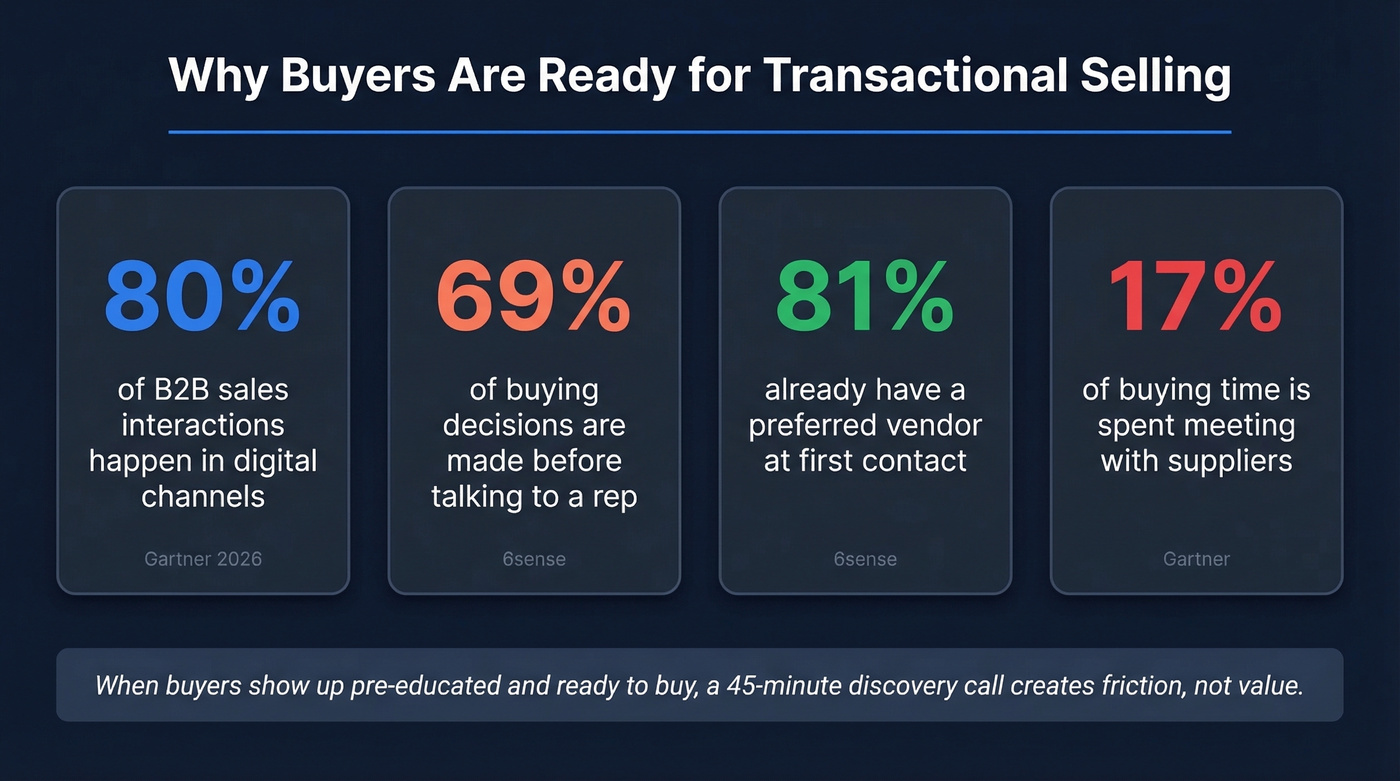
When buyers show up pre-educated and ready to buy, adding a 45-minute discovery call doesn't create value. It creates friction. Some commentators argue transactional sales are obsolete in a world of complex SaaS, but self-serve buying is accelerating, not shrinking.
Transactional vs. Consultative: A Decision Framework
The choice isn't philosophical. It maps to five concrete variables:
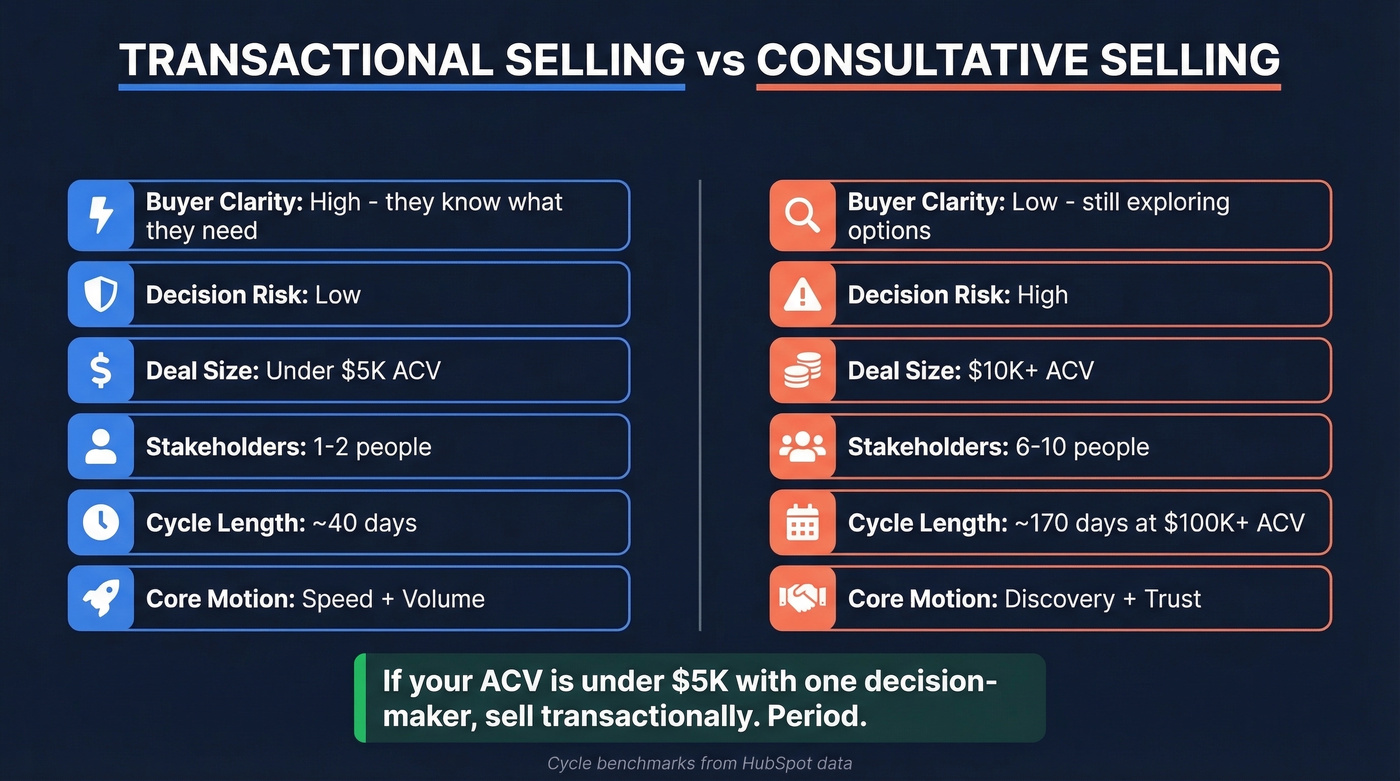
| Criteria | Transactional | Consultative |
|---|---|---|
| Buyer clarity | High - knows what they need | Low - exploring options |
| Decision risk | Low | High |
| Deal size | Under ~$5K | $10K+ |
| Stakeholders | 1-2 | 6-10 |
| Cycle length | ~40 days | ~170 days (at $100K+ ACV) |
| Core motion | Speed + volume | Discovery + trust |
Those ACV-to-cycle benchmarks come from HubSpot data: deals under $5K ACV close in roughly 40 days, while $100K+ deals stretch past 170 days.
If your ACV is under $5K and you have one decision-maker, sell transactionally. Period.
We've seen reps placed in roles where the lead environment and product complexity demand consultative behavior, but the comp plan rewards transactional volume. That's a job-design problem, not a skills problem.

Transactional deals are won on speed and volume - but only if your emails actually land. One bad bounce rate tanks your domain and kills every sequence after it. Prospeo delivers 98% email accuracy with a 7-day refresh cycle, so your high-velocity outbound hits real inboxes every time.
Stop losing transactional deals to bounced emails and stale data.
When the Transactional Approach Works
Transactional selling thrives in B2B SaaS where the product is self-explanatory and a single buyer can sign off. Stripe, HubSpot Starter, BambooHR - these are transactional SaaS products by design. Self-serve tools like Mailchimp, Semrush, and QuickBooks Online take it further: the entire cycle happens without a rep.
It also works for post-contract reorders. A customer won through consultative selling doesn't need another discovery call to add licenses. The hybrid model - consultative to acquire, transactional to maintain - is one of the most underrated motions in B2B. If you're running a PLG funnel with expansion revenue, you're already doing this whether you've named it or not.
When Transactional Selling Fails
Here's the contrarian take most guides won't give you: transactional selling isn't simple. In competitive markets, it's harder because your only differentiation levers are speed and data quality. Every other vendor can match your price. Few can match your responsiveness.
This approach breaks down the moment the buyer is making a rare, strategic decision where getting it wrong actually hurts. If someone's choosing a new ERP or signing a three-year security contract, a quick pitch and a discount won't win - it'll lose. And when buyers design RFPs to force commoditization, playing transactionally means competing on price alone with zero leverage.
The strategic risks compound over time: dependence on constant new acquisition, exposure to seasonality, and discount addiction that erodes margins. As one r/sales AE put it, "price becomes the sole focus" when you skip discovery - you can't uncover the emotion behind the buyer's pain. Skip this approach entirely for deals above $10K with buying committees. You'll burn cycles and lose on trust.
Real talk: when your manager says you're "too transactional," they don't mean slow down. They mean you're jumping to features and price before understanding what the buyer actually needs.
How to Close Transactional Deals Faster
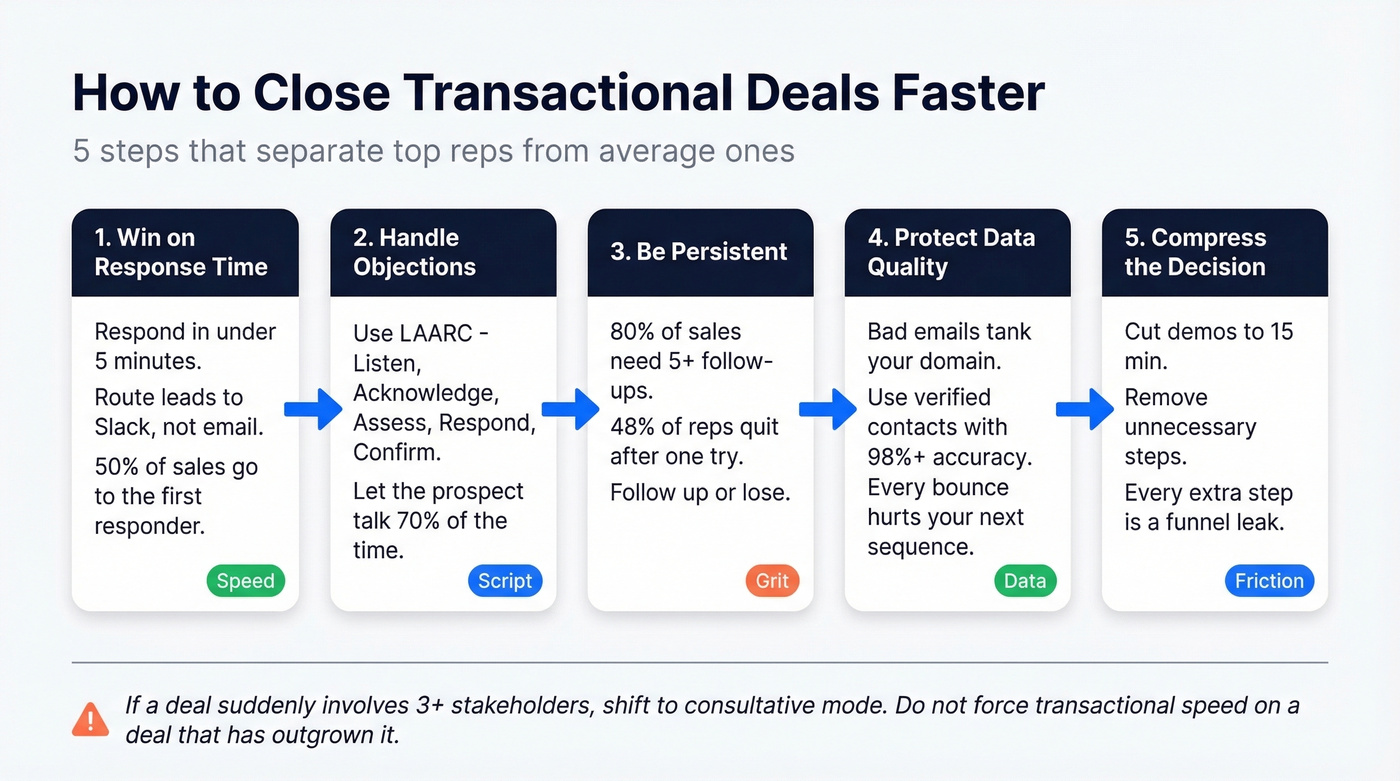
If your deal profile fits the transactional framework, here's what actually works. In our experience, the reps who win these deals aren't smoother talkers - they're faster responders with cleaner data.
Win on Response Time
Up to 50% of sales go to the first vendor that responds. If a lead comes in at 2pm and you call at 4pm, you've already lost ground. Automate your first touch. Get a human follow-up within minutes, not hours. We've watched teams cut their speed-to-lead from 90 minutes to under 5 just by routing inbound notifications to Slack instead of email - and their conversion rate jumped 22%.
If you want to systematize this, build it into your sales activities and your sales process optimization.
Handle Objections with Scripts
Use the LAARC framework - Listen, Acknowledge, Assess, Respond, Confirm - and follow the 70/30 rule where the prospect talks 70% and you talk 30%.
"I don't have time" - "Totally fair. Can I get 30 seconds? We help teams like yours [specific value prop]. If that doesn't resonate, I'll let you go."
"I need to check with my boss" - "Makes sense. What would make this a no-brainer for them? I'll send a one-pager that answers their top concern."
For more ready-to-use language, keep a set of sales follow-up templates and a tight talk track.
Be Persistent
60% of buyers reject an offer four times before saying yes, but 48% of reps never follow up after the first objection. 80% of successful sales require five or more follow-up touches. Persistence isn't annoying in fast-cycle deals - it's the job.
If you're trying to improve this systematically, focus on the importance of follow-up in sales and track your follow-up email reply rate.
One signal to watch: if a deal suddenly involves 3+ stakeholders, that's your cue to shift to consultative mode. Don't force transactional speed on a deal that's outgrown it.
Protect Your Data Quality
Transactional outbound at scale lives or dies on deliverability. If too many of your emails bounce, your domain reputation tanks and every subsequent sequence lands in spam. Prospeo's 98% email accuracy and 7-day refresh cycle keep sequences landing in real inboxes - at roughly $0.01 per email with a free tier, it's built for the volume high-velocity selling demands.
If you want the deeper mechanics, start with email deliverability and monitor your email bounce rate.

Compress the Decision
Remove every unnecessary step between interest and signature. If the buyer can self-serve a trial, let them. If they need a demo, make it 15 minutes, not 45. Every added step is a leak in your funnel. I once watched a team cut their demo from 30 minutes to 12 and saw close rates go up - turns out the extra 18 minutes were just filler that gave prospects time to second-guess themselves.
If you need a tighter structure, use a product demo checklist and a clear set of steps to close a sale.
KPIs to Track
Transactional motions need different metrics than consultative ones.
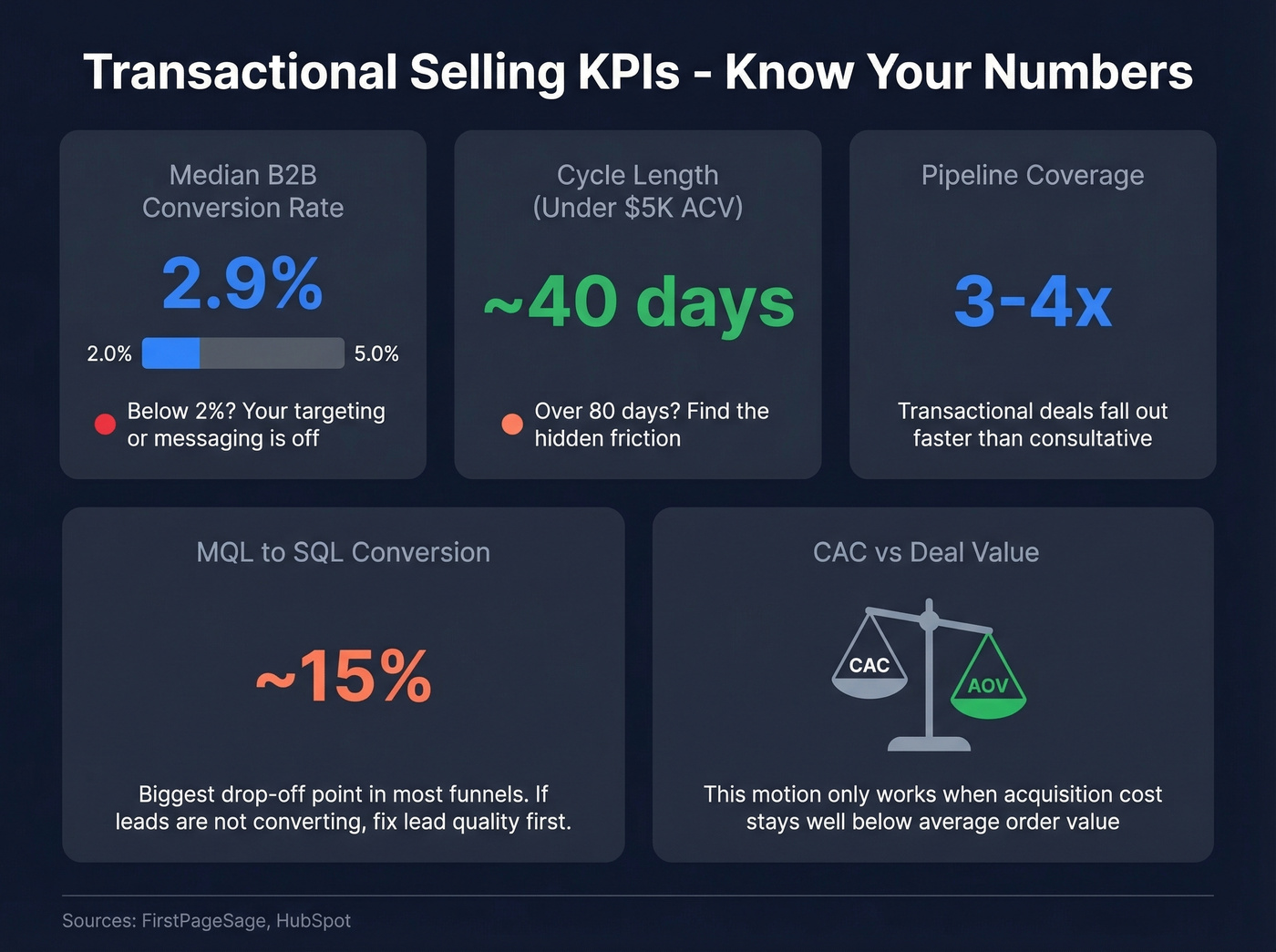
The median B2B conversion rate sits at 2.9%, with a typical range of 2.0-5.0%. If you're below 2%, your targeting or messaging is off. Benchmark cycle length against your ACV: deals under $5K should close in ~40 days, and if you're at 80+, something's adding friction you haven't identified.
Maintain 3-4x pipeline coverage because transactional deals fall out faster than consultative ones. Watch your MQL-to-SQL conversion closely - the biggest drop-off in most funnels sits around 15%, and if your leads aren't converting, your lead quality is the problem, not your selling. Track CAC against deal value. This motion only works when acquisition cost stays well below AOV.
To benchmark and diagnose, compare against average B2B lead conversion rate and keep an eye on pipeline health.
When your ACV is under $5K and speed wins the deal, you can't afford to waste cycles on bad contact data. Prospeo gives you 300M+ verified profiles with 30+ filters - find the right single decision-maker, grab their verified email, and fire off your sequence in minutes, not hours. At ~$0.01 per email with a free tier, it's built for transactional volume.
Be the first vendor to respond with data you can trust.
FAQ
What does "too transactional" mean as manager feedback?
It means you're skipping discovery and jumping to price or features before understanding the buyer's situation. The fix: ask two or three deeper questions before presenting solutions, even in fast-cycle deals. You can still close quickly - just show you listened first.
Is transactional selling obsolete?
No - the motion is growing, not dying. Self-serve purchasing, PLG funnels, and digital-first buyers all favor transactional speed. What's obsolete is using a transactional approach on deals that require consultative depth. Match the motion to the deal profile and it remains one of the most efficient paths to revenue.
What's the difference between transactional and consultative selling?
Transactional selling optimizes for speed on low-risk, high-clarity deals under $5K ACV with one or two stakeholders. Consultative selling invests in deep discovery for complex, high-ACV deals with multiple decision-makers. Most mature sales orgs use both - consultative to land new accounts, transactional to expand them.
What tools support high-velocity sales at scale?
You need a sequencer like Instantly or Smartlead, a CRM like HubSpot or Salesforce, and verified contact data. Prospeo handles the data layer with 98% email accuracy, 125M+ verified mobiles, and a free tier of 75 emails per month - pair it with your sequencer and you're running.