

Buying Groups: The Definitive Guide to All Three Meanings
The term "buying groups" is broken. It refers to three completely different things - B2B sales committees, bulk-discount purchasing organizations, and credit card reward schemes. They share a name and almost nothing else.
Most content covers only one meaning and ignores the other two. That's a problem when you're trying to figure out which version actually applies to your situation. This guide covers all three with real data, honest assessments, and practical frameworks you can act on today.
Quick disambiguation:
- B2B buying group - the committee of 3-20+ people who influence a purchase decision inside a company, with 6-10 being the most common range. If you're in sales, marketing, or RevOps, this is your world.
- Group Purchasing Organization (GPO) - an entity that pools buying power across companies to negotiate bulk discounts. Membership is often free.
- Credit card / resale buying group - individuals who buy promotional items for a group and profit via stacked credit card rewards. It's a side hustle, not a business model.
If you're in B2B sales or marketing, keep reading. For GPOs, jump to Section 6. For credit card buying groups, jump to Section 7.
Why Buying Groups Matter in B2B Sales
A B2B buying group is the collection of stakeholders inside (and increasingly outside) a company who collectively influence a purchase decision. It's not one decision-maker signing a check. It's the champion who found your product, the CFO who needs an ROI model, the IT lead who'll vet your security posture, the end users who'll revolt if the UX is terrible, and the procurement team who'll grind your pricing down.
The concept isn't new. Thomas V. Bonoma defined the "buying center" in a 1982 Harvard Business Review article, identifying six roles that influence corporate purchases. What's changed is the scale. Forrester's State of Business Buying 2026 report found that the average B2B purchase now involves 13 internal stakeholders and 9 external participants. When the purchase includes generative AI features, the committee doubles in size.
Here's why this matters operationally: leads are too narrow, and accounts are too broad. A single lead doesn't represent the 13 people who'll weigh in on your deal. An account-level view doesn't tell you which opportunity is active or who's involved. The buying group sits in the middle - it aligns your GTM motion to the actual unit of decision-making.
The stakes are steep. 86% of B2B purchases stall during the buying process, and 81% of buyers end up dissatisfied with the provider they choose. Buyers spend roughly 17% of their total buying time with potential suppliers - the rest is internal research, peer consultation, and committee alignment. Economic pressure has pushed the point of first seller contact from 69% to 61% of the way through the buyer's journey, meaning purchase committees are forming opinions long before you get a meeting.
Buying Group vs. Committee vs. Center
These three terms get used interchangeably. "Buying center" is the academic term from Bonoma's 1982 framework. "Buying committee" is what you'll hear in sales meetings. "Buying group" is the modern GTM standard that Forrester and most revenue platforms have adopted. Use whichever your org prefers - they all point to the same reality: multiple people, multiple agendas, one purchase decision.
The 5 Roles in Every B2B Committee
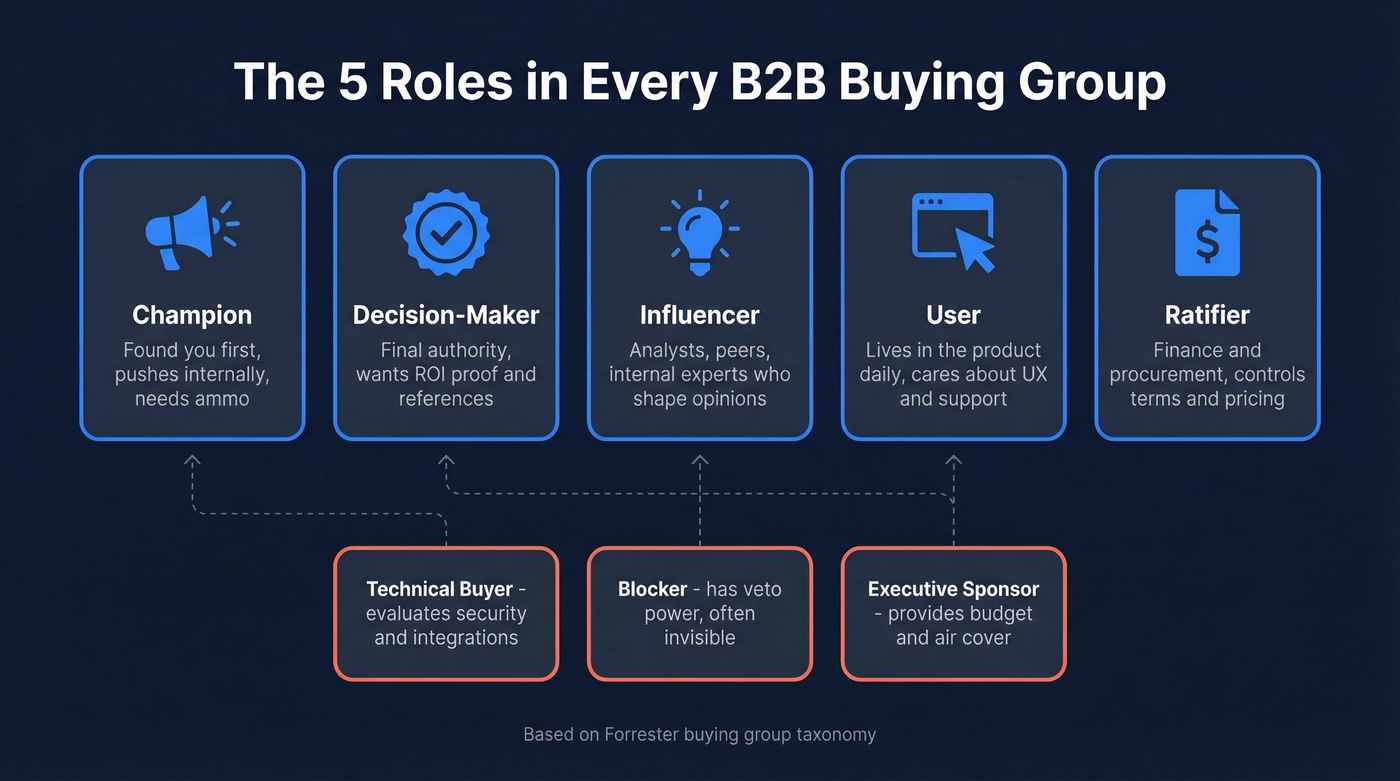
Forrester's five-role taxonomy is the most actionable framework for mapping decision-makers inside a target account:
| Role | What They Care About | How to Engage Them |
|---|---|---|
| Champion | Seller credibility, rapport | Give early access, co-create the business case |
| Decision-Maker | Business/financial value | Share customer references, build the ROI model |
| Influencer | Implementation, pricing | Provide analyst reports, peer proof points |
| User | Support quality, UX | Offer trials, surface peer reviews |
| Ratifier | Terms, conditions, cost | Lead with pricing transparency, clear SLAs |
Champions are your internal advocates - they found you, they're pushing for you, and they need ammunition. Decision-makers have final authority and scrutinize business value; customer references and prior vendor experience carry the most weight here. Influencers include both internal stakeholders and external voices like analysts, journalists, and industry peers. They're often not swayed by sales reps directly, which is why third-party validation matters so much.
Users become active mid-to-late in the process and are heavily influenced by trial experiences and peer input. Ratifiers - typically finance and procurement - focus on terms and pricing. They shape the deal earlier than most sellers realize through cost constraints and approval workflows.
Beyond these five, you'll encounter practical roles that don't map neatly to the taxonomy. The technical buyer evaluates integration, security, and implementation complexity (see technical buyer). The blocker has veto power and may never attend a single meeting - they kill deals through internal channels. The executive sponsor provides air cover and budget authority. And the economic buyer owns the ROI calculation and total cost of ownership analysis (see economic buyer).
The simplest discovery question that surfaces these roles: "Who else will be involved in this decision?" Procurement teams self-identify as decision-makers 53% of the time, and C-suite leaders do so at 68%. Don't assume the person on your demo call represents the full committee.
Key B2B Buying Group Stats for 2026
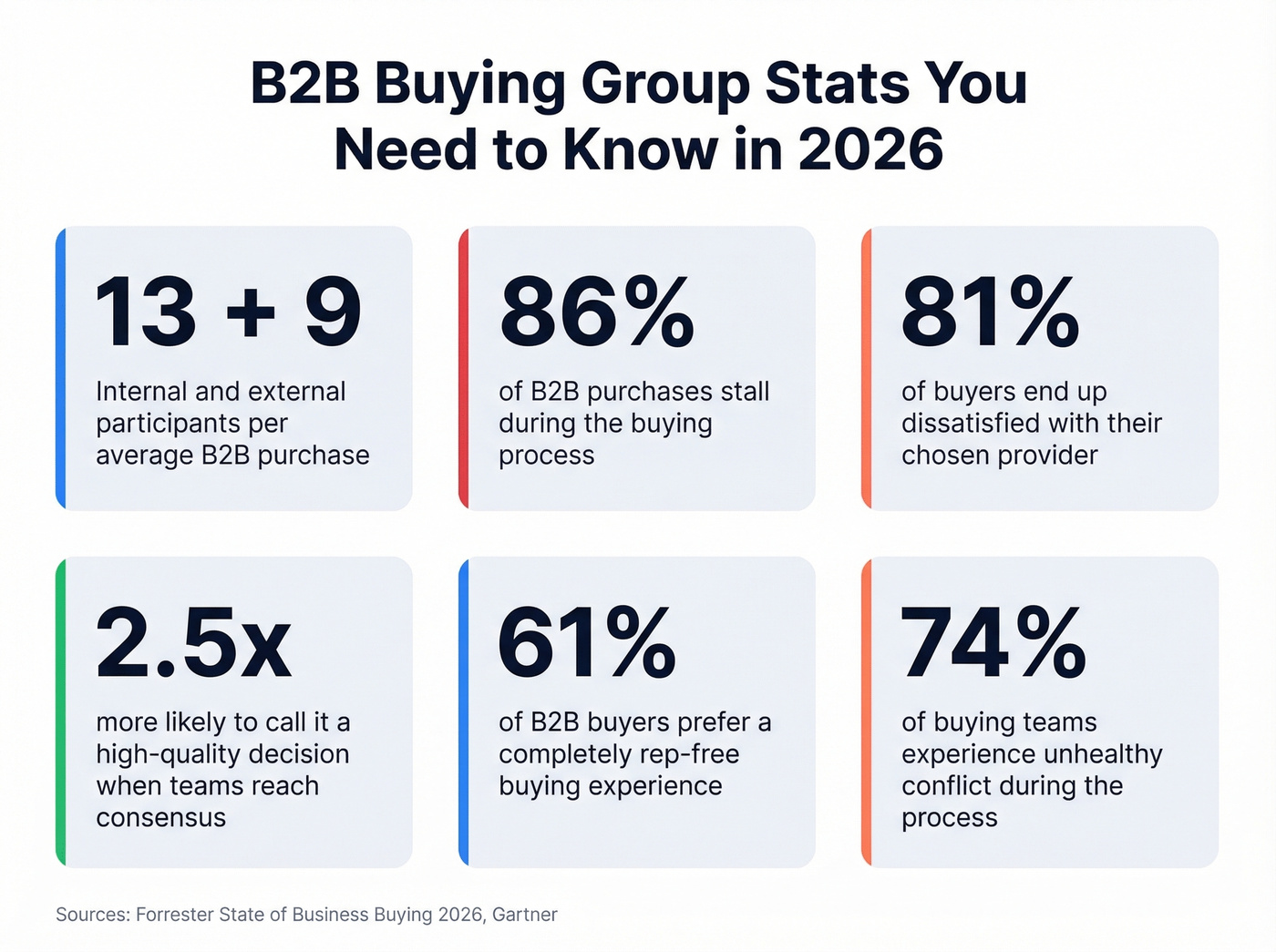
- 13 internal + 9 external participants influence the average B2B purchase
- Purchases with genAI features double the committee size; 36% of buyers evaluating genAI felt more confident in their decision while 20% felt less confident due to unreliable AI-generated information
- 86% of purchases stall; 81% of buyers are dissatisfied with their final choice
- 74% of buying teams experience "unhealthy conflict" during the process; teams that reach consensus are 2.5x more likely to call it a high-quality decision
- 83% of buyers define purchase requirements before talking to sales
- 61% of B2B buyers prefer a rep-free buying experience; 73% avoid vendors that blast irrelevant outreach
- Over 60% of respondents engaged in a trial before committing; 36% convert with the same provider, 35% switch to a different provider, 10% start a new trial entirely
That last stat is sobering. More than a third of buyers who trial your product end up buying from someone else. The trial isn't the finish line - it's the starting gun for committee alignment.
Here's the thing: most B2B teams obsess over generating more leads when the real problem is that they're only talking to one person in a 13-person committee. You don't have a pipeline problem. You have a multi-threading problem (and it shows up fast in sales pipeline challenges).

You just read that the average B2B deal involves 13 internal stakeholders. Reaching one of them isn't a strategy - it's a coin flip. Prospeo gives you 30+ filters to identify every member of the buying committee, from the champion to the CFO, with 98% verified emails and 125M+ direct dials. Multi-thread every deal at $0.01 per contact.
Stop single-threading deals into stalled pipelines.
How to Identify and Engage Buying Groups
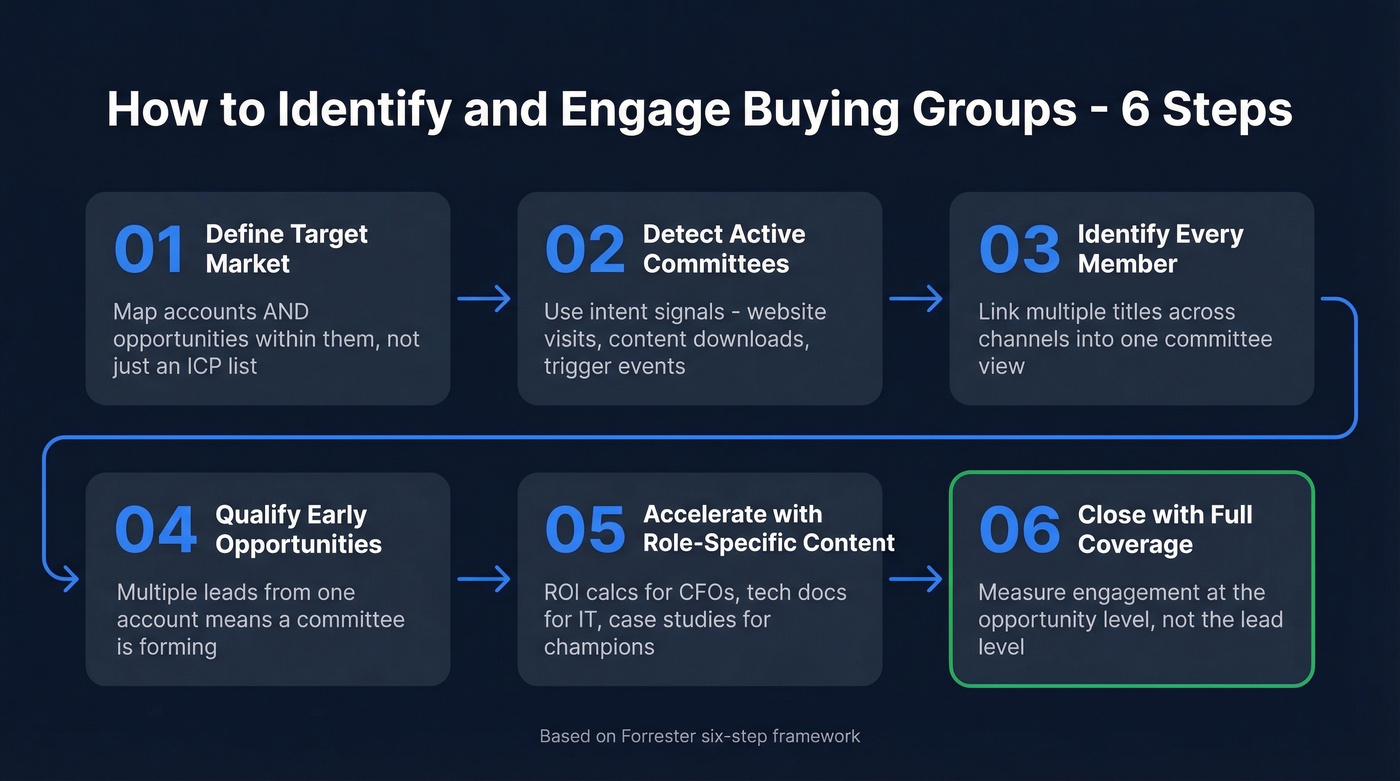
Forrester's six-step framework is the most practical playbook for operationalizing this approach. Gartner's research reinforces the same conclusion: sellers who engage the full committee - not just a single champion - dramatically increase their win rates.
Define Your Target Market
This isn't just your ICP list. You're defining accounts and the opportunities within those accounts. A single enterprise account might have three active purchase committees - one evaluating your category in North America, another in EMEA, and a third exploring a different use case entirely. Map the account landscape first, then identify which opportunities are worth pursuing based on fit, timing, and budget signals (use an Ideal Customer Profile to keep it consistent).
Detect Active Committees
Intent signals are your early warning system. First-party signals include website visits, content downloads, and pricing page views from multiple contacts at the same company. Third-party intent data - from providers like Bombora - tracks research behavior across thousands of topics. Triggering events matter just as much: a company relocating, a regulatory change, a new funding round, or a leadership change. These create urgency that activates stakeholder groups (more on identifying buying signals).
Identify Every Member
This is where most teams fall apart. You've detected an active committee - maybe three people from the same company hit your pricing page in the same week. Now you need to link multiple job titles engaging across channels and build a complete picture of who's involved.
We've found that the fastest path is combining intent data with a deep contact database. Prospeo covers 300M+ professional profiles with 30+ search filters - job title, department, buyer intent, technographics, headcount growth - so you can find every committee member in a single search (see firmographic and technographic data). With 98% email accuracy and 125M+ verified mobile numbers, your sequences actually reach people instead of bouncing into the void (and you can protect deliverability with email bounce rate benchmarks).

Qualify Early-Stage Opportunities
When a second or third lead from the same account engages, that's not noise - it's a reinforcing signal that a purchase committee is forming. Move from the lead object to the opportunity object in your CRM. Run sequences across multiple people tied to the same opportunity, not isolated lead records sitting in different rep queues (tie this to lead scoring so reps don’t ignore the pattern).
Accelerate Opportunities
Here's where marketing earns its keep. Run programs specifically designed to attract absent members of the committee. If you've engaged the champion and two influencers but haven't reached the CFO or the technical buyer, that's a gap that will stall your deal.
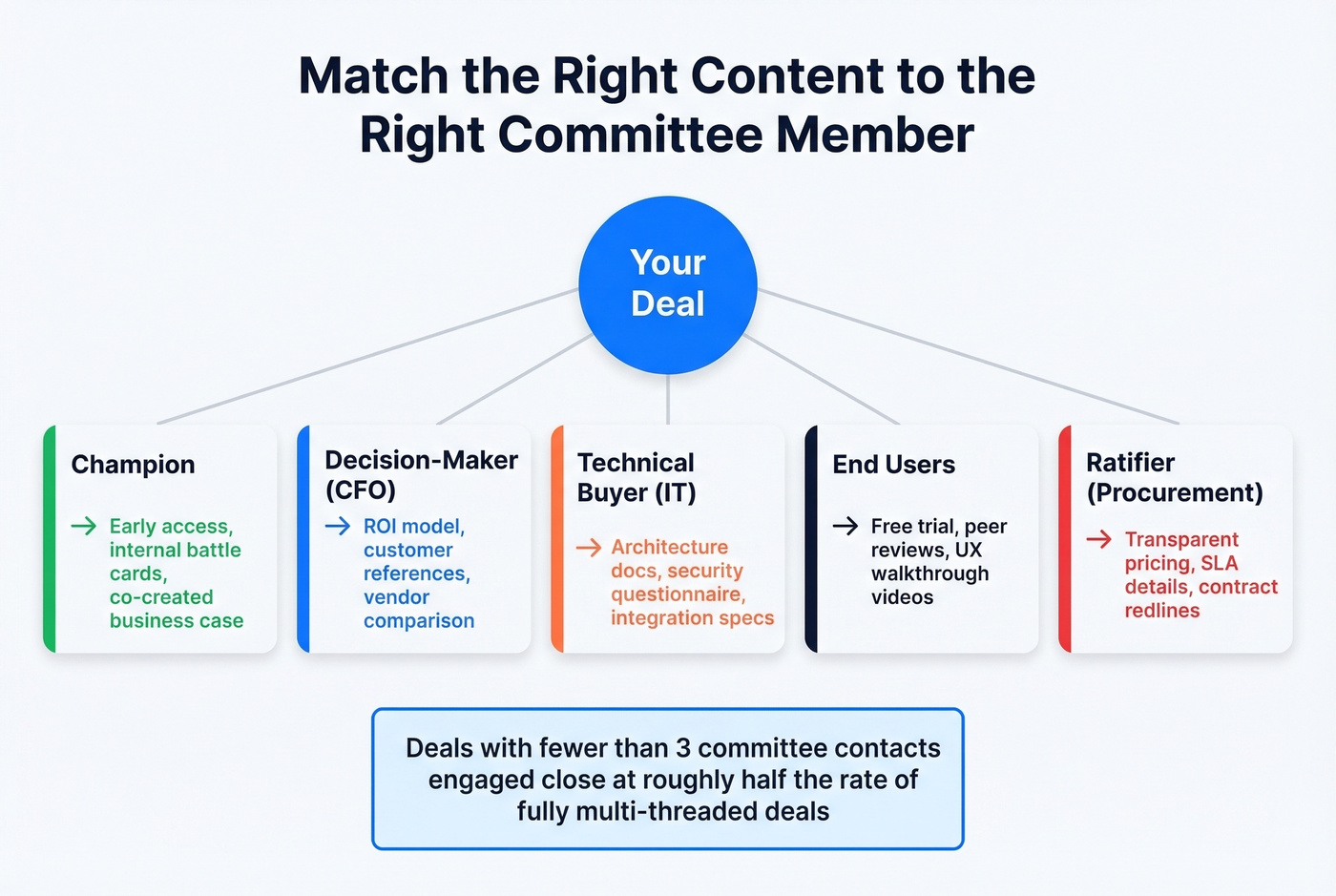
Role-specific content is non-negotiable: ROI calculators for the economic buyer, technical architecture docs for IT, case studies for the champion to circulate internally, and pricing transparency for procurement. In our experience, deals with fewer than three committee contacts engaged close at roughly half the rate of fully multi-threaded deals. Proactively sending the right asset to the right person - before they ask - can shave weeks off a deal cycle (especially when paired with sales follow-up templates that keep threads moving).
Close with Full Coverage
Measure engagement at the opportunity level, not the lead level. Segment your in-pipeline deals by how many committee members you've engaged versus how many you haven't. Deals where you've multi-threaded across five or more stakeholders close at dramatically higher rates (track it like pipeline health, not vanity lead metrics).
For teams that still have gaps late in the cycle, targeted outreach works. If procurement hasn't engaged, send a competitive pricing comparison. If the executive sponsor hasn't weighed in, get your champion to facilitate an intro. The deal isn't closed until the full committee is covered.
86% of B2B purchases stall because sellers engage too few stakeholders too late. Prospeo's intent data tracks 15,000 topics so you can detect when a buying group is forming - then pull verified contact data for every role in the committee. Data refreshes every 7 days, not 6 weeks, so you reach the right people while the deal is still alive.
Catch buying groups while they're active, not after they've decided.
Group Purchasing Organizations (GPOs)
A GPO aggregates the purchasing volume of multiple companies to negotiate better pricing, terms, and contracts from suppliers. By pooling demand, a GPO gives small and mid-sized businesses the leverage of a much larger organization.
The revenue model runs on supplier administrative fees - a small percentage of contract spend paid by the vendor, not the buyer. This is why GPO membership is often free. The GPO negotiates volume discounts, passes the savings to members, and takes a cut from the supplier side.
GPOs come in two flavors. Vertical GPOs specialize in a single industry - healthcare is the dominant example, where GPOs save the system up to $55 billion annually, with individual members seeing 10-18% savings on supplies. Horizontal GPOs work across industries, focusing on indirect spend categories like office supplies, IT equipment, telecom, and facilities management. Companies like Una and DealerShop operate in this space, and members often see savings in the 10-30% range depending on category.
If you're not in a GPO, you're leaving meaningful savings on the table. The barrier to entry is essentially zero.
GPO vs. Cooperative vs. Informal Group
| Feature | GPO | Purchasing Co-op | Informal Buying Group |
|---|---|---|---|
| Ownership | Independent entity | Member-owned | No formal structure |
| Fees | Supplier-funded | Member dues | None or ad hoc |
| Scope | Vertical or cross-industry | Industry-specific | Specific purchases |
| Typical Savings | 18-22% | 10-20% | Negotiation-dependent |
| Duration | Ongoing | Ongoing | Often short-term |
Purchasing cooperatives are member-owned and typically vertical - think agricultural co-ops or foodservice groups. Profits get shared among members. Informal groups are the loosest structure: a few businesses team up to negotiate terms for a specific purchase, often with one member leading negotiations. The PPE bulk-buying groups that formed during COVID are a good example.
Credit Card and Resale Buying Groups
This is a completely different animal. Credit card buying groups - sometimes called merchandise groups - work like this: a group organizer identifies promotional deals on high-demand items like electronics, gift cards, and limited-quantity sales. Individual members purchase those items using their own credit cards, ship them to the group's address (often in a sales-tax-free state), and get reimbursed. The "profit" comes from stacking multiple reward mechanisms on top of each other.
The stacking mechanics: buy discounted gift cards through a platform like Pepper Rewards, route the purchase through a cashback portal like TopCashback or BeFrugal, and pay with a high-reward credit card - say, a 5% cashback card in the right category. Each layer adds a thin margin. Named groups in this space include BFMR and USA Buying Group.
Real math from Reddit's r/BuyingGroups: one user broke down an iPad deal - nearly $3,000 in spend, netting $53.82 in cashback profit using an Amazon 5% card. That's a 1.8% return on capital deployed, with meaningful risk attached.
The risks are real and worth understanding before you commit any capital. Non-payment is the biggest fear - groups can go under, and there's at least one notorious case where a participant was owed $100K+ when a gift card group collapsed. Retailers actively hunt resellers: Target, Best Buy, eBay, and Dell all shut down accounts suspected of this activity. Dell operates on a hair-trigger.
Is It Worth It?
Let's be honest - for most people, no.
Credit card buying groups serve one specific purpose well: meeting the minimum spend requirement on a new credit card signup bonus. If you need to hit $4,000 in spend within three months to unlock a $750 bonus, routing some of that through a group makes sense. Beyond that, the margins are razor-thin, the operational overhead is real (order cancellations, sold-out inventory, timing sensitivity around Prime Day and holiday sales), and the downside risk is asymmetric.
Skip this entirely if you don't already understand credit card rewards optimization. Start small, ramp slowly, and never deploy capital you can't afford to lose. Groups like BFMR and USA Buying Group are well-known names in this space, but even established groups carry counterparty risk.
FAQ
How many people are in a typical B2B buying group?
Forrester's 2026 data shows an average of 13 internal stakeholders and 9 external participants per deal. For purchases involving generative AI features, the committee doubles in size. The commonly cited 6-10 range still holds for many mid-market deals, but enterprise purchases regularly exceed 20 participants.
What's the difference between a buying group and a buying committee?
They're the same concept with different labels. "Buying center" is the academic term from Bonoma's 1982 HBR framework, "buying committee" is the practitioner term, and "buying group" is the modern GTM standard. All three refer to the collection of decision-makers who collectively influence a purchase.
Are group purchasing organizations free to join?
Most GPOs charge nothing for membership. They're funded by administrative fees paid by suppliers, not by members. Savings typically run 18-22% on contracted products and services. Some GPOs offer premium tiers with additional services for a fee, but baseline access to negotiated contracts is free.
How do you find contact info for every committee member?
Use a B2B data platform with intent signals and verified contact data. Layer intent data to identify who's actively researching your category, then search by company, job title, and department to build a complete contact map. We use Prospeo's 30+ search filters to go from "we know three people at this account" to a full committee map in minutes - 98% email accuracy means the outreach actually lands.
Are credit card buying groups risky?
Yes. Non-payment from organizers, retailer account shutdowns, and razor-thin margins are all real risks. Treat them as a mechanism for meeting card signup bonus minimums, not as a primary income stream. Start with small orders, stick to established groups, and never overextend.