

B2B Sales Objection Handling: What 300M+ Cold Calls Reveal About What Actually Works
Most objection-handling advice starts with scripts. That's backwards.
Gong analyzed 300M+ cold calls and found that nearly half of all objections are dismissive brush-offs - "not interested," hang-ups, "send me an email" - that have more to do with relevance and timing than your product. Meanwhile, 73% of B2B buyers actively avoid suppliers who send irrelevant outreach. Buyers research harder, decide slower, and expect contextual answers - not canned rebuttals. With up to 70% of reps missing quota, how you handle the objections you do get matters more than ever.
The problem isn't your rebuttal. It's your targeting.
The Quick Version
- Most objections (49.5%) are dismissive brush-offs. Fix your targeting before memorizing scripts.
- Master 5 responses, not 50. The top 5 objections account for 74% of everything you'll hear.
- Pause 5x longer after hearing an objection. That single behavior separates top reps from everyone else across 67,149 analyzed calls.
The 3 Types of B2B Objections
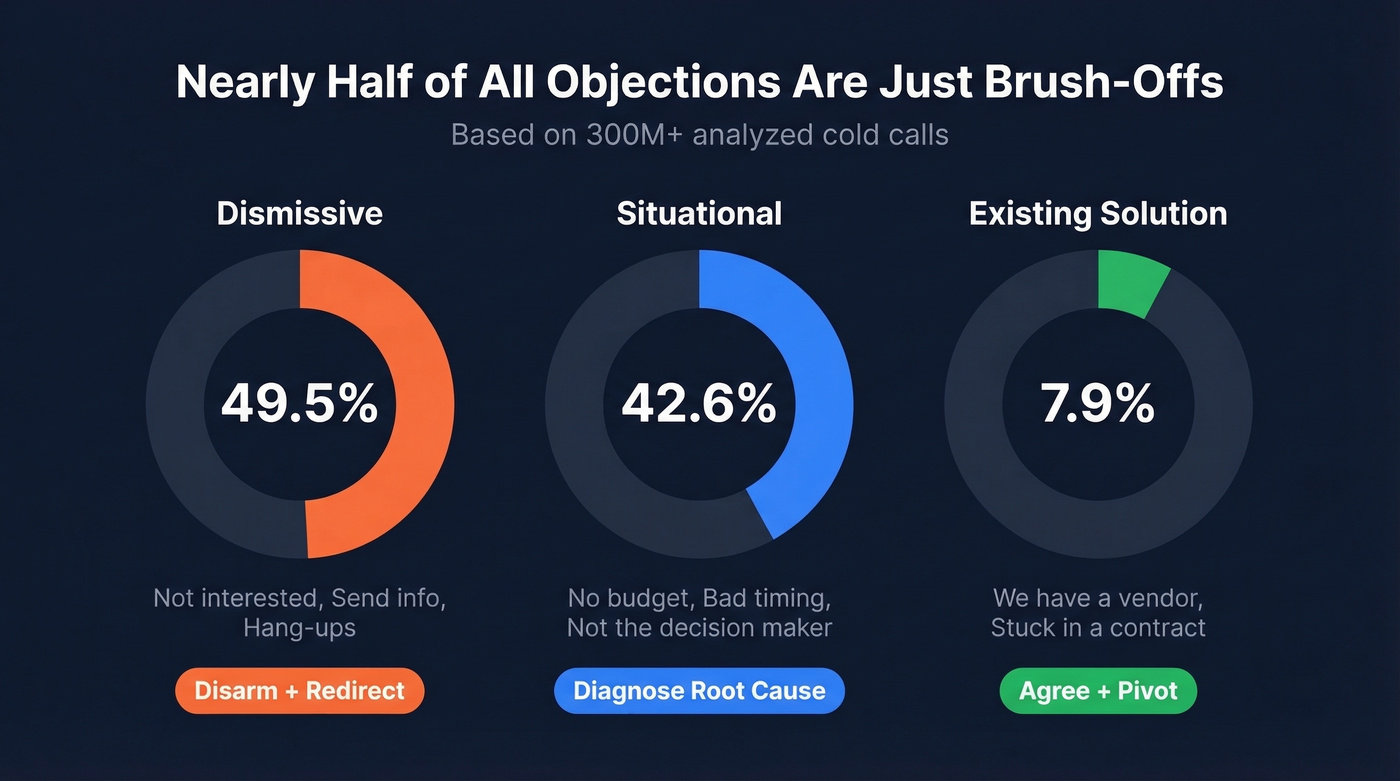
The 300M+ call dataset doesn't just count objections - it categorizes them. The categories matter more than individual objections because each type demands a fundamentally different response.
| Type | % of All | Examples | Response |
|---|---|---|---|
| Dismissive | 49.5% | "Not interested," "Send info" | Disarm + redirect |
| Situational | 42.6% | "No budget," "Bad timing" | Diagnose root cause |
| Existing Solution | 7.9% | "We have a vendor" | Agree + pivot |
Dismissive objections are the big one. They're not real objections - they're reflexes. The prospect doesn't know enough about you to be genuinely uninterested; they're brushing you off because you interrupted their day. Responding with a feature dump here is the worst thing you can do.
Situational objections are where the real selling happens. "No budget" might mean "I don't see enough value to fight for budget." "Bad timing" might mean "I don't understand why this is urgent." These require diagnosis, not debate.
Existing solution objections are the rarest but the trickiest. The prospect has a vendor they chose, possibly championed internally. Criticizing that vendor means criticizing their judgment. One important distinction: don't confuse objections with obstructions. A procurement freeze or compliance review isn't something you can "handle" - it's a structural barrier that requires a different playbook entirely.
6 Frameworks for Handling Objections
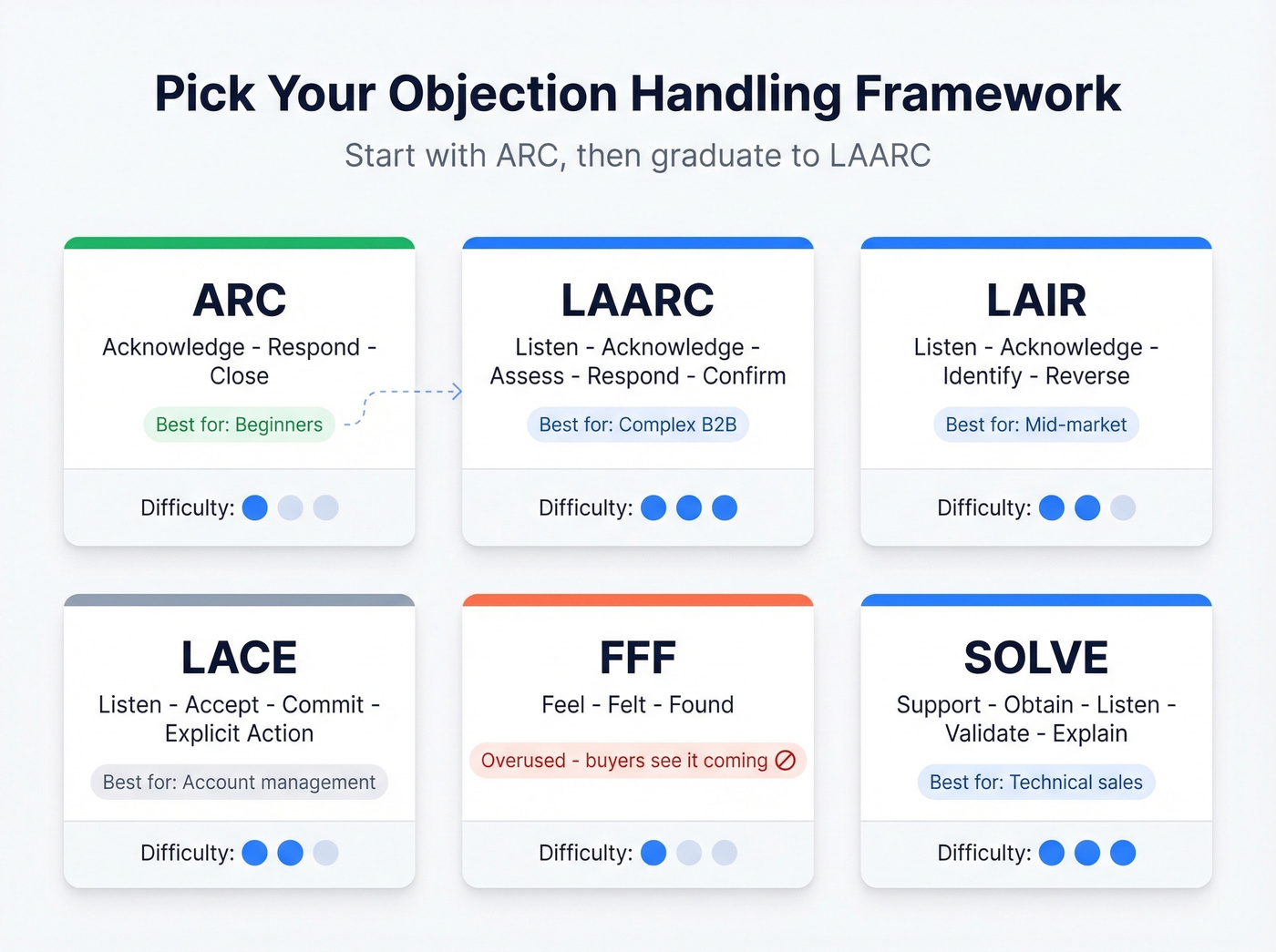
There are more frameworks than anyone needs. Here's the rundown, with an honest take on each.
| Framework | Steps | Best For | Weakness |
|---|---|---|---|
| ARC | Acknowledge, Respond, Close | Beginners, fast cycles | Too simple for complex deals |
| LAARC | Listen, Acknowledge, Assess, Respond, Confirm | Complex B2B | Takes practice to internalize |
| LAIR | Listen, Acknowledge, Identify, Reverse | Mid-market, discovery | "Reverse" can feel aggressive |
| LACE | Listen, Accept, Commit, Explicit Action | Account management | Weak for cold outreach |
| FFF | Feel, Felt, Found | Junior reps, warm leads | Overused - buyers see it coming |
| SOLVE | Support, Obtain, Listen, Validate, Explain | Technical/consultative | Too many steps for cold calls |
New to outbound? Start with ARC. Three steps, easy to remember, hard to screw up. Once you're comfortable, graduate to LAARC - the "Assess" step forces you to actually diagnose the objection before responding, which is where most reps fail. This progression works for telesales and field sales alike.
Let's be honest about Feel-Felt-Found: it needs to die. Buyers in 2026 have heard "I understand how you feel, other clients felt the same way, and what they found was..." a thousand times. It sounds rehearsed because it is.
Scripts That Work on Real Calls
Dismissive Objections
"Not interested." Around 60% of cold calls run into this. It's a reflex, not a verdict.
"Totally fair - you don't have enough context to be interested yet. Can I take 20 seconds to tell you why I called, and you can tell me if it's worth continuing?"
"Send me an email."
"Happy to. So I send you something relevant - what's the one thing about [problem area] that would actually be worth reading about?"
If you want more variations, see our breakdown of the "Send me an email" objection.
"Is this a cold call?"
"100%. I figured being honest was better than pretending we met at a conference. I'm calling because [one-sentence reason tied to their company]. Worth 30 seconds?"
Situational Objections
"Too expensive / No budget."
"I hear you. Is it that the price is higher than you expected, or that you're not sure the ROI justifies any spend right now?"
Here's the persona-specific nuance most reps miss: the CFO who says "too expensive" needs ROI math. The VP of Ops who says "bad timing" needs urgency framing. Same words, different root cause. Diagnose before you prescribe.
For more price-specific language, use these price objection handling scripts.
"Not a priority right now."
"Makes sense - when would it become a priority? Most teams we work with said the same thing, and the trigger was usually [specific event like missed quota, lost deal, leadership change]."
"I'm not the decision maker."
"That's fine - I'm not looking for a decision today. Who typically owns [specific function] decisions? I'd love to loop them in so you're not playing telephone."
Existing Solution Objections
"We already have a vendor."
"Totally makes sense - almost everyone we talk to does. Usually the reason they still chat with us isn't to replace everything, it's to fix one specific gap their current setup doesn't cover. Is there anything like that on your end?"
"We're stuck in a contract."
"No problem. When does it renew? I'd rather have a real conversation 60 days before renewal than rush something now. Can I reach back out in [month]?"
A note on channel: these scripts are phone-first. In email, you don't get the real-time pause or vocal tonality - so lead with a proof point or specific number instead of a question. Keep it to a couple of sentences.
If you need more options beyond these, here are additional objection handling examples you can adapt.

The data is clear: most objections aren't about your pitch - they're about relevance. When you reach the right person at the right time with the right context, half your objections disappear before the call starts. Prospeo's 30+ filters (buyer intent, job changes, headcount growth, technographics) let you build lists so targeted that prospects actually want to hear what you have to say.
Stop rehearsing rebuttals. Start reaching buyers who are already in-market.
3 Advanced Techniques Top Reps Use
The 5x Pause
Across [67,149 analyzed sales calls](https://www.gong.io/blog/here-are-the-7-best-objection-handling-techniques-youll-read-this-year), successful reps pause 5x longer after hearing an objection than their less-successful peers. Not a little longer. Five times longer.
This pairs well with a tighter sales call structure so you don’t rush to “pitch mode.”
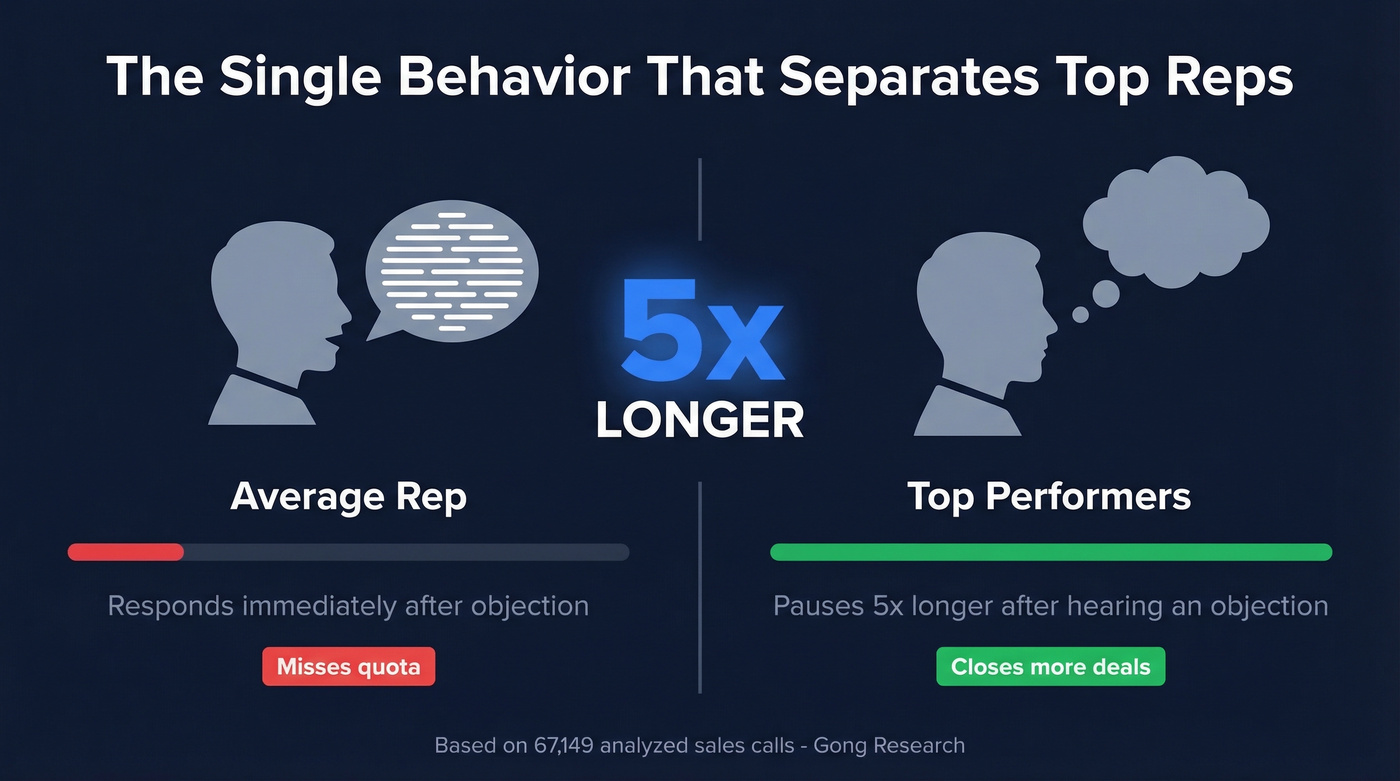
The pause signals confidence. It tells the prospect you're not rattled, you're not scrambling for a rebuttal, and you're actually listening. More importantly, it gives them space to elaborate - and often, they'll fill the silence with the real objection hiding behind the surface-level brush-off. In our experience, this is the single hardest technique to actually execute under pressure. Your instinct screams "say something." Resist it.
The "Yes, And" Rule
Borrowed from improv comedy, this technique treats every objection as a reality to build from, not a wall to argue against. The consensus on r/salestechniques is that people push back less on ideas than on feeling ignored or pressured.
For "We're not focusing on outbound right now": Yeah, that checks out - a lot of teams paused outbound after getting burned by spray-and-pray. We usually look at what actually broke last time - data, targeting, messaging - so if you come back to it later, you don't repeat the same mess.
Never "block" the prospect's reality. Accept it, then redirect.
The Calm Guess
This one comes from r/b2b_sales and it's the most counterintuitive technique here. Instead of handling the objection, you make a calm guess about what's really behind it - then shut up.
- "It's too expensive." --> "You were expecting this to be a zero less." (silence)
- "I need to think about it." --> "You're not fully convinced this would work in your environment." (silence)
- "We're already working with someone." --> "Sounds like things are working well enough." (silence)
This is an elicitation move: people are wired to correct inaccurate assumptions and confirm accurate ones. Either way, they give you the real objection.
One practitioner reported their close rate jumping from 19% to 34%, with average deal size up 23%. The technique works because it flips the dynamic - you stop selling and start listening. For enterprise deals involving multiple stakeholders and longer cycles, the calm guess is especially effective because it surfaces hidden concerns that committee members won't volunteer on their own.
Prevent Objections Before They Happen
Here's the thing: the best objection handler on your team is probably your worst prospector. They've gotten so good at rebuttals because they're constantly calling the wrong people. Nearly half of all objections are dismissive brush-offs caused by reaching the wrong person at the wrong moment with the wrong message. That's a targeting problem, not a selling problem.
If you’re rebuilding your targeting from scratch, start with how to define your ICP vs persona.
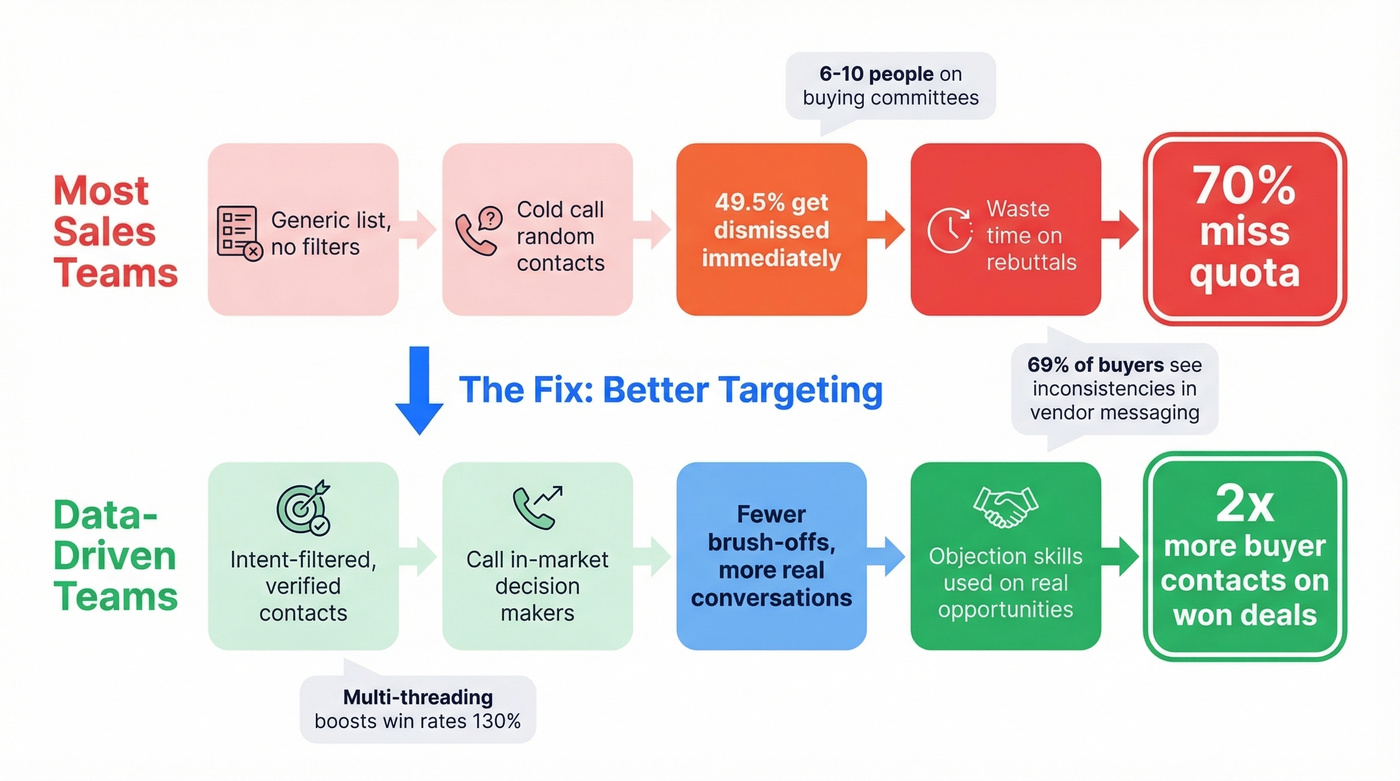
The data backs this up. Buying committees now run 6-10 people deep - sometimes 15+ on enterprise deals. Closed-won deals have roughly 2x as many buyer contacts as lost deals, and for deals over $50K, multi-threading boosts win rates by 130%. On top of that, 69% of buyers report inconsistencies between what they read on a vendor's website and what sellers tell them. Trust is fragile before the first call even happens.
We've seen teams cut their brush-off rate in half by switching to intent-filtered lists. Prospeo's B2B database lets you filter by buyer intent across 15,000 topics, job title, company growth signals, and technographics - 30+ filters in total. With 98% email accuracy, 125M+ verified mobiles, and a 7-day data refresh cycle, you're starting conversations with decision-makers who are actually in-market instead of burning dials on people who were never going to buy.
If you’re comparing vendors, use this guide to B2B data list providers to sanity-check coverage and accuracy claims.

Better data means fewer brush-offs. Fewer brush-offs means more of your call block spent on real conversations where your objection handling skills actually matter.
Every "wrong number" or bounced email is a dead objection-handling opportunity. Prospeo delivers 98% email accuracy and 125M+ verified mobile numbers with a 30% pickup rate - so your reps spend time handling real objections on live calls, not chasing bad data. Teams using Prospeo book 26% more meetings than ZoomInfo users.
Get direct dials that actually connect - at $0.01 per verified email.
5 Mistakes That Kill Deals
- Getting defensive. The moment you argue, you've lost. An objection is information, not a personal attack.
- Jumping to solutions before diagnosing. "Let me tell you about our pricing tiers" before understanding why they said "too expensive" is a guaranteed dead end.
- Using canned responses. Buyers can smell a script. If your response sounds like it came from a training deck, it probably did - and they know it.
- Dismissing the concern. "Oh, that's not really an issue" tells the prospect their judgment doesn't matter. Good luck closing that deal.
- Moving too fast. Rushing past the objection to get back to your pitch leaves the prospect feeling unheard. The 5x pause exists for a reason.
How to Practice Without Burning Prospects
You don't get better at objection handling by reading about it. You get better by doing reps - but not on live prospects.
AI roleplay tools like Hyperbound, Second Nature, and Yoodli let you practice specific objection scenarios with realistic AI personas. They're not perfect, but they're infinitely better than rehearsing in the mirror. For conversation intelligence - reviewing what actually happened on real calls - Gong and Sybill are the standard. Sybill's particularly useful for spotting patterns in how you respond to objections you didn't even realize you were fumbling.
If you want a simple system for practice sessions, use a mock calls script and score reps consistently.
Skip the AI tools if your team has fewer than five reps. The free alternative works just as well: weekly objection clinics where one person plays the prospect, throws curveballs, and the rep practices live. Record it. Review it. Pay attention to pause length after objections and whether you diagnosed before responding. Low-tech, and I've watched it transform reps faster than any software.
FAQ
What's the most common B2B sales objection?
"Not interested" - a dismissive brush-off making up the largest share of the 49.5% of objections classified as dismissive across 300M+ analyzed cold calls. It's rarely genuine. It's a reflex from someone who doesn't have enough context to form an actual opinion yet.
What's the best objection-handling framework for beginners?
ARC (Acknowledge, Respond, Close). Three steps, easy to memorize, works for fast-cycle sales. Once you're consistently using it without thinking, graduate to LAARC for complex B2B deals where you need to diagnose before responding.
How do you handle "we already have a vendor"?
Don't criticize the incumbent - that means criticizing the prospect's judgment. Use the "yes, and" approach: acknowledge they have a solution, then pivot to a specific gap their current vendor likely doesn't cover. Most prospects engage if you're not asking them to rip and replace.
Can you prevent objections instead of handling them?
Yes - and it's the highest-return move available. Nearly half of all objections are dismissive brush-offs caused by reaching the wrong person. Tools like Prospeo let you filter by buyer intent across 15,000 topics and verify contact data at 98% accuracy, so you're calling decision-makers who are actually in-market.
How many follow-ups should you make after an objection?
At least four. Six in ten buyers say no four times before saying yes, but only 12% of reps make three or more follow-up attempts. Most reps quit right before the prospect would've said yes - the math is brutal.