

Price Objection Handling Scripts: Diagnose First, Script Second
"That's more than we budgeted." Three seconds of silence. Your stomach drops. You reach for a discount - and the deal starts dying right there.
You've read a dozen articles that give you "I understand, let's talk about value" and call it a day. That's not a price objection handling script. That's a platitude. Roughly two-thirds of price objections aren't actually about price - they're about uncertainty. You don't need 33 scripts. You need five, one for each type of price objection, and the diagnostic skill to know which one to pull.
Why "Too Expensive" Is Never Really About Price
Kahneman and Tversky's prospect theory showed that losses are felt roughly twice as intensely as equivalent gains as equivalent gains. When a prospect says "too expensive," their brain isn't running a spreadsheet. It's running a fear calculation: what do I lose if this doesn't work?
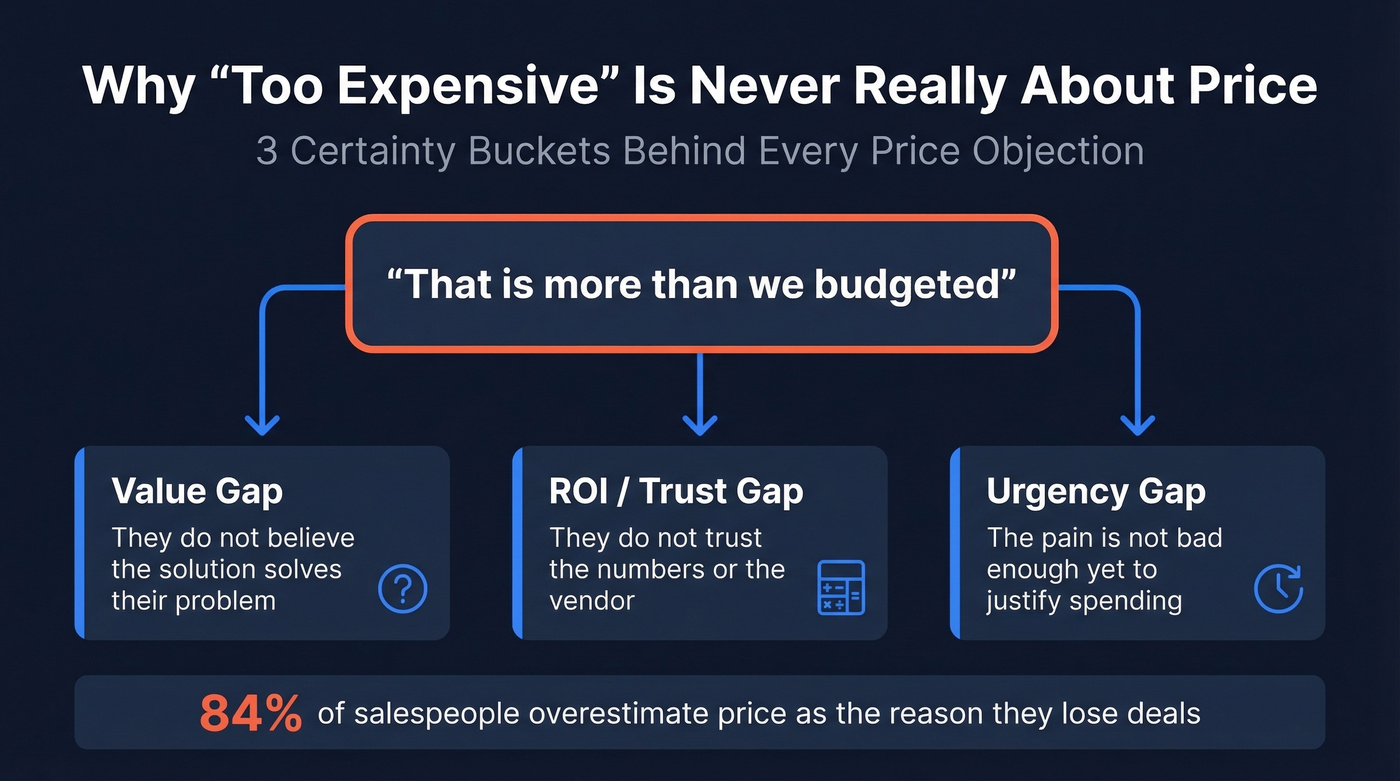
That fear falls into one of three certainty buckets. The prospect either lacks certainty about the value (they don't believe the solution solves their problem), the ROI (they don't trust the numbers or the vendor), or the urgency (the problem doesn't hurt enough yet to justify spending). The consensus across r/sales threads is pretty clear on this - price objections are really about "lack of certainty," and your job is figuring out which kind.
Here's a stat most reps don't know: 84% of salespeople overestimate price as the reason they lose deals compared to what buyers actually report. Layer in 57% of sales pros saying [cycles are lengthening](https://www.salesforce.com/sales/state-of-sales/) and the average B2B deal involving [7.4 decision-makers](https://www.gartner.com/en/newsroom/press-releases/2025-05-07-gartner-sales-survey-finds-74-percent-of-b2b-buyer-teams-demonstrate-unhealthy-conflict-during-the-decision-process), and you start to see why "too expensive" surfaces constantly - even when the real blocker is something else entirely.
Diagnose Before You Script
Sandler nailed it: "Prescription without diagnosis is malpractice." Before you reach for any script, run three diagnostic questions - one per certainty bucket:
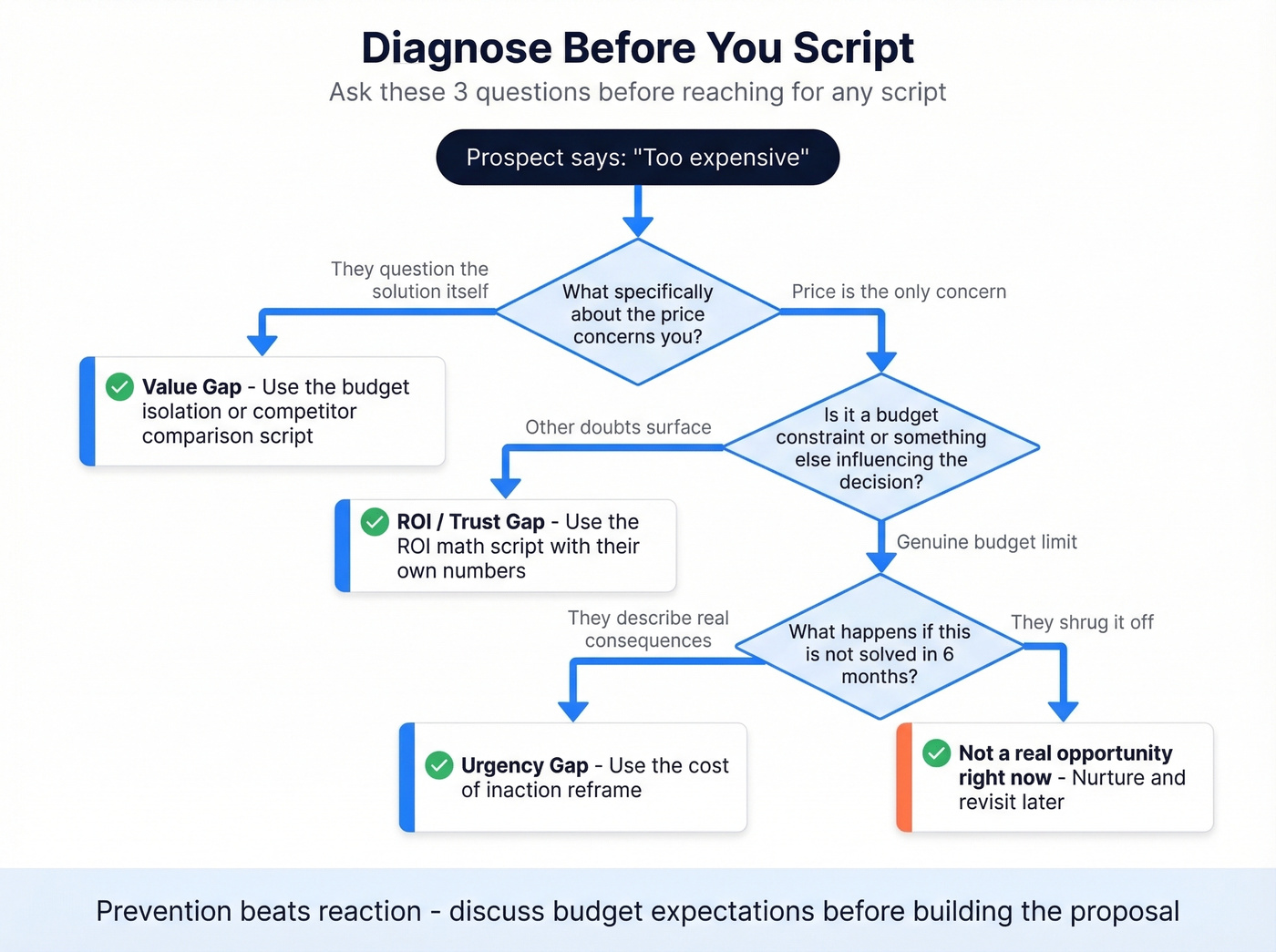
- Value gap: "Can you help me understand what specifically about the price concerns you?" This surfaces whether they see the solution as worth it at any price.
- ROI/trust gap: "Is it a budget constraint, or are there other reasons influencing your decision?" This isolates money from doubt.
- Urgency gap: "What happens if this problem isn't solved in the next six months? How does that affect you personally?" This tests whether the pain is real or theoretical.
Better yet, prevent the objection entirely. Sandler recommends discussing budget expectations before you build the proposal: "Is this project funded? Is there a budget range you're shooting for?" Prevention beats reaction every time.
Skip diagnosis and jump straight to discounting, and you create what Sandler calls the credibility gap - scaling back your solution to meet a lower number signals that either your original proposal was bloated or the new one is inadequate. Neither builds trust.
Scripts for Every Objection Type
"We Don't Have the Budget"
"If budget wasn't an issue, would this solution be the right fit for you?"
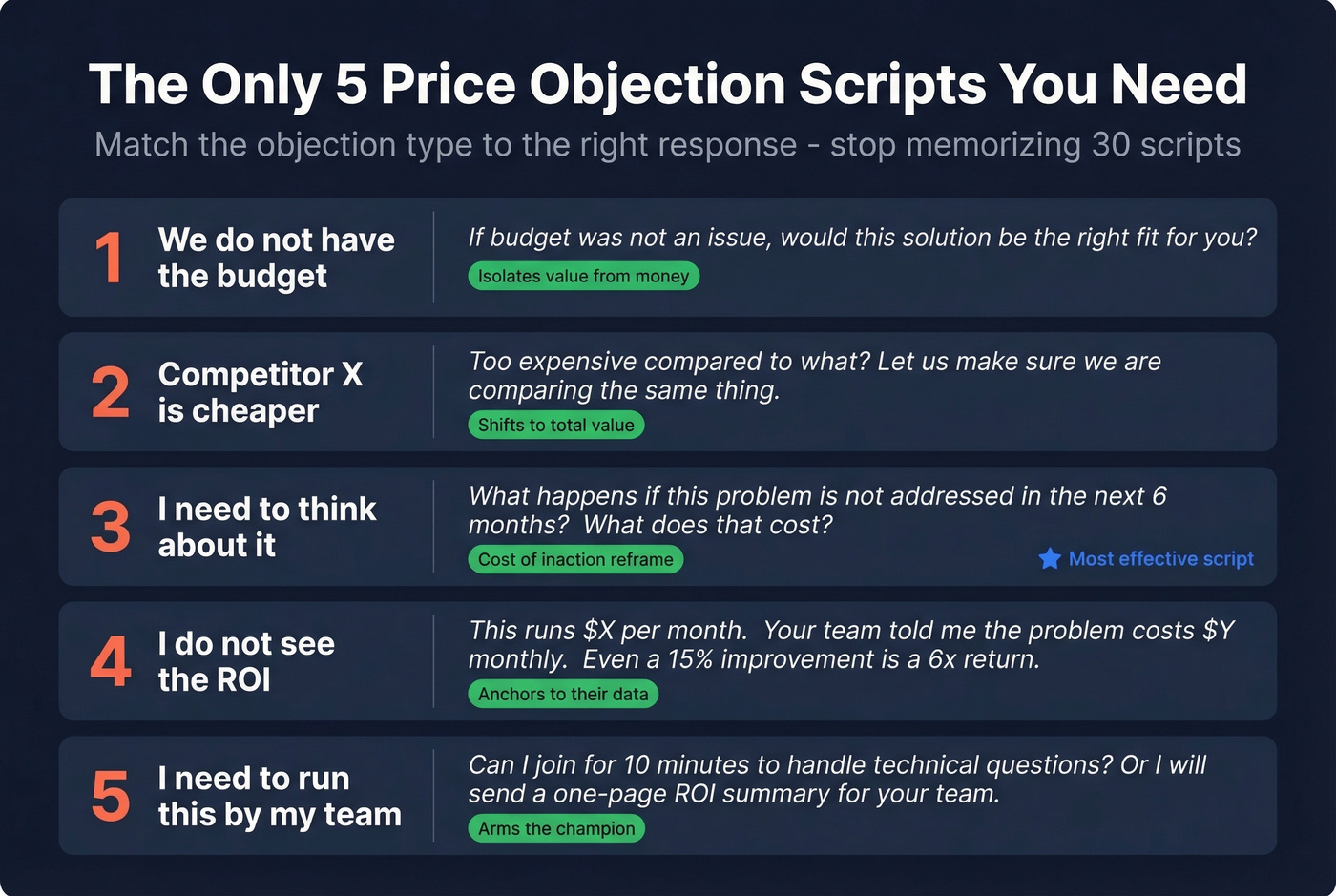
If they say yes, shift to financing, phasing, or creative deal structure. If they say no, you've surfaced the real objection and saved yourself weeks of chasing a dead deal. This no budget objection handling approach works because it separates the financial constraint from the value question entirely.
When the constraint is genuine, try phasing: "What if we rolled this out in two phases - solve the most urgent problem now, expand in Q3?" Don't bother phasing a solution they don't believe in. That just delays the "no."
"Competitor X Is Cheaper"
"Too expensive compared to what? Let's make sure we're comparing the same thing."
Then ask what's included in the competitor's quote - onboarding, support, analytics, contract terms. Highspot's framework shifts the conversation from sticker price to total value, which is where most competitors fall apart under scrutiny.
Here's the thing: if the competitor genuinely offers the same thing at a lower price, you have a positioning problem, not a script problem. No talk track fixes that.
"I Need to Think About It"
This is where the single most effective sales objection script lives.
"Totally fair. While you're thinking it over - what happens if this problem isn't addressed in the next six months? What does that cost?"
The prospect's brain weighs the pain of inaction against the pain of spending. We've seen this cost-of-inaction reframe convert more stalled deals than any other pattern on our team. If you only memorize one script from this article, make it this one.
To prevent the ghost, always lock a specific follow-up: "Can we reconnect Thursday at 2 so I can answer any questions that come up?" (If you want a few ready-to-send options, steal these follow-up templates.)
"I Don't See the ROI"
Picture this: your champion just got out of a board meeting where the CFO killed two vendor contracts. They're gun-shy. Lead with their own numbers.
"This runs $1,500 a month. Your team told me churn costs roughly $10,000 in lost revenue monthly. If we cut churn by even 15%, that's a 6x return."
Tie every dollar to a quantified outcome the prospect already acknowledged. Without their numbers from discovery, you're guessing - and they'll know it. Anchoring to the prospect's own data is the fastest way to rebuild confidence when ROI doubt creeps in. (If you need a tighter discovery framework, use these discovery questions.)
"I Need to Run This by My Team"
With 7.4 decision-makers in a typical B2B deal - and 61% of B2B buyers preferring a completely rep-free sales experience - this objection is almost always legitimate. Your job isn't to overcome it. It's to arm your champion.
Offer to join for 10 minutes to handle technical questions directly. If the prospect's culture is clearly "we decide internally," respect that - send a one-page summary with the ROI math and implementation timeline so your champion isn't playing telephone with half-remembered numbers. (This is also where team selling makes objections easier to handle.)

The best price objection script is one you never need. When your emails actually land and your dials reach real buyers, you close faster - and price becomes a footnote. Prospeo delivers 98% email accuracy and a 30% mobile pickup rate, so every conversation starts with confidence, not credibility gaps.
Stop defending your price. Start reaching the right people.
Email Script for Price Pushback
When price pushback comes over email, you get one shot to reframe before the thread goes cold.
Subject: Quick math on the [Product] investment
Hi [Name],
Totally understand the hesitation on price. Here's the math that convinced [similar company/role]: at $[price]/month, if [Product] delivers even [conservative outcome], that's a [X]x return in the first quarter alone.
Worth a 10-minute call Thursday to walk through the numbers together?
Keep it under 100 words. Async objections need sharper framing than live calls - nobody rereads a four-paragraph email. (For more options, pull from these email subject lines.)
Cold Calling Pricing Objections
Live calls compress everything. You have seconds, not minutes, to diagnose and respond. When a cold calling pricing objection hits early in the conversation, resist the urge to justify the number immediately. Use a pattern interrupt instead: "Totally fair - most of our customers said the same thing before they saw the ROI. Can I ask one quick question?" Then pivot to a diagnostic question from the certainty buckets above. (If you’re building a repeatable motion, start with a cold calling system.)
On cold calls, budget objections are especially common because you're catching prospects before they've mentally allocated spend. Acknowledge that reality: "I wouldn't expect you to have budget set aside for something you weren't planning for. Most of our clients didn't either - they found budget after seeing what the problem was actually costing them."
That reframes the conversation from allocation to cost of inaction - the same principle from the "I need to think about it" script, just compressed for a cold call cadence.
Delivering Scripts Without Sounding Scripted
Your prospect should talk 70% of the time. If you're monologuing through a script, you've already lost. Cognism's framework reinforces this - listen first, script second. (If you want more examples that don’t sound robotic, use these talk track examples.)
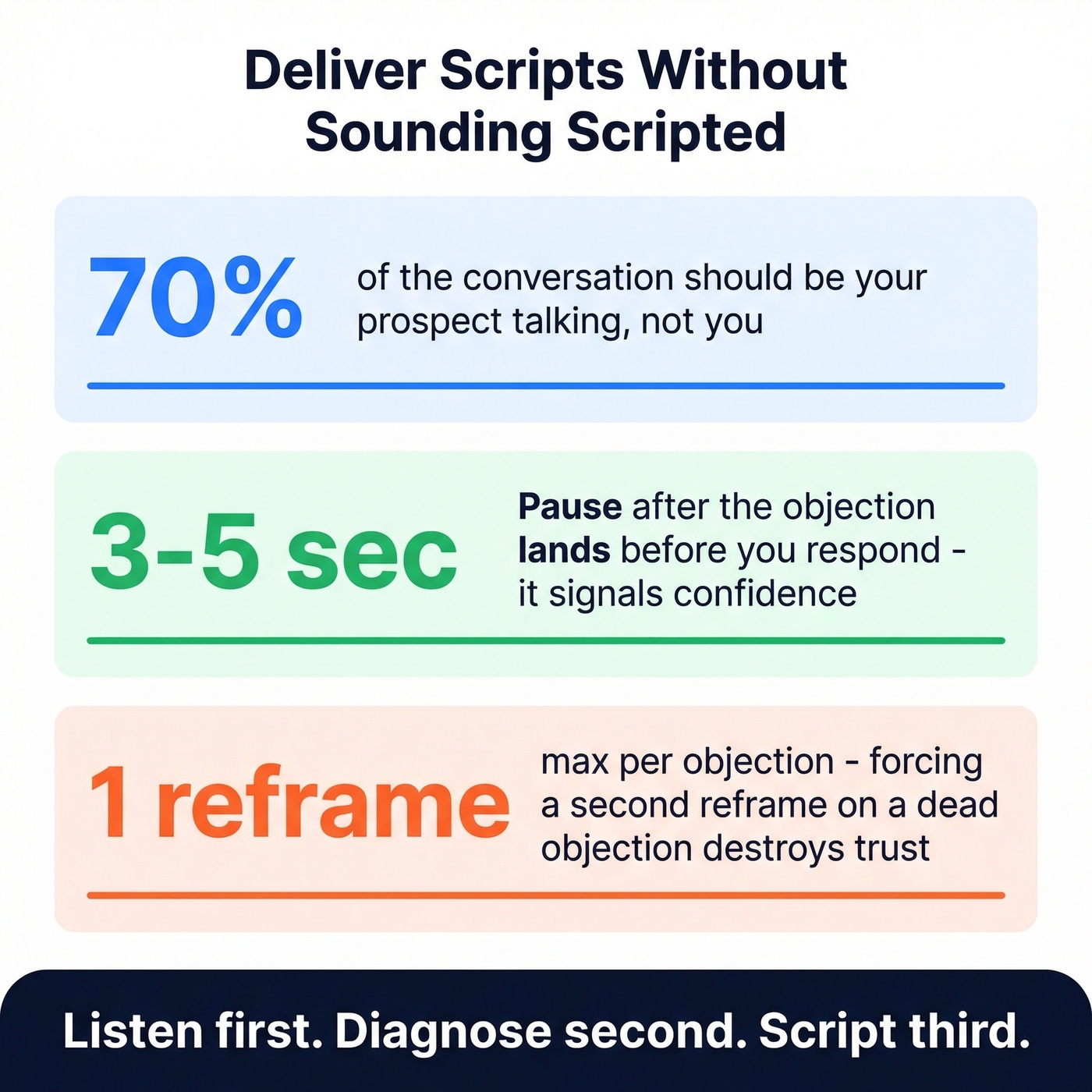
After the objection lands, wait 3-5 seconds before responding. HubSpot's objection-handling guidance recommends pausing after a prospect raises a pricing concern. It signals confidence and gives your brain time to diagnose which certainty bucket you're dealing with.
Let's be honest about something: if your reframe gets a flat "no, it's genuinely just too expensive," pivot to phased rollout or walk away gracefully. Forcing a second reframe on a dead objection destroys trust faster than the price ever could. (This is also where having a clear walk away point helps.)
Scripts Fail When Your Data Does
The best price objection handling script is worthless if you're delivering it to the wrong person - or to a number that rings out. 73% of B2B buyers actively avoid sellers who send irrelevant outreach, and stale contact lists with 30%+ bounce rates guarantee you never reach the decision-maker who can actually say yes. In our experience, the upstream data problem kills more deals than bad scripting ever does. Tools like Prospeo, with 98% email accuracy and a 7-day data refresh cycle, solve that before you ever pick up the phone. (If you’re cleaning lists at scale, start with data enrichment services and an email deliverability guide.)
Arming your champion with the right data wins deals. But arming your reps with the right contacts wins pipelines. Prospeo's 300M+ profiles with 30+ filters - including buyer intent and job changes - mean your team spends time selling, not chasing dead leads that stall on price.
Build lists that convert at $0.01 per verified email.
FAQ
What's the best response when a prospect says "your price is too high"?
Diagnose first - ask "too expensive compared to what?" to surface whether it's a budget issue, competitor comparison, or value gap. Then match the right script to the real objection. Jumping straight to a discount signals your original price was inflated.
Should you ever discount on the first price objection?
Almost never. Immediate discounting creates a credibility gap and trains buyers to push harder next time. Explore phased implementation, adjusted scope, or flexible payment terms before touching the number.
How do you handle price objections over email?
Lead with empathy, restate the quantified ROI in one sentence, and propose a specific next step like a 10-minute call. Keep the email under 100 words - async objections need shorter, sharper framing than live conversations.
How can better prospect data reduce pricing objections?
Reaching verified decision-makers - not gatekeepers - means your pitch lands with someone who controls budget. When your data's fresh and accurate, you're running these scripts against the right contacts instead of wasting cycles on stale leads that never convert.