

7 B2B Sales Tactics That Book Meetings and Close Deals
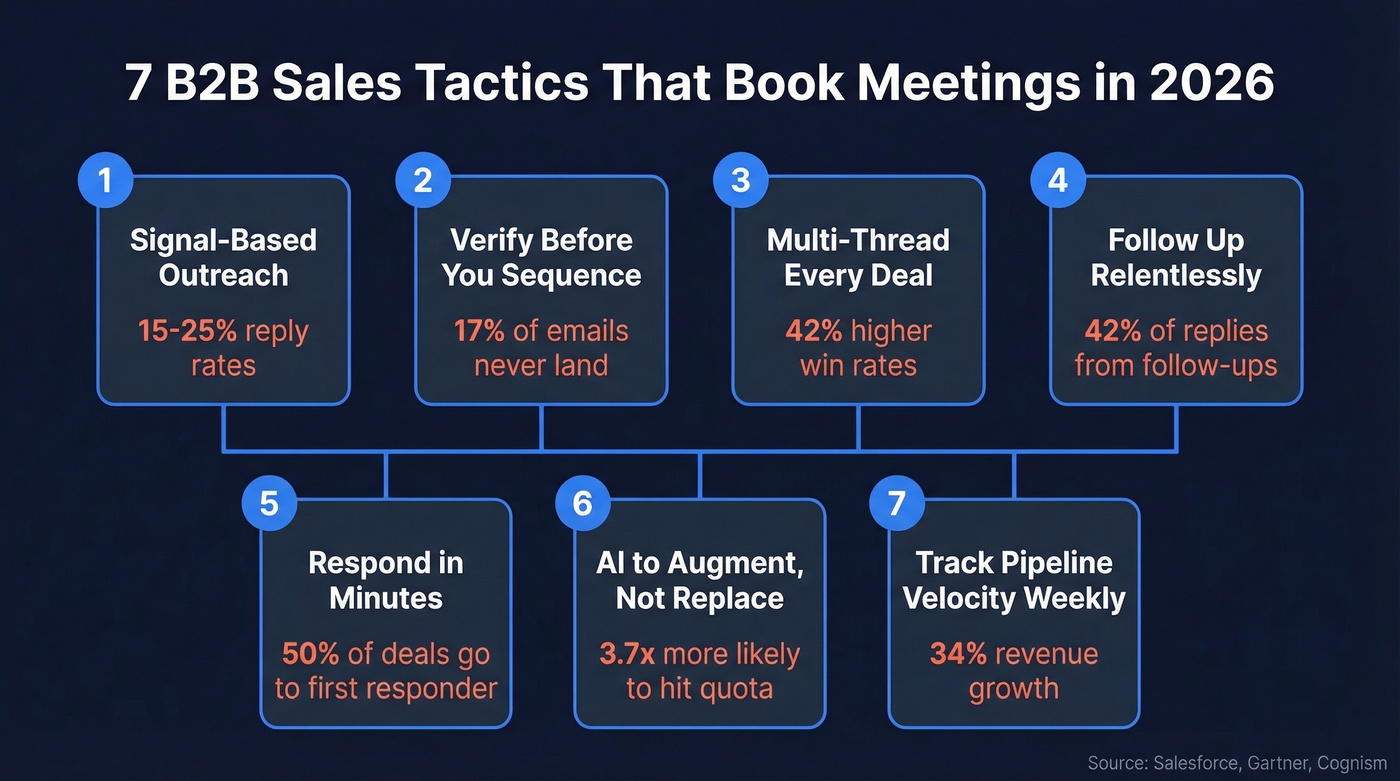
84% of reps missed quota last year. Not because they weren't working - because the infrastructure underneath them is broken. Bad contact data, single-threaded deals, and spray-and-pray outbound don't survive a world where the average B2B buying cycle runs 10.1 months and the biggest funnel leak - MQL to SQL - converts at just 15%. These seven b2b sales tactics are the moves we've seen work in 2026 for teams that need pipeline now.
The Short Version
Fix your data before you add more tactics. Verify every contact before it hits a sequence. Multi-thread every deal worth closing. And follow up relentlessly - 42% of replies come from follow-up messages, yet 48% of reps never send a second one. If you're serious about growing revenue, start with the fundamentals below.

Signal-based outreach and multi-threading only work when your contact data actually connects you to real buyers. Prospeo gives you 300M+ profiles with 30+ filters - intent data, headcount growth, technographics - so every sequence starts with a verified, in-market target. Meritt tripled their pipeline from $100K to $300K/week after switching.
Stop building campaigns on broken data. Start with 98% accuracy.
7 Tactics Worth Your Time in 2026
Lead with Signals, Not Spray-and-Pray
The teams hitting 15-25% reply rates aren't writing better subject lines. They're picking better targets. Signal-based outreach means anchoring every touchpoint to something real: a leadership change, a funding round, a hiring surge in the exact department you sell into, or earnings commentary that reveals a strategic priority. It's one of the most reliable ways to increase B2B sales without inflating your send volume.
Build a 5-minute research habit before every send. The signal types that matter most:
- Leadership changes - new VPs have budget and mandate
- Funding rounds - capital means spend
- Hiring patterns - 10 new SDRs means an outbound investment
- Earnings commentary - public companies telegraph priorities quarterly
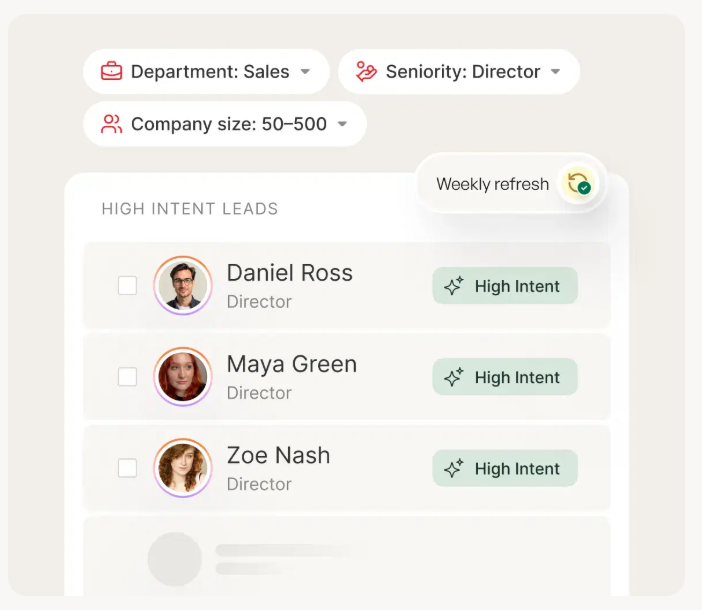
Prospeo's intent data tracks 15,000 Bombora topics, so you can spot in-market accounts without relying on guesswork. Layer that with 30+ search filters - technographics, headcount growth, department size - and you're building lists that practically qualify themselves.
Verify Before You Sequence
17% of cold emails never reach the inbox. They bounce or get filtered before a human ever sees them. Every bounce chips away at your domain reputation, which tanks deliverability for the emails that should've landed.
Practitioners on Reddit are blunt about this - Apollo's contact data is user-populated, and as one put it, "they're not verifying anything by themselves." The smart workflow: export a tight ICP list under 1,000 contacts, verify with at least two tools, then sequence only the clean records. Prospeo runs 98% email accuracy with a 7-day data refresh cycle - compared to the industry average of six weeks. One customer, Meritt, dropped their bounce rate from 35% to under 4% after switching their verification step. Clean data is the foundation of any growth strategy - without it, every tactic downstream underperforms.
Multi-Thread Every Deal
Use this when: Deal size exceeds $15k or the buying committee is larger than two people.
Skip this when: You're running high-velocity, single-buyer transactions where the user is the decision-maker.
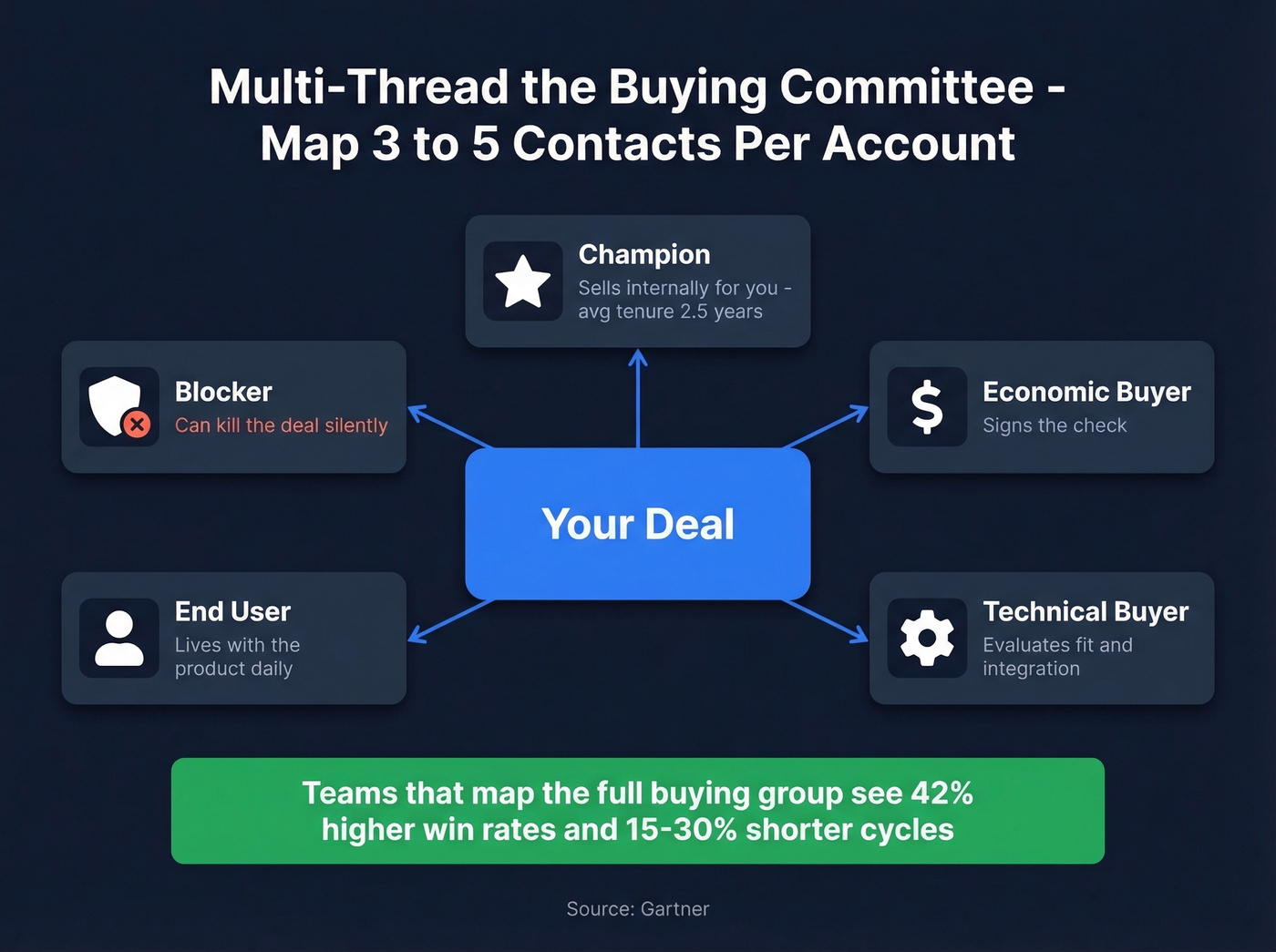
Gartner puts the average B2B buying committee at 11 stakeholders, and 86% of purchases stall because sellers fail to align those stakeholders early. Teams that map the full buying group see 42% higher win rates and 15-30% shorter cycles. Map at least 3-5 contacts per account before you launch: Champion, Economic Buyer, Technical Buyer, End User, and Blocker. Your champion's average tenure at the manager/director level is 2.5 years - if you're single-threaded and they leave, the deal dies with them. Multi-threading remains one of the most effective techniques for closing enterprise accounts.
Follow Up (Seriously)
42% of all replies come from follow-up messages, yet 48% of reps never send a second one. That's not a tactic gap - it's a pipeline leak you can fix today.
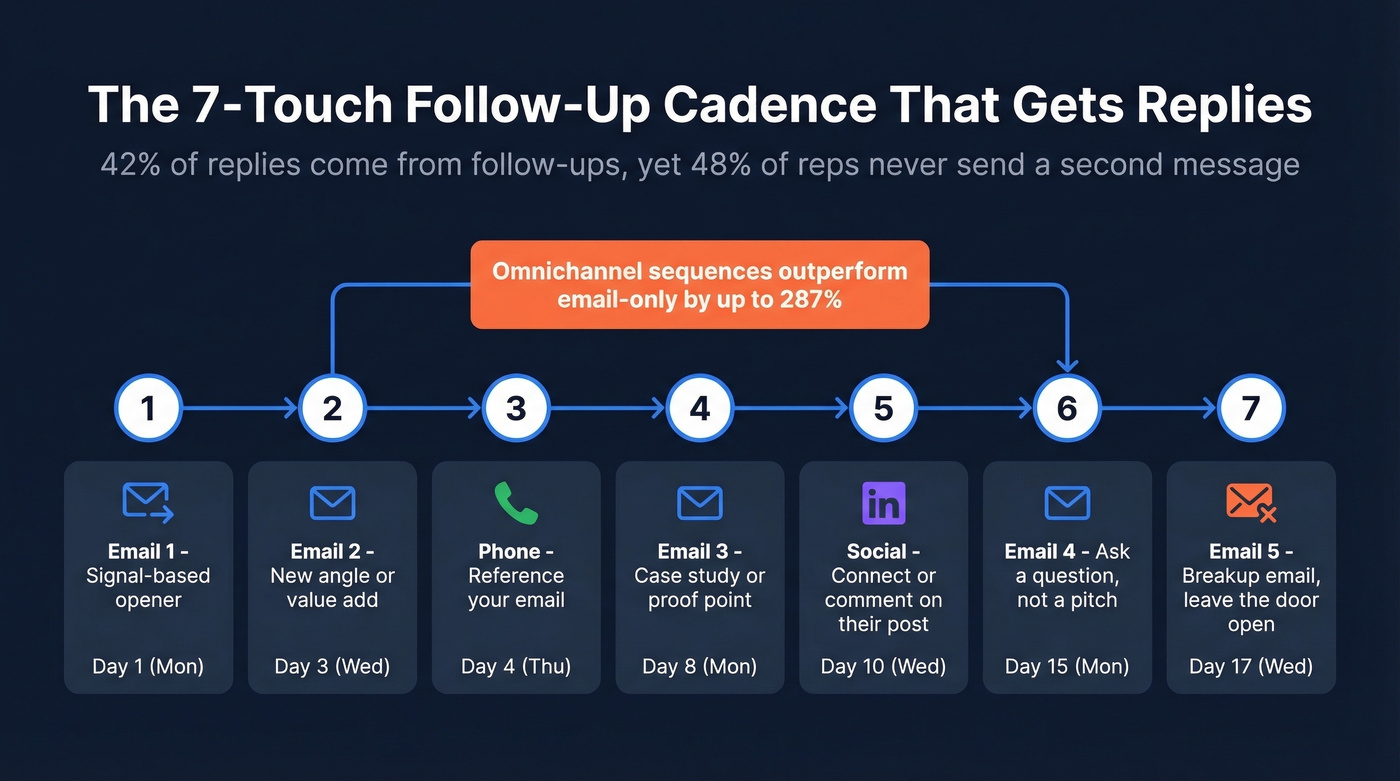
Cap at 7 touches per contact, staggered across email, phone, and social. Monday is the best day to launch a sequence; Wednesday drives peak engagement for follow-ups. Omnichannel sequences combining email, phone, and social outperform email-only by up to 287%. We've seen teams double their reply rates just by adding three well-timed follow-ups to a sequence that previously stopped at one email. If you're looking for quick wins that move the needle immediately, a structured follow-up cadence is the lowest-hanging fruit. If you need copy you can deploy fast, use these sales follow-up templates.
Respond in Minutes, Not Hours
The average B2B lead response time is over 40 hours. Meanwhile, up to 50% of deals go to the first vendor to respond.
Set a 5-minute response window for inbound leads. Route them directly to the rep who owns the account or territory. If your team can't respond in five minutes during business hours, you have a process problem, not a headcount problem. Speed-to-lead is the single cheapest conversion lever most teams ignore - and one of the simplest ways to accelerate pipeline across the board.
Use AI to Augment, Not Replace
Sellers using AI effectively are 3.7x more likely to meet quota. But here's the paradox worth understanding: AI SDRs can process 1,000+ contacts per day versus 50-80 for a human rep, yet meeting-to-opportunity conversion runs about 15% for AI-generated meetings versus 25% for human-sourced ones. Volume without quality is just expensive noise.
Where AI wins: Prospecting research, email drafting, lead scoring, and admin automation. Reps spend only 25% of their time actually selling - AI reclaims chunks of the other 75%. (If you want a deeper workflow, see AI cold email outreach.)
Where humans win: Judgment, nuance, and relationships. Don't automate the relationship. Automate the grunt work around it. The teams growing fastest in 2026 use AI to free reps for the conversations that actually close deals.
Track Pipeline Velocity Weekly
Pipeline velocity tells you how fast revenue moves through your funnel:
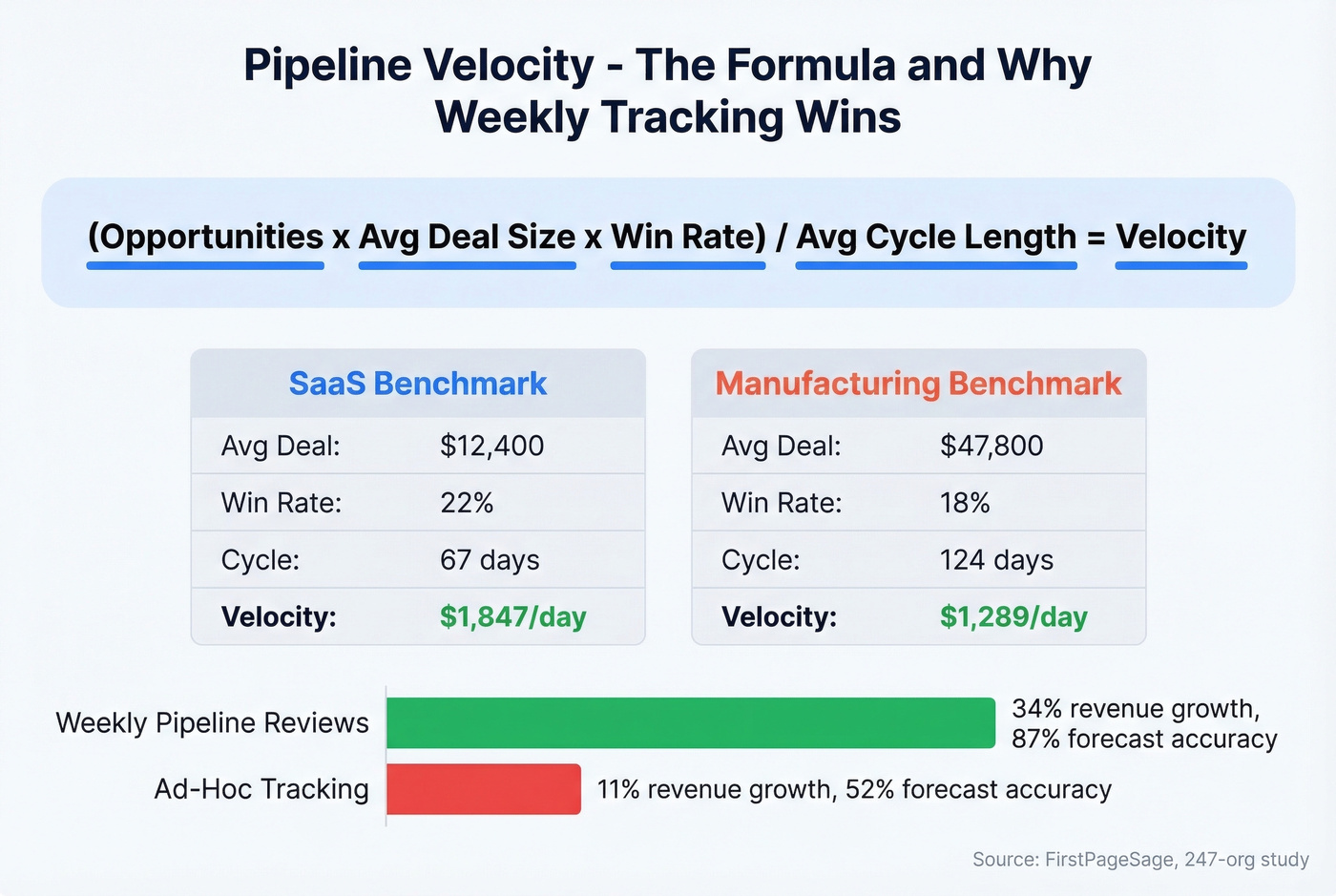
(# of opportunities × average deal size × win rate) ÷ average cycle length = velocity
For SaaS, the benchmark from a 247-org study: $12,400 average deal, 22% win rate, 67-day cycle - producing $1,847/day. Manufacturing runs higher deal sizes ($47,800) but longer cycles (124 days), landing at $1,289/day.
Here's the hot take: the formula itself doesn't matter. The tracking frequency does. Teams that review velocity weekly see 34% revenue growth and 87% forecast accuracy. Ad-hoc tracking produces 11% growth and 52% accuracy. Weekly pipeline reviews are the difference between forecasting and guessing - and the single best habit to boost sales predictably quarter over quarter. If forecasting is a pain point, consider upgrading your sales forecasting solutions.
Mistakes That Kill B2B Sales Growth
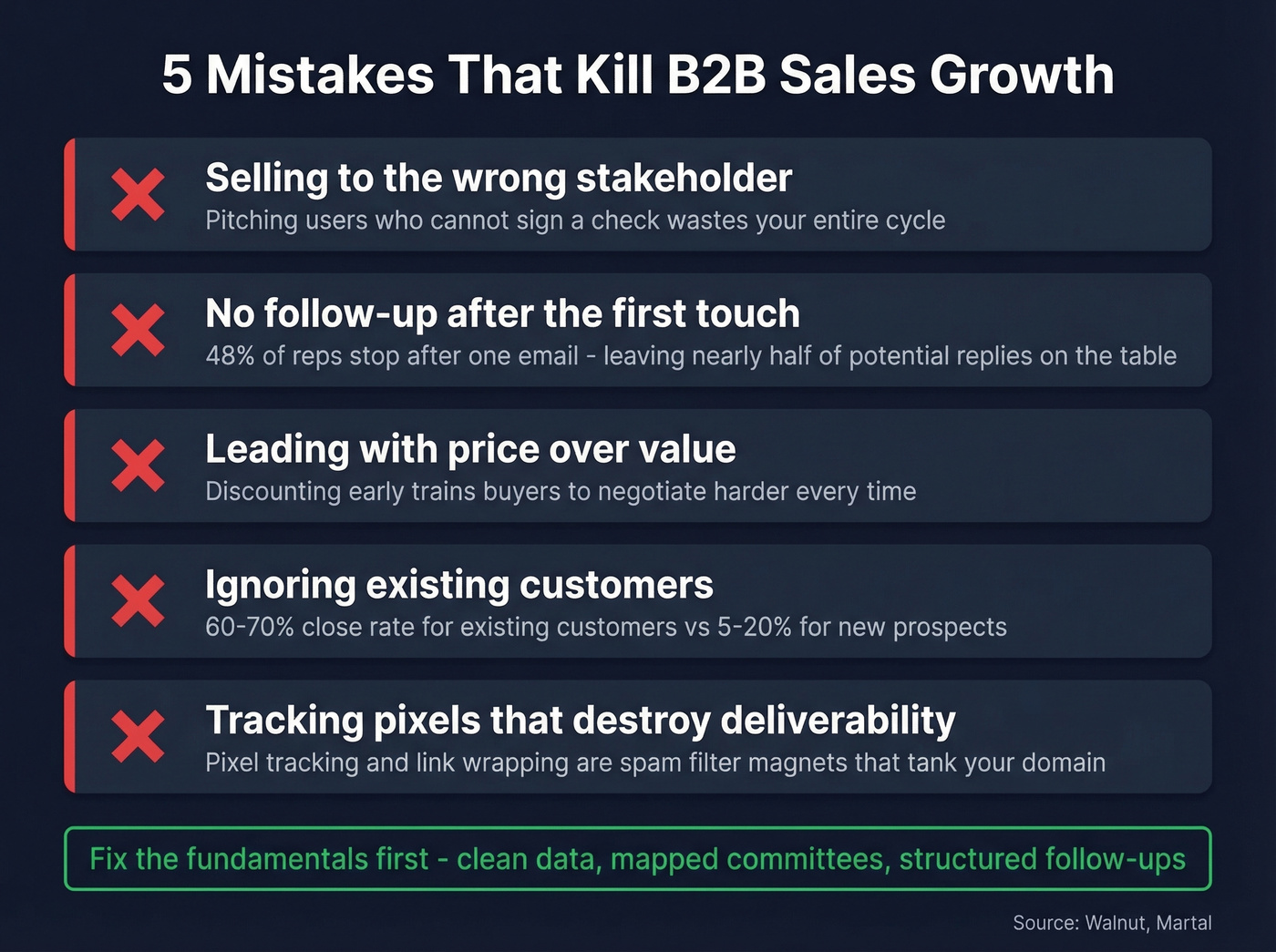
- Selling to the wrong stakeholder. If you're pitching a user who can't sign a check, you're building a champion without a path to the Economic Buyer. Map the committee first.
- No follow-up. 48% of reps stop after one touch. That's leaving nearly half your potential replies on the table.
- Leading with price over value. Discounting early trains buyers to negotiate harder. Anchor on the problem you solve, not the line item. (More on this: anchor in negotiation.)
- Ignoring existing customers. The probability of closing an existing customer is 60-70% versus 5-20% for new prospects. Your best pipeline might already be in your CRM.
- Using open/click trackers that destroy deliverability. Pixel tracking and link wrapping are spam-filter magnets. Reddit threads are full of reps who tanked their domain reputation before realizing their tracking setup was the problem. If you want the technical breakdown, start with email tracking pixels and email deliverability.
You just read that 17% of cold emails never reach the inbox and 48% of reps never follow up. Fix both problems at once: Prospeo's 7-day data refresh and 5-step verification keep bounce rates under 4%, so every follow-up in your cadence actually lands. At $0.01 per email, clean data costs less than a single wasted send.
Your follow-up cadence is only as good as the emails behind it.
FAQ
How Many Touchpoints Close a B2B Deal?
Most deals require 5-12 touchpoints across email, phone, and social. Since 42% of replies come from follow-ups, a single outreach attempt is almost never enough. Plan for 5-7 touches per contact, staggered over 2-3 weeks.
How Do You Shorten a B2B Sales Cycle?
Multi-thread early, respond to inbound in under five minutes, and track pipeline velocity weekly. Teams that map 3-5 stakeholders per account see 15-30% shorter cycles because they build consensus instead of waiting for one champion to sell internally.
What Are the Best Tools for B2B Prospecting in 2026?
You need three layers: a CRM (Salesforce or HubSpot), a verified contact database, and a sequencing tool for multi-channel cadences. Prospeo covers the data layer with 300M+ profiles, 98% email accuracy, and a 7-day refresh cycle - starting free at 75 emails/month. The critical step most teams skip is verifying data before loading it into any sequence.