

B2B Segments: What Works, What Fails, and How to Activate Them
81% of businesses say segmentation is critical for growth. Only 25% believe they're doing it well. That gap isn't a strategy problem - it's an activation problem. Teams build beautiful B2B segments in slide decks, present them to leadership, and then nobody loads them into the CRM or adjusts outbound targeting. The segments die in a PowerPoint.
Most B2B companies need three or four segments. Start with firmographics, layer intent data, and you'll convert 2-3x faster. The major reason segmentations fail isn't bad strategy - it's that nobody activates them in CRM or outbound.
What Is B2B Market Segmentation?
B2B segmentation divides your addressable market into groups that share characteristics relevant to how they buy. Market segmentation groups prospects before they buy; customer segmentation groups them after. Most teams need both, but they're different exercises.
The B2B version looks nothing like B2C. You're not segmenting millions of individual consumers by lifestyle or shopping habits. You're dealing with buying committees - technical evaluators, procurement, finance, end users - where the decision-making unit is inherently complex. Many large B2B companies have 100 or fewer customers driving most of their revenue, which means your segments are smaller, more concentrated, and the stakes of getting them wrong are much higher.
The benchmark? B2B markets generally have three or four segments. If you're managing more than four, you're slicing too thin for your data to support meaningful differentiation.
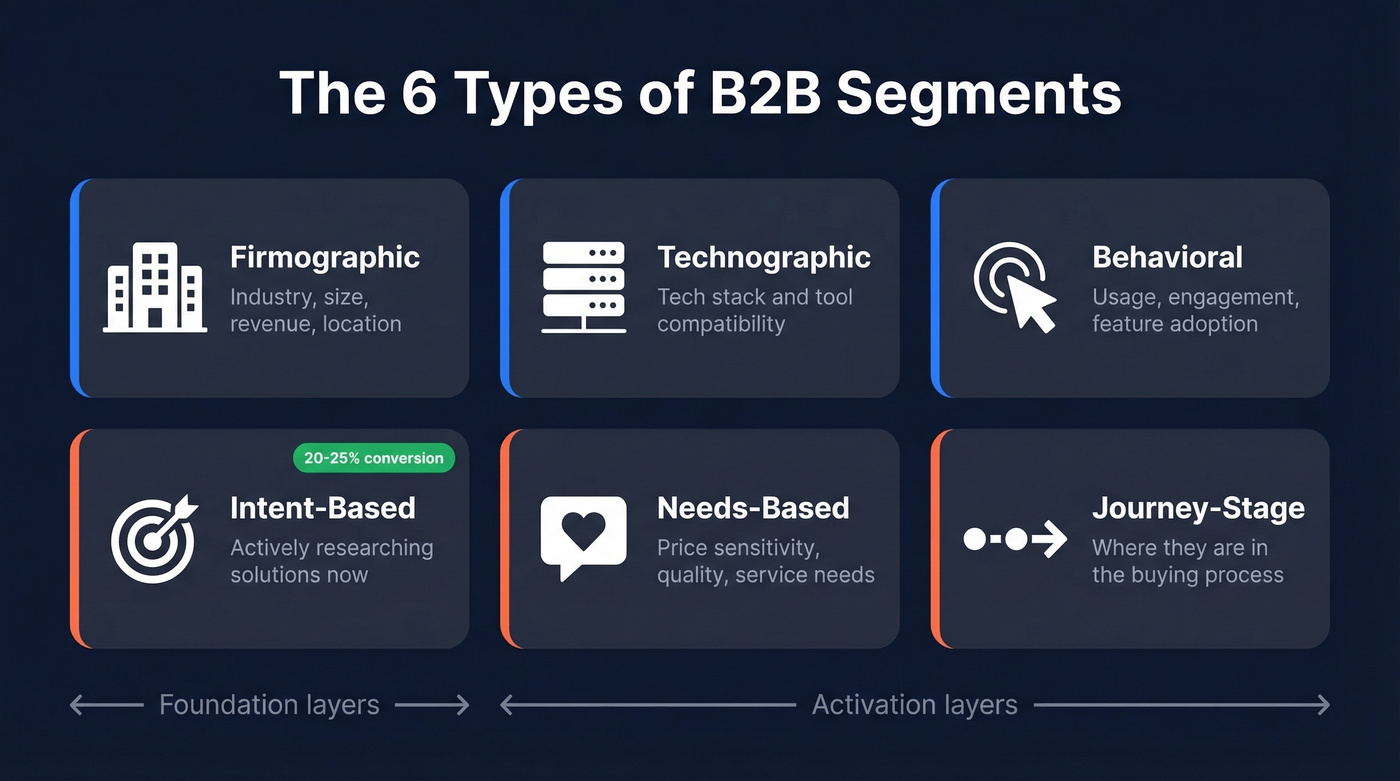
6 Types of B2B Segments
Firmographic
The foundation. Industry, company size, revenue, location, ownership type. Every segmentation model starts here because firmographics are the easiest data to collect and the most stable over time. Analyze your closed-won accounts and document the attributes that appear in 60%+ of your best deals - that pattern becomes your targeting filter.
Technographic
What technology does the prospect already use? If your product only supports a specific stack - say it integrates exclusively with Salesforce - companies on a different CRM are a lower-priority segment. Technographic data tells you whether a company can even use what you sell. It's the compatibility filter that firmographics miss entirely.
Behavioral
How prospects interact with your product, content, or sales team: usage frequency, feature adoption, engagement depth, content consumption patterns. Behavioral segmentation works well but requires data you might not have yet. It's most useful for customer segmentation and expansion plays, less so for cold outbound.
Intent-Based
Here's where the conversion math changes. Intent-based segments identify companies actively researching solutions in your category. The numbers are stark: intent-driven leads convert at 20-25% vs 5-10% for traditional leads, and sales cycles close 40% faster. The tradeoff is higher upfront CPL ($150-200 vs $50-100), but qualified-lead costs drop significantly over time. For teams focused on audience targeting, intent signals are the fastest way to prioritize accounts that are actually in-market right now.
Needs-Based
What does the buyer actually care about? Price sensitivity, quality requirements, service expectations, partnership depth. Needs-based segmentation is harder to build because it requires primary research - talking to customers, analyzing deal notes, surveying lost opportunities. But it's often the most actionable for messaging and positioning.
Journey-Stage
Where is the prospect in their buying process? In ABM terms: target account, engaged account, MQA, opportunity, customer, post-sale. Journey-stage segmentation determines what you say and through which channel. A company in early research needs education; one evaluating vendors needs proof points and pricing.
Firmographic vs Intent: The Conversion Gap
| Metric | Firmographic Only | Firmographic + Intent |
|---|---|---|
| Conversion rate | 5-10% | 20-25% |
| Sales cycle | 3-6 months | 1-2 months |
| CAC impact | Baseline | ~30% reduction |
| First-year ROMI | 1.5-2x | 3-4x |
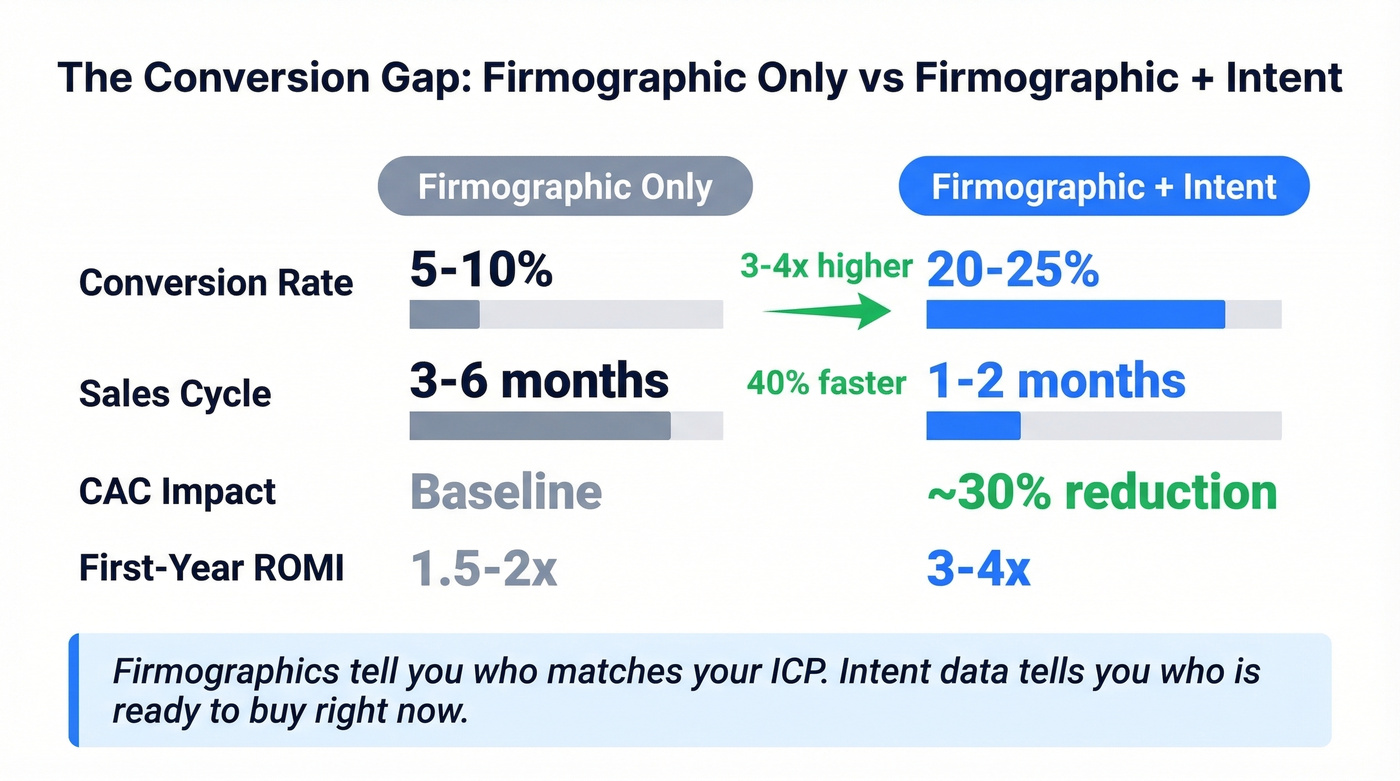
Firmographics alone are table stakes. They tell you who matches your ICP. Intent data tells you who's ready to buy right now.
How to Build a Segmentation Model
Most guides tell you to "define your segments" without explaining the operational sequence. Here's the actual process we've seen work across dozens of B2B teams.
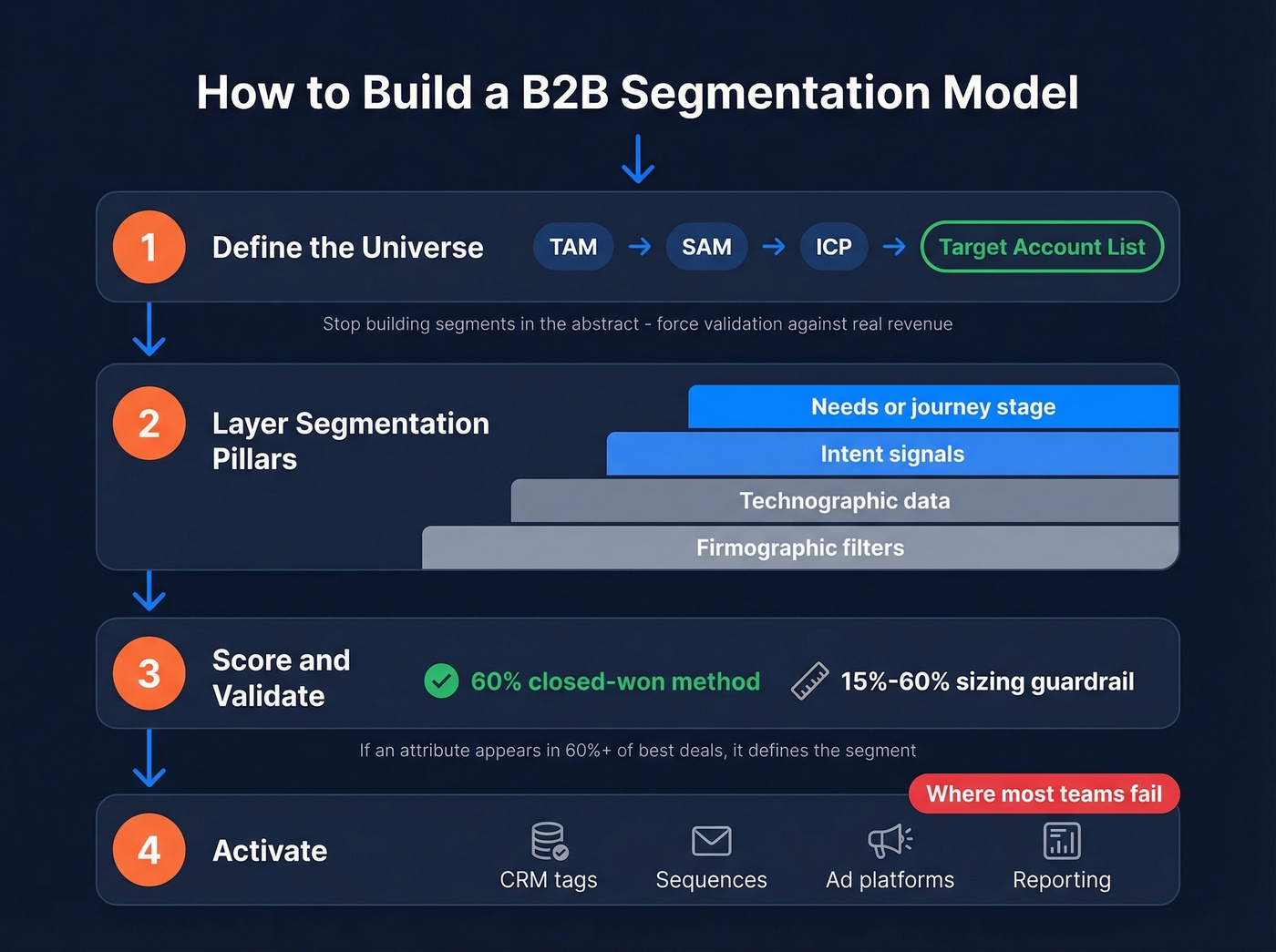
Phase 1: Define the universe. Start with your TAM, narrow to your SAM, then build your ICP. From the ICP, generate a Target Account List. Stop building segments in the abstract - a target account list forces validation against real revenue.
Phase 2: Layer segmentation pillars. Start with firmographic filters. Add technographic data for stack compatibility. Layer intent signals to find who's actively researching. Apply needs-based or journey-stage segmentation for messaging.
Phase 3: Score and validate. Use the 60% closed-won method: if an attribute appears in 60%+ of your best deals, it's a segment-defining characteristic. Apply the 15%-60% sizing heuristic - segments smaller than ~15% of your TAM struggle to attract investment; segments larger than ~60% are too broad to benefit from segmentation at all.
Phase 4: Activate. This is where most segmentations die. Load segments into your CRM as properties or tags. Build filtered views for sales. Create segment-specific sequences in your outbound tool. Push segments to ad platforms for targeted campaigns. If your segments don't exist in the systems your team uses daily, they don't exist.

You just saw that firmographic + intent segments convert 20-25% vs 5-10%. Prospeo combines 30+ search filters - firmographics, technographics, buyer intent across 15,000 Bombora topics, job changes, and headcount growth - so your segments go from slide deck to live target account list in minutes. Every contact comes back with 98% verified emails.
Build segments that exist in your CRM, not just your PowerPoint.
Why Most Segmentations Fail
We've watched this play out enough times to see the pattern. Five failure categories, each with a one-line fix:
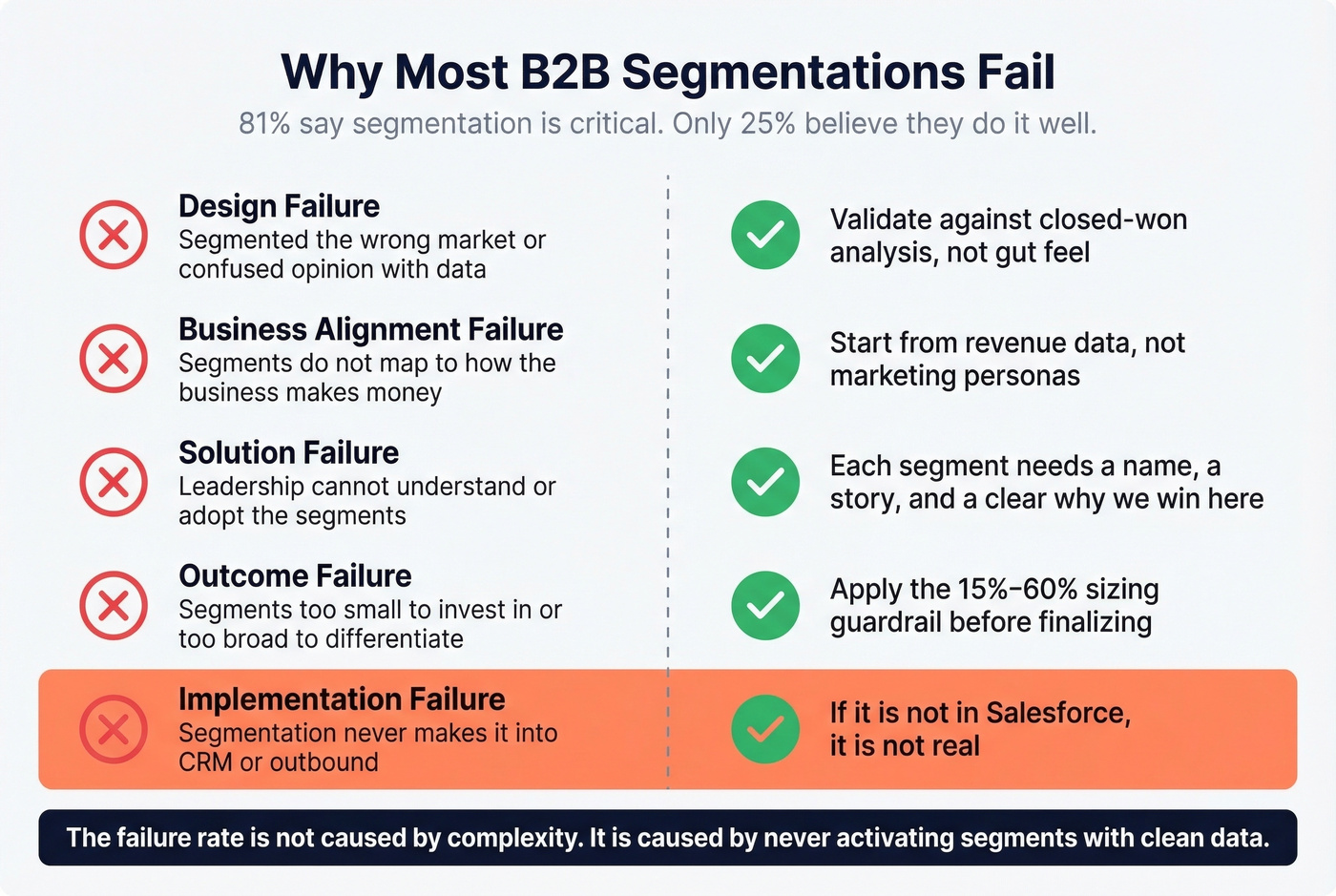
- Design failure - you segmented the wrong market, or confused opinion with data. Fix: validate segments against closed-won analysis, not gut feel.
- Business alignment failure - your segments don't map to how the business actually makes money. Fix: start from revenue data, not marketing personas.
- Solution failure - leadership can't understand or adopt the segments because they have no narrative. Fix: each segment needs a name, a story, and a clear "why we win here."
- Outcome failure - segments are too small to invest in or too broad to differentiate. Fix: apply the 15%-60% sizing guardrail before finalizing.
- Implementation failure - the segmentation never makes it into CRM, outbound, or ad targeting. Fix: if it isn't in Salesforce, it isn't real.
The consensus on r/sales is telling: segmentation feels hard because "information is lacking and the buying process is long and complicated." That's real. But the failure rate isn't caused by complexity. It's caused by never activating the segments with clean data.
Segmentation as a Sales-Marketing Alignment Tool
Here's the thing: we've seen this pattern repeatedly. Marketing generates 500 MQLs in a quarter, sales works 80 of them, and both teams blame each other. The root cause is almost always a segmentation gap - marketing targets one definition of "good fit," sales has a different one, and nobody wrote either down.
Segmentation fixes this by creating a shared language. When both teams agree on which groups matter and which are out of scope, lead handoff stops being a negotiation. One tactic that works: catalogue your accounts as in-market versus out-of-market. That single binary forces alignment on who deserves resources right now versus who goes into a nurture track.
If your deal sizes run below five figures, skip the four-segment model. You need two - "ready to buy" and "not yet" - and a fast way to tell them apart. Overengineering segmentation at low ACV burns more time than it saves.
Another move that pays off fast: call your lost deals and ask why they didn't buy. That feedback loop refines your segments faster than any data platform.
Activating Segments for Outbound
Once your segmentation model is built, the next challenge is pushing it into the platforms where campaigns actually run - email sequences, ad platforms, ABM tools.
The key is translating each segment into filter criteria your tools understand. A firmographic segment like "Series B+ SaaS companies with 50-200 employees" becomes a saved audience in your ad manager and a filtered list in your enrichment tool. When every dollar of ad spend and every outbound sequence maps directly to a defined group with known conversion characteristics, you stop wasting budget on accounts that were never going to close.
Let's be honest: most teams skip this step because it's tedious. Building the segment model feels like the hard part. Loading it into six different tools, maintaining it as data changes, and keeping sales aligned on which list they're working - that's the actual work.
Tools to Operationalize Segments
A segmentation model is only as good as the data feeding it and the systems activating it. In our experience, the most common failure point isn't strategy - it's that teams export 10,000 target companies and then discover half the emails bounce on the first sequence.
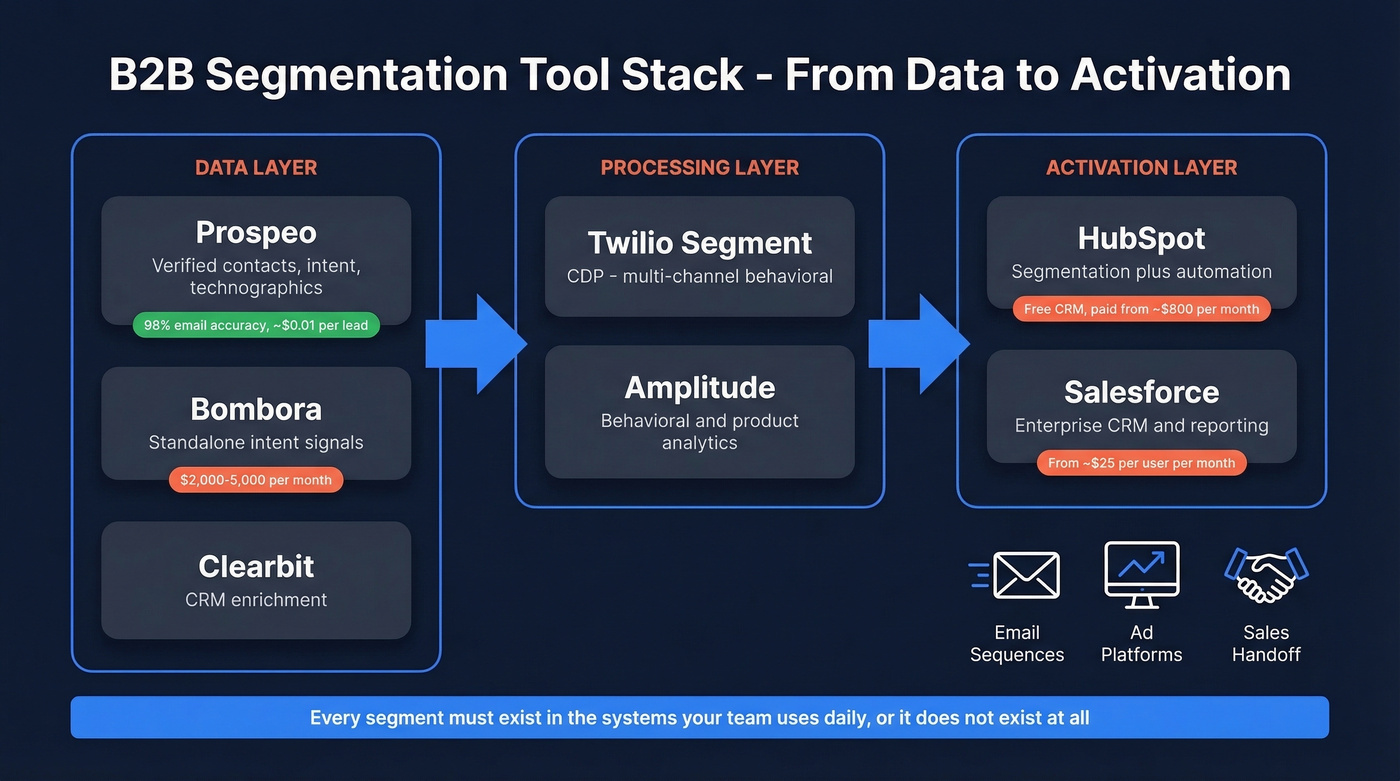
Prospeo sits at the data quality and enrichment layer, turning segment definitions into verified contact lists. With 30+ search filters covering buyer intent across 15,000 topics, technographics, headcount growth, and funding signals, you can build segment-specific lists at roughly $0.01 per lead with 98% email accuracy on a 7-day refresh cycle.

| Tool | Category | Best For | Starting Price |
|---|---|---|---|
| Prospeo | Data/Enrichment | Verified lists per segment | ~$0.01/lead; free tier |
| Twilio Segment | CDP | Multi-channel behavioral | Free |
| UpLead | B2B Leads | Firmographic lead lists | From $99/mo |
| Clearbit | Enrichment | CRM enrichment | Custom pricing |
| HubSpot | CRM | Segmentation + automation | Free CRM; paid from ~$800/mo |
| Salesforce | CRM | Enterprise reporting | From ~$25/user/mo |
| Amplitude | Analytics | Behavioral/product analytics | From $49/mo |
| Bombora | Intent Data | Standalone intent signals | ~$2,000-5,000/mo |
Implementation failure kills more segmentations than bad strategy. Prospeo pushes activated segments directly into Salesforce, HubSpot, Smartlead, Instantly, and Lemlist - with 92% enrichment match rates and 50+ data points per contact. At $0.01 per email, activating a 10,000-contact segment costs less than a team lunch.
Turn every segment into a live outbound campaign in one click.
FAQ
What's the difference between market segmentation and customer segmentation?
Market segmentation divides your total addressable market into groups before they buy; customer segmentation groups existing accounts by behavior, value, or needs. Most teams need both - market segmentation for acquisition, customer segmentation for retention and expansion.
How many segments should a B2B company have?
Three or four is the benchmark for most B2B markets. B2C brands run 10+, but B2B audiences are smaller and more concentrated. More than four segments usually means you're slicing too thin for your data to support meaningful differentiation.
What tools help activate segments with intent data?
Prospeo layers 15,000 intent topics with firmographic and technographic filters to build verified lists per segment starting at ~$0.01/lead with 98% email accuracy. For standalone intent signals, Bombora typically runs ~$2,000-5,000/month. Enterprise ABM platforms like Demandbase usually start at $30,000+/year.
How do I segment for outbound campaigns?
Start by defining your ICP with firmographic and technographic criteria, then layer intent data to identify accounts actively researching. Load each segment into your CRM and outbound tools as distinct lists with tailored messaging - every sequence and ad campaign should map to a specific group with known buying characteristics.