

B2B Technologies: Categories, Tools, Trends, and How to Build Your Stack
The global B2B eCommerce market is projected to hit $36 trillion by 2026, growing at a 14.5% CAGR. Behind every dollar of it sits a stack of B2B technologies that either works or doesn't. Most guides on this topic are vendor homepages dressed up as thought leadership, or surface-level definitions that won't help you make a single decision.
What follows is the practical taxonomy we wish someone had handed us before we inherited a 17-tool stack with three overlapping CRMs and an integration layer held together by Zapier automations nobody remembered the password to.
What You Need (Quick Version)
Every B2B team needs coverage across five core categories:
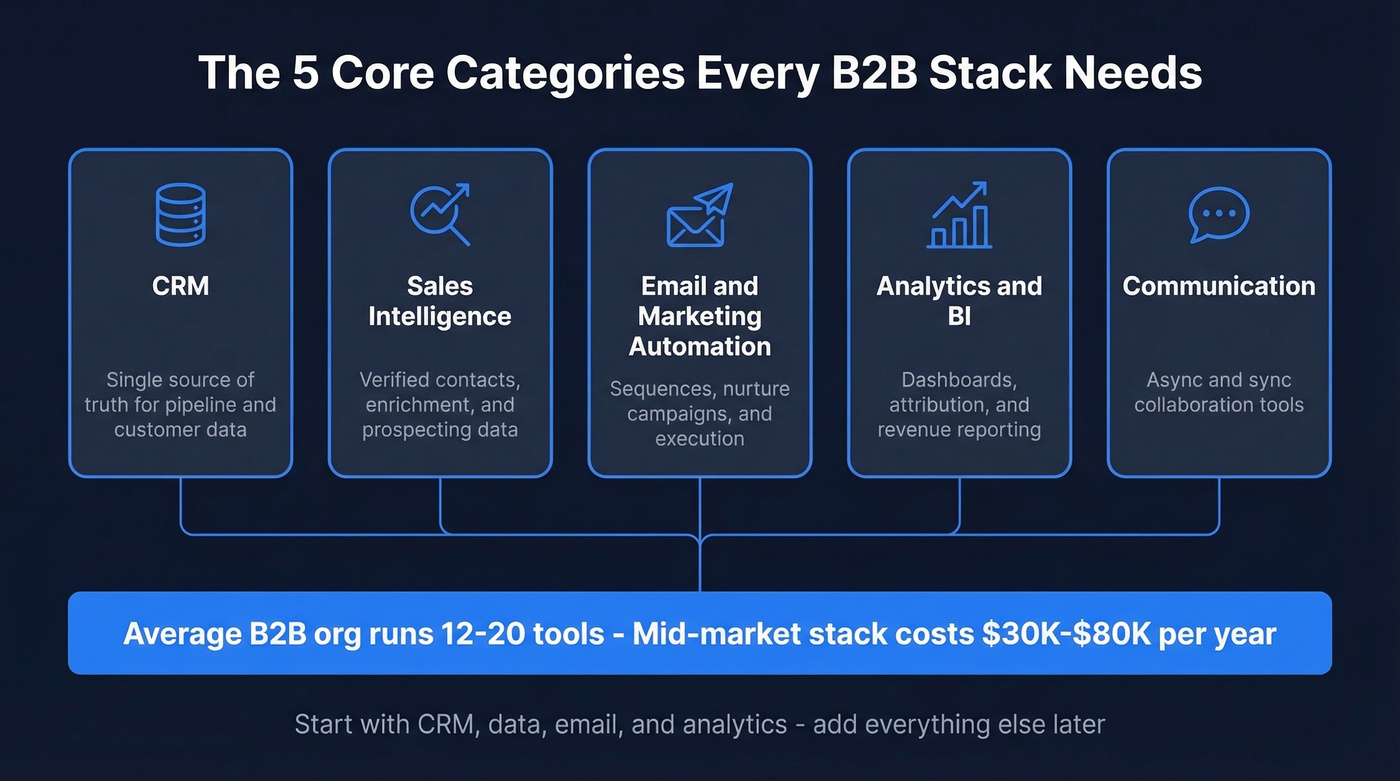
- CRM - your single source of truth for pipeline and customer data (see examples of a CRM)
- Sales intelligence / data platform - verified contacts and enrichment (compare data enrichment services)
- Email & marketing automation - sequences, nurture, campaign execution (tighten your sequence management)
- Analytics & BI - dashboards, attribution, revenue reporting
- Communication & collaboration - the connective tissue for async and sync work
The average B2B organization runs 12-20 tools. A mid-market stack (CRM + marketing automation + analytics + ads) typically costs $30,000-$80,000/year. Most teams have too many tools, not too few. Start with CRM, data, email, and analytics - add everything else later.
What Are B2B Technologies?
These are the software platforms, data tools, and infrastructure that businesses use to sell to, serve, and operate alongside other businesses. The distinction from B2C tech matters more than most people realize.
Consumer-facing tools optimize for individual UX and impulse purchasing. B2B tools need to handle multi-user accounts, role-based permissions, approval workflows, requisition lists, bulk ordering, and complex pricing structures like volume discounts and negotiated contract terms. A Shopify storefront and a B2B procurement portal solve fundamentally different problems, even if they both process transactions.
Here's the reality check: 78% of B2B transactions still flow through EDI, email, or fax. EDI alone processes roughly 20 billion transactions yearly. While the industry talks about moving everything online, the majority of actual commerce still runs on infrastructure that predates the smartphone. The tech powering B2B isn't just about shiny dashboards - it's about bridging the gap between legacy operations and modern workflows.
Why B2B Tech Matters in 2026
That $36 trillion market isn't just big - it's accelerating. APAC alone will account for 80% of that market share by 2026, making it the center of gravity for B2B digital commerce. Since 2020, over 90% of B2B companies have shifted to a virtual sales model, at least partially. Roughly 85% now operate an eCommerce storefront or self-service portal. And 56% reported new-product revenue growth specifically through digital channels.
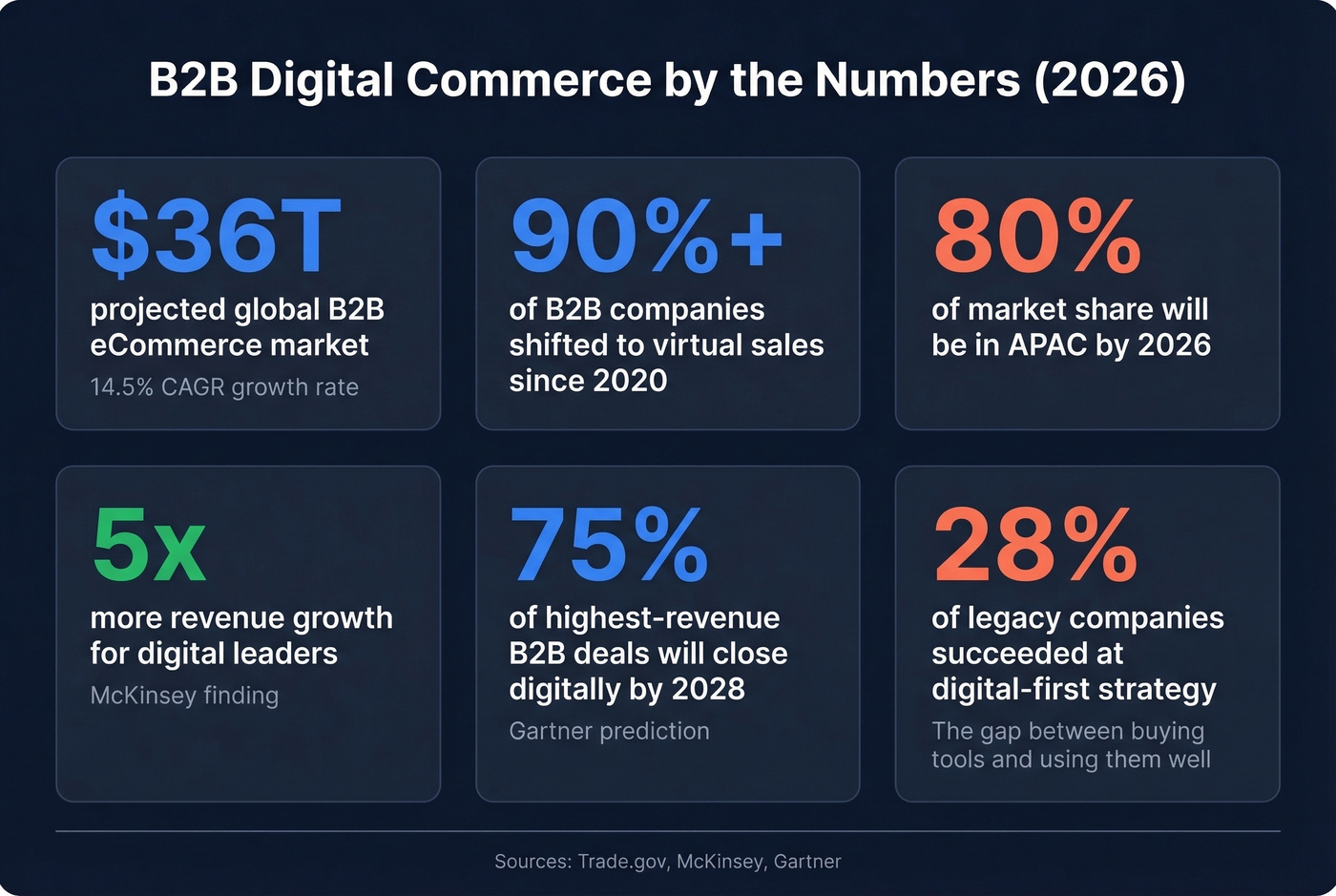
Gartner predicts that 75% of the highest-revenue B2B deals will close via digital channels by 2028. Companies that haven't invested in their technology stack by then won't just be behind - they'll be invisible to buyers who've already moved on.
The ROI case is equally stark. McKinsey found that B2B digital leaders drive 5x more revenue growth than their peers. But only 28% of legacy companies have actually succeeded at implementing a digital-first strategy. The gap between "we bought the tools" and "we use the tools well" is where most of the value gets lost.
Core Categories and Tools
Here's what the modern B2B stack actually looks like, broken down by category with real adoption rates and pricing.
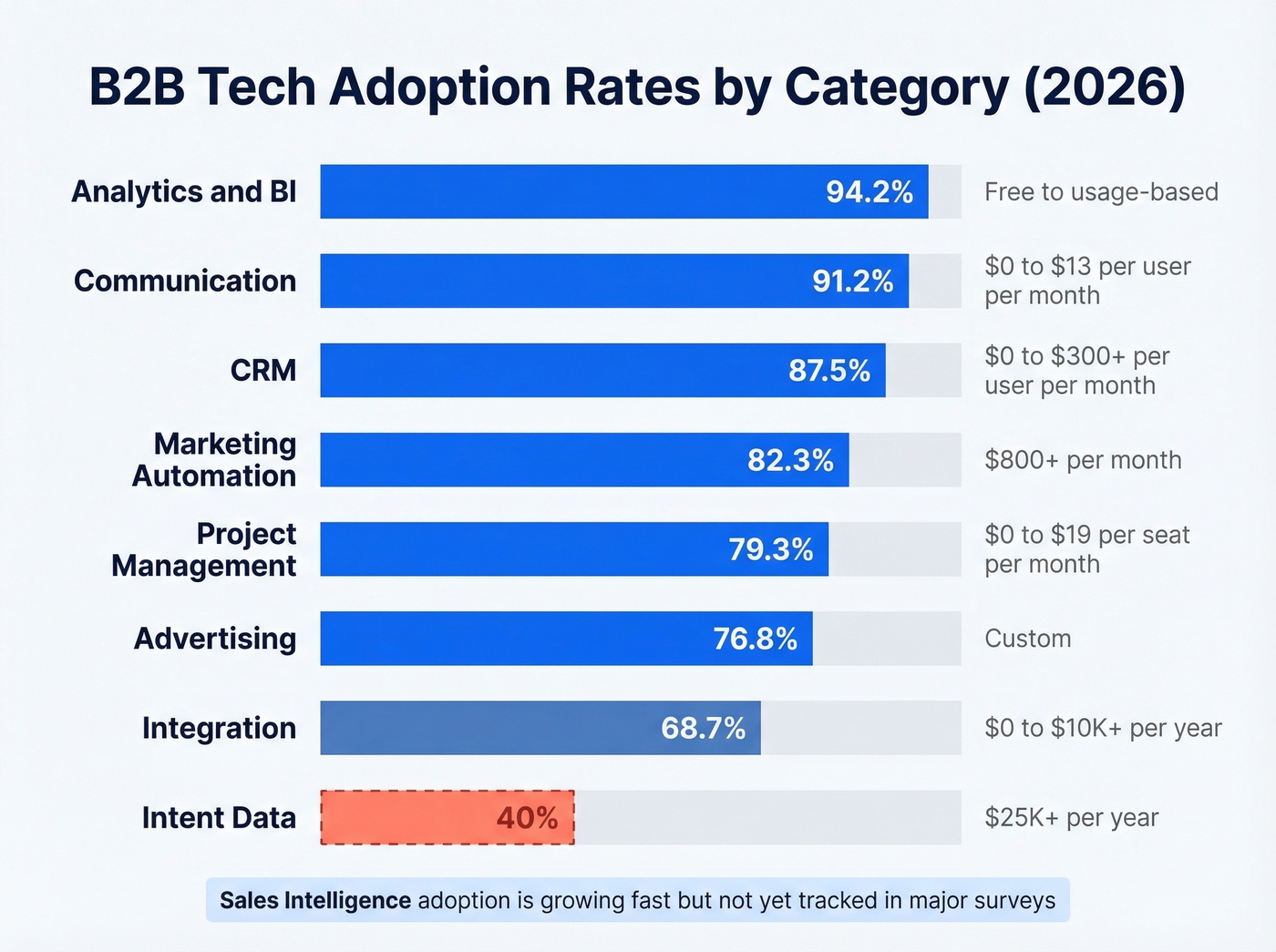
| Category | Adoption | Example Tools | Entry Price |
|---|---|---|---|
| Analytics/BI | 94.2% | GA4, Snowflake, Looker | Free - usage-based |
| Communication | 91.2% | Slack, Zoom, Teams | Free - ~$13/user/mo |
| CRM | 87.5% | Salesforce, HubSpot | Free - $300+/user/mo |
| Marketing Automation | 82.3% | HubSpot, Marketo | ~$800/mo+ |
| Project Management | 79.3% | monday.com, Asana | Free - $19/seat/mo |
| Advertising | 76.8% | Google Ads, LinkedIn Ads | Custom |
| Sales Intelligence | - | Prospeo, Apollo, Cognism | Free - $30,000+/yr |
| Integration | 68.7% | Zapier, Make, Workato | Free - $10,000+/yr |
| Intent Data | - | Bombora | ~$25,000+/yr |
CRM
Salesforce remains the default for mid-market and enterprise at $25-$300+/user/month depending on the edition. HubSpot offers a genuinely free CRM that's good enough for early-stage teams, with paid hubs starting around $800/month. Get this wrong and every downstream tool suffers - we've seen teams burn six months trying to migrate CRMs mid-year because they picked the wrong one at the start. If you're still deciding, start with a shortlist of contact management software.
Sales Intelligence & Data
This is the category most teams underinvest in, and it's the one that determines whether your outbound actually works. Prospeo covers 300M+ professional profiles, 143M+ verified emails at 98% accuracy, and 125M+ verified mobile numbers - all on a 7-day data refresh cycle while the industry average sits at six weeks. Typical competitors land around 79-87% email accuracy. Pricing is credit-based and transparent at roughly $0.01 per email, with a free tier of 75 verified emails per month. No contracts, no sales calls required.

Apollo offers a generous free tier for early prospecting, with paid plans starting around $49/user/month. Cognism wins on EMEA mobile coverage and compliance but runs $15,000-$30,000+/year as an enterprise play. Gong handles conversation intelligence on the revenue side. The results speak for themselves: Snyk's 50-person AE team saw AE-sourced pipeline jump 180% after switching to higher-accuracy data, generating 200+ new opportunities per month. (If you're building outbound from scratch, use these sales prospecting techniques.)
Marketing Automation
HubSpot Marketing Hub dominates the mid-market. Marketo (Adobe) is enterprise-focused with custom pricing; expect $1,000+/month for entry packages. The free tiers in this category are lead magnets, not real solutions - budget $800/month minimum for meaningful automation.
Analytics & BI
The highest adoption category at 94.2%. Google Analytics is the universal starting point (free). Snowflake uses usage-based pricing. Looker and Tableau handle the heavier lifting when you need custom dashboards. Budget varies wildly, from zero to six figures depending on data volume.
Project Management
monday.com runs free for up to 2 seats, then $9/$12/$19 per seat per month for Basic/Standard/Pro tiers with a 3-seat minimum. Asana and ClickUp compete at similar price points. Nearly 80% of B2B teams use dedicated project management tools - the question is whether yours actually maps to how your team works or just creates busywork.
Communication & Collaboration
Slack runs free, with paid plans in the ~$8-$13/user/month range. Zoom offers a free tier and paid plans around ~$15-$20/user/month. Microsoft Teams comes bundled with most Microsoft 365 plans.
At 91.2% adoption, this is table stakes. The real question is how many overlapping communication tools you're paying for. Most teams end up with Slack, Teams, and email all running simultaneously, with nobody sure which channel is canonical.
Integration & Automation
Zapier starts free with paid plans from ~$20/month. Make offers a free tier with paid plans from ~$9/month. Workato targets enterprise workflows at $10,000+/year. At 68.7% adoption, this category is still underutilized - which explains why 65.7% of teams report data integration difficulties. If your CRM doesn't talk to your sequencer, which doesn't talk to your analytics, you don't have a stack. You have a collection. (If you're stuck here, follow a connect outreach tool to CRM setup.)
Intent Data & Buyer Signals
Bombora is a dominant provider of B2B intent data at roughly $25,000+/year, tracking topic-level research signals across thousands of sites. Many platforms - Prospeo included, with 15,000 tracked topics - layer Bombora-powered intent data directly into their prospecting workflows, letting you filter prospects by both firmographic fit and active buying signals in one search. To operationalize this, build a system for identifying buying signals.
Security & Compliance
Cybersecurity is increasingly a board-level investment. Gartner's 2026 strategic trends include Preemptive Cybersecurity, AI Security Platforms, and Digital Provenance - reflecting the reality that B2B data flows require serious protection. Budget scales with company size, but even SMBs should account for security tooling.

Your B2B tech stack is only as good as the data feeding it. Prospeo gives you 300M+ profiles, 143M+ verified emails at 98% accuracy, and 125M+ mobile numbers - all refreshed every 7 days, not the 6-week industry average. At $0.01 per email with no contracts, it's the data layer your stack is missing.
Stop overpaying for stale data that tanks your outbound.
Trends Shaping B2B Tech in 2026
Gartner's 2026 top strategic technology trends cluster into three themes: AI-native infrastructure (AI-Native Development Platforms, AI Supercomputing, Domain-Specific Language Models), security and trust (Confidential Computing, Preemptive Cybersecurity, Digital Provenance, AI Security Platforms), and physical/geo infrastructure (Physical AI, Geopatriation, Multiagent Systems).
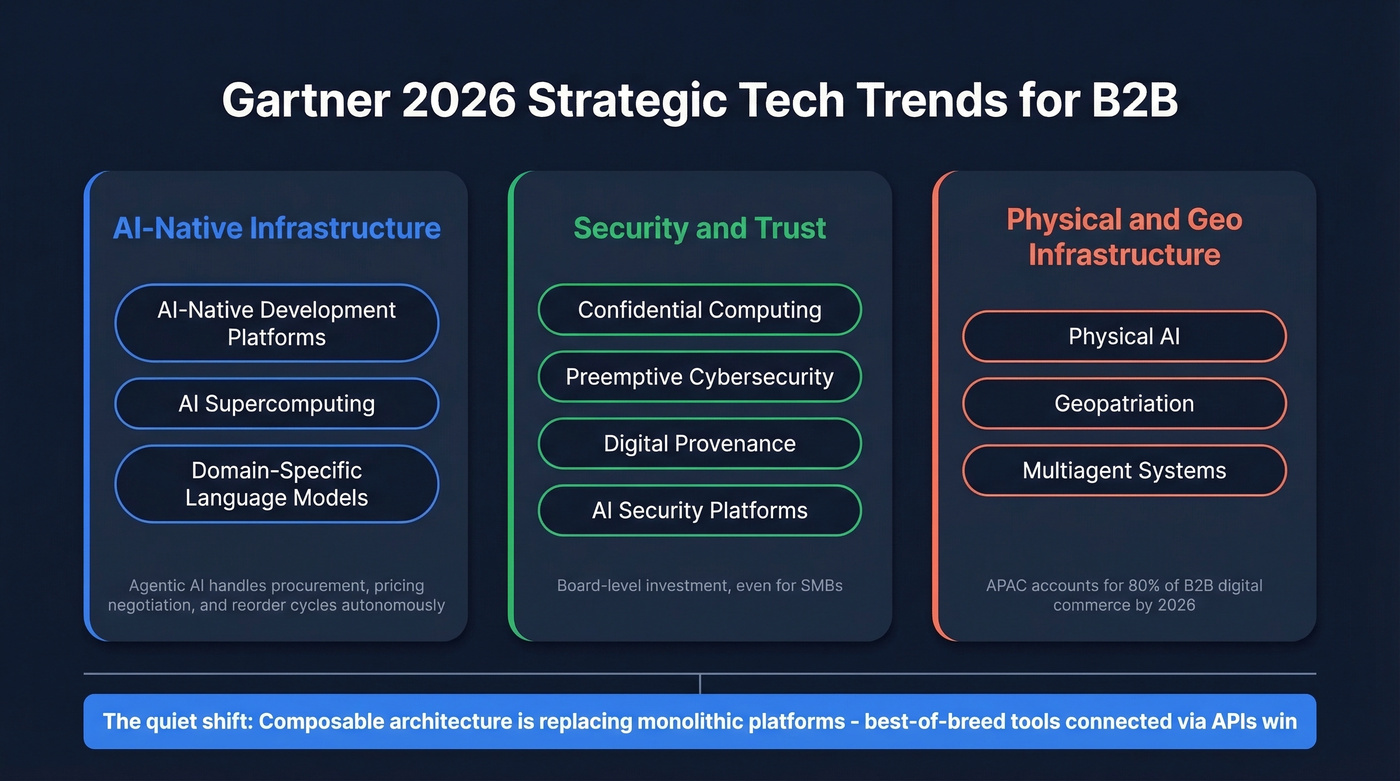
The headline trend is agentic AI - autonomous systems that don't just respond to prompts but execute multi-step workflows independently. For B2B commerce, this means AI agents handling procurement workflows, negotiating pricing within parameters, and managing reorder cycles without human intervention. The companies that figure out autonomous procurement workflows first will have a structural advantage that compounds over years.
Composable architecture is the quieter but equally important shift. Instead of monolithic platforms that try to do everything, leading teams are assembling best-of-breed tools connected via APIs and iPaaS layers. This is why the integration category matters more than ever - and why tools with open APIs and native integrations have a structural advantage over walled gardens.
Let's be honest: if your average deal size is under $15K, you probably don't need a $100K+ monolithic platform. A composable stack of best-in-class tools connected through Zapier or Make will outperform an enterprise suite that your team only uses 30% of.
AI in B2B: Real ROI Behind the Hype
Here's the thing about AI in B2B: it's overhyped in vendor decks and underdeployed in practice.
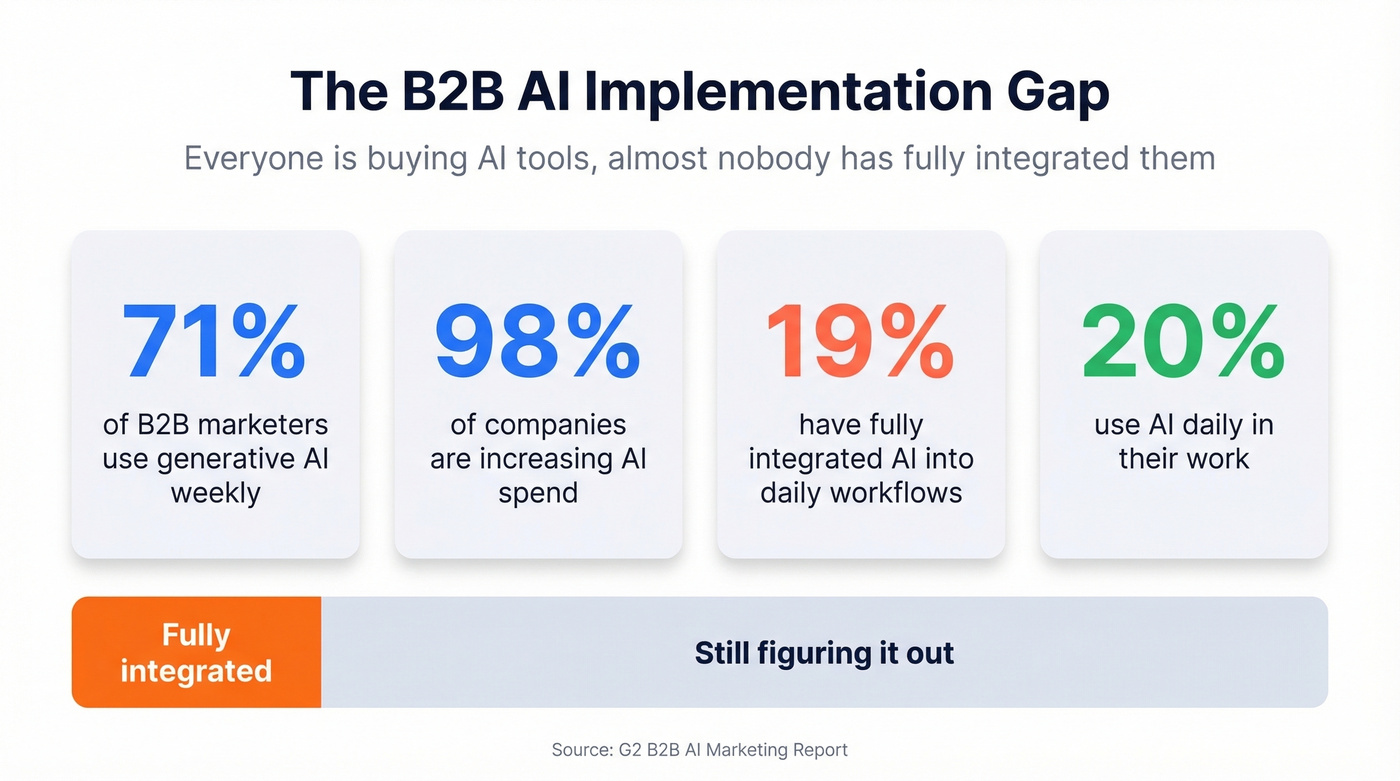
On the adoption side, 71% of B2B marketers use generative AI weekly, and 20% use it daily. 98% of companies are increasing AI spend. But only 19% have fully integrated AI into their daily workflows. That's a massive implementation gap - nearly everyone's buying, almost nobody's operationalizing. And 67% of teams say their internal AI systems outperform third-party solutions, which suggests the real value comes from custom implementations, not off-the-shelf AI features bolted onto existing tools.
The ROI potential is real when execution follows investment. Bain found that sellers spend roughly 25% of their time actually selling - the rest goes to admin, research, and internal coordination. AI can double that selling time. Early adopters are seeing 30%+ improvement in win rates when AI improves conversion across funnel steps.
Chatbots are the most tangible example: 57% of B2B teams use AI chatbots, and 26% report a 10-20% lift in lead generation. Not earth-shattering on its own, but meaningful when compounded across the funnel.
The lesson from every team we've watched succeed with AI is the same: value comes from process redesign, not from automating broken processes. If your data is dirty, AI just makes bad decisions faster. If your workflows are sound, AI amplifies them. Industry estimates put annual B2B data decay at 20-25%, which means data quality isn't a nice-to-have - it's the prerequisite for everything else working. (If you're scaling outbound, consider a set of SDR tools that fit your workflow.)
Common Mistakes to Avoid
Buying tools before defining workflows. We've all been in the meeting where someone demos a shiny new platform and the team signs up before anyone asks "what problem does this solve?" The average B2B org runs 12-20 tools, but 32% aren't using the full capabilities of what they already own. Meanwhile, 68% struggle with incorporating tech into a new go-to-market strategy. That's not a tool problem - it's a strategy problem.
Ignoring integration from day one. 65.7% of teams report data integration difficulties. When your CRM, sequencer, enrichment tool, and analytics platform don't share data cleanly, you end up with reps manually copying information between tabs. That's not a tech stack - it's a spreadsheet with extra steps.
Underestimating legacy channel volume. Teams pour budget into beautiful self-service portals while the majority of their actual transaction volume still flows through EDI, email, or fax. By 2028, only 27.5% of B2B digital commerce is expected to happen through websites. Build for the channels your buyers actually use, not the ones that look good in a board deck.
Treating cost as an afterthought. Cost is the #1 concern for 61% of B2B tech buyers, and 59% struggle with proper implementation for everyday use. The fact that so many enterprise tools still hide their pricing behind "talk to sales" gates makes this worse - teams commit to annual contracts before understanding total cost of ownership.
If a vendor won't show you pricing on their website, they're optimizing for their sales team's leverage, not your buying experience. Skip them if you can.
How to Evaluate Your Stack
When we assess any B2B tool, six criteria matter more than feature lists:
Integration depth. Does it connect natively to your existing stack, or do you need middleware for everything? Native integrations with your CRM and sequencer save more time than any feature ever will.
Data quality and freshness. How often is the data refreshed? What's the verification process? Look for vendors with documented refresh cycles - weekly, not monthly - and multi-step verification. If a vendor can't articulate their data hygiene process clearly, that's a red flag. (If email quality is a bottleneck, use email reputation tools to protect deliverability.)
Adoption ease. Will reps actually use it, or will it become shelfware within 90 days? The best tool your team won't use is worse than a mediocre tool they will.
Pricing transparency. Can you model costs before talking to sales? Credit-based and per-seat models are easier to forecast than opaque enterprise quotes.
Scalability. Does pricing scale linearly, or do you hit a cliff at a certain usage tier?
ROI measurability. Can you tie the tool's output to pipeline or revenue, or is the value purely "operational efficiency" - which is often code for unmeasurable?

Skip the feature comparison spreadsheet. Run a 2-week trial with real data and real workflows instead. Any tool that can't prove value in 14 days probably won't prove it in 14 months either.
Snyk's 50 AEs saw pipeline jump 180% after upgrading their sales intelligence layer. Stack Optimize built a $1M agency on data with sub-3% bounce rates. The difference isn't more tools - it's accurate data powering the tools you already have. Prospeo's 7-day refresh cycle and 98% email accuracy make every other tool in your stack work harder.
Replace the weakest link in your 12-tool stack for free.
FAQ
What separates B2B from B2C technology?
B2B technologies handle multi-stakeholder buying, approval workflows, bulk ordering, and complex pricing like volume discounts and negotiated contract terms. B2C tools optimize for individual consumer UX and impulse purchasing. The structural requirements - role-based permissions, requisition lists, quote management - make B2B platforms fundamentally different from consumer software.
How much does a B2B tech stack cost?
A mid-market stack covering CRM, marketing automation, analytics, and advertising typically runs $30,000-$80,000/year. Individual tools range from free tiers (HubSpot CRM, Google Analytics) to $300+/user/month for enterprise Salesforce editions. The biggest cost driver is stack sprawl, where overlapping subscriptions quietly compound.
What should I invest in first?
CRM and a reliable data platform. Everything else - automation, analytics, sequencing - depends on clean contact data and a single source of truth for your pipeline. Start with a free CRM tier and a data provider with a free plan so you can validate workflows before committing budget.
What's the biggest B2B technology trend for 2026?
Agentic AI - autonomous systems that execute multi-step workflows without human intervention. Gartner ranks it among the top 2026 strategic trends. For sales and procurement teams, this means AI agents handling reorder cycles, negotiating within set parameters, and routing approvals automatically. Early adopters report 30%+ improvement in win rates.