

B2B Telemarketing: Costs, Benchmarks, and Scripts for 2026
A RevOps lead we know ran a B2B telemarketing test last quarter. Two vendors, same script, same ICP, 10,000 dials each. One vendor booked 3 meetings. The other booked 47. The difference wasn't the callers - it was the phone numbers. One list had been verified that week; the other hadn't been touched in four months.
That gap isn't an outlier. It's the story of B2B telemarketing in 2026: the channel works, but only when the foundation underneath it - data, compliance, call structure - is solid. Let's break it down.
The Short Version
B2B telemarketing still earns budget in 2026. Cognism's phone-first model hits an 11.3% success rate, while the broader benchmark sits at 2.7%. Most campaigns fail because of bad data, not bad callers. Fix your phone numbers before you fix your scripts. Budget $75-$300 per qualified appointment if outsourcing, or $6,000-$10,000/month per in-house agent.
What Is B2B Telemarketing?
It's outbound phone outreach from one business to another - typically to generate leads, set appointments, qualify prospects, nurture existing relationships, or conduct market research. You're not cold-calling consumers during dinner. You're reaching a VP of Engineering at their desk about a problem their company actually has.
The distinction matters because the regulations differ, the call dynamics differ, and the economics differ. A single B2B appointment can be worth $5,000-$500,000 in pipeline. That math doesn't exist in B2C. Campaign types range from pure cold outbound for net-new logos to warmer plays like event follow-up, renewal outreach, and win-back campaigns. Business telemarketing also doubles as a market intelligence channel - every conversation teaches you what competitors prospects are evaluating, what pain points are top of mind, and where budget is actually flowing.
Inbound telemarketing exists too, but this guide focuses on outbound, where the returns are highest.
Does It Still Work?
Every year someone publishes a "cold calling is dead" article. Every year the data says otherwise.
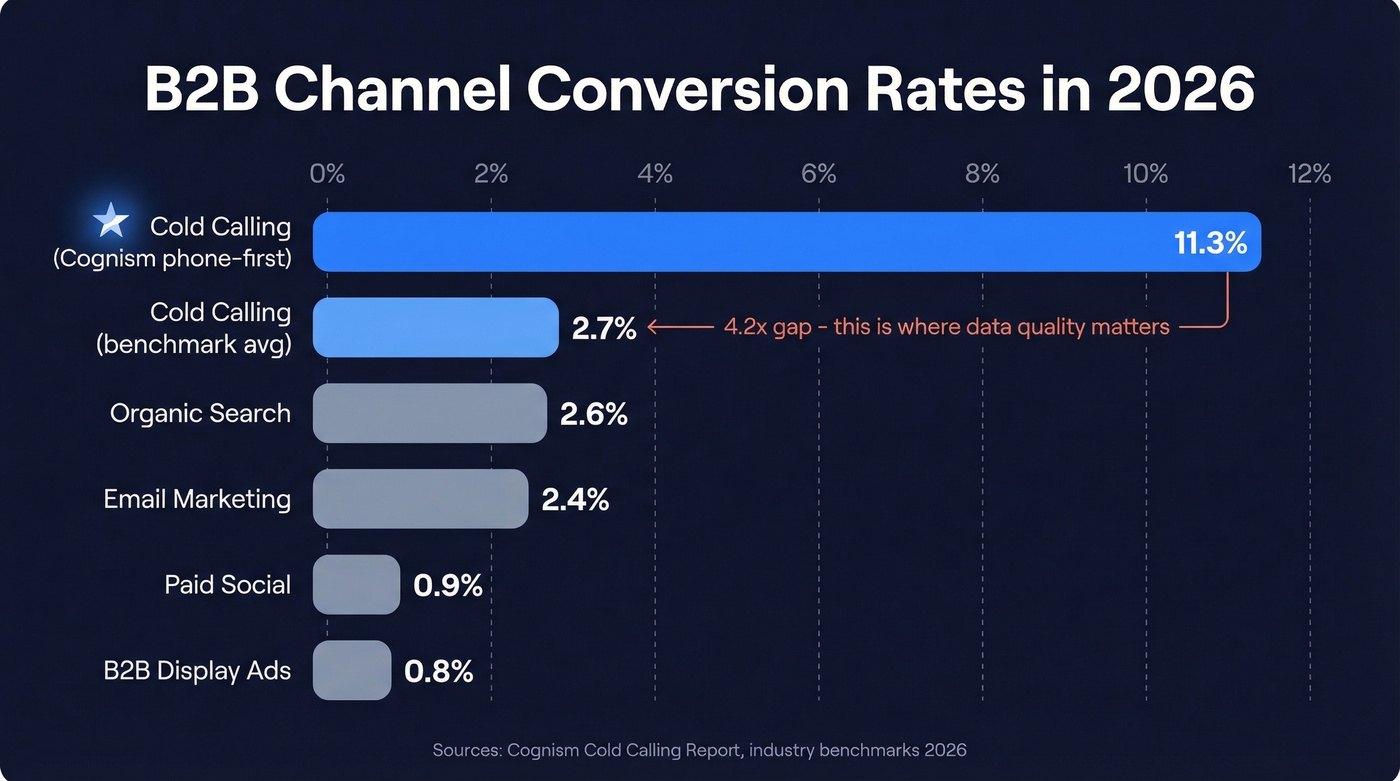
57% of C-level executives and VPs prefer phone calls when they want to understand an offer. In a survey of 1,400+ sales professionals, phone calls ranked as the #2 most effective sales tactic, behind only in-person meetings. Only 19% of sales pros rank telemarketing as their best lead source - but for the deals that matter most, senior buyers still pick up the phone.
Here's the context that makes this matter more: 84% of reps missed quota last year, and buyers now use an average of 10 interaction channels, up from 5 in 2016. Gartner projected that 80% of B2B sales interactions would occur in digital channels - which is exactly why a phone call cuts through. When every buyer's inbox has 47 unread cold emails and their feed is saturated with retargeting ads, a direct conversation becomes the differentiated channel.
| Channel | Avg Conversion Rate |
|---|---|
| Cold calling (benchmark average) | 2.7% |
| Cold calling (Cognism phone-first model) | 11.3% |
| Organic search | 2.6% |
| Email marketing | 2.4% |
| Paid social | 0.9% |
| B2B display ads | 0.80% |
The gap between average and top-performing cold callers is roughly 4x. That gap is the entire story. The channel works. The question is whether your team has the data, scripts, and discipline to be on the right side of it.
2026 Benchmarks You Should Know
Cognism's cold calling competitiveness report tracks year-over-year shifts, and the trend is clear: the floor is rising, but the ceiling is rising faster. Success rates climbed from 2.3% in 2025 to 2.7% in 2026. Average attempts needed to reach a prospect dropped from 2.9 to 1.55. Average call duration decreased from 93 seconds to 82 seconds - callers are getting to the point faster.
| Metric | Average | Top Teams |
|---|---|---|
| Success rate | 2.7% | 11.3% |
| Connect/answered rate | 6-8% | 13.3% |
| Attempts per contact | 1.55 | - |
| Meeting held rate | - | 85.9% |
| Avg call duration | 82 sec | - |
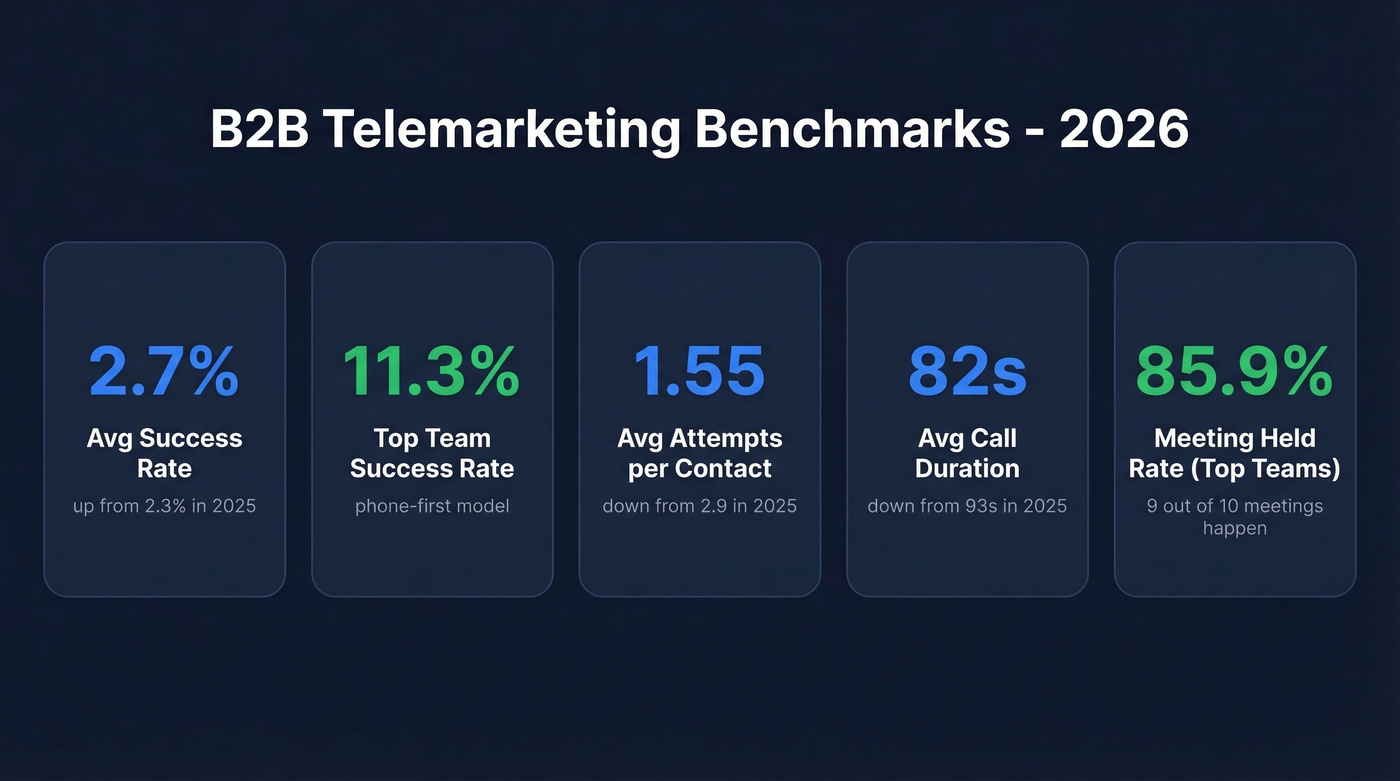
That 85.9% meeting held rate from top teams should grab your attention. It means their qualification is tight enough that nearly 9 out of 10 booked meetings actually happen. If your held rate is below 60%, you're booking meetings with the wrong people - or your data is putting callers in front of contacts who've already left the company.
For outsourced operations, expect 200-300 dials per day with a parallel dialer, a 6-8% connect rate, and a 15-25% connect-to-meeting conversion once you're actually talking to someone.
What It Actually Costs
Good luck finding what B2B telemarketing services actually charge by searching online. You'll get 10 pages of "contact us for a quote." Here are the real numbers.
Outsourced Pricing
| Pricing Model | Typical Range | Notes |
|---|---|---|
| Pay per appointment | $75-$300 | Most common; varies by ICP |
| Hourly (US-based) | $35-$75/hr | Native English, higher quality |
| Hourly (offshore) | $15-$25/hr | Lower cost, quality varies |
| Monthly retainer | $3K-$15K/mo | Dedicated agent(s) + management |
| Per lead | $25-$100 | Define "qualified" in writing |
In-House vs. Outsourced
| Cost Component | In-House | Outsourced |
|---|---|---|
| Monthly cost/agent | $6K-$10K+ | $2.5K-$7K |
| Annual salary | $35K-$60K | Included |
| Training/onboarding | $2K-$5K | Usually included |
| CRM/tools | $500-$2K/mo | Usually included |
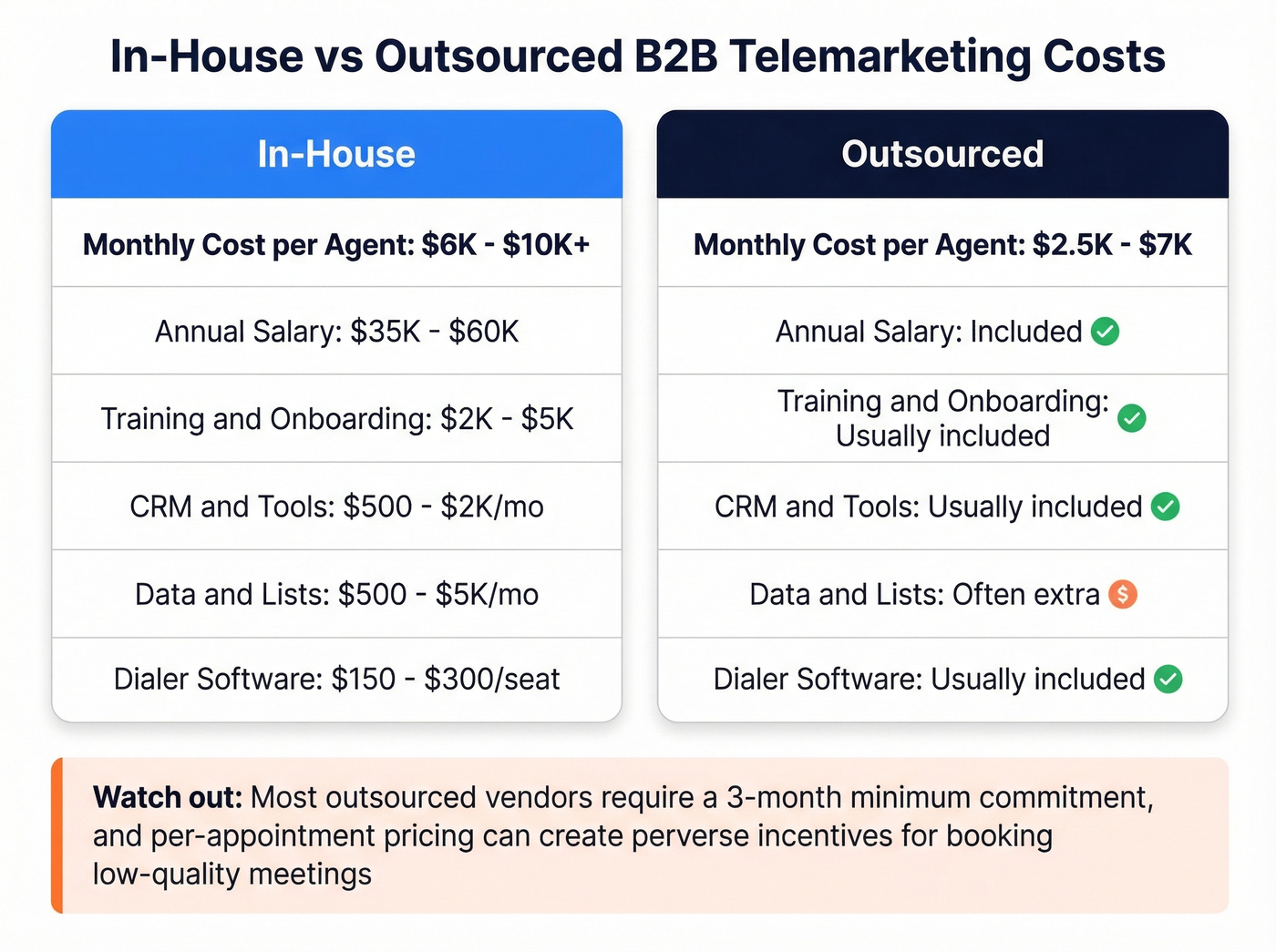
The hidden costs are what kill budgets. Data and list acquisition runs $500-$5,000/month. Dialer software adds $150-$300 per seat. Setup and onboarding fees range from $1,000-$5,000. Most outsourced vendors lock you into a 3-month minimum commitment - so if the first month is rough (it usually is), you can't just walk away.
Here's the thing about the per-appointment model: it sounds attractive, but it creates perverse incentives. Vendors optimize for booking volume, not meeting quality. If you go this route, define "qualified" in writing - with specific criteria like title, company size, and confirmed pain point - before you sign anything.
Data Quality Kills More Campaigns Than Bad Scripts
One poster on r/techsales described making 20,000+ cold calls over three years with "minimal results." The recurring issue? Dead numbers, wrong contacts, people who'd left the company years ago. That's not a script problem or a training problem. It's a data problem.
We've seen this pattern repeatedly: teams invest in coaching, buy expensive dialers, hire experienced SDRs - then feed them a list that's 40% stale. B2B contact data decays at roughly 30% per year. If you haven't verified your phone numbers in the last 60 days, your connect rates are already sliding.
This is where your data platform matters more than anything else in the stack. Prospeo maintains 125M+ verified mobile numbers with a 30% pickup rate, refreshed on a 7-day cycle - compared to the 6-week industry average. The difference shows up in real campaigns: Meritt tripled their connect rate to 20-25% after switching, and Snyk took their bounce rate from 35-40% down to under 5% across 50 AEs.
If your average deal size is under $15K, you probably don't need a $30K/year data platform. But you absolutely need verified phone numbers - that's non-negotiable regardless of deal size.

Bad phone numbers are the #1 reason B2B telemarketing campaigns fail. Prospeo's 125M+ verified mobile numbers are refreshed every 7 days - not every 6 weeks. Teams using Prospeo data see 20-25% connect rates and bounce rates under 5%.
Stop burning dials on dead numbers. Start connecting with real buyers.
Scripts That Actually Work
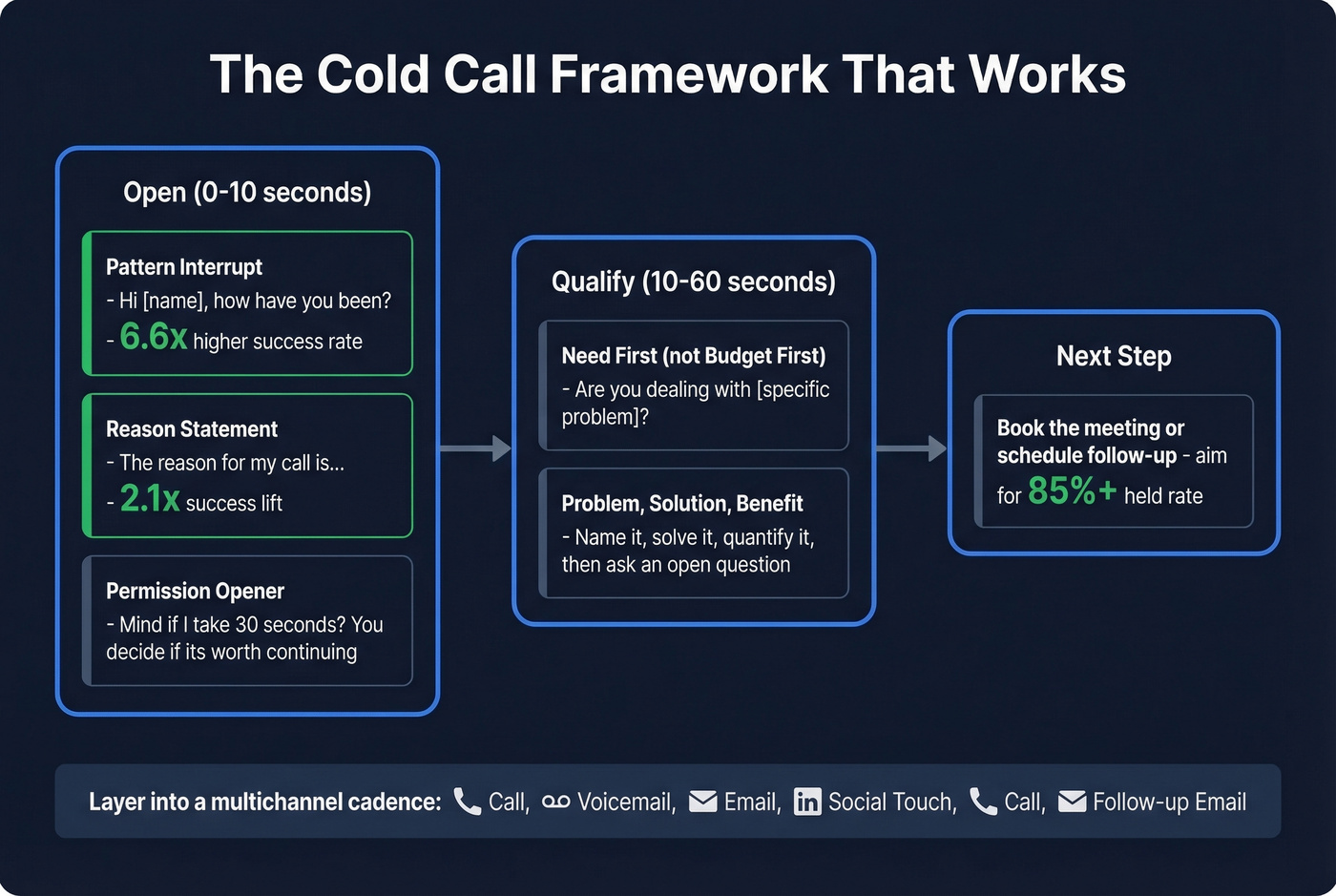
The best cold call script is one that earns the next 30 seconds. Everything else - qualification, objection handling, the close - is downstream of that first moment.
The Pattern Interrupt
Instead of "Hi, this is Jake from Acme," try "Hi [name], how have you been?" Sounds counterintuitive - you've never spoken before - but this opener is associated with a 6.6x higher success rate than standard introductions in cold-calling script research. It breaks the prospect's mental script of "this is a sales call, hang up now."
The Reason Statement
"The reason for my call is..." is associated with a 2.1x lift in success rate. It works because it immediately signals you won't waste their time. Follow it with a single, specific sentence about why you're calling them - not a generic pitch.
The Permission-Based Opener
"Mind if I take 30 seconds to tell you why I called, and you can decide if it's worth continuing?" This lowers resistance by giving the prospect control. It's especially effective for senior buyers who are used to being pitched all day.
The Student Frame
One Reddit user shared a curiosity-based opener and got 4 great conversations out of 5 calls. It works because it removes the sales pressure entirely. The prospect becomes the expert, not the target. Skip this one if your product is simple and transactional - it's best suited for complex sales where the prospect genuinely has domain expertise you can learn from.
Full-Call Frameworks
BANT (Budget, Authority, Need, Timeline) is the classic qualification framework, but modern sequencing flips the order. Start with Need - does this person actually have the problem you solve? - before asking about budget or authority. Leading with "what's your budget?" feels transactional. Leading with "are you dealing with X?" feels consultative.
Problem-Solution-Benefit works well for discovery calls: name the problem you've seen at similar companies, briefly describe how you solve it, then quantify the benefit. Keep it under 60 seconds before asking an open-ended question.
The Multichannel Cadence
A phone call rarely works in isolation. The highest-performing teams layer it into a sequence: Call, voicemail, email, social touch, call, follow-up email. The first call warms the name. The email gives context. The second call converts. Treat phone outreach as the centerpiece of a multichannel cadence, not a standalone channel.
The Essential Tech Stack
Every telemarketing operation needs four layers. Skipping any one creates friction that compounds across thousands of dials.
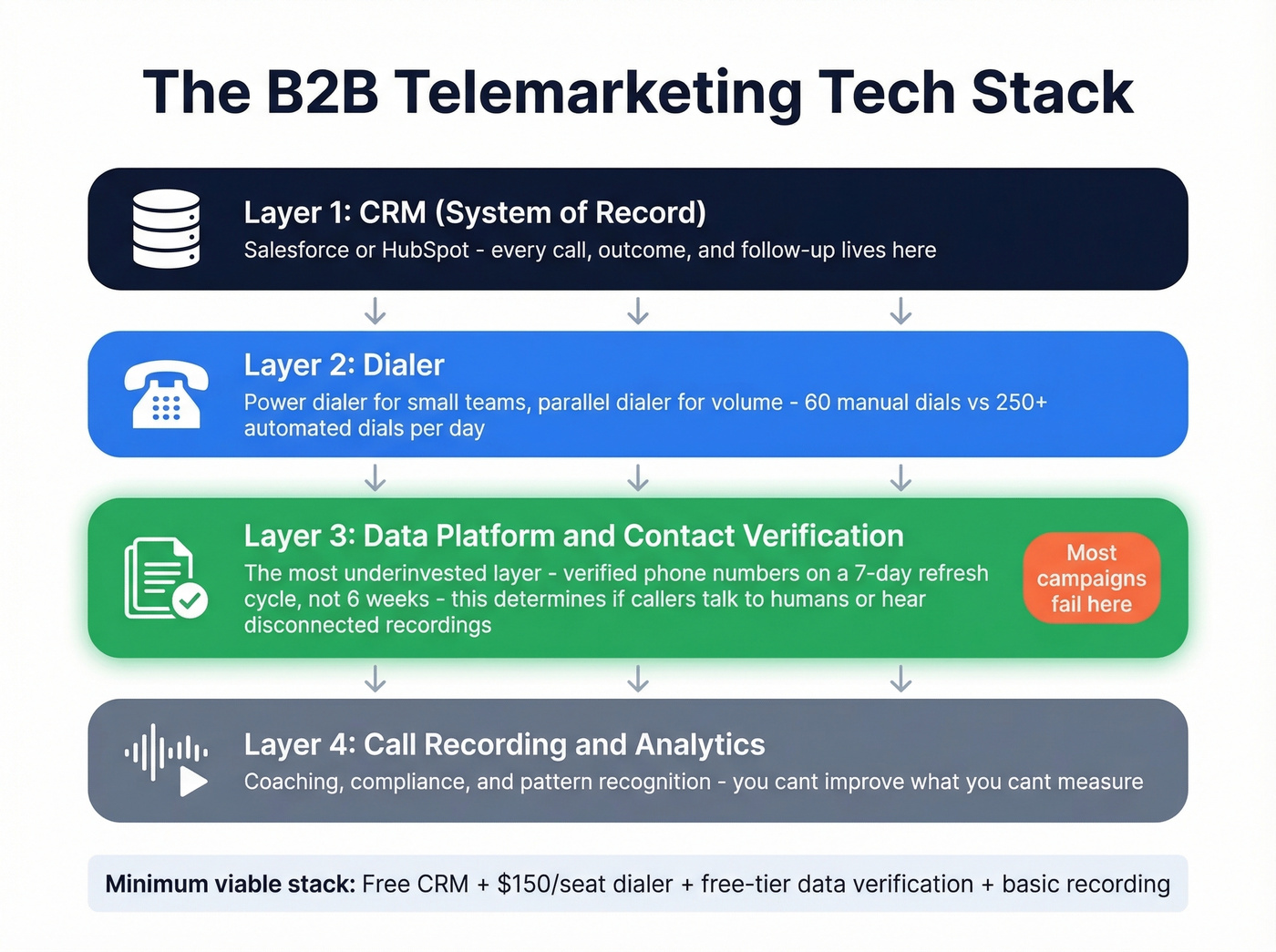
CRM - Salesforce or HubSpot for most teams. This is your system of record. Every call, every outcome, every follow-up lives here. (If you need a quick refresher on what counts as a CRM, see CRM.)
Dialer - A power dialer for smaller teams, a parallel dialer for high-volume operations. The difference between 60 manual dials and 250+ automated dials per day is the difference between one meeting and five. If you're evaluating calling tools, start with dialer options.
Data platform and contact verification - This is the layer most teams underinvest in, and it's the one that determines whether your callers spend their day talking to humans or listening to disconnected-number recordings. Prospeo covers 125M+ verified mobiles with a 30% pickup rate on a 7-day refresh cycle, and integrates natively with Salesforce, HubSpot, and outbound sequencers like Instantly and Smartlead. (More on data enrichment if you're building a full pipeline.)
Call recording and analytics - For coaching, compliance, and pattern recognition. You can't improve what you can't measure.
The stack doesn't need to be expensive. A free CRM, a ~$150/seat dialer, a free-tier data platform for verification, and a basic call recording tool can get a small team operational for under $500/month.
AI's Role (and Its Limits)
93% of CROs now embed AI into their prospecting workflows. 80% of sales leaders prefer AI for list building and enrichment specifically. But only 13% believe AI will match humans at the actual phone conversation.
That tells you exactly where AI fits: before and after the call, not during it.
AI is excellent at prioritizing which accounts to call based on intent signals, technographic fit, and recent funding. It's great at summarizing call recordings for coaching and automating post-call CRM updates. It's terrible at reading the micro-hesitation in a CFO's voice when you mention their competitor. The teams winning in 2026 aren't replacing SDRs with bots - they're giving each SDR better data, better prioritization, and fewer admin tasks so they can spend more time in actual conversations. If you're building that workflow, start with sales prospecting fundamentals.
Why Phone Outreach Still Earns Budget
With so many digital channels available, let's spell out why B2B telemarketing still gets funded. First, it compresses the feedback loop - you learn in real time whether your messaging resonates, your ICP is right, and your value prop lands. Email and ads give you lagging indicators; a phone conversation gives you instant signal.
Second, it creates two-way dialogue that no other outbound channel can match. A prospect who pushes back on pricing during a call is giving you more useful information than a thousand ad impressions. Third, the channel scales qualification in a way that inbound alone can't - you choose who to call, when to call, and what to ask, rather than waiting for the right person to find your content.
And it builds pipeline that's already partially warmed by the time it reaches an AE, shortening sales cycles and improving close rates. (If you're tracking this end-to-end, use pipeline health metrics.)
B2B vs. B2C Telemarketing
If you're coming from a consumer telemarketing background - or evaluating vendors who serve both markets - the differences are significant. B2B calls target decision-makers at companies, involve longer sales cycles, and typically lead to high-value contracts. B2C calls target individual consumers, rely on volume and scripted pitches, and face stricter regulatory scrutiny since the National DNC Registry applies more broadly to consumer calls.
In B2B, the caller needs industry knowledge and consultative skills. In B2C, the emphasis is on speed and objection handling at scale. The economics are fundamentally different too - a single B2B meeting can justify hundreds of dials, while B2C campaigns need conversion at volume to be profitable.
Compliance Checklist
The fact that most B2B telemarketing guides don't mention TCPA penalties - which can hit $50,120 per illegal call - is borderline irresponsible.
Federal Rules
TCPA penalties run $500 per violation, up to $1,500 if willful. These add up fast across a high-volume campaign. DNC/TSR penalties reach $50,120 per illegal call. Scrub your lists against the National Do Not Call Registry at least every 31 days - this isn't optional. The calling window is 8 a.m. to 9 p.m. in the recipient's local time, not yours. Prior express written consent is required for automated or prerecorded marketing calls to cell phones, and an existing business relationship doesn't substitute.
State Mini-TCPA Laws
Florida, Maryland, Oklahoma, and Washington have their own telemarketing laws with no B2B exemptions. Some require telemarketer registration and bonds. If you're calling into these states - and you probably are - check the specific requirements. Some states are stricter than the federal 8 a.m.-9 p.m. window, so don't assume federal rules are the tightest ones you need to follow.
Emerging Traps
Ringless voicemail and AI voice calls are treated as prerecorded messages requiring consent. If your vendor is dropping voicemails without explicit opt-in, you're exposed. Several states require two-party consent for call recording. The safe play: announce recording at the start of every call, regardless of state.
GDPR/PECR (EU/UK)
If you're calling into the EU or UK, GDPR requires a lawful basis for processing - typically legitimate interest for B2B. PECR in the UK allows unsolicited B2B calls unless the company has registered with the Corporate Telephone Preference Service. Document your legitimate interest assessment and honor opt-outs immediately.
That RevOps lead who booked 47 meetings instead of 3? The difference was weekly-verified phone data. Prospeo gives your callers 125M+ verified mobiles at $0.10/number with a 30% pickup rate - no contracts, no sales calls required.
Fix your data before you fix your scripts. It takes 2 minutes.
FAQ
Is B2B telemarketing legal?
Yes, but heavily regulated. TCPA, TSR, and state mini-TCPA laws apply even to business-to-business calls. Scrub lists against the National DNC Registry every 31 days, call only 8 a.m.-9 p.m. in the recipient's local time, and honor opt-outs immediately. Penalties reach $50,120 per illegal call.
What's a good cold call success rate?
The 2026 benchmark average is 2.7%, while top phone-first teams hit 11.3%. If you're consistently below 2%, your data quality - not your script - is almost certainly the bottleneck. Verify numbers weekly to stay above the floor.
How many calls should an SDR make per day?
With a parallel dialer, 200-300 dials per day is standard. Without one, expect 60-80 manual dials. The key metric isn't dials - it's connect rate. 200 dials to bad numbers produces fewer conversations than 80 dials to verified numbers.
Should I outsource or build in-house?
Outsource to test the channel quickly at $2,500-$7,000/month per agent. Build in-house for full control at $6,000-$10,000+/month per agent. Most companies start outsourced, then bring calling in-house once they've validated the playbook and have a repeatable script.
How do I get accurate phone numbers for outbound calling?
Use a verified data platform with a short refresh cycle - weekly is ideal. Bad numbers are the #1 reason campaigns fail, so this is the single highest-leverage investment you can make before a single dial goes out.