

How to Build BDR Sales Training That Actually Produces Pipeline
Your new BDR class started three weeks ago. They've sat through product training, watched the demo video twice, and memorized the talk track. They're still booking zero meetings.
The problem isn't effort. Most BDR sales training programs front-load information and skip the parts that actually move pipeline. We've watched this pattern repeat across dozens of teams, and the fix is almost always structural - not motivational.
The Short Version
Structure training around milestones, not boot camps. Reps should hit performance gates before advancing. Prioritize phone skills hard, because phone-centric reps generate 1.4x more quality conversations than email-centric ones. And fix your contact data before you fix your scripts. Contact data is the #1 resource BDRs request to feel equipped - ahead of intent data, better tools, or more coaching.
Why BDR Training and Development Matters
The gap between supported and unsupported BDRs is brutal. 6sense's benchmark of 262 BDRs found that supported reps hit 95% of quota. Unsupported reps? 80%. That 15-point gap compounds fast across a 10-person team - it's the difference between hitting your pipeline number and scrambling to explain a miss to the board.
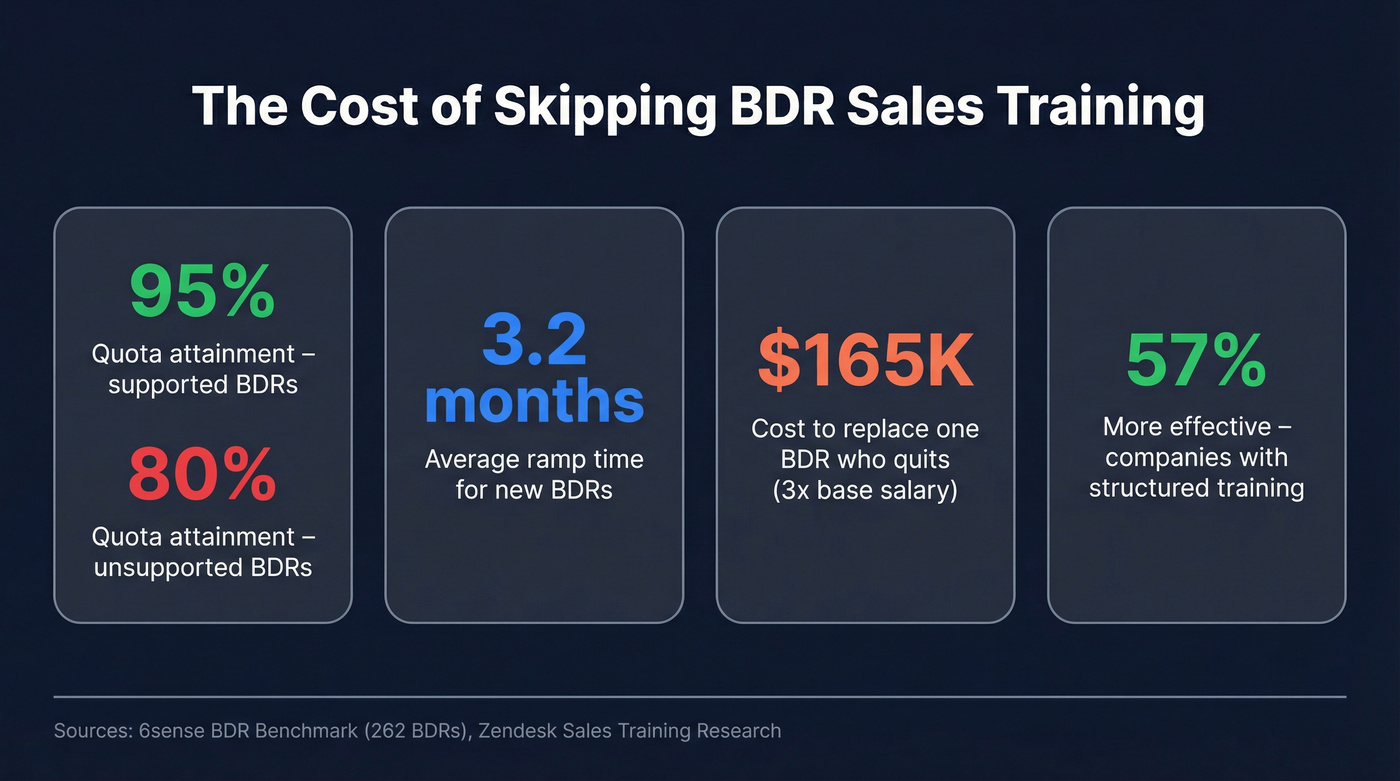
The average BDR takes 3.2 months to ramp. During that window, 20% of new hires leave, usually because onboarding was a one-week fire hose followed by "go figure it out." Replacing a rep who quits costs roughly 3x their base salary. For a BDR making $55K base, that's $165K out the door. Companies that invest in structured sales development training are 57% more effective than those that don't.
Core Skills Every Program Must Cover
Most programs teach product knowledge and call it done. The skills that actually drive meetings are more specific - and more trainable - than most managers realize.
Cold Calling Mechanics
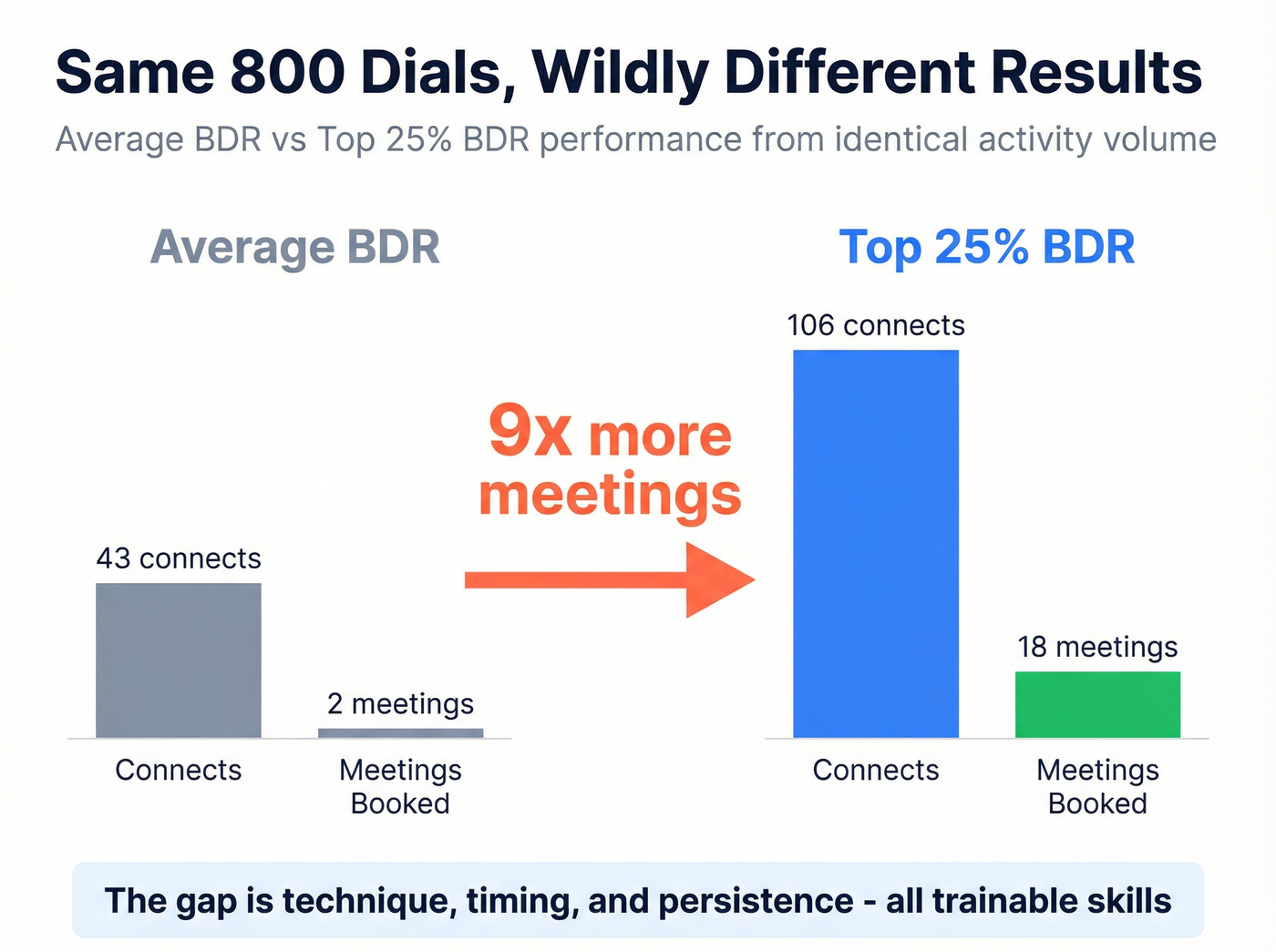
Phone skills deserve the most airtime. Here's why: from 800 dials, the average rep pulls 43 connects at a 5.4% connect rate and books 2 meetings. Top 25% reps? 106 connects and 18 meetings from the same 800 dials. That's a 9x difference in output from the same activity volume. The gap is technique, timing, and persistence - all trainable.
The First 60 Seconds
Train the opener as its own skill. I've watched reps fumble hundreds of connects because nobody drilled the first minute. Use a three-phase structure: 0-15 seconds for a confident intro and permission-based hook, 15-45 seconds for a relevant observation tied to a problem, 45-60 seconds for an open-ended ask toward a next step.
Calls under one minute have a 0% success rate. Calls that hit five minutes jump to 16%. That's the whole game - getting past the first minute.
Multithreading, Cadences, and AI
These three skills work best taught together rather than in isolation. Multithreading means reaching ~9 contacts per account, up from 6.4 last year, which feeds directly into cadence design where the average BDR makes 21 attempts per contact across 53 days with roughly 5 social touches, 8 calls, and 8 emails. AI fluency accelerates both: 60% of BDRs already use AI tools for research, email drafting, and call prep. Train reps to use AI as a force multiplier, not a replacement for thinking. If you're standardizing outbound, document your sales prospecting techniques so reps aren't improvising per account.

Contact data is the #1 resource BDRs request to feel equipped - ahead of coaching, intent data, or better tools. Prospeo delivers 98% verified emails and 125M+ direct dials with a 30% pickup rate. Your reps can't practice what they learned in training if they're dialing dead numbers and bouncing emails.
Stop training reps on skills they can't use because the data is garbage.
How to Structure Training That Sticks
A two-day boot camp followed by "shadow a senior rep" isn't a program. It's a hope strategy.
If you want a clean onboarding arc, build it like a 30-60-90 day plan with measurable gates.
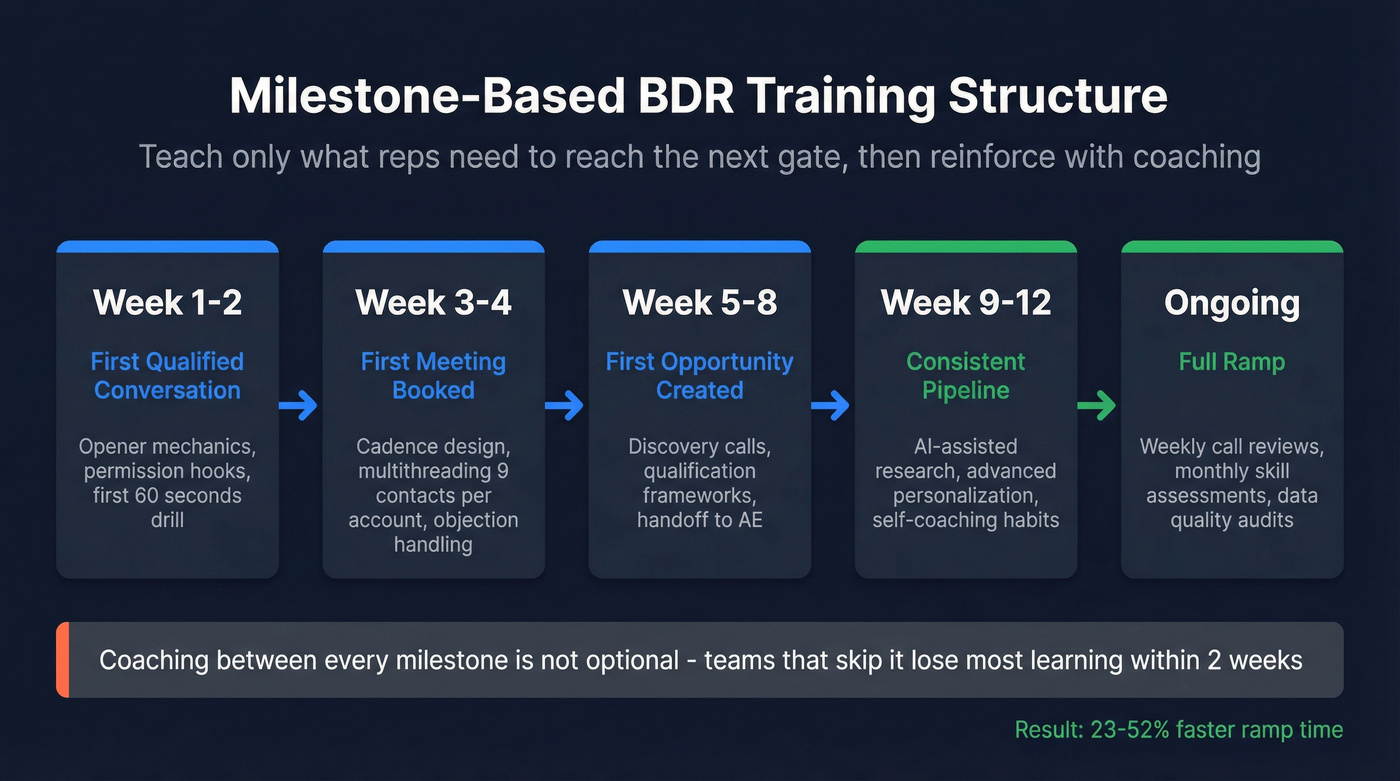
What works is milestone-based design. Define 3-5 performance milestones - first qualified conversation, first meeting booked, first opportunity created - and teach only the need-to-know content required to reach the next gate. Reinforce with coaching between milestones. Companies using this approach have cut ramp time by 23-52%.
In our experience, teams that skip coaching cadences lose the majority of what reps learned within two weeks. Here are the failure modes we see most often:
- One-time boot camp with no follow-up coaching
- Content overload - teaching everything in week one instead of sequencing by milestone
- No measurement plan - if you can't quantify whether training worked, you can't improve it (tie it to funnel metrics)
- No coaching cadence - weekly call reviews and monthly skill assessments aren't optional
- Assigning bad data to new reps and wondering why they can't book meetings
That last one deserves its own section.
BDR Training Programs Worth Evaluating
Factor 8
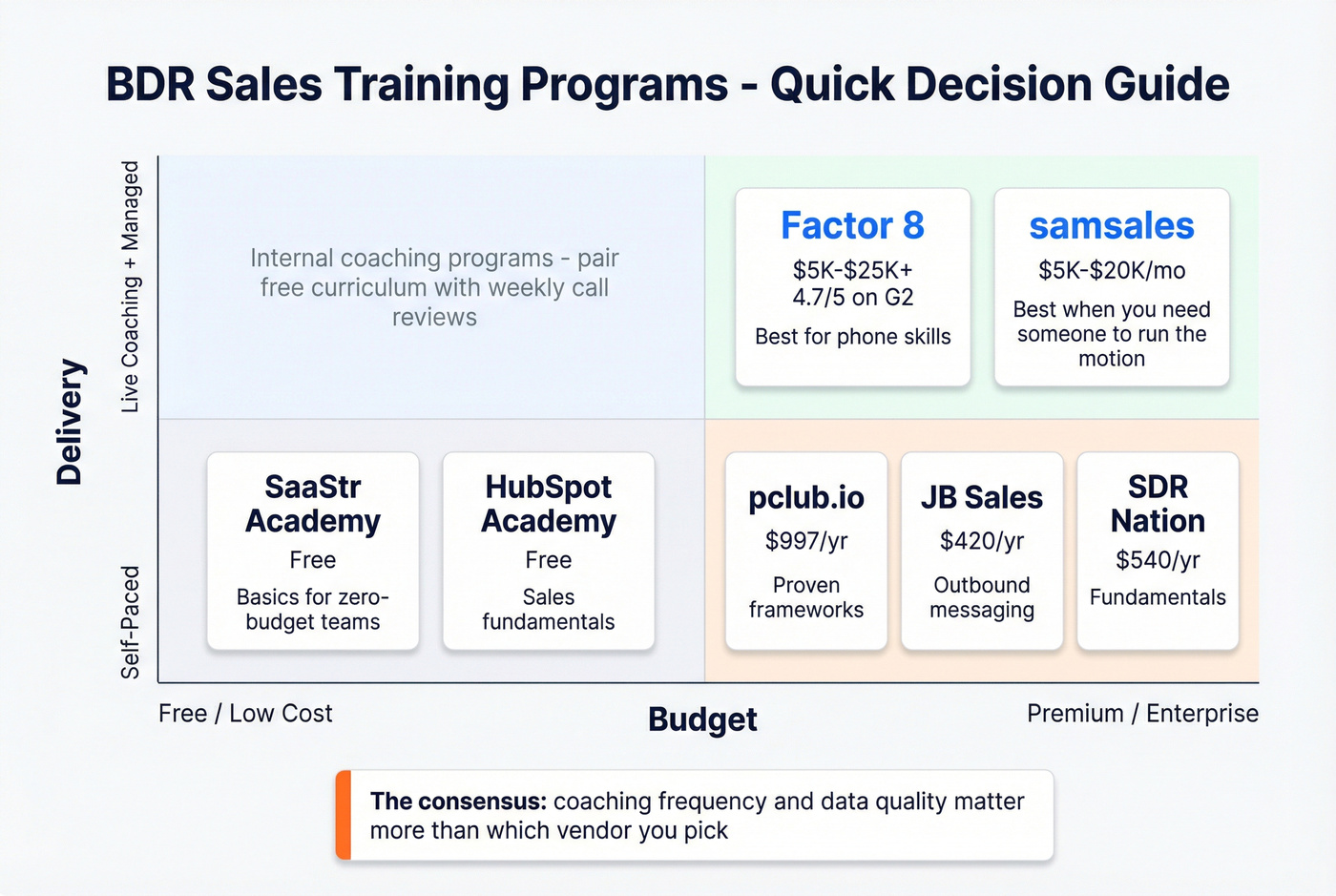
The strongest option for teams that want structured phone-skills training with live coaching. Three curriculum levels cover intros and brush-off handling, prospecting strategy, and closing for next steps. Four delivery models span on-demand training, classes with coaching, full-service, and an all-access license for internal delivery. G2 reviewers give it 4.7/5 across 79 reviews, praising the interactive role plays. Main complaints: module ordering inconsistencies and time-zone scheduling for live sessions. $5K-$25K+ depending on cohort size.
Let's be honest - Factor 8 is expensive. But if cold calling is your primary channel and your managers don't have time to run weekly role-play sessions themselves, the ROI math works. We've seen teams recoup the cost within a single quarter of improved connect rates.
samsales Consulting
Skip this if you already have strong BDR management and just need curriculum. Use it if you need someone to actually run the BDR motion - daily 1:1s, weekly stand-ups, playbook design, hands-on oversight. Their testimonials cite specific results: email open rates jumping from 27% to 43% in six weeks, one team doubling meetings booked in a month, another landing a $397K contract within the first month. ~$5K-$20K/month depending on scope.
The Full Landscape
| Program | Best For | Format | Price |
|---|---|---|---|
| Factor 8 | Teams building phone skills | Live + on-demand | $5K-$25K+ |
| samsales | Teams needing an operational partner | Fractional management | $5K-$20K/mo |
| pclub.io | Solo reps wanting proven frameworks | Self-paced | $997/yr |
| JB Sales | Reps focused on outbound messaging | Self-paced | $420/yr |
| SDR Nation | New SDRs building fundamentals | Self-paced | $540/yr |
| SalesBuzz* | Reps drilling phone objection handling | 8 modules, 12-mo access | Not public |
| SaaStr Academy | Zero-budget teams needing basics | Self-paced | Free |
| HubSpot Academy | Reps who want free sales fundamentals | Self-paced | Free |
*SalesBuzz refers to the B2B Phone Skills Improvement Program - not the Sales Buzz field sales automation tool on G2.
The consensus across sales communities on Reddit is that coaching frequency and data quality are the two most underinvested areas - more than any specific training vendor choice. Pick a program that fits your budget, then invest equally in the coaching infrastructure around it.
The Fix Most Teams Miss: Data Quality
Here's the thing: the #1 bottleneck holding your BDRs back probably isn't their scripts, their confidence, or their cadence design. It's their data.
If you're diagnosing issues, start with sales pipeline challenges before you blame rep effort.

6sense's benchmark found that contact data is the single most requested resource BDRs need to feel equipped. If a rep makes 21 attempts per contact and the phone number is wrong on attempt #1, attempts 2 through 21 are theater. Every bad number erodes confidence, wastes dial time, and teaches new reps that "outbound doesn't work here" - which is the most expensive lesson a BDR can learn.
This is also why teams pair training with data enrichment services instead of treating data as an afterthought.
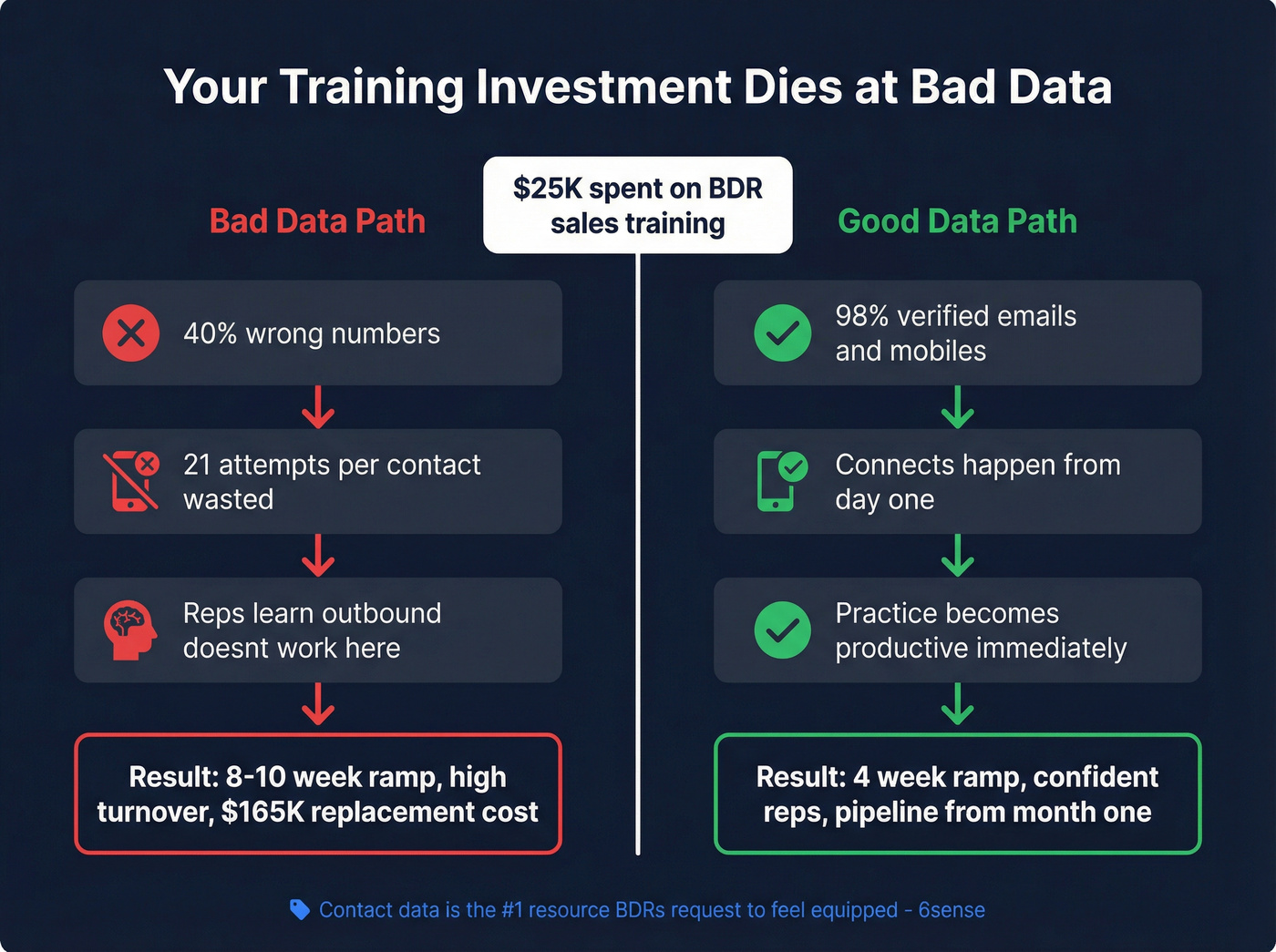
GreyScout cut rep ramp time from 8-10 weeks to 4 weeks after switching to Prospeo for their contact data - 98% email accuracy, 125M+ verified mobile numbers, and a 7-day data refresh cycle meant new reps were dialing numbers that actually connected from day one. Practice became productive immediately instead of demoralizing.
If your BDRs are ramping slower than 10 weeks, audit your data before you audit your training. I've seen teams spend $25K on training programs while feeding reps phone numbers with a 40% wrong-number rate. That's not a skills problem. If you're cleaning lists, start with email bounce rate benchmarks and root causes.
Top BDRs book 9x more meetings from the same dial volume - but only if connects actually happen. Teams using Prospeo cut bounce rates from 35%+ to under 4% and tripled pipeline. At $0.01 per verified email, arming a 10-rep BDR team costs less than one bad hire.
Cut ramp time in half by giving new reps data that actually connects.
FAQ
How long does it take to ramp a new BDR?
Industry average is 3.2 months. Companies using milestone-based onboarding with coaching reinforcement cut that by 23-52%. The biggest accelerator is giving reps verified contact data from day one so practice calls actually connect.
What's the ROI of investing in BDR sales training?
Supported BDRs hit 95% of quota vs. 80% for unsupported ones. Replacing a rep who quits costs roughly 3x base salary (~$165K for a typical BDR), so even modest retention improvements from structured training pay for themselves within one quarter.
Can you build a BDR training program for free?
Yes. SaaStr Academy and HubSpot Sales Academy are both free. Pair either with weekly call reviews, monthly skill assessments, and a reliable contact data source - Prospeo's free tier gives you 75 emails per month - and you've got a functional program at zero cost.