

Behavioral Intent Data: Why Most Teams Waste It (And How to Fix That)
You signed a ~$25K-$40K intent data contract six months ago. Marketing exports the "surge" list every Monday, SDRs work it for a week, bounce rates hover around 10-20%, and the pipeline contribution report is embarrassing. You're not alone - 91% of B2B marketers use intent data to prioritize accounts, but only 24% report exceptional ROI. The gap isn't the data. It's what happens after behavioral intent data lands.
The approach works when you build a scoring model with concrete thresholds, layer first-party signals on top of third-party, and pair account-level intent with verified contact data so SDRs actually reach the right person. What follows is the scoring rubric, the failure modes, and the activation workflow that close the gap.
What Behavioral Intent Data Actually Is
This category of data tracks what people do - the digital body language of a buying committee. Pricing page visits, content downloads, search queries for your category, competitor research activity, repeat visits to solution pages. It captures buyer behavior at the account level and translates it into timing signals your sales team can act on.
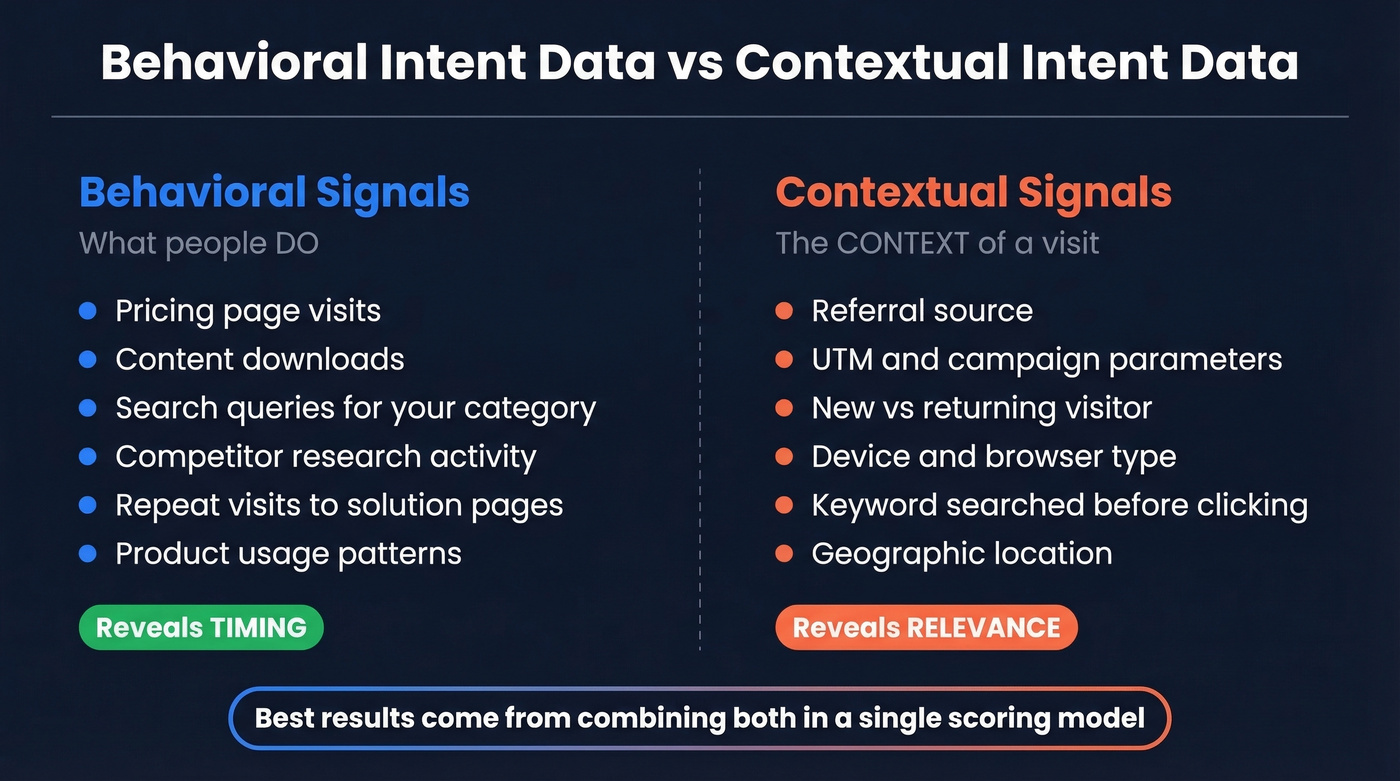
Don't confuse it with contextual intent, which focuses on the context of a visit - referral source, UTM/campaign parameters, new vs. returning visitor, device/browser, the keyword searched before clicking. Behavioral signals are observed actions. They reveal timing, but they're easy to misread.
How B2B Intent Signals Are Collected
Two channels, fundamentally different in quality.
First-party signals come from your own properties: website visits, product usage, email engagement. Highest fidelity, but limited to people who already know you exist.
Third-party signals come from publisher co-ops and bidstream data. Co-op data aggregates shared content consumption events across publisher networks. Bidstream data is derived from ad exchanges and needs heavy filtering. When vendors talk about third-party buyer intent signals, they're usually referring to one of these two sources - and the quality gap between them is enormous.
Bombora, the largest co-op, tracks content consumption across 5,000+ premium B2B sites processing 17B+ monthly interactions. The tradeoff: account-level resolution only, 48-72 hour signal delay, and noise. Lots of noise.
The B2B intent data market hit $4.49B in 2026, projected to reach $20.89B by 2035. Money is pouring in. Quality hasn't kept pace.
Why Intent Data Fails
Let's be honest: intent data doesn't fail because the signals are wrong. It fails because teams treat a prioritization layer like a lead list.
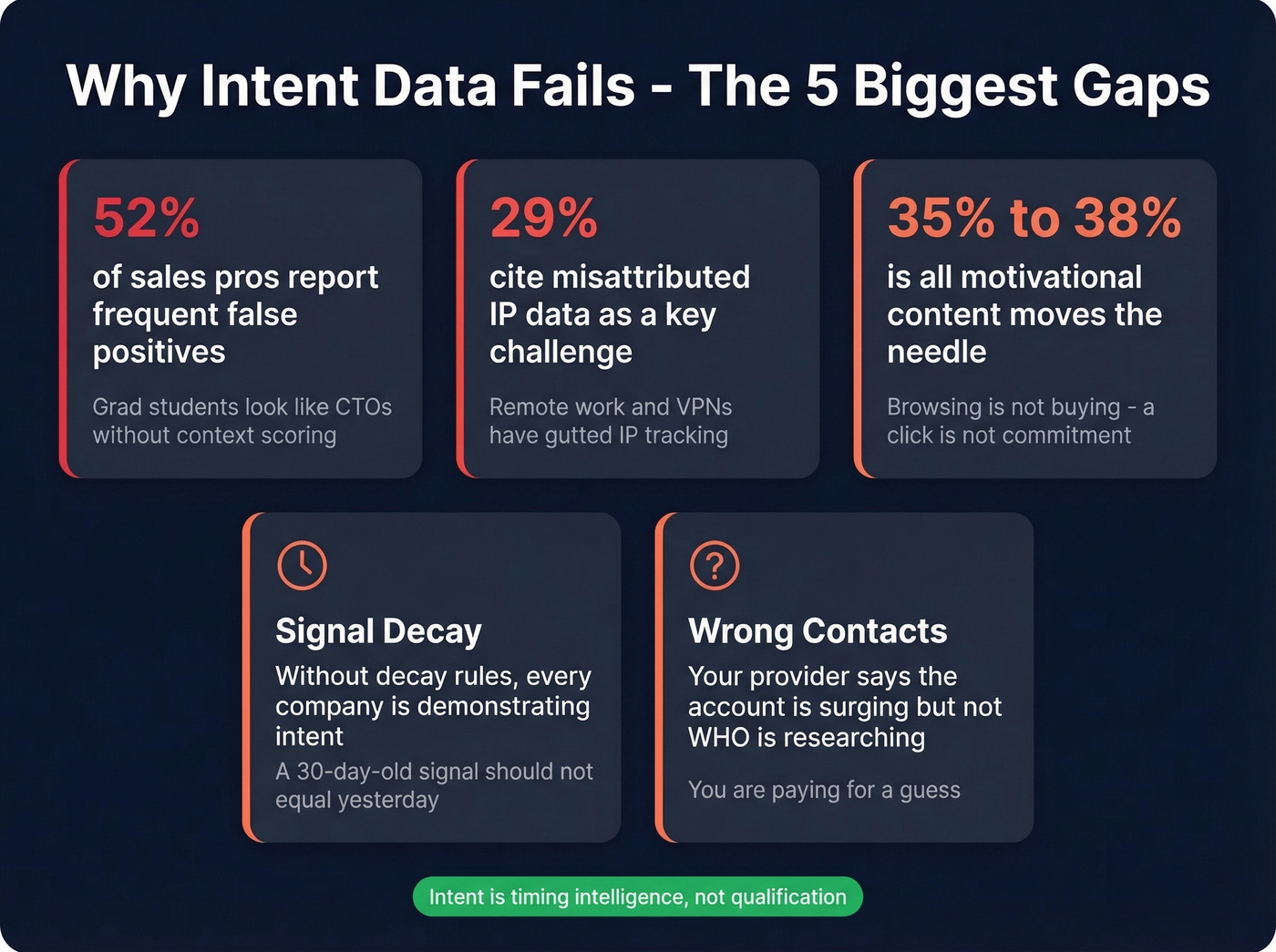
False positives everywhere. 52% of sales professionals report frequent false positives. A grad student researching a thesis looks identical to a CTO evaluating vendors unless you score for context.
IP misattribution. 29% of teams cite misattributed IP data as a key challenge. Remote work and VPNs have gutted IP-based tracking. One Reddit poster put it bluntly: "90% of the leads were ghosts."
Browsing isn't buying. A click isn't commitment. In one widely cited behavior-change study, motivational content moved outcomes from 35% to 38%, but asking people to specify when/where/how they'd act jumped it to 91%. Most intent tools can't separate casual research from concrete readiness to buy.
Signal decay. As Forrester warns, without decay rules, "every company is demonstrating intent." A 30-day-old signal shouldn't carry the same weight as yesterday's.
Wrong contacts. Your provider tells you the account is surging but not which person is researching. You're paying for a guess.
Most teams treat intent as qualification. It's not. It's timing intelligence. The qualification still has to happen.

Intent data tells you the account is surging. But 52% of those signals are false positives - and even the real ones are useless without verified contacts. Prospeo tracks 15,000 Bombora intent topics and layers them with 300M+ profiles refreshed every 7 days, so you reach the actual decision-maker at 98% email accuracy.
Turn anonymous surge signals into booked meetings for $0.01 per verified email.
How to Build a Scoring Model
Start by analyzing your last 50 closed-won deals. What signals appeared before they entered pipeline? Which titles signed? That backward-looking analysis - essentially mining your own buyer behavior data - gives you the weights.
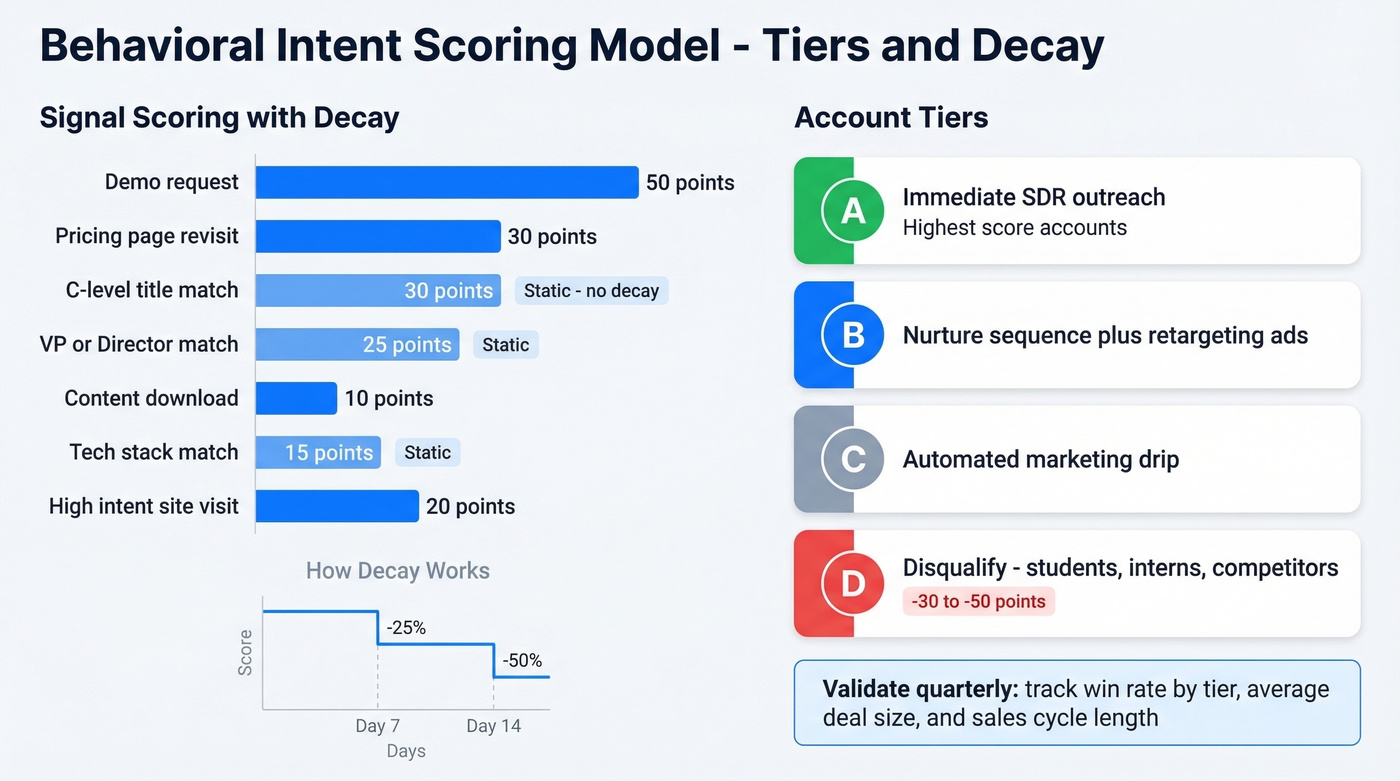
| Signal | Points | Decay |
|---|---|---|
| Demo request | +50 | -25% after 7 days |
| Pricing page revisit | +30 | -25% after 7 days |
| C-level title match | +30 | Static |
| VP/Director match | +25 | Static |
| Manager match | +15 | Static |
| Tech stack match | +15 | Static |
| Content download | +10 | -50% after 14 days |
| Student/intern/competitor | -30 to -50 | Hard disqualifier |
Decay is non-negotiable. In this rubric, a demo request from 7 days ago is worth 75% of its original score. At 14 days, about half.
Build four tiers: A (immediate outreach), B (nurture sequence), C (marketing drip), D (disqualify). In our experience, teams that skip decay rules end up treating every account as Tier A - and their SDRs burn out fast. We've watched it happen at three different companies we've worked with, and the pattern is always the same: initial excitement, a flood of "hot" accounts, then a slow collapse in response rates as reps lose trust in the data.
Track win rate by tier, average deal size, and sales cycle length to validate your weights. Recalibrate quarterly.
From Score to Pipeline
A scored account list is worthless if you can't reach the right person.
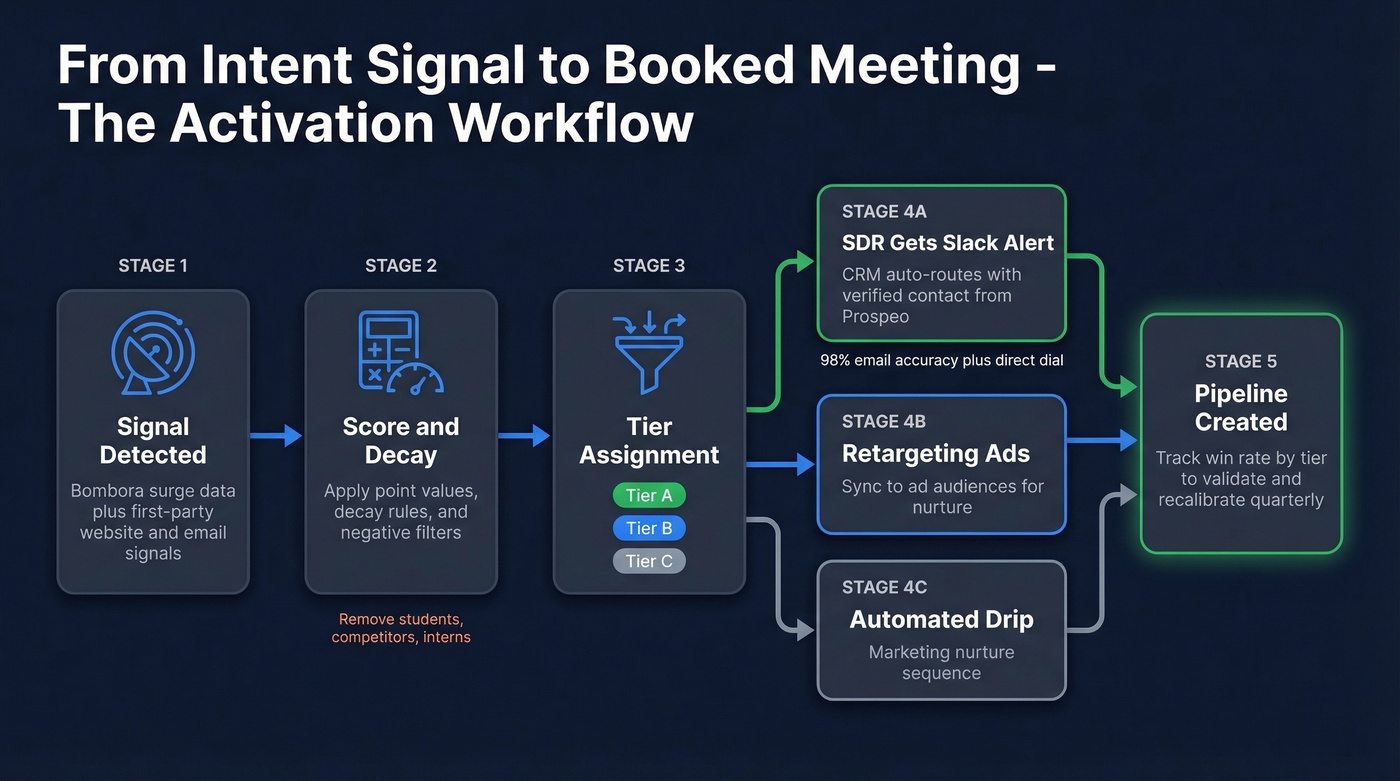
Route Tier A accounts directly to SDRs via CRM with Slack alerts. Sync Tier B to ad audiences for retargeting. Push Tier C into automated nurture. Chargebee used G2 Buyer Intent data to generate 280+ leads and drive 3x YoY growth in ICP deals by integrating intent signals into HubSpot for real-time routing - proof that the workflow matters more than the data source.
Here's the thing: your intent provider identifies the account but not the decision-maker, their email, or whether that email will bounce. We've seen teams waste weeks exporting surge lists, guessing at contacts, and watching bounce rates climb. Third-party intent signals are only as useful as the contact layer sitting on top of them.
You don't need a $100K+ enterprise platform. A scoring model, your CRM data, and verified contact data get you 80% of the way there. Prospeo tracks 15,000 intent topics via Bombora and pairs them with 300M+ professional profiles refreshed every 7 days, so when an account surges, you get the verified decision-maker's email at 98% accuracy plus access to 125M+ verified mobile numbers for direct dials - not an anonymous signal.
Skip the enterprise intent platform if your average deal size is under $15K. A well-built scoring model on first-party data plus a contact verification tool will outperform a six-figure intent contract that nobody on your team actually activates. I've seen $200K/year 6sense contracts sit half-configured because the RevOps team didn't have bandwidth to build the routing logic.
Privacy and Compliance
The CNIL's EUR150M fine against SHEIN wasn't about intent data specifically, but the principle applies: tracking-based data collection without valid consent is increasingly expensive.
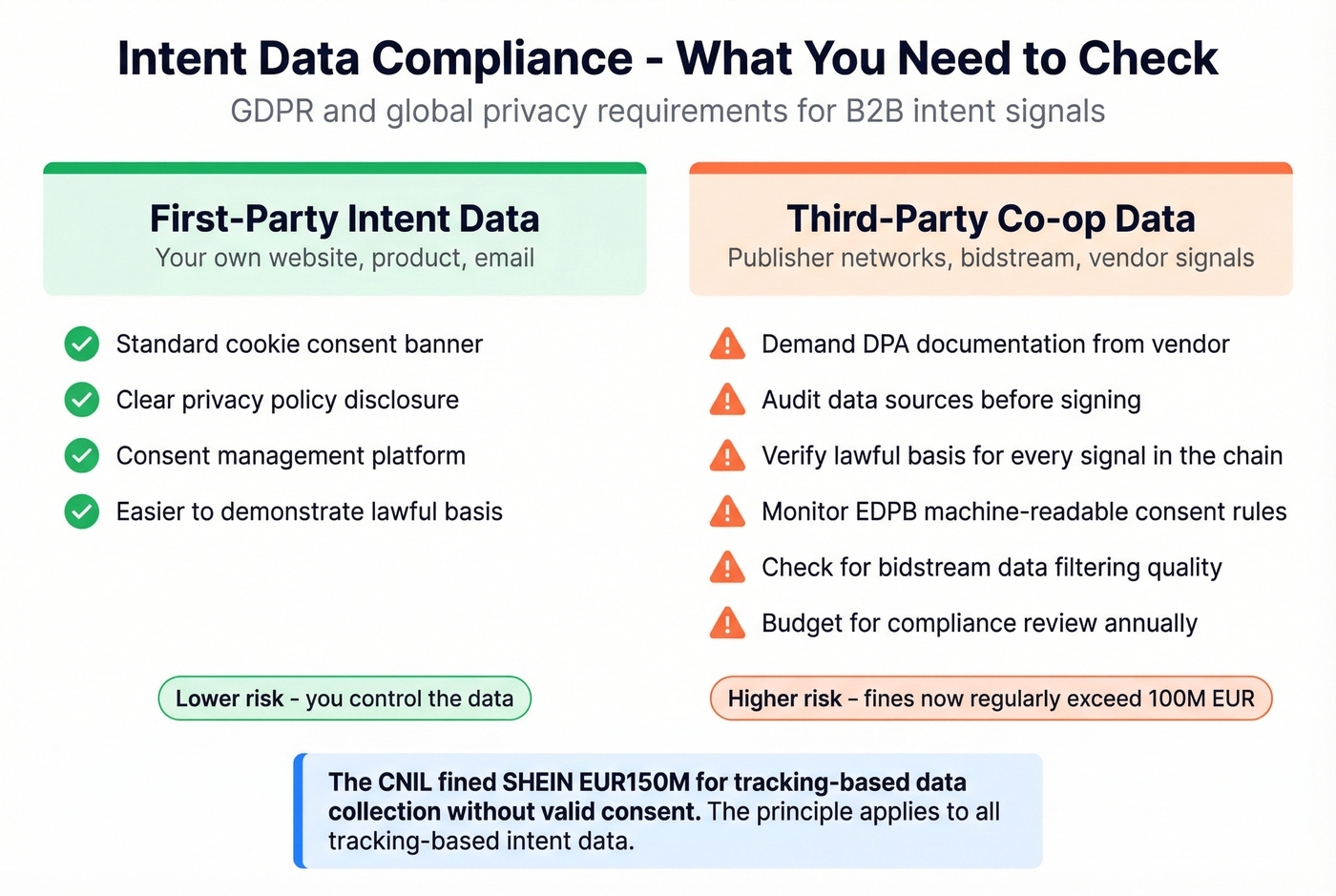
GDPR requires consent that's freely given, specific, informed, and unambiguous. The EDPB is pushing toward machine-readable consent signaling, which will tighten enforcement further. First-party intent is easier to manage. For third-party co-op data, demand that your vendor demonstrate lawful basis - ask for DPA documentation and data-source audits before you sign. Non-compliance fines now regularly exceed EUR100M. If you need a deeper framework, start with a GDPR compliant database checklist and audit trail.
Your scoring model is only as good as the contact data underneath it. Teams using Prospeo cut bounce rates from 35% to under 4% and book 26% more meetings than ZoomInfo users - because every intent-flagged account comes with verified emails and 125M+ direct dials.
Score the account, reach the person - no more guessing at contacts.
FAQ
What's the difference between behavioral and contextual intent data?
Behavioral intent data tracks actions - pages visited, content downloaded, competitor research patterns. Contextual focuses on visit context (referral source, UTMs, device/browser, new vs. returning) to infer relevance without a long trail of tracked actions. Best results come from combining both types in a single scoring model.
How much does B2B intent data cost?
Bombora runs $12K-$40K/year depending on deployment. Enterprise platforms like 6sense cost $100K-$300K+/year. For teams that need intent signals paired with verified contacts without the enterprise price tag, Prospeo starts free with 75 credits/month, and paid plans run ~$0.01 per verified email.
Is third-party intent data GDPR compliant?
First-party intent from your own site is manageable with standard consent flows. Third-party co-op data requires your vendor to demonstrate lawful basis for every signal in the chain - ask for DPA documentation and data-source audits before you sign.