

The Best Closing for Email, According to 350K Threads and 1,005 Americans
The email sign-off with the highest reply rate is also the one people hate most. "Thanks in advance" pulls a 65.7% response rate across 350,000 email threads - and yet only 5% of recipients actually prefer receiving it. The rest find it presumptuous, passive-aggressive, or both.
That tension tells you everything about why finding the best closing for email is harder than it looks.
Three Defaults That Cover 90% of Situations
Stop overthinking it.
- "Thank you" - the safest all-around closer. 38% of recipients prefer it, and it pulls a 57.9% reply rate. Works everywhere from outreach to executive updates.
- "Best regards" - your formal/external default. Nobody loves it, nobody hates it. That's the point.
- "Thanks" - the internal/casual default. 63% reply rate, 30% preference rate. Quick, warm, done.
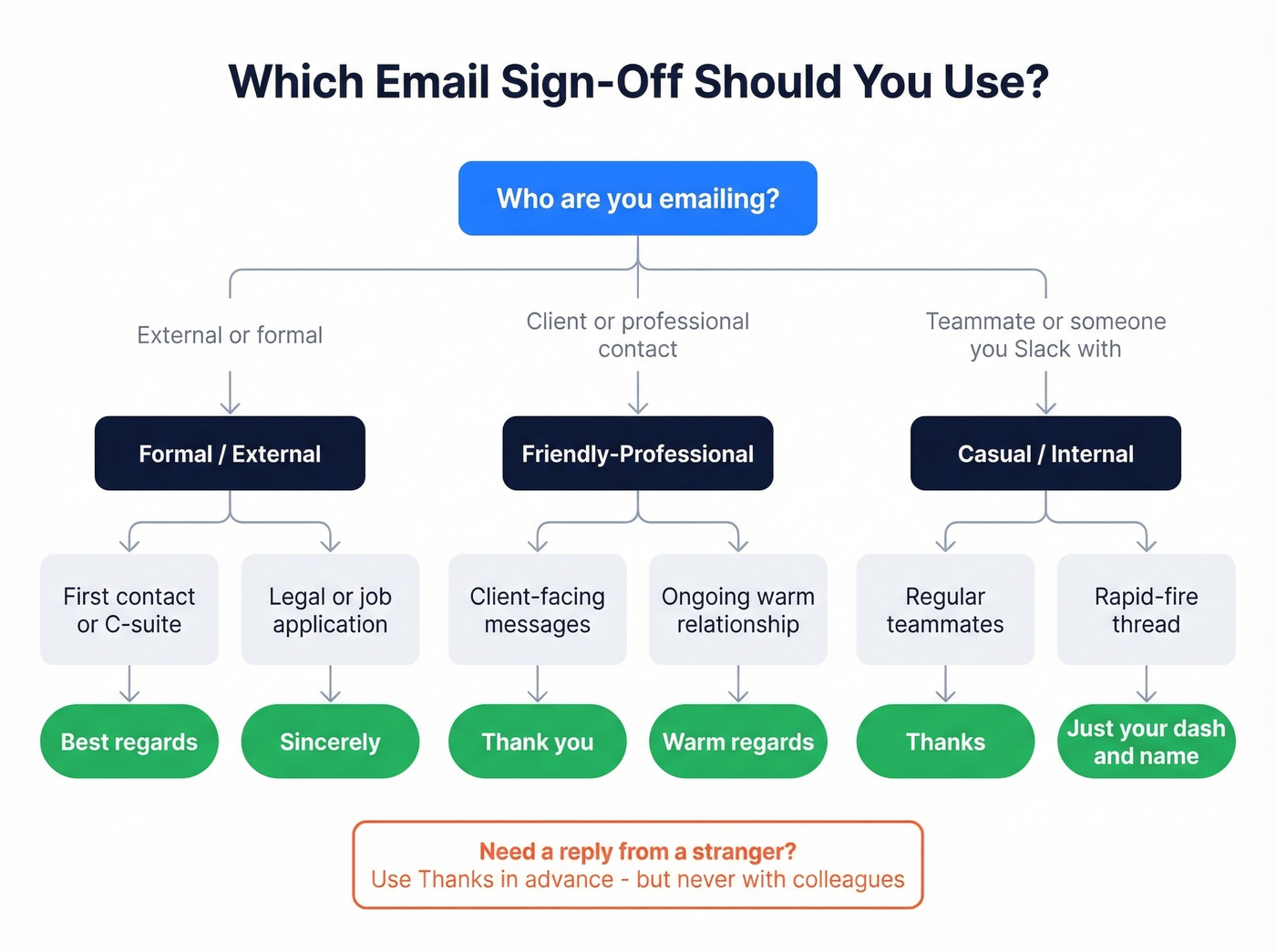
If you're emailing someone you know, use "Thanks." Someone you don't? "Thank you." Formal context? "Best regards." That's the whole framework. The rest of this article is for people who want to understand why - and what to do when the stakes are higher.
What the Data Actually Says
A lot of the internet's advice about email closings traces back to one big dataset. Worth knowing that before you treat any of this as gospel.
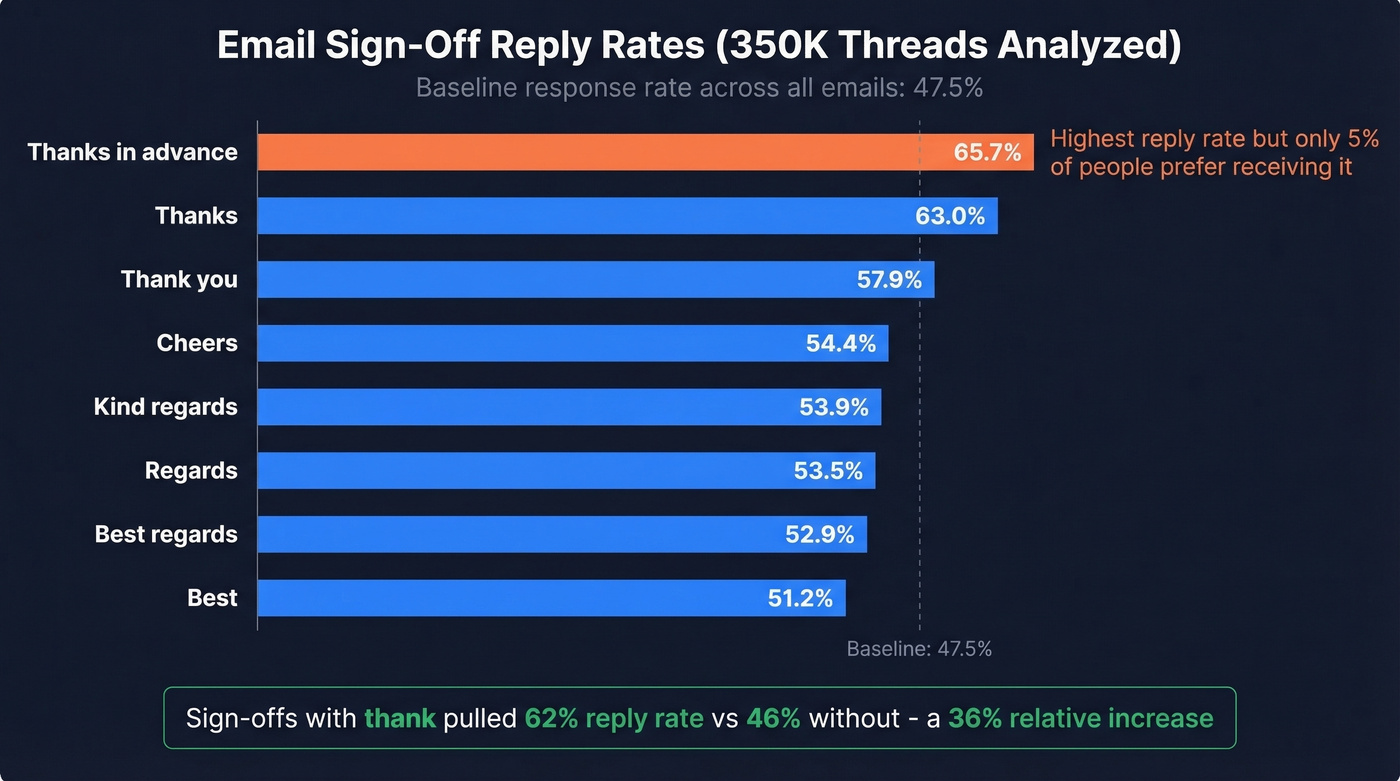
Boomerang analyzed 350,000+ email threads pulled from mailing list archives across twenty-plus online communities - many open-source and software lists, plus niche groups like UCLA's Religion Law list. The baseline response rate across all emails was 47.5%. Here's how sign-offs performed:
| Sign-Off | Reply Rate |
|---|---|
| Thanks in advance | 65.7% |
| Thanks | 63.0% |
| Thank you | 57.9% |
| Cheers | 54.4% |
| Kind regards | 53.9% |
| Regards | 53.5% |
| Best regards | 52.9% |
| Best | 51.2% |
The pattern is clear: gratitude wins. Closings containing "thank" pulled a 62% response rate versus 46% without - a 36% relative increase. The researchers controlled for "emails that require a response" by re-running the analysis on threads whose initial message contained a question mark, and the pattern held.
This aligns with a separate study by Grant & Gino (2010 , Journal of Personality and Social Psychology) that found adding "thank you" made recipients more than twice as likely to help. Gratitude isn't just polite. It's a behavioral nudge.
But there's a catch. A survey of 1,005 Americans found that "thanks in advance" is used by 41% of people but preferred by only 5%. It ranked among the most aggressive sign-offs. So the closing that gets the most replies is also the one most likely to annoy your recipient. That's not a contradiction - it's a signal that "thanks in advance" creates social pressure to respond, which works on strangers but erodes trust with people you'll email again.
Here's the thing: if your deals are typically small - say, sub-$10K ACV - you probably don't need to agonize over sign-offs at all. A clear CTA and a simple "Thanks" will outperform any clever closing. The people who obsess over "Regards" vs. "Best regards" are optimizing the wrong variable.
How to End an Email by Situation
You don't need 89 options. You need the right one for the context.
Formal / External
Sincerely is for job applications, legal correspondence, and first contact with C-suite at enterprise companies. It's the suit-and-tie of sign-offs. Best regards is the universal professional default - safe for clients, vendors, and anyone you haven't emailed before. Boring in the best way.
Respectfully works when writing to someone significantly senior or in government/military contexts. In casual settings, it reads stiff. With appreciation lands when someone's done you a genuine favor, but don't use it as a default or it loses meaning.
Friendly-Professional
Thank you is the workhorse. Warm enough for clients, professional enough for executives. We've tested this across cold email campaigns, and "Thank you" consistently outperforms "Best" in client-facing messages - it signals effort without formality.
Best is the khakis of email closings. Kind regards runs slightly warmer than "Best regards," especially in the UK where "Regards" alone can sound cold. Warm regards takes it another half-step warmer - good for ongoing client relationships where you want to signal friendliness without going casual. All the best splits the difference between "Best" and "Best regards," and reads as genuinely warm rather than formulaic.
Casual / Internal
Thanks - 63% reply rate, zero pretension. The default for teammates, direct reports, and anyone you Slack with regularly.
Cheers is polarizing: it pulls a 54.4% reply rate, but the same survey ranked it among the most aggressive sign-offs. Works in UK/Australian offices. In the US, it can read as affected unless it's genuinely your style. The consensus on r/email threads is basically "if you wouldn't say 'cheers' out loud to this person, don't type it."
Talk soon implies an ongoing relationship and works for wrapping up a thread where you'll reconnect. Take care adds a personal touch without being overly familiar. And --[Name] - just a dash and your name - is the minimalist's choice for rapid-fire internal threads where a sign-off would slow things down.
When You Need a Reply
Thanks in advance is the nuclear option. Use it in mass outreach where relationship doesn't matter and you need a response. Don't use it with colleagues or clients you'll email again.
Looking forward to hearing from you is softer but still signals you expect a reply - good for follow-ups. Thanks for your time acknowledges the recipient's effort without being presumptuous, and works well after a meeting request or detailed ask.
One more thing: what goes below your sign-off matters too. Your signature block should include your name, title, and one contact method. Skip the inspirational quotes and five-line legal disclaimers - they dilute the closing you just crafted.

A perfect sign-off means nothing if your email never reaches the inbox. Prospeo's 98% verified emails and 7-day refresh cycle keep your bounce rate under 4% - so every closing line you craft actually gets read.
Stop optimizing closings for emails that bounce. Fix the data first.
Closing Lines vs. Sign-Offs
Your closing line matters 10x more than your closing word.
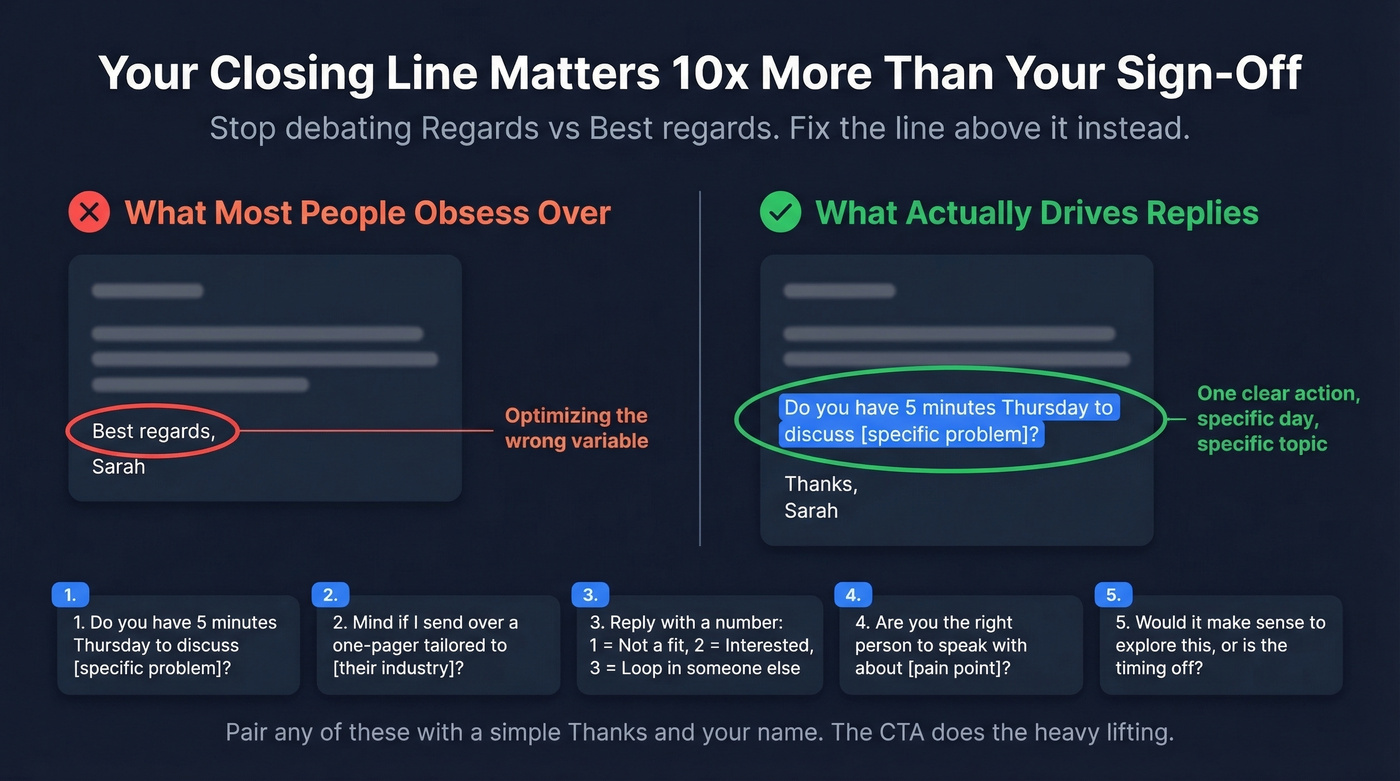
The sentence before your sign-off - the one that tells the reader what to do next - is where replies are won or lost. Most guides obsess over "Regards" vs. "Best regards" when the real difference is in the CTA. A strong closing line gives one clear action. Not two. Not "let me know your thoughts and also feel free to loop in your team and maybe we can find time next week." One thing.
We've tested dozens of closing lines in outreach campaigns, and the small-ask pattern consistently wins. Requesting five minutes about a specific problem works because it respects the recipient's time while triggering commitment. If you're A/B testing sign-offs, test the CTA line first - run at least 500 emails per variant before drawing conclusions.
Five closing lines worth stealing:
- "Do you have 5 minutes Thursday to discuss [specific problem]?" - specific day + specific topic. Easy to say yes to.
- "Mind if I send over a one-pager tailored to [their industry]?" - low commitment, high relevance.
- "Reply with a number: 1 = Not a fit, 2 = Interested, 3 = Loop in someone else." - reduces friction to a single keystroke.
- "Are you the right person to speak with about [pain point]?" - gives them an easy out, which paradoxically increases replies.
- "Would it make sense to explore this, or is the timing off?" - binary choice, no pressure.
Pair any of these with a simple "Thanks, [Name]" and you're done. The CTA does the heavy lifting. If you want more ready-to-send options, pull from these follow-up templates and adapt the ask.
Email Sign-Offs to Avoid
91% of workers say their coworkers are sometimes passive-aggressive over email, and 46% say they can tell a coworker's mood based on greetings and sign-offs. Your closing isn't just a formality - it's a signal, and some signals are toxic.
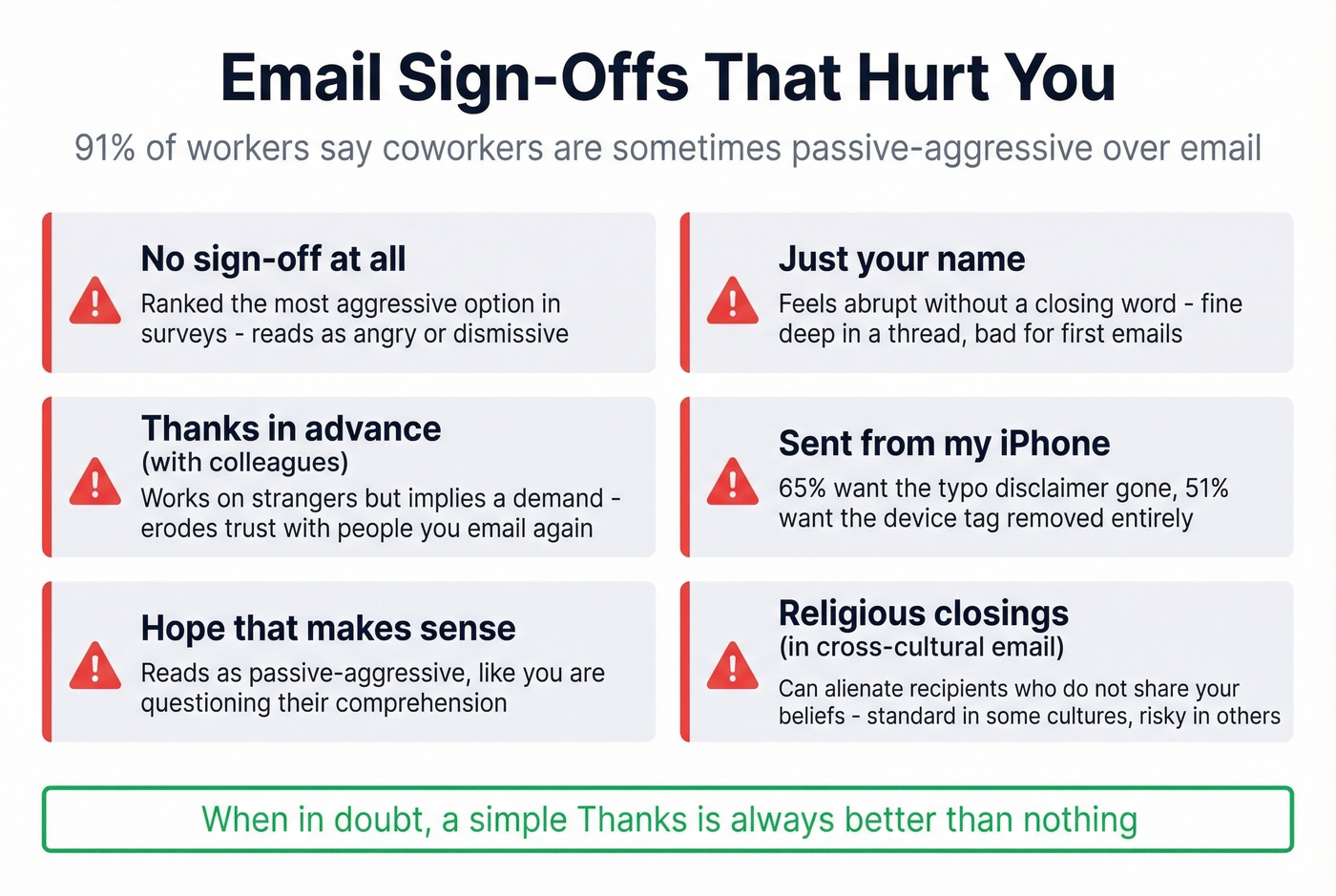
No sign-off at all ranked as the most aggressive option in the survey. It reads as either angry or dismissive. Even a bare "Thanks" is better than nothing.
Just your name has a similar problem - without a closing word, it feels abrupt. Fine in a long email thread where you've already exchanged pleasantries, but not for a first or second email.
"Thanks in advance" with colleagues - we've covered this. It works for strangers. It annoys people you work with. Grammarly warns against it because it implies a demand.
Religious closings like "Have a blessed day" can alienate recipients who don't share your beliefs. In some cultures - Nigeria, parts of the Middle East - these are standard and even expected. In cross-cultural business email, they're a risk.
"Sent from my iPhone" - 65% of people want the "please excuse typos" disclaimer gone, and 51% want the device tag removed entirely. It's not a sign-off. It's a default you forgot to delete.
"Hope that makes sense" reads as passive-aggressive, like you're questioning the recipient's comprehension. Just don't.
Professional Email Closings Around the World
A study referenced by the BBC found that 40% of Korean academics found Australian emails impolite, versus 28% the other way around. Your sign-off doesn't mean the same thing everywhere.
In the UK, "Regards" alone can sound cold or even hostile - "Kind regards" or "Best regards" is the safe default. In France, "Mille baisers" (a thousand kisses) is a casual closing among friends that would be alarmingly intimate in an English workplace. In Nigeria, emails commonly end with religious notes like "Stay blessed" - these are genuine prayers, not filler, and dismissing them can damage relationships.
One real misinterpretation I came across: a Nigerian professional's closing "I hope to read from you soon" was mistaken by an American recipient as scam-like phrasing, costing a legitimate business opportunity.
European business email has its own shorthand:
| Region | Full Closing | Abbreviation |
|---|---|---|
| Sweden | Med vanliga halsningar | Mvh |
| Norway | Med vennlig hilsen | Mvh |
| Germany | Mit freundlichen Grussen | MfG or LG |
| Hungary | Udvozlettel | Udv |
The practical approach: before emailing someone in an unfamiliar culture, review formal local communications - bank letters, government correspondence - to calibrate your formality level. Match or slightly exceed the formality of the most senior person in the thread.
None of This Matters If It Bounces
Let's be honest about something. You're drafting a cold email to a VP of Sales at a Series B company. You've nailed the subject line, written a tight three-sentence body, and closed with a perfect small-ask CTA. There's a 17% chance that email never reaches their inbox. It bounces, hits spam, or lands in a dead mailbox.
Cold email reply rates have been declining steadily - every bounced email makes that number worse and damages your sender reputation in the process. Even the best closing for email can't save a message that never arrives. Before you optimize your sign-off, verify your list. Prospeo checks emails in real time with 98% accuracy and refreshes data every 7 days, so you're not crafting the perfect closing for an inbox that doesn't exist. If you want the full playbook, start with this email deliverability guide and then track your email bounce rate like a core KPI.
You just learned the closing lines that drive replies. Now you need the right people to send them to. Prospeo gives you 300M+ verified contacts with 30+ filters - buyer intent, job changes, tech stack - so your perfectly crafted emails land with decision-makers who actually convert.
Great closings deserve great contact lists. Build yours in minutes.
FAQ
Is "Best regards" or "Kind regards" better?
Both are safe and interchangeable in US business email. "Kind regards" reads slightly warmer, especially in the UK where "Regards" alone can sound cold or curt. Pick whichever feels natural - the difference in recipient perception is negligible.
Is "thanks in advance" rude?
It gets the highest reply rate at 65.7%, but only 5% of recipients prefer it - many perceive it as presumptuous. It's safe with strangers you won't email again. It's risky with colleagues and clients who'll remember the implied demand.
What's the best way to close a cold email?
Focus on your closing line, not the sign-off word. A single-action CTA like "Do you have 5 minutes Thursday to discuss [specific problem]?" drives replies far more than any sign-off. For the sign-off itself, "Thanks, [Name]" is all you need - but verify your addresses first so your outreach doesn't bounce before anyone reads it.
What's the most professional email sign-off?
"Sincerely" is the most formal, but "Thank you" is the most effective - it pulls a 57.9% reply rate and 38% of recipients rank it as their preferred sign-off. "Best regards" is the safe middle ground when you're unsure about formality level.