

Best Days to Send Cold Emails: What 2026 Data Actually Shows
You've been sending cold emails at 10 AM on Tuesdays because that's what every blog post told you. Your open rates are stuck at 18%. Cold email isn't dead - your timing advice is just from 2022.
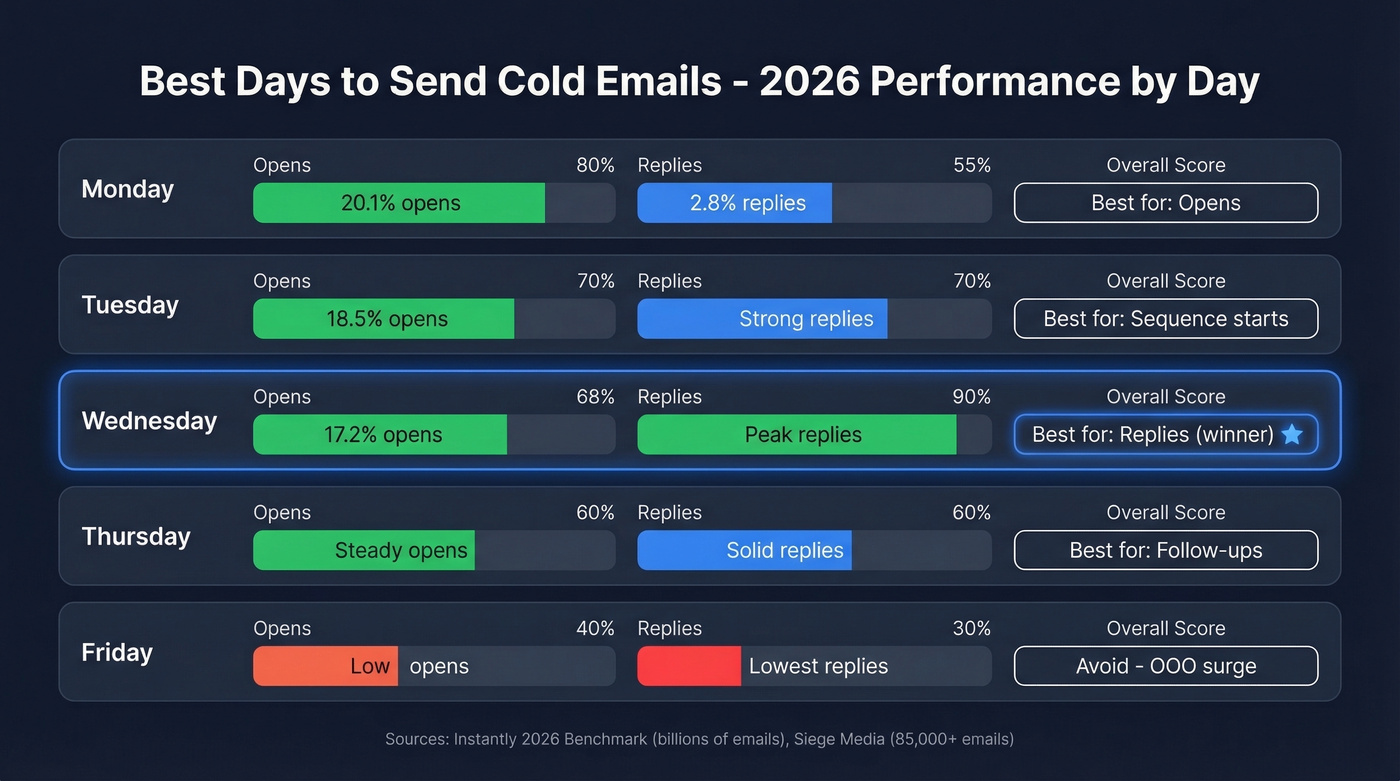
Every cold email timing guide cites "studies show Tuesday at 10 AM" without linking to a single study. Here's what actual datasets - 85,000 emails from Siege Media, billions from Instantly's 2026 benchmark report - actually show. The average professional's inbox gets 15 cold emails per week, and 50.9% of recipients never engage with any of them. Timing won't fix a bad offer, but it can be the difference between landing in the morning scan and getting buried.
| Day | Best for | Notes |
|---|---|---|
| Mon | Opens (especially early) | Fresh inbox; strong for personalized outreach |
| Tue | Consistent performance | Reliable for first touches and sequence starts |
| Wed | Replies (peak in 2026 data) | Mid-week outperforms the edges |
| Thu | Follow-ups + steady engagement | Works well as a continuation day |
| Fri | Lowest-reply weekday | OOO setup and end-of-week drop-off |
Wednesday for replies, Tuesday as a close second, 7-8 AM local time delivery. But timing is the second lever. Data quality is the first.
What 2026 Benchmark Data Shows
The 2026 benchmark data, drawn from billions of cold email interactions across thousands of active workspaces, paints a clear picture. Headline numbers: a 3.43% average reply rate, with the top quartile hitting 5.5%+ and the top 10% clearing 10.7%. Mid-week consistently outperformed the edges, with Wednesday taking the crown.
That lines up with what we've seen across campaigns. But the story isn't as simple as "send everything Wednesday."
Wednesday vs Tuesday
Wednesday edges out Tuesday for replies, and the pattern makes intuitive sense. Monday is catch-up day. By Tuesday, people are deep in their workload. Wednesday hits the sweet spot - prospects have cleared their backlog but haven't mentally checked out for the weekend.
Tuesday remains a strong second choice, especially for sequences where your first email lands Tuesday and a follow-up hits Wednesday or Thursday. The benchmark data shows 58% of all replies come from the first email, so initial send timing matters more than follow-up timing. Follow-ups written as casual replies outperform formal follow-up templates by roughly 30% - a reminder that how you write matters as much as when you send.
The Monday Surprise
Siege Media's dataset of 85,000+ personalized emails found Monday with the highest open rate - just over 20% - along with a 4.3% click rate and 2.8% reply rate. Wednesday in their data hit 17.2% open and 2.6% reply. Monday winning on opens contradicts the "never send Monday" conventional wisdom.
Why? Monday mornings bring fresh inboxes and clearer priorities. If your email is personalized and relevant, it catches the "inbox triage" window before the week's noise builds up. An analysis cited by EmailTooltester points to early Monday performance too: Monday mornings between 5-8 AM produced the highest reply rates at 2.3%. For high-volume automated sequences, Wednesday still wins. For highly personalized outreach, Monday deserves a test.
Friday and Weekends
Friday is consistently the weakest weekday for replies. It's the "auto-reply surge" day - prospects are setting OOO messages, wrapping up loose ends, and mentally checked out. Your email doesn't just get ignored; it gets buried under a weekend's worth of incoming mail by Monday morning.
Weekends are worse. Most B2B recipients aren't monitoring work inboxes Saturday or Sunday. Stick to Monday through Thursday.
Best Time of Day to Send
The "10 AM is the best time" advice is overrated for cold email. Siege Media's data showed significant declines in both opens and clicks at 10 AM PST and 10 AM EST. Our hypothesis: everyone sends at 10 AM because every guide says to, so your email lands in a pile of other cold emails all hitting the inbox at once.
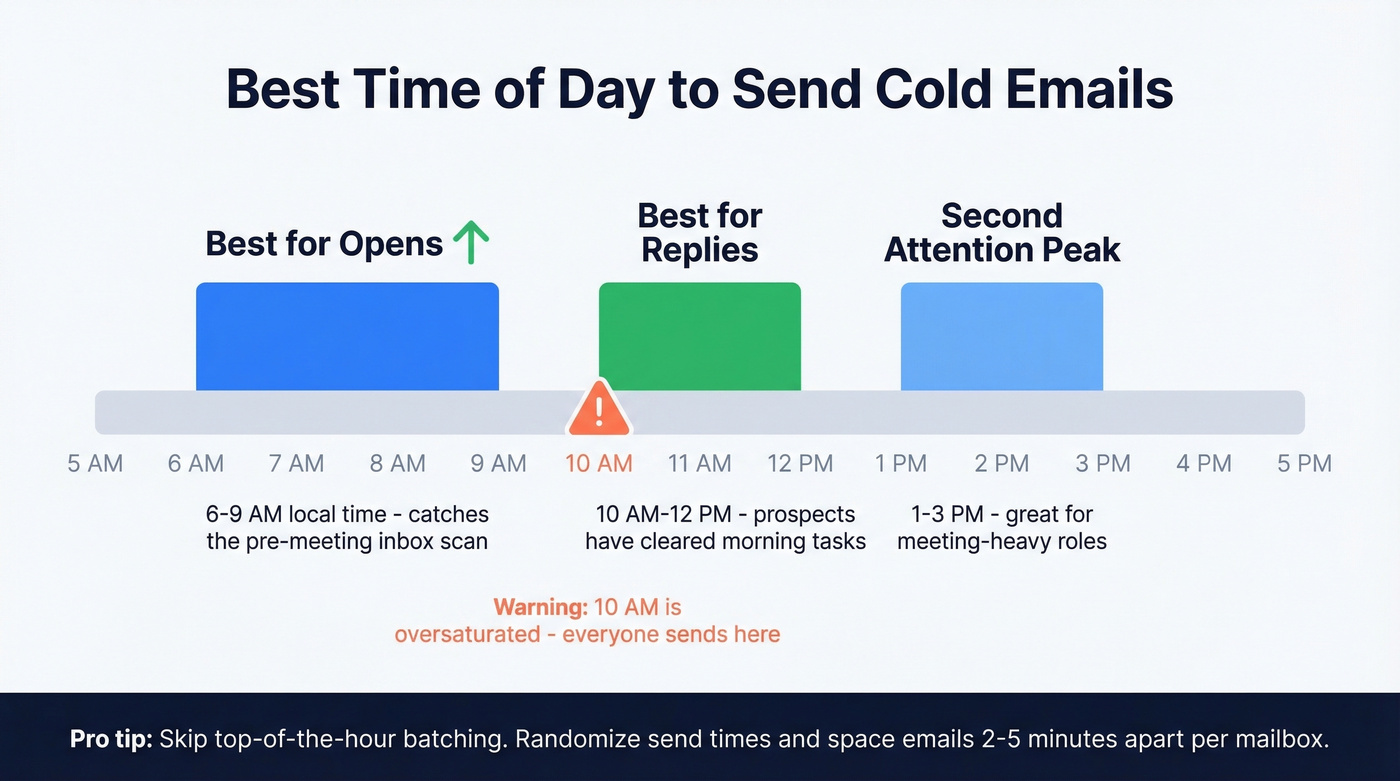
6-9 AM local time works best for opens. This catches the pre-meeting inbox check when prospects are scanning for anything urgent or interesting. Schedule delivery for 7-8 AM to hit the 8-10 AM engagement spike.
10 AM-12 PM is strong for replies. People have cleared their morning tasks and have bandwidth to actually respond.
1-3 PM catches a second attention peak, particularly for roles that spend mornings in meetings. Worth testing if your morning sends aren't performing.
Skip top-of-the-hour batching. Bulk sends at :00 can trigger filtering and rate limiting. Randomize your send times and space emails 2-5 minutes apart per mailbox.
Timing by Industry and Role
Most timing guides give one answer for every industry. That's lazy. A VP of Engineering at a SaaS company and a plant manager at a manufacturing firm have completely different email habits.
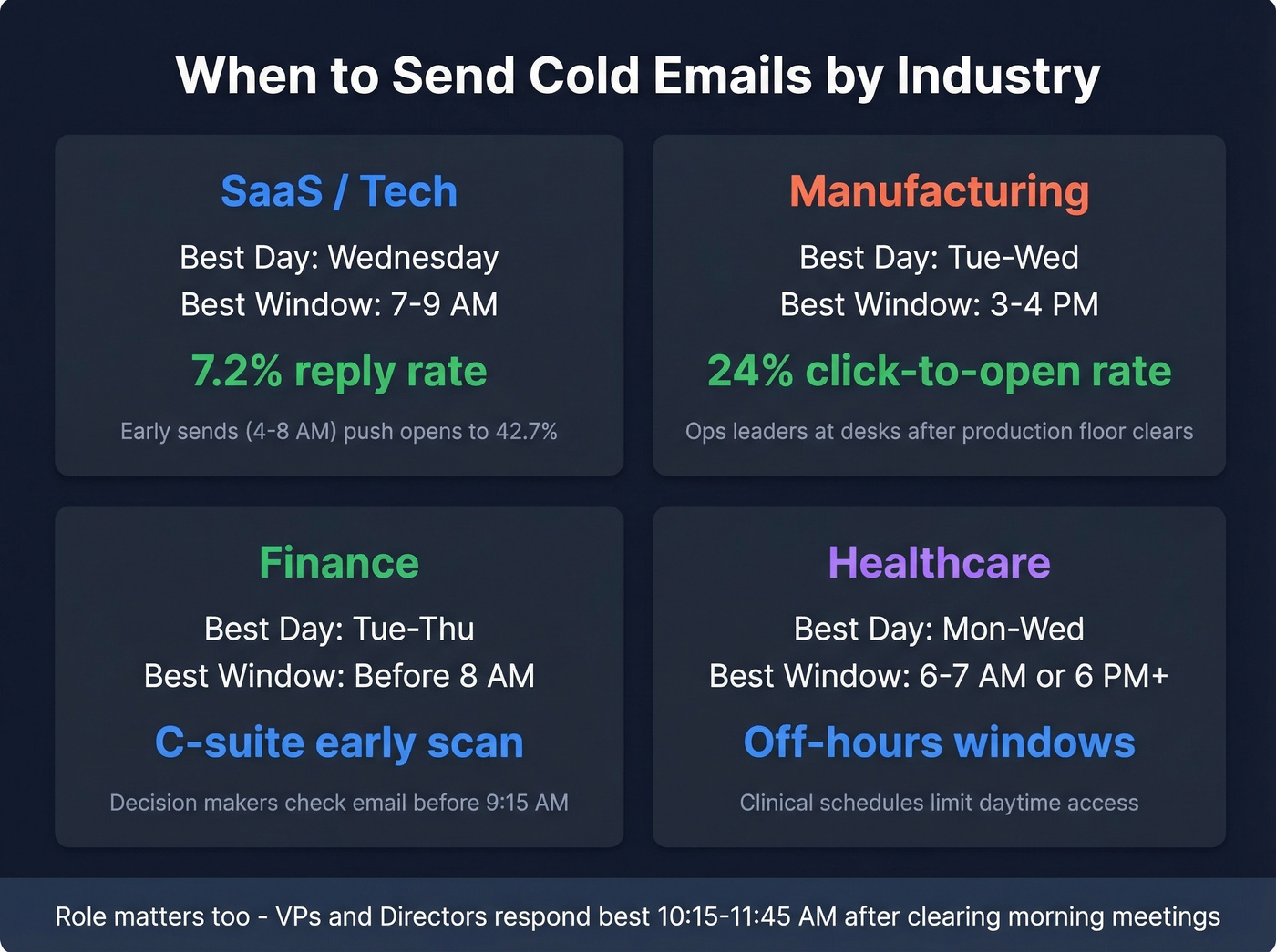
| Industry | Best Day | Best Window | Key Metric |
|---|---|---|---|
| SaaS/Tech | Wed | 7-9 AM | 7.2% reply rate |
| Manufacturing | Tue-Wed | 3-4 PM | 13.05% open rate |
| Finance | Tue-Thu | Before 8 AM | C-suite early scan |
| Healthcare | Mon-Wed | 6-7 AM or 6 PM+ | Off-hours windows |
Zapmail's industry breakdown reveals useful patterns. SaaS and tech prospects respond best on Wednesday with a 7.2% reply rate and 37% open rate. Early sends between 4-8 AM can push open rates to 42.7% in tech - these are people who check email before standup.
Manufacturing is a different animal entirely. Manufacturers open fewer emails overall (10.5% vs 21.5% average) but have a higher click-to-open rate: 24% vs 10.5%. The 3-4 PM window works because plant managers and ops leaders are at their desks after the production floor clears out.
Role matters as much as industry. Zapmail's role-based timing data suggests C-suite prospects check email before 9:15 AM - your window is the pre-meeting scan - while VPs and Directors are more responsive in the 10:15-11:45 AM window, after they've cleared their morning meetings. One SaaS operator on Reddit reported 43% open rates and 7.3% reply rates, well above the 3-5% industry average, by prioritizing list quality and role-specific targeting over timing tricks.

Sending on Wednesday at 7 AM means nothing if 35% of your emails bounce. Prospeo's 98% email accuracy and 7-day data refresh ensure every perfectly timed cold email actually reaches the inbox - not a dead address.
Fix your data before you fix your send schedule.
Time Zone Strategy
Here's the thing: 23% of email opens happen in the first hour after delivery. If you're blasting your entire list at 8 AM Eastern and half your prospects are in Pacific time, you're hitting their inbox at 5 AM. That's not a timing strategy - it's a timing accident.
If you want the full workflow, start with automated cold email scheduling and then layer in time-zone logic.
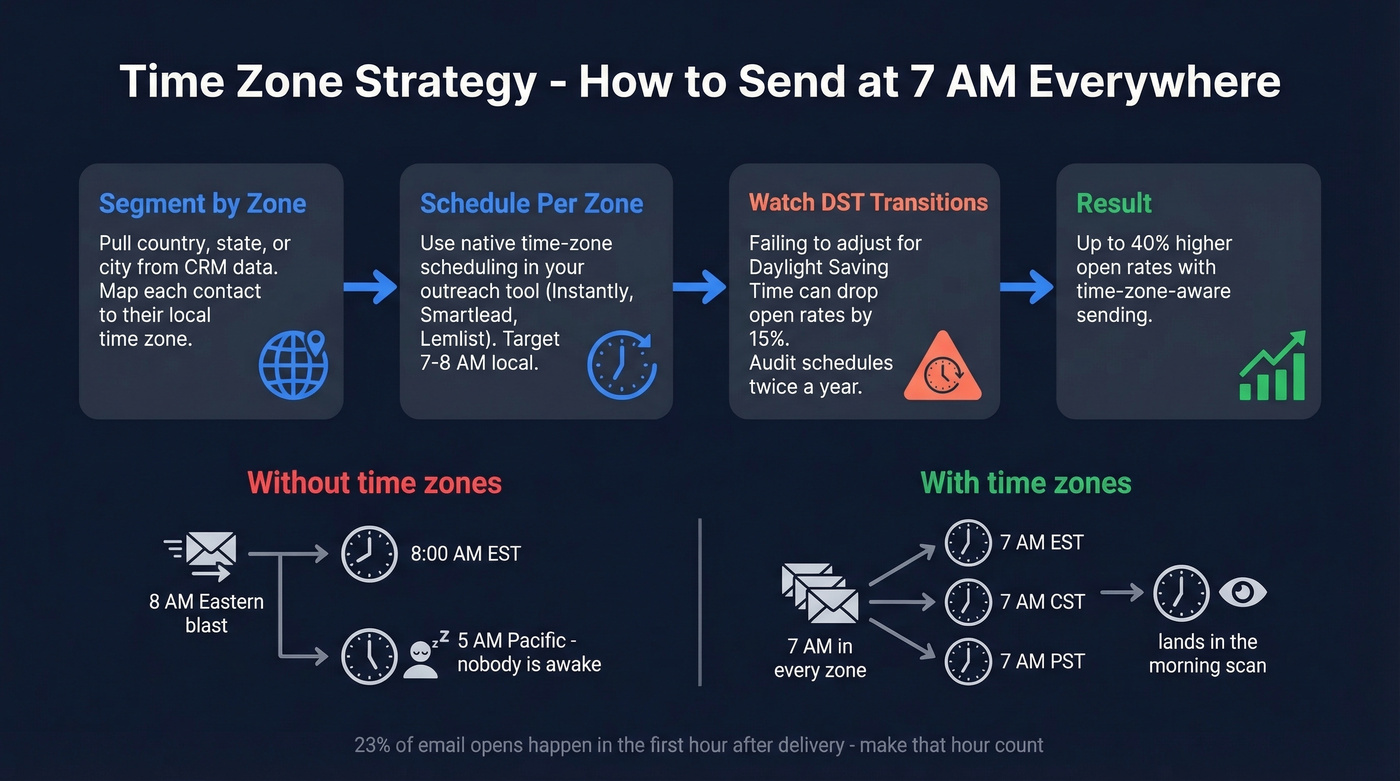
Time-zone-aware sending can boost open rates by up to 40%. The workflow is straightforward:
- Segment by time zone. Pull country, state, or city from your CRM data. Map each to a standard time zone.
- Schedule per zone. Most outreach tools - Instantly, Smartlead, Lemlist - support time-zone-aware scheduling natively. Use it.
- Watch DST transitions. Failing to adjust for Daylight Saving Time can drop open rates by 15%, especially the Monday through Wednesday after the clocks change. Audit your schedules twice a year.
Why Timing Fails Without Clean Data
You can nail the perfect Wednesday 7 AM send window and still watch your campaign crater. The reason is almost always data quality.
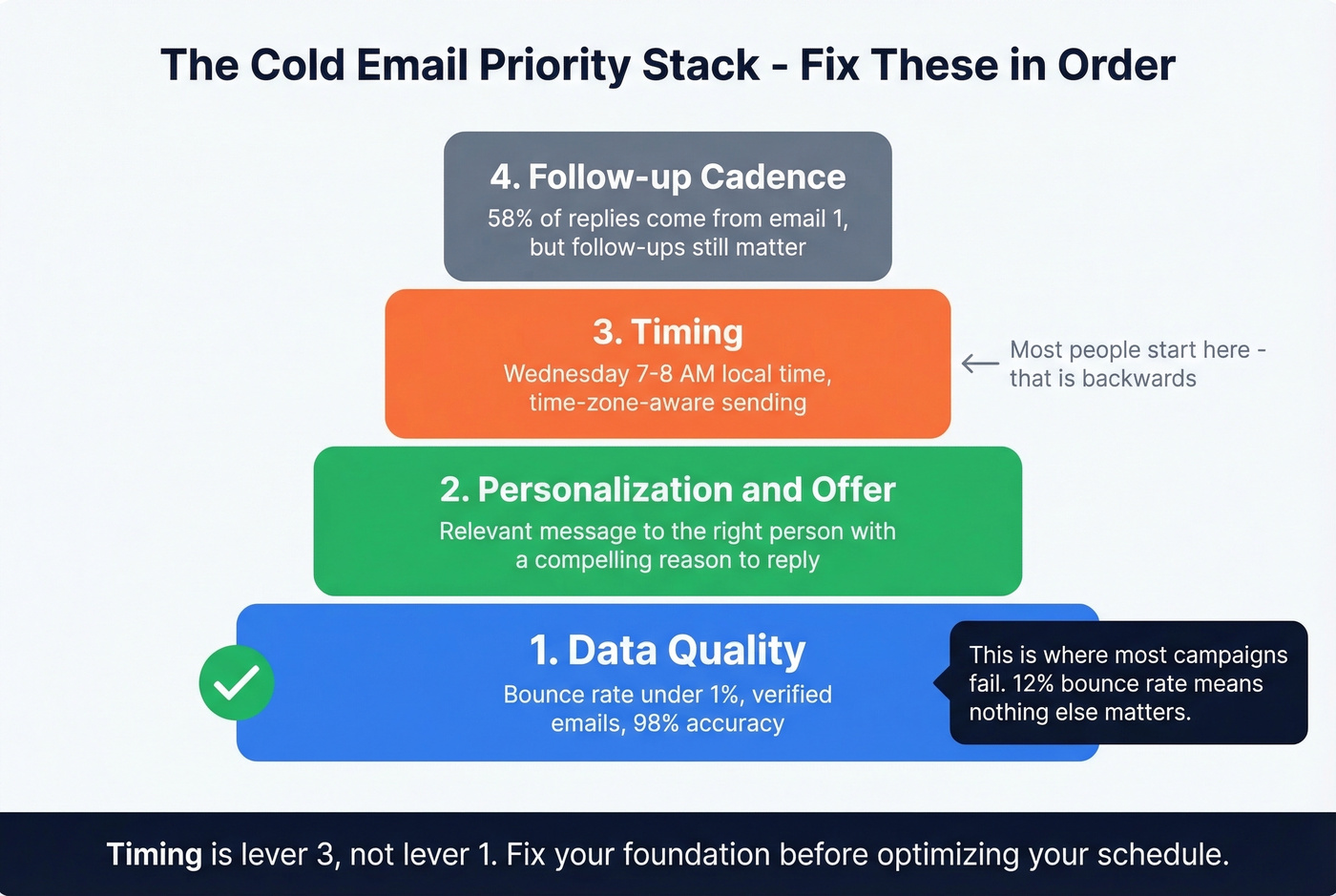
If your bounce rate exceeds 3%, deliverability problems compound fast. The target is under 1% - and you can't get there if your list is packed with invalid addresses, spam traps, and honeypots from a stale database. We've seen teams spend weeks A/B testing send days when their bounce rate was 12%. Fix the foundation before you optimize the trim.
If you need a benchmark and remediation checklist, use this email bounce rate guide.
Prospeo's 5-step verification catches these problems before they reach your sequence. Every email runs through catch-all domain handling, spam-trap removal, and honeypot filtering, delivering 98% email accuracy on a 7-day refresh cycle - not the 6-week industry average. Stack Optimize used Prospeo to build from $0 to $1M ARR while keeping client deliverability above 94% and bounce rates under 3% with zero domain flags.
On the sending side, space emails 2-5 minutes apart per mailbox and cap each at roughly 30 cold emails plus 20 warm-up emails per day. With clean data and disciplined sending, your deliverability stays healthy enough for timing optimization to actually matter. For safe scaling, follow email velocity limits.
That Reddit operator hitting 43% opens and 7.3% replies? They credited list quality over timing tricks. Prospeo gives you 30+ filters - buyer intent, job changes, technographics - so your Wednesday morning send lands with prospects who actually care.
Build the list that makes your timing strategy work.
When Timing Barely Matters
Look, if you're sending fewer than 1,000 emails per month, stop obsessing over send day. Your sample size is too small for timing to matter statistically. Focus on list quality and your offer.
A Reddit operator running 100K+ sends per month put it bluntly - they send equal volume five days a week and the timing differences are "small." At that scale, a roughly 1.6% reply rate translates to far more meetings than a tiny list with a 5% reply rate.
The priority stack is data quality first, then personalization and offer relevance, then timing, then follow-up cadence. Timing is lever three, not lever one. If you're building a sequence from scratch, use a proven B2B cold email sequence structure.
How to Find Your Optimal Send Day
Don't take any of these benchmarks as gospel for your specific audience. Here's how to find your own windows:
Pick 2-3 time slots to test. Start with the data above - 7 AM vs 10 AM vs 1 PM on your best-performing day.
Run each test for 2-3 weeks minimum. You need at least 200-300 sends per variant to get directionally useful data. Anything less is noise.
Track reply rate, not open rate. Apple Mail Privacy Protection inflates open rates by pre-loading tracking pixels. Replies are the signal that matters.
Refresh quarterly. Inbox behavior shifts with seasons, industry cycles, and ESP algorithm changes. What works in Q1 won't necessarily hold in Q3.
If you want to improve the lever that usually beats timing, start with cold email subject lines and then tighten your sales follow-up templates.
Keep a simple spreadsheet: date, day, send time, volume, replies. After 4-6 weeks, the pattern will emerge - and it'll be more useful than any benchmark report because it's your data, your audience, your offer. The best days to send cold emails depend on your specific ICP and vertical, so let your own numbers guide you.
FAQ
Is Saturday a good day to send cold emails?
No. B2B inboxes are inactive on weekends, and your email gets buried under Monday morning's flood. Stick to Monday through Thursday.
Does send time matter more than subject line?
Subject line wins every time. A great subject line at a mediocre time outperforms a bad subject line at the perfect time. Optimize copy first, then test timing.
How many cold emails should I send per day?
Cap each mailbox at roughly 30 cold emails plus 20 warm-up emails. Use multiple mailboxes and rotate them to distribute volume safely without triggering ESP rate limits.
Should I send cold emails in the prospect's time zone?
Yes. 23% of opens happen in the first hour after delivery. Time-zone-aware sending can boost open rates by up to 40% - most outreach tools support this natively.
How do I prevent cold emails from landing in spam?
Keep bounce rates under 1%, space sends 2-5 minutes apart, warm up new domains for 4-6 weeks, and verify every address before sending. Prospeo's bulk verification catches invalid emails, spam traps, and catch-all domains at 98% accuracy - eliminating the top deliverability killers before you hit send.