

Best Email Finder Tools in 2026 (Tested & Compared)
You just sent 1,200 cold emails. 180 bounced. Your domain reputation tanked, and now even your warm follow-ups land in spam. That's not a hypothetical - it's what happens when you trust an email finder that measures "accuracy" differently than your ESP does. We pulled data from three public benchmarks, two Reddit bake-offs, and real pricing pages to figure out which email finder tools actually deliver usable emails in 2026.
Why Most "Best Of" Lists Are Useless
Most page-one results for email finder comparisons are published by an email finder vendor - and they almost always rank themselves #1. Dropcontact runs a 20,000-contact benchmark and wins. Anymail Finder runs a 5,000-contact benchmark and wins. Tomba runs a 5,000-search benchmark and - you guessed it - wins.
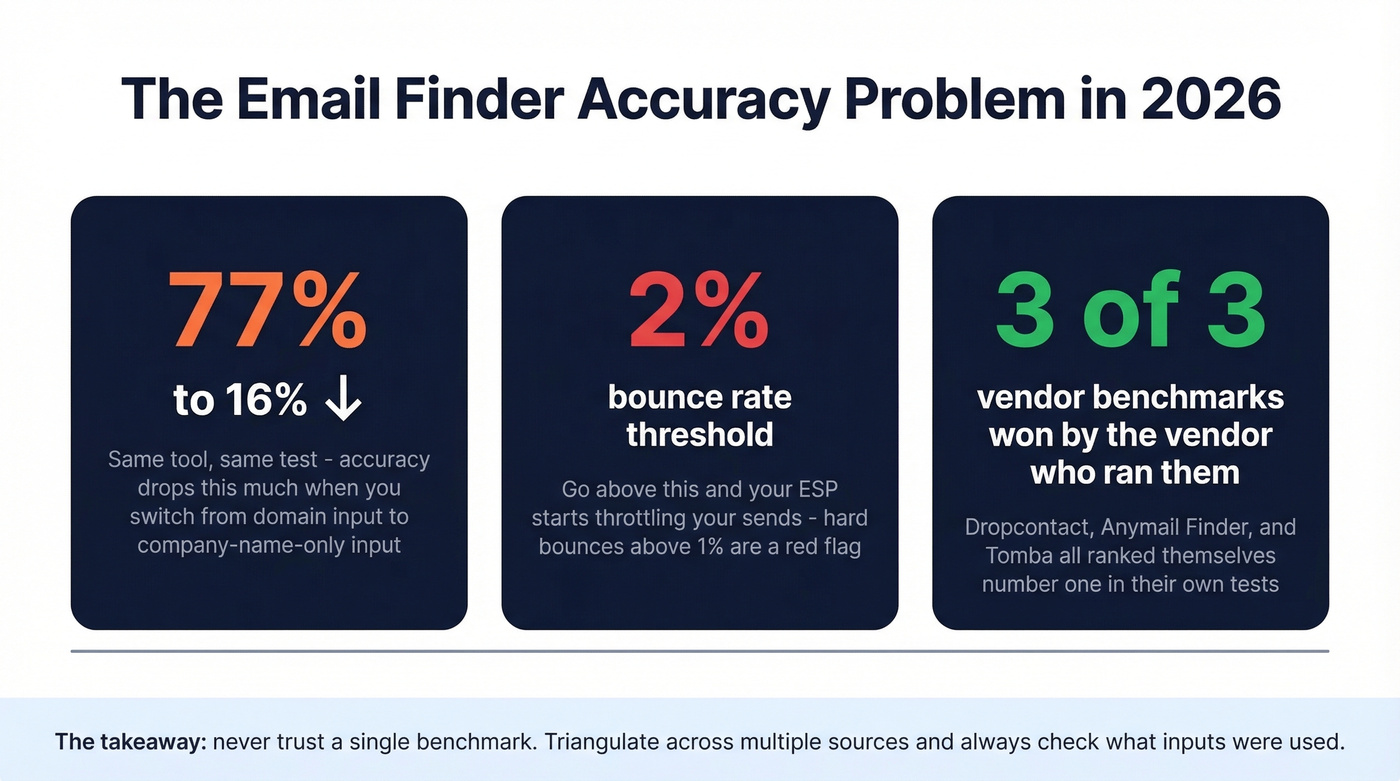
That doesn't make the data useless. It means you need to read across all of them, triangulate the results, and understand what each test actually measured. A tool that scores 77% when given a company domain might score 16% when given only a company name. Same tool, wildly different result, depending on the input.
If your email finder delivers contacts that bounce above 2%, you're damaging your sender reputation. Hard bounces above 1% are a red flag most ESPs will act on.
Our Picks at a Glance
| Tool | Best For | Accuracy Range* | Starting Price | Free Tier |
|---|---|---|---|---|
| Prospeo | Accuracy + freshness | 98% on returned results | Free / ~$0.01/email | 75 emails/mo |
| Apollo.io | Free tier + volume | 60-75% match rate | Free / ~$49/user/mo | Available |
| Hunter.io | Domain lookups | ~35-38% verified rate | Free / $49/mo | 50 credits/mo |
| Findymail | Verified accuracy | ~75% verified rate | ~$49/mo | No |
| Anymail Finder | Budget + guarantee | 77.5% verified rate | $19/mo | No |
| Snov.io | International leads | ~20-40% depending on test | Free / ~$30-$39/mo | Limited |
| RocketReach | C-suite contacts | Strong for exec data | $80/user/mo | No |
| Lusha | Phone + email combo | Credit-based | Free / ~$30-$100/user/mo | 70 credits/mo |
| Kaspr | Unlimited B2B email | Unlimited email credits (paid) | Free / $49/user/mo | 15 B2B email credits/mo |
| ContactOut | Budget prospecting | Solid budget alternative | Free / $36/user/mo | 5 credits/mo |
| Cognism | EU/UK enterprise | Compliance-focused | ~$1,000-$3,000+/mo | No |
| Tomba | Budget domain search | 76-80% in its own tests | $49/mo | Available |
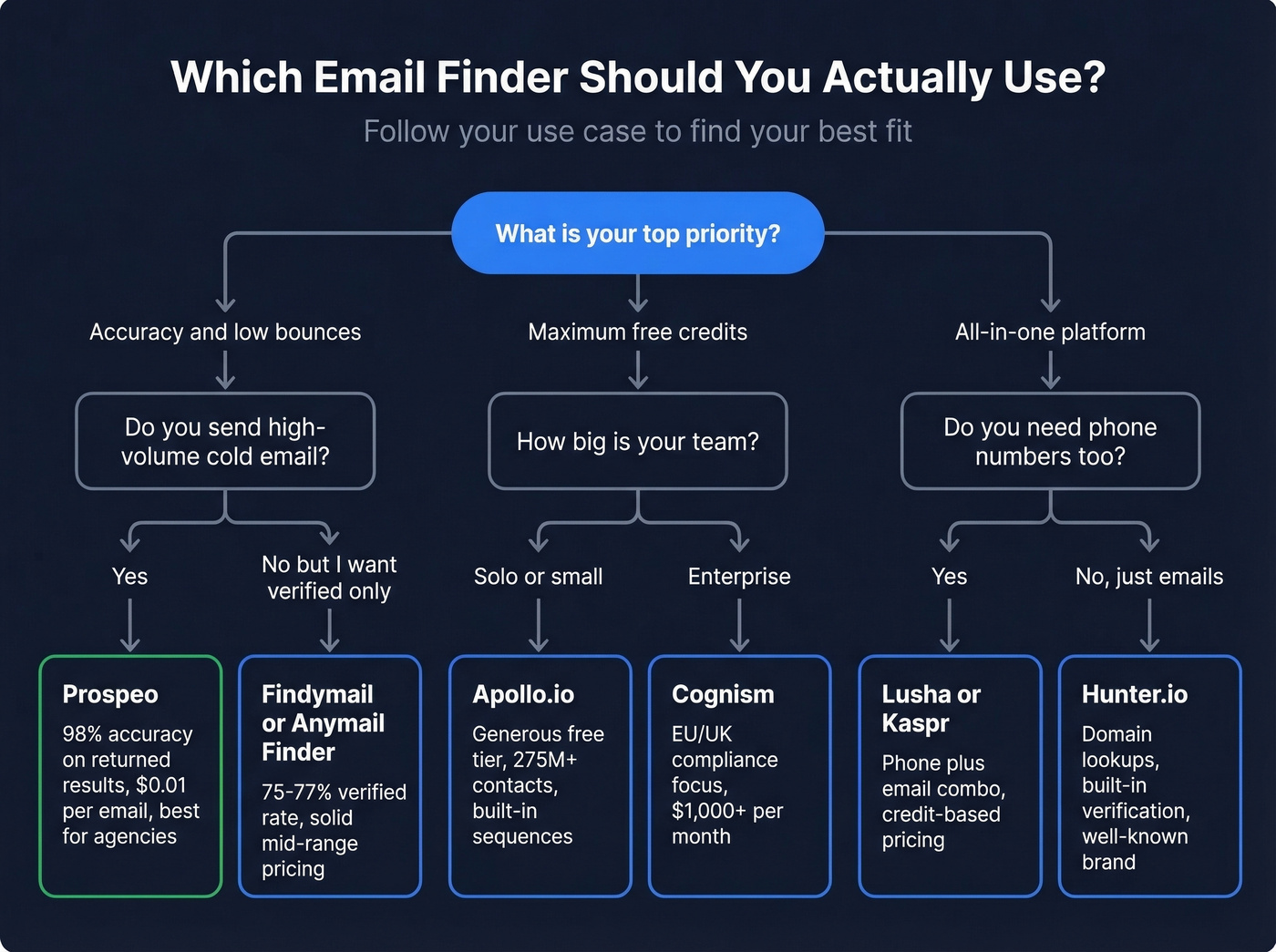
*Accuracy ranges come from third-party benchmarks where available. "Verified rate" in these tables means the percentage of searches where the tool returned a deliverable email. "On returned results" means the validity rate of emails actually delivered, excluding searches where no email was found. These are different metrics - a tool can have a low match rate but near-perfect accuracy on the emails it does return.
What the Benchmarks Show

Three vendor-run benchmarks and two Reddit bake-offs give us enough data to triangulate. None are unbiased, but together they paint a useful picture.
The Dropcontact benchmark tested 15 tools against 20,000 real contacts using only first name, last name, and company name - no domains, no URLs. They actually sent emails to every address found, measuring real hard bounces and wrong-domain matches. The top "real enrichment rate" was Dropcontact at 54.9%, followed by Fullenrich at 48.3% (with a 15.3% combined error rate), and Enrow at 40.9%. Findymail hit 39.9% with a relatively clean 6.2% error rate.
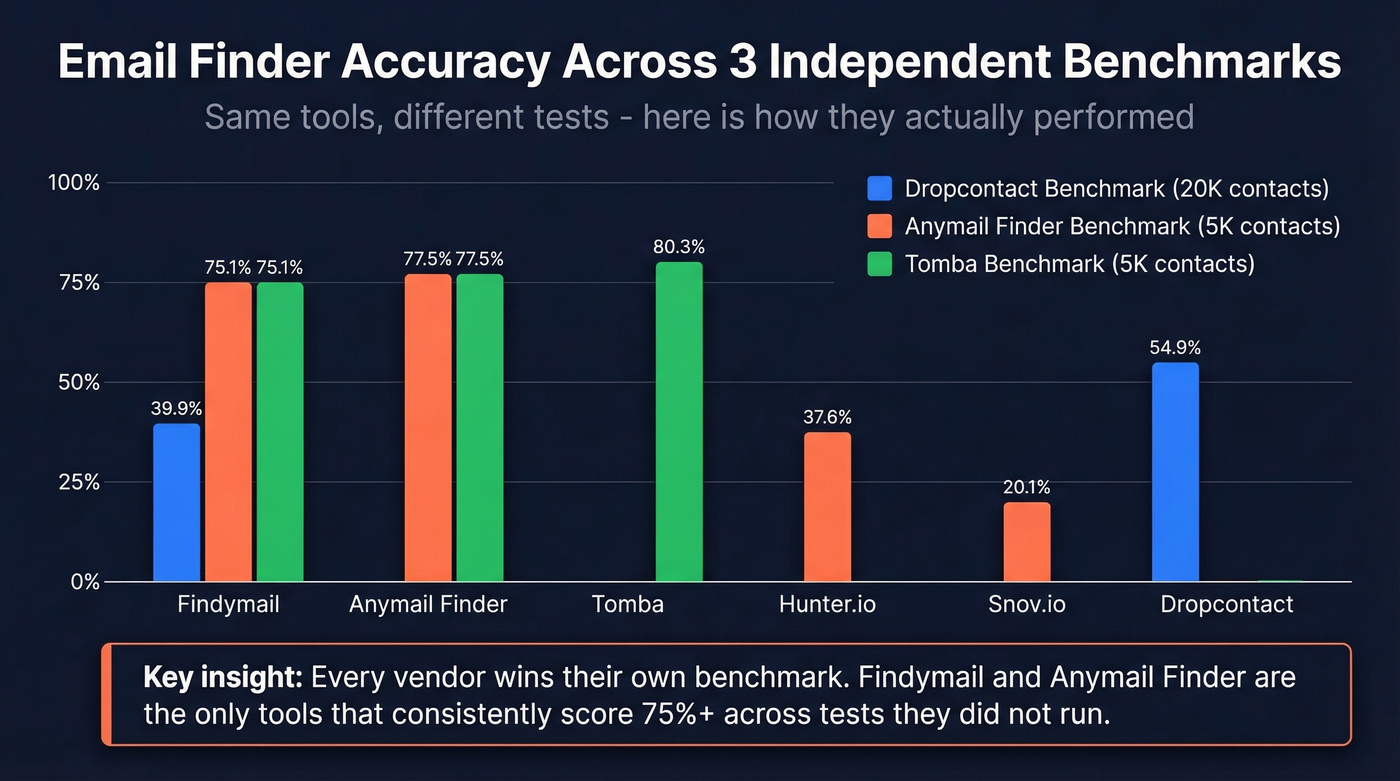
The Anymail Finder benchmark used 5,000 Sales Navigator exports and reported verified rates. Anymail Finder topped its own test at 77.5%, Findymail came in at 75.1%, and Hunter landed at 37.6%. Snov.io scored 20.1%.
The Tomba benchmark ran 5,000 searches - half domain-based, half company-name-only - across 9 tools. Tomba scored 80.3% in its own test, with Anymail Finder at 77.5% and Findymail at 75.1%.
On Reddit, a user tested 8 tools against 2,500 identical contacts. Tomba hit 76.9% and Findymail 75.2%.
Here's the thing every benchmark buries: there's a massive gap between "raw match rate" and "usable email rate." A tool that returns results for 80% of your list but 10% of those bounce is worse than a tool that returns results for 40% of your list with near-zero bounces. The first tool looks better in benchmarks. The second tool keeps your domain alive.
That distinction matters because these benchmarks overwhelmingly test company-name-only inputs, which favor pattern-guessing tools. Tools built around real-time verification - where the architecture prioritizes returning only confirmed-valid emails over maximizing match volume - score lower on raw match rate but deliver virtually zero bounces on the emails you actually get.
The consistent performers across multiple benchmarks? Findymail and Anymail Finder show up near the top regardless of who's running the test. Hunter consistently underperforms expectations. We didn't review Dropcontact, Enrow, or Fullenrich individually because they're primarily enrichment-first tools rather than standalone email finders - but their benchmark numbers are worth noting if you're building a waterfall stack.

You just saw the benchmarks: most email finders hover between 35-77% accuracy. Prospeo's 5-step verification delivers 98% on returned results - with catch-all handling, spam-trap removal, and a 7-day data refresh that keeps contacts current. At ~$0.01 per verified email, it's the lowest cost-per-valid-contact on this list.
Stop paying for emails that bounce. Start with 75 free credits.
The Real Cost Per Verified Email
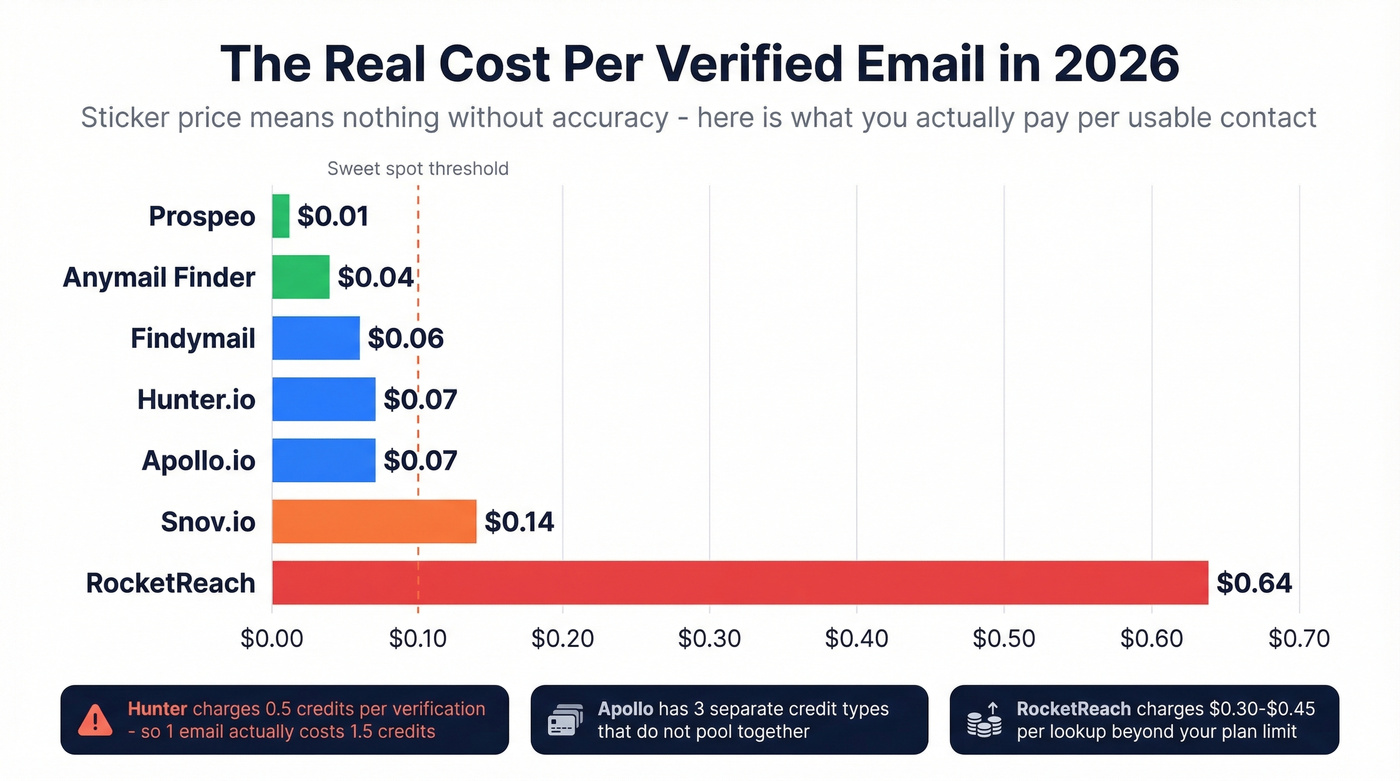
Sticker price is meaningless without accuracy. A $49/mo tool that finds 75% valid emails is cheaper per usable contact than a $150/mo tool that finds 35%.
| Tool | Monthly Cost | Credits/Mo | Accuracy Est. | Cost/Valid Email |
|---|---|---|---|---|
| Prospeo | Free-$39+ | 75+ free | 98% (returned) | ~$0.01 |
| Anymail Finder | $19-$39 | 50-1,000 | 77.5% | ~$0.04-$0.05 |
| Findymail | ~$49 | ~1,000 est. | ~75% | ~$0.05-$0.07 |
| Hunter Starter | $49 | 2,000 | ~37% | ~$0.07 |
| Snov.io | ~$30-$39 | 1,000 | ~20-40% | ~$0.08-$0.20 |
| Apollo Basic | $49/user | 1,000 exports | ~60-75% | ~$0.07-$0.08 |
| RocketReach | $80/user | 125 lookups | - | ~$0.64+ |
| Lusha | ~$30-$50/user | ~70-150 | - | - |
A few hidden costs worth flagging: Hunter charges 0.5 credits per verification, so finding and verifying a single email costs 1.5 credits, not 1. Apollo has three separate credit types - mobile, export, and data credits - that don't pool. RocketReach charges $0.30-$0.45 per lookup beyond your plan limit. And Lusha's phone numbers cost 10 credits each, so a plan that looks generous for emails evaporates fast if you need direct dials.
12 Top Email Finder Tools Reviewed
Prospeo
Agencies switching to Prospeo report bounce rates dropping from 35%+ to under 3-4%. That's the difference between a healthy domain and one that's been flagged. The reason comes down to architecture: a 5-step verification process handles catch-all domains, strips spam traps, and filters honeypots before you ever see a result. The tool returns fewer results than pattern-guessing competitors, but the emails you get are usable.
The database covers 300M+ professional profiles with 143M+ verified emails and 125M+ verified mobile numbers, all refreshed on a 7-day cycle. Most competitors update every 4-6 weeks, which means you're emailing people who changed jobs a month ago. The Chrome extension (40,000+ users) works across any website, pulling verified emails and phone numbers in one click.
One feature that doesn't belong in an email finder but somehow works: Bombora-powered intent data tracking 15,000 topics. You'd normally pay $500+/mo for standalone intent data from a dedicated provider. No other email finder in this list includes it. Integrations cover the full stack - Salesforce, HubSpot, Instantly, Lemlist, Clay, Zapier, and Make.
Pricing starts free with 75 emails and 100 Chrome extension credits per month. Paid plans run about $0.01 per email with 10 credits per mobile number. No contracts, no annual commitments.
Use it if: you send high-volume cold email and can't afford bounces. It's the strongest pick for agencies running client campaigns where a single bounce spike can jeopardize multiple sender domains.
Skip it if: you need maximum coverage from name-only inputs and plan to verify elsewhere. The tool prioritizes precision over recall.
The real cost of bad data isn't the subscription - it's the domain reputation you burn through. Teams switching to Prospeo cut bounce rates from 35%+ to under 4% and book 26% more meetings than with ZoomInfo. No contracts, no sales calls, no credit card required.
Find out why 15,000+ companies trust Prospeo over every tool on this list.
Hunter.io

Hunter is the tool everyone's heard of. It's been around forever, the domain search is fast, and the brand recognition means your boss won't question the purchase. But the data tells a different story than the reputation.
In the Anymail Finder benchmark, Hunter's verified rate was 37.6%. In the Reddit 2,500-contact bake-off, it hit 35.5%. The consensus on r/coldemail is that Hunter works better as a verification layer than a primary finder - the database is smaller than you'd expect for a tool this well-known.
One hidden cost: verification eats 0.5 credits per check. So finding + verifying a single email costs 1.5 credits, not 1. On the Starter plan ($49/mo for 2,000 credits), that's effectively ~1,333 fully verified lookups. Pricing scales to $299/mo for 25,000 credits on the Scale plan, with annual billing cutting costs ~30%. All plans include unlimited users and built-in sequences.
Use it if: you already have company domains and need quick pattern-based lookups with built-in verification.
Skip it if: you need high coverage from name + company inputs. The match rate will disappoint you. If you're comparing options, see our breakdown of Hunter alternatives.
Apollo.io
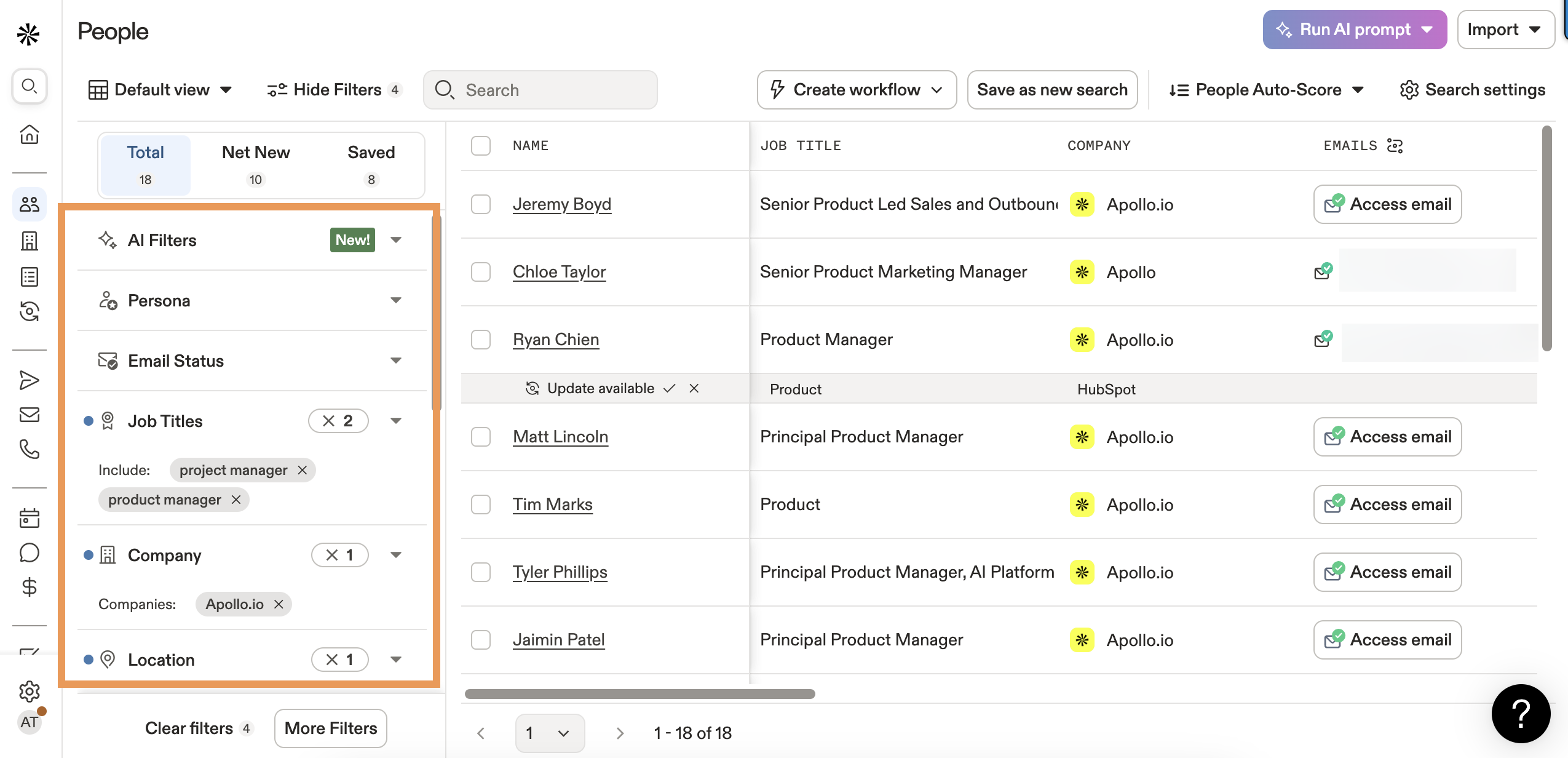
Apollo is the obvious starting point for teams that want everything in one platform. The database covers 275M+ contacts, the free tier is remarkably generous, and the built-in sequencing means you can find, enrich, and email without leaving the app.
The problem is data quality. Reddit threads consistently flag "data feels bad sometimes" and "lots of bounces on older contacts." We've seen similar patterns in our own testing - Apollo's database is massive, but older records create bounce problems if you don't verify externally.
The credit system is needlessly confusing. You get mobile credits for phone numbers, export credits for downloading contacts, and data credits for enrichment - all separate pools with different limits. On the Basic plan at $49/user/mo, you get 75 mobile credits per month, 1,000 export credits per month, and 5,000 data credits per year. Professional ($79/user/mo) and Organization ($119/user/mo, minimum 3 seats) scale those up.
Let's be honest: Apollo is still the best free-tier prospecting tool on the market. But if your deal sizes run above $5k and you're sending more than 200 cold emails a day, you need to run Apollo's output through a dedicated verifier. Treat it as a database, not a deliverability guarantee. (If you're building a stack, start with our email deliverability guide and email bounce rate benchmarks.)
Snov.io
Snov.io is the go-to for teams prospecting internationally. The credit pricing is approachable (starting around $30-$39/mo for 1,000 credits), and the platform bundles email finding with drip campaigns and a built-in verifier. Reddit users describe it as "good for international leads" with "affordable credits" - and that tracks with what we've seen.
Accuracy is the weak spot. Benchmark results range from 20% to 40% depending on the test methodology and input type. That's a wide spread, and it means you'll want to verify externally if you're sending at any real volume.
Use it if: you prospect across multiple countries and want finding + outreach in one affordable tool.
Skip it if: accuracy is your top priority. The benchmark numbers aren't competitive with Findymail or Anymail Finder.
RocketReach
RocketReach is absurdly expensive for what you get. Individual plans run $80-$300/user/month. The Essentials tier gives you 125 lookups for $80/mo - that's $0.64 per lookup before you even factor in accuracy. Extra lookups cost $0.30-$0.45 each.
For that price, you get no outreach features, no enrichment workflows, no intent data. Just lookups. Team plans are slightly better ($83-$207/user/mo billed annually), but you're still paying premium prices for a single-function tool. Reddit threads rarely recommend RocketReach for SMB use cases - the pricing is the consistent complaint.
The database is strong for executive-level contacts, and the data quality at the C-suite level is solid. But unless you're exclusively targeting senior leadership and budget isn't a concern, there are better options.
Use it if: you need C-suite contacts at large enterprises and your company is paying.
Skip it if: you're cost-conscious. Most teams should skip it.
Lusha
Lusha's Chrome extension is slick, and the tool works well for quick lookups when you're browsing professional profiles. Reddit users praise the extension's speed but consistently warn about the credit math: 1 credit per email, but 10 credits per phone number. That phone-number cost eats through credits fast.
The free tier offers 70 credits per month, and unused credits roll over up to 2x your limit. Paid plans land in the $30-$100/user/mo range depending on tier. The rollover mechanic is nice, but if you're pulling phone numbers regularly, you'll burn through even generous credit allotments in a week.
Use it if: you need phone numbers alongside emails and do most of your prospecting from professional profiles.
Skip it if: you need bulk email finding. Credits deplete too quickly at scale.
Kaspr
Kaspr's standout feature is unlimited B2B email credits on paid plans - a rarity in this category. The Starter plan at $49/user/mo includes unlimited email lookups plus 100 phone credits. Business ($79/user/mo) bumps that to unlimited B2B email credits, 200 phone credits/month, and 200 direct email credits/month. Phone credit add-ons run $0.21-$0.36 per credit, so budget accordingly if direct dials matter. Best for teams that prospect heavily from professional profiles and want email lookups without counting credits.
Anymail Finder
Most email finders charge you whether the result is good or not. Anymail Finder flips that: you only pay for fully verified results. No result, no charge. Credits roll over month to month.
In their own benchmark, they hit 77.5% - and they performed competitively in other vendors' tests too, which is more than most tools can say. Pricing starts at $19/mo for 50 searches, scaling to $39/mo for 1,000. The best option for budget-conscious teams who refuse to pay for bad data.
Findymail
Here's what makes Findymail stand out: consistency. It scored 75.1% in the Anymail Finder benchmark, performed similarly in the Tomba test, and showed up near the top of the Reddit bake-off at 75.2%. That kind of cross-benchmark consistency - across different vendors with different methodologies - is rare. Most tools swing 20+ points depending on who's running the test. Findymail barely moves. Pricing starts around $49/mo. The pick for users who prioritize verified accuracy over database size and don't need built-in sequencing.
ContactOut
ContactOut is the Reddit-recommended Apollo alternative for professional profile prospecting. Users describe the data as "solid" and "way more cost-effective than Apollo." The free tier gives you 5 credits per month, with paid plans starting at $36/user/mo. A strong choice for individual reps doing profile-based prospecting on a budget who don't need a full platform.
Cognism
Strong EU/UK data with real GDPR compliance and human-verified mobile numbers. Enterprise pricing typically runs $1,000-$3,000+/mo for small teams. Built for enterprise teams targeting European markets - overkill and overpriced for SMBs doing outbound email. But if you're selling into the UK or EU and compliance matters, Cognism is one of the most compliance-focused options in this category.
Tomba
Budget-friendly domain search tool that performs well in benchmarks (76-80% in its own tests, ~77% on Reddit). Quality varies by industry, and Reddit users describe it as "cheap and useful." Best for quick domain lookups when budget is tight - not a full prospecting platform, but a solid utility player in a waterfall stack.
How to Pick the Right Tool
Don't start with features. Start with your workflow.
High-volume cold email (500+ per day): Accuracy is everything. A single bad batch can torch your domain reputation for weeks. You need a tool with built-in verification and a fast data refresh cycle. Pair it with your sequencer of choice - Instantly, Lemlist, Smartlead - and stop worrying about bounces. (If you're scaling, also track email velocity and use email reputation tools.)
All-in-one platform seekers should start with Apollo. It gives you the most functionality per dollar. Just run your lists through a separate verifier before hitting send.
For international prospecting across Europe, LATAM, or APAC, Snov.io is worth testing. Its coverage and affordable credits handle multi-region campaigns well. Add Cognism if you're specifically targeting the UK/EU and have enterprise budget.
Budget-first teams should look at Anymail Finder's pay-for-verified-results model. You never waste money on bad data. Combine it with Hunter for verification and you've got a sub-$70/mo stack that punches above its weight.
When you need phone numbers, evaluate Lusha or Kaspr - but watch the credit math. Phone lookups cost 10x what email lookups cost on both platforms.
What's Changed Since 2025
Three shifts are reshaping this category, and they explain why recommendations from even a year ago no longer hold up.
Data freshness is now a buying criterion. Teams used to evaluate email finders on database size and match rate. Now they're asking how often records get refreshed. A database refreshed weekly delivers better results than one twice its size refreshed every 6 weeks. Stale data is the #1 cause of bounces, and buyers are finally wising up to it.
Intent data is entering the email finder category. Tools that used to just find emails now bundle buyer intent signals - topic tracking, job change alerts, funding signals. Expect more tools to follow this trend in the next 12 months.
Waterfall enrichment is the practitioner play. Smart teams aren't relying on a single tool anymore. They're running contacts through 2-3 finders in sequence, keeping the best result from each. Clay and Make have made this workflow accessible - a typical stack chains a high-coverage finder first for raw match rate, then a high-accuracy verifier second, then a final deliverability check. The "best" solution for many teams is actually three tools chained together, and the real question is which one you put first in the waterfall. (If you're building this out, start with data enrichment services and a clean lead generation workflow.)
FAQ
How accurate are email finder tools really?
The largest benchmark in our sources (20,000 contacts) found the best tool hit 54.9% "real enrichment rate" after removing bounces and wrong-domain matches. Most tools land between ~20% and ~55% on real enrichment. Claims of 95%+ accuracy typically measure validity of returned results only, excluding searches where no email was found.
Do I need a separate verification tool?
Finders with built-in multi-step verification deliver send-ready results out of the box. Others - especially Apollo and Hunter - benefit from a second-pass verifier. Standalone verifiers like ZeroBounce and NeverBounce run $8-$10 per 1,000 emails at 95-99% accuracy. If your bounce rate exceeds 2%, add a verification layer.
What's a good bounce rate for cold email?
Keep total bounces below 2% and hard bounces under 1%. Those are the thresholds where ESPs start throttling or flagging your domain. Above 3% consistently, expect deliverability problems within weeks.
How many email finders do I need?
One good finder and one good verifier covers most teams. For waterfall enrichment, 2-3 finders in sequence with a final verification pass is the ceiling - beyond that, you hit diminishing returns and added complexity without meaningful coverage gains.
What does "cost per verified email" mean?
It's the real cost of getting one usable, verified email address - factoring in accuracy, not just sticker price. A $49/mo tool with 75% accuracy is cheaper per valid email than a $150/mo tool with 35% accuracy. Always divide your monthly cost by the number of verified, sendable emails you actually receive.