

Best Email List Providers for B2B Prospecting in 2026
A RevOps lead we know ran a 3-tool bake-off last quarter. The "best" database - the one with the biggest logo and the fattest contract - produced a 19% bounce rate on the first outbound sequence. The cheapest tool in the test had better deliverability and half the cost per usable contact. Finding the best email list providers isn't about who has the biggest database. It's about who gives you contacts that actually convert without torching your domain.
At least [23% of an email list](https://www.prnewswire.com/news-releases/nearly-a-quarter-of-email-lists-decay-each-year-new-report-finds-302697945.html) degrades every year. That's nearly a quarter of your database going stale while you're running sequences against it. Poor data quality costs organizations [$12.9 million per year](https://www.gartner.com/en/data-analytics/topics/data-quality) on average in lost productivity, misallocated budgets, and missed pipeline. And here's the part most teams get wrong: your ESP accounts for roughly 30% of deliverability. List quality drives the rest.
Looking for email marketing platforms like Mailchimp or Brevo? That's a different category. This guide covers B2B contact data providers - the tools that give you the email addresses to put into your marketing or outbound platform.
So the real question isn't "which provider has the most contacts?" It's "which provider gives me contacts that actually convert?" Here are the providers worth your money - and the ones that aren't.
Our Picks (TL;DR)
| Pick | Provider | Why |
|---|---|---|
| Best for accuracy & value | Prospeo | 98% email accuracy, 7-day refresh, ~$0.01/lead, free tier |
| Best free tier to start | Apollo.io | 1,200 free credits/mo, 270M+ contacts, needs verification |
| Best for enterprise | ZoomInfo | Deepest dataset, intent + org charts, $15K+/yr minimum |
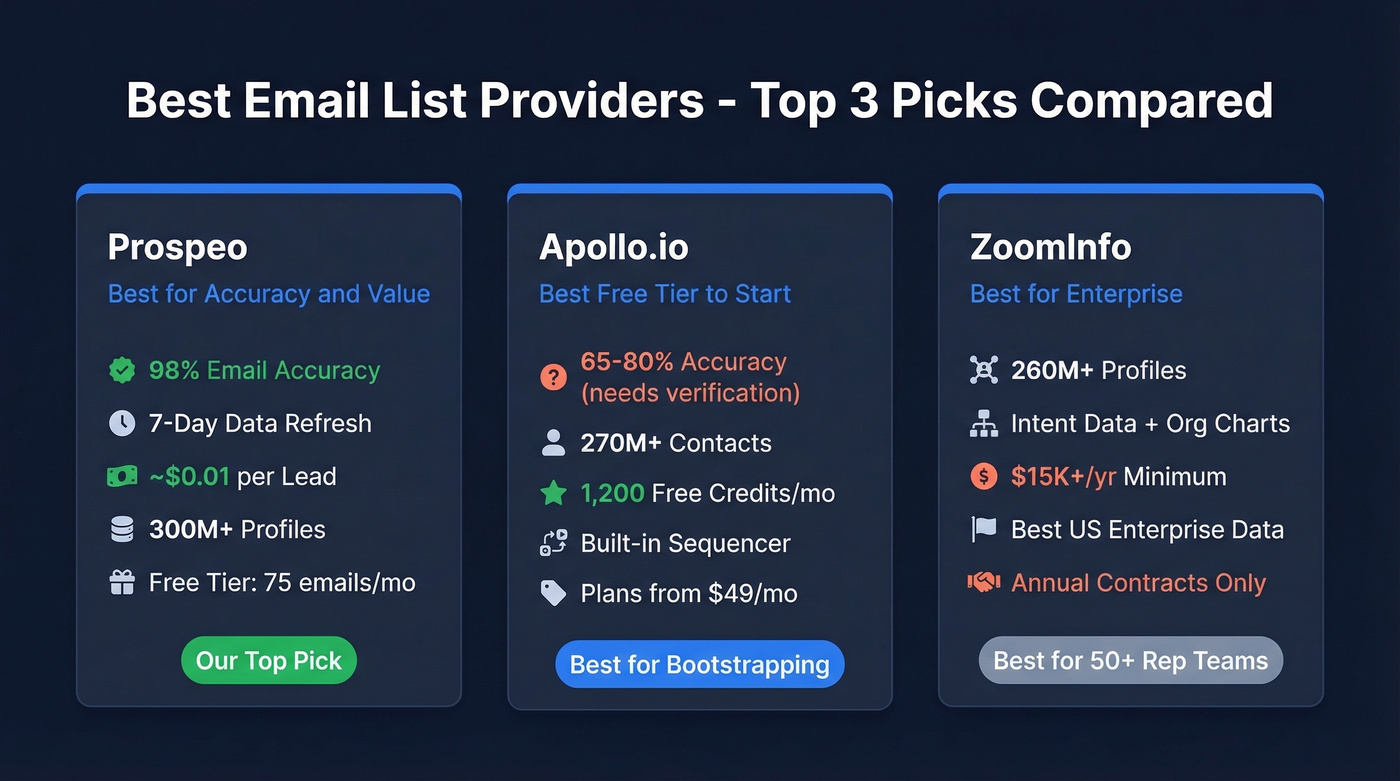
Prospeo wins on unit economics and data freshness - 98% verified emails at roughly a penny per lead, with a weekly refresh cycle that's 6x faster than the industry average. Teams using Prospeo book 26% more meetings than ZoomInfo users and 35% more than Apollo users. Apollo is the obvious entry point if you're bootstrapping and need volume. ZoomInfo is the 800-pound gorilla that makes sense once you've got 50+ reps and the budget to match.
Here's the thing: ZoomInfo is still the deepest all-in-one platform. But most teams don't need all-in-one - they need accurate data fed into the tools they already use. If your average deal size sits below $15k, you're almost certainly overpaying for ZoomInfo-level infrastructure.
Quick Picks by Use Case
- Best for startups on zero budget: Apollo.io (1,200 free credits/mo)
- Best for EMEA compliance: Cognism (13 DNC lists, human-verified mobiles)
- Best for one-time purchases: BookYourData (pay-as-you-go, no subscription)
- Best for enterprise GTM consolidation: ZoomInfo (intent, org charts, workflow automation)
How to Evaluate a Contact Data Provider
Database size is a vanity metric. A provider with 300 million profiles and 98% accuracy will outperform one with 600 million profiles and 70% accuracy every single time. Here's what actually matters.
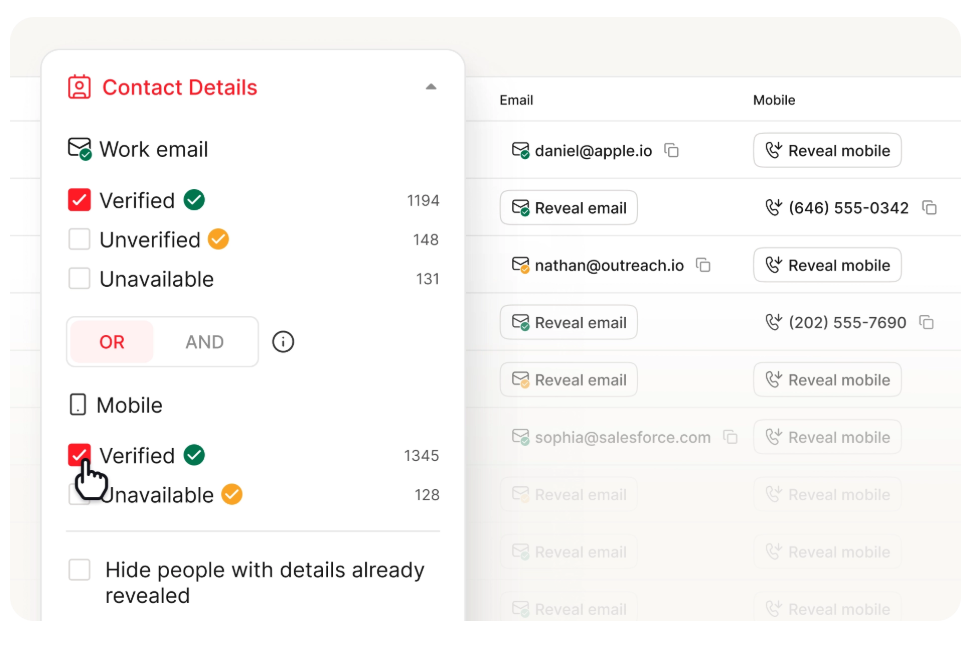
Accuracy methodology. Every provider claims 95%+ accuracy. Ask for their methodology, not their marketing number. Do they verify in real-time at export? Use human researchers? Run multi-step validation? The difference between "check MX records" and "we run 5-step verification with catch-all handling and spam-trap removal" is the difference between a 15% bounce rate and a 2% one.
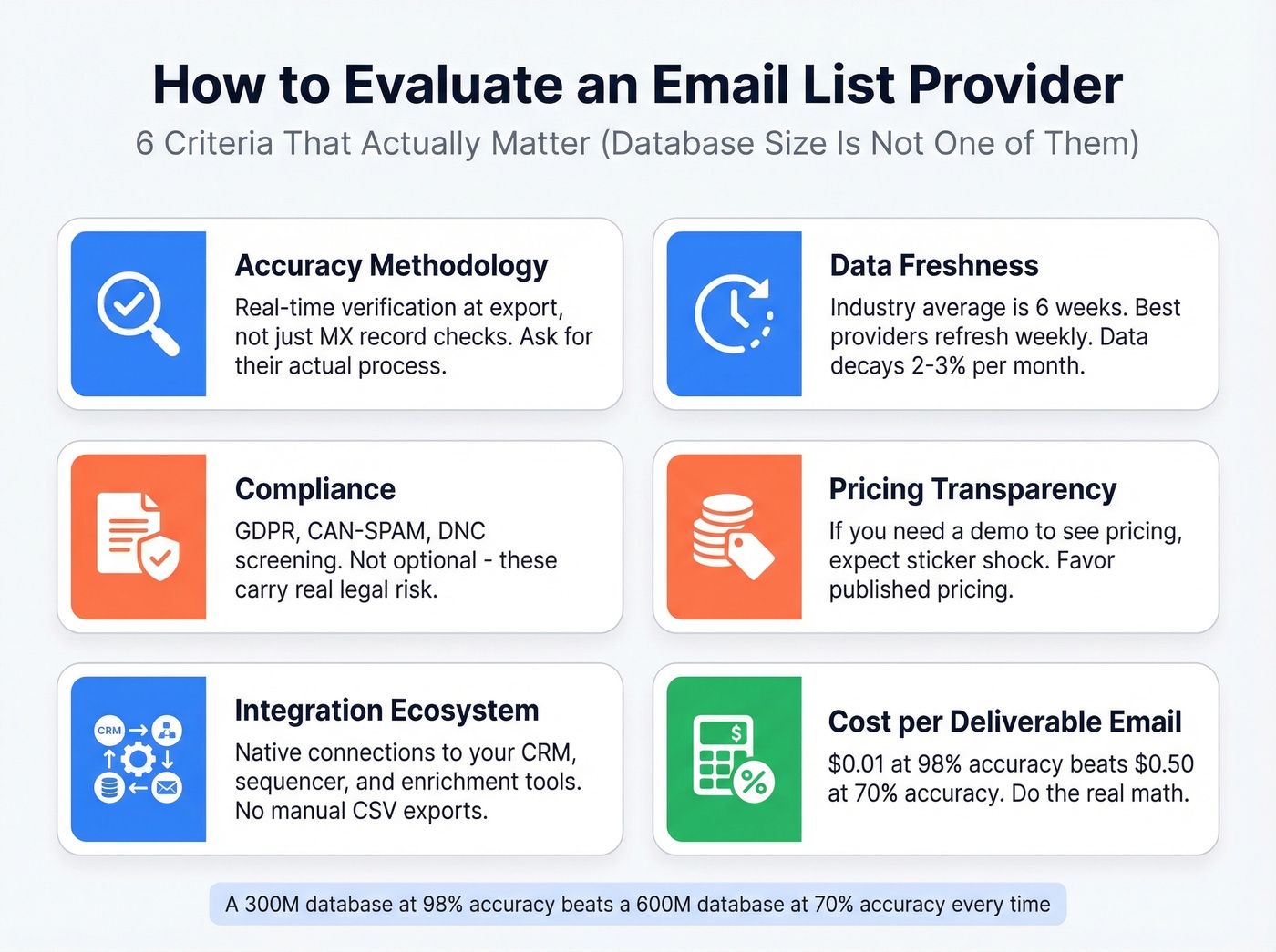
Data freshness. B2B contact data decays at [2-3% per month](https://www.hubspot.com/database-decay). A database refreshed every six weeks - the industry average - is already serving you stale records. That gap compounds fast when you're running weekly outbound campaigns.
Pricing model transparency. Credits, seats, platform fees, add-ons, annual commitments - every provider structures pricing differently, and the "talk to sales" model exists because the number would scare you if they published it. Favor providers that let you see pricing before you book a demo.
Compliance. GDPR, CAN-SPAM, DNC screening - these aren't optional checkboxes. If your provider doesn't enforce opt-outs or offer a DPA, you're carrying legal risk on every send. (For a deeper framework, see our guide to B2B compliance.)
Integration ecosystem. Your data provider needs to feed your sequencer, your CRM, and your enrichment workflows without manual CSV exports. Native integrations with Salesforce, HubSpot, Instantly, Lemlist, and Clay matter because they eliminate busywork that eats hours every week. If you're mapping your stack, start with a lean RevOps tech stack.
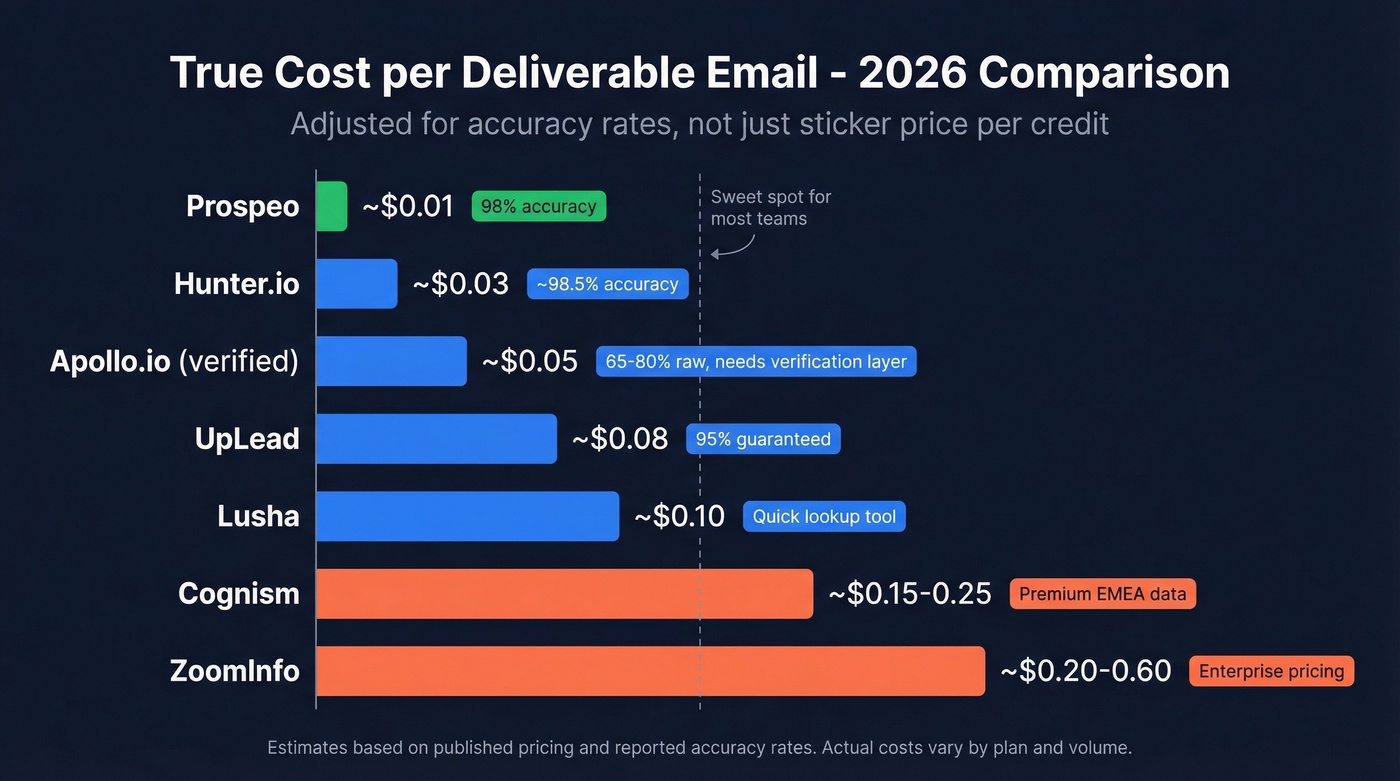
Credit economics. What does one usable, verified contact actually cost you? A provider charging $0.01 per lead with 98% accuracy is dramatically cheaper per deliverable email than one charging $0.50 per lead with 70% accuracy. Do the math on cost per deliverable email, not cost per credit.
Top B2B Email List Providers Compared
Prospeo
Prospeo's database covers 300M+ professional profiles, 143M+ verified emails, and 125M+ verified mobile numbers with a 30% pickup rate - all running on a 7-day refresh cycle that makes most competitors look glacial.
Use this if: You care about data quality over database size. The 98% email accuracy rate comes from a proprietary 5-step verification process with catch-all handling, spam-trap removal, and honeypot filtering. At ~$0.01 per lead, the unit economics are hard to beat - roughly 90% cheaper than ZoomInfo on a per-contact basis. The free tier gives you 75 verified emails and 100 Chrome extension credits per month, which is enough to run a real test before committing. If you want more options in this category, compare against other verified contact databases.

The 30+ search filters include buyer intent data powered by Bombora across 15,000 topics, technographics, job change signals, headcount growth, and funding data. Native integrations push directly into Salesforce, HubSpot, Smartlead, Instantly, Lemlist, and Clay. Real results tell the story: Snyk's 50-person AE team went from a 35-40% bounce rate to under 5%, with AE-sourced pipeline up 180%. GreyScout saw pipeline climb 140% after switching, with bounce rates dropping from 38% to under 4%. (If you’re building your outbound motion end-to-end, use this B2B prospecting strategies playbook.)
Apollo.io
Apollo is the best free tier in the market, and it's not particularly close. 1,200 credits per month, access to 270M+ contacts, and a built-in sequencer that lets you prospect and send from one platform.
Use this if: You're a startup or small team that needs to get outbound running this week without spending a dollar. The G2 rating of 4.8/5 across 9,344+ reviews reflects real product love, and the all-in-one approach - database, sequences, analytics - reduces tool sprawl.
Skip this if: You're sending at scale without a verification layer. Apollo's accuracy falls between roughly 65% and 80% without independent verification, and the consensus on r/coldemail is that Apollo's deliverability doesn't always match its database breadth. Credits don't roll over between billing cycles, and waterfall enrichment can make costs unpredictable. If you’re deciding between tools in this tier, see our roundup of the best B2B database options.
Paid plans run $49/mo (Basic), $79/mo (Professional), and $119/mo (Organization, minimum 3 seats) on annual billing. The free tier is genuinely useful - just budget for a separate verification step before you hit send.
ZoomInfo
ZoomInfo is the default enterprise data platform. 260M+ professional profiles, 100M+ company profiles, intent data, org charts, and workflow automation that can run your entire GTM motion from one contract.
Let's start with what you'll actually pay, because that number shapes everything else. Professional runs $15,000-$18,000/year. Advanced hits $22,000-$28,000/year. Elite goes $35,000-$45,000+/year. Annual contracts only, and renewals typically increase 10-20%. Additional users cost $2,500 each at list price, and the Global Data add-on is $9,995. Discounts of 30-65% are common if you negotiate hard, but the starting conversation is still five figures. Credit unit economics range from $0.20 to $0.60 per credit depending on volume.
Where it wins: You're a 50+ rep org that needs the deepest US dataset, intent signals, and the ability to consolidate multiple point solutions into one platform. The G2 footprint of 4.5/5 across 12,600+ reviews is massive, and the data depth for North American mid-market and enterprise accounts is unmatched.
Where it doesn't: Teams under 20 reps, or teams whose primary market is EMEA. We've talked to enough mid-market companies to say this confidently: most teams under 50 reps are overpaying by 3-5x for features they never activate.
Cognism
Cognism is the provider you pick when GDPR compliance isn't a nice-to-have - it's a requirement. Their human-verified mobile numbers and screening against 13 global DNC lists make them the safest choice for teams prospecting into Europe.
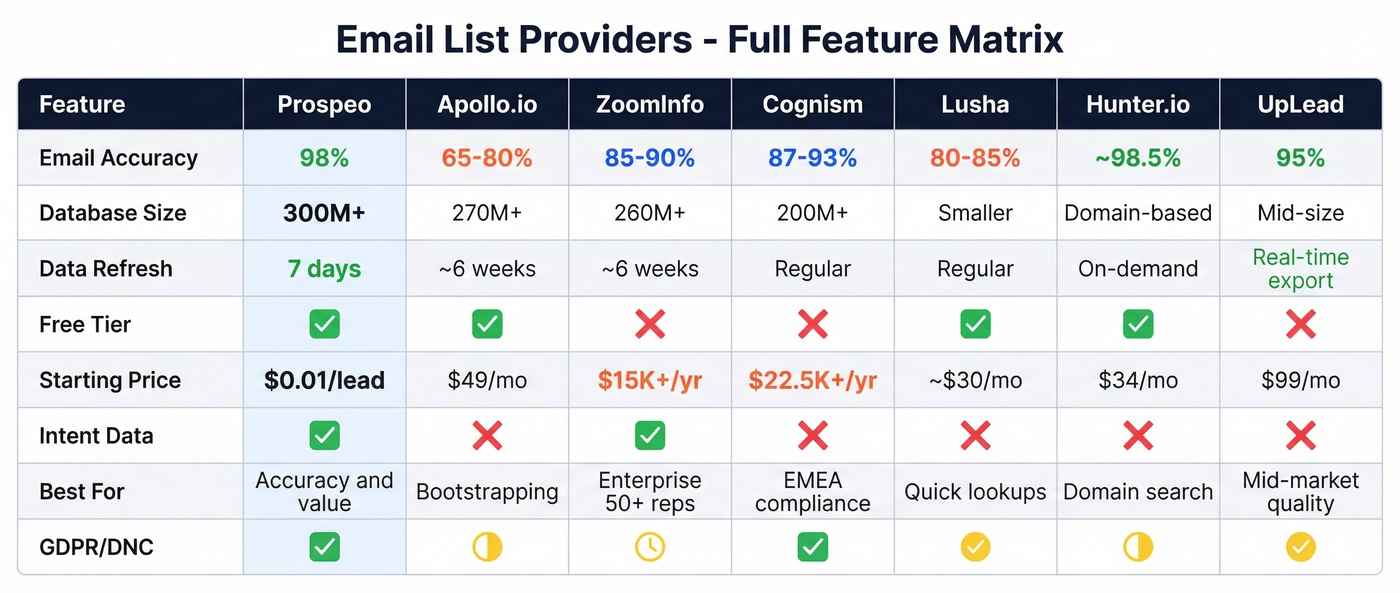
Where Cognism wins: Your ICP includes EMEA decision-makers and you can't afford compliance risk. The Diamond Data verified mobiles connect at higher rates than competitors' phone data in European markets. For EMEA data quality and DNC compliance, Cognism beats ZoomInfo.
Where it doesn't: US-only, price-sensitive teams. Cognism's Grow tier runs ~$22,500/year for 5 users. Elevate jumps to ~$37,500/year for the same headcount. Enterprise contracts range from $30,000 to $100,000+/year. Negotiated discounts of ~36% are documented, but this is still premium pricing for a regional strength.
Lusha
Lusha works best as a quick-lookup tool rather than a full prospecting engine. The Chrome extension is fast and clean, the freemium plan gets you started immediately, and paid plans typically run ~$30-$60/user/month. The UI has the shortest learning curve of any tool on this list.
The tradeoff is a smaller database than the Tier 1 tools - you're getting simplicity and speed at the expense of depth and volume. For targeted account research where you need a handful of contacts fast, Lusha delivers. For building 10,000-contact lists, look elsewhere.
Hunter.io
Hunter is the best domain-based email finder on the market. Paste a company domain, get every email pattern and verified address associated with it. Free tier available, paid plans start at $34/month. A Clay benchmark test showed ~98.5% data quality scores for Hunter's verification engine, which is impressive for a lightweight tool.
The limitation is scope: Hunter isn't a full B2B database. You can't filter by job title, company size, or intent signals the way you can with Apollo or ZoomInfo. It's a domain-search tool - perfect for targeted research, not for building large prospecting lists. If you’re comparing similar tools, here are the top Hunter alternatives.
UpLead
95% accuracy guarantee with real-time verification at the moment of export - meaning you don't pay credits for bad emails. Plans start around $99/month, the interface is clean, and it's a solid mid-market option for teams that prioritize quality over volume. Credit allocation is tight at the entry tier, and the database is smaller than Apollo or ZoomInfo, so coverage for niche industries or international markets can be spotty.
SalesIntel
95% accuracy guarantee backed by human verification - actual researchers checking contact data, not just algorithmic validation. The research-on-demand feature lets you request contacts that aren't in the database yet, which is genuinely useful for high-value accounts where you need verified data and can't find it elsewhere. Custom pricing typically falls between $5,000-$15,000/year for small teams. The human verification process means data isn't always available in real-time, and the database is smaller than ZoomInfo's - but cleaner for the contacts it does cover.
Lead411
Budget-friendly at $49/month for 1,000 exports with a freemium tier available. Solid option for early-stage teams that want straightforward exports without enterprise pricing. Database depth doesn't match the Tier 1 providers and the UI feels dated, but it's good enough for early-stage teams. You'll likely outgrow it as your outbound operation scales.
BookYourData
True pay-as-you-go pricing - ~$99 for 250 contacts with a 97% accuracy guarantee. Free 10-credit pack to test. Best option for one-time or small-batch purchases where you don't want a subscription. No sequencing, no intent data, no CRM integrations worth mentioning. Think of it as a vending machine for contacts - useful when you need a specific list, not when you need a platform. For more options in this pricing model, see pay-as-you-go B2B data.
Kaspr
European-focused Chrome extension tool with a freemium tier and paid plans from ~EUR 45/month per user. Good for quick lookups on professional profiles, but the database skews heavily toward EMEA - US coverage is limited compared to Apollo or other global providers.
Seamless.AI
Real-time search engine model that finds contact data on demand rather than pulling from a static database. Free tier available, paid plans typically run $125-$200/month. Accuracy reviews are mixed - we've seen teams report bounce rates north of 15% without a verification layer. Best for high-volume prospecting if you're pairing it with a dedicated verifier like ZeroBounce or Million Verifier.
LeadsPlease & Data Axle USA
Worth a mention for teams buying consumer or SMB lists rather than enterprise B2B data. LeadsPlease offers pre-built lists at $299.75 for 1,000 consumer records. Data Axle USA provides broader business and consumer data with custom pricing typically starting around $500-$1,000 for small batches. Neither competes with the B2B platforms above for prospecting into mid-market or enterprise accounts, but they fill a niche for local business outreach and consumer marketing.

You just read that 23% of email lists decay every year and most providers refresh every 6 weeks. Prospeo refreshes every 7 days - 6x faster - with 98% email accuracy from a proprietary 5-step verification process.
Get 75 free verified emails and see the accuracy difference yourself.
Pricing Breakdown: What You'll Actually Pay
Let's be direct about what these tools cost. The providers that hide pricing behind "talk to sales" do it because the number would make you flinch.
| Provider | Starting Price | Model | Free Tier | Contract |
|---|---|---|---|---|
| Prospeo | ~$39/mo | Credits (~$0.01/lead) | Yes (75 emails/mo) | None |
| Apollo.io | $49/user/mo | Seats + credits | Yes (1,200 credits/mo) | Annual for best rate |
| ZoomInfo | ~$15K/yr | Platform + seats | No | Annual only |
| Cognism | ~$22.5K/yr (5 users) | Platform + per-user | No | Annual |
| Lusha | ~$30/user/mo | Seats + credits | Yes | Monthly available |
| Hunter.io | $34/mo | Credits | Yes | Monthly available |
| UpLead | ~$99/mo | Credits | No | Monthly available |
| SalesIntel | ~$5K-$15K/yr | Custom | No | Annual typical |
| Lead411 | $49/mo | Credits (1,000/mo) | Yes | Monthly available |
| BookYourData | ~$99/250 contacts | Pay-as-you-go | Yes (10 credits) | None |
| Kaspr | ~EUR 45/user/mo | Seats + credits | Yes | Monthly available |
| Seamless.AI | ~$125-$200/mo | Seats + credits | Yes | Annual typical |
The credit economics tell the real story. At ~$0.01 per lead versus ZoomInfo's $0.20-$0.60 per credit, a 10,000-contact list costs roughly $100 with a credit-based provider and $2,000-$6,000 with ZoomInfo. Even accounting for ZoomInfo's broader feature set, that's a hard gap to justify for teams that primarily need accurate contact data.
Accuracy and Freshness Compared
Every provider's marketing page says "95%+ accuracy." The reality is messier. ZeroBounce reports that only 62% of emails submitted for verification were actually valid across 11+ billion email addresses processed. That's the state of list hygiene across the industry. For a full breakdown of tools and benchmarks, see our guide to the best email verifier.
| Provider | Accuracy | Verification Method | Refresh Cycle |
|---|---|---|---|
| Prospeo | 98% | 5-step proprietary + catch-all | 7 days |
| Apollo.io | ~65-80% est. | Algorithmic | Not published |
| ZoomInfo | ~85-90% est. | Multi-source | ~4-6 weeks |
| Cognism | ~90-95% est. | Human + DNC screening | ~4 weeks |
| SalesIntel | 95% guaranteed | Human verification | 90 days |
| UpLead | 95% guaranteed | Real-time at export | Continuous |
| Hunter.io | ~98.5% (verification) | MX + SMTP check | N/A (finder tool) |

The refresh cycle matters more than most teams realize. At 2-3% monthly decay, a database refreshed every 6 weeks is already serving you contacts who've changed jobs, left companies, or deactivated email addresses. A 7-day refresh cycle cuts that exposure dramatically.
Don't trust any provider's accuracy number without testing it yourself. Export 500 contacts, run them through an independent verifier like ZeroBounce, and measure the actual valid rate. That 30-minute test will tell you more than any marketing page. We've run side-by-side exports from Apollo and ZoomInfo against smaller providers - the gap between claimed and actual accuracy is real, and it's often 10-15 percentage points.
How Practitioners Actually Build Lists
The consensus on r/coldemail is clear: verification isn't optional at scale. One practitioner put it bluntly - 2% bounce on 10,000 contacts equals 200 hard bounces, and that's enough to damage your sender reputation.
Most experienced outbound teams run a four-layer stack:
- Data provider - Pull your initial list from a database based on ICP filters like title, industry, headcount, and intent signals.
- Enrichment - Run contacts through Clay or a similar tool to fill gaps in firmographic and technographic data. (Here are the best data enrichment tools if you’re comparing.)
- Verification - Push the enriched list through a dedicated verifier like ZeroBounce or Million Verifier to catch invalid, catch-all, and risky addresses before they hit your sequencer.
- Sending - Load verified contacts into your sending platform - Instantly, Smartlead, or Lemlist - with proper domain warmup and rotation. If you’re scaling sequences, use an outbound email automation tool checklist.
Some providers collapse this stack. When your data provider builds 5-step verification into the export step, you eliminate the need for a separate verification tool and save both time and money. For teams running lean, that consolidation matters. In our testing, pre-verified exports caught catch-all addresses that standalone verifiers missed, which kept bounce rates under 2% consistently.
Cost per deliverable email is the only metric that matters. At ~$0.01 per lead with 98% accuracy, Prospeo delivers more usable contacts per dollar than providers charging 10-50x more with bounce rates above 15%.
Snyk cut bounce rates from 35% to under 5%. Your turn.
Compliance Checks Before You Buy
Buying raw email lists carries real risk - deliverability damage, ESP suspension, and compliance violations that can result in actual fines. Before you commit to any provider, verify these five things:
GDPR opt-out enforcement. If you're emailing anyone in the EU, your provider must honor opt-out requests and provide Data Processing Agreements. Ask for their DPA before you sign.
CAN-SPAM requirements. Every commercial email needs a physical address, clear sender identification, and a working unsubscribe mechanism. Your provider's data doesn't exempt you from these requirements.
DNC list screening. Cognism screens against 13 global Do-Not-Call lists - that's the gold standard. Ask your provider how many DNC lists they check, and whether screening happens before or after export.
ESP terms of service. Most mainstream ESPs restrict imported third-party lists. If you're using a cold email tool like Instantly or Smartlead, you have more flexibility - but verify your platform's policies before uploading.
Deliverability risk of unverified data. Even "verified" data from a provider should be independently checked before large sends. A single campaign with a 5%+ bounce rate can tank your domain reputation fast. (If you’re troubleshooting, start with an email reputation check.)
FAQ
Is buying email lists legal?
Yes, in most B2B contexts. GDPR requires legitimate interest or consent for EU contacts, while CAN-SPAM governs US commercial email with opt-out requirements. Use providers that enforce opt-outs globally and offer DPA documentation. The real risk isn't legality - it's deliverability damage from low-quality purchased data.
What bounce rate is acceptable for cold outreach?
Keep it under 2%. Above that threshold, your domain reputation takes measurable damage - 200 hard bounces on a 10,000-contact campaign is enough for inbox providers to flag you. Verify every list before sending, regardless of what your provider guarantees.
Do I need a separate verification tool?
It depends on your provider's built-in verification. Providers with 5-step verification at export eliminate the extra step entirely. If your provider doesn't verify in real-time, always run contacts through ZeroBounce or Million Verifier first - a few dollars per 1,000 checks is cheap insurance against domain damage.
How often should I refresh my contact data?
At minimum quarterly, but monthly is better. B2B contact data decays at 2-3% per month, meaning roughly a quarter of your list goes stale annually. Providers with weekly refresh cycles reduce this burden dramatically compared to the 6-week industry average.
What's the difference between an email list provider and an ESP?
An email list provider gives you contact data - who to email. An ESP like Mailchimp, Brevo, or SendGrid is the tool you use to send. Your ESP accounts for roughly 30% of deliverability; list quality, sender reputation, and authentication setup drive the other 70%.
Choosing the Right Provider in 2026
The market has consolidated around a few clear winners. The best email list providers in 2026 aren't the ones with the largest databases - they're the ones delivering contacts that actually reach inboxes and generate pipeline. Prospeo leads on accuracy and unit economics, Apollo.io remains the strongest free-tier option for startups, and ZoomInfo holds the enterprise crown for teams with the budget to match.
The biggest shift this year is that data freshness and verification quality now matter more than raw contact counts - teams are choosing providers that refresh weekly over those that simply claim the largest numbers. Test before you commit, verify before you send, and optimize for cost per deliverable email rather than cost per credit.