

Best Practices of a Chief Revenue Officer: The Playbook That Keeps You Past Month 25
The average CRO lasts 25 months. That's often less than two full sales cycles. A Pave dataset covering 14,000 executives puts it even shorter - 1.8 years, with roughly 32% annual turnover. CEOs last 4.3 years. CTOs get 3.7. CFOs, 2.9. The CRO seat is the ejector seat of the C-suite.
Replacing one isn't cheap, either. CROs typically earn around $200K in salary plus another $200K in bonuses, and a typical replacement scenario includes about six months of severance and three months of search time. Understanding the best practices of a chief revenue officer is the difference between surviving year three and updating your resume.
So what separates the CROs who stick around? It comes down to operating cadence, data discipline, and expectation management - the boring stuff that doesn't make conference keynotes but determines whether you're still employed when your equity vests.
The quick version:
- Your first 90 days determine your tenure - master the ICP, align with the CEO, upgrade the team.
- Run a weekly CRO/CFO/RevOps sync with a shared scorecard. Single highest-leverage cadence you can build.
- Your forecast is only as good as your data - if your CRM hasn't been cleaned this quarter, fix that before anything else.
Why CROs Actually Get Fired
Most CROs don't get fired for missing a quarter. They get fired for surprises. 91% of companies miss annual targets - if missing targets alone were fatal, nobody would survive.
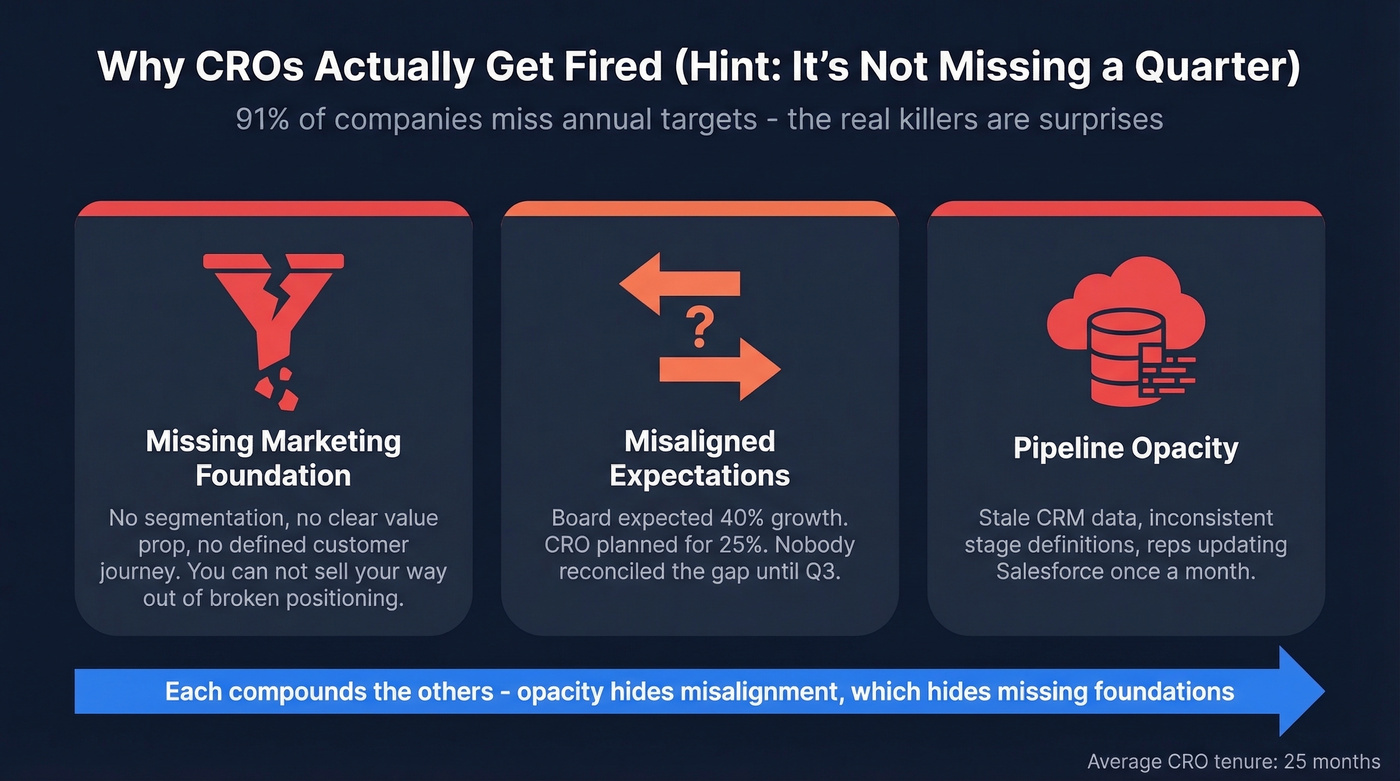
We've talked to enough revenue leaders to see the same pattern: the forecast miss that kills you is the one the board didn't see coming. The real failure modes cluster into three areas.
Missing marketing foundation. Craig Group's research finds CROs often exit before 18 months because there's no strategic marketing infrastructure - no segmentation, no clear value prop, no defined customer journey. You can't sell your way out of broken positioning, no matter how talented your reps are.
Misaligned expectations. The board expected 40% growth. The CRO planned for 25%. Nobody reconciled the gap until Q3. This kills more tenures than actual performance does.
Pipeline opacity. Stale CRM data, inconsistent stage definitions, reps who update Salesforce once a month. When the forecast is built on garbage, every board meeting becomes a credibility crisis. A related pattern compounds all three: over-indexing on short-term new logo acquisition while ignoring enablement infrastructure and retention foundations.
The First 90 Days That Define Your Tenure
SaaStr synthesized patterns from 18 elite CROs who collectively built $100B+ in enterprise value. The playbook is remarkably consistent - and the top advice from every one of them starts with listening before acting.
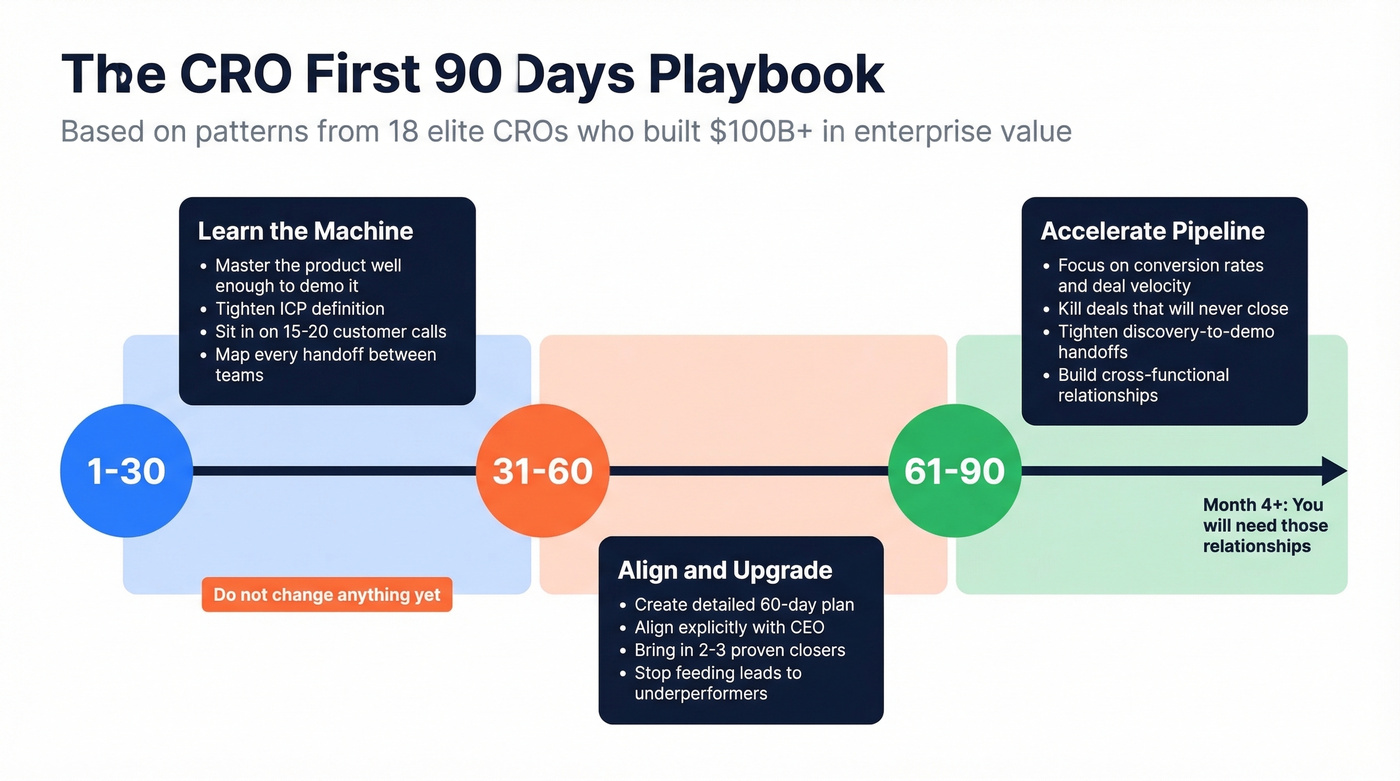
Days 1-30: Learn the machine. Master the product well enough to demo it. Tighten the ICP definition. Sit in on 15-20 customer calls. Map every handoff between marketing, sales, and CS. Don't change anything yet - just understand where the friction lives.
Days 31-60: Align and upgrade. Create a detailed 60-day plan and align it explicitly with the CEO. Misalignment here is one of the most common reasons new revenue leaders fail, and it's almost always avoidable if you force the conversation early. Bring in 2-3 proven closers you trust. Stop feeding leads to chronic underperformers - uncomfortable but non-negotiable.
Days 61-90: Accelerate existing pipeline. Don't obsess over building new pipeline yet. Focus on conversion rates and deal velocity for what's already in the funnel. Kill deals that are never going to close, tighten discovery-to-demo handoffs, and build cross-functional relationships with marketing, product, and CS leaders. You'll need those relationships by month four.
The Operating Cadence
The Growth Trifecta sync. Salesloft's playbook recommends a weekly CRO + CFO + RevOps sync built around one shared scorecard. One team, one set of numbers, one decision log. In our experience, this single cadence transforms forecast accuracy more than any tool or process change. Companies with an aligned end-to-end revenue engine grow nearly 20% faster and are 15% more profitable.
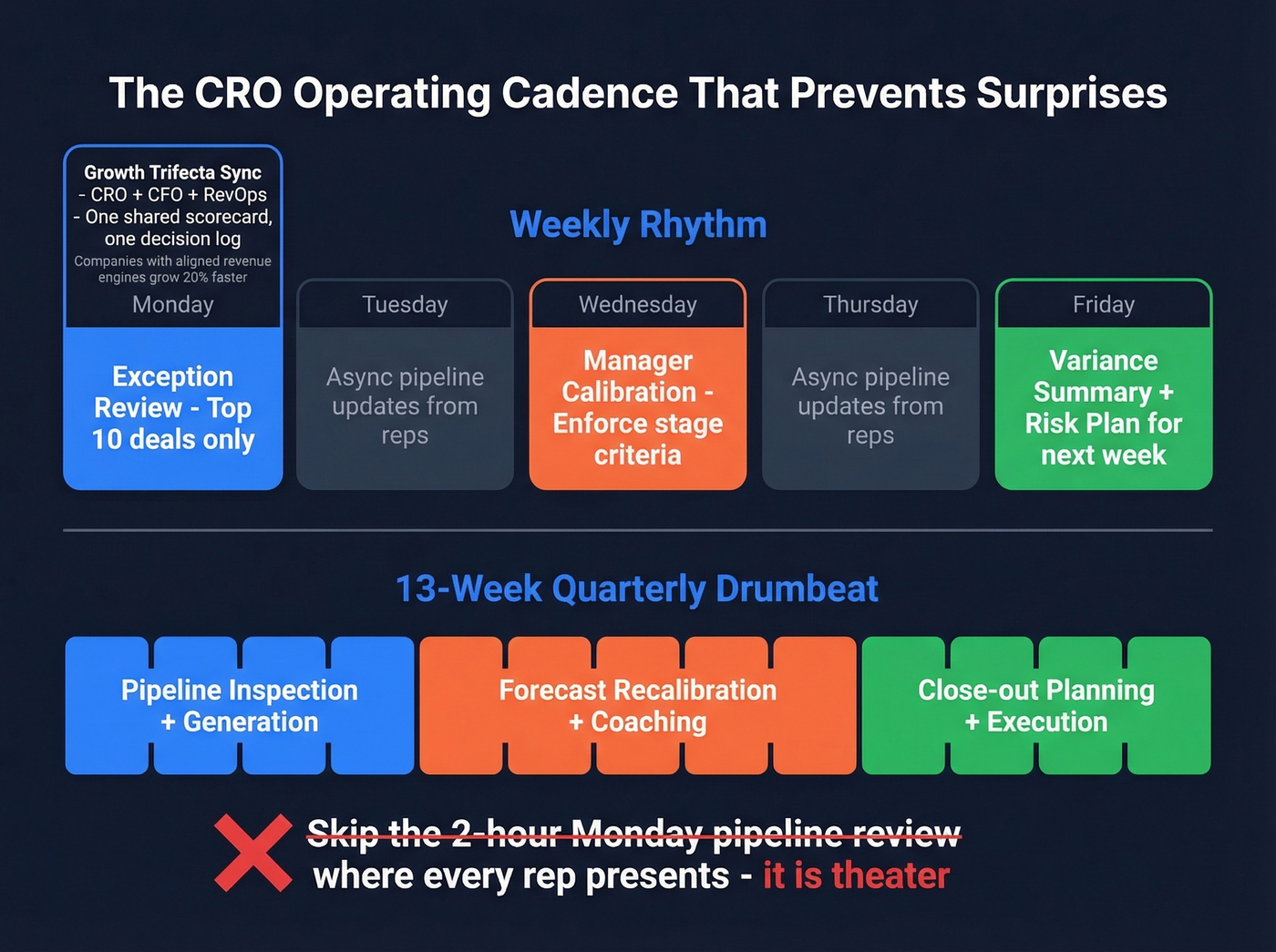
The Mon/Wed/Fri governance rhythm. Monday: exception review on your top opportunities. Wednesday: manager calibration sessions to enforce consistent stage criteria. Friday: variance summary with a risk plan for the following week. This cadence, adapted from AskElephant's framework, keeps surprises from compounding into crises.
The 13-week quarterly drumbeat. Structure each quarter around a 13-week operating cadence with clear milestones and recurring checkpoints for pipeline inspection, forecast recalibration, and close-out planning. This prevents the hockey stick Q4 panic that destroys forecast credibility with the board.
Here's the thing: skip the two-hour Monday pipeline review where every rep presents. It's theater. Replace it with async pipeline updates and use sync time for exception-based coaching on the 5-10 deals that actually matter.
2026 KPIs and Benchmarks
Benchmarkit's data gives us a clear picture of what "good" looks like right now:
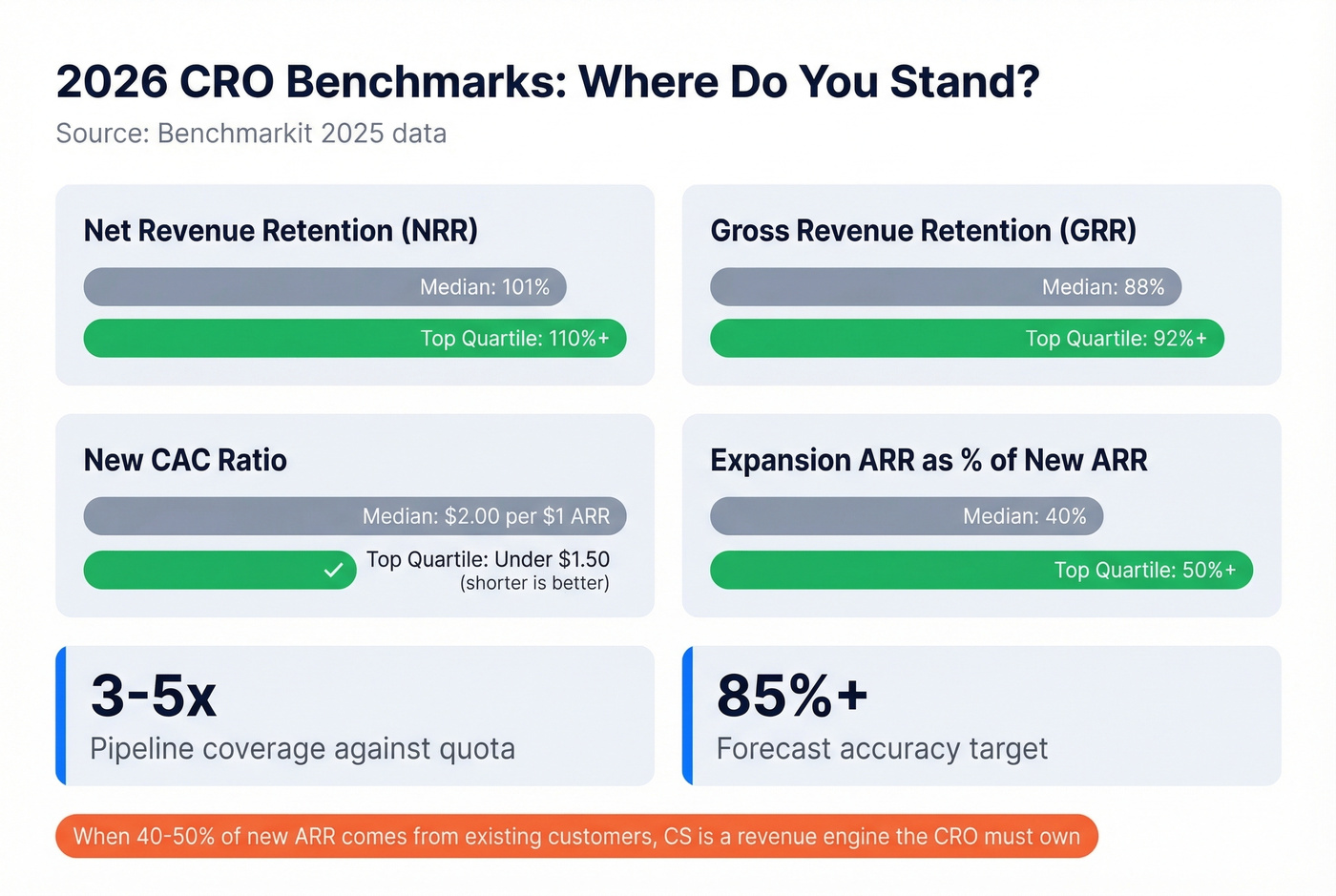
| Metric | Median | Top Quartile |
|---|---|---|
| NRR | 101% | 110%+ |
| GRR | 88% | 92%+ |
| New CAC Ratio | $2.00 per $1 ARR | Under $1.50 |
| Expansion ARR % | 40% of new ARR | 50%+ |
That expansion ARR number deserves attention. When 40-50% of new ARR comes from existing customers, Customer Success isn't a support function - it's a revenue engine the CRO must own. The best revenue leaders treat CS-qualified leads, premium success tiers, and account health scores as pipeline metrics, not afterthoughts.
For stage-specific targets, CathCap's framework is practical. At $1M-$10M ARR, aim for 110-120% NRR and 3:1+ LTV:CAC. At $10M+, the Rule of 40 and a Magic Number of 1.0 or higher become the board's primary lenses. S&M spend as a percentage of revenue runs around 47% for VC-backed companies and 33% for PE-backed ones.
Two operating heuristics that don't show up in benchmark reports: maintain 3-5x pipeline coverage against quota, and hold forecast accuracy at 85% or better. If you're consistently below either threshold, your cadence or your data has a problem.

Stale CRM data is the #1 reason CRO forecasts blow up in board meetings. Prospeo enriches your pipeline with 50+ data points per contact at a 92% match rate - refreshed every 7 days, not every 6 weeks. When your forecast accuracy needs to hit 85%+, your data can't be the weak link.
Stop building forecasts on garbage data. Start with 98% accuracy.
Board Communication That Builds Trust
Boards don't fire CROs for bad quarters. They fire CROs for surprises.
Let's be honest about what the CRO role really is: it's an internal sales job. You're selling the board on your model, selling product on your roadmap priorities, selling CS on your expansion targets. The CROs who treat board meetings as quota calls - with the same rigor around objection handling and proof points - outlast everyone else. Frame every board slide around the question "what changed and why" rather than a static dashboard.
Run a weekly flash report structured as four columns: plan vs. assigned quota vs. forecast vs. actuals. This format forces you to surface gaps early. When the board sees you flagging a miss in week 6 instead of week 12, trust compounds over time in a way that no single great quarter can replicate.
Model your sales machine month-by-month. Show ramp times, expected turnover, onboarding timelines. Assign roughly 20% extra quota above target to account for rep attrition and uneven attainment - requiring 100% of reps to hit 100% is a fantasy that erodes credibility when it inevitably doesn't happen.
Building Your Personal Playbook
Every operating cadence and benchmark above is generic until you adapt it to your specific company, stage, and market.
The CROs who last build a personal playbook - a living document that codifies their decision frameworks, hiring rubrics, forecast methodology, and escalation triggers. This isn't a strategy deck for the board. It's your private operating system that travels with you from role to role, and it compounds in value every time you update it after a win or a miss.
Start by documenting the three to five principles that have worked across your career: the specific discovery questions that unlock enterprise deals, the leading indicators you watch before anyone else notices a pipeline problem, the exact week in the quarter when you shift from pipeline generation to deal acceleration. I've seen CROs who can point to a single page in their playbook that saved an entire quarter - because they'd already solved that exact problem two companies ago.
AI as a Revenue Lever in 2026
Interviews with 30+ CROs in a 2026 insights report break AI adoption into three practical tiers:
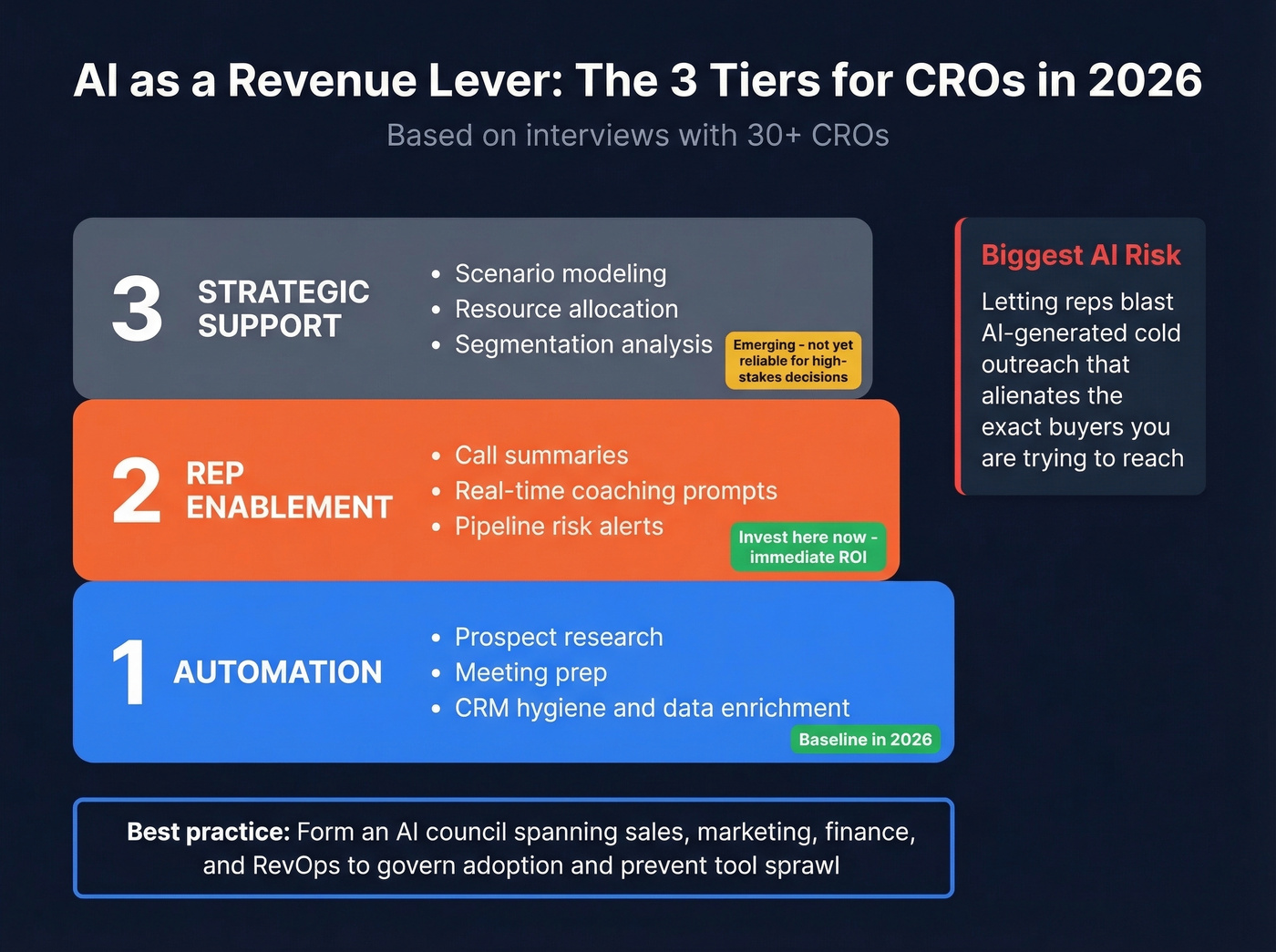
Tier 1 - Automation
Prospect research, meeting prep, CRM hygiene. This is baseline in 2026. If your reps are still manually researching accounts, you're burning hours that AI handles in seconds.
Tier 2 - Rep Enablement
Call summaries, real-time coaching prompts, pipeline risk alerts. This is where most teams should invest right now. The ROI is immediate and measurable.
Tier 3 - Strategic Support
Scenario modeling, resource allocation, segmentation analysis. Emerging but not yet reliable enough to replace human judgment on high-stakes decisions.
Clari recommends forming an AI council - a cross-functional group spanning sales, marketing, finance, and RevOps - to govern adoption and prevent tool sprawl. Real talk: the biggest AI risk for CROs isn't falling behind on adoption. It's letting reps blast AI-generated cold outreach that alienates the exact buyers you're trying to reach.
Pipeline Data Quality
Every cadence, KPI, and board report described above collapses if the underlying data is wrong. Stale contacts destroy forecast accuracy. Bounced emails waste rep hours and tank domain reputation. Dead phone numbers turn pipeline coverage ratios into fiction.
This is where most CROs underinvest. You can build the perfect operating cadence, but if 20% of your pipeline contacts have outdated emails or wrong phone numbers, your forecast is built on sand. We've seen teams with beautiful dashboards and disciplined cadences still miss forecasts because their contact data was six months stale - and nobody caught it until the bounce rates spiked.
Tools like Prospeo help close this gap with 300M+ professional profiles on a 7-day refresh cycle, 98% email accuracy, and native Salesforce and HubSpot integrations that clean your CRM automatically. At roughly $0.01 per email, it's a fraction of what bad data costs in wasted rep time and blown forecasts.
If you're evaluating vendors, start with a shortlist of data enrichment services and compare them against your CRM workflow.
Maintaining 3-5x pipeline coverage means your reps need verified contact data that actually connects. Prospeo delivers 98% email accuracy and a 30% mobile pickup rate across 300M+ profiles - so your team books meetings instead of bouncing emails. At $0.01 per email, it costs less than one missed opportunity.
Give your reps the data that gets 26% more meetings booked.
FAQ
What are the most important best practices of a chief revenue officer?
Align with the CEO in the first 60 days, run a weekly CRO/CFO/RevOps sync with a shared scorecard, maintain 3-5x pipeline coverage, hold forecast accuracy at 85% or better, and own expansion revenue through Customer Success - not just new logos.
What's the average CRO tenure?
25 months per HBR, among the shortest C-suite tenures. Pave's dataset of 14,000 executives puts it at 1.8 years with roughly 32% annual turnover - about double the churn rate of CFOs and CTOs.
What KPIs should a CRO track in 2026?
Net revenue retention (101% median, 110%+ top quartile), gross retention (88% median), pipeline coverage (3-5x), forecast accuracy (85%+), CAC ratio (under $2.00 per $1 new ARR), and expansion ARR as a percentage of total new ARR (40%+).
How do CROs keep pipeline data accurate at scale?
Use a data platform with automated CRM enrichment and short refresh cycles. Prospeo, for example, refreshes 300M+ profiles every 7 days and returns 50+ data points per contact at a 92% match rate - eliminating the stale records that silently erode forecast credibility.