

How to Write the Best Sales Introduction Email in 2026
You sent 200 emails last week and got 3 replies. Two were "please remove me from your list."
Decision-makers receive roughly 15 cold emails per week, and 71% get ignored because they lack relevance. The problem isn't email as a channel - it's how most sales introduction emails are written. We've tested thousands of openers across different industries, and the gap between a mediocre intro and a great one isn't talent or luck. It's structure.
The Short Version
- Lead with a timeline or numbers hook. Timeline hooks pull a 10.01% reply rate vs. 4.39% for generic problem hooks - 2.3x more replies from the same list.
- Keep it under 125 words with a soft CTA. Don't ask for a meeting in email #1.
- Send in small batches. Cohorts of 50 or fewer contacts outperform broad blasts by 2.76x on reply rate.
- Verify your list before sending. Bounce rates above 2% damage your domain reputation and crush future deliverability.
Warm Intros vs. Cold Outreach
If you have a mutual connection, use them. Warm introductions convert at 4x the rate of cold outreach. Ask your connector to send a two-line email introducing you, with one sentence on why the prospect should care.
This guide covers the cold path - when you need to earn attention from scratch. If you’re building a repeatable outbound motion, pair this with sales prospecting techniques that keep your targeting tight.
Why Most Intro Emails Fail
The biggest killer is self-centeredness. Scroll through your inbox and count how many cold emails open with "I" instead of "you." The sender talks about their product, their features, their awards - and the prospect checks out by sentence two. The r/sales community flags this constantly: emails that read like a resume get archived unread.
Then there's the CSM-style intro email that still circulates as a template. Subject line "New CSM," body that opens with a meeting request, drops a generic agenda, and buries personalization at the bottom. It checks every wrong box: high-friction CTA from a stranger, no value proposition, and the one relevant detail arrives after the reader has already stopped reading.
The other silent killer? No CTA at all. The reader finishes your email and thinks "so what?" And claiming "industry-leading" without a single proof point is the fastest way to sound like every other email in their trash folder. If you want a tighter system for writing these, use a proven email copywriting framework.

You just learned that bounce rates above 2% crush deliverability. Prospeo's 5-step email verification delivers 98% accuracy - so your carefully crafted intro emails actually reach the inbox. At $0.01 per email with a 7-day data refresh cycle, you're never sending to stale addresses.
Stop perfecting copy that bounces. Start with verified data.
The High-Reply Framework
Here's the thing most guides skip: the hook type you choose matters more than almost any other variable. We've seen this play out across thousands of sends. If you’re mapping this into a repeatable sequence, start with a solid B2B cold email sequence.
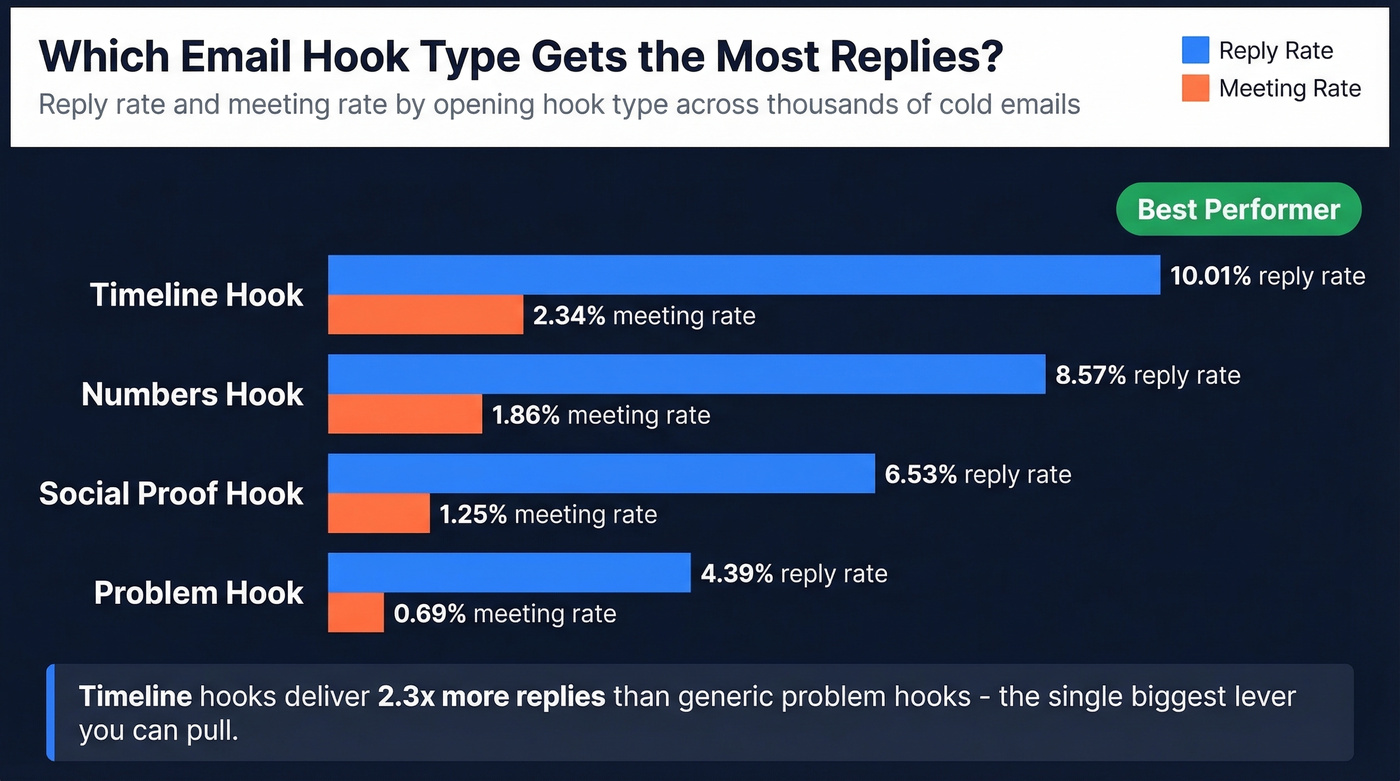
| Hook Type | Reply Rate | Meeting Rate |
|---|---|---|
| Timeline | 10.01% | 2.34% |
| Numbers | 8.57% | 1.86% |
| Social Proof | 6.53% | 1.25% |
| Problem | 4.39% | 0.69% |
Timeline hooks win decisively. "Three companies in [their industry] cut [metric] by 30% in the last 90 days" creates urgency without being pushy. If you only change one thing about your outreach, change your opening hook.
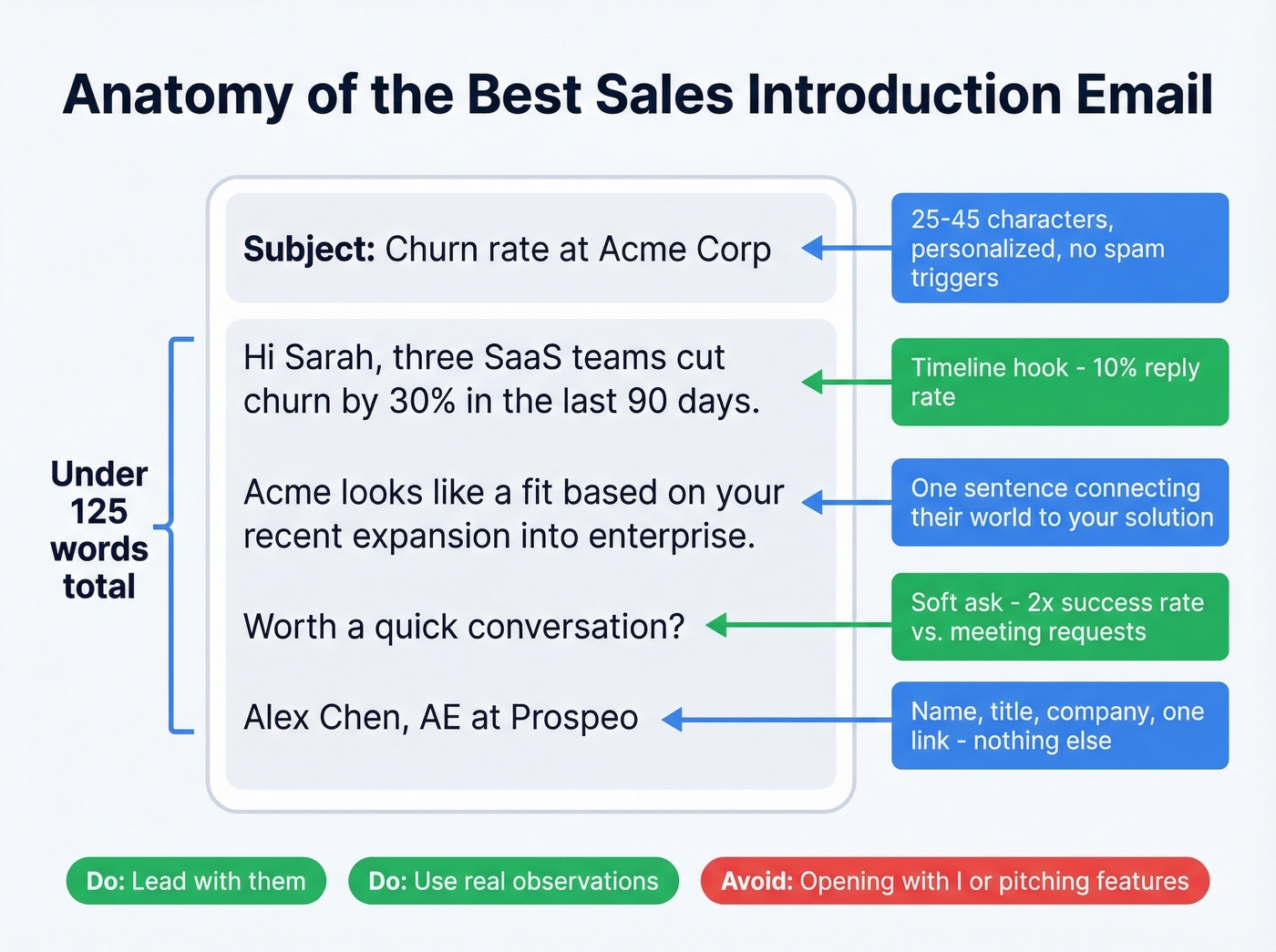
Subject Line
Keep it 25-45 characters to avoid mobile truncation. Personalization in the subject line lifts open rates 22-36%. Skip spam triggers like "Free," "Reminder," or ALL CAPS. Run at least 250 contacts per variant before drawing conclusions on A/B tests. If your open rate drops below 15%, stop testing copy and check inbox placement first - that's almost always the real problem. For more options, pull from these cold email subject line examples.
Value Bridge
One sentence connecting their problem to your solution. Not what your product does, but what changes for them. "We help mid-market SaaS teams reduce churn by identifying at-risk accounts before renewal" beats "We're an AI-powered customer success platform" every time.
CTA
Soft asks outperform hard asks decisively. Gong Labs data shows interest-based CTAs like "Does this sound worth exploring?" double the success rate compared to specific meeting requests. "Worth a conversation?" Five words that work. If you want more patterns, see email call to action examples.
Signature
Name, title, company, one link. No eight-line disclaimers, no inspirational quotes. Every extra line dilutes focus.
5 Templates You Can Steal
Cold Outreach (Timeline Hook)
Subject: [Metric] at [Company]
Hi [First Name], three [industry] teams cut [metric] by [X%] in the last [timeframe]. [Company] looks like a fit based on [observation]. Worth a quick conversation?
Referral Request
Subject: Introduction - [Your Name] ↔ [Prospect Name]
Hi [Connector], I'd love an intro to [Prospect] at [Company]. We helped [similar company] with [result]. Happy to draft a note if easier.
Trigger Event
Subject: Congrats on the [new role / round]
Hi [First Name], saw you just [joined Company / closed Series B]. Teams at that stage usually hit [challenge] within 90 days. We've helped [similar company] navigate it - interested in comparing notes?
Social Proof
Subject: How [Known Company] solved [problem]
Hi [First Name], [Known Company] cut [problem] by [X%] in [timeframe]. Your setup at [Company] looks similar. Want me to share what worked?
Problem Hook
Subject: [Problem] at [Company]
[First Name] - most [role]s at [stage] companies tell us [problem] eats [X hours/week]. We built [brief solution]. Quick look worth it?
Let's be honest: templates are starting points, not scripts. The best sales introduction email you'll ever send is one where the prospect can tell you actually looked at their business before hitting send. Swap in real observations, real numbers, and real specifics. A template with lazy fill-ins is just another forgettable email.
Send Timing and Follow-Up
An 85,000-email study found Monday between 6-9am PST delivers the best results: 20%+ open rate, 2.8% reply rate. Tuesday morning runs a close second. If you want the full breakdown, use this best time to send cold emails guide.
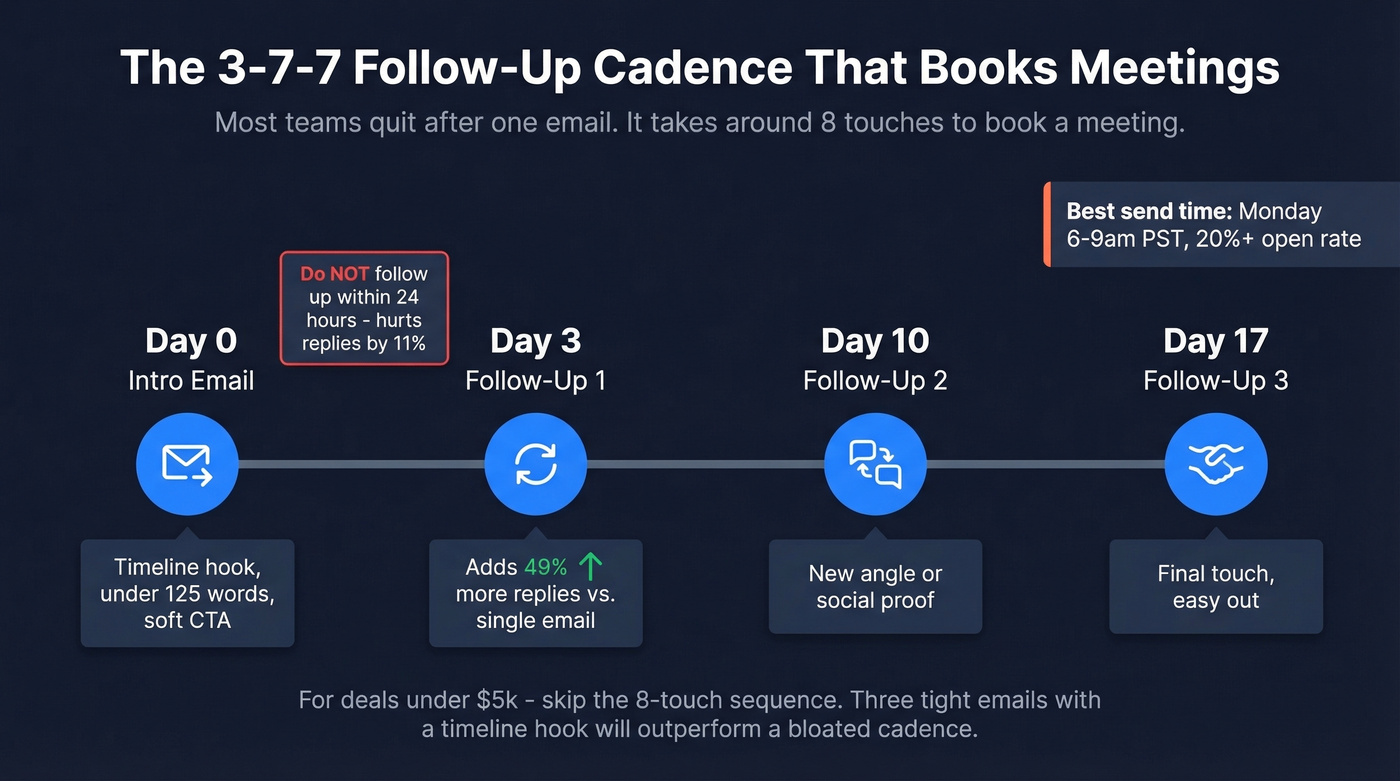
Use the 3-7-7 cadence: intro on Day 0, first follow-up on Day 3, second on Day 10, third on Day 17. Your first follow-up alone boosts replies roughly 49% vs. sending only one email - but following up within 24 hours actually hurts by about 11%. In our experience, most teams give up after one email when the data shows it takes around 8 touches to book a meeting. If you need copy for those touches, grab these cold email follow-up templates.
For teams with average deal sizes under $5k, skip the eight-touch multi-channel sequence. Three tight emails with a timeline hook will outperform a bloated cadence that nobody has time to maintain. Complexity isn't a strategy - relevance is.
Deliverability Checklist
None of the above matters if your email lands in spam. Google, Yahoo, and Microsoft now enforce SPF, DKIM, and DMARC for bulk senders - yet 84% of B2B domains still lack DMARC protection. If you’re troubleshooting, start with an email deliverability guide before you rewrite copy.
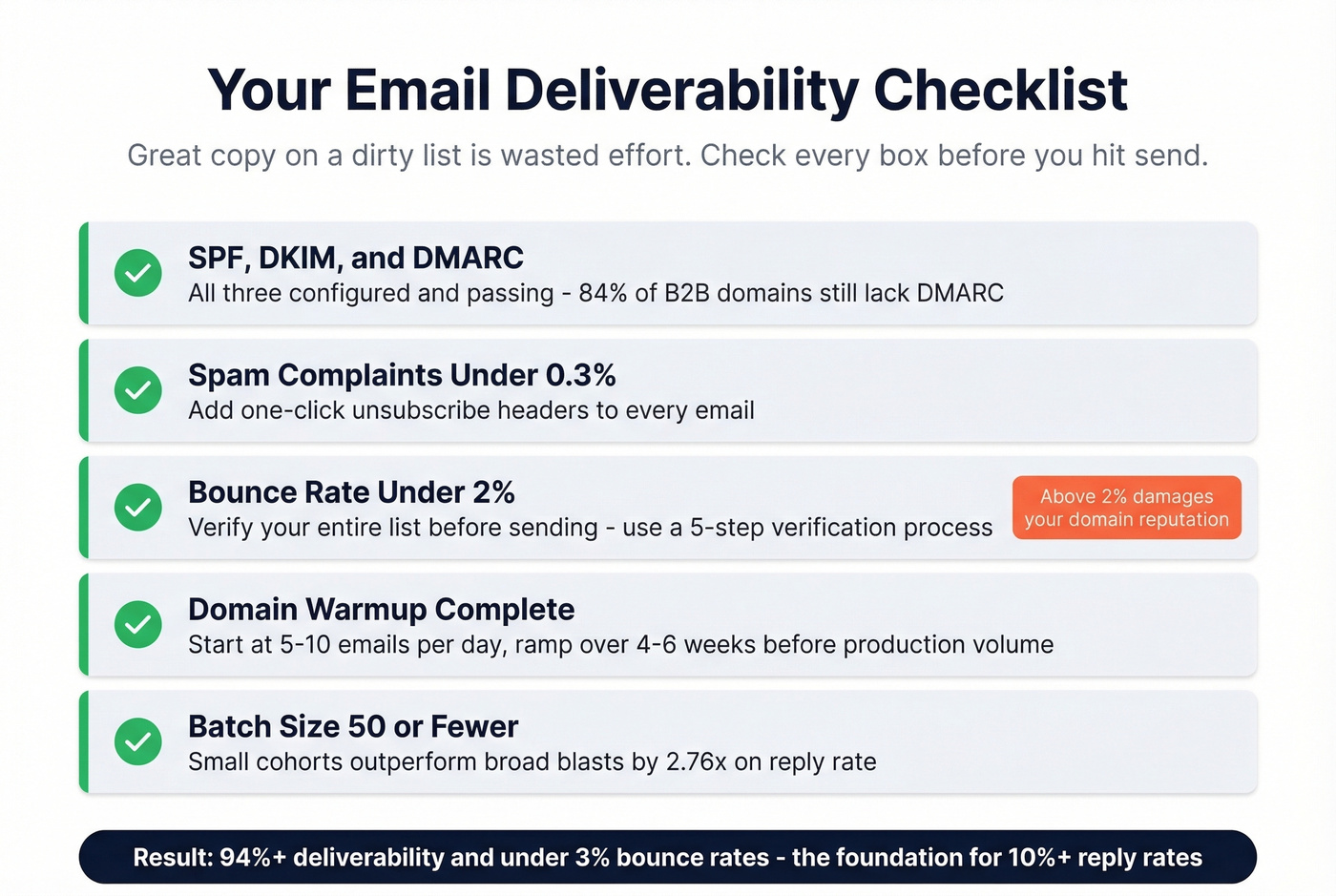
- SPF, DKIM, and DMARC configured and passing.
- Spam complaints under 0.3%. One-click unsubscribe headers help.
- Bounce rate under 2%. Verify your list before sending - Prospeo's email verification uses a 5-step process that catches spam traps and honeypots before they torch your sender reputation, with 98% accuracy and a free tier of 75 emails/month.
- Domain warmup: 5-10 emails/day, ramp over 4-6 weeks before production volume.
Great copy on a dirty list is wasted effort. One of our agency customers, Stack Optimize, built from $0 to $1M ARR while maintaining 94%+ deliverability and under 3% bounce rates across all their clients - and they'll tell you list hygiene was the single biggest factor. If you’re diagnosing list quality, start with Bounce rates above 2% and what they signal.
Sending in small batches of 50 works - but only if every contact is real. Prospeo gives you 300M+ professional profiles with 30+ filters so you can build hyper-targeted lists that match your timeline hooks. Teams using Prospeo book 35% more meetings than Apollo users.
Build the list your best intro email deserves.
FAQ
How long should a sales introduction email be?
50-125 words - three to five sentences. Anything longer belongs in a follow-up. Shorter first-touch emails consistently earn higher reply rates because they respect the reader's time and reduce friction.
What reply rate should I expect?
Average cold email reply rate sits around 7-10%. With a timeline hook and a verified list, 15-20% is achievable. Below 5%, audit your targeting and hook type before blaming the channel.
How do I keep intro emails out of spam?
Set up SPF, DKIM, and DMARC. Keep bounces under 2% by verifying emails before sending. Warm your domain gradually and avoid trigger words in subject lines.
What's the best subject line length for sales emails?
Aim for 25-45 characters. Subject lines in this range avoid mobile truncation and see 22-36% higher open rates when they include a personalized element like the prospect's company name or a relevant metric.