

Best Sales Presentations: Frameworks, Examples, and Tools for 2026
You've spent three hours on a deck. The fonts are perfect. The animations are smooth. Then the prospect clicks through two slides, says "can you just walk me through the problem you solve?" and your masterpiece becomes a $0 PDF sitting in a Downloads folder.
The issue isn't your design skills - it's that most sales presentations are built backwards, starting with the product instead of the prospect's world.
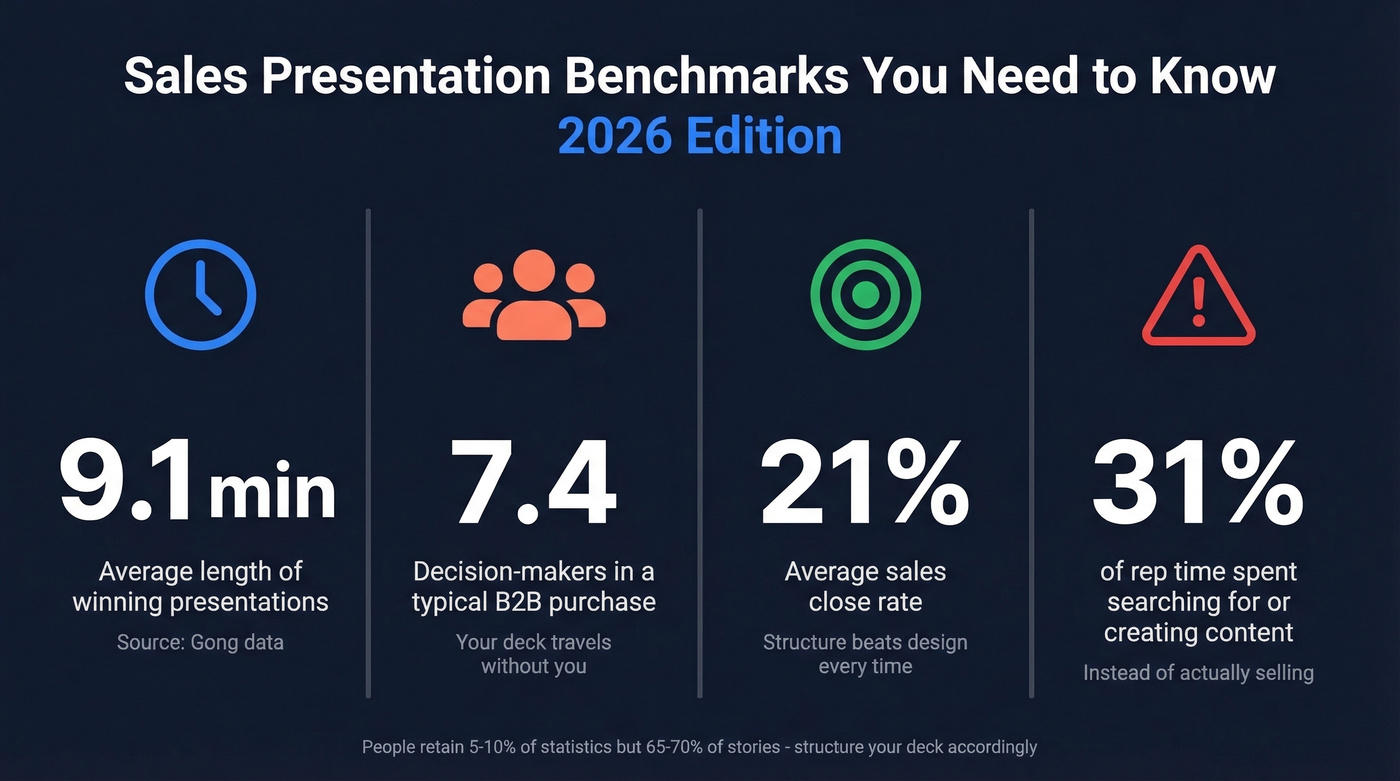
As one founder on r/Entrepreneur put it, decks always end up either "short and not informative" or "super long and overloaded and boring." That's not a design problem. It's a framework problem. And reps spend 31% of their working hours searching for or creating sales content instead of selling, which means the cost of getting this wrong compounds fast.
What You Need (Quick Version)
- Framework: Raskin's 5-Element Narrative for enterprise deals, Before-After-Bridge for SMB/transactional sales.
- Length: Winning presentations average 9.1 minutes per Gong data. Not 20 minutes. Not 45. Nine.
- #1 mistake: Pitching before discovering. If you send the deck two minutes into a call, you've already lost.
- Slide count: Forget the 10-20-30 rule. Match slides to deal complexity and audience.
Why Your Sales Deck Matters More Now
A typical B2B purchase now involves 7.4 decision-makers. Your deck isn't just for the person on the call - it's the artifact that travels through the buying committee after you hang up.
Meanwhile, 80% of B2B sales interactions happen virtually, which means your deck is often the only visual anchor in a Zoom call where attention spans are measured in seconds. Speed matters too: 35-50% of sales go to the vendor that responds first. A sharp, ready-to-send deck is a competitive weapon.
The average sales close rate hovers around 21%. The teams pulling ahead aren't doing it with prettier slides - they're doing it with better structure, prospect-specific proof points, and decks that function as conversation guides rather than monologues. Here's the thing: people retain 5-10% of statistics, but 65-70% of stories. Your deck's structure matters more than your data tables.
Proven Sales Presentation Frameworks
Most "best sales deck" roundups show you pretty slides with zero context on whether those decks actually closed anything. We've reviewed hundreds of decks, and the ones that close share one trait: they open with change, not product.
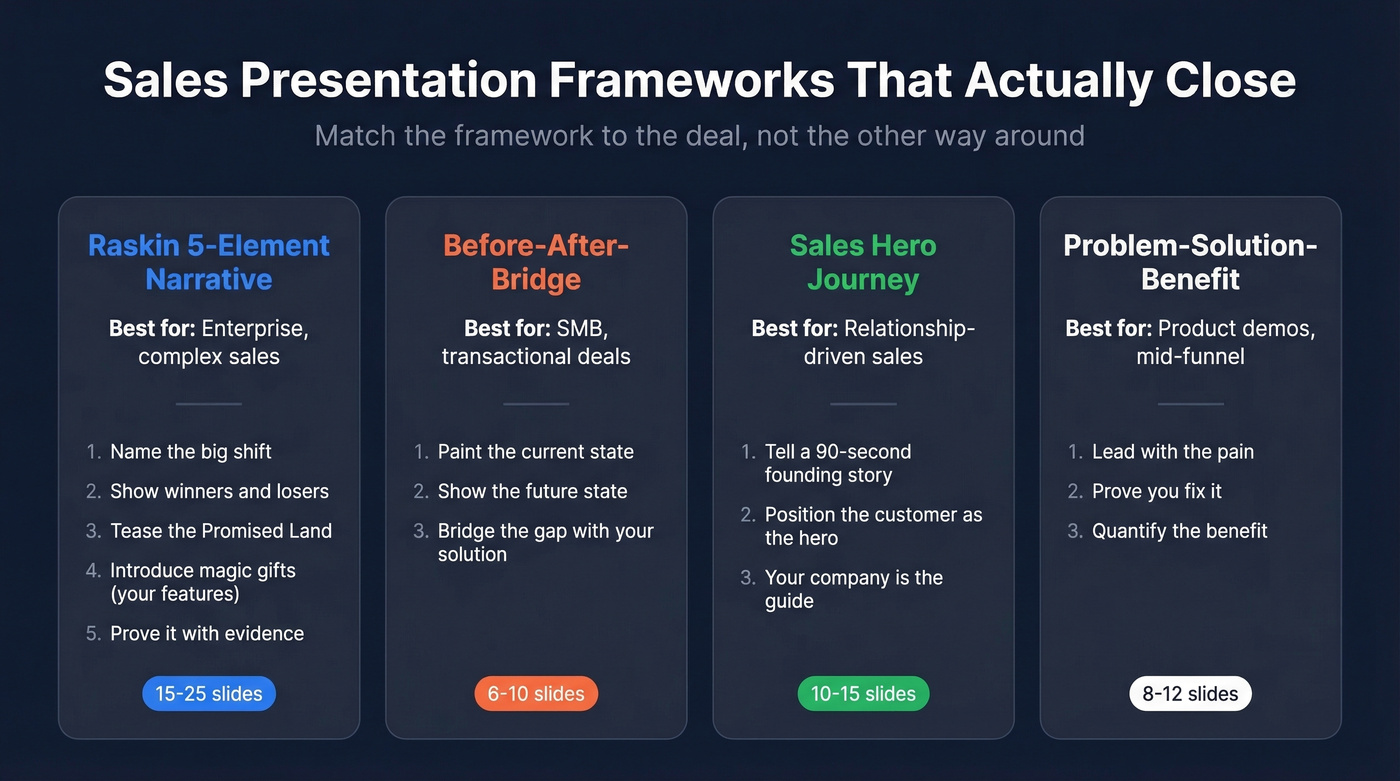
| Framework | Best For | Key Move | Slide Count |
|---|---|---|---|
| Raskin's 5-Element Narrative | Enterprise, complex sales | Open with market shift, not your product | 15-25 slides |
| Sales Hero's Journey | Relationship-driven sales | 90-second founding story as trust hook | 10-15 slides |
| Before-After-Bridge | SMB, transactional deals | Show the gap between now and the future state | 6-10 slides |
| Problem-Solution-Benefit | Product demos, mid-funnel | Lead with the pain, prove you fix it | 8-12 slides |
Raskin's 5-Element Narrative is the gold standard for enterprise decks. Andy Raskin broke it down using Zuora's deck as the case study. The structure: name a big, relevant change in the world, show there'll be winners and losers, tease the "Promised Land" - a future state, not your product - introduce your features as "magic gifts" that get the prospect there, and prove it with evidence.
The critical insight is starting with change, not problems. Leading with "you have a problem" puts prospects on the defensive. Leading with "the world is shifting" makes them lean in. That single reframe separates decks that open conversations from decks that close laptops.
Before-After-Bridge is the workhorse for shorter sales cycles. Paint the current state, show the future state, then bridge the gap with your solution. Simple, fast, and built for decks that need to close in one meeting.
The Sales Hero's Journey works when trust-building matters more than data - open with a timed 90-second founding story that positions your customer as the hero and your company as the guide.
Regardless of framework, the strongest decks follow a consistent delivery rhythm: Hook, Problem, Impact, Solution, Proof, Objection handling, CTA, Q&A. That sequence keeps the audience anchored even when the conversation goes off-script.
Deck Types by Funnel Stage
Not every deck serves the same purpose. Duarte's typology maps out ten use cases, but most teams need five:

| Deck Type | Funnel Stage | Goal | Recommended Framework |
|---|---|---|---|
| First-call deck | Top of funnel | Establish relevance, earn a second meeting | Raskin's Narrative or Hero's Journey |
| Product demo deck | Mid-funnel | Show the product solving their specific problem | Problem-Solution-Benefit |
| Executive briefing | Mid-to-late funnel | Align with C-suite priorities | Raskin's Narrative |
| Leave-behind / async deck | Any stage | Travel through the buying committee without you | Before-After-Bridge |
| Partnership deck | Expansion | Prove mutual value for co-selling or integration | Problem-Solution-Benefit |
In our experience, the leave-behind deck is where most teams drop the ball. It needs to stand alone - no presenter, no voiceover, no context beyond what's on the slides. If your deck doesn't make sense without you talking over it, it dies in the committee. Full stop.
Pitch supports async sales deck templates that let you add presenter recordings, and Storydoc focuses on interactive decks with engagement insights. That data is gold for iteration.
If you're building a deck to support a broader B2B sales funnel, make sure the "first-call" and "leave-behind" versions are distinct assets, not the same file with a few slides removed.

Personalized decks close deals - but only when they reach the right people. Prospeo gives you verified emails and direct dials for all 7.4 decision-makers on the buying committee, with 98% email accuracy and a 7-day data refresh cycle.
Stop sending winning decks to dead email addresses.
Deck Examples That Actually Closed
Before the examples, one lesson: every winning deck below shares a trait - the product doesn't appear until the audience already wants it.
Zuora vs. Snapchat illustrate two opposite approaches that both worked. Zuora opens with "the subscription economy is here" - a market shift that creates urgency before it positions itself as the answer. Snapchat's 2015 sales deck opens with a direct claim: "Snapchat is the best way to reach 13-34-year-olds." Zuora sold through narrative. Snapchat sold through audience-first positioning. Both worked because they matched the framework to the buyer's decision style.
Reddit Ads took a wildcard approach: brand voice and humor. Their deck felt like Reddit - irreverent, self-aware, fun. The takeaway isn't "be funny." It's that your deck's tone should match your brand, not some generic corporate template.
ChartMogul uses a clear "old way vs. new way" contrast inside a broader Problem-Solution-Benefits flow designed to work as a pre-read without a voiceover. The framework travels.
How to Personalize Your Deck
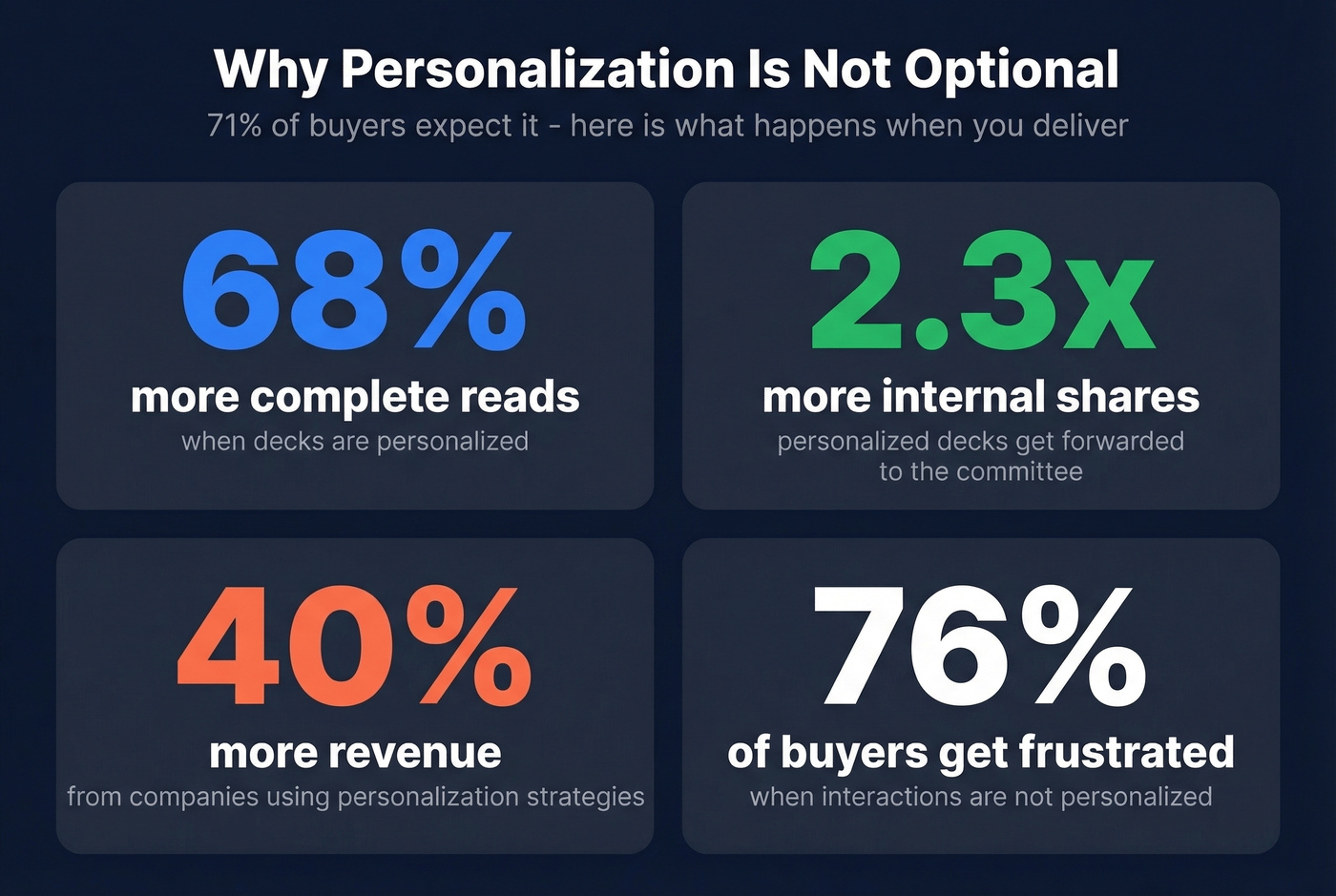
71% of buyers expect personalized interactions, and 76% get frustrated when it doesn't happen. Personalized decks get 68% more complete reads and are shared internally 2.3x more often. The fastest-growing companies drive 40% more revenue from personalization strategies.
But personalization starts before the deck. If your prospect data is stale - wrong title, wrong email, wrong company - no amount of slide customization matters. Prospeo's database covers 300M+ profiles with 98% email accuracy and a 7-day data refresh cycle, so you're building decks for people who'll actually receive your follow-up.

Build a modular deck with 2-3 slides that swap based on whether you're talking to a VP of Sales, a CFO, or a RevOps lead. Same core narrative, different proof points. Keep a library of 5-6 case studies tagged by vertical and drop in the one that matches. Use CRM-integrated tools to auto-populate company name, logo, and relevant metrics into your template.
If your personalization depends on better contact records, consider adding a lightweight data enrichment step before you build the deck.
The goal isn't a one-off deck for every prospect. It's a 10-minute personalization pass that makes the prospect feel like you did your homework - because you did.
Your leave-behind deck travels through the buying committee without you. Make sure it lands in every inbox. Prospeo's 300M+ profiles and 30+ filters let you map the full committee - titles, departments, verified contacts - before you even build slide one.
Nail the personalization that drives 68% more complete reads.
Mistakes That Kill Sales Decks
Pitching before discovering. A HubSpot case study describes a rep who sent the pitch deck two minutes into a call - before the buyer finished explaining the problem. The deck was irrelevant because the rep never learned what mattered. Discovery first, always. (If you need a tighter discovery flow, start with a discovery call script and a short list of discovery questions.)
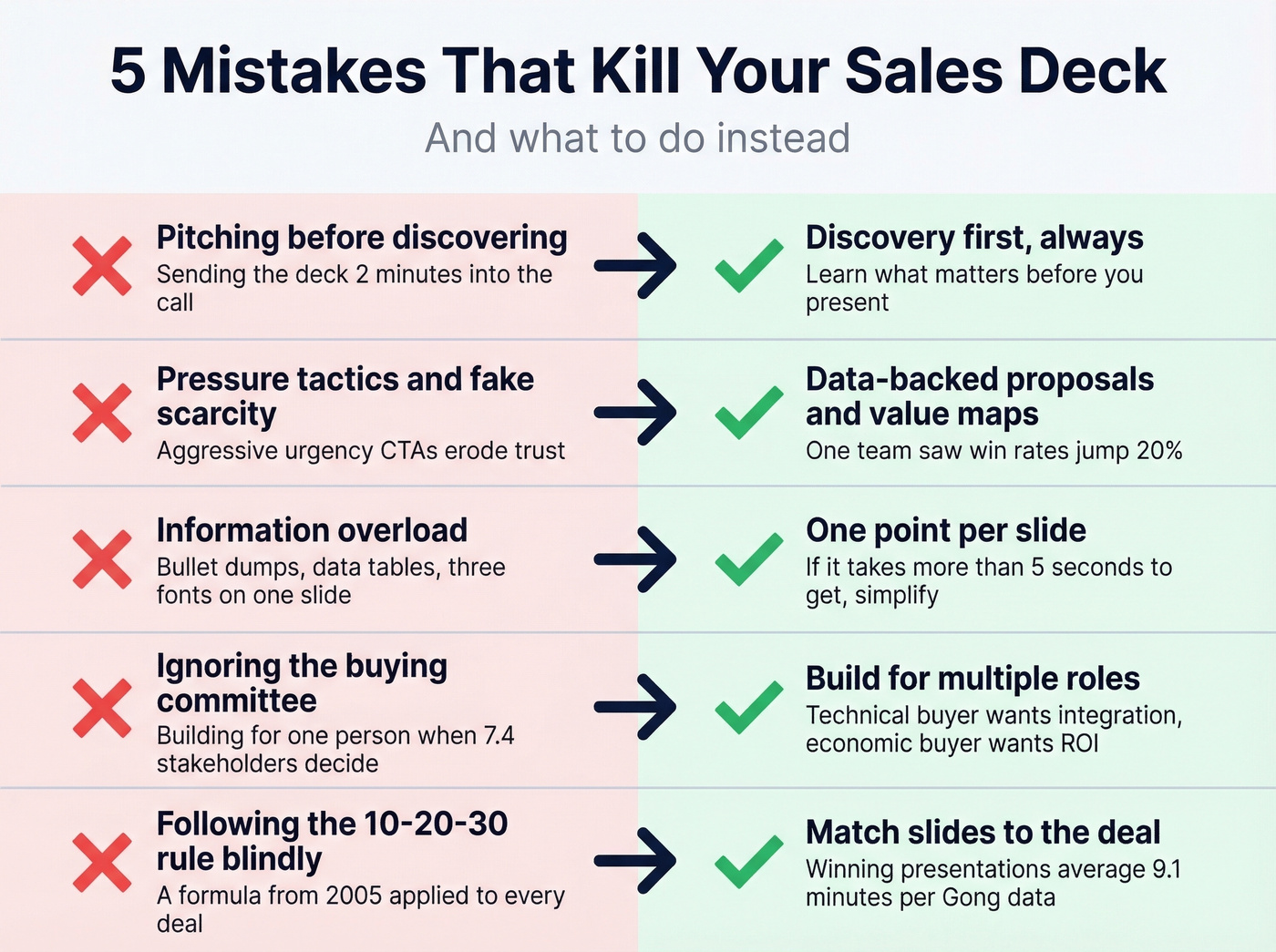
Pressure tactics that backfire. Fake scarcity, exaggerated social proof, aggressive urgency CTAs - they erode trust. One Head of Sales replaced urgency-based CTAs with data-backed proposals and tailored value maps. The result: win rate up 20% over two quarters.
Information overload. Every slide should make one point. If you're dumping bullet points and data tables onto a single slide while mixing three fonts and clashing colors, you're not presenting - you're overwhelming.
Ignoring the buying committee. With 7.4 stakeholders in a typical B2B deal, your deck needs to speak to multiple roles. The technical buyer cares about integration. The economic buyer cares about ROI. Build for both, or watch your champion fail to sell internally on your behalf. (More on this split: technical buyer vs economic buyer.)
Following the 10-20-30 rule blindly. Guy Kawasaki's rule - 10 slides, 20 minutes, 30-point font - is nearly two decades old. Gong data says winning presentations average 9.1 minutes. Complex enterprise deals might need 25 slides with an appendix. A first-call SMB deck might need 6. Match your slide count to the deal, not an outdated formula.
Top Tools for Building Sales Decks in 2026
Let's be honest: the presentation tool you pick matters far less than the framework you apply. AI deck tools are good enough now. Stop spending three hours in PowerPoint. Gamma gets you 80% of the way there in 10 minutes, and you can spend the remaining time on personalization and rehearsal - the things that actually move close rates.
| Tool | Starting Price | CRM Integration | Best For |
|---|---|---|---|
| Gamma | $8/mo | Limited | Fast AI-generated decks |
| Beautiful.ai | $12/mo | Yes | Design-forward teams |
| PlusAI | $10/mo | Google Slides | Google Workspace users |
| monday CRM | $12/user/mo | Native | CRM-native presentations |
| Pitch | Free tier | Yes | Collaborative team decks with async sharing and recordings |
| Canva | Free tier | Yes | Non-designers who need templates |
Skip Canva if your team already lives in Google Slides - the context-switching isn't worth it for marginal design improvements.
The next frontier for sales decks is interactive elements and real-time engagement tracking. Tools like Storydoc let you see exactly which slides a prospect spent time on, whether they forwarded the deck, and where they dropped off. Their data shows adding video to your cover slide drives 32% more interaction. If your current tool doesn't offer engagement data, you're flying blind on every leave-behind.
If you're standardizing decks across the org, this is classic sales enablement work: one narrative, multiple variants, and a system to keep them current.
We've seen teams agonize over which AI deck tool to pick when the real bottleneck is that they don't have a clear narrative structure. Pick any tool from this list, apply one of the frameworks above, and you'll outperform 90% of sales decks in the wild.
FAQ
How many slides should a sales presentation have?
There's no universal number. Gong data shows winning presentations average 9.1 minutes. A complex enterprise deal might need 20+ slides with an appendix; a first-call SMB deck might need 6. Match slide count to deal complexity, not the outdated 10-20-30 rule.
What's the difference between a sales deck and a pitch deck?
Sales decks target customers to close revenue; pitch decks target investors to raise funding. Customers want to see how you solve their problem, while investors want market size and return potential. Don't use one for the other.
What separates a winning presentation from a forgettable one?
Structure. The best sales presentations open with a change or insight that matters to the buyer, build tension around the gap between their current state and where they could be, and only then introduce the product as the bridge. Forgettable decks lead with features and hope something sticks.
How do I personalize a deck without rebuilding it every time?
Build a modular template with 2-3 swappable slides for different buyer roles and a library of 5-6 case studies tagged by vertical. Use a data tool like Prospeo (75 free credits/month) to verify prospect details before customizing, then auto-populate company name and metrics via your CRM integration.