

The Best Time to Send Email in 2026 (And Why "Tuesday at 10 AM" Isn't the Full Answer)
Every day, 376.4 billion emails fight for attention. You scheduled yours for Tuesday at 10 AM because that's what every guide recommends - and so did 10,000 other companies targeting the same buyers. Your perfectly crafted message landed in an inbox avalanche, buried under a dozen competitors who read the same blog post you did.
Tuesday at 10 AM isn't wrong. It's just incomplete. The real answer depends on whether you're sending a marketing blast, a cold email, or a follow-up - and on who's receiving it, what industry they're in, and whether your list is clean enough for timing to even matter.
Quick-Answer Table
Short on time? Here's the cheat sheet. The rest of the article explains why these windows work and when to deviate.
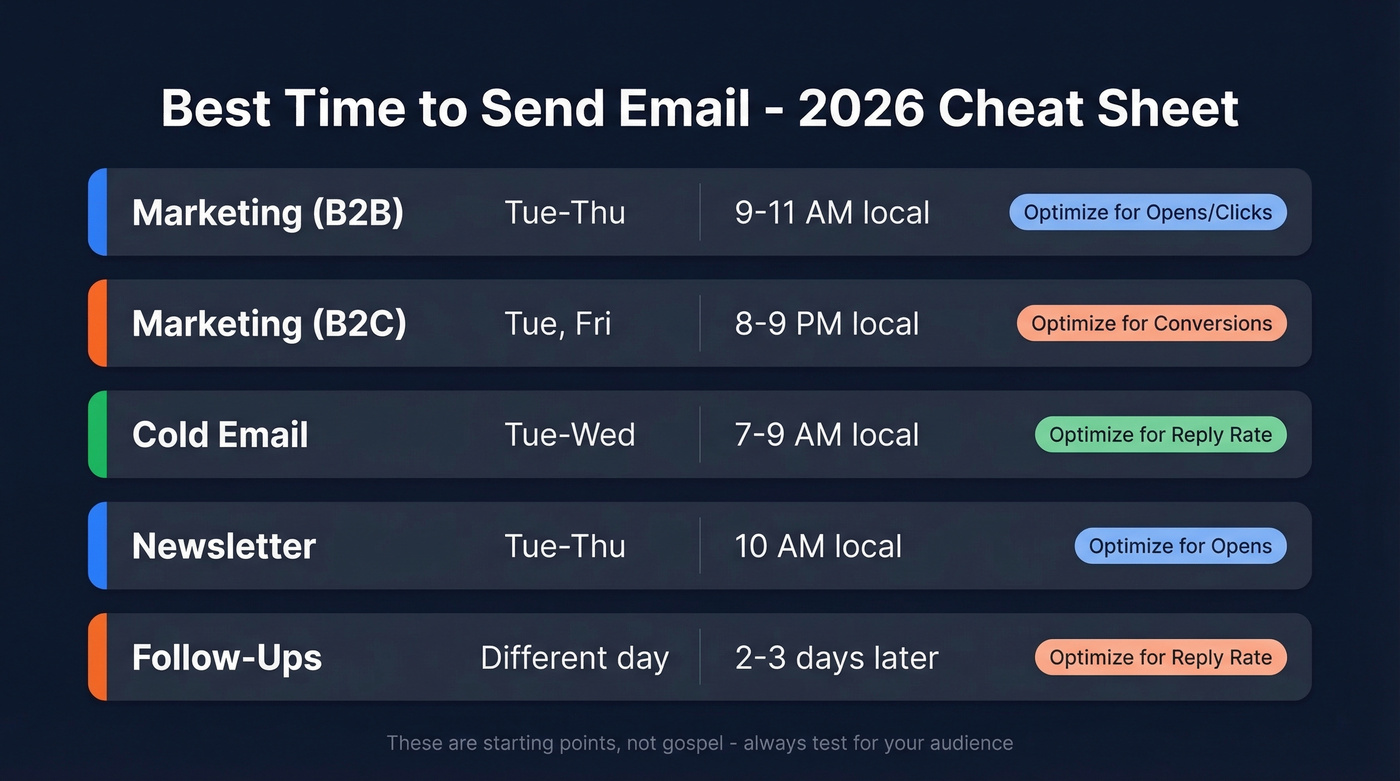
| Email Type | Best Days | Best Time | Optimize For |
|---|---|---|---|
| Marketing (B2B) | Tue-Thu | 9-11 AM local | Opens/Clicks |
| Marketing (B2C) | Tue, Fri | 8-9 PM local | Conversions |
| Cold Email | Tue-Wed | 7-9 AM local | Reply Rate |
| Newsletter | Tue-Thu | 10 AM local | Opens |
| Follow-Ups | Different day | 2-3 days later | Reply Rate |
These are starting points, not gospel. A SaaS company selling to CTOs and a DTC brand selling candles have wildly different optimal windows. Let's break it down.
When to Send Marketing Emails
The largest recent dataset comes from MailerLite's benchmark report - 3.6 million campaigns across 181,000 accounts. The overall numbers: 43.46% open rate, 2.09% click rate, 6.81% click-to-open rate. Those are medians, so half of all campaigns perform worse.
The conventional wisdom - mid-morning, mid-week - holds up across major benchmarks. Mailchimp's system-wide analysis also points to 10 AM in recipients' own time zones as a strong default for newsletters. But opens aren't the whole story, and this is where most guides stop too early.
Morning vs. Evening
Bloomreach's data found open rates peaking at 8 PM with a 59% open rate, followed by 2 PM at 45% and 11 PM at 40%. That figure is likely inflated by Apple Mail Privacy Protection pre-loading tracking pixels, but the directional signal is clear: evenings can outperform what most marketers expect. It makes sense when you think about behavior - people check email on the couch after dinner without the urgency of a workday inbox. They're browsing, not triaging.
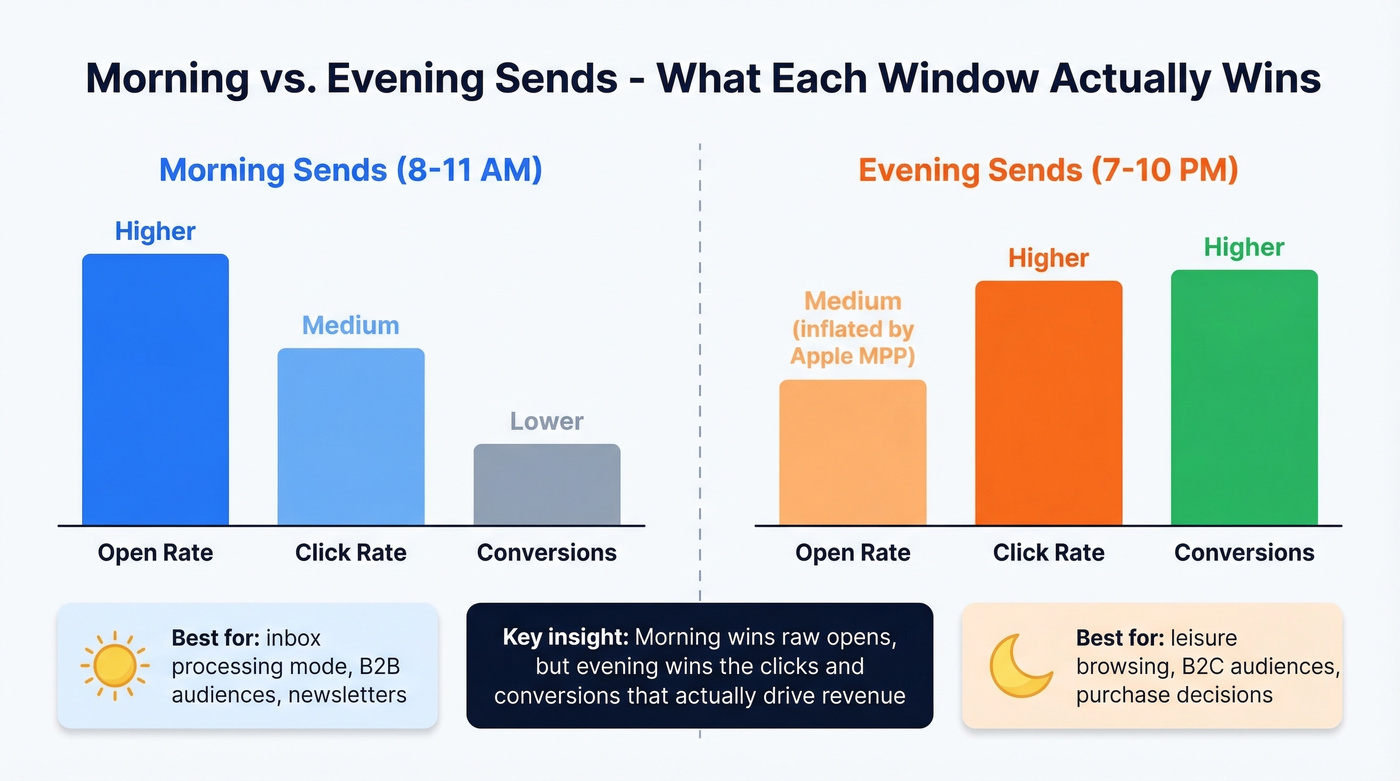
The distinction matters. Morning sends win on raw opens because that's when people process their inbox. Evening sends can win on clicks and conversions because recipients have more attention to give. If you're optimizing for someone to actually click through and buy, evenings deserve a real test. Most B2C brands are leaving money on the table by defaulting to morning sends without ever trying an 8 PM window.
The Off-the-Hour Trick
A lot of promotional email gets scheduled right on the hour - 9:00 AM, 10:00 AM, 11:00 AM - which means your email arrives alongside a wall of other messages. Send at :10 or :15 past the hour instead. Your message lands when the initial batch has already been scanned and partially cleared. It's a small edge, but small edges compound across thousands of sends.
B2B vs. B2C Timing
The timing gap between B2B and B2C is bigger than most marketers realize. Think of it as two completely different sports.
B2B recipients are in work mode during business hours. They're scanning for relevant vendor emails between meetings. The 9-11 AM window catches them during their first inbox pass of the day. The average click-through rate for B2B services sits around 2.21%, and 59% of B2B marketers say email is their number-one revenue channel. Your email needs to arrive when someone is actively processing work communications, not when they're mentally checked out.
B2C recipients are consumers first. They engage with promotional email when they're not working, which means evenings and weekends get more consideration than B2B marketers would expect. Retail CTRs average around 1.34%. The 8-9 PM Tuesday and Friday windows catch people during leisure browsing, when they're more willing to click through and buy. Nonprofits are the outlier worth noting: they pull a 2.66% CTR, beating both B2B services and retail. If you're in nonprofit, message-market fit and the strength of your story usually matter more than micro-optimizing send time.
Best Time to Send Cold Emails
Cold email is a different animal entirely. You're not sending to subscribers who opted in - you're interrupting someone's day. Timing isn't just about when they're checking email; it's about when they're in a mental state to respond to a stranger.
The data points to early morning. Emails sent between 4-8 AM PST show a 42.7% open rate, and 60.58% of all cold email responses happen between 8 AM and noon. Wednesday edges out the other days with a 2.6% reply rate, followed by Tuesday at 2.5%. Friday drops to 13-14% open rates, and weekends account for less than 2.11% of weekly responses - but none of this matters if the email addresses aren't real. More on that below.
Persona-Based Timing
Generic "send at 9 AM" advice ignores that a CEO and an IT manager have completely different schedules.
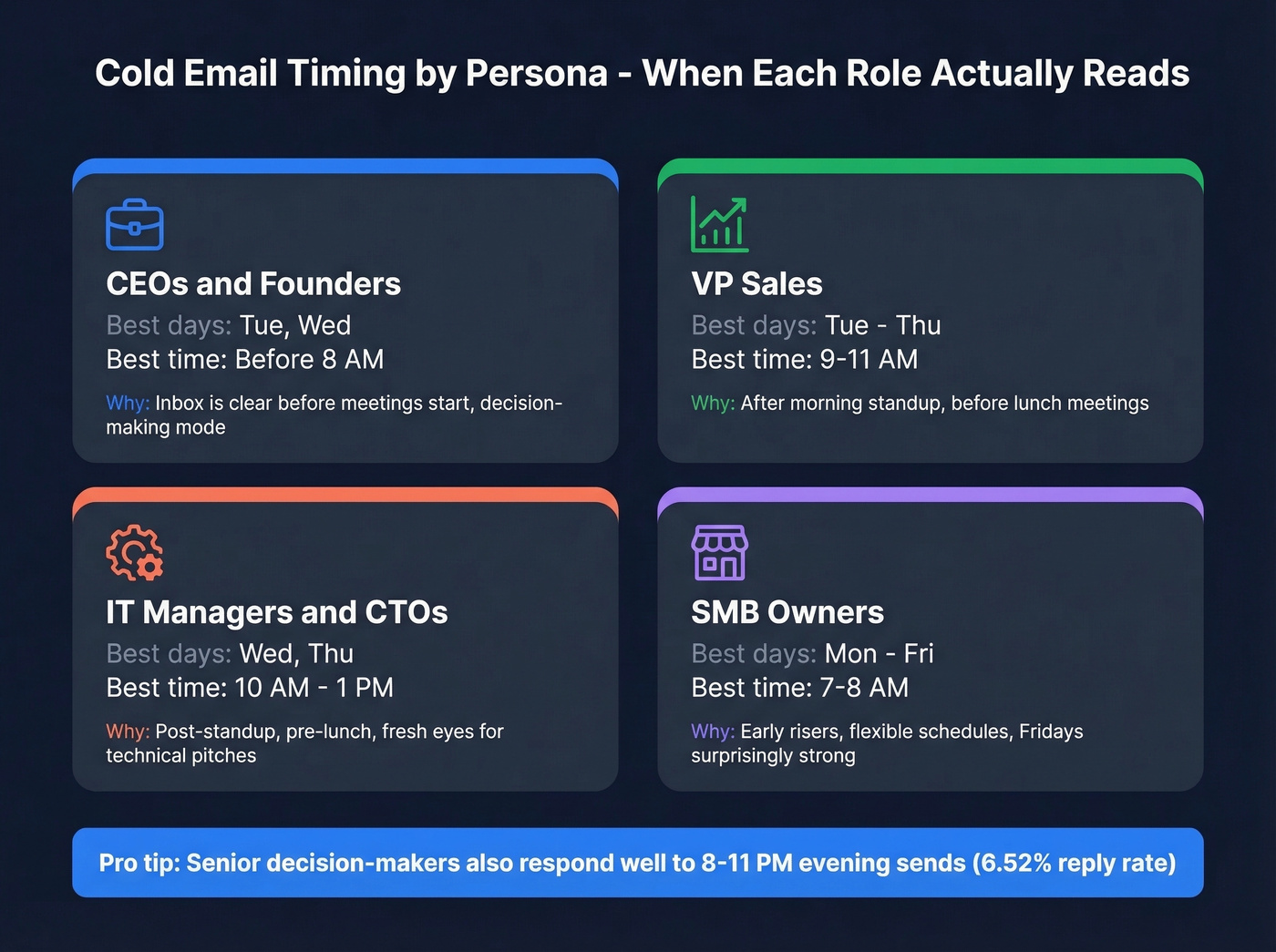
CEOs and founders check email before 8 AM on Tuesdays and Wednesdays. Their inbox is clear before the meeting gauntlet starts, and they're in decision-making mode - this is your best window for strategic pitches.
VP Sales types live between pipeline reviews. The 9-11 AM slot on Tuesday through Thursday catches them after their morning standup but before lunch meetings consume the day.
IT managers and CTOs skew later: 10 AM to 1 PM on Wednesdays and Thursdays. They're post-standup, pre-lunch, and more likely to evaluate a technical pitch with fresh eyes.
SMB owners are early risers with flexible schedules. The 7-8 AM window works Monday through Friday, and Friday mornings are surprisingly effective - they're planning the next week and more open to new conversations.
These aren't rigid rules, but they're a dramatically better starting point than blasting everyone at the same time. Finding the ideal send window for each persona requires testing, but persona-based scheduling gets you closer on day one.
Why Evenings Work for Decision-Makers
Here's a counterintuitive finding: the 8-11 PM window produces a 6.52% reply rate for cold emails to senior decision-makers. That's significantly higher than the daytime average. Executives do a second inbox pass after dinner, and they're more reflective in the evening. The competitive noise is also lower - fewer salespeople schedule sends for 9 PM.
We've seen this pattern consistently in outbound campaigns targeting C-suite buyers. Senior leaders are often more reachable at night than during business hours, when gatekeepers and meeting schedules create barriers. The evening window won't work for every persona, but for senior leaders, it's worth testing before you dismiss it.

You just optimized your send time - but 35% of your list might be bouncing before anyone sees it. Prospeo's 5-step verification delivers 98% email accuracy, so every perfectly timed email actually reaches a real inbox. At $0.01 per email, fixing your data costs less than one wasted campaign.
Stop perfecting send times for email addresses that don't exist.
When to Send Follow-Ups
Here's the uncomfortable truth most timing guides skip: 60-80% of cold email replies come from follow-ups, not the initial send. If you're optimizing the timing of your first email but not following up, you're polishing the least important part of the sequence.
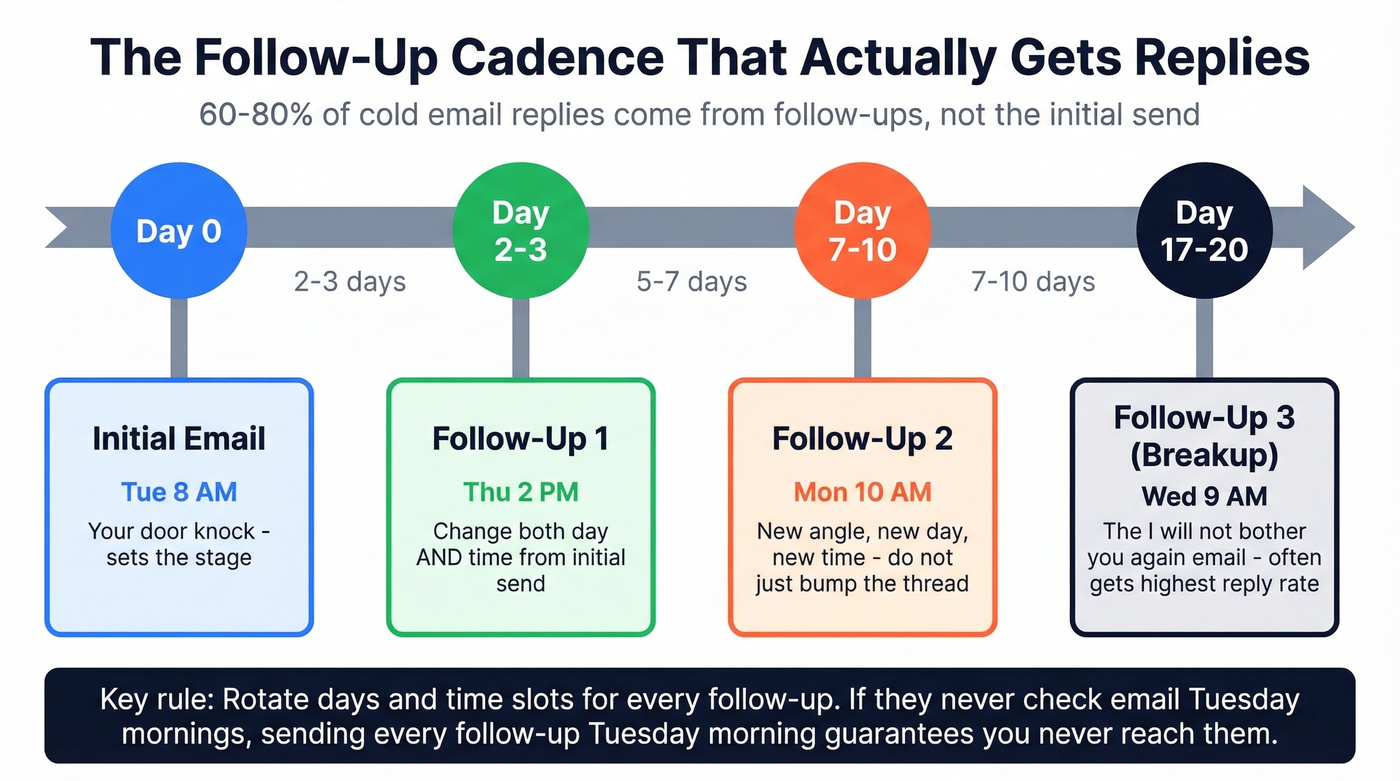
The cadence that works:
- Follow-up #1 - 2-3 business days later. Change both the day and time. If you sent Tuesday at 8 AM, follow up Thursday at 2 PM.
- Follow-up #2 - 5-7 days after #1. New angle, new day, new time slot. Don't just bump the thread.
- Follow-up #3 (breakup) - 7-10 days later. The "I won't bother you again" email. These often generate the highest reply rates because they create urgency without pressure.
The key insight is changing the day and time for each follow-up. If your prospect doesn't check email on Tuesday mornings, sending every follow-up on Tuesday morning guarantees you'll never reach them. Rotate across the week and across time slots. For ready-to-use copy, keep a few proven follow-ups on hand so cadence doesn't slip.
We've watched SDRs send 200 cold emails, get discouraged by a 1% reply rate, and abandon the campaign - without ever sending a single follow-up. The first email is just the door knock. Follow-ups are where conversations start.
Email Timing by Industry
Generic timing advice breaks down fast when you look at industry-specific data. Bloomreach provides strong marketing-email timing benchmarks, and cold email practitioner data fills in additional verticals:
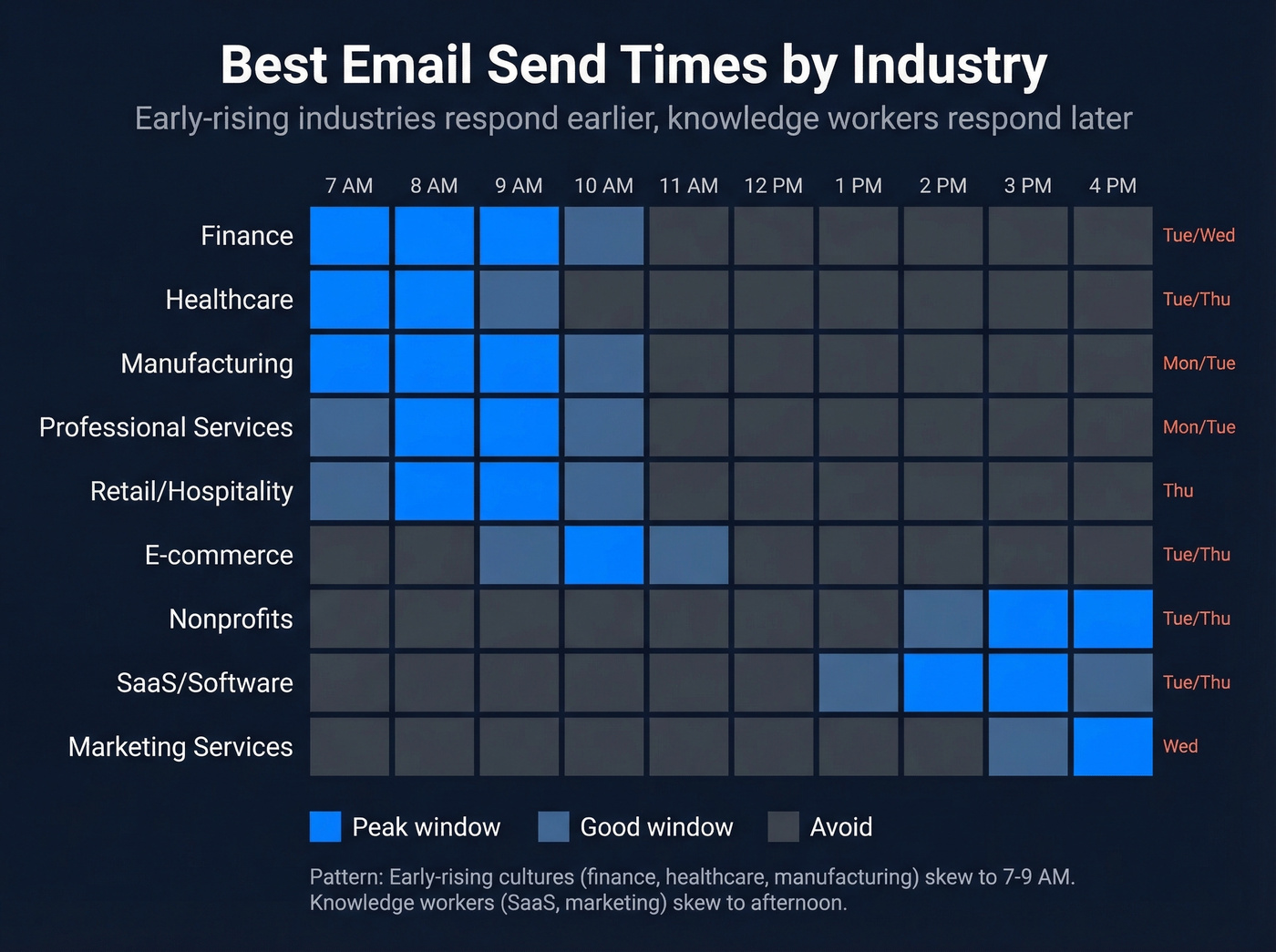
| Industry | Best Days | Best Time |
|---|---|---|
| E-commerce | Tue/Thu | 10 AM |
| SaaS/Software | Tue/Thu | 2-3 PM |
| Marketing Services | Wed | 4 PM |
| Professional Services | Mon/Tue | 8-10 AM |
| Nonprofits | Tue/Thu | 3-4 PM |
| Finance | Tue/Wed | 7-9 AM |
| Healthcare | Tue/Thu | 7-8:30 AM |
| Manufacturing | Mon/Tue | 7-9 AM |
| Retail/Hospitality | Thu | 8-10 AM |
A few patterns jump out. Industries with early-rising cultures (finance, healthcare, manufacturing) respond to earlier sends. Knowledge-worker industries (SaaS, marketing services) skew later in the day. Nonprofits perform best in the mid-afternoon, when donors are winding down their workday and more receptive to mission-driven messaging.
Use these as starting hypotheses, not permanent settings. Your audience within an industry might behave differently based on company size, geography, or role. If you're building tighter segments, layering in firmographic filters can help you test timing by company size and market.
How to A/B Test Send Times
Every timing article ends with "test it for your audience" and then offers zero guidance on how. Let's fix that.
Sample Size and Duration
You need at least 10,000 recipients per test group for statistically meaningful results. If your list is smaller, extend the test across multiple sends - a single campaign with 2,000 recipients won't tell you anything reliable.
Test one variable at a time. If you're testing send time, keep the subject line, content, and audience segment identical. Changing two variables simultaneously makes it impossible to attribute results. If you want to improve the other big lever, pull from a library of proven email subject lines before you touch timing again.
Pitfalls That Skew Results
Send-order bias is the one nobody talks about. When testing a send-time optimization (STO) cohort against a blast, send the STO group first. ESPs evaluate message performance holistically - early engagement from the STO cohort can improve inbox placement for the blast group, making the blast look better than it actually is.
Overlapping campaigns during your test window will confound results. If your marketing team sends a newsletter on the same day as your A/B test, the extra inbox noise depresses attention for both.
Open rate inflation from Apple Mail Privacy Protection is a real problem. Apple pre-loads tracking pixels, which inflates open rates across the board. Use click rate as your primary metric - it's harder to fake and more closely tied to actual engagement. MailerLite's benchmark report calls out that open rates are inflated under modern privacy changes, which is why clicks and click-to-open matter more than they used to.
Randomization matters more than you think, too. Manual spreadsheet splits introduce bias. Use your ESP's built-in randomization, and wait at least 48 hours after the last email is sent before analyzing results. For teams implementing STO for the first time, give the algorithm at least 90 days to learn before you split-test it against a manual blast - testing too early measures the algorithm's cold start, not its actual performance.
Send-Time Optimization Tools
STO tools analyze each subscriber's past behavior - session times, open patterns, click history - and schedule sends individually. The results can be significant.
Braze's "Intelligent Timing" feature produced some of the strongest documented lifts: OneRoof saw a 57% uplift in unique clicks, foodora got a 9% CTR increase with a 26% reduction in unsubscribes, and KFC Ecuador improved open rates by 15%. These are real case studies from named brands, not hypothetical projections.
The catch is that STO requires enough behavioral data per subscriber to work. If someone's been on your list for two weeks, the algorithm doesn't have much to go on. STO shines for mature lists with months of engagement history. Approximate pricing as of early 2026: Mailchimp plans with send-time features start around $10-$20/month for small lists, MailerLite's Smart Sending plans run $15-$30/month depending on list size, Klaviyo starts around $20/month and scales with contacts, and Braze is enterprise-tier at $50K+/year.
Here's the thing: the lift from STO is typically 5-20% over a well-chosen manual send time. That's meaningful at scale, but it won't save a bad subject line or a poorly targeted list. If your deal sizes are modest and your list is under 10,000 contacts, skip STO entirely. Get the fundamentals right first, and the timing refinements become a bonus rather than a crutch. If you're running outbound sequences, automated cold email scheduling can also reduce manual errors while you test.
Why List Quality Matters More Than Timing
If your bounce rate is above 5%, stop optimizing send times and fix your data. This isn't a minor detail - it's the foundation everything else sits on.
Here's the death spiral: bad email addresses lead to bounces, bounces damage your sender reputation, damaged reputation means worse inbox placement, and your carefully timed emails land in spam. At that point, it doesn't matter if you've nailed the perfect send window. Your messages aren't reaching anyone.
Prospeo's Email Finder runs a 5-step verification process with catch-all handling, spam-trap removal, and honeypot filtering - delivering 98% email accuracy. The results speak for themselves: Meritt dropped their bounce rate from 35% to under 4% and tripled their pipeline. Snyk's 50-person AE team went from 35-40% bounces to under 5%, driving a 180% increase in AE-sourced pipeline. The free tier gives you 75 emails per month to test it. If you're diagnosing issues, start with bounce rate benchmarks and fixes and then work through a full email deliverability checklist.
Timing optimization is the last 10% of email performance. List quality is the first 90%.
Persona-based timing only works when you can actually reach the right personas. Prospeo gives you 143M+ verified emails and 125M+ direct dials filtered by job title, seniority, and intent - so your 7 AM CEO send hits a real CEO inbox, not a generic info@ address.
Find the decision-maker first, then time the send perfectly.
FAQ
Does the day you send an email really matter?
Yes - Tuesday through Thursday consistently outperform other days across major benchmarks. The gap between those three days is usually small. The bigger levers are time of day, list hygiene, and whether you actually follow up.
Is it better to send emails in the morning or evening?
Morning sends (9-11 AM) win for raw opens; evening sends (8-9 PM) often win for clicks and conversions, especially in B2C. Most teams default to mornings without ever testing evenings - run a proper A/B test before deciding.
What's the best time to send a cold email?
Tuesday or Wednesday between 7-9 AM in the recipient's local time zone. Wednesday pulls the highest reply rate at 2.6%. Follow up 2-3 business days later at a different time and day to maximize responses.
How do I find the optimal send time for my audience?
A/B test with at least 10,000 recipients per group, changing only one variable at a time. Use click rate - not open rate - as your primary metric, since Apple Mail Privacy Protection inflates opens. Start with the windows in this guide, then let your own data refine the schedule. Tools like Prospeo can verify your list first so bounces don't skew results.