

Every Major Blacklisted Domains List, Compared and Explained
You want an actual blacklisted domains list - not a checker tool, not a "what is a blacklist?" explainer. Here's every list worth knowing about, organized by use case.
What You Need (Quick Version)
Three answers, depending on why you're here:
DNS filtering (Pi-hole, AdGuard, pfBlockerNG): Grab HaGeZi Multi Pro - 385,525 entries, free, updated daily. It's a common default pick in practitioner circles, and it's the only list most setups need.
Email deliverability: Check Spamhaus DBL first. It's the gold standard - served from over 80 mirrors worldwide and continuously updated. If you're clean there, check SURBL, Barracuda, and Invaluement. That covers 90% of what matters.
Largest downloadable list: The fabriziosalmi/blacklists GitHub repo aggregates 2,874,201 blacklisted domains from 61 sources, updated daily, in every format you'd need.
Two Types of Domain Blacklists
Most articles blur two completely different audiences together. Let's fix that.
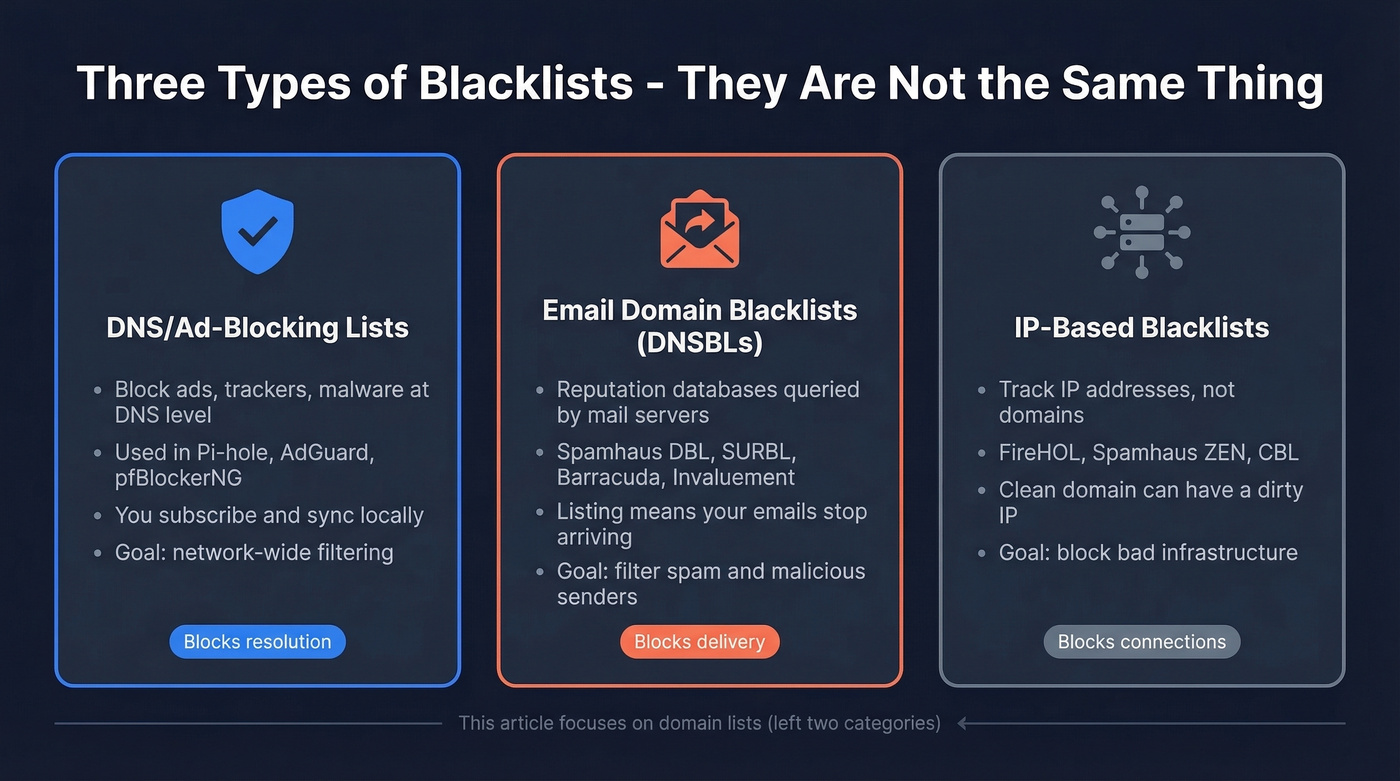
DNS/ad-blocking lists are curated collections of domains associated with ads, trackers, malware, and phishing. You subscribe to them in tools like Pi-hole or AdGuard Home, and they block resolution at the DNS level. The goal is network-wide filtering - effectively maintaining your own domain blocklist at the network edge.
Email domain blacklists (DNSBLs) are reputation databases that mail servers query in real time to decide whether to accept, quarantine, or reject messages. If your sending domain lands on Spamhaus DBL, your emails stop arriving. Simple as that.
There's also a third category that gets mixed in: IP-based blacklists. Projects like FireHOL maintain catalogs of IP reputation lists, not domain lists. You can have a clean domain and a dirty IP, or vice versa. We're focusing on domain lists here.
Best DNS Filtering Blocklists
If you're running a DNS sinkhole at home or in your org, these are the lists worth subscribing to.
HaGeZi DNS Blocklists
HaGeZi has become the default recommendation in the DNS filtering community. The repo has 21k+ GitHub stars and offers a tiered system so you can dial in exactly how aggressive you want your blocking to be.
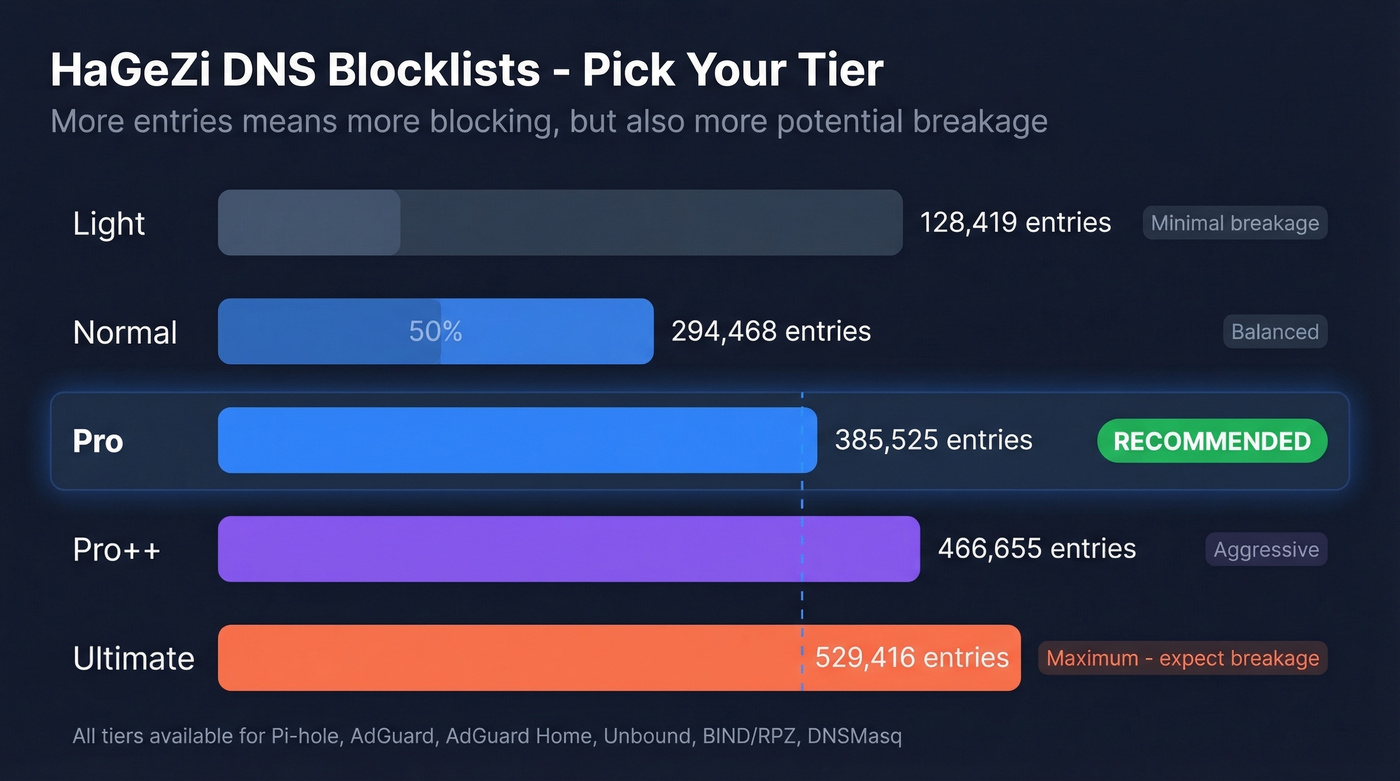
| Tier | Entries | Aggressiveness |
|---|---|---|
| Light | 128,419 | Minimal breakage |
| Normal | 294,468 | Balanced |
| Pro | 385,525 | Recommended |
| Pro++ | 466,655 | Aggressive |
| Ultimate | 529,416 | Maximum |
Multi Pro is the right tier for most users. It catches the vast majority of ads, trackers, and malicious domains without breaking legitimate sites. Formats cover Pi-hole, AdGuard, AdGuard Home, Unbound, BIND/PowerDNS RPZ, and DNSMasq.
The practitioner signal on r/pfBlockerNG is telling - the OP updated the post with: "Hagezi's Lists are the way to go... I removed all other lists." That tracks with what we've seen. HaGeZi's curation is good enough that stacking additional lists often adds false positives without meaningful coverage gains.
fabriziosalmi/blacklists
This is the brute-force option: 2,874,201 domains from 61 sources, deduplicated and updated daily. It publishes in every format you'd want - Pi-hole, AdGuard, uBlock Origin, Squid, Unbound, BIND/PowerDNS RPZ.
The trade-off is obvious. Aggregating dozens of sources increases false positive risk, and aggregation can delay unlisting compared to the original source. That means you'll sometimes need to whitelist locally even after a domain is removed upstream. Use this if you want maximum coverage and don't mind maintaining a whitelist.
Other Notable Lists
| List | Updates | Formats | Best For |
|---|---|---|---|
| StevenBlack | Regular | Hosts file | Beginners |
| OISD | Regular | Multiple | Low false positives |
| Peter Lowe | Regular | Hosts, AdGuard | Minimal blocking |
StevenBlack is the OG aggregated hosts file - solid starting point if you're new to DNS filtering. OISD focuses on minimal false positives. Peter Lowe's list is small, conservative, and nearly zero breakage.
Email Blacklist Providers
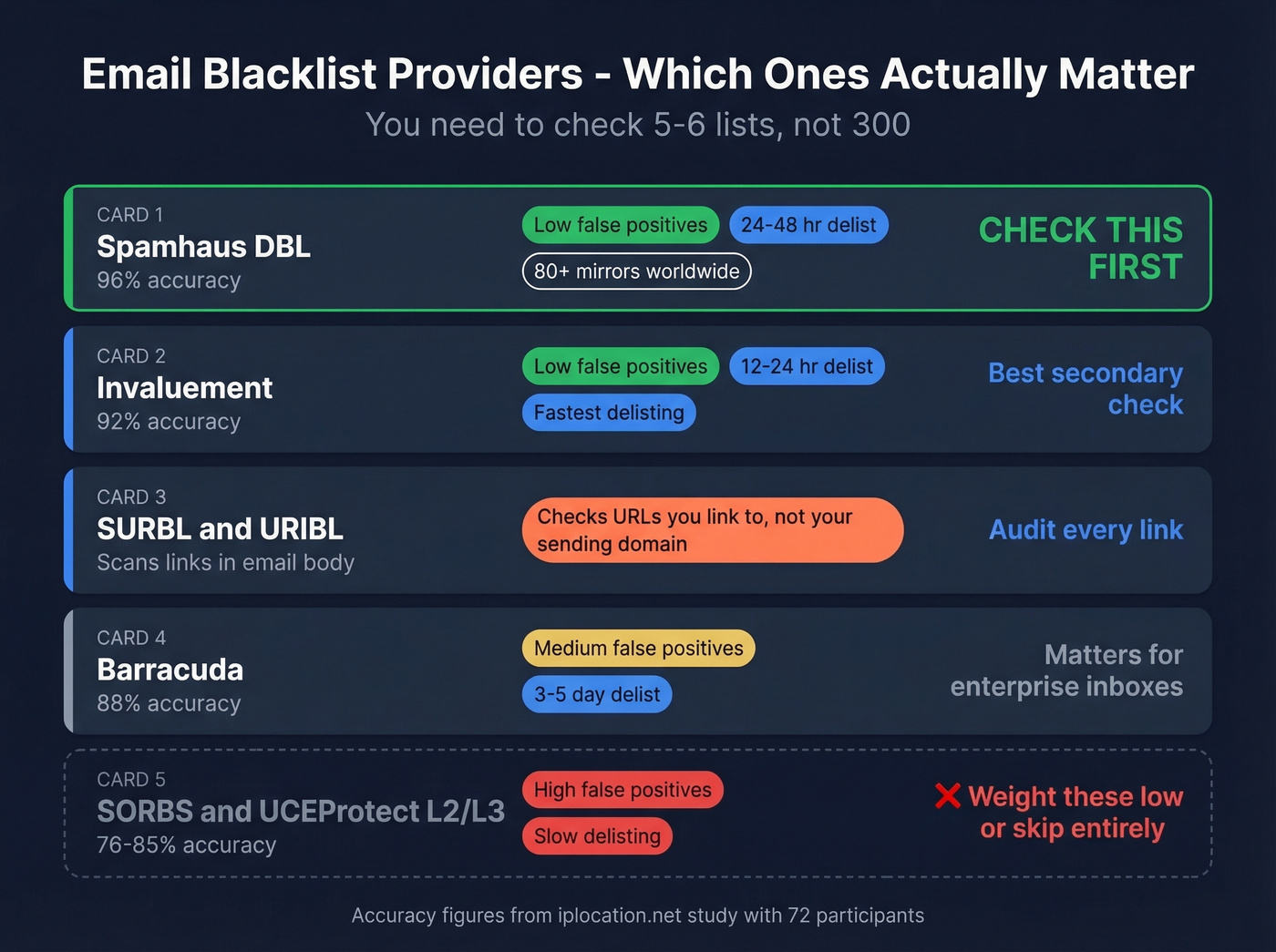
You don't need to check 300 blacklists. You need to check 5-6 that actually matter.
Here's the thing: most "check 100+ blacklists!" tools pad their count with defunct lists that no major mail server queries. We've watched clients panic over listings on obscure DNSBLs that haven't influenced delivery decisions in years.
Spamhaus DBL
The Domain Blocklist from Spamhaus is the single most important email domain blacklist. It covers domains associated with spam and malicious activity, including phishing and malware distribution, and it can flag suspicious domain activity before it's even seen in the wild.
Free for low-volume, non-commercial use. Commercial use requires an annual subscription with a free 30-day trial. If you're only going to check one DNSBL, make it this one.
SURBL & URIBL
These work differently than sender-reputation lists. SURBL and URIBL track domains that appear in spam message bodies - not the sending domain itself. Even if your sending IP and domain are perfectly clean, linking to a listed domain in your email triggers filtering.
This catches people off guard constantly. You link to a partner's site or a shortened URL that's been flagged, and suddenly your emails land in spam. The fix: audit every link in your emails before sending, avoid obscure URL shorteners, and use your own tracking domains.
Other Providers Worth Knowing
Invaluement has 92% accuracy and one of the fastest delisting timelines at 12-24 hours. Best secondary check after Spamhaus.
Barracuda sits at 88% accuracy with a medium false positive rate and 3-5 day delisting. Widely used by corporate mail filters, so it matters if you're selling to enterprises.
Abusix is smaller but highly accurate. Worth monitoring if you're sending at high volume.
Skip worrying about SORBS (76% accuracy, high false positives, 1-2 week delisting) and UCEProtect Level 2/3, which blacklists entire ISP ranges based on neighbor behavior. UCEProtect Level 1 is reasonable; anything above that is noise.
| Provider | Accuracy | False Positives | Delist Time | Our Take |
|---|---|---|---|---|
| Spamhaus | 96% | Low | 24-48 hrs | Check this first, always |
| Invaluement | 92% | Low | 12-24 hrs | Best secondary check |
| Barracuda | 88% | Medium | 3-5 days | Matters for corporate inboxes |
| UCEProtect | 85% | High | Varies | Ignore Level 2/3 |
| SORBS | 76% | High | 1-2 weeks | Weight these low |
Accuracy and delisting figures come from an iplocation.net study with 72 participants - 40 cybersecurity professionals and 32 students.

Blacklists exist because of bad data. Every bounced email from an unverified list chips away at your sender reputation. Prospeo's 5-step verification - with catch-all handling, spam-trap removal, and honeypot filtering - delivers 98% email accuracy. Clients like Snyk dropped bounce rates from 35-40% to under 5%.
Stop feeding blacklists with bad emails. Start with data that's actually verified.
Threat Intelligence Domain Feeds
If you're building DNS firewalls, SIEM rules, or automated threat response, you need raw domain IoC feeds - not email reputation lists.
For malware and phishing domains, Abuse.ch runs URLhaus, ThreatFox, and MalwareBazaar, while OpenPhish offers a verified phishing URL feed and Malc0de maintains a malware domain database. For community-contributed intelligence, AlienVault OTX provides domain indicators from a global contributor network. For structured data pipelines, CIRCL/MISP OSINT feeds deliver threat data in STIX/TAXII formats and Shadowserver Foundation publishes daily compromised infrastructure reports.
The Awesome Threat Intelligence GitHub repo catalogs hundreds of feeds - start there if you're building a multi-source pipeline.
How to Check If Your Domain Is Blacklisted
72% of email senders have never checked their DNSBL history. 25% are already on at least one list they've never heard of.
SMTP bounce logs are your first signal. In our experience, the bounce log is always more reliable than any third-party checker. Look for these codes:
550 5.7.1- blocked due to blacklist554 5.7.1- message rejected421 4.7.0- temporary block, poor reputation5.7.26- DMARC/authentication failure
Blacklist checker tools fill in the gaps. MxToolbox runs free quick checks against major lists and checks a mail server IP against over 100 DNS-based email blacklists. ZeroBounce offers blacklist monitoring and alerts you when your status changes.

Inbox placement tests are the final confirmation. Send test emails to seed accounts across Gmail, Outlook, and Yahoo. Consistent spam folder placement points to a blacklisting even when no checker flags you directly.
If you want a deeper deliverability workflow, start with an email deliverability audit and track your email bounce rate by campaign.
How to Get Delisted
Your marketing team just launched a campaign and 40% of emails bounced. Here's the playbook:
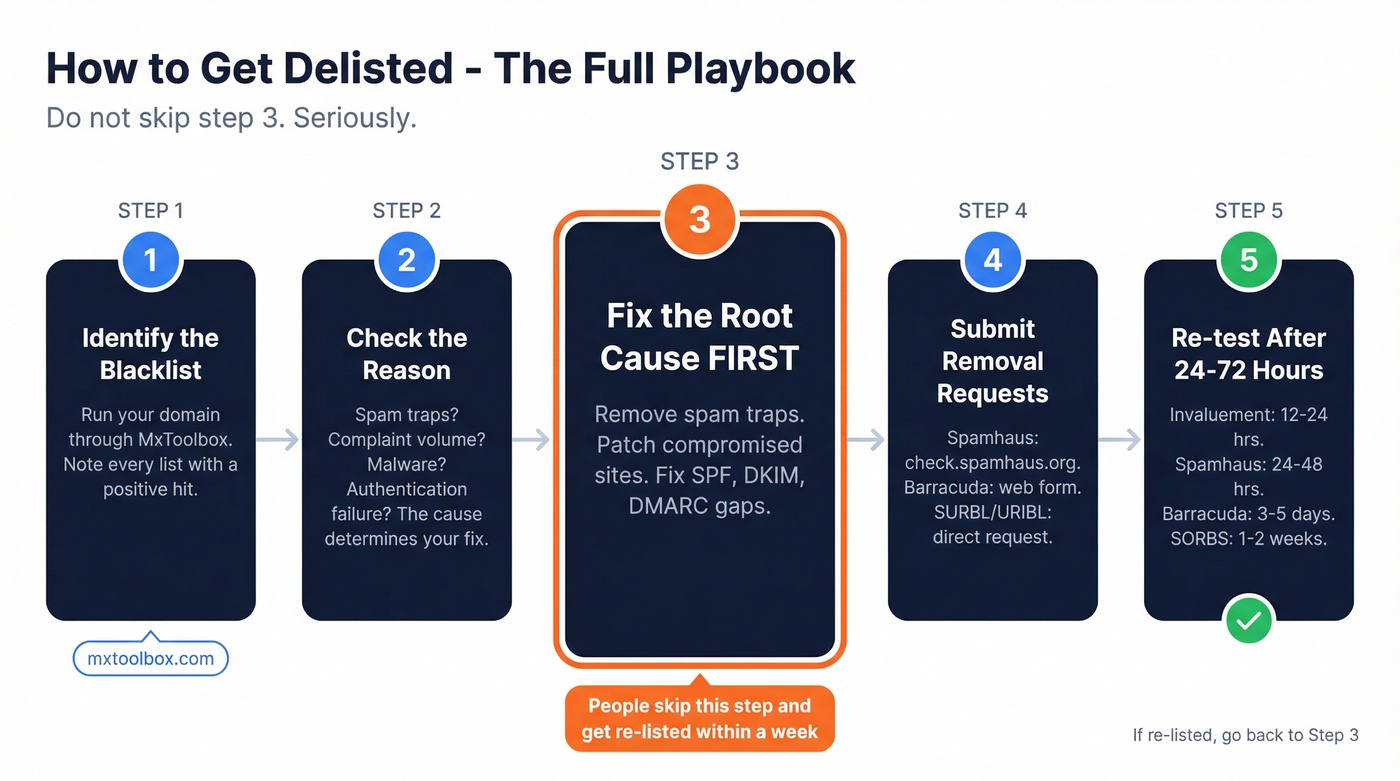
- Identify which blacklist flagged you. Run your domain through MxToolbox. Note every list that returns a positive hit.
- Check the stated reason. Spam traps, complaint volume, malware hosting, authentication failures - the cause determines your fix.
- Fix the root cause first. This is the step people skip, and it's why they get re-listed within a week. Remove spam trap addresses. Patch compromised sites. Fix SPF/DKIM/DMARC gaps.
- Submit removal requests. Spamhaus uses check.spamhaus.org. Barracuda has a web form. SURBL and URIBL require direct requests. Don't submit until the root cause is actually fixed.
- Re-test after 24-72 hours. Invaluement processes in 12-24 hours, Spamhaus in 24-48 hours, Barracuda in 3-5 days, SORBS in 1-2 weeks.
For Spamhaus-specific steps, follow our Spamhaus Blacklist Removal guide.
How to Avoid Getting Blacklisted
Prevention is cheaper than remediation. Every time.
If your average deal size is under $15K, a single blacklisting event will cost you more in lost pipeline than a year of proper email hygiene tooling. The math isn't close.
Set up SPF, DKIM, and DMARC. This is table stakes in 2026. If you haven't configured all three, you're one spam complaint away from a listing. Mailmonitor's guide covers the setup well. For the technical details, see DMARC alignment and an SPF record example.
Maintain list hygiene ruthlessly. Remove hard bounces immediately. Honor unsubscribes fast. Purge inactive addresses quarterly. Stay below a 0.1% spam complaint threshold. If you suspect traps, use a dedicated spam trap removal process.
Audit every link in your emails. SURBL and URIBL don't care about your sender reputation. One link to a flagged domain and your message gets filtered.
Use separate domains for transactional email and marketing/outbound. If your marketing domain gets listed, your password reset emails still arrive.
Verify your data before sending. Most domain blacklisting starts with bad data - sending to spam traps, dead addresses, or honeypots that exist specifically to catch careless senders. Prospeo's 5-step verification catches all three before you hit send, with 98% email accuracy and a 7-day data refresh cycle. Stack Optimize scaled to $1M ARR on verified data from Prospeo - 94%+ deliverability, bounce under 3%, zero domain flags across every client.

Check domain reputation before purchasing. Inherited blacklistings from previous owners are a real risk that catches new domain buyers off guard.
Never use purchased or scraped lists. They're loaded with traps. The $200 you saved on a bought list will cost you $20,000 in lost deliverability and remediation time. If you're sending at scale, use the best way to send bulk email without getting blacklisted playbook and monitor email reputation tools.
You're reading about blacklisted domains because deliverability matters to your pipeline. Stack Optimize built a $1M agency on Prospeo data - 94%+ deliverability, under 3% bounce rate, zero domain flags. That's what happens when emails are refreshed every 7 days instead of the industry-average 6 weeks.
Clean data at $0.01/email beats delisting requests every time.
FAQ
What Is a DNSBL?
A DNS-based blackhole list is a real-time database of IP addresses or domains linked to spam or malicious activity, queried by mail servers via standard DNS lookups to accept, quarantine, or reject messages. The lookup adds near-zero latency since it piggybacks on existing DNS infrastructure.
Can I Download a Blacklisted Domains List for Free?
Yes. The fabriziosalmi/blacklists GitHub repo aggregates 2.87 million domains from 61 sources, updated daily, in Pi-hole, AdGuard, Unbound, and BIND formats. For curated lists with lower false positive risk, HaGeZi offers tiers from 128K to 529K entries. Both are free.
What's the Difference Between IP and Domain Blacklists?
IP blacklists flag sending server addresses - the infrastructure delivering your email. Domain blacklists flag domain names in sender addresses, URLs, or email body links. You can be clean on one and listed on the other, so check both using MxToolbox or a similar multi-list checker.
How Do I Blacklist a Domain on My Own Network?
Add it to your Pi-hole or AdGuard Home blocklist manually, or append it to a custom hosts file. Most DNS filtering tools let you maintain a personal list alongside community-maintained feeds like HaGeZi or OISD.
How Long Does Blacklist Delisting Take?
Invaluement is fastest at 12-24 hours. Spamhaus processes most requests within 24-48 hours. Barracuda takes 3-5 days. SORBS is slowest at 1-2 weeks. The biggest variable is whether you've actually fixed the root cause - submit without fixing and you'll be re-listed within days.