

Bouncify vs ListKit: Which Do You Need in 2026?
Comparing Bouncify to ListKit is like comparing a spell-checker to a word processor. One cleans email lists you already have. The other builds lead lists from scratch. They don't compete - they solve different problems at different stages of outbound.
The confusion exists because ListKit markets "triple verification" as a built-in feature, which makes people wonder if they need a dedicated verifier at all. A Skool community report found 35-40% of ListKit leads got discarded on re-verification. So yes, you probably do.
What Each Tool Actually Does
Bouncify is a pure email verification service. Upload a CSV, and it runs syntax checks, domain/DNS validation, SMTP verification, catch-all detection, spam-trap removal, and disposable email filtering. It doesn't find leads. It takes emails you already have and tells you which ones are safe to send to.
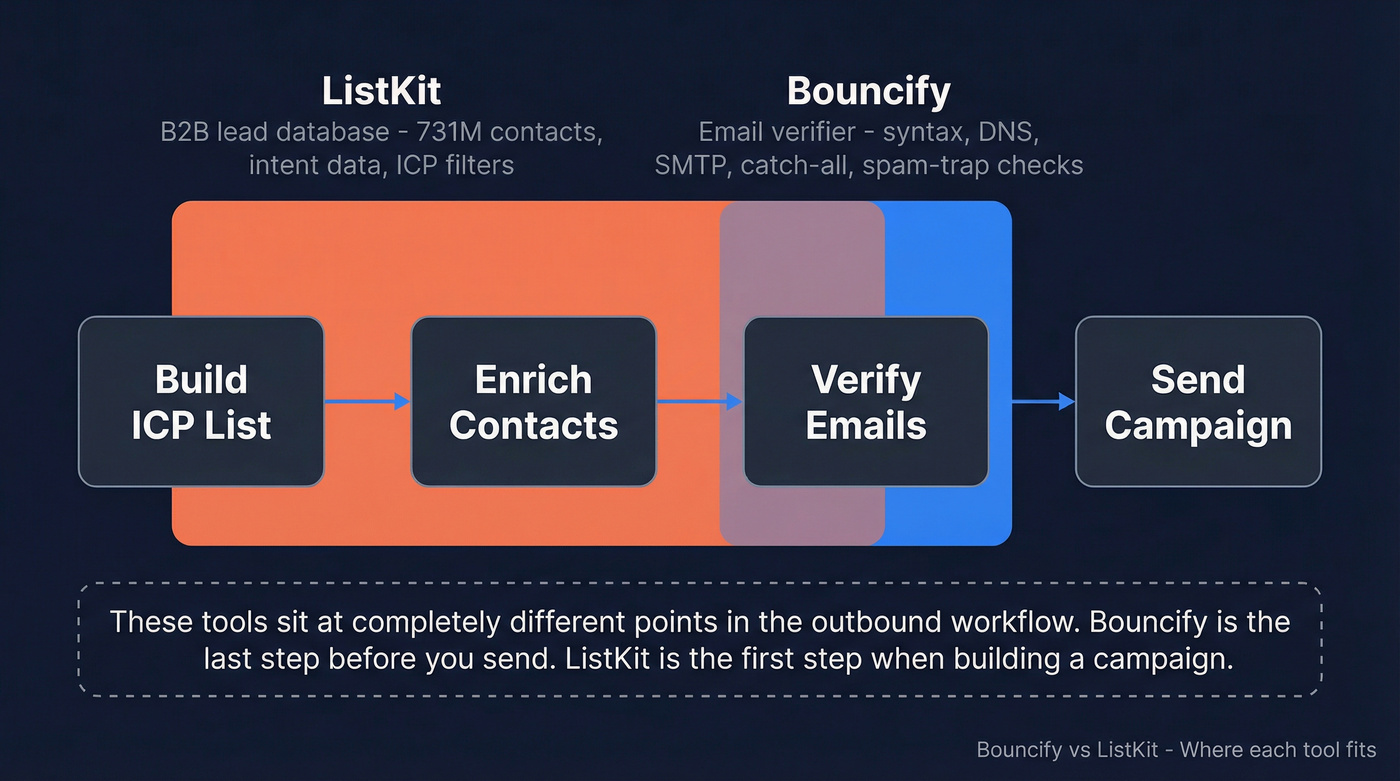
ListKit is a B2B lead generation database with 731M contacts, intent data powered by 21B daily buying signals, and workflows that push leads into sequencers. You search by ICP filters, export enriched leads, and push them into your sending tool. Its credit system is field-based - different data points like business email, mobile phone, and intent signals each cost different amounts.
Here's the thing: these tools sit at completely different points in the outbound workflow. Bouncify is the last step before you hit send. ListKit is the first step when you're building a campaign from zero.
Side-by-Side Comparison
| Bouncify | ListKit | |
|---|---|---|
| Category | Email verifier | B2B lead database |
| G2 Rating | 4.3/5 (15 reviews) | 4.7/5 (388 reviews) |
| Pricing Model | Pay-as-you-go credits | Subscription + credits |
| Starting Price | $9 / 3K verifications | $0 (free / 100 credits) |
| Integrations | n8n, Zoho CRM | Instantly, Make, Salesforce, Google Workspace, Outlook, Apollo.io |
| Best For | Cleaning existing lists | Building new lists |
ListKit has 25x more G2 reviews, which makes sense for a broader product. Bouncify's smaller footprint reflects niche focus, not quality issues.
Pricing Breakdown
Bouncify runs on simple pay-as-you-go packs:
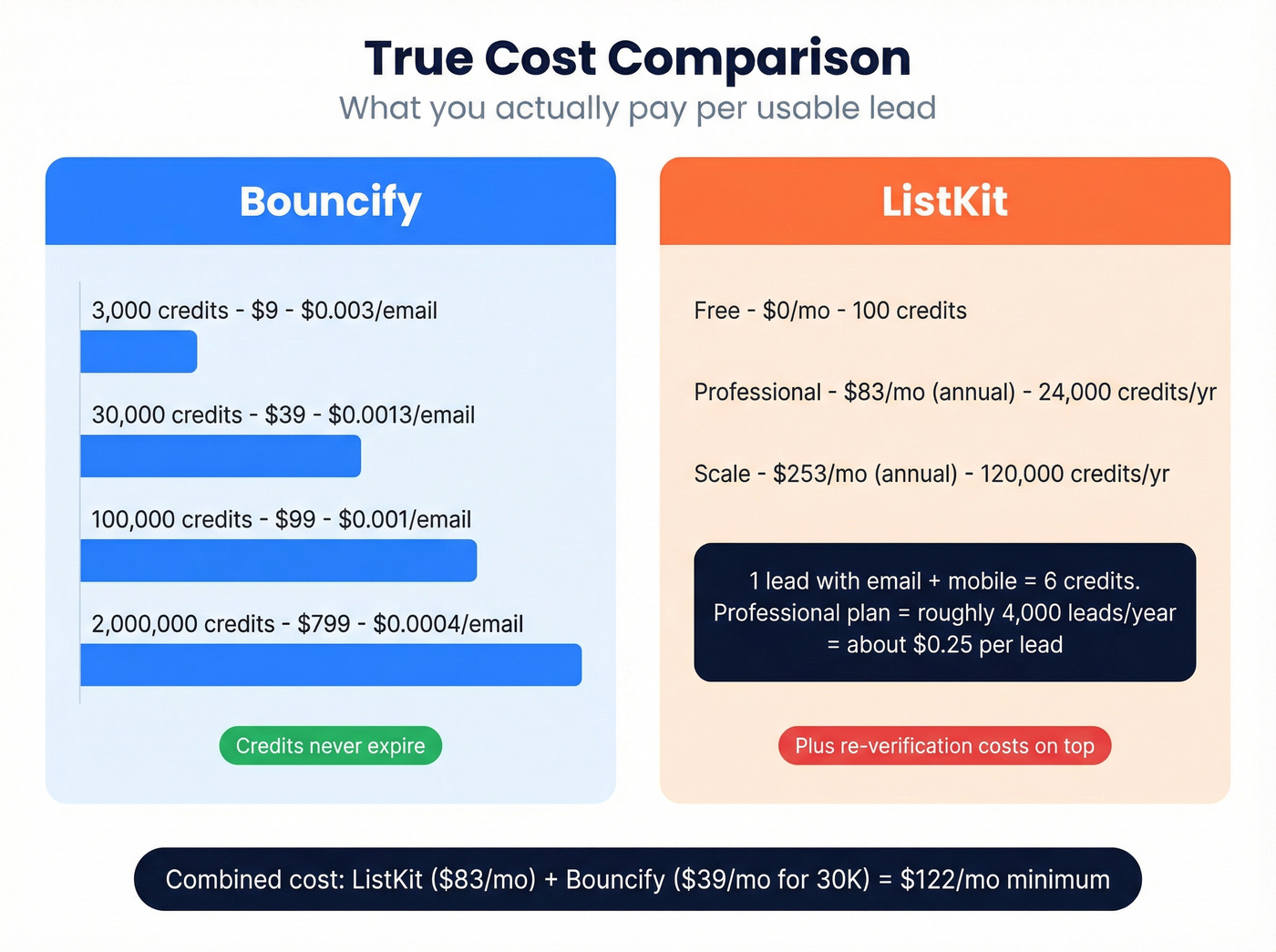
| Credits | Price | Per Email |
|---|---|---|
| 3,000 | $9 | $0.003 |
| 30,000 | $39 | $0.0013 |
| 100,000 | $99 | $0.001 |
| 2,000,000 | $799 | $0.0004 |
Unused credits don't expire - a nice touch for teams with irregular volumes.
ListKit uses subscription tiers (annual billing):
| Plan | Monthly (annual) | Credits/Year |
|---|---|---|
| Free | $0 | 100 |
| Professional | $83/mo | 24,000 |
| Scale | $253/mo | 120,000 |
One gotcha: ListKit's pricing page shows $83/mo for Professional, but the calculator shows $97/mo. The $83 figure is the annual-billed effective rate (~$996/year), while $97 is month-to-month.
A single lead with a business email and mobile number costs 6 credits (1 for business email + 5 for mobile). On Professional, that's roughly 4,000 usable leads per year - about $0.25 per lead before re-verification costs and any extra enrichment fields you tack on. (If you want the full math, see our ListKit pricing breakdown.)

ListKit charges ~$0.25/lead before re-verification. Bouncify adds another bill on top. Prospeo finds leads from 300M+ profiles AND verifies them in one step - 98% accuracy, 7-day data refresh, ~$0.01 per email. No two-tool tax.
Stop duct-taping a lead database to a verifier. Use one platform.
Do You Still Need a Verifier with ListKit?
ListKit's own comparison pages say "No need for separate email verification." But that Skool community report tells a different story: 35-40% of ListKit leads got discarded when re-verified through Smartlead's built-in verifier. On a 1,000-lead export, that's 350-400 emails that would bounce.
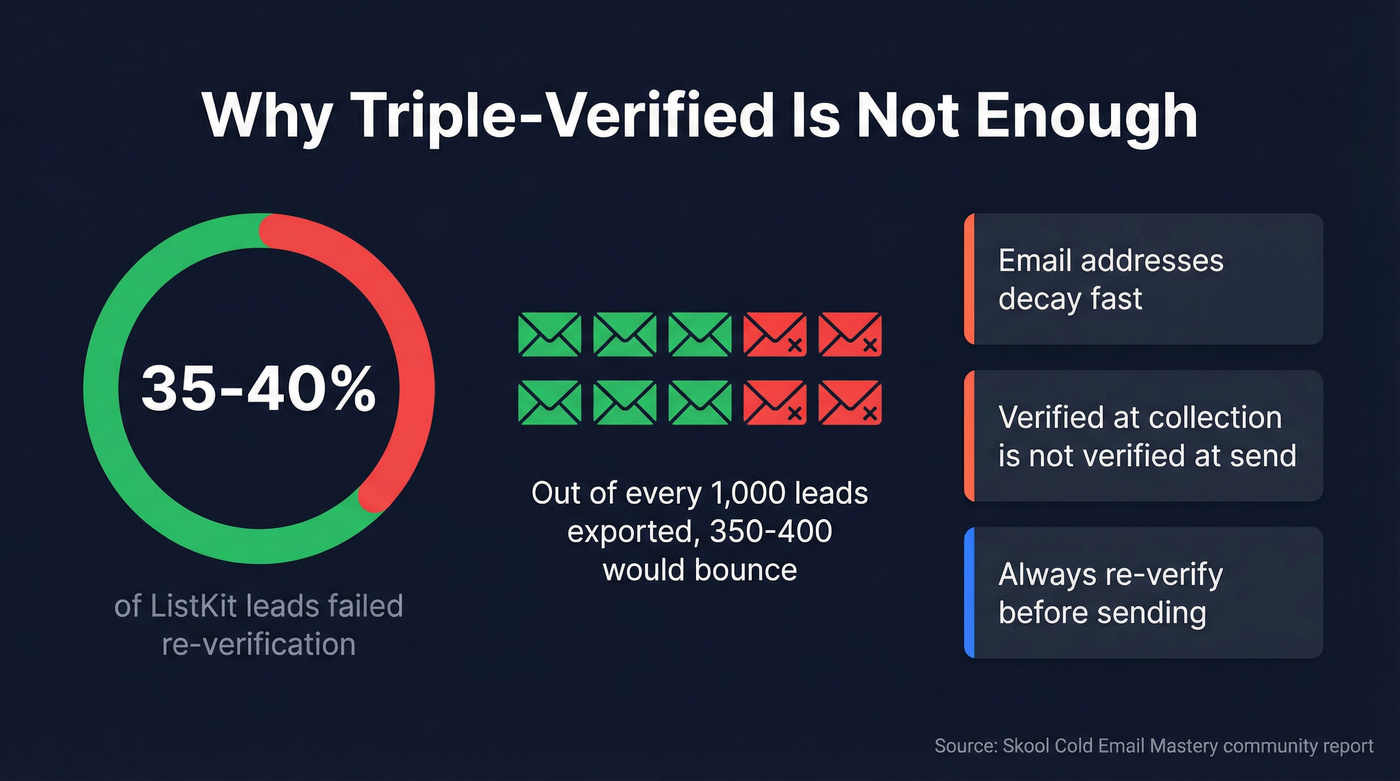
We've seen this pattern across multiple lead databases. Verification at collection doesn't equal verification at send. Dedicated verifiers run real-time SMTP handshakes, catch-all domain handling, and spam-trap detection at the moment you're about to mail, while a lead database typically verifies as part of its data pipeline weeks or months earlier.
Email addresses decay fast. Someone valid when ListKit indexed them three months ago might bounce today. If you're using ListKit, budget for a separate verification pass.

What Users Actually Say
ListKit earns praise for customer support (64 G2 mentions) and ease of use (54 mentions), with 90% five-star reviews. The cons are real though: cost complaints appear in 16 reviews, and users frequently mention incorrect or outdated contact info leading to no-shows on calls. One Reddit user reported being required to attend an "onboarding meeting" just to cancel, followed by repeated rebilling after a chargeback. The poster later edited that the billing pressure stopped, but still criticized the model.
Bouncify gets praised for accuracy and straightforward bulk cleaning. The downsides: API stability issues with jobs hanging near completion, and rigid credit packaging with no tier between 30K and 100K verifications.
Let's be honest - "triple-verified" is doing heavy marketing lifting for ListKit. It's a solid product with genuinely good support. But if your deliverability matters (and it should), treat any lead database's built-in verification as a first filter, not the final word. The consensus on r/coldemail threads is pretty consistent: always re-verify before sending, regardless of what the data provider claims. (More on protecting your domain in our email deliverability guide.)
A Platform That Handles Both
Most cold email teams end up paying for a lead database and a verifier anyway. We got tired of that two-tool tax.
At ~$0.01 per email with a free tier (75 emails + 100 Chrome extension credits/month), no annual contracts, and no sales calls required, one tool beats two. If you're comparing stacks, start with these outbound lead generation tools and email reputation tools.
35-40% of leads failing re-verification means you're burning credits and killing sender reputation. Prospeo's proprietary 5-step verification - with catch-all handling, spam-trap removal, and honeypot filtering - runs on a 7-day refresh cycle so your data is verified when you send, not when it was scraped months ago.
Get leads that actually land in inboxes. Free tier, no contracts.
Which One Do You Need?
You have lists and need to clean them. Bouncify. It's cheap, credits don't expire, and it does one thing well. Start at $9 for 3,000 verifications. (If you're evaluating options, see our Bouncer alternatives list.)
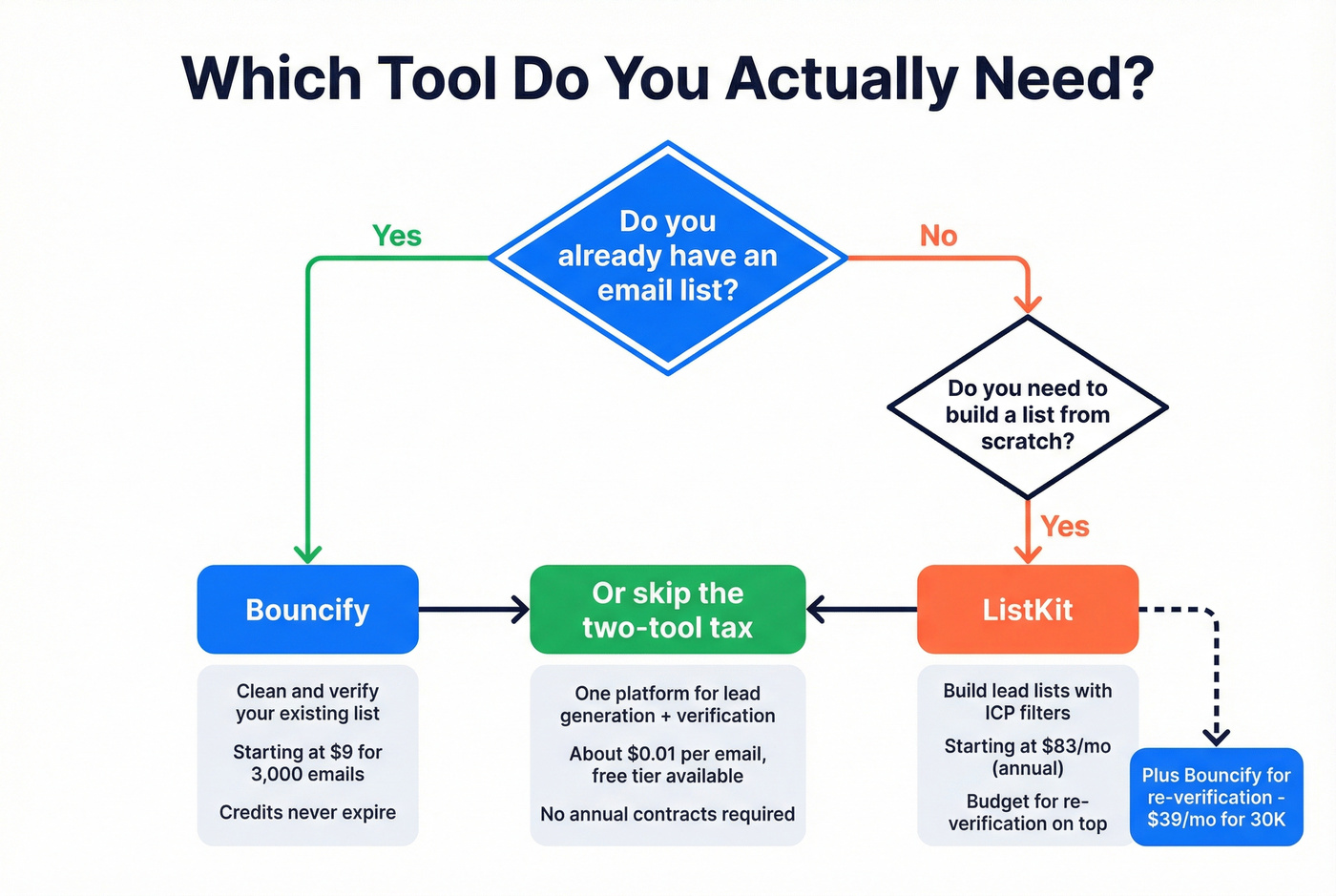
You need to build lists from scratch. ListKit works, but budget for re-verification on top. Between the subscription and a separate verifier, expect $100-130/mo minimum. If you're still deciding, compare more sales prospecting databases and data enrichment services.
You want both in one tool. Skip the two-subscription shuffle. If you're running volume outbound and your deal sizes are mid-market or above, paying for two tools to do what one platform handles is money left on the table.
FAQ
Is Bouncify a ListKit alternative?
No - they solve different problems. Bouncify verifies existing email lists; ListKit builds new lead lists from a B2B database. You can use them together, but they don't replace each other.
Does ListKit replace email verification?
Not reliably. Community reports show 35-40% of "triple-verified" ListKit leads failing third-party re-verification. Run a dedicated verification pass before sending to protect your domain reputation.
Is there a tool that combines lead generation and verification?
Prospeo offers 300M+ leads with built-in 5-step verification, 98% email accuracy, and a free tier of 75 credits per month. It handles both list building and verification without a separate subscription.
How much does Bouncify cost per email?
Between $0.003 at the 3,000-credit tier and $0.0004 at 2,000,000 credits. Credits never expire, so you can buy in bulk without pressure to use them immediately.