

How to Handle Budget Objections: What 67,149 Sales Calls Reveal
You just heard "our budget is locked until next fiscal year" for the third time this week. Your instinct is to pitch harder. That instinct is wrong - and Gong's analysis of 67,149 sales meetings shows the behaviors that separate top reps from everyone else when budget objection handling matters most.
Here's the stat that should keep you up at night: 60% of prospects say "no" up to four times before saying "yes," yet 56% of reps quit after the first rejection. Getting this right can lift win rates by nearly 30%. The gap between good and great here is enormous.
Quick version of what we've found works:
- Diagnose first. A lot of "no budget" objections are brush-offs. Ask a question before you respond.
- Pause, don't monologue. Top reps pause after objections. Average reps launch into a 21.45-second lecture.
- Understand where budget comes from. Contingency funds, OpEx levers, deferred investment. Help your champion build the internal case.
Real or Brush-Off? Diagnose First
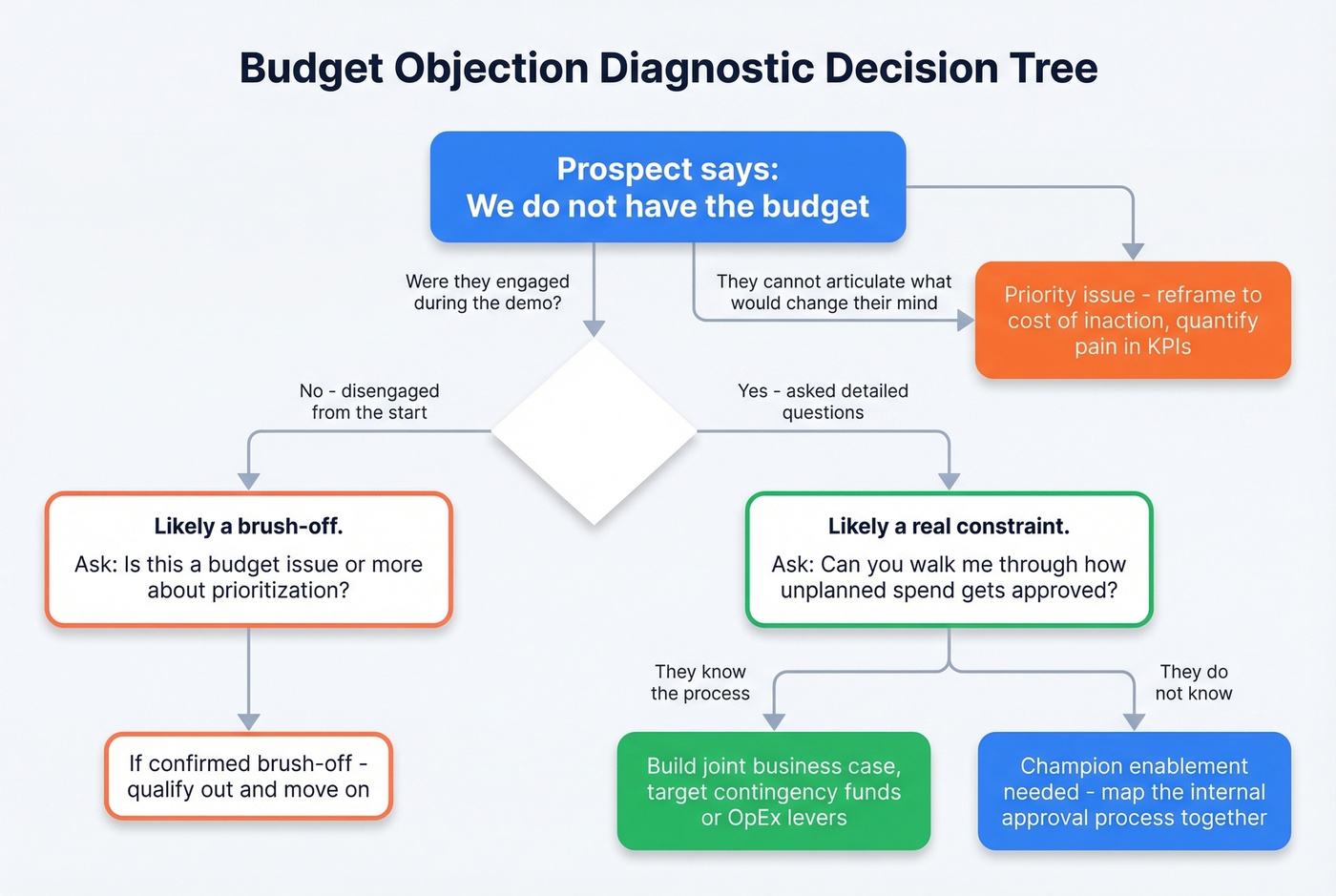
The classic mistake is believing the first objection is real. It rarely is. Budget objections are often less about money and more about priority, trust, or talking to the wrong person entirely.
Real constraint: The prospect was engaged throughout the demo, asked detailed questions, but objected at close. The money genuinely isn't there right now. Brush-off: The prospect was disengaged from the start and dropped "no budget" the moment you mentioned pricing - they're trying to exit the conversation. Priority issue: The prospect says "budget is locked" but can't articulate what they'd need to see to revisit. You haven't made the case for urgency.
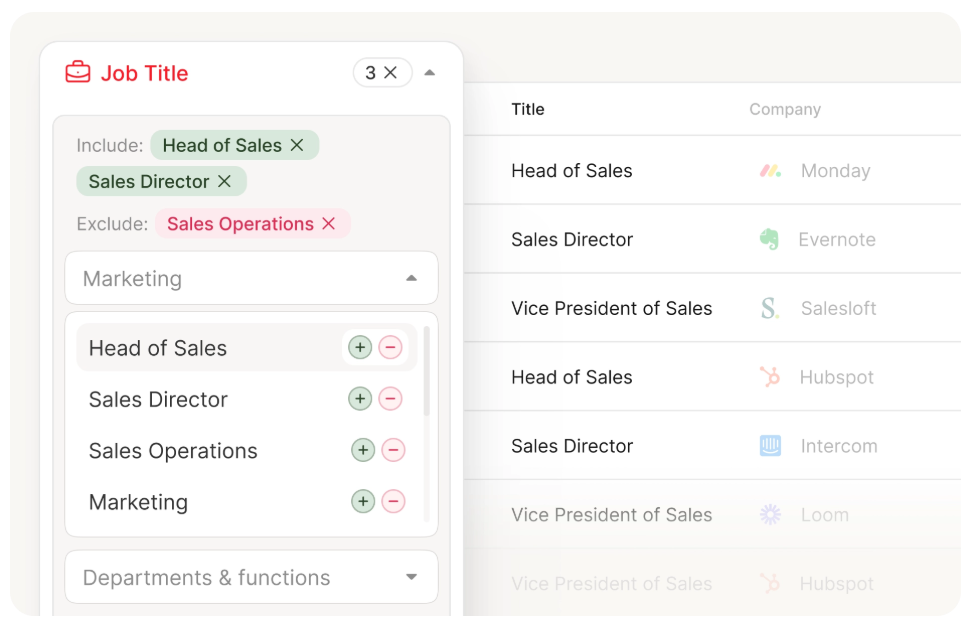
Here's a pattern we see constantly: reps getting these objections from people who don't control budget. If that's happening, the problem is upstream - you're targeting the wrong contact. Prospeo's 30+ search filters let you target economic buyers by seniority, department, and title with 98% email accuracy, so your outreach actually reaches the person who signs off on spend.
What Top Reps Do Differently
When an objection lands, average reps speed up and start talking. Top reps do the opposite.
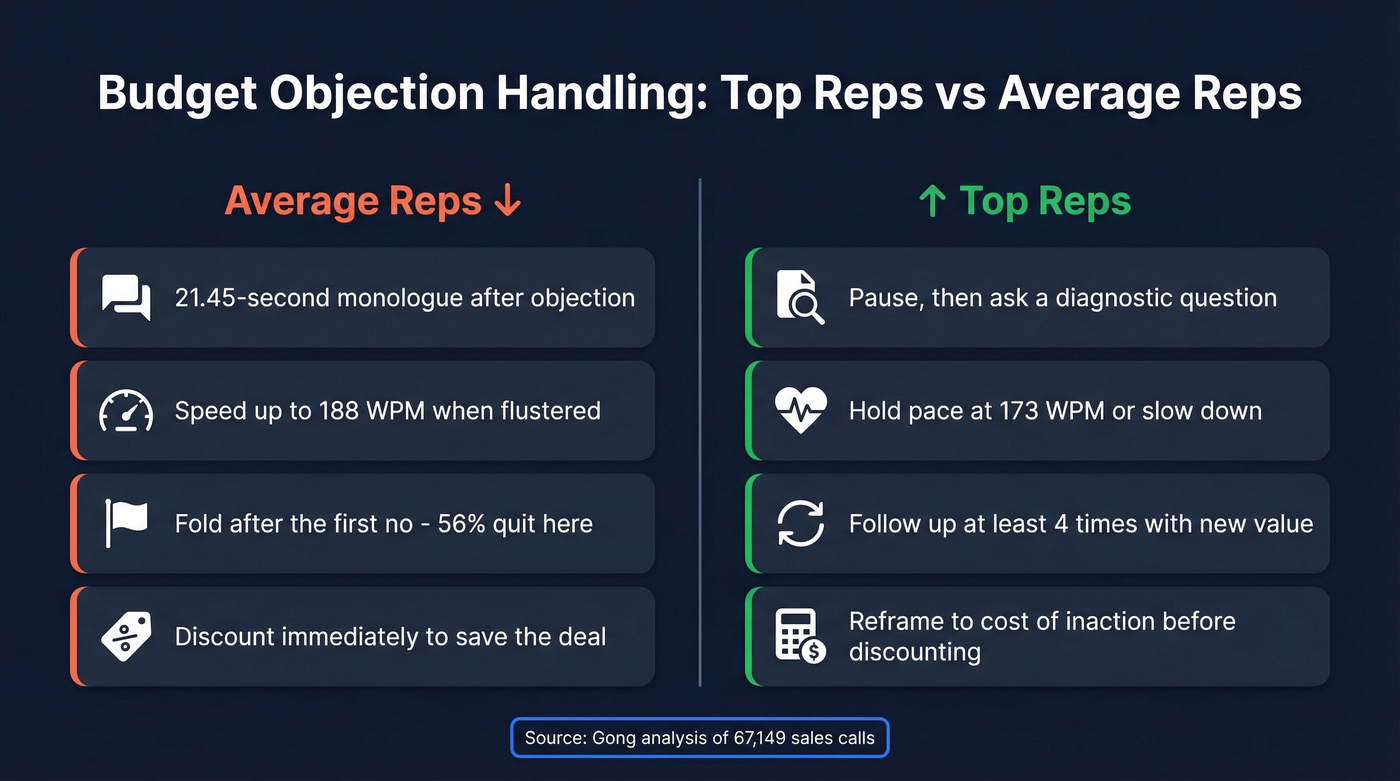
They pause, then ask a question. That single behavioral difference separates winners from everyone else, and the numbers are specific. Average reps respond to objections with a 21.45-second monologue. The conversation becomes a lecture. Top reps maintain steady back-and-forth - their "speaker switches" stay consistent even through tough objections. Instead of asking "why" (which triggers defensiveness), they use lines like "Can you help me understand what's driving that concern?" to keep the dialogue open.
Talking speed tells the same story. The average in sales conversations is 173 WPM. When flustered, reps accelerate to 188 WPM. Prospects hear panic, not confidence. Top reps hold pace or slow down deliberately.
Let's be honest about something: surface the pain before you ever discuss money. If a prospect doesn't viscerally feel the cost of inaction, no reframe or script will save you. The reps who close budget-constrained deals aren't the ones with better scripts - they're the ones who made the problem feel urgent three calls ago.
Five Mistakes That Kill Deals
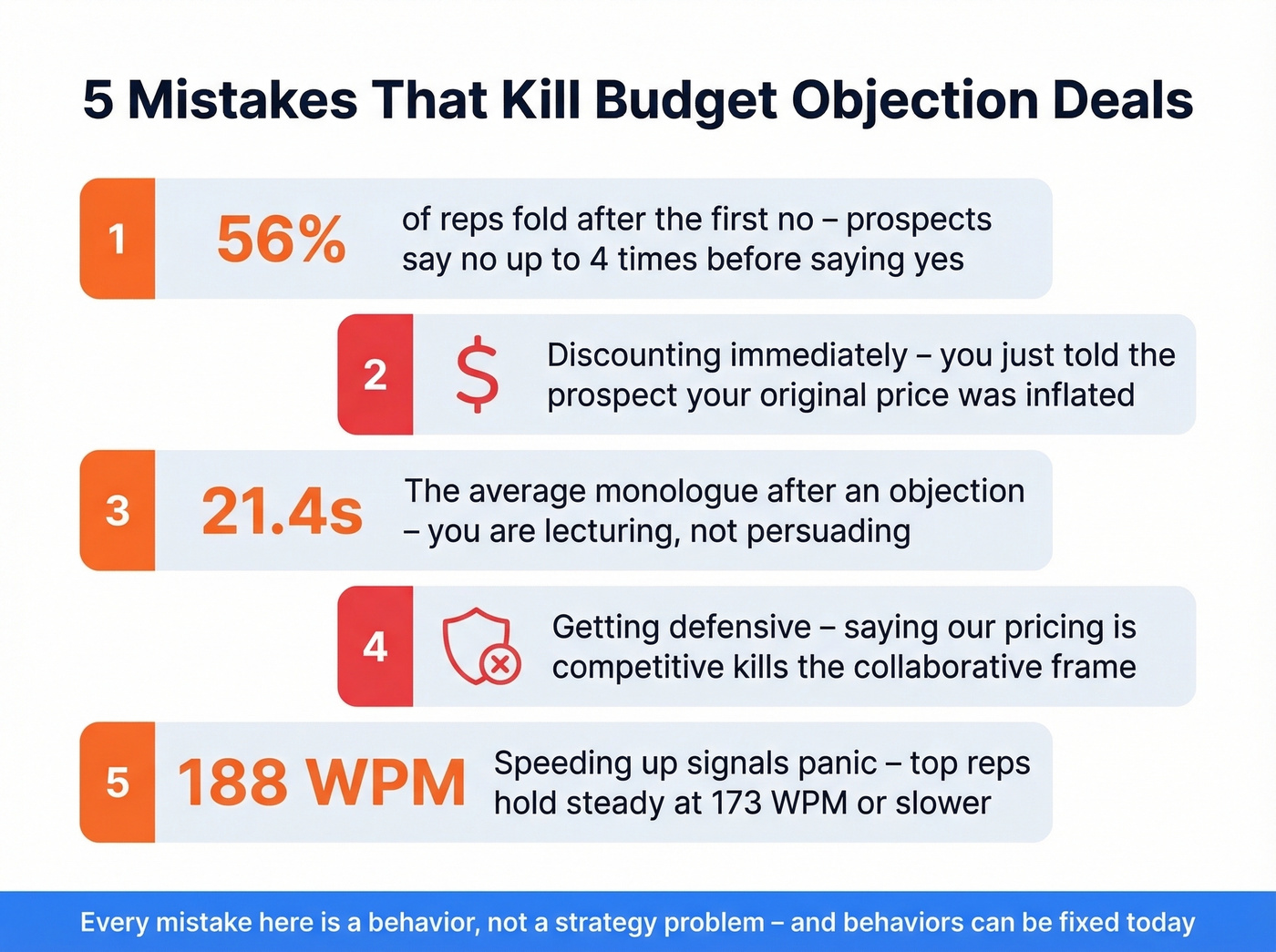
- Folding after the first no. 56% of reps do this. The prospect hasn't even finished objecting and you're already mentally moving to the next lead.
- Discounting immediately. You just told the prospect your product is worth $50k/year, then offered 30% off ten seconds later. You've negotiated against yourself.
- Monologuing. The 21.45-second lecture. You're not persuading - you're making the prospect wait for you to stop talking so they can say no again.
- Getting defensive. The moment you say "but actually, our pricing is very competitive," you've lost the collaborative frame.
- Speeding up. 188 WPM is the sound of a rattled rep. Slow down.
Mistake #2 is the one that frustrates us most, because it's so easy to avoid. If you discount within the first 30 seconds of hearing a budget objection, you've told the prospect your original price was inflated - and they'll push for more.
If you want to reduce how often you hear this in the first place, focus on how to reduce sales objection rate upstream (targeting, positioning, and qualification), not just rebuttals.

Half of budget objections happen because reps pitch the wrong person. Prospeo's 30+ search filters let you target economic buyers by seniority, department, and title - so you reach the person who actually signs off on spend. 98% email accuracy means your outreach lands.
Stop pitching gatekeepers. Start reaching budget holders.
Scripts That Actually Work
"Budget is locked until next quarter"
This is usually a priority issue disguised as a timing issue. A response from r/sales nails the reframe - quantify the cost of waiting, then offer collaborative escalation:
"Jordan... if this backlog compounds... we're talking about 300+ hours lost by next fiscal; is there usually a process for surfacing that kind of operational risk to leadership now, or would it make sense for us to map out the cost together...?"
It shifts from "can we afford this?" to "can we afford not to?" You're not pushing - you're helping them build the internal case.
Handling a Budget Freeze
The Black Swan Group's paraphrase technique works here: "So it sounds like you really see the value... but the budget is standing in the way." Then pause. This validates the prospect while separating value from budget - two different conversations. A freeze requires patience because the constraint is often organization-wide, not personal.
If it's a real constraint, pivot to structure: a pilot, phased rollout, or monthly billing instead of annual. SMB buyers especially value low-risk entry points like trials, guarantees, and month-to-month options. Skip this approach for enterprise deals where the buyer has already confirmed executive sponsorship - in those cases, structural concessions signal weakness rather than flexibility.
"It's too expensive"
This is a value gap, not a budget gap. Label it: "It sounds like the value just isn't there for you." Then stop talking.
Dynamic silence forces the prospect to either confirm (you rebuild the value case) or correct you (which reopens the conversation on their terms). For enterprise deals, quantify pain in KPIs - lost productivity hours, delayed time-to-revenue, cost of the status quo. Arm your champion with a business case they can take to finance. This is how you overcome budget objections consistently: make the cost of inaction louder than the cost of your solution.
If you need a tighter discovery flow to uncover that pain earlier, use a structured set of discovery questions (or go deeper with MEDDIC sales qualification).
Where Budget Actually Comes From
Look - the "no budget" objection is rarely about the budget. It's about financial priority. Understanding how your prospect's finance team works gives you an unfair advantage over every rep who just "reframes to value."
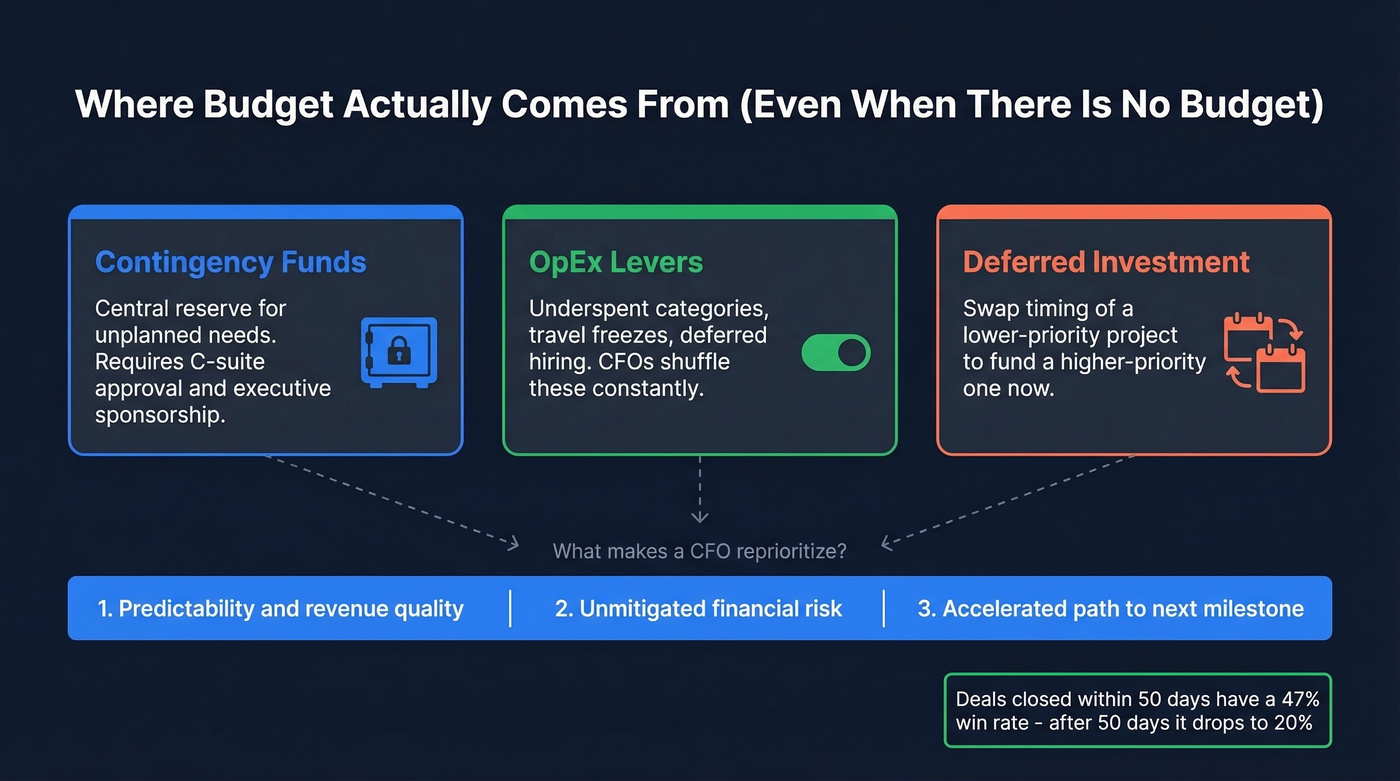
Three places budget comes from, even when "there's no budget":
- Contingency funds. Most companies hold a central reserve for unplanned needs. Accessing it requires C-suite approval, which means you need executive sponsorship.
- OpEx levers. Underspent categories, travel freezes, deferred hiring. CFOs shuffle these constantly, especially during periods of tighter financial scrutiny across the org.
- Deferred investment. Swapping the timing of a lower-priority project to fund a higher-priority one right now.
What makes a CFO reprioritize? Predictability and revenue quality, unmitigated financial risk, and an accelerated path to the next milestone. Frame your pitch around one of those and you're speaking finance, not sales. We've seen reps close six-figure deals mid-freeze by walking a champion through the contingency fund request process step by step - most champions don't even know the process exists until you tell them.
One more data point worth knowing: deals closed within 50 days have a 47% win rate. After 50 days, win rates drop to 20% or lower. Every week you let a "budget is locked" stall drag on, your odds are shrinking.
To keep deals moving, build a repeatable sales process optimization cadence and track pipeline health so stalls show up early.
Quick-Reference Cheat Sheet
| Objection | Diagnosis | Best Response | Next Step |
|---|---|---|---|
| "Budget is locked next quarter" | Priority / timing | Cost-of-inaction reframe | Joint business case session |
| "We don't have the money" | Real or brush-off | "Budget issue or prioritization?" | If real: pilot. If not: qualify out |
| "It's too expensive" | Value gap | Label + pause | Pivot to ROI quantification |
| "Need to check with finance" | Missing champion enablement | "What will you tell them?" | Build the case together |
| "Already spent our budget" | Deferred investment | "Where does unplanned spend come from?" | Introduce contingency/OpEx framing |
If you're following up after a budget objection, don't wing it - use proven sales follow-up templates and a consistent sales meeting follow-up email format to keep momentum.
You can't arm a champion with a business case if you never reached them in the first place. Prospeo gives you verified emails and direct dials for 300M+ professionals - refreshed every 7 days, not 6 weeks. At $0.01 per email, bad targeting is the only expensive mistake left.
Reach the right buyer before you ever have to overcome an objection.
FAQ
What's the most common budget objection in B2B sales?
"No budget" or "budget is locked" tops the list. Often it's a brush-off masking a priority or trust issue rather than a genuine financial constraint. Effective budget objection handling starts with diagnosing which scenario you're facing - real constraint, brush-off, or priority gap - before choosing a response.
How do you respond when a prospect says "we don't have the budget"?
Pause, then ask a diagnostic question: "Is this truly a budget issue, or more about prioritization right now?" Gong data shows top reps ask a question first while average reps launch into a 21.45-second monologue. That pause is the single highest-leverage habit you can build.
How many times should you follow up after a budget objection?
At least four times. 60% of prospects say no four times before saying yes, but 56% of reps give up after the first rejection. Pair each follow-up with new value - a case study, an ROI calculation, or a relevant trigger event - not just a "checking in" email.
How do you find the right person to pitch when budget decisions sit higher up?
Use a B2B data platform with seniority and department filters to target VP-level and C-suite contacts directly. Prospeo's 30+ search filters let you find economic buyers by title, department, and company size, with 98% verified emails so your outreach lands in the right inbox instead of bouncing.