

The 8 Best Bulk Email Finder Tools in 2026
A bad bulk email finder will cost you more than money. Upload 10,000 contacts, hit send, and a 12% bounce rate tanks your sending domain overnight - now even warm leads aren't seeing your emails. We've watched it happen to teams that picked their tool based on database size alone, and the recovery takes months.
Here are eight tools worth testing, ranked by what actually matters: accuracy, cost per usable email, and whether they'll protect your domain or destroy it.
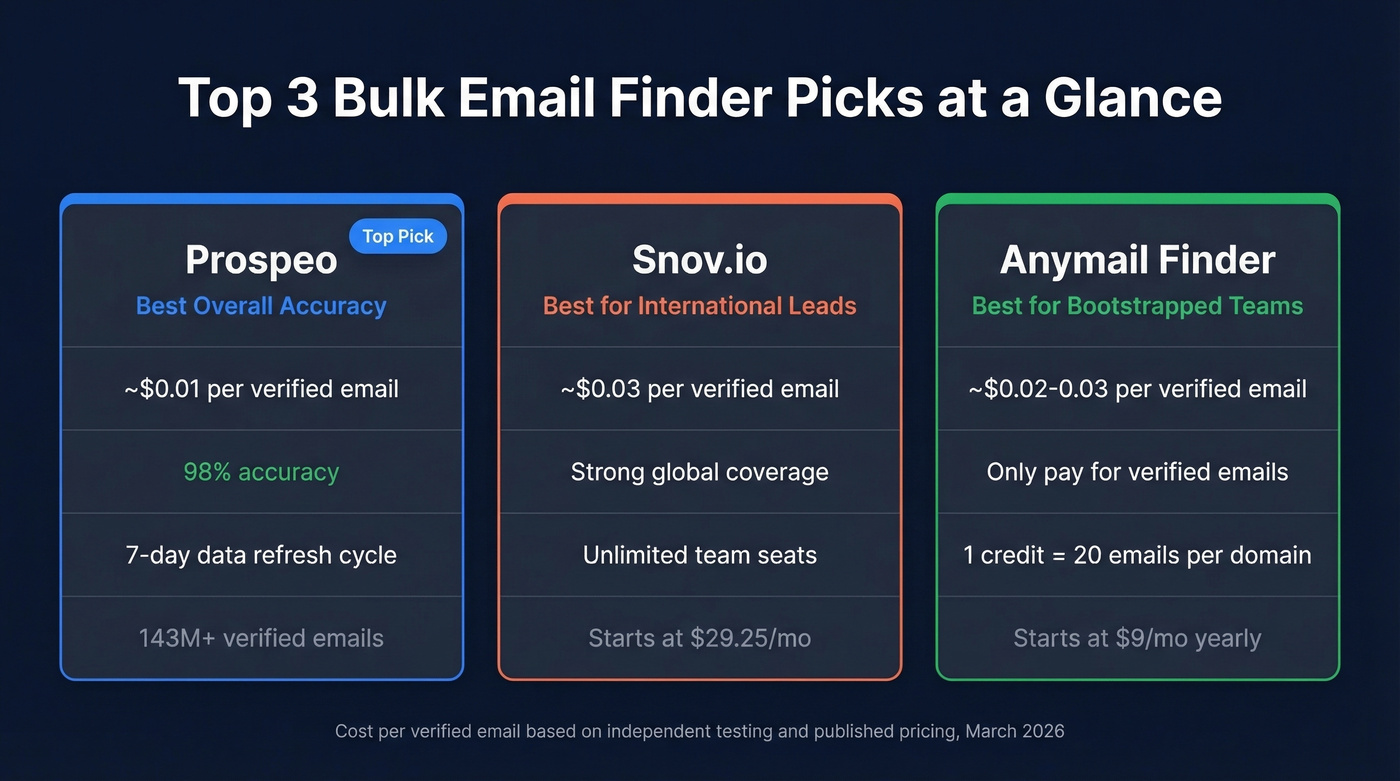
Our Picks (TL;DR)
| Tool | Cost/Verified Email | Best For |
|---|---|---|
| Prospeo | ~$0.01 | Accuracy and data freshness |
| Snov.io | ~$0.03 | International leads on a budget |
| Anymail Finder | ~$0.02-0.03 | Bootstrapped teams |
What Makes a Good Tool
Not all email finders are built the same. Before you trial any software, evaluate against these six criteria:
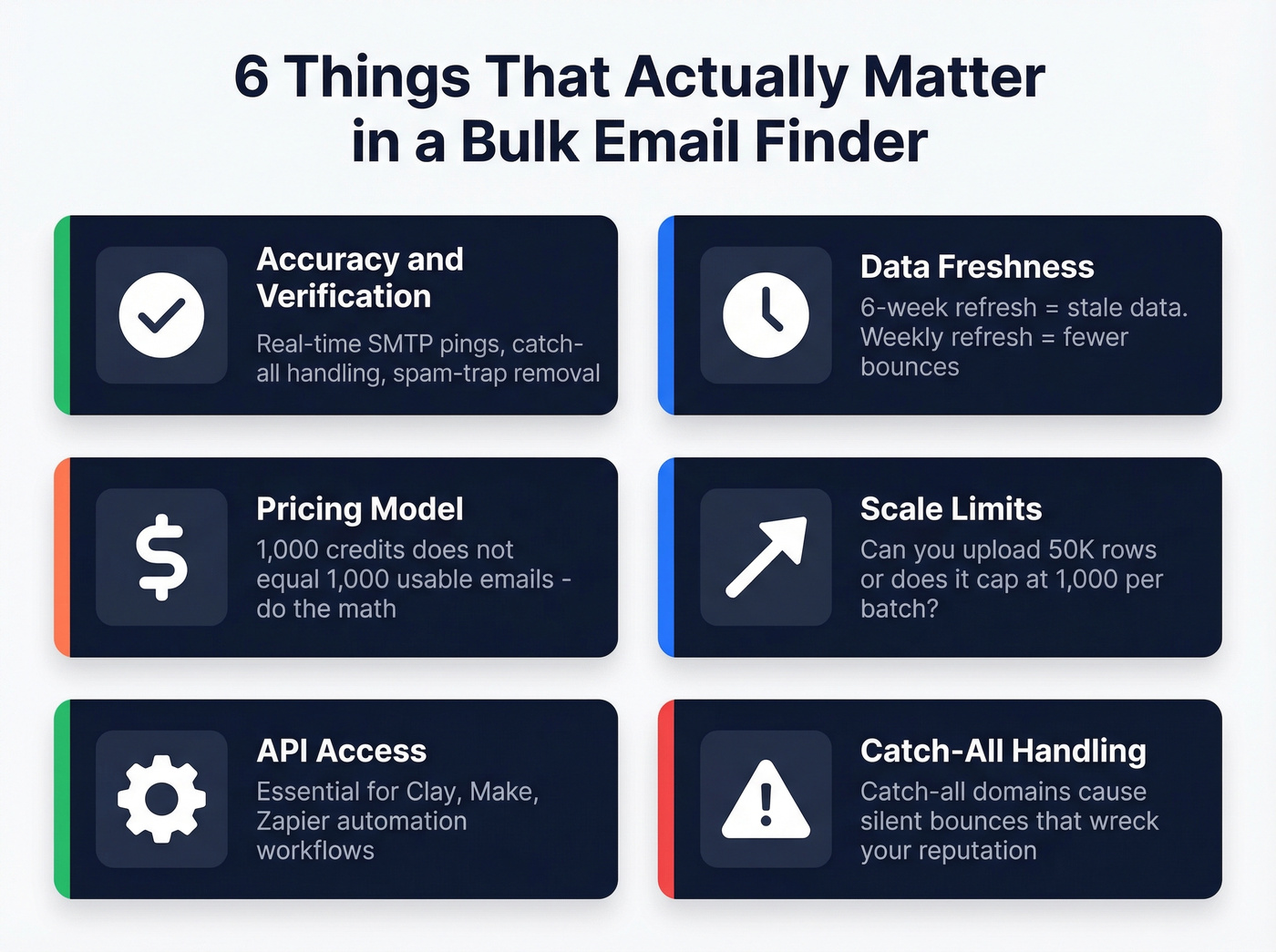
Accuracy and verification method. Does the tool verify in real time, or are you getting cached results from six months ago? SMTP pings are the minimum - look for spam-trap removal, catch-all handling, and honeypot filtering.
Data freshness. People change jobs constantly. A database refreshed every six weeks is already stale. Weekly refresh cycles dramatically reduce bounces.
Pricing model. Credits vs. flat subscription vs. pay-per-verified-email aren't interchangeable. A "1,000 credits" plan might only yield 600 usable emails once you account for verification burns.
Scale limits. Can you upload a 50,000-row CSV, or does the tool cap at 1,000 rows per batch? Bulk means bulk.
API access. If you're building automated enrichment workflows through Clay, Make, or Zapier, you need a reliable API - not just a web UI. (If you’re doing this at scale, see our Clay list building workflow breakdown.)
Catch-all domain handling. Catch-all domains accept every email address, making verification impossible through standard SMTP checks. Tools that flag catch-alls separately save you from silent bounces that wreck your reputation without warning.

8 Best Bulk Email Finder Tools Compared
Prospeo
Prospeo's database covers 300M+ professional profiles with 143M+ verified emails, all refreshed on a 7-day cycle. The 5-step verification process handles catch-all domains, strips spam traps, and filters honeypots - and it runs on proprietary infrastructure rather than chaining third-party email providers. That distinction matters more than most people realize: when your finder relies on the same upstream data as everyone else, accuracy claims are just marketing.
98% email accuracy. $0.008 per valid contact in independent testing. The free tier gives you 75 emails/month to test before committing. Integrations with Salesforce, HubSpot, Instantly, Lemlist, and Clay push verified contacts directly into your workflow, so there's no manual CSV juggling between tools.
Real results back this up: Meritt dropped their bounce rate from 35% to under 4%, and Stack Optimize maintains 94%+ deliverability across all client campaigns with zero domain flags. If you need to find professional emails at scale without wrecking deliverability, this is the benchmark we measure other tools against. (For a broader view of providers, compare against other sales prospecting databases.)

Most bulk email finders charge you for unverified results and refresh data every 6 weeks. Prospeo's 5-step verification runs on a 7-day refresh cycle - catch-all handling, spam-trap removal, honeypot filtering included. 98% accuracy at ~$0.01 per email. Stack Optimize runs all client campaigns on it with zero domain flags.
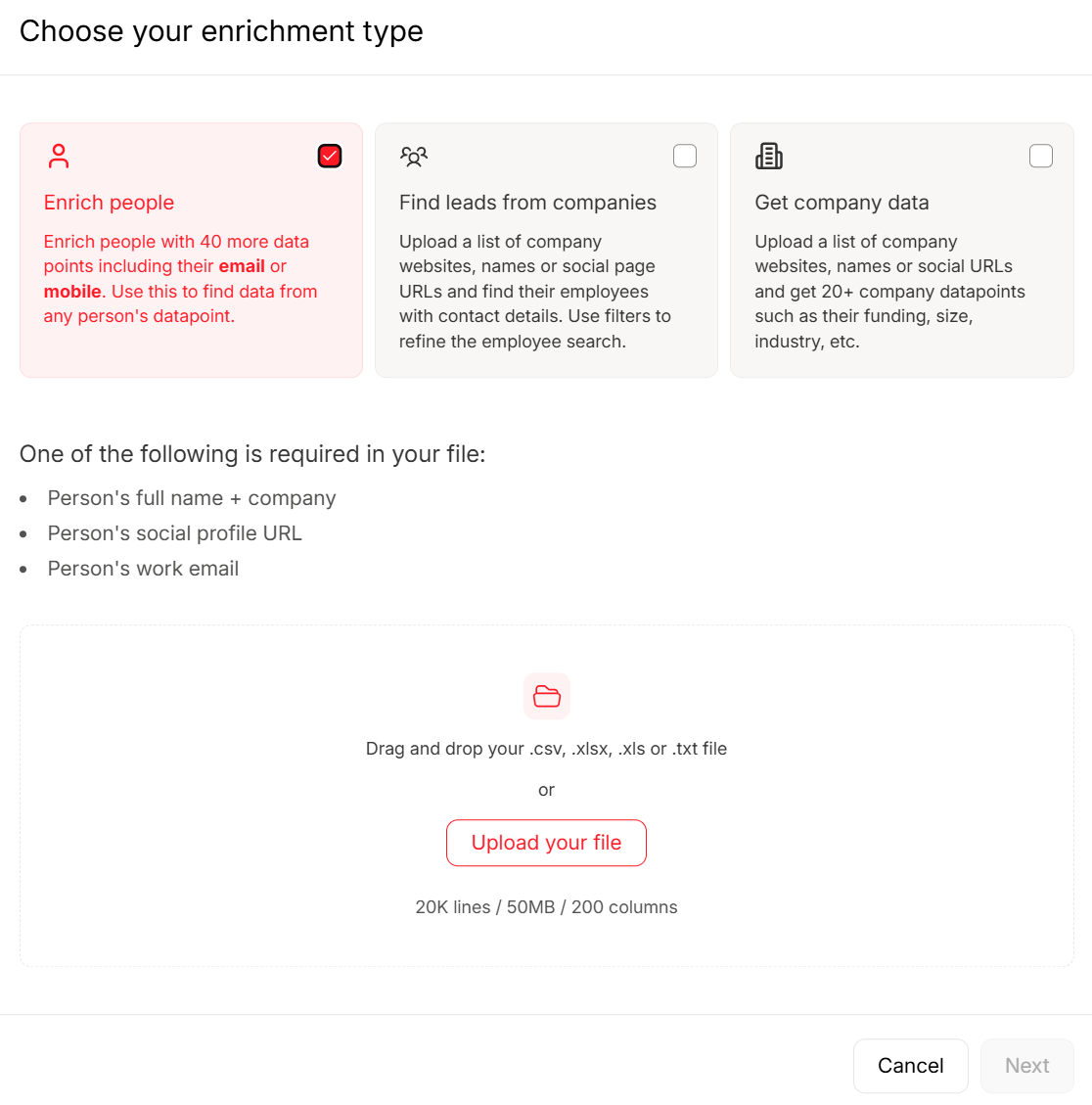
Upload your CSV and get verified emails back in minutes.
Hunter
Here's the credit math that trips people up with Hunter: verification costs an additional 0.5 credits. So a find-and-verify workflow typically burns 1.5 credits per contact. Your 2,000-credit Starter plan at $49/mo actually yields about 1,333 verified emails. Annual billing drops that to $34/mo. Starter includes 3 connected email accounts and 2,500 recipients per sequence, making it a decent all-in-one for small teams already running outreach.
The free plan gives you 50 credits/month - enough to test accuracy but not enough for real campaigns. Growth runs $149/mo for 10,000 credits, or $104/mo annually.
Skip this if you need a primary data source. The consensus on r/agency is that Hunter works better as a verification layer than as a standalone prospecting database. We've seen teams pair Hunter's bulk email lookup with a larger data provider and get better results than using Hunter alone. (If you’re comparing options, see our Hunter alternatives.)

Snov.io
If you're prospecting outside North America, Snov.io deserves a serious look. Reddit threads consistently flag it as strong for international leads with affordable credits, and the pricing backs that up. The Starter plan at $29.25/mo annually includes 1,000 credits, 5,000 recipients, and unlimited team seats - that last part is rare at this price point.
The credit system is straightforward: each email search and each verification costs 1 credit. So 1,000 credits means roughly 500 found-and-verified emails if every lookup hits. In practice, expect 400-500 usable contacts per 1,000 credits depending on your list quality. Pro bumps to $74.25/mo for 5,000 credits with unlimited mailbox warm-ups included.
The hidden cost to watch: LinkedIn automation is a $69/mo add-on per slot. That changes the value equation fast if you assumed it was included. For teams focused purely on mass email search, the core plans are solid - just don't expect multichannel out of the box.
Anymail Finder
Anymail Finder starts at $9/mo billed yearly for 600 credits/year. The real differentiator: you only pay for verified emails. Risky, not-found, and unverifiable results don't burn credits. A single domain search returns up to 20 valid emails for just 1 credit, and standalone verification runs only 0.2 credits - making it exceptionally cost-effective for company-level prospecting.
One gotcha: free trial credits expire after 7 days. Unused paid credits roll over and accumulate up to 2x your plan size, which is generous. For bootstrapped teams running domain-based lookups, it's hard to beat the economics.
GetProspect
GetProspect offers a free tier with 50 valid emails and 100 verifications per month. Starter at $49/mo includes 1,000 valid emails and 2,000 verifications. The standout feature is their verification credit packs sold separately - 10,000 verifications for $29, scaling up to 1 million for $369. Best for teams that already have lists and just need bulk verification at scale. No charge for duplicates, and credits roll over up to one month's allowance.
Clearout
Clearout charges 4 credits per found email and 2 for role-based addresses, with unknown results going uncharged. Each email gets a confidence score, and their Advanced Catch-All Resolver handles the domains that trip up most other tools. Credits never expire, and new users get 100 free.
Here's the thing: they don't publish pricing. In 2026, that usually means they're optimizing for sales calls, not self-serve buyers. Expect $50-150/mo based on comparable tools. Budget time for a sales conversation you probably don't want to have. Their verification capabilities are strong, but the opaque pricing makes it hard to compare cost per verified email against transparent competitors.
Lemlist
Lemlist takes a different approach with waterfall enrichment - sequentially checking 8 data sources until a verified email is found. They report an 80% find rate versus 30-60% from single-provider tools. Pricing is usage-based at $5 per 100 verified emails, roughly $0.05/email, with 100 free verified emails per month. Best suited for teams already using Lemlist for outreach who want email finding built into the same platform.
findmassleads
A bare-bones option for domain-based email lookups. The free version handles 10 domains at a time, with paid plans around $10-30/mo unlocking much higher limits. Don't expect the depth or accuracy of dedicated platforms - this is a quick-and-dirty tool for small batches.
Bad data doesn't just waste credits - it tanks your sending domain. Meritt cut their bounce rate from 35% to under 4% after switching to Prospeo. 143M+ verified emails, proprietary infrastructure, no third-party email providers in the chain. 75 free emails/month to prove it.
Protect your domain reputation starting with your next campaign.
Pricing Comparison
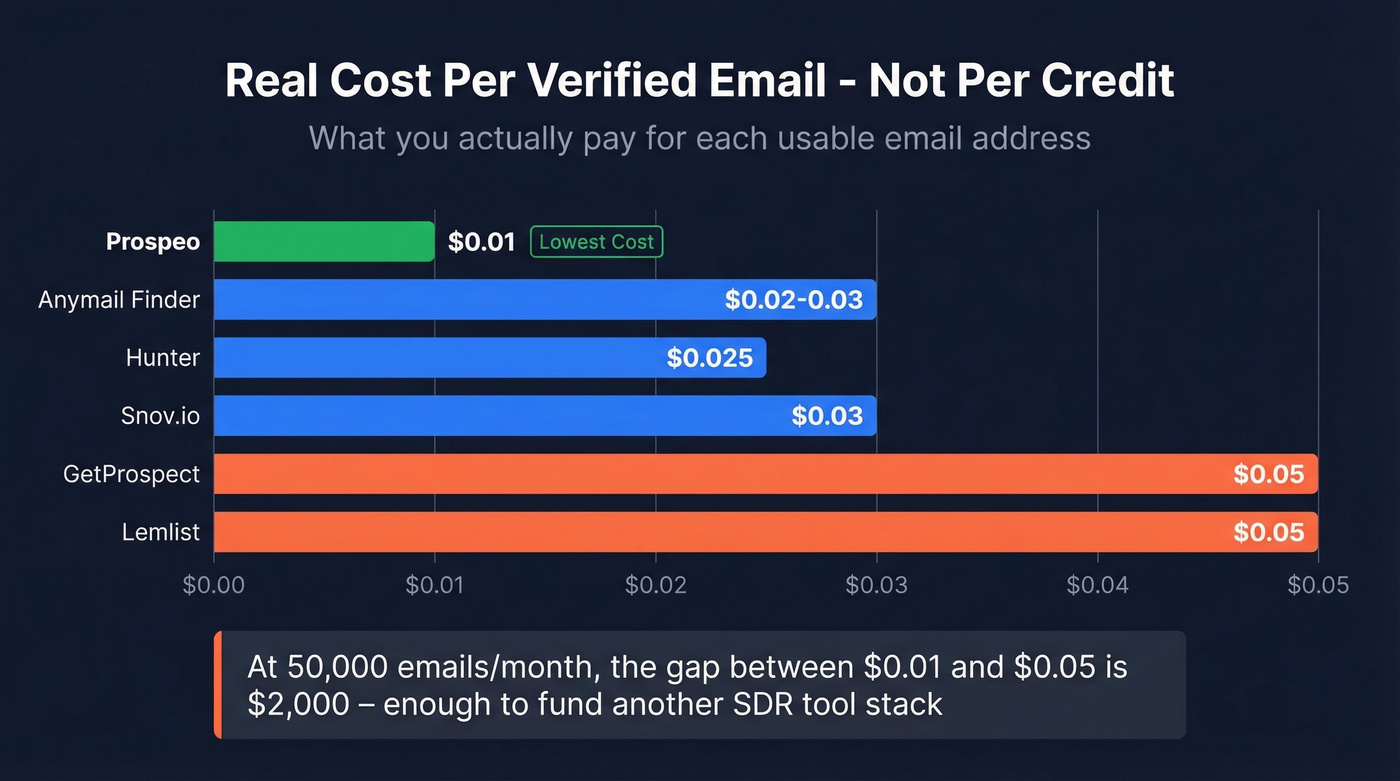
The biggest mistake in comparing these tools is looking at "cost per credit" instead of "cost per usable email." Credits burn on verification, failed lookups, and catch-all domains. Let's break this down. (If you’re also evaluating vendors that append emails to existing records, see email append vendors.)
| Tool | Free Tier | Entry Price | Credits | Best For |
|---|---|---|---|---|
| Hunter | 50 credits/mo | $49/mo | 2,000 | Verification layer |
| Snov.io | Trial | $29.25/mo | 1,000 | International leads |
| Anymail | 100 credits | $9/mo yearly | 600/yr | Bootstrapped teams |
| GetProspect | 50 emails/mo | $49/mo | 1,000 | Bulk list cleaning |
| Clearout | 100 credits | Not public | Varies | Catch-all handling |
| Lemlist | 100 emails/mo | Usage-based | Pay-per-use | Waterfall enrichment |
| findmassleads | 10 domains | ~$10-30/mo | Unlimited | Quick domain lookups |
Cost per verified email:
| Tool | Cost/Verified Email |
|---|---|
| Anymail Finder | ~$0.02-0.03 |
| Hunter | ~$0.025 |
| Snov.io | ~$0.03 |
| GetProspect | ~$0.05 |
| Lemlist | ~$0.05 |
The gap between $0.01 and $0.05 per email doesn't sound like much until you're finding 50,000 emails a month. That's the difference between $500 and $2,500 - enough to fund another SDR's tool stack. (If you’re building a full stack, start with the broader list of SDR tools.)
How Accurate Are These Tools, Really?
Most accuracy claims are self-reported and meaningless. Two independent benchmarks tell a more honest story.
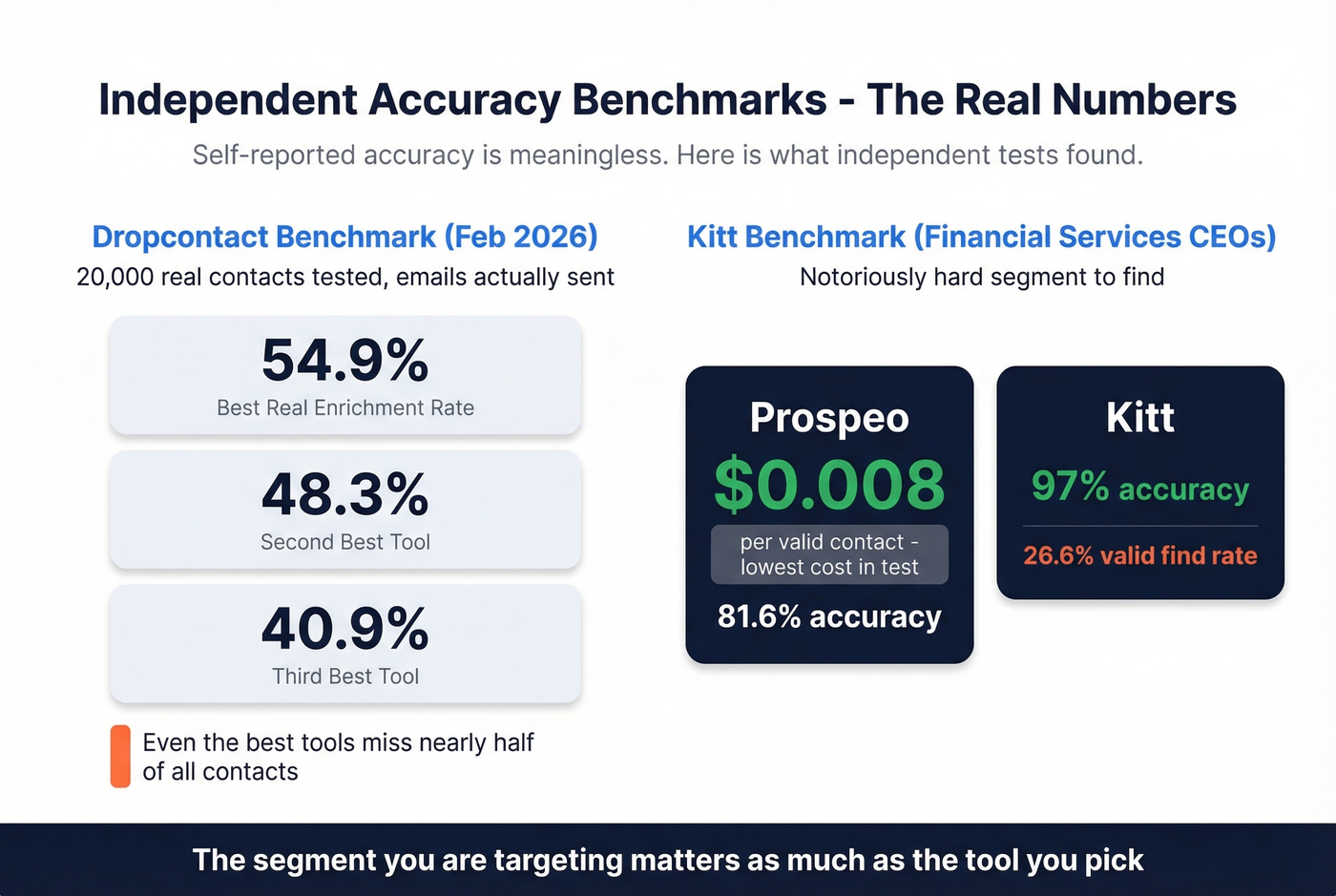
A Dropcontact benchmark from February 2026 tested 15 tools against 20,000 real contacts, then actually sent emails to every found address to measure hard bounces and wrong-domain errors. Their "real enrichment rate" - raw finds minus bounces minus wrong domains - paints a sobering picture. Top performers hit 54.9%, 48.3%, and 40.9%. Even the best tools miss nearly half the contacts.
A separate benchmark from Kitt focused on Financial Services CEOs - a notoriously hard segment - showed accuracy varying wildly by tool. Prospeo came in at $0.008 per valid contact, the lowest cost in the test, with 81.6% accuracy on a segment where most tools struggled. Kitt itself hit 97% accuracy but only a 42.5% find rate with a 26.6% valid find rate.
The segment you're targeting matters as much as the tool you pick. A lookup for CIOs will perform differently than one optimized for mid-level marketing managers, and no single benchmark captures every use case.
Stop comparing tools by database size. 450M contacts at 70% accuracy is worse than 143M at 98%. I'd rather have a smaller database that doesn't torch my domain than a massive one full of dead addresses. (More on this in our guide to data enrichment services.)
Building the Right Workflow
The smartest outbound operators don't rely on a single tool. The practitioner consensus on r/coldemail is that your cold email stack should be layered: data source, enrichment, verification, sending infrastructure. Here's how to build a workflow that actually protects your domain.
Pull your target list from your data source, filtered by ICP criteria like title, industry, headcount, and funding stage. (Use an ideal customer profile template if you don’t have one.)
Enrich with your primary finder to attach verified email addresses. If your first tool misses contacts, run the gaps through a second provider. Waterfall enrichment can push find rates from 30-60% to around 80%.
Verify everything before it touches your sequencer. Even "verified" emails from finders should get a second pass through a dedicated verification tool. We've seen teams skip this step and regret it within a week - one bad batch of 200 bounces can crater a domain that took months to warm. (If you’re troubleshooting, start with email bounce rate.)
Check your bounce math. If you pull 10,000 contacts and even 2% bounce, that's 200 hard bounces - enough to damage your domain reputation. Keep bounce rates below 1.5% before scaling send volume. (For remediation, see how to improve sender reputation.)
Push to your sequencer like Instantly at ~$30/mo or Smartlead at ~$29/mo, and keep daily sends around 15-20 per inbox. Patience here pays off. The teams that scale too fast are the ones posting "my domain got blacklisted" threads on Reddit. (If you need the sending side, compare AI bulk email senders.)
FAQ
Is there a free bulk email finder?
Yes - several tools offer meaningful free tiers. Prospeo gives 75 verified emails/month, Hunter offers 50 credits/month, GetProspect provides 50 valid emails/month, and Lemlist includes 100 free verified emails/month. These are enough to test accuracy on real contacts before committing to a paid plan.
What's a good bounce rate for bulk campaigns?
Under 2% is acceptable for most outbound campaigns; under 1% is ideal. Above 3% and you're actively damaging your sender reputation - pause sends and clean your list immediately before resuming.
Do I need a separate verification tool?
Tools with strong built-in verification - like Prospeo's 5-step process - don't require a second layer. If your finder treats verification as optional or charges extra credits for it, adding a dedicated verifier like Million Verifier is cheap insurance, especially when pulling contacts from multiple sources.
What's the difference between email finding and enrichment?
Email finding locates a work address from a name and company. Enrichment adds multiple data points - job title, phone number, company revenue, tech stack - to an existing record. Many platforms do both, but they're distinct functions with different accuracy benchmarks and cost structures.
Are these tools GDPR compliant?
Most process publicly available business data, which is permissible under GDPR's legitimate interest basis. Look for providers that offer Data Processing Agreements, enforce opt-out requests globally, and don't scrape personal addresses. Any reputable tool will have compliance documentation readily available.