

Business Acumen in Sales: What It Actually Takes to Sound Like a Business Person
You're on a call with a VP of Finance. She asks how your solution impacts their gross margin. You freeze - reaching for product features instead of financial outcomes.
That's exactly where deals die.
Sales orgs spend weeks on product training and zero hours on financial literacy, then wonder why reps can't get past procurement. We've watched this play out dozens of times across teams we work with. Business acumen in sales is the gap between reps who stall at procurement and reps who co-build business cases with the C-suite.
What You Need (Quick Version)
It boils down to three things: read the buyer's 10-K before any enterprise call, know five financial metrics by persona, and ask discovery questions about business outcomes instead of features.
You don't need an MBA. You need a framework and the discipline to use it.
Buyers Already Think You're Unprepared
A survey of 260 executive decision-makers by ValueSelling Associates found about one-third believed vendors weren't consistently well informed. Twenty percent said reps lacked even general business competence. One in five. That's brutal.
Gartner surveyed 632 B2B buyers and found 61% prefer a rep-free buying experience. Sixty-nine percent reported inconsistencies between what a supplier's website says and what sellers actually tell them. The bar for seller-added value has never been higher, and most reps aren't clearing it.
What Sales Acumen Really Means
This isn't generic "business knowledge." It's understanding how the buyer's company makes money and connecting your solution to those financial outcomes. Every framework, metric, and discovery question in this article serves that single purpose: translating financial context into deal-advancing conversations.
Why It Matters Right Now
Lepaya's analysis of 196 industry-leading companies found a 27% increase in commercial sensitivity training hours between 2024 and 2025. Buyers still want sellers for contextual intelligence - determining fit, navigating complexity, connecting dots between priorities and capabilities. Financial fluency fills that gap.
The ROI backs it up. Effective sales training returns $4.53 for every $1 spent, with a 19% increase in win rates. Business acumen is the module that makes every other training investment compound.

Business acumen gets you into the right conversations. Bad data keeps you out of them. Prospeo delivers 98% email accuracy on a 7-day refresh cycle, so the CFO you spent 15 minutes researching actually sees your message - not a bounce notification.
Stop wasting financial homework on emails that never arrive.
The Three Pillars, Ranked
1. Financial literacy - the biggest unlock. Only 59% of companies say everyone on their sales and marketing teams is aware of how financial KPIs are trending. Speak fluently about margins, CAC, and revenue growth and you're ahead of nearly half the field. This is where we tell every new rep to start, because it produces the fastest visible improvement in how buyers respond during calls - sometimes within a single week.
If you're tying margin and CAC to pipeline outcomes, it helps to track pipeline health consistently across deals.
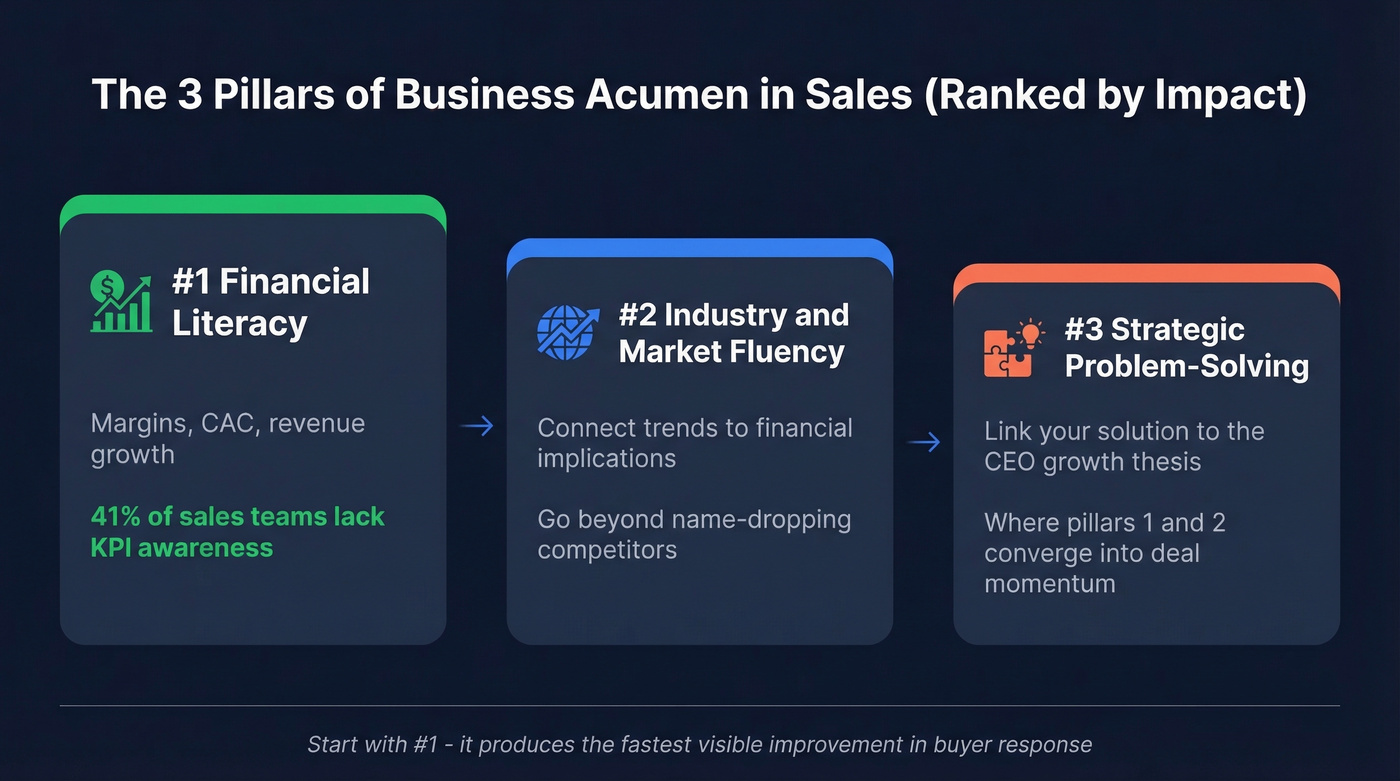
2. Industry and market fluency. Most reps have surface-level industry knowledge. The difference is connecting trends to specific financial implications for the buyer's business, not just name-dropping a competitor or citing a market size number.
This is also where competitive intelligence can sharpen your POV before the first call.
3. Strategic problem-solving. This is where the other two pillars converge into deal momentum. You're connecting your solution to their CEO's growth thesis, not your feature list.
Other frameworks list five or six abstract "drivers." These three are ranked by impact and mapped to what you can actually do before your next call.
How to Build Sales Acumen Fast
Read a 10-K in 15 Minutes
A 10-K is the SEC-required annual filing, and it's typically denser and more detailed than an annual report. Here's the four-section framework that matters:
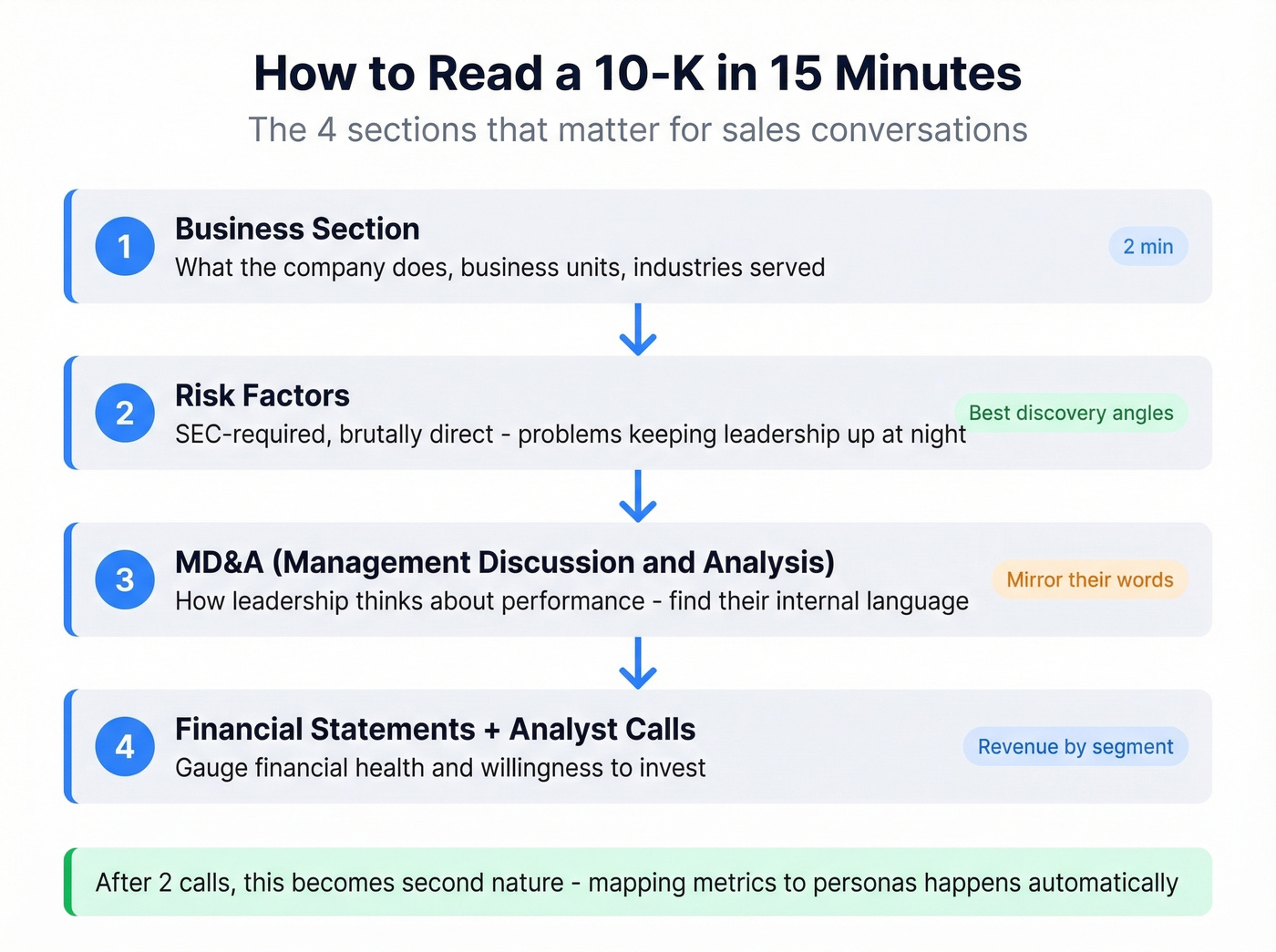
- Business section. Skim for what the company does, its business units, and industries served. Two minutes here gives you enough context to ask informed questions on the first call.
- Risk factors. SEC-required and brutally direct. These are the problems keeping leadership up at night - and your best discovery angles.
- MD&A (Management Discussion & Analysis). How leadership thinks about performance and projections. This is where you find the language they use internally, which is gold for mirroring in your conversations.
- Financial statements + Analyst calls. Gauge financial health and willingness to invest. Analyst calls often include revenue-by-segment detail that's easier to pull than from the statements alone.
In our experience, this framework takes about two calls to become second nature. After that, mapping the right metrics to the right persona happens almost automatically.
Financial Metrics by Persona
You don't need to know every metric. You need the right five for the person across the table.
If you want a deeper breakdown of CAC specifically, see our guide to cost to acquire customer.
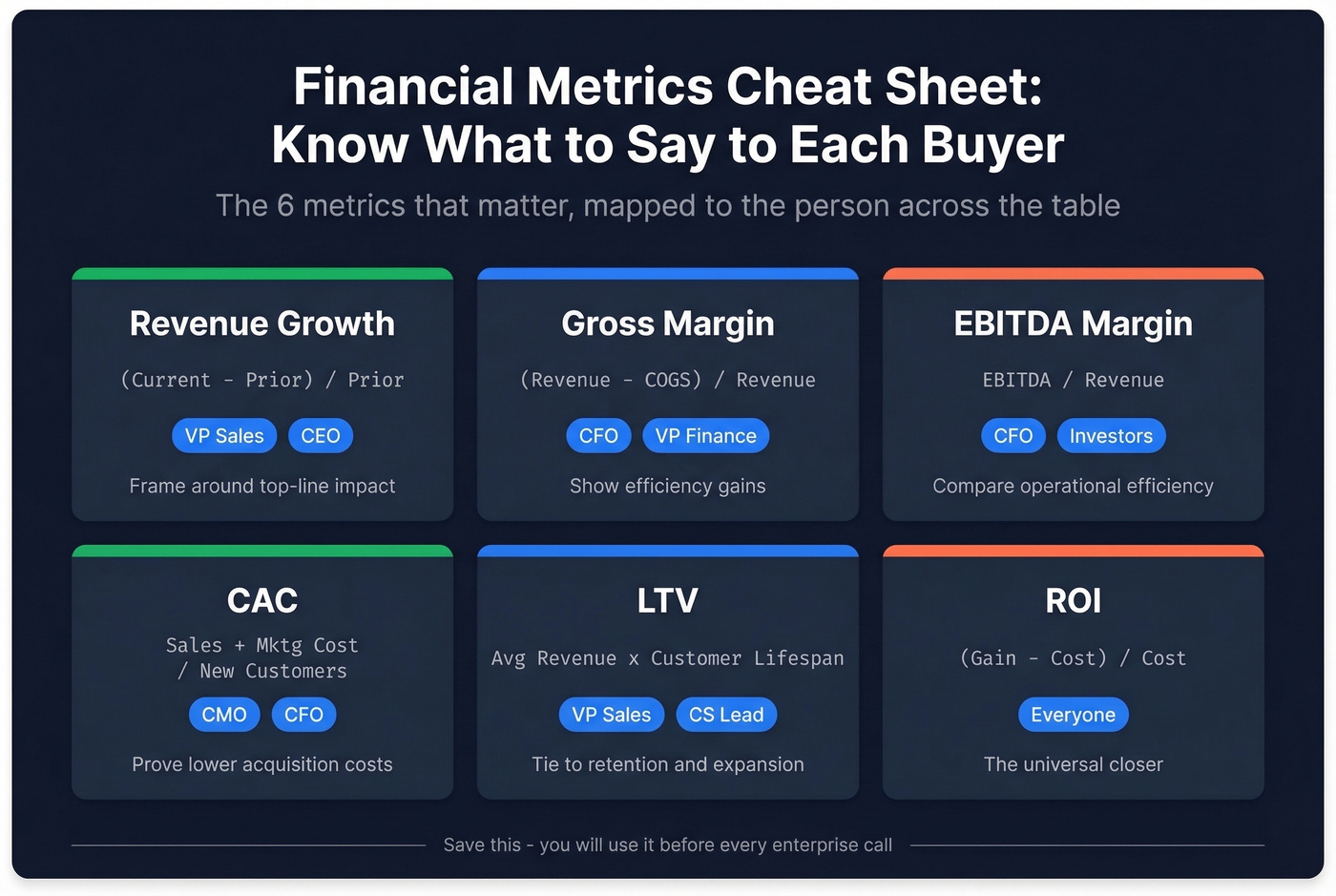
| Metric | Formula | Who Cares | How to Use It |
|---|---|---|---|
| Revenue growth | (Current - Prior) / Prior | VP Sales, CEO | Frame around top-line impact |
| Gross margin | (Revenue - COGS) / Revenue | CFO, VP Finance | Show efficiency gains |
| EBITDA margin | EBITDA / Revenue | CFO, investors | Compare operational efficiency |
| CAC | Sales + Mktg cost / New customers | CMO, CFO | Prove lower acquisition costs |
| LTV | Avg revenue x Customer lifespan | VP Sales, CS lead | Tie to retention and expansion |
| ROI | (Gain - Cost) / Cost | Everyone | The universal closer |
Pre-Call Research Playbook
Search the CEO's strategic vision. Use this query: "CEO Strategic Vision for [Company] [Year]". You'll surface earnings call transcripts and interviews that reveal stated priorities.
Set Google Alerts for your top 10 accounts. Funding rounds, leadership changes, earnings surprises - real-time triggers for relevant outreach. This takes five minutes to set up and pays dividends for months.
If you're building this into a repeatable motion, borrow from account-based selling best practices.
Find private company data. For companies without 10-Ks, check Crunchbase for funding, industry reports for benchmarks, and press coverage for direction.
Verify contact data before you reach out. All this research is wasted if your email bounces. Prospeo runs 98% email accuracy on a 7-day refresh cycle, so the VP of Finance you spent 15 minutes researching actually receives your message. (If you need a process, start with how to check if an email will bounce.)
Discovery Questions That Prove Your Homework
Gong's analysis of 1M+ sales calls found top performers ask 39-40% more questions during discovery - focused on business impact, not features. Here's the thing: the quality of those questions matters more than the quantity.
If you want a full library, use these discovery questions to pressure-test your call plan.
CFO / VP Finance: "Your gross margin compressed about 2 points last quarter - what's driving that?" or "How are you thinking about CAC efficiency heading into next year's budget cycle?"
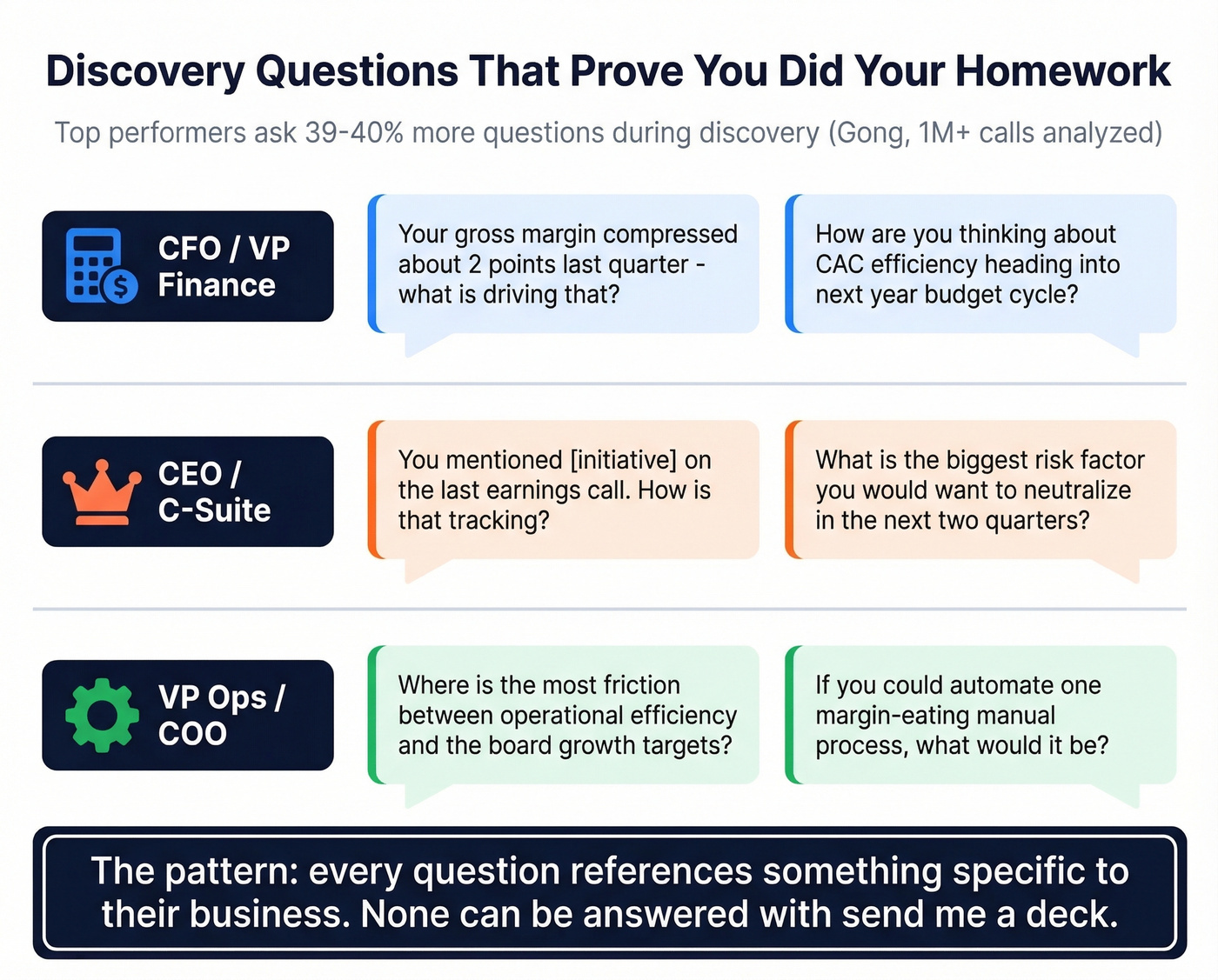
CEO / C-Suite: "You mentioned [initiative] on the last earnings call. How's that tracking?" or "What's the biggest risk factor you'd want to neutralize in the next two quarters?"
VP Ops / COO: "Where's the most friction between operational efficiency and the board's growth targets?" or "If you could automate one margin-eating manual process, what would it be?"
Notice the pattern. Every question references something specific to their business. None of them can be answered with "send me a deck."
Mistakes That Kill Credibility
Citing vanity metrics to a CFO is an instant credibility killer. Telling a finance leader about "engagement rates" when she's thinking about EBITDA margin signals you don't understand her world.
This is also why sales communication matters: the same data can land as insight or noise depending on how you frame it.
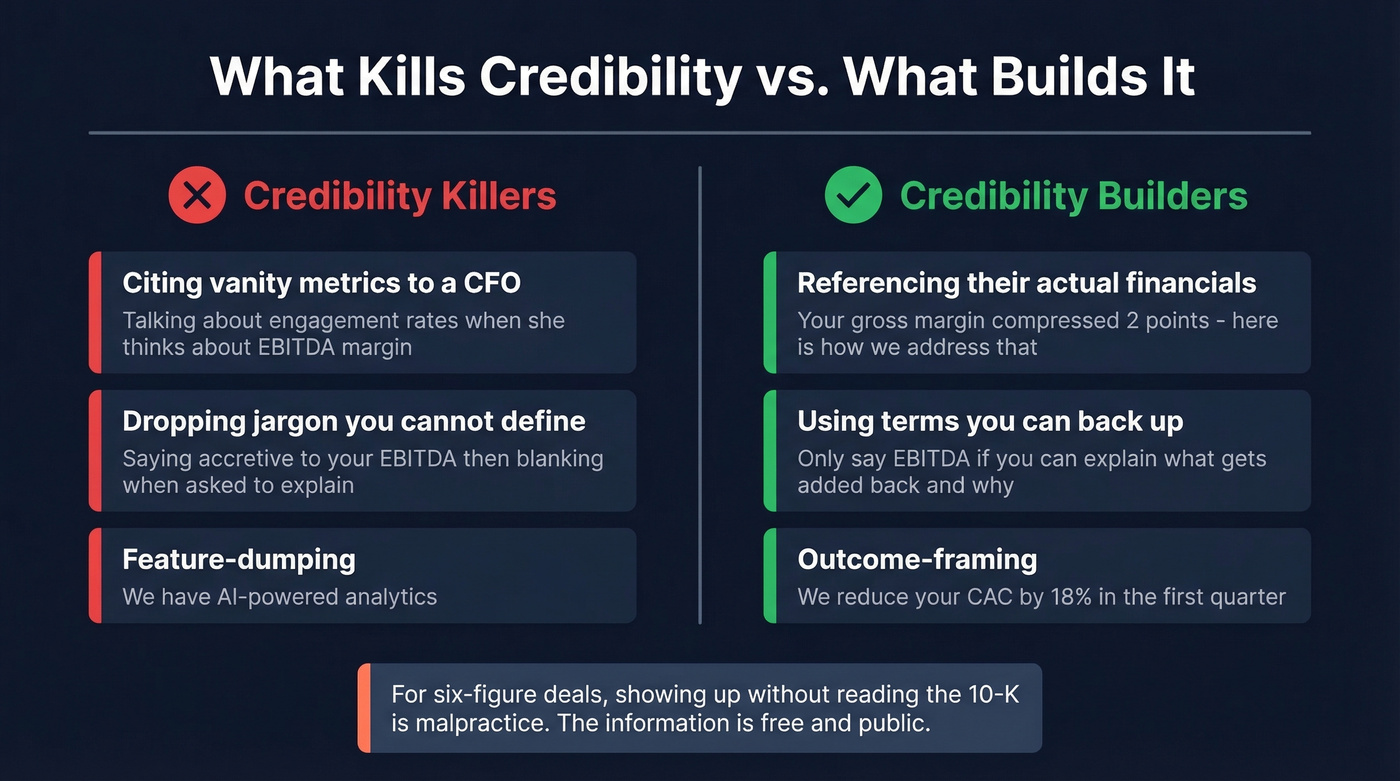
Equally damaging: dropping financial jargon you can't define if pressed. If you say "EBITDA," you'd better explain what gets added back and why it matters. A Reddit thread on r/sales put it perfectly - a user described watching a rep say "accretive to your EBITDA" in a meeting, then get asked to define EBITDA, and completely blank. The deal died on the spot.
The most common mistake is still feature-dumping. "We have AI-powered analytics" means nothing. "We reduce your CAC by 18% in the first quarter" means everything.
Let's be honest: once you're selling six-figure deals, showing up without reading the 10-K is malpractice. The information is free and public. Not reading it signals you don't care enough to prepare. Skip the 10-K and you deserve to lose to the rep who didn't.
If you're moving into bigger deal sizes, this pairs well with our guide to enterprise B2B sales.
You know the buyer's gross margin, CAC, and strategic priorities. Now reach them directly. Prospeo gives you verified emails and direct dials for 300M+ professionals - at $0.01 per email, with 30+ filters to target by role, intent, and company growth.
Turn your pre-call research into actual conversations with decision-makers.
FAQ
Do I need an MBA to develop business acumen in sales?
No. Fifteen minutes with a 10-K and five financial metrics gets you further than most MBAs in a sales conversation. The frameworks above - risk factors, MD&A, and persona-mapped metrics - are everything you need to speak a buyer's language.
What's the fastest way to improve sales acumen?
Read the 10-K of your top three target accounts. Focus on risk factors and MD&A. Then map the five financial metrics to your buyer personas. Two hours of work, permanent advantage.
How do I make sure my research reaches the right person?
Verify emails before sending. At roughly $0.01 per verified email, it takes seconds and protects hours of preparation. There's no point building a financially literate outreach sequence if it lands in a dead inbox.