

Business Email Salutations: You Only Need Three (Plus When to Use the Rest)
A developer in India recently posted that their manager called "Hi" unprofessional for client emails - while the dev said writing "Dear" made them physically cringe. That thread blew up because everyone has an opinion about business email salutations, and almost nobody agrees.
Here's the reality: you only need three greetings to handle virtually every professional email you'll ever send. The rest is edge cases and overthinking. We've watched teams agonize over greeting words longer than they spend writing the actual message.
The Only Three You Need
Three greetings cover most of your professional emails:
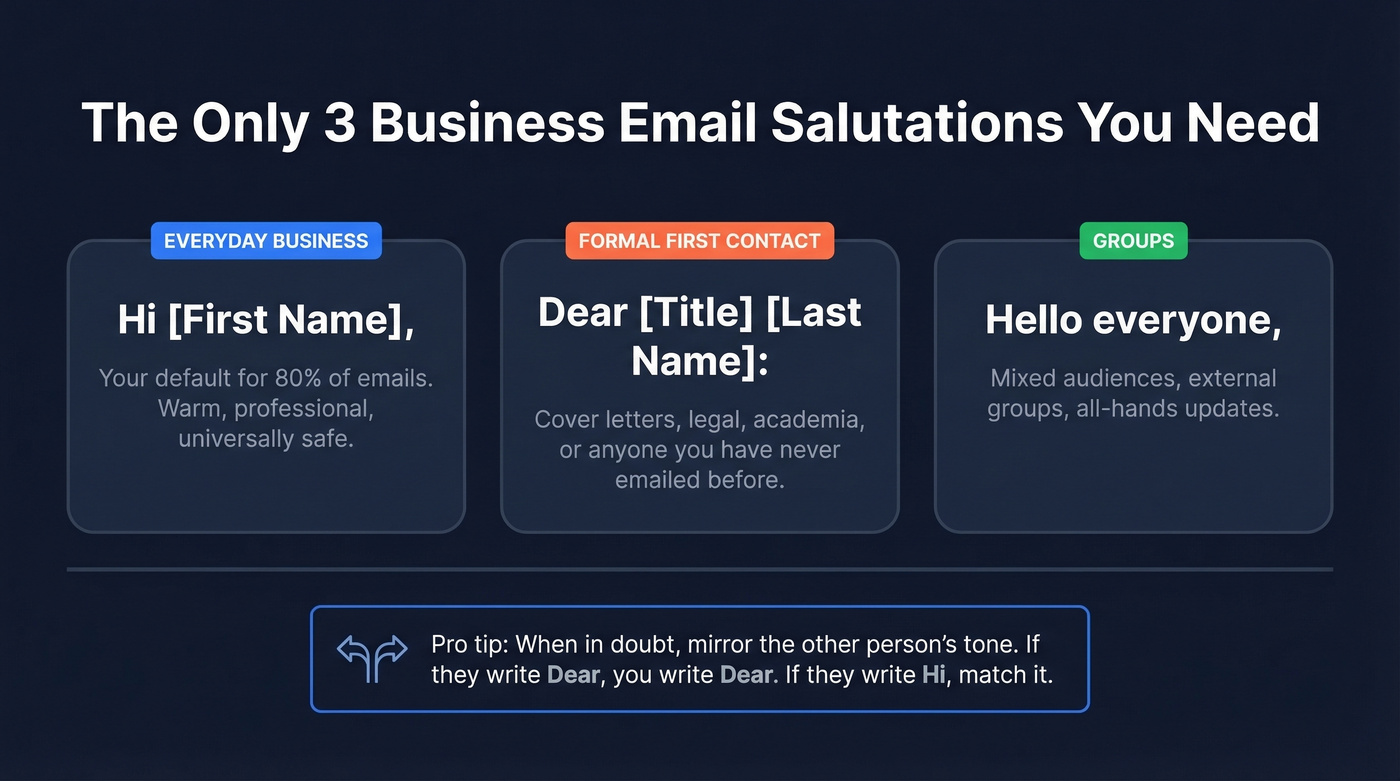
- Everyday business: "Hi [First Name],"
- Formal first contact: "Dear [Title] [Last Name]:"
- Groups: "Hello everyone,"
Pick the one that fits, write your email, and move on.
One useful rule from etiquette coach Jacqueline Whitmore: mirror the other person's tone. If they write "Dear," respond with "Dear." If they write "Hi," match it. When in doubt, "Hi [First Name]," is the safest default in the English-speaking business world.
That covers most of your emails. Read on for the edge cases, the data, and the mistakes that make people silently judge you.
Every Email Salutation, Ranked
Not every email is the same, and sometimes you need something more specific than the big three. Here's a reference table covering the full spectrum.
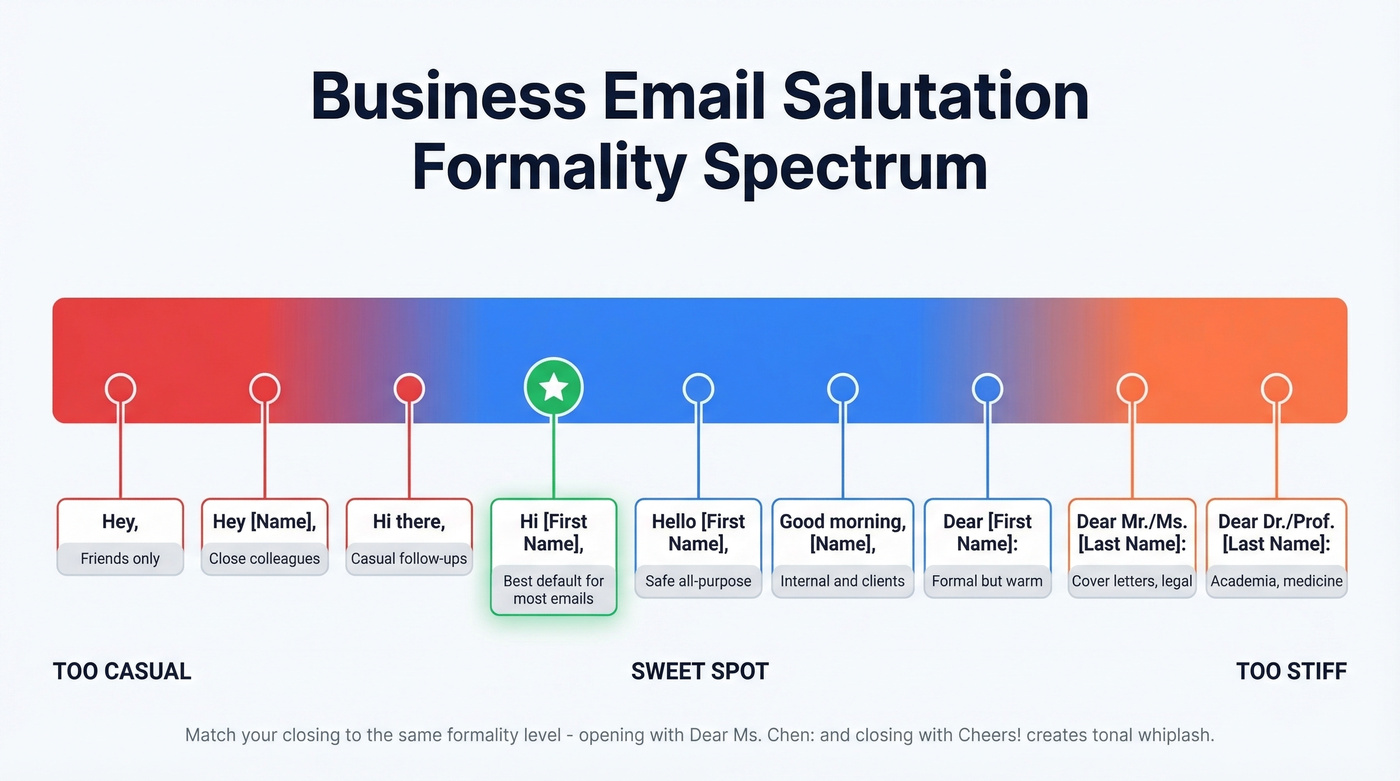
| Salutation | Formality | Best For | Avoid When | Pairs With |
|---|---|---|---|---|
| Dear Dr./Prof. [Last Name]: | Very high | Academia, medicine | You're peers | Respectfully, |
| Dear Mr./Ms. [Last Name]: | High | Cover letters, legal | On first-name terms | Sincerely, |
| Dear [First Name]: | Medium-high | Formal but warm | Group emails | Best regards, |
| Good morning, [Name], | Medium | Internal, clients | Unknown time zone | Best, |
| Hello [First Name], | Medium | Safe all-purpose | Very casual teams | Kind regards, |
| Hi [First Name], | Medium-low | Everyday business | Legal, academic | Thanks, / Best, |
| Hi team, | Medium-low | Internal groups | External stakeholders | Thanks, |
| Hello everyone, | Medium | Mixed/external groups | One-on-one emails | Best, |
| Hi there, | Low | Casual follow-ups | First contact with execs | Cheers, |
| Hey [First Name], | Low | Close colleagues | New contacts | Cheers, |
| Hey, | Very low | Friends at work | Literally anyone else | - |
A note on the "Pairs With" column - many guides skip this. Your salutation and closing should live at roughly the same formality level. Opening with "Dear Ms. Chen:" and closing with "Cheers!" creates tonal whiplash. And never abbreviate closings: "KR" and "BW" read as passive-aggressive to most recipients, even if you don't mean them that way.
In ongoing email threads, you can drop the salutation after the initial exchange. Just don't be the first to do it with clients or senior colleagues.
Best Greetings by Scenario
Cold Sales Outreach
"Hi [First Name]," - every time. It's warm without being presumptuous, and it doesn't waste words. A Belkins analysis of 16.5 million emails found that messages of 6-8 sentences hit a 6.9% reply rate, while longer emails dropped off fast. Your salutation should get out of the way and let your opening line do the work.
If you're building a repeatable outbound motion, pair this with proven sales prospecting techniques so your greeting isn't the most "strategic" part of the email.
Job Applications
"Dear [Hiring Manager Name]:" - full formal.
Don't write "Hey!" or "Hi there," to someone deciding your career. Recruiters are drowning in applications. A polished salutation won't get you the job, but a sloppy one can get you filtered out before anyone reads your qualifications. If you can find the hiring manager's name, use it. If you can't, "Dear Hiring Manager:" works without sounding lazy.
Internal Team Emails
Why does "John," - just the name, no greeting - rub people the wrong way? Because it reads as curt, even when you don't mean it that way. Adding "Hi" takes half a second and removes the ambiguity entirely. "Hi team," or "Good morning," keeps things light and human.
Client Communication
Mirror their tone. If your client writes "Dear [Your Name]," respond in kind - even if it feels stiff. Whitmore's mirroring advice applies double here because clients set the formality level, and your job is to match it, not challenge it.
Unknown Recipient
"Hello," or a role-based greeting like "Dear Hiring Manager:" are your safest options. Never guess gender. If you're unsure whether to use Mr. or Ms., just use their full name instead - guessing wrong is worse than being slightly informal. Skip "Dear Colleagues" when emailing people senior to you; it can read as presumptuous.
Customer Complaint Response
"Dear [First Name]," - slightly elevated formality signals that you're taking the issue seriously. It's a small thing, but it sets a tone of care before you've even addressed the problem.
Punctuation and Formatting
The rules here are simple, but getting them wrong looks sloppy.
Use a colon after formal salutations ("Dear Ms. Chen:") and a comma after casual ones ("Hi Marcus,"). Grammarly's guidance is clear on this - when you're unsure, the colon is the safer choice.
For time-of-day greetings, it's "Good morning, [Name]," - comma after the greeting phrase, comma after the name. Capitalize the first word of your email body, and leave one line break between the salutation and the first paragraph. These are small formatting details that signal you know what you're doing.
If you're writing outreach at scale, it also helps to standardize your email copywriting so tone stays consistent across reps.

Cold outreach lives or dies in the first line - but only if your email actually reaches the inbox. Prospeo delivers 98% verified email accuracy with a 7-day refresh cycle, so your carefully crafted "Hi [First Name]," lands in front of real decision-makers, not dead inboxes.
Nail the salutation. We'll make sure it actually gets delivered.
Inclusive and Gender-Neutral Options
The fact that "Dear Sir or Madam" still appears in email guides in 2026 tells you how slowly this advice evolves. It's gendered, it's dated, and it assumes a binary that doesn't reflect your audience.
For groups, replace "Ladies and Gentlemen" or "Hey guys" with "Hello everyone" or "Hi team." Japan Airlines made this exact switch - retiring "ladies and gentlemen" in favor of "hello everyone" and "all passengers." If an airline can update language used for decades, your Tuesday standup recap can too.
For individuals, use their first name when you're unsure about titles or pronouns. "Hi Jordan," works perfectly without requiring you to guess anything. Want to go further? Add your own pronouns to your email signature. It normalizes the practice and makes it easier for others to share theirs.
If you're doing outbound, this is also where a clear ideal customer profile helps: you can usually find the right name and role before you hit send.
Cross-Cultural Considerations
If you're emailing someone in a different country for the first time, default to formal. Always.
You can dial it back once they signal a more casual tone, but you can't un-send a "Hey!" to a German executive who expected "Dear Herr Schmidt." 60% of email misunderstandings in global teams stem from tone interpretation, not language barriers. Salutations are where tone is set - they're the first thing your recipient reads, and as Kristina Laliberte of Talaera puts it, etiquette missteps can "slow down decision-making and hinder progress" before you've even gotten to the ask.
Use titles and last names until invited to do otherwise. Avoid idioms - "Hey there" doesn't translate well and can confuse non-native speakers. Stick to "Dear [Title] [Last Name]:" for first contact, and let the relationship evolve naturally from there.
Cold Outreach: What the Data Says
Here's the thing: your salutation matters less than you think, and your deliverability matters more than you realize.
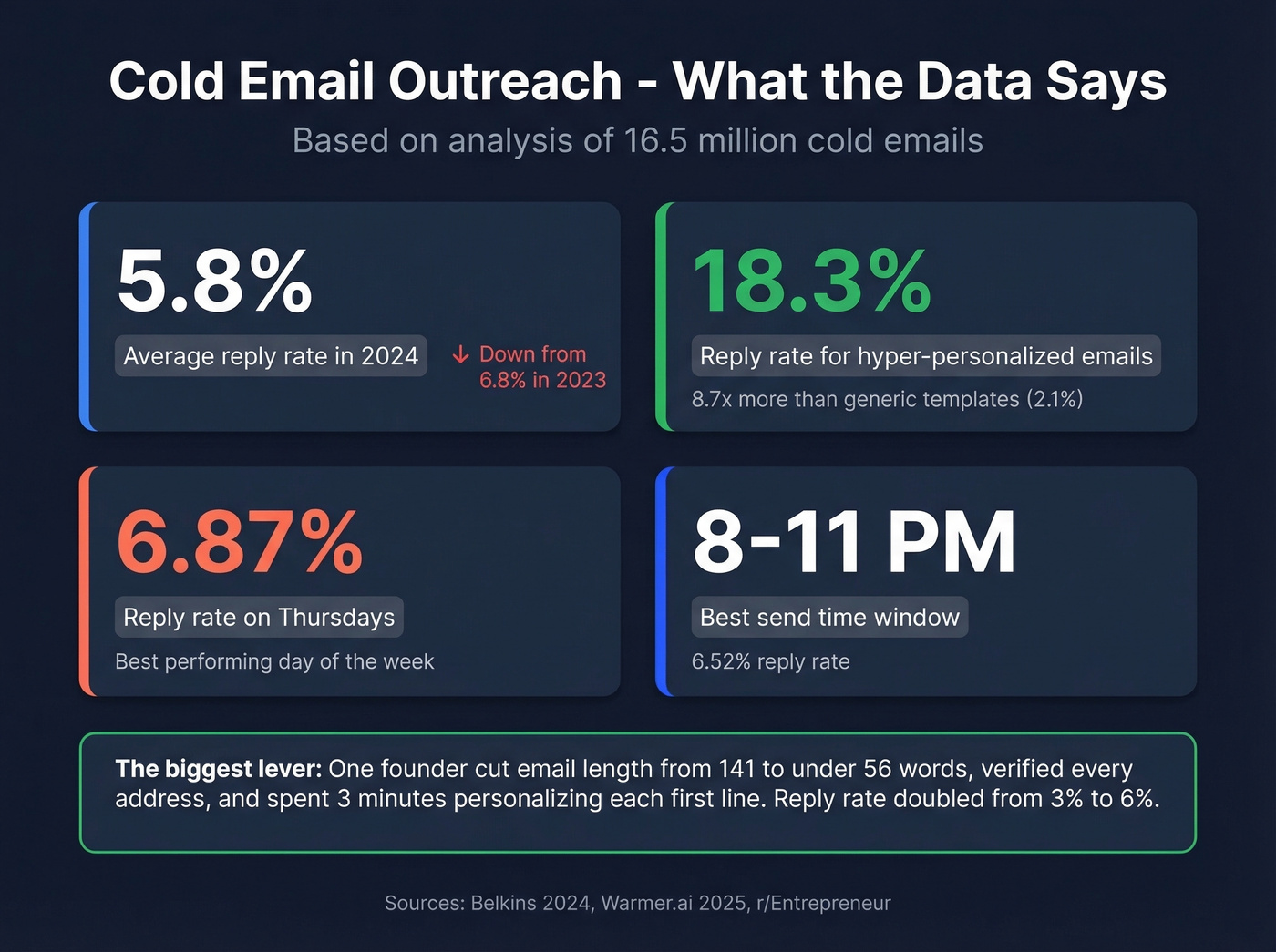
Belkins' analysis of 16.5 million cold emails showed an average reply rate of 5.8% in 2024, down from 6.8% the year before. Thursdays outperformed other days at 6.87%, and emails sent between 8-11 PM hit 6.52%. Timing and structure drive replies more than whether you wrote "Hi" or "Hello." (If you're optimizing send strategy, see our breakdown of the best time to send cold emails.)
Personalization is what actually moves the needle. Hyper-personalized emails that reference specific business challenges see 8.7x more responses than generic templates - 18.3% reply rate versus 2.1%. One founder on r/Entrepreneur doubled their reply rate from 3% to 6% by cutting email length from 141 words to under 56, verifying every address, and spending about three minutes personalizing each first line.
But none of that matters if the email bounces. We've seen teams obsess over greeting words while sending to lists full of dead addresses. Your perfectly crafted "Hi Sarah," is worthless if Sarah left that company eight months ago. Before you fine-tune salutations, verify your list - Prospeo checks emails in real time with 98% accuracy, and the free tier gives you 75 verifications per month to test whether your current list is as clean as you think. (If you're troubleshooting bounces, start with email bounce rate benchmarks and fixes.)
You just learned the right way to open a business email. Now make sure you're sending it to the right person. Prospeo gives you 300M+ professional profiles with 30+ filters - so you can personalize every "Dear [Name]" with confidence, not guesswork.
Stop perfecting greetings for contacts that don't exist.
Salutations to Avoid
Let's be direct about the ones that hurt you:
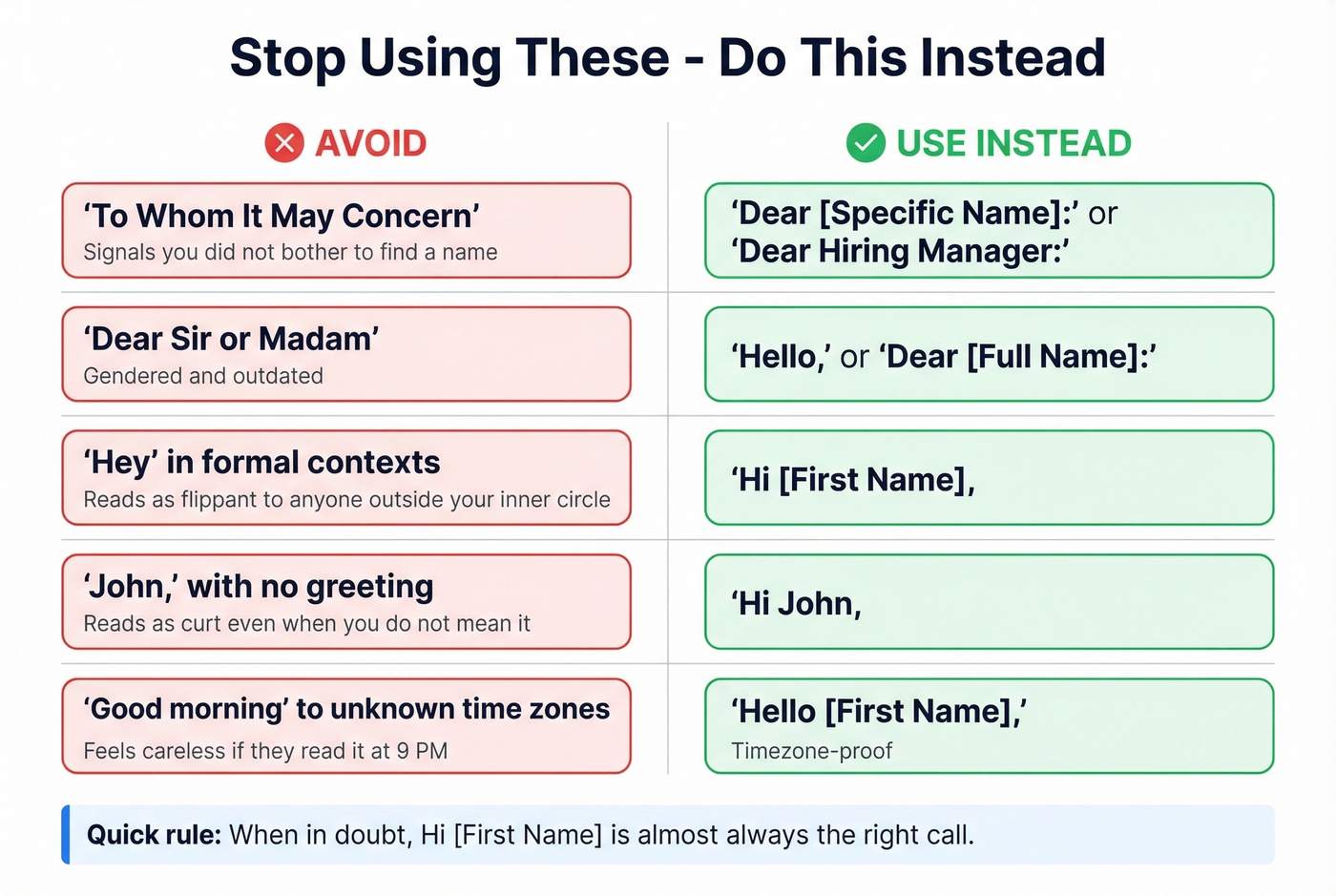
- "To Whom It May Concern" - Lazy. It signals you didn't spend 30 seconds finding a name.
- "Dear Sir or Madam" - Gendered and dated. Use "Hello," or a role-based greeting instead.
- "Hey" in formal contexts - Reserve this for close colleagues. It reads as flippant to anyone else.
- "John," with no greeting - Reads as curt even when you don't intend it. Add "Hi" and the problem disappears.
- "Good morning" when you don't know their time zone - If they're reading it at 9 PM, it feels careless. "Hello" is timezone-proof.
Outside the greeting itself, your follow-up cadence matters more than most people think - use these sales follow-up templates to stay persistent without sounding pushy.
FAQ
What's a good salutation for a business email?
"Hi [First Name]," works for the vast majority of professional emails. It's warm without being casual and appropriate for both internal and external communication. When you genuinely don't know the formality level, this is your default.
Should I use a colon or comma after a salutation?
Colon for formal emails and cover letters ("Dear Ms. Chen:"). Comma for everyday messages ("Hi Marcus,"). When you're unsure, the colon is the safer bet - it never reads as too casual.
How do I address someone when I don't know their name or gender?
Use a role-based greeting ("Dear Hiring Manager:") or a neutral "Hello,". Avoid guessing titles or pronouns - getting it wrong is worse than being slightly less formal. For cold outreach, tools like Prospeo can surface contact names and verified emails from 300M+ professional profiles so you don't have to guess.
What are the best formal email salutations?
Stick with "Dear [Title] [Last Name]:" for cover letters, legal correspondence, and first contact with senior executives. It signals professionalism and respect without overcomplicating things. Once the recipient shifts to a more casual tone, follow their lead.