

How to Build a Business Sales Plan That Actually Works
Only 47% of B2B reps hit quota. That's not a people problem - it's a planning problem. Most business sales plans are either 25-page documents nobody reads or a revenue target scribbled on a whiteboard with zero math behind it. Below: the framework, the benchmarks, and a template you can copy today.
Need a 30/60/90-day plan for an interview or onboarding? Jump to that section.
What Is a Business Sales Plan?
A business sales plan is your revenue execution roadmap. It translates company-level growth goals into specific targets, activities, and timelines for your sales team. It's not a business plan - that covers everything from product strategy to fundraising. The sales plan lives inside the business plan and answers one question: how are we going to hit our number?
Why this matters more than most leaders admit: roughly 47% of reps hit quota, per Forrester's benchmarks. A plan doesn't magically fix that, but it forces you to confront the math before the quarter starts - not after you've missed by 30%.
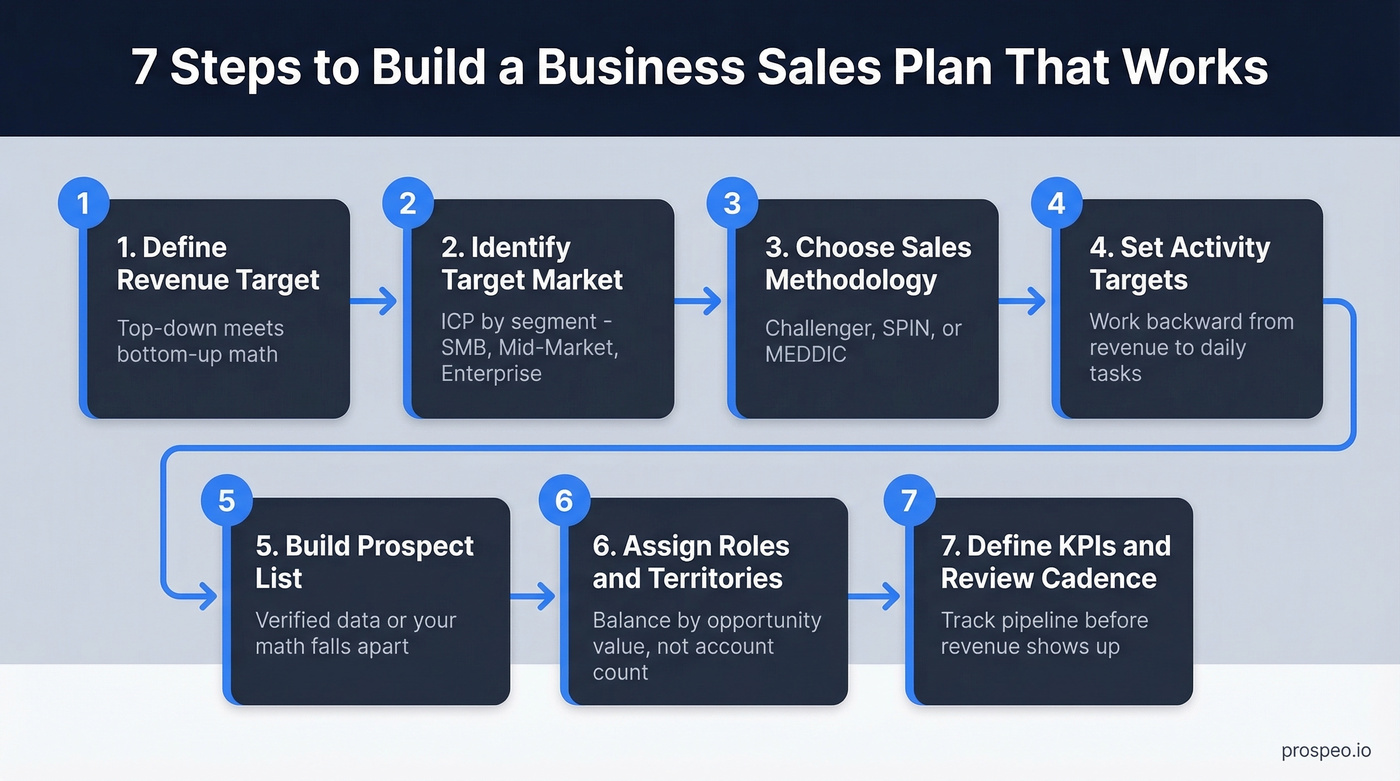
How to Write a Sales Plan in 7 Steps
1. Define Your Revenue Target
Start with a specific, time-bound number. Not "grow 30%" - something like $1.2M in new ARR by Q4 2026.
Run it two ways. Top-down: leadership says we need $5M this year, divide by four quarters, allocate across reps. Bottom-up: each rep can realistically close X deals per month at Y average deal size, multiply out. If those two numbers don't converge, you've got a planning problem to solve before you do anything else. In our experience, teams that skip the bottom-up calculation always overshoot their targets and spend Q4 scrambling.
2. Identify Your Target Market
Build an ICP that includes industry, company size, tech stack, and the specific pain your product solves. Then segment by tier.
SMB typically means under 100 employees with faster cycles and smaller deals. Mid-market (100-1,000 employees, $50M-$1B revenue) introduces more stakeholders. Enterprise can stretch to 18-month cycles with procurement, legal, and security reviews. Each segment demands different activity volumes, messaging, and pipeline assumptions. Don't build one plan and pretend it covers all three.
3. Choose a Sales Methodology
Challenger, SPIN, MEDDIC - pick one that fits your sale. The Challenger Sale was built on research across 6,000+ reps. SPIN Selling analyzed 35,000+ sales calls over 12 years. MEDDIC is the go-to for complex enterprise deals with multiple stakeholders.
A popular thread on r/sales nails it: most methodologies converge on the same fundamentals - need, budget, stakeholders, timeline. Don't spend three months debating frameworks. Pick one that gives your team a shared vocabulary, train on it, and move on.
One data point worth building into whatever methodology you choose: a HubSpot sales leader shared a 20% win rate increase over two quarters when a team replaced pressure-based closing tactics with data-backed proposals and tailored value maps. Trust outsells urgency.
4. Set Activity Targets
This is where most plans fall apart. You need to work backward from your revenue target to daily activities, and the conversion rates in between need to be honest.
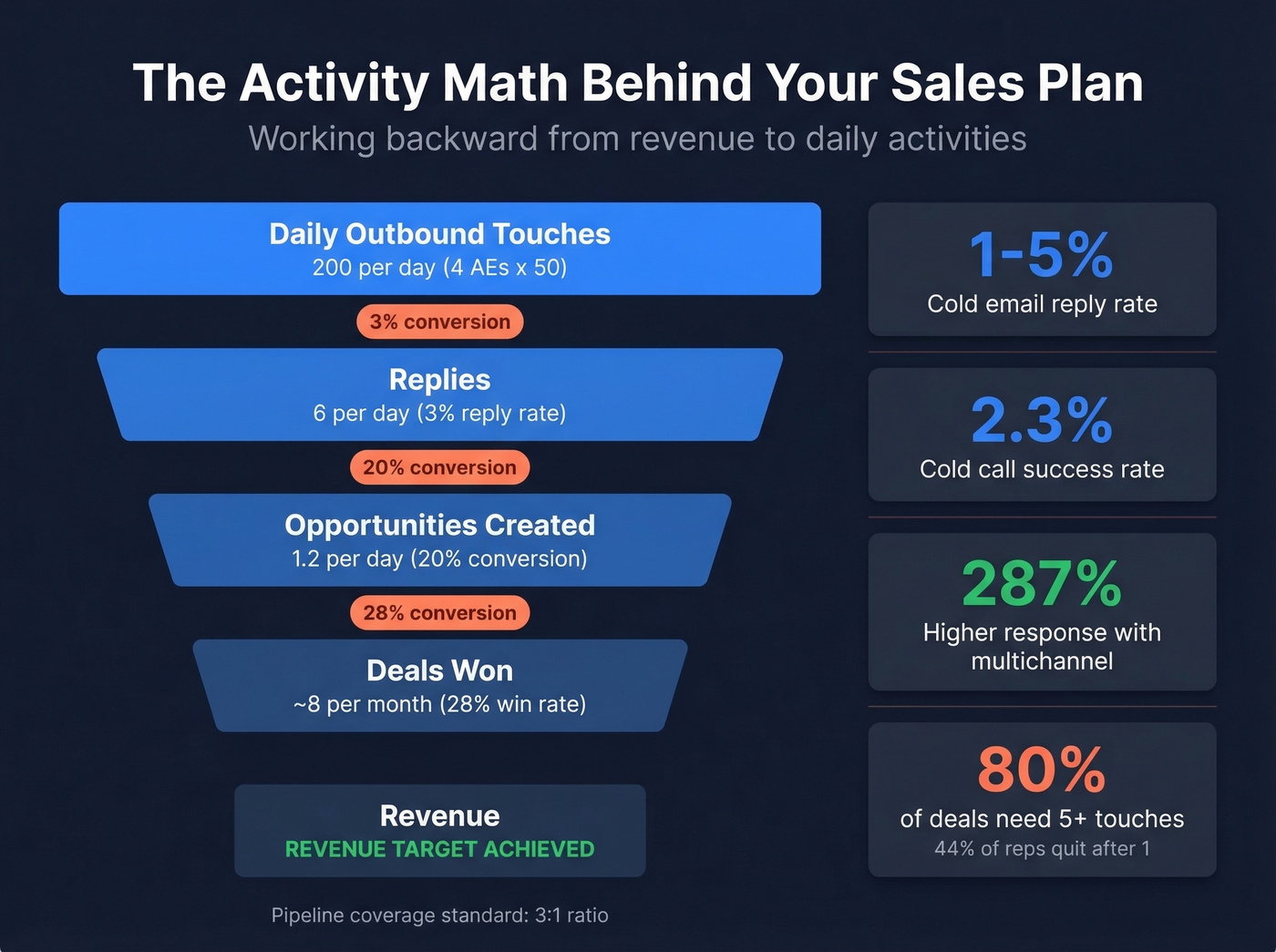
Cold email reply rates run 1-5%. Cold calling success averages 2.3%. The average B2B sales win rate sits around 28%. And 80% of deals require five or more touches, yet 44% of reps give up after one. Multichannel outreach - email plus phone plus social - drives 287% higher response rates than single-channel approaches. Standard pipeline coverage is 3:1.
Here's the capacity math: (number of reps) x (daily activities per rep) x (conversion rate at each stage) = pipeline generated. Four AEs doing 50 outbound touches per day at a 3% reply rate and a 20% opportunity conversion gives you 4 x 50 x 0.03 x 0.20 = 1.2 new opportunities per day across the team. Run that against your average deal size and cycle length. If the math doesn't work, you need more reps, better conversion, or a lower target.
If you want a clearer breakdown of what to count, use these sales activities as your baseline.
5. Build Your Prospect List
Your activity targets are fiction if 30% of your emails bounce. Data quality isn't a nice-to-have - it's a planning input. A bounce rate above 10% doesn't just waste rep time; it tanks your domain reputation and makes every subsequent email less likely to land.
We've seen this play out firsthand. Meritt was running a 35% bounce rate before switching to verified data - their pipeline tripled from $100K to $300K per week once bounces dropped below 4%. Prospeo's database covers 300M+ professional profiles with 98% verified email accuracy, all refreshed on a 7-day cycle. The free tier gives you 75 verified emails per month to test. Your pipeline math holds up only if the contacts are real - start there before you worry about sequences or messaging.
If you're diagnosing deliverability, start with email bounce rate benchmarks and fixes.

6. Assign Roles and Territories
If you're running a pod model (SDR + AE + CSM), map the handoff points. If you're territory-based, split by geography, vertical, or company size - not by alphabet. The worst territory plans give one rep all the Fortune 500 accounts and another a list of pre-seed startups.
Balance territories by opportunity value, not account count. A rep with 50 mid-market accounts and a rep with 200 SMB accounts might have equivalent pipeline potential. Document this so there's no ambiguity when commission disputes arise.
7. Define KPIs and Review Cadence
Track these six metrics at minimum: pipeline value, deal count, pipeline coverage ratio, stage conversion rates, average stage duration, and slippage rate. These tell you whether the plan is working before revenue shows up - or doesn't.
If you want a tighter KPI set, use these pipeline health metrics as your weekly view.
Salesforce recommends startups review at least quarterly, with new product lines potentially needing monthly check-ins early after launch. A deal with no activity for 30+ days is 80% less likely to close. Catch it at 15 days, not 30. The cadence isn't bureaucracy - it's your early warning system.
Tailor Your Plan by Company Size
| SMB | Mid-Market | Enterprise | |
|---|---|---|---|
| Deal size | $5K-$25K | $25K-$150K | $150K-$1M+ |
| Cycle length | 2-6 weeks | 1-3 months | 6-18 months |
| Stakeholders | 1-2 | 3-5 | 7-15+ |
| Pipeline coverage | 3:1 | 3-4:1 | 4-6:1 |
| Review cadence | Monthly | Monthly | Bi-weekly |
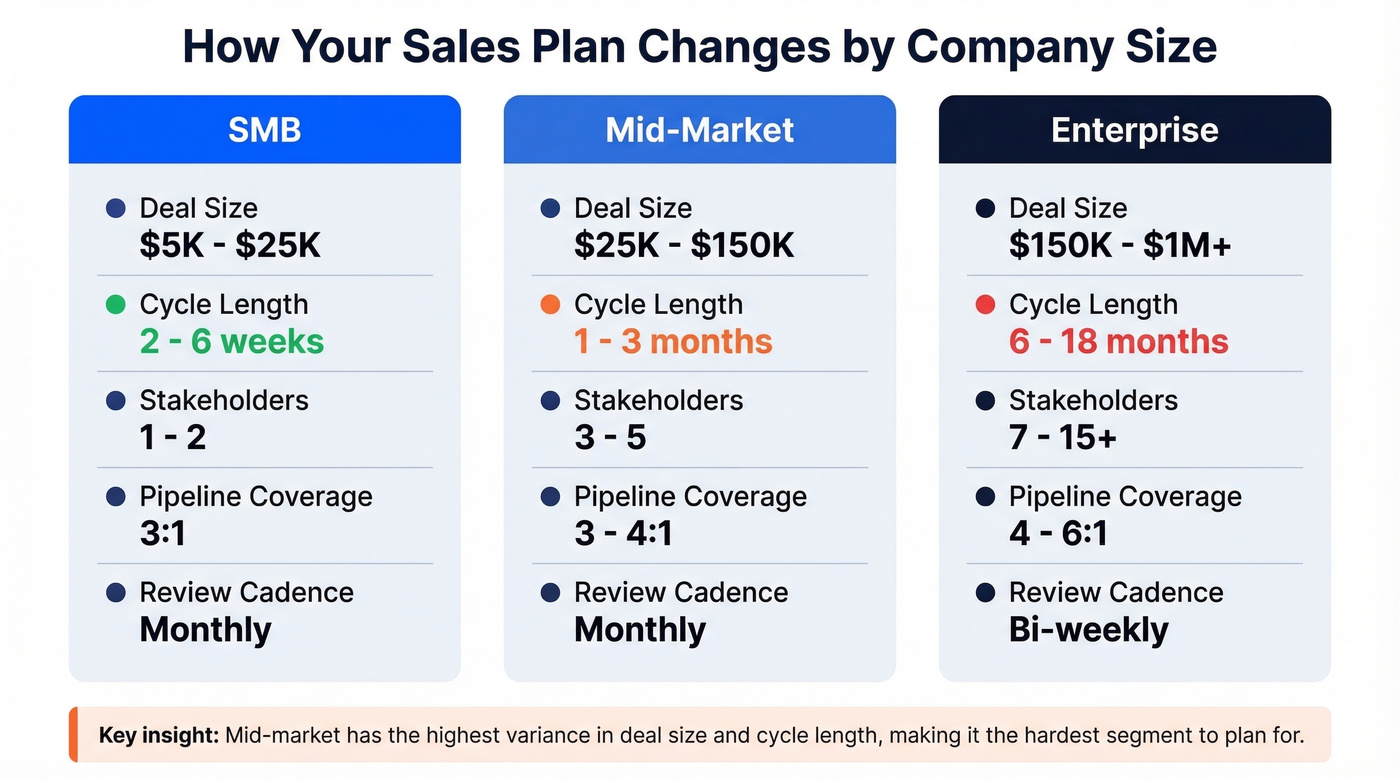
Enterprise deals need higher pipeline coverage because slippage is brutal - a single deal pushing from Q3 to Q4 can blow up your entire quarter. SMB plans should emphasize velocity and volume. Mid-market is actually the hardest to plan for because the variance in deal size and cycle length is enormous; we've closed mid-market deals in two weeks and also watched them drag on for five months with no clear pattern.
If you're selling upmarket, this enterprise B2B sales guide will help you set more realistic cycle and stakeholder assumptions.

Your pipeline math falls apart when 30% of emails bounce. Prospeo's 300M+ profiles are verified to 98% accuracy on a 7-day refresh cycle - so the activity targets in your sales plan actually convert. Meritt tripled their pipeline from $100K to $300K/week after dropping bounces below 4%.
Start with 75 free verified emails and pressure-test your plan.
The 30/60/90-Day Sales Plan
On r/sales, the most common ask is for a plan "someone actually used to get hired" - not a generic template. Here's the framework.
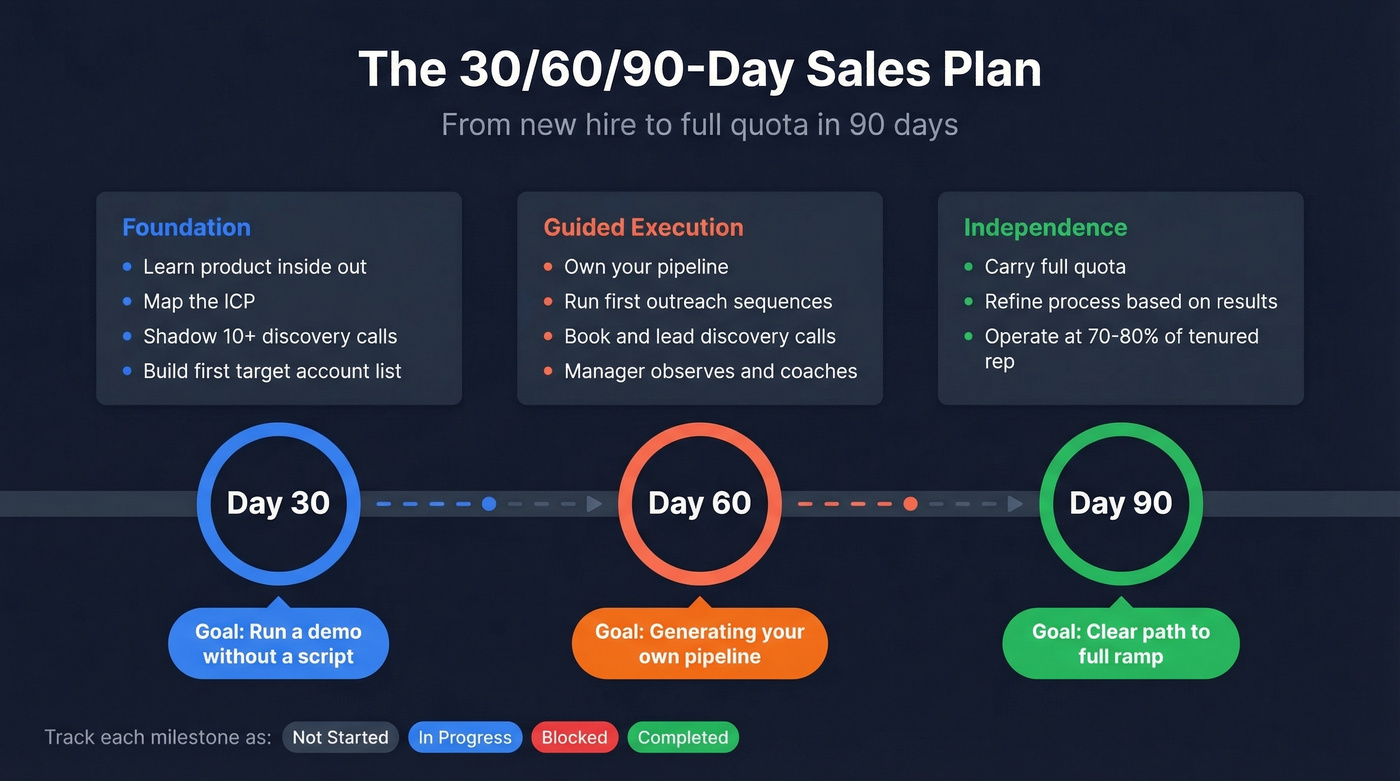
Days 1-30: Foundation. Learn the product inside out. Map the ICP. Shadow 10+ discovery calls. Build your first target account list. By day 30 you can run a demo without a script and articulate the top three objections.
Days 30-60: Guided execution. Own your pipeline. Run first outreach sequences. Book and lead discovery calls with manager observation. By day 60 you're generating your own pipeline and have a realistic forecast.
Days 60-90: Independence. Carry full quota. Refine your process based on what's working. By day 90 you're operating at 70-80% of a tenured rep's productivity with a clear path to full ramp.
Track each milestone as Not Started, In Progress, Blocked, or Completed. If you're presenting this in an interview, fill in specific actions for that company - generic plans get generic reactions.
For a more detailed version you can adapt, use this 30/60/90-day plan.
Why Most Sales Plans Fail
Plans fail at execution, not strategy.
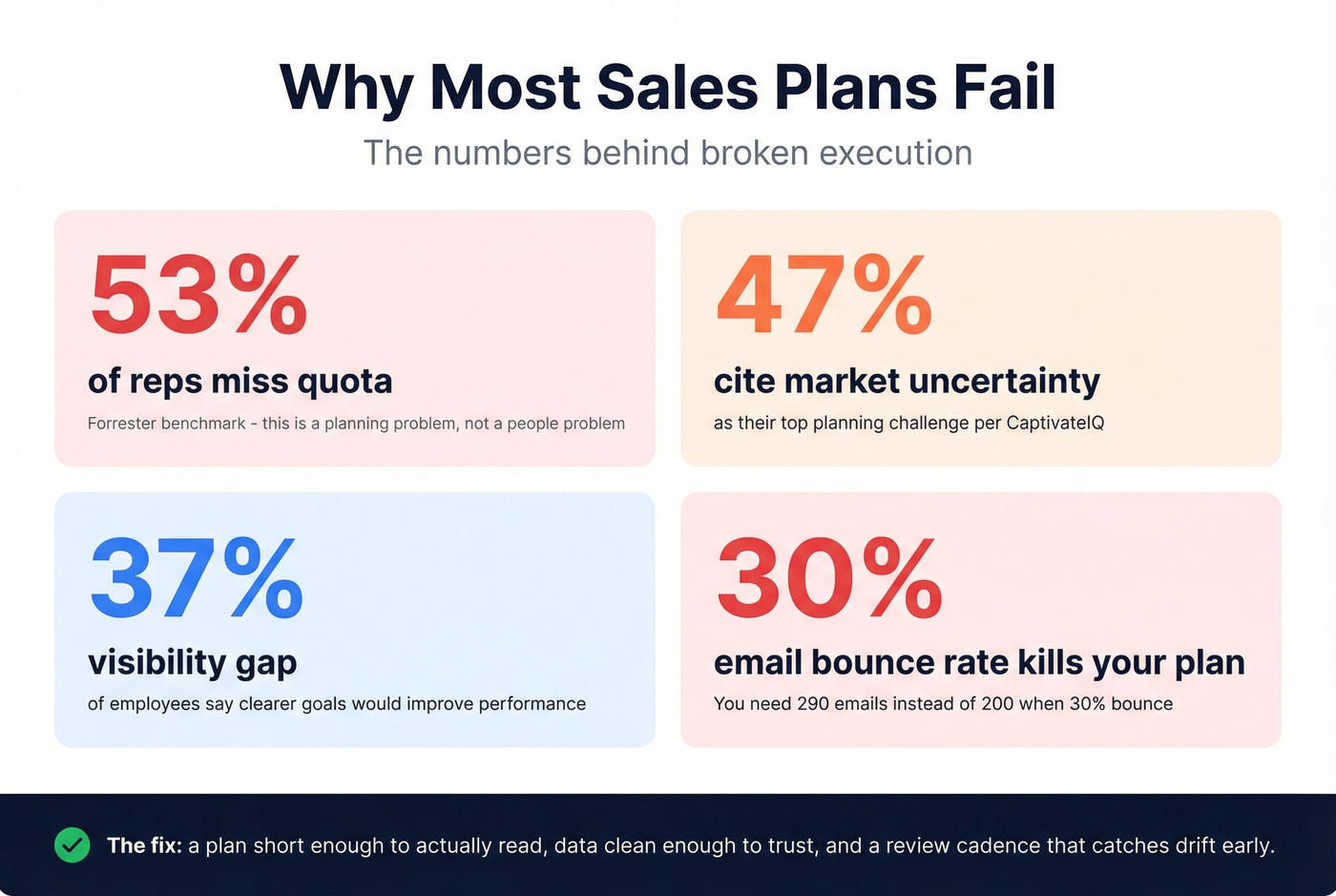
CaptivateIQ's research shows 47% of companies cite market uncertainty as their top challenge, and only 27% have a fully automated commission process - meaning most teams run critical planning functions in spreadsheets that break. The silent killer, though, is bad contact data. If 30% of your emails bounce, every conversion assumption in your plan collapses. Your activity math says you need 200 outbound emails to generate 6 replies and 1 opportunity. But if 60 of those emails never land, you actually need 290 emails for the same result - and your domain reputation degrades with every bounce.
Here's the thing: most sales plans don't fail because the strategy was wrong. They fail because nobody built the plan to survive contact with reality. A 37% visibility gap - that's how many employees say they'd perform better with clearer goals - doesn't get fixed with more dashboards. It gets fixed with a plan short enough to actually read and a review cadence that catches drift before it compounds.
If you're seeing execution issues, these sales pipeline challenges are usually the root cause.
You just built activity targets, territories, and KPIs. Now you need contacts that won't wreck your domain reputation. Prospeo gives you 30+ filters - buyer intent, technographics, headcount growth, funding - so every rep's list matches your ICP exactly. At $0.01 per email, scaling your sales plan doesn't blow your budget.
Stop planning around bad data. Build your prospect list in minutes.
Use AI to Sharpen Your Plan
The sales planning software market passed $24.1B in 2025 and is projected to reach $79.3B by 2037. Sellers with AI tools are 3.7x more likely to meet quota, and among teams using AI SDR tools, 40% save 4-7 hours per week.
Deals closed within 50 days carry a 47% win rate. Beyond 50 days, that drops to 20%. Your plan should include deal velocity as a KPI - not just pipeline value. AI tools that flag stalled deals and predict slippage are worth the $50-$200 per user per month they typically cost. Skip them if your team is under five reps and your CRM pipeline view already gives you the visibility you need - the ROI doesn't kick in until you've got enough deal volume to surface patterns.
If you're evaluating tooling, start with these SDR tools and sales forecasting solutions.
Free Sales Plan Template
You don't need 25 pages. We've seen three-page plans outperform 25-page plans every time. Here's the structure:
Plan owner: [Name] | Date: [Q3 2026] | Review cadence: Monthly
Revenue objectives: $1.2M new ARR | $200K expansion revenue
Target customers (ICP): B2B SaaS companies, 50-500 employees, Series A-C, using Salesforce or HubSpot, VP Sales or RevOps buyer
Strategies and tactics: Outbound-led with inbound support. 200 outbound emails/day across 3 AEs. ABM for top 25 accounts. Partner channel for mid-market.
Team roles: 1 SDR (top-of-funnel), 3 AEs (full-cycle), 1 RevOps (data + reporting)
Roadblocks and solutions: Data quality - use a verified contact database. Rep ramp time - 30/60/90 onboarding plan. Forecast accuracy - weekly pipeline scrub.
Market conditions: Competitive pressure from [competitor]. Budget scrutiny increasing - emphasize ROI in proposals.
Deadlines: Pipeline target by end of month 1. First closed deals by month 2. Full run-rate by month 3.
KPIs: Sales velocity, CAC under $8K, 3:1 pipeline coverage, lead response time under 5 minutes, stage conversion rates tracked weekly.
Copy this structure, fill in your numbers, and pin it where your team will actually see it - Slack channel, Notion page, or the office whiteboard. A plan that lives in a Google Doc nobody opens isn't a plan. It's a wish.
If you need to sanity-check your funnel assumptions, use these sales pipeline benchmarks.
FAQ
How long should a sales plan be?
Three to five pages covers targets, ICP, activity math, team structure, and KPIs without becoming a document people avoid. Enterprise orgs with multiple product lines might need 10+ pages, but the executive summary should still fit on one page.
How often should you update your plan?
Monthly for established teams, quarterly at minimum for startups. New product lines may need weekly check-ins during the first 90 days. Compare actual conversion rates and pipeline coverage against your assumptions and adjust activity targets accordingly.
What's the difference between a sales plan and a business plan?
A business plan covers the entire company - product, market, funding, operations. A sales plan is the revenue execution piece that lives inside it. Think of the business plan as the "what and why" and the sales plan as the "how and how much."
What tools help execute a sales plan?
A CRM like HubSpot or Salesforce handles pipeline tracking. For verified prospect data so your activity math doesn't collapse from bounced contacts, tools like Prospeo offer free tiers to test. Gong or similar platforms cover coaching and deal inspection.
What is a 30/60/90-day sales plan?
A phased onboarding framework: days 1-30 focus on learning product and process, days 30-60 shift to guided pipeline execution, and days 60-90 target full independence at quota. It's the most common format hiring managers request and the most practical way to structure new rep ramp.