

Buyer Pain Points: The Friction That Stalls 86% of B2B Deals
Your champion went dark after the second demo. The deal was "90% there" two weeks ago. Now procurement wants a security review, the CFO is questioning the line item, and a new VP just joined the buying committee wanting to re-evaluate everything from scratch. That deal didn't die because of your product. It died because of buyer pain points embedded in the buying process itself.
Forrester's research puts the number at 86% of B2B purchases - that's the share of B2B purchases that stall during the buying process. And 81% of buyers end up dissatisfied with the provider they ultimately choose. Average sales cycles compressed from 11.3 to 10.1 months recently, but deals still stall. The problem isn't your pitch. It's the friction surrounding the decision.
The Short Version
Buyer pain points aren't customer pain points. The friction lives in the buying process, not in the product problem your solution fixes. Three things kill deals more than anything else: stakeholder misalignment, pricing opacity, and seller-created friction from bad data, zero research, and irrelevant outreach. Fix it upstream - verify contact data before outreach, research accounts before the first touch, and use SPIN discovery to surface real friction.
Buyer Pain vs. Customer Pain
Most pain point frameworks focus on post-purchase experience - support tickets, onboarding friction, churn. That's customer pain. Buyer pain is everything that happens before the signature: risk, uncertainty, internal politics, and the cognitive load of evaluating vendors while still doing your actual job.
83% of buyers mostly or fully define their requirements before talking to sales. They already know what they need. What they don't know is how to get six stakeholders aligned, navigate procurement, and feel confident they won't regret the decision in six months.
Sellers who jump straight to product pain miss the real blocker entirely. Understanding the friction at this stage - before the first call - is what separates reps who close from reps who chase.

59% of buyers say reps don't do basic research. That friction starts with bad data - wrong contacts, stale titles, emails that bounce. Prospeo's 7-day refresh cycle and 98% email accuracy mean your first touch reaches the right person with their current role, not a ghost from last quarter's org chart.
Stop creating buyer friction before the first conversation even starts.
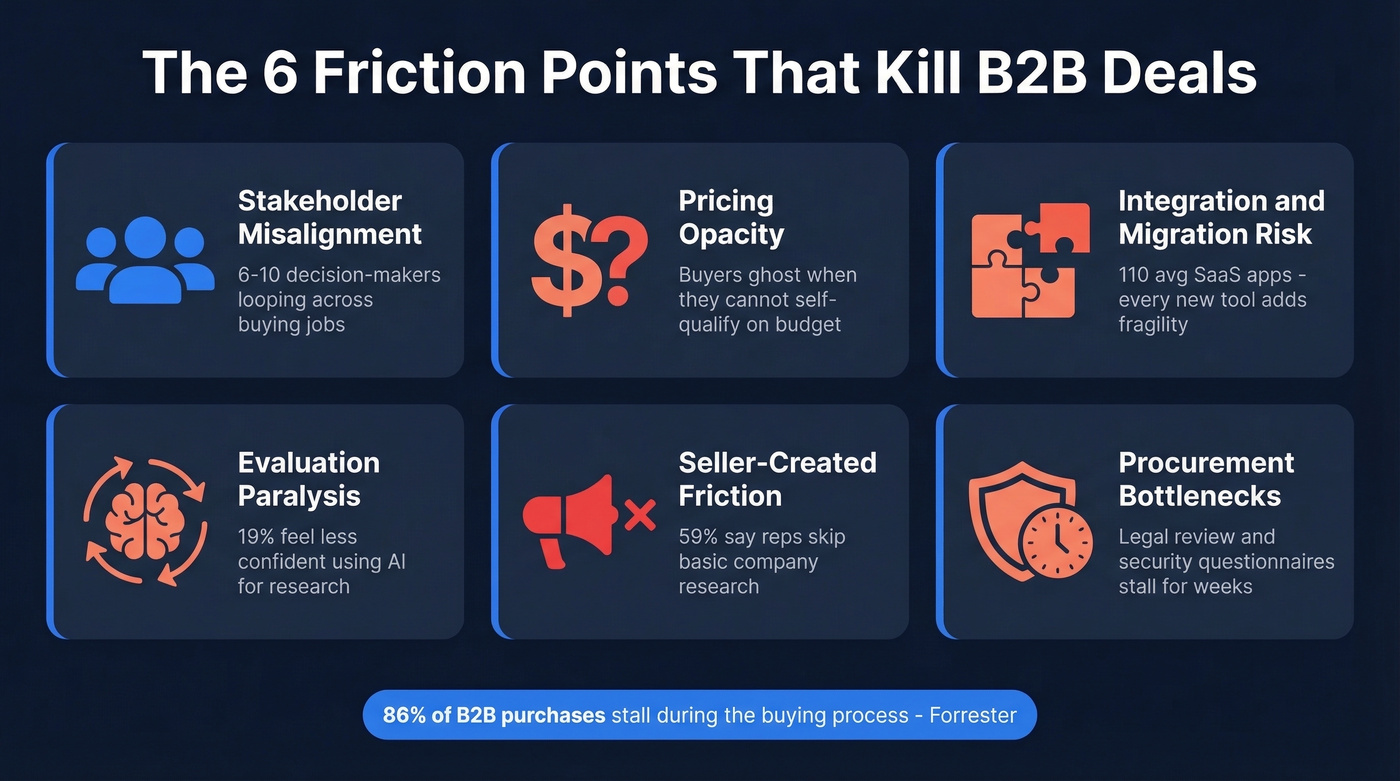
The Six B2B Buying Friction Points That Actually Kill Deals
Stakeholder Misalignment
B2B buying groups involve 6-10 decision-makers, and Gartner's research shows buyers loop across six buying jobs, revisiting each at least once. That VP who joined the committee in week three? They're back at "problem identification" while everyone else is at "supplier selection." In our experience, the deals that stall longest aren't the ones with product objections - they're the ones where the seller never mapped the buying committee in the first place.
Pricing Opacity
"I just want to know if this is $5K or $50K before I waste an hour on a demo."
Every buyer has thought this. Hidden costs, gated pricing pages, and "talk to sales" walls create resentment before a single conversation happens. Buyers want to self-qualify on budget. When they can't, they ghost. It's that simple.
Integration and Migration Risk
Companies use an average of 110 SaaS applications. Every new tool means another integration, another data migration, another potential point of failure. Buyers aren't evaluating your product in isolation - they're evaluating the operational risk of adding it to an already fragile stack, and they're doing that mental math long before they tell you about it.
Evaluation Paralysis
More information should mean better decisions. It doesn't. 94% of B2B buyers now use LLMs during the buying process, yet 19% of buyers using genAI feel less confident in their purchasing decisions because of inaccurate or unreliable AI-generated information. Decision fatigue is real, and it's getting worse.
Seller-Created Friction
Here's the paradox: 75% of B2B buyers prefer a rep-free experience, yet buyers who engage with a sales rep alongside digital tools are 1.8x more likely to complete a high-quality deal. Buyers don't hate reps. They hate bad reps - the ones who send irrelevant demos and clearly haven't spent five minutes researching the account. Salesforce found that 73% of buyers say most sales interactions feel transactional.
Procurement and Compliance Bottlenecks
Your champion sends the contract to legal on a Friday. Four weeks later, you're still waiting on a security questionnaire response. Legal review, regulatory sign-offs, vendor risk assessments - these aren't objections, they're process requirements. Skip this section if you're selling deals under $10K with a single signer, but for enterprise? Sellers who don't anticipate this timeline lose deals they thought they'd already won.
Why Sellers Create Most of Their Own Friction
Let's be honest: sellers cause most of the buying friction they complain about. 59% of buyers say reps don't bother doing basic research that a quick look at the company's website would answer. Meanwhile, 84% of buyers expect reps to act as trusted advisors. The gap between expectation and reality is enormous.
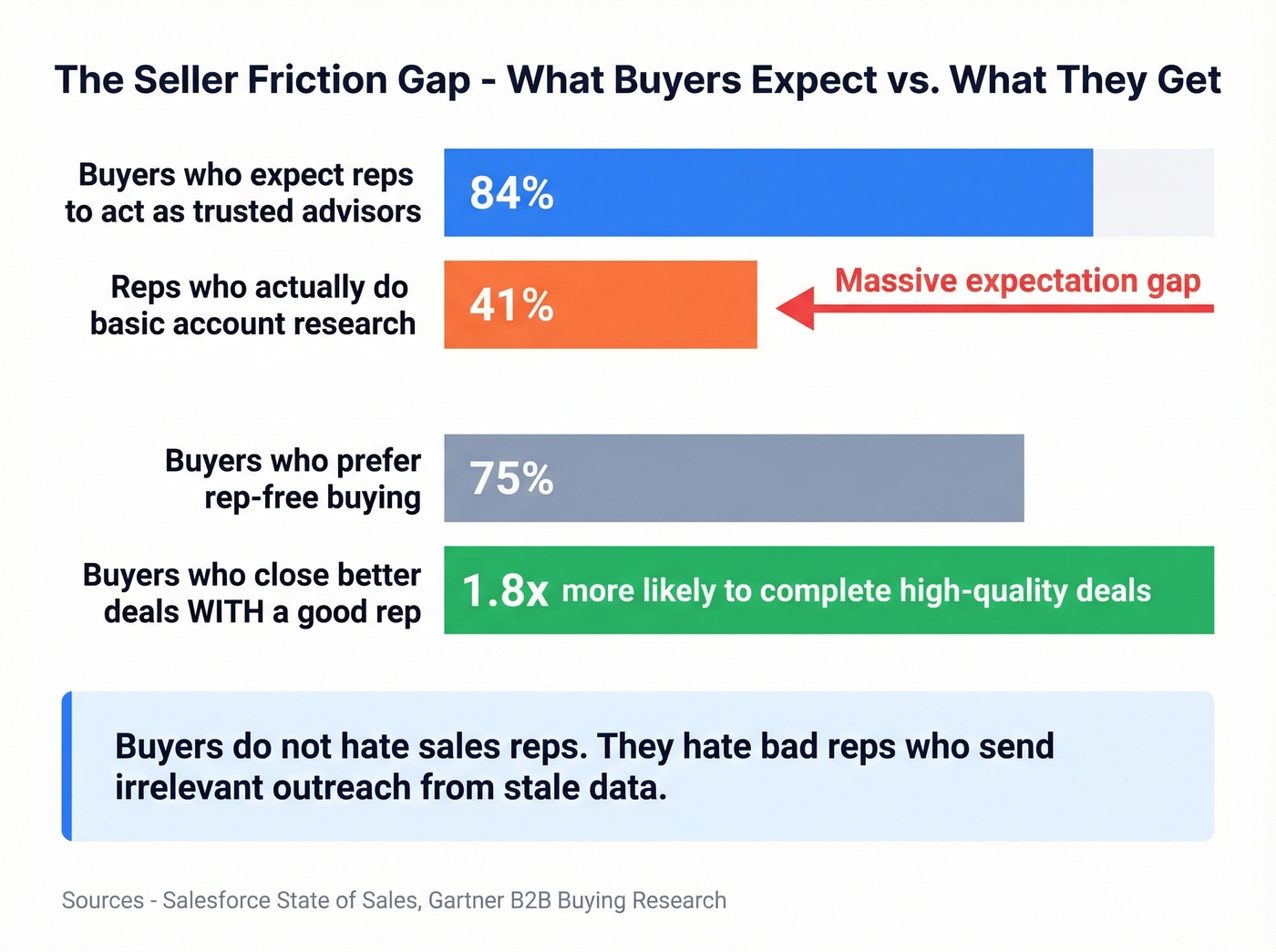
A recurring theme on r/sales: reps get handed generic, product-centric scripts with zero ICP context and are told to sell "problem-centric." The failure starts upstream. Bad contact data means you're reaching the wrong person. Stale data means you're referencing a role they left three months ago. No account research means your opening line is irrelevant. All of that registers as friction on the buyer's end, and they don't give you a second chance to fix it.
This is where data quality becomes a deal-quality issue. We've seen teams cut bounce rates from 35% to under 4% just by switching to data that's actually refreshed weekly - Prospeo's 7-day refresh cycle and 98% email accuracy mean your first email reaches the right person with a current title, not a stale CSV contact who left the company a quarter ago. (If you're diagnosing deliverability, start with email bounce rate benchmarks and fixes.)

How to Uncover Real Buyer Pain Points
Discovery isn't "what keeps you up at night?" That question gets you a polite non-answer. Use the SPIN framework to systematically surface real friction:
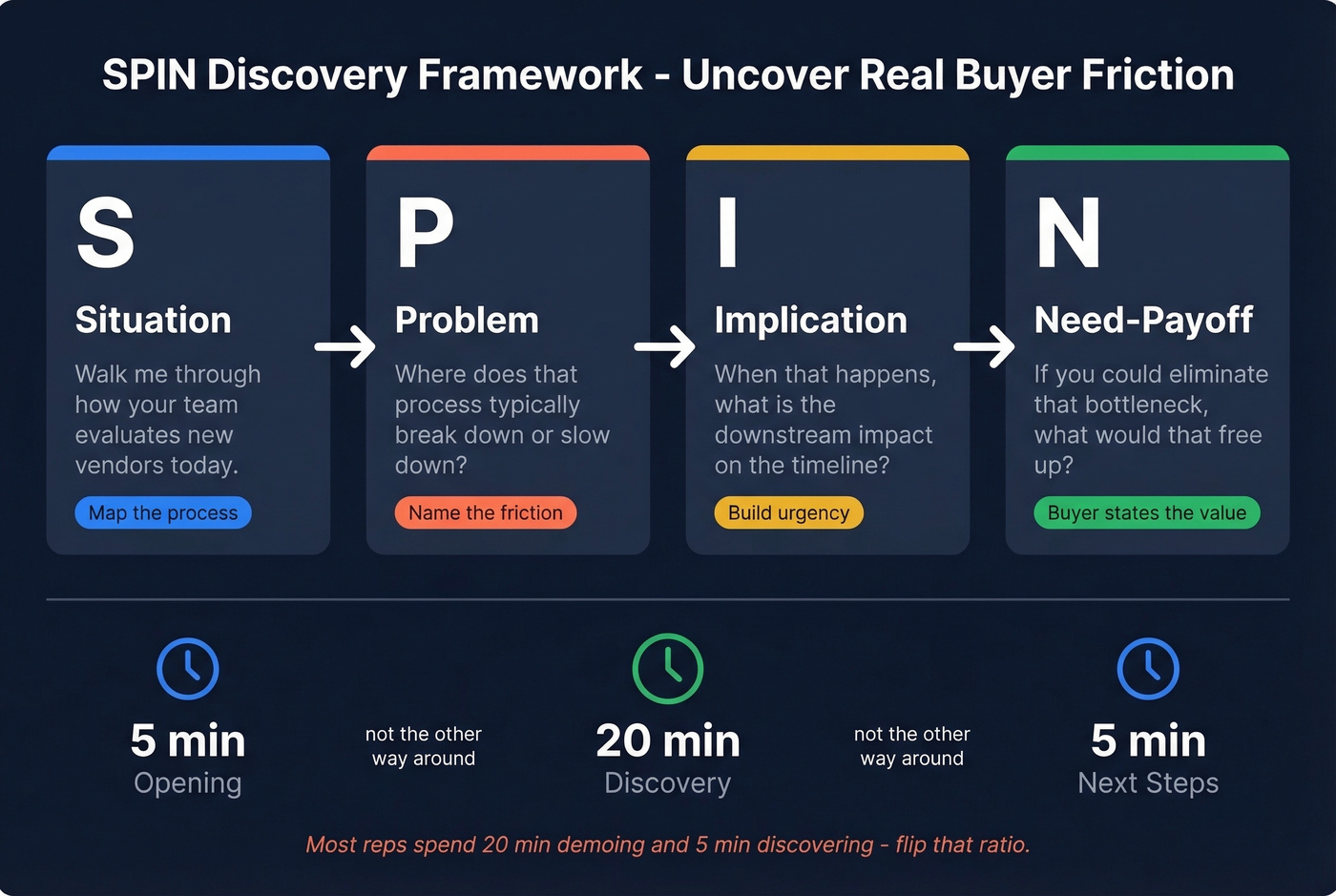
Situation: "Walk me through how your team evaluates new vendors today." You're mapping the process, not pitching.
Problem: "Where does that process typically break down or slow down?" Let them name the friction.
Implication: "When that happens, what's the downstream impact on the team's timeline?" This is where urgency lives.
Need-Payoff: "If you could eliminate that bottleneck, what would that free up?" Let the buyer articulate the value themselves.
Structure your calls around five minutes of opening, twenty minutes of discovery, and five minutes for next steps. The biggest mistake we see is reps who spend 20 minutes demoing and 5 minutes discovering. Flip that ratio. (If your demos are dragging, use a tighter product demo checklist.)
Then prioritize the friction you uncover by deal impact multiplied by frequency. A bottleneck that affects every enterprise deal matters more than one that shows up in 10% of SMB conversations.
Here's a take that might ruffle some feathers: if your average deal size is under $15K, most buyer pain points aren't about your product at all - they're about the internal effort required to justify any purchase at that price. Your job isn't to sell harder. It's to make the buying process so frictionless that the effort-to-value math becomes obvious. (This is also why sales process optimization beats “more activity” most quarters.)
Mapping a 6-10 person buying committee is impossible when your data is stale. Prospeo gives you 30+ filters - department headcount, job changes, org hierarchy - across 300M+ verified profiles so you can identify every stakeholder before your champion goes dark.
Map the full buying committee at $0.01 per verified email.
FAQ
What's the difference between buyer and customer pain points?
Buyer pain points are pre-purchase decision friction - stakeholder misalignment, evaluation paralysis, pricing opacity. Customer pain points are post-purchase issues like onboarding or support. Addressing buyer friction requires mapping the decision process and reducing risk before the signature, not fixing product experience after it. Gartner's B2B buying research is a solid starting point for understanding the difference.
What are the biggest B2B buyer pain points in 2026?
Stakeholder misalignment across 6-10 decision-makers, pricing opacity that blocks self-qualification, and seller-created friction from irrelevant outreach. The first two are structural. The third is self-inflicted - reps working from stale data or skipping account research before the first touch.
How do you stop creating friction with outreach?
Verify contact data before sending anything - Prospeo refreshes B2B data every 7 days so you reach the right person with current titles. Then spend five minutes on account research so your first touch is relevant. Teams using fresh, verified data see bounce rates drop below 4% and connect rates climb to 20-25%. Salesforce's State of Sales report backs up the broader finding that research-driven outreach dramatically outperforms spray-and-pray.