

10 Buyer Persona Examples You Can Actually Use in 2026
Most buyer persona examples floating around are fiction. Stock photo, a name like "Marketing Mary," a list of hobbies nobody will ever reference, all sitting in a Google Doc that hasn't been opened since the quarter it was created. The practitioner term on Reddit is "fairytale personas" - built by marketers who never talked to a customer, then left to collect dust.
That's a waste. 71% of companies that exceed revenue and lead goals have documented buyer personas, compared to 37% that merely meet goals and 26% that miss them. The gap isn't whether personas matter. It's whether yours reflect how people actually buy.
Here's the thing: most teams don't need better persona templates. They need to talk to five customers and write down what they hear. A messy doc based on real interviews beats a beautifully designed persona card built on assumptions every single time.
What Is a Buyer Persona?
A buyer persona is a semi-fictional profile of the person who buys your product - their goals, pain points, decision criteria, and how they evaluate options. It's not a demographic sketch. It's a decision-making model.
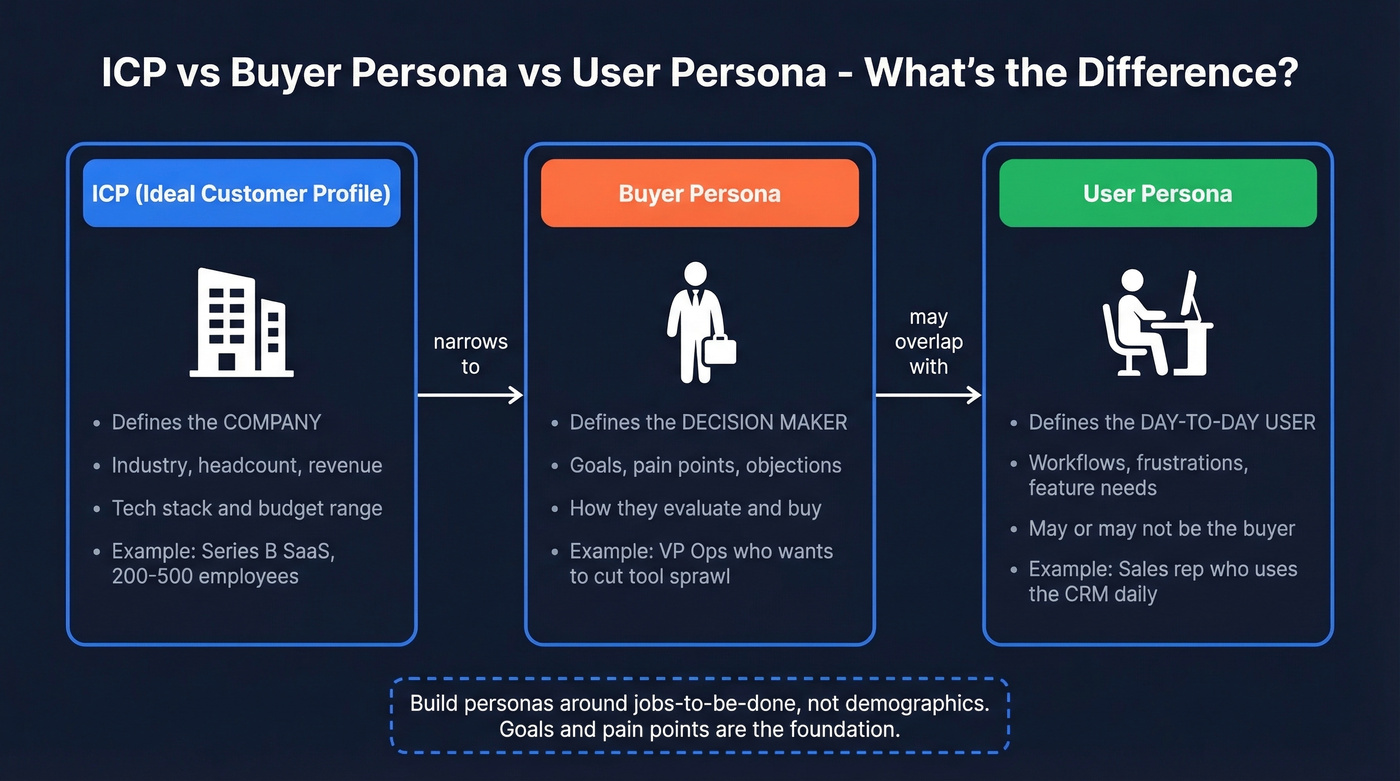
The confusion usually starts here. An ICP (ideal customer profile) defines the company - industry, headcount, tech stack, budget range. A buyer persona defines the person inside that company. A user persona, more common in product and UX work, defines whoever actually uses the product day-to-day, who may or may not be the buyer.
Build personas around jobs-to-be-done, not demographics. "VP of Operations at a 300-700 employee SaaS company" tells you something. "VP of Operations who wants to reduce tool sprawl and cut implementation timelines" tells you what to say to them. Goals and pain points are the foundation. Demographics are context.
One field most teams skip: first-person statements. Write a sentence from your persona's perspective - "I need to prove ROI to my CFO before I can greenlight another tool." This forces you out of abstract thinking and into the buyer's actual headspace.
Do Personas Actually Drive Revenue?
The data is consistent. Persona-driven email campaigns see 2x open rates and 5x click-through rates. A MarketingSherpa case study found a 171% increase in marketing-generated revenue and a 900% increase in time-on-site after implementing personas.
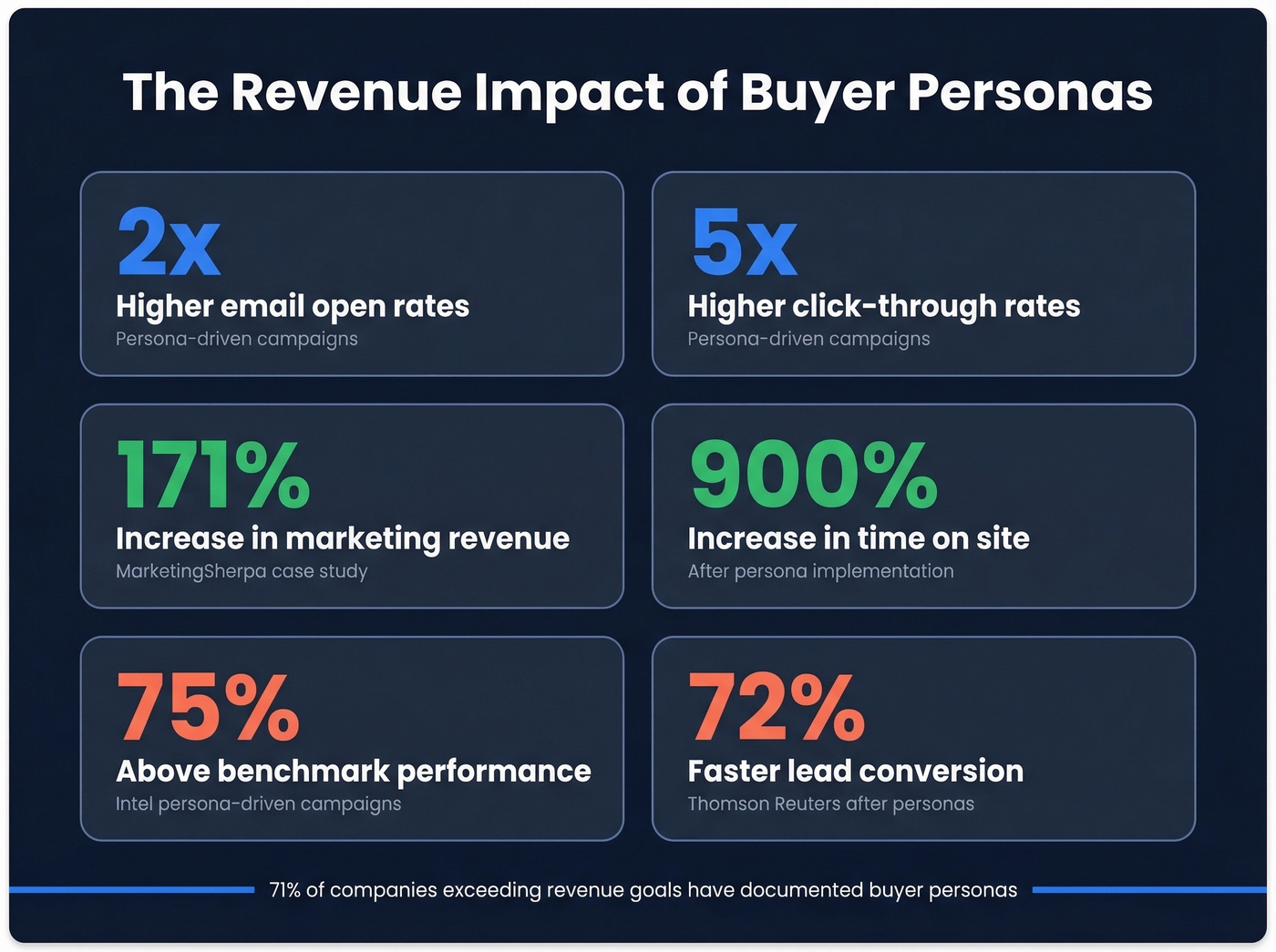
Named-company results are just as strong. Intel's persona-driven campaigns surpassed benchmarks by 75% while being 48% more cost-efficient. Thomson Reuters saw a 175% increase in marketing-attributed revenue and a 72% reduction in lead conversion time. MetLife refreshed their entire persona strategy using 50,000+ customer interviews - extreme, but it illustrates the principle. The more real data behind your personas, the better they perform.
Companies that treat personas as living research documents outperform the ones that treat them as a one-time marketing exercise. Every time.
10 Buyer Persona Examples You Can Steal
Each persona below includes the fields that drive real decisions: role, goals, pain points, decision criteria, preferred channels, and objections. Adapt these to your market - don't copy them blindly.
B2B SaaS Personas
Operations Olivia - VP of Operations
- Company: 300-700 employee SaaS company
- Goals: Process efficiency, reduce tool sprawl, standardize workflows across departments
- Pain points: Too many disconnected tools, long implementation timelines, internal resistance to change
- Decision criteria: Integration depth with existing stack, total cost of ownership, implementation timeline under 90 days
- Preferred channels: Peer benchmarks, analyst reports, vendor case studies
- Objections: "We've tried tools like this before and adoption was terrible."
Why this works: It centers on a specific operational anxiety - change management - not generic "wants efficiency." If you copy this without adjusting the company size range to your actual ICP, you'll target the wrong accounts.
Technical Evaluator Tomas - Senior Engineer
- Company: Mid-market to enterprise, any vertical with a technical buying process
- Goals: Ensure the tool meets security, compliance, and integration requirements before the team commits
- Pain points: Vendors who can't answer technical questions, no sandbox access, vague API documentation
- Decision criteria: API docs quality, SSO/SCIM support, security posture (SOC 2, pen test reports), sandbox or trial environment
- Preferred channels: GitHub, developer communities, documentation sites
- Objections: "Does it integrate with our stack? Show me the API."
Tomas is a gatekeeper. He won't champion your product, but he can kill the deal. The mistake teams make: forcing him through a sales demo to find out if you support SAML. Give him technical depth early or lose him.
Budget Owner Brenda - CFO / VP Finance
- Company: Series B+ SaaS, 200-1,000 employees
- Goals: Control spend, ensure positive payback window, reduce vendor risk
- Pain points: Surprise costs, unclear ROI models, vendors who can't articulate business impact in financial terms
- Decision criteria: Payback window under 12 months, TCO vs. point solutions, vendor financial viability
- Preferred channels: Analyst reports, peer CFO benchmarks, board-ready ROI models
- Objections: "Show me the ROI model. What's the payback period?"
Brenda enters the deal late and leaves fast. If your champion can't hand her a one-page business case, you've already lost.
B2C Personas
Cost-Conscious Carlos - Graduate Student, 26
| Field | Detail |
|---|---|
| Goals | Get quality without overpaying, maximize value per dollar |
| Pain points | Hidden fees, complex pricing tiers, feeling tricked by "free" offers |
| Channels | Reddit, YouTube reviews, comparison sites, student discount aggregators |
| Objections | "Is there a cheaper option that does the same thing?" |
Carlos will spend 45 minutes comparing three products to save $8/month. Your pricing page needs to be crystal clear, and your free tier needs to be genuinely useful - not a bait-and-switch. What's missing if you copy this blindly: Carlos's decision timeline. B2C personas need a "how long does this person deliberate?" field. For Carlos, it's days. For an impulse buyer, it's seconds.
Cautious Insurance Buyer Claire - First-Time Homeowner, 33
Claire's buying process is driven by anxiety, not excitement. She wants to protect her investment without overpaying for coverage she doesn't need, but she's overwhelmed by industry jargon and distrusts upselling. She researches through Google, personal referrals, and review sites. Her core objection: "How do I know I'm not being sold more than I need?" She needs education and trust signals - plain-language explanations, transparent pricing, and social proof from people like her.
Buying Committee Personas for 2026
In 2026 SaaS deals, you're not selling to one person. You're convincing a committee of 6-10 stakeholders. These committee personas focus on what each role needs from you, since they're defined by their function in the deal, not their individual profile.
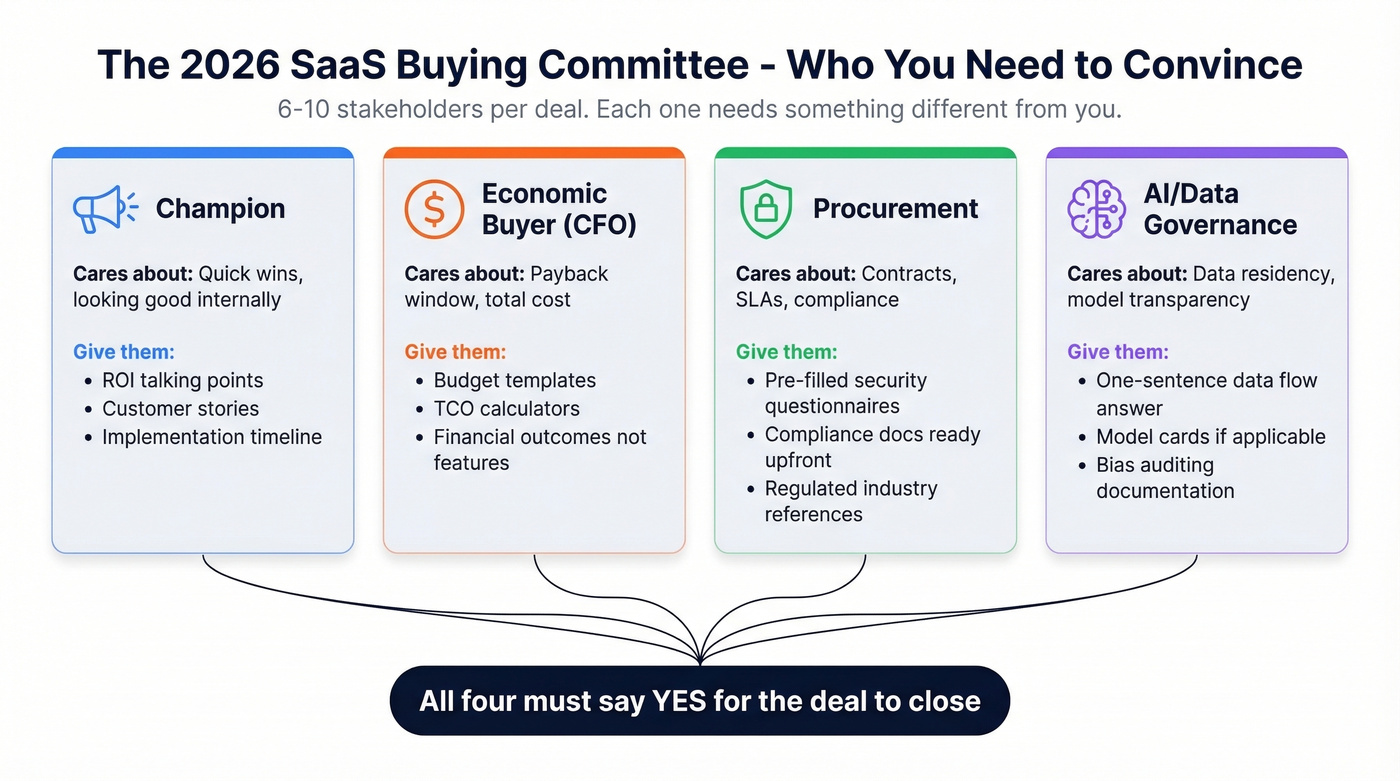
Champion / Project Owner
- Cares about: Ease of adoption, making themselves look good internally, quick wins
- Needs from you: ROI talking points they can repeat in internal meetings, implementation timeline, customer stories from similar companies
- How to engage: Give them ammunition. A champion without a business case is just someone who likes your product.
Economic Buyer - CFO or VP
- Cares about: Payback window, tradeoffs vs. alternatives, total cost including implementation and training
- Needs from you: Budget templates, TCO calculators, competitive pricing comparisons
- How to engage: Speak in financial outcomes, not features. "Reduces rep ramp time by 50%" beats "AI-powered onboarding."
Procurement
- Cares about: Contract terms, DPA, SLAs, vendor viability, compliance certifications
- Needs from you: Pre-filled security questionnaires, compliance documentation, references from regulated industries
- How to engage: Don't make them chase you. Have a security page and compliance docs ready before they ask.
Data/AI Governance Reviewer
This role barely existed two years ago. Now it's a deal-blocker for any product touching customer data or using AI.
- Cares about: Data residency, model transparency, evaluation logs, bias auditing
- Needs from you: Clear documentation on where data is stored and processed, model cards if applicable
- How to engage: If you can't answer "where does our data go?" in one sentence, you're not ready for this conversation.
Negative Persona
Freebie Hunter Frankie
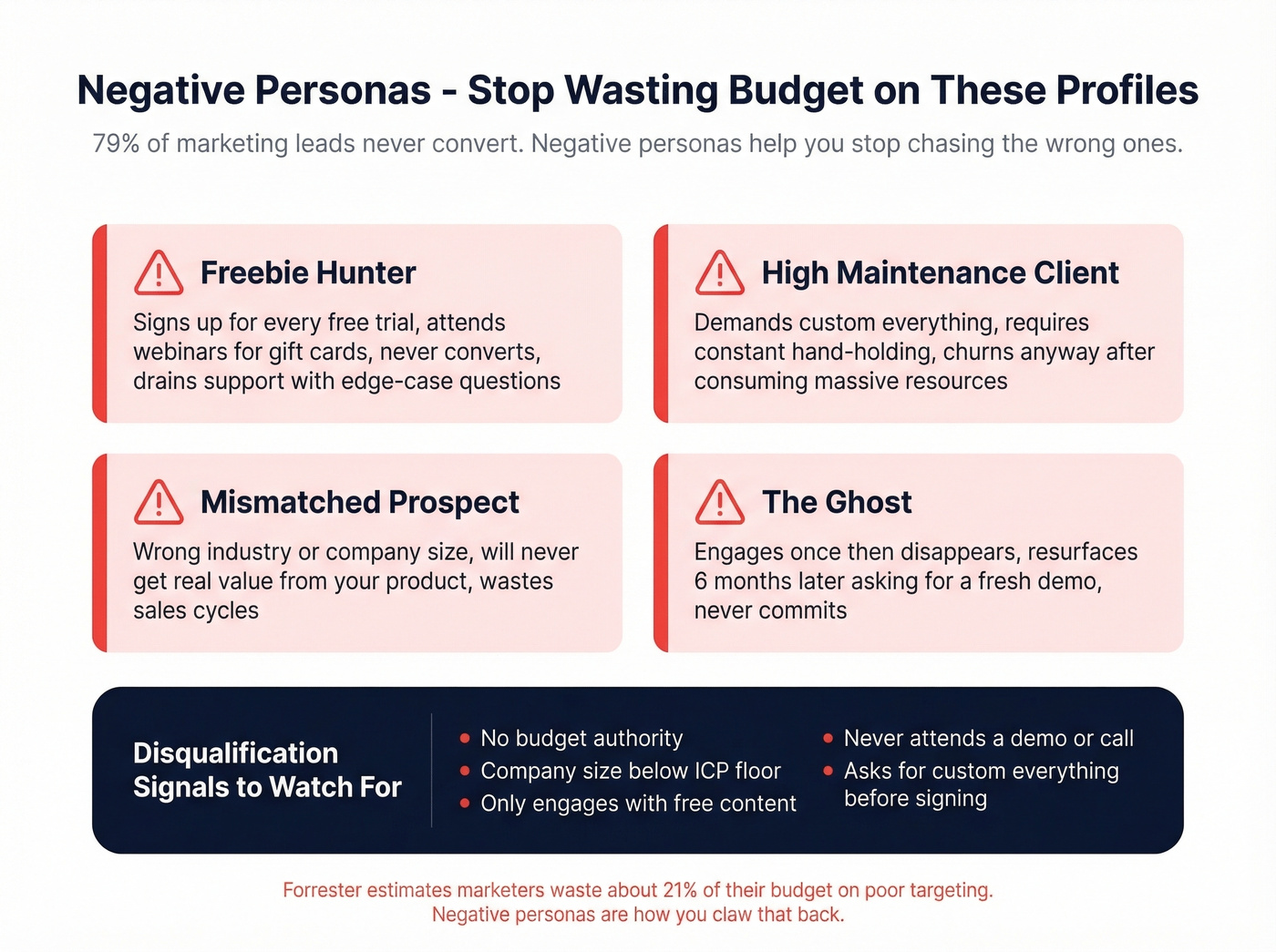
- Profile: Signs up for every free trial, attends every webinar for the gift card, never converts, drains support resources with edge-case questions
- Disqualification signals: No budget authority, company size below ICP floor, only engages with free content, never attends a demo
- Why it matters: 79% of marketing leads never convert to sales. Every dollar spent on Frankie is budget you could've spent on retention or qualified pipeline.
Three more negative archetypes worth naming: the High Maintenance Client who demands custom everything and churns anyway, the Mismatched Prospect in the wrong industry or company size who'll never get value, and the Ghost who engages once, disappears, and resurfaces six months later asking for a fresh demo. Forrester estimates marketers waste about 21% of their budget on poor targeting. Negative personas are how you claw that back.
B2B vs. B2C - Which Fields Matter
| B2B Fields | B2C Fields |
|---|---|
| Firmographics (size, industry, revenue) | Demographics (age, income, location) |
| KPIs they're measured on | Lifestyle and interests |
| Buying committee role | Shopping behavior |
| Decision criteria | Brand preferences |
| Common objections | Price sensitivity |
| Buying triggers (funding, hiring, tech change) | Emotional triggers |
| Tech stack / infrastructure | Media consumption habits |
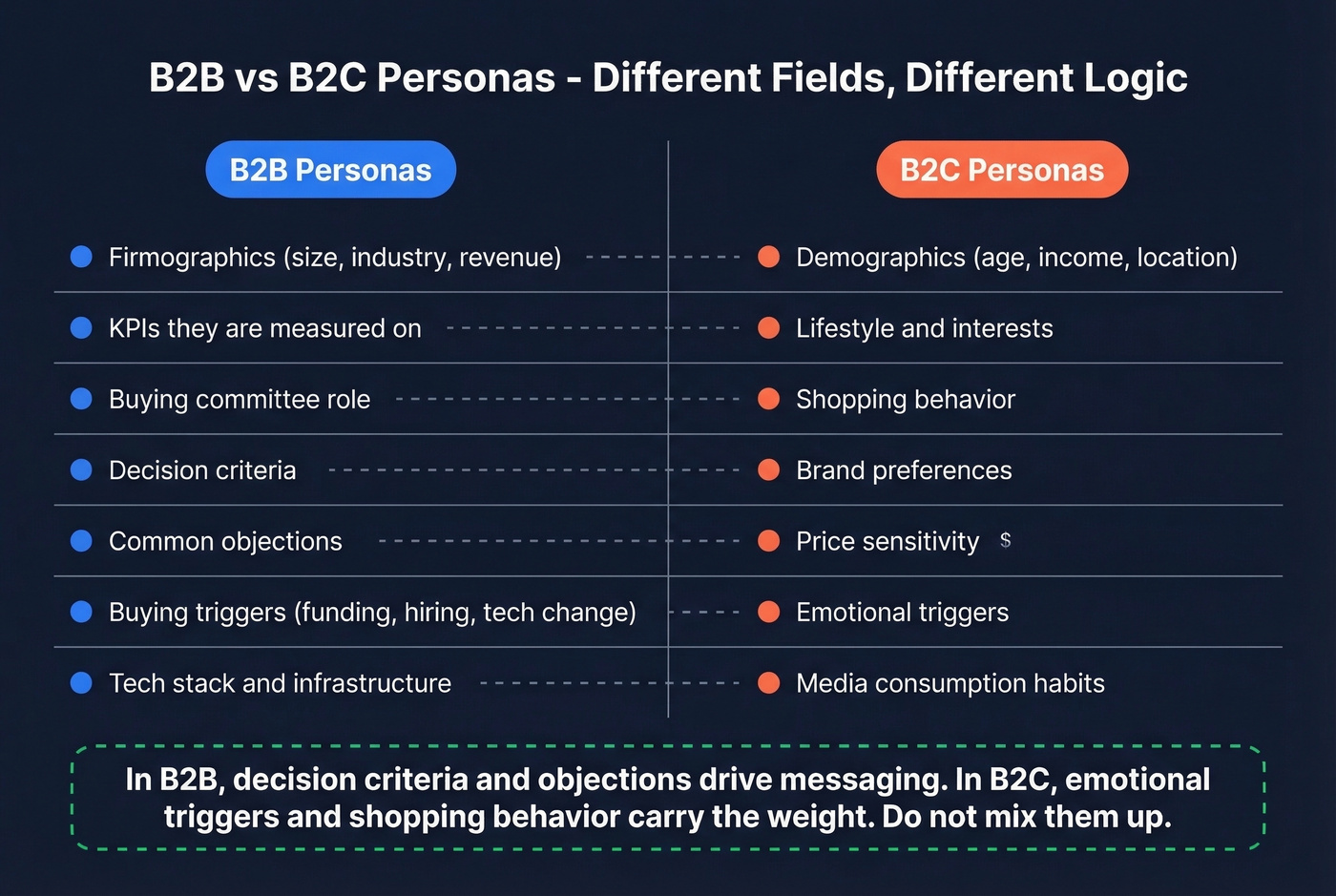
The biggest mistake we see teams make is applying B2C persona logic to B2B. Adding "hobbies: hiking and podcasts" to your VP of Operations persona doesn't help anyone write better outreach. In B2B, decision criteria and objections drive messaging. In B2C, emotional triggers and shopping behavior carry the weight.
One advanced layer worth considering: decision styles. Some buyers are methodical - spreadsheet comparisons, long evaluation cycles. Others are spontaneous - gut feel, fast decisions. Mapping your persona to a decision style changes how you structure your sales process, not just your messaging.

Buyer personas only drive revenue when you can actually reach the people they describe. Prospeo's 300M+ profiles with 30+ filters - including buyer intent, technographics, job changes, and department headcount - let you turn every persona field into a search filter and pull verified contacts that match.
Stop documenting personas. Start filling pipelines with them.
How to Research Your Personas
Start With Internal Interviews
Your sales reps, account managers, and customer service team hear the same patterns every week. They know which objections surface in every deal, which titles ghost after the first call, and which pain points close deals fastest. 82.4% of organizations that exceed revenue goals conduct qualitative buyer interviews, and high performers are far more likely to interview sales teams (58.8%) and executives (70.6%) during persona development.
Start there. Not with a brainstorm. Not with a survey. With the people who talk to buyers every day.
A recurring theme on r/b2bmarketing: teams that build personas without sales input end up with "demographics-first" profiles that nobody on the revenue team trusts or uses. We've seen this firsthand - our own personas got dramatically sharper the moment we stopped guessing and started recording patterns from actual sales calls.
Questions to Ask
Organize your interviews around these ten questions:
- What does success look like in your role this quarter?
- What metrics are you personally measured on?
- What's the biggest obstacle to hitting those goals right now?
- What have you tried before that didn't work?
- Who else is involved in purchasing decisions like this?
- Walk me through your last software evaluation - what did the process look like?
- How long does a typical purchase decision take from first research to signed contract?
- Where do you go to research solutions? Which communities, analysts, or publications do you trust?
- What would make you hesitate to buy a product like ours?
- What's killed deals like this in the past?
Most companies need 3-5 buyer personas. If you're starting from scratch, begin with one - your highest-value buyer. Validate it before adding more.
Validate With Data
Internal interviews give you patterns. External data tells you whether those patterns hold at scale. 41% of high performers use external studies during persona development, compared to just 17% of low performers. Pull a sample from a B2B database like Prospeo to test whether your persona actually exists in meaningful numbers - if you've defined "VP of Engineering at 200-500 employee fintech companies using AWS," you should be able to find enough of them to justify building campaigns around that profile.
Content Mapping by Persona x Funnel Stage
Once you've built your personas, map content to each one across the funnel:
| Persona | TOFU | MOFU | BOFU |
|---|---|---|---|
| Champion | Industry trends, pain-point content | Case studies, ROI frameworks | Implementation guides |
| Budget Owner | Benchmarks, market reports | TCO comparison guides | ROI calculators, budget templates |
| Technical Evaluator | GitHub samples, blog posts | Integration guides, sandbox | API docs, security whitepapers |
| User | "How-to" content, community | Product walkthroughs | Free trial, onboarding docs |
| Executive | Thought leadership, analyst reports | Peer case studies | Board-ready business cases |
Each persona needs different content at each stage. Sending your technical evaluator a case study about revenue growth is a waste. Sending your CFO an API doc is worse.
7 Persona Mistakes That Kill ROI
1. Demographics-first construction for B2B. "Sarah, 34, lives in Austin, enjoys yoga" tells you nothing about how she buys software. Start with goals, pain points, and decision criteria. Demographics are footnotes.
2. Creating too many personas. Fifteen personas means zero focus. Start with 1-3. You can always add more after you've validated the first ones actually change how your team sells and markets.
3. Never talking to customers or sales. This is how fairytale personas happen. If your persona was built in a conference room without a single customer interview, it's fiction. We've seen teams spend months on persona decks that sales ignores on day one - because nobody asked a rep what objections they hear every week.
4. Keeping personas in a marketing silo. If sales, product, and CS don't use your personas, they're decorative. Share them. Train on them. Reference them in deal reviews.
5. Forgetting negative personas. Every lead you spend time on that was never going to buy is budget you lit on fire. Define who you don't want. (If you want a template, see negative personas.)
6. Never updating personas. Personas built on 2022 data won't hold up in 2026. Review quarterly, refresh annually. Markets shift, buying committees evolve, new roles like the AI governance reviewer emerge out of nowhere.
7. Skipping decision-making criteria. A persona without objections and evaluation criteria is a character sketch, not a sales tool. Stop adding hobbies to your B2B personas and start adding the questions buyers actually ask before signing.
Tools to Build Buyer Personas
HubSpot's Make My Persona is free and the best starting point for teams that have never built a formal persona. It walks you through a guided flow and outputs a shareable document. Basic, but most teams need basic.
UXPressia offers more flexibility with a free tier and paid plans starting around $16/month - better for teams that want to visualize customer journeys alongside personas. Xtensio works well for collaboration where multiple team members need to edit and comment. Canva handles visually polished persona cards for presentations.
AI-powered generators are an emerging category worth watching. They can draft initial personas fast, though the output still needs human validation against real interviews. Skip these if you haven't done at least five customer interviews first - you'll just be generating prettier fiction.
No tool replaces talking to actual customers. The best persona template in the world is useless if it's filled with assumptions instead of interview data.
From Persona to Prospect List
You've defined "VP of Operations at a 300-700 employee SaaS company who cares about reducing tool sprawl." Now you need to find 500 real people who match that description, with verified emails and direct dials, so your team can actually reach them.
This is where persona documents become pipeline. Prospeo's 30+ search filters - buyer intent, technographics, job change signals, headcount growth, department size, funding stage - let you translate a persona into a live lead prospecting list. Search for the exact titles, company sizes, industries, and tech stacks your persona defines. Layer intent data across 15,000 topics to prioritize buyers actively researching your category right now. The database covers 300M+ profiles with 98% email accuracy and a 7-day data refresh cycle, so you're not reaching out to people who changed jobs two months ago. Snyk runs 50 AEs on this workflow and generates 200+ new opportunities per month - that's what operationalized personas look like at scale.
Let's talk measurement. Track persona effectiveness the same way you'd track any GTM motion: role coverage in target accounts, reply rate by persona, stage velocity by role, and win rate deltas. If your "Champion" persona converts at 3x the rate of your "Technical Evaluator" outreach, that tells you where to double down.
Your buying committee has 6-10 stakeholders. Prospeo gives you 98% accurate emails and 125M+ verified mobiles so you can reach the Champion, the CFO, and the Technical Evaluator - not just whoever's easiest to find. At $0.01 per email, multi-threading every deal is finally affordable.
Reach every stakeholder on the committee for less than a dollar.
FAQ
How many buyer personas do I need?
Most companies need 3-5. Start with one - your highest-value buyer - and validate it against real deal data before adding more. If sales can't name the persona they're selling to on a current deal, you have too many.
What's the difference between a buyer persona and an ICP?
An ICP defines the ideal company - industry, headcount, revenue, tech stack. A buyer persona defines the person inside that company - their goals, objections, and decision criteria. You need both: the ICP tells you which accounts to target, the persona tells you what to say.
How often should I update my personas?
Review quarterly, refresh annually. If win rates shift, a new competitor emerges, or your product changes significantly, update immediately. Personas built on 2022 research won't reflect 2026 buying committees or newly common roles like AI governance reviewers.
How do I turn a persona into a prospect list?
Use a B2B data platform to filter by the job titles, company sizes, industries, and tech stacks your persona defines. Layer intent data to prioritize active buyers, export verified contacts into your sequencer or CRM, and start outreach the same day.
Do buyer persona examples work for B2C?
Yes, but B2C personas emphasize lifestyle, emotional triggers, and shopping behavior instead of firmographics and buying committees. The core research process - customer interviews plus data validation - is identical regardless of whether you sell to businesses or consumers.