

Negative Buyer Persona: The 2026 Playbook With Templates, Scoring Rules, and Ad Exclusions
A small business owner on Reddit shared something that stuck with us: they stopped saying yes to every client, tightened their intake questions, and ended up with fewer clients but higher margins, smoother projects, and less stress. That's the negative buyer persona in its purest form - knowing who to walk away from.
Here's the uncomfortable math. 79% of marketing leads never convert to sales, and 61% of marketers say generating high-quality leads is their biggest challenge. Most teams keep pouring budget into dead-end contacts because they've never formally defined who doesn't belong in their pipeline. This playbook fixes that - with a filled-out template, a scoring rubric you can drop into HubSpot tomorrow, and the ad exclusion workflow that stops you from paying for clicks that were never going to convert.
Quick Summary
- A negative buyer persona defines who NOT to target. Build it from closed-lost deals and churned customers in your CRM.
- Deploy it in three places: lead scoring, Google Ads negative keywords, and sales qualification scripts.
- Review every six months. Markets shift, products evolve, and yesterday's bad fit might be tomorrow's ideal customer.
- Need the template now? Jump to the filled-out template section.
What Is a Negative Buyer Persona?
A negative buyer persona - also called an exclusionary persona - is a data-driven profile of the person or company you actively don't want as a customer. Where a standard buyer persona describes your ideal prospect's goals, pain points, and buying behavior, a negative persona captures the traits and signals that mean a deal will waste your team's time.
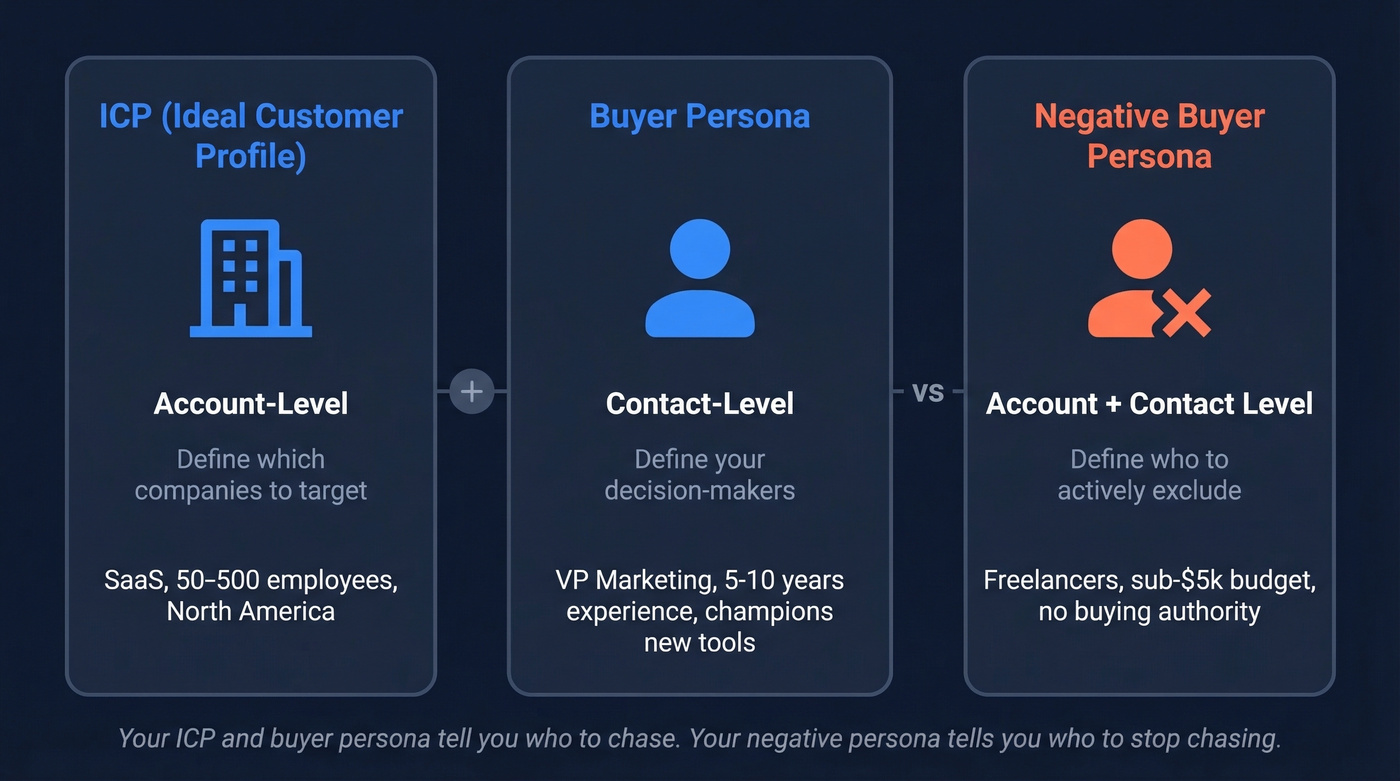
The distinction from your ideal customer profile matters. Your ICP operates at the account level: company size, industry, tech stack, revenue range. Buyer personas operate at the contact level: the VP of Marketing who champions your product, the CFO who signs off. Exclusionary personas work at either level - you might exclude an entire company category or a specific contact archetype like the intern downloading every whitepaper for a school project.
| Concept | Scope | Purpose | Example |
|---|---|---|---|
| ICP | Account-level | Define target companies | SaaS, 50-500 employees, NA |
| Buyer Persona | Contact-level | Define decision-makers | VP Marketing, 5-10yr exp |
| Negative Persona | Both | Define who to exclude | Freelancers, sub-$5k budget |
Why Exclusionary Personas Matter
The budget case is straightforward. A Forrester study found that bad data costs marketers 21 cents of every media dollar. On the paid ads side, 25-30% of Google Ads budgets go to waste through unqualified clicks. For a team spending $10k/month on search ads, that's $2,500-$3,000 on fire every single month.
The pipeline case is just as compelling. The average B2B purchase involves 6-10 stakeholders for mid-market deals and up to 13 for enterprise, and 86% of deals stall because a stakeholder's concerns weren't addressed. Negative personas help you spot these stall patterns before they eat a quarter's worth of pipeline.
There's a brand risk angle too. Wrong-fit customers generate negative reviews, distort your product feedback loops, and churn loudly. Every hour your AE spends on a deal that was never going to close is an hour they didn't spend on one that could. These exclusion profiles aren't just a marketing exercise - they're a capacity multiplier for your entire revenue team.
Let's be honest: if your average contract value sits below $8k, you probably can't afford not to have negative personas. The smaller your deal size, the more lethal every wasted sales hour becomes.
Seven Types of Bad-Fit Buyers
Not all disqualified prospects look the same. Here are seven archetypes we've seen repeatedly across our own pipeline and in conversations with sales teams, each with the red-flag signals that should trigger disqualification.
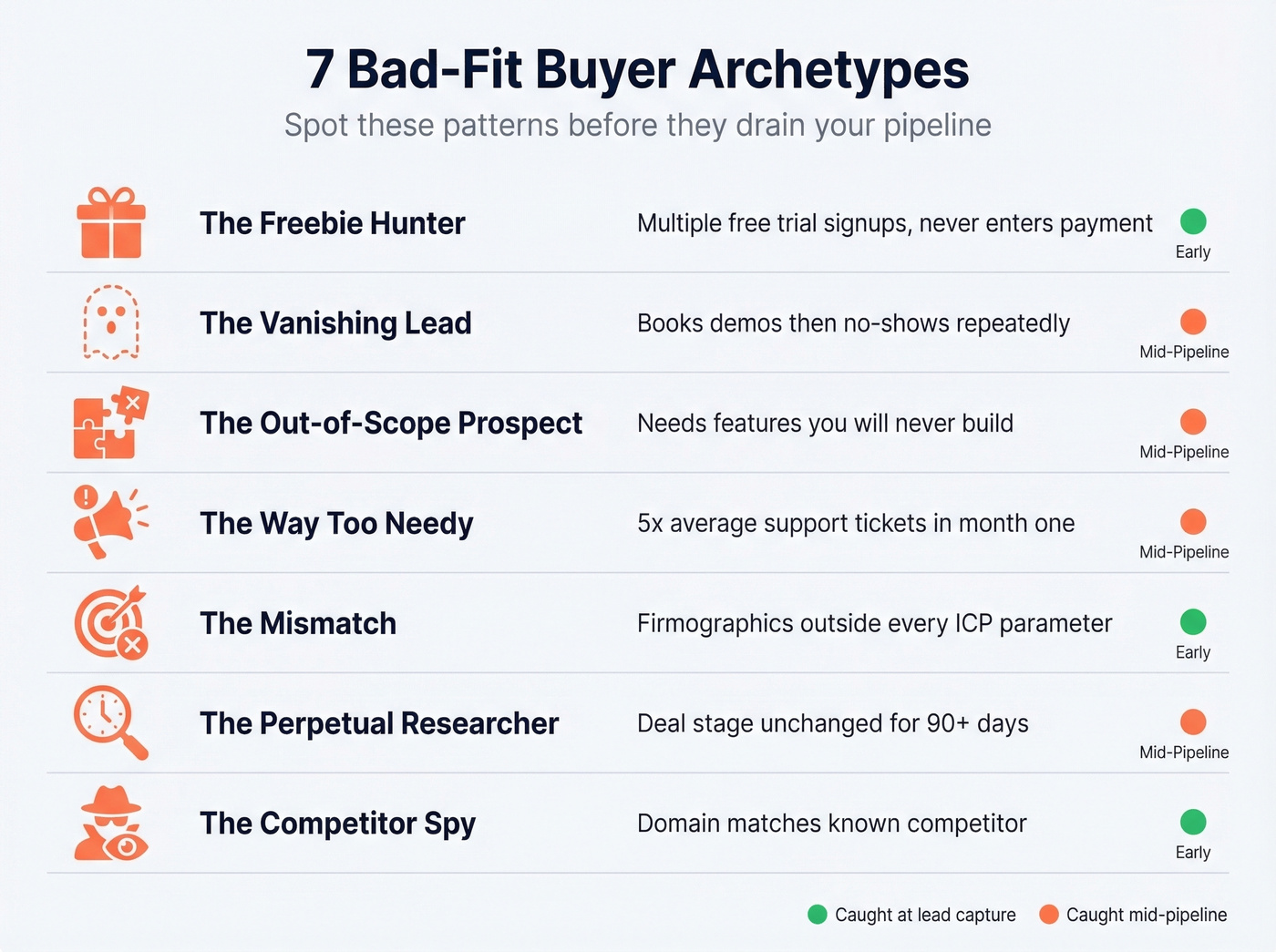
The Freebie Hunter signs up for every free trial, downloads every resource, and never enters a credit card. Watch for multiple free trial signups across different email addresses.
The Vanishing Lead engages enthusiastically for two weeks, books a demo, then disappears. They were likely benchmarking or satisfying an internal requirement to "evaluate three vendors." We've all had that sinking feeling when a promising demo no-shows for the third follow-up call.
Two archetypes often travel together: The Out-of-Scope Prospect and The Way Too Needy. The first needs something you don't build - a company wanting Forbes placements from a mid-market guest posting service. The second wants white-glove service on a self-serve plan, filing 5x your average support tickets in month one. Both share a root cause: misaligned expectations that no amount of nurturing will fix.
| Archetype | Red Flag | Typical Timeline |
|---|---|---|
| The Mismatch | Firmographics outside every ICP parameter | Caught at lead capture |
| The Perpetual Researcher | Deal stage unchanged for 90+ days despite multiple touchpoints | Caught mid-pipeline |
| The Competitor Spy | Company domain matches a known competitor; unusual interest in API docs | Caught at signup |

You just mapped your negative buyer personas. Now operationalize them. Prospeo's 30+ search filters - including intent data, technographics, headcount growth, and funding - let you exclude bad-fit accounts before they ever touch your pipeline.
Build lists that only include prospects worth your team's time.
How to Build a Negative Buyer Persona
Mine Your CRM Data
Pull your last 100 closed-lost deals and your highest-churn customers from the past 12 months. Sort by the deal stage where they dropped off and look for patterns in firmographics - company size, industry, geography, tech stack. Then examine engagement behavior: did they visit your pricing page once and vanish? Did they open zero emails after the demo?
The patterns will cluster. You'll likely find two or three distinct types that account for the majority of your wasted pipeline. Those clusters become your exclusionary personas.
Talk to Your Sales Team
Your reps already know who the bad fits are - they just haven't formalized it. Ask two questions: "Which deals did you know were dead on arrival?" and "What traits do your worst-fit prospects share?" Push past demographics. You want jobs-to-be-done insights - what were these prospects actually trying to accomplish, and why was your product the wrong answer?
No Customers Yet? Bootstrap It
If you're pre-revenue, start with competitor analysis. Look at who your competitors serve and identify the segments that clearly don't fit your positioning. Mine community forums for complaints about products in your category - the people complaining about features you'll never build are your negative personas in the wild. Early-stage marketers on Reddit acknowledge this approach isn't perfect, but a rough exclusion profile built on competitor research beats no profile at all. Refine it as first-party data accumulates.
Negative Buyer Persona Template (Filled Out)
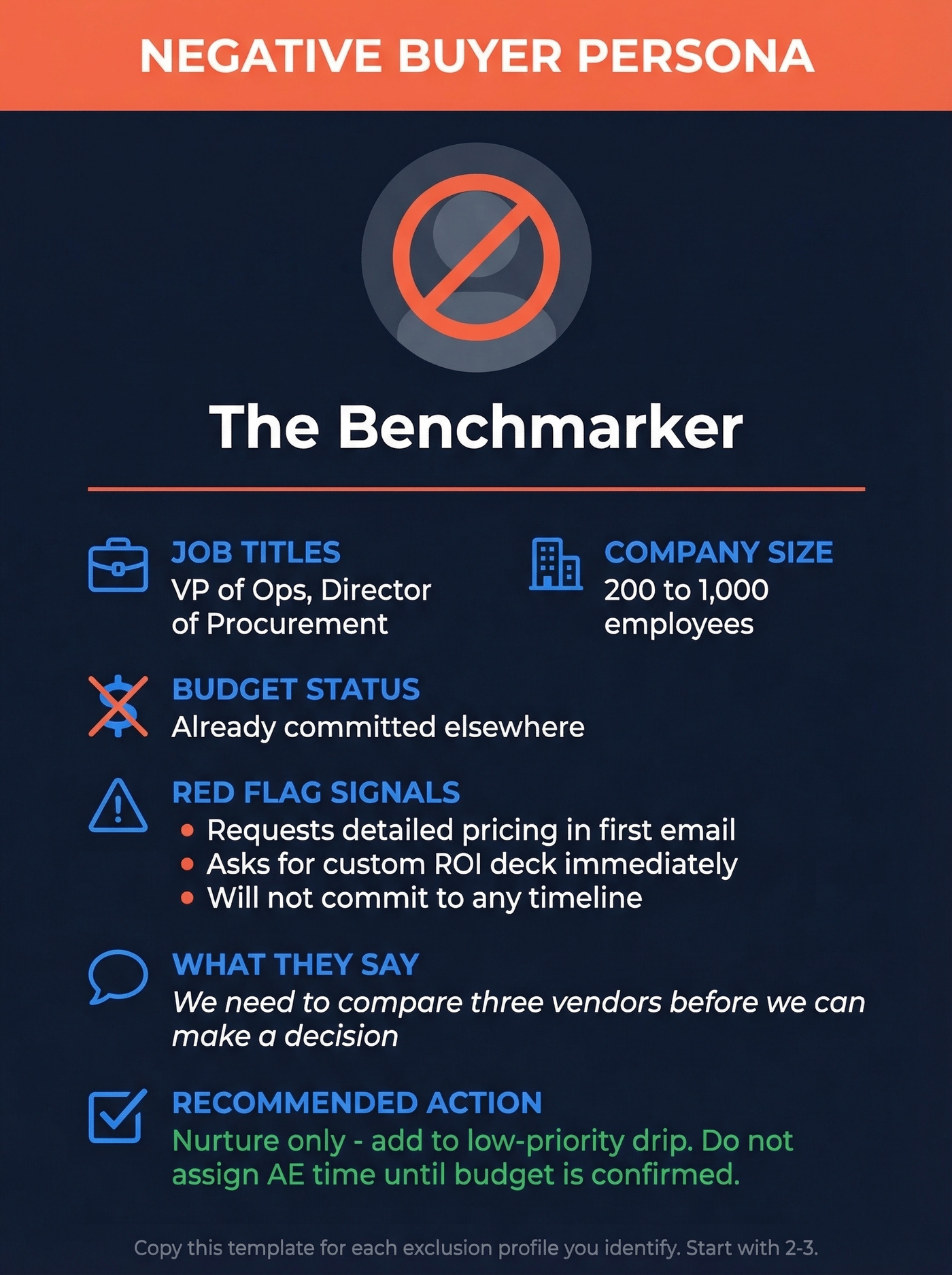
Stop adding hobbies and favorite podcasts to your personas. An exclusionary persona needs exactly five things: who they are, why they show up, what disqualifies them, what they typically say, and what you should do about it.
| Field | Example: "The Benchmarker" |
|---|---|
| Persona Name | The Benchmarker |
| Job Title(s) | VP of Ops, Director of Procurement |
| Company Size | 200-1,000 employees |
| Industry | Any (cross-industry pattern) |
| Budget Range | Already committed elsewhere |
| Behavioral Signals | Requests detailed pricing in first email; asks for custom ROI deck; won't commit to timeline |
| Disqualifying Triggers | Admits they're "renegotiating with current vendor"; no budget line item; evaluation has no end date |
| Typical Objection | "We need to compare three vendors before we can make a decision" |
| Recommended Action | Nurture only - add to low-priority drip; don't assign AE time until budget is confirmed |
Copy this structure for each exclusion profile you identify. Two or three is the right starting point. You can always add more as your data matures.
How to Operationalize Negative Personas
A negative buyer persona sitting in a slide deck is worthless. It needs to live in three systems: your lead scoring model, your ad platform, and your CRM segmentation.
Lead Scoring Rules
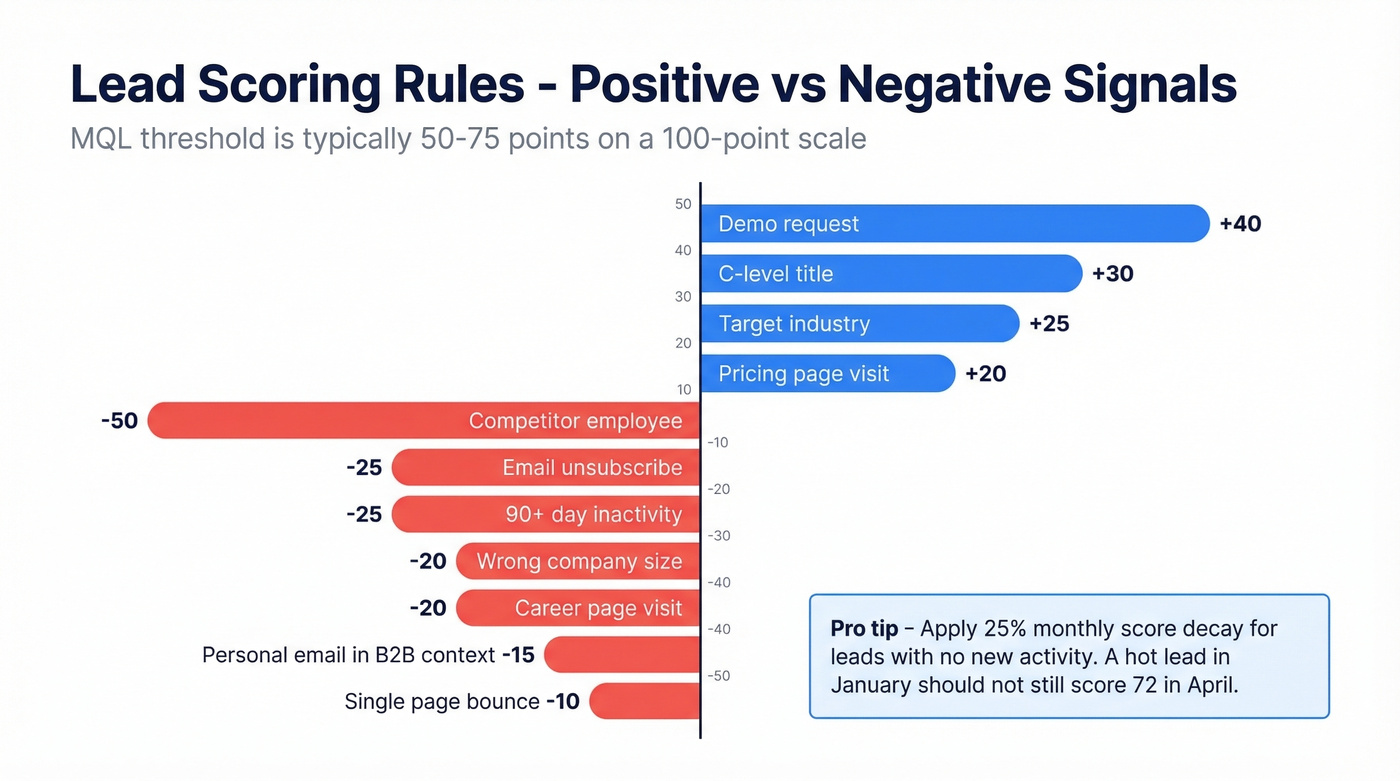
The table below gives you a starting framework. Positive signals push leads toward your MQL threshold - typically 50-75 points on a 100-point scale, targeting the top 20% of leads. Negative signals pull bad-fit contacts away from that threshold before your reps ever see them.
| Signal | Points | Type |
|---|---|---|
| C-level title | +30 | Positive |
| Target industry | +25 | Positive |
| Pricing page visit | +20 | Positive |
| Demo request | +40 | Positive |
| Personal email (B2B context) | -15 | Negative |
| Competitor employee | -50 | Negative |
| Email unsubscribe | -25 | Negative |
| Wrong company size | -20 | Negative |
| Career page visit | -20 | Negative |
| 90+ day inactivity | -25 | Negative |
| Single page bounce | -10 | Negative |
Apply time-based score decay too - reduce scores by 25% monthly without new activity. A lead who was hot in January and silent through March shouldn't still be sitting at 72 points in April.
In HubSpot, create a custom property called "ICP Tier" (Tier 1, 2, or 3) and a "Disqualified Reason" field that syncs back to your marketing automation platform. When sales disqualifies a lead, marketing knows why and can adjust targeting. (If you need a starting point, use an Ideal Customer Profile template alongside your exclusions.)
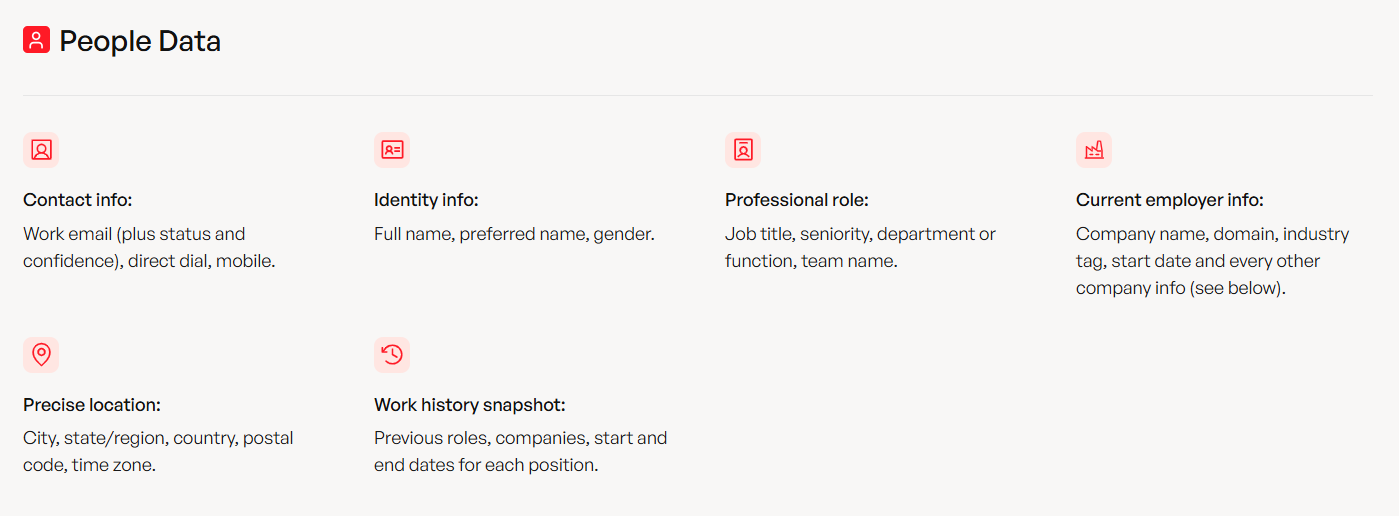
Here's the thing: your scoring model is only as good as your data. If job titles are outdated or emails bounce, your exclusion flags fire on the wrong people. A data enrichment tool like Prospeo can close this gap - it returns 50+ verified data points per enrichment with 98% email accuracy on a 7-day refresh cycle, so your scoring rules match reality instead of six-month-old records.
Google Ads Exclusions
Open your Google Ads account, navigate to Keywords, then Search Terms, and start flagging irrelevant queries. Job seekers, students, competitors researching your brand, people looking for free alternatives - these are your exclusion persona's search patterns.
Negative keyword match types matter. A broad match negative like "free" blocks any query containing that word. Phrase match negatives block the exact phrase in sequence. Layer these with placement exclusions, customer list exclusions, and demographic filters. When you build exclusion lists directly from your negative personas, you stop paying for the same categories of unqualified clicks month after month.
Email, CRM, and KPI Tracking
Build suppression lists in your marketing automation platform that map directly to your exclusion profiles. "Competitor Spy" contacts get suppressed from all nurture sequences. "Freebie Hunter" contacts get routed to a low-touch drip instead of your high-value ABM cadence.
Create a "Disqualified Reason" field in your CRM and sync it back to your MAP. Then track three KPIs by persona segment to validate your exclusions are working:
| KPI | What It Tells You | Review Cadence |
|---|---|---|
| MQL to SQL conversion rate | Whether your scoring rules filter effectively | Monthly |
| Churn rate by persona segment | Whether excluded segments actually churn more | Quarterly |
| CAC by segment | Whether exclusions are lowering your blended CAC | Quarterly |
If your MQL-to-SQL rate doesn't improve within 90 days of deploying exclusion scoring, your criteria are either too loose or targeting the wrong signals. Go back to the CRM data.
Common Mistakes
Building fairytale personas. The consensus on r/marketing is blunt: hyper-detailed personas with fictional hobbies aren't defensible without data. If your exclusion profile includes "enjoys hiking and listens to the Tim Ferriss Show," you've gone off the rails. Stick to firmographics, behavioral signals, and disqualifying triggers.
Over-excluding. Cutting too many segments means you're shrinking your addressable market based on incomplete data. Start conservative - exclude only the patterns you're confident about, then expand as data confirms your hypotheses. (This is also where addressable market thinking keeps you honest.)
Ignoring the buying committee. Your champion might be a perfect fit, but their CFO could be your negative persona's twin - budget-obsessed, risk-averse, and predisposed to stall. 86% of B2B deals stall because a stakeholder's concerns weren't addressed. Map the committee, not just the champion.
Scoring ghosts with stale data. A prospect who changed jobs six months ago still shows their old title in your CRM, and your scoring model treats them as a match. Skip this mistake by running regular enrichment cycles - Prospeo's 7-day refresh, for instance, catches job changes before bad scores compound into wasted pipeline. If you want a deeper system view, align this with your lead status definitions and your broader lead generation workflow.
FAQ
What's the difference between a buyer persona and a negative buyer persona?
A buyer persona profiles people you want to attract; a negative buyer persona profiles people you want to exclude. Same research process, opposite outcome. Both should be grounded in CRM data, not assumptions.
How many exclusionary personas should I create?
Start with two or three based on your highest-volume bad-fit patterns. Those few archetypes typically account for 60-80% of wasted pipeline. Add more only when new data clusters emerge.
Can a negative persona become a positive persona over time?
Yes. Products evolve, pricing tiers expand, and markets shift. That's why the six-month review cadence matters. Treat exclusion profiles as living documents, not permanent blacklists.
How do I build one without CRM data?
Use competitor research, community listening, and sales team interviews. Study who competitors serve, identify segments that don't fit your positioning, and mine forum discussions for complaints about features you'll never build. Refine once you have first-party data.
What tools help operationalize negative personas?
HubSpot or Salesforce handle lead scoring and disqualification workflows. Google Ads manages keyword and audience exclusions. For the data quality layer, Prospeo enriches contacts with 50+ verified data points at 98% email accuracy - its 7-day refresh cycle means your exclusion flags match real people, not stale records.
Bad-fit leads don't just waste ad spend - they wreck deliverability. Prospeo's 98% email accuracy and 7-day data refresh mean the contacts that pass your negative persona filter are verified, current, and reachable. No bounces burning your domain.
Exclude the noise. Reach the buyers who actually convert.