

Lead Prospecting in 2026: Benchmarks, Cadences, and the Stack That Actually Works
84% of reps missed quota last year. Not because they weren't working - because their lead prospecting systems are built on decaying data, single-channel cadences, and tools that overpromise on coverage. The gap between reps who prospect well and reps who prospect at all is widening fast.
Here's the playbook that closes it.
Why Most Prospecting Is Broken
The math is brutal. Salesforce research shows 84% of reps missed quota, and 67% don't expect to hit it this year either. Meanwhile, reps spend only about 33% of their time actually selling - the rest disappears into researching contacts, cleaning lists, and chasing bad numbers. On the buyer side, the average mid-market deal involves 7 decision-makers, and those buyers spend just 17% of their total buying time meeting with any supplier. You're fighting for a sliver of attention from a buying committee, not a single champion.
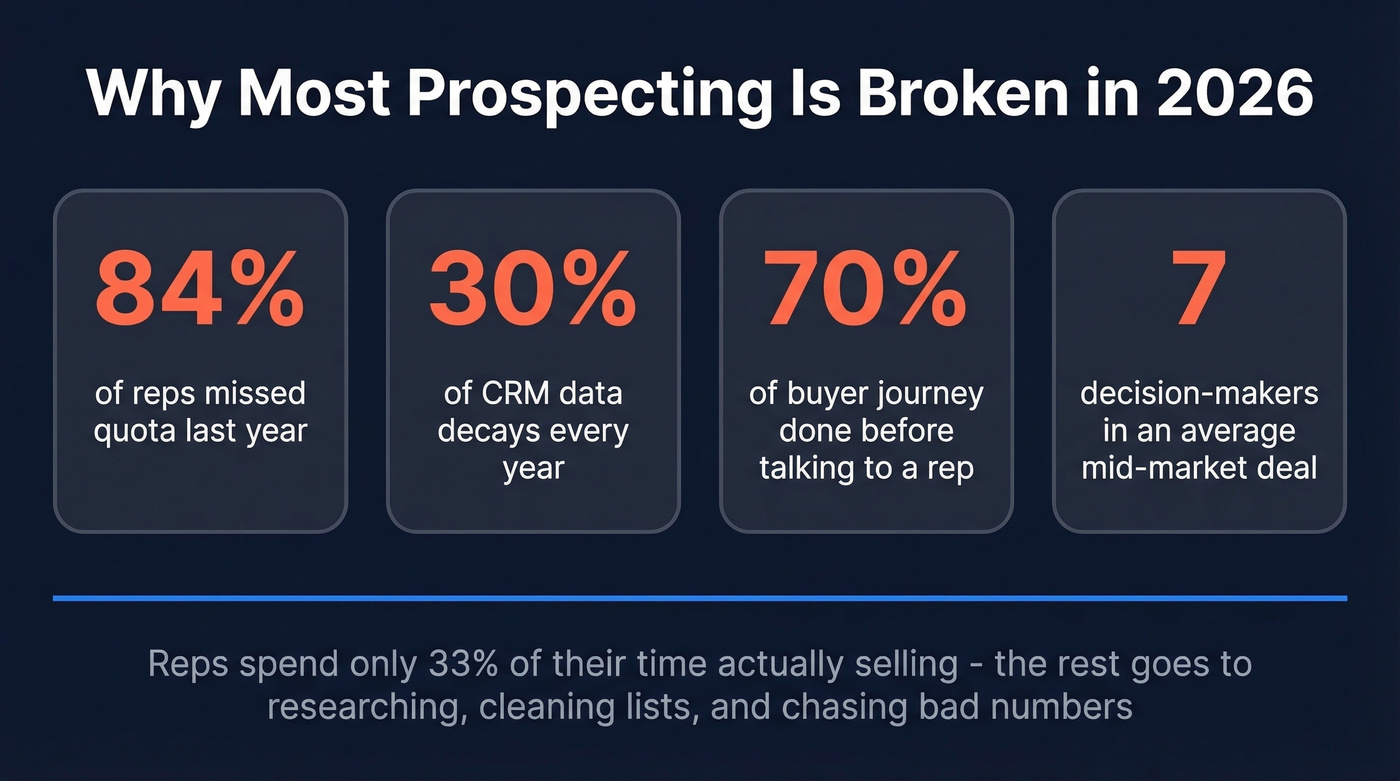
The data problem compounds everything. CRM data decays at roughly 30% per year. People change jobs, companies get acquired, email addresses go stale. If you built a list six months ago and haven't refreshed it, nearly a third of those contacts are dead weight.
Then there's the demand side. 89% of B2B buyers report at least one deal stalling in the past year, and prospects complete up to 70% of their buying journey before talking to a rep. By the time you reach out, they've already formed opinions. Generic "just checking in" emails don't cut it when the buyer has read three competitor case studies before breakfast (see how to say just checking in professionally).
Here's the thing: prospecting isn't broken because reps are lazy. It's broken because the infrastructure underneath - the data, the cadences, the measurement - hasn't kept pace with how buying committees actually buy.
What You Need to Get It Right
Lead prospecting in 2026 comes down to three things: verified data so your emails actually land and your calls connect, a multi-channel cadence you run consistently, and a measurement system so you know what's working and what's wasting time.
Pick two channels, master them, measure everything. This isn't a glossary - it's the full playbook with benchmarks, templates, and the exact stack top SDR teams run (plus more sales prospecting techniques you can test).
Lead vs. Prospect vs. Opportunity
These terms get used interchangeably, and that's a problem. When your CRM treats every name the same, you can't prioritize (use a simple lead status model to fix this).
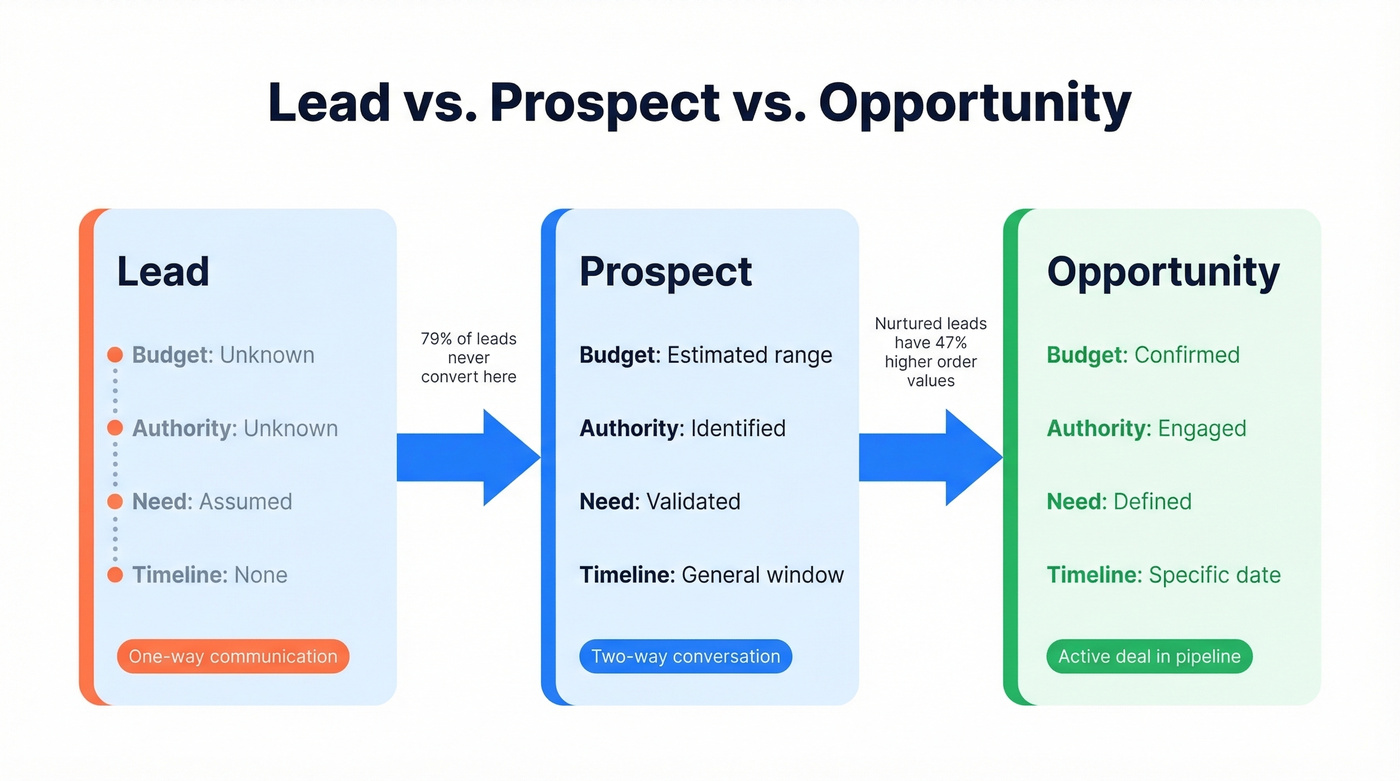
| Criteria | Lead | Prospect | Opportunity |
|---|---|---|---|
| Budget | Unknown | Estimated range | Confirmed |
| Authority | Unknown | Identified | Engaged |
| Need | Assumed | Validated | Defined |
| Timeline | None | General window | Specific date |
The practical shift: leads receive one-way communication from you. Prospects are in a two-way conversation. This distinction matters because 79% of marketing leads never convert into sales - usually because nobody qualified them before handing them off. Lead generation attracts inbound interest through content, ads, and events. Prospecting is outbound: reps actively identifying and reaching out to potential buyers. Nurtured leads produce 47% higher order values than those rushed into a pipeline, so the qualification step isn't optional overhead. It's where revenue is made or lost (use a consistent lead scoring rubric to keep handoffs clean).
Prospecting Methods That Work
Not every channel deserves equal investment. Here's what actually performs, with numbers attached.
Cold Email
Cold email remains the highest-volume outbound channel, but the bar for quality keeps rising. The overall average reply rate sits at 3.43%, per Instantly's analysis of billions of interactions. Top-quartile senders hit 5.5%+, and elite performers exceed 10%.
The gap between average and elite isn't magic - it's data quality and copy discipline. Best-performing campaigns keep emails under 80 words and A/B test messaging weekly. If you're below 3% reply rate, check your data first, copy second (start with proven cold email follow-up templates and iterate).
Cold Calling
Reports of cold calling's death are exaggerated. Top-performing cold callers convert up to 15% of conversations into meetings. The key word is "conversations" - you need a working phone number to have one. Bad mobile data means reps burn hours dialing disconnected numbers (tighten your process with a repeatable cold calling system).
Social Selling
LinkedIn outreach delivers roughly double the response rate of cold email. That's significant, but it comes with a volume ceiling - you can't send 100+ connection requests a week without hitting platform limits. Social works best as a complement to email and phone, not a replacement.
The personalization payoff is real: 81% of decision-makers engage with cold outreach when it's tailored to their company and context. A 30-second scan of someone's recent posts before reaching out isn't optional anymore (see a practical personalized outreach workflow).
Referrals
Referrals convert at 3-5x the rate of cold outbound. The problem is they don't scale predictably. Build referral asks into your post-sale process - every happy customer is a potential introduction. But don't build your pipeline plan around them.
Intent-Based Outreach
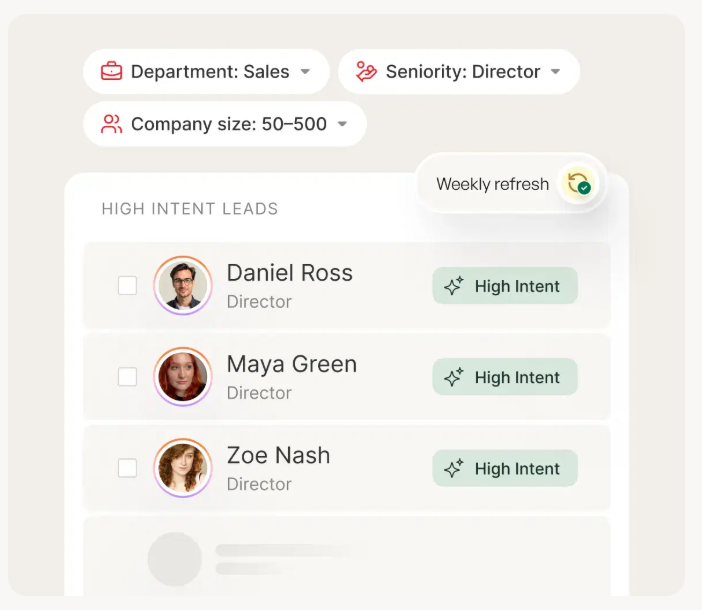
This is where B2B prospecting is heading. Instead of emailing a stale list, intent data tells you which companies are actively researching your category right now. Teams using intent signals report 20-30% shorter sales cycles because they're reaching buyers who already have the problem top of mind (here’s how to operationalize identifying buying signals).
The lead generation software market hit $7.4B in 2025 and is projected to reach $16.2B by 2034. Most of that growth is in intent and signal-based tools, not bigger databases (more on lead generation trends).
Building Your Cadence
A cadence isn't a sequence of emails. It's a multi-channel system with deliberate timing.
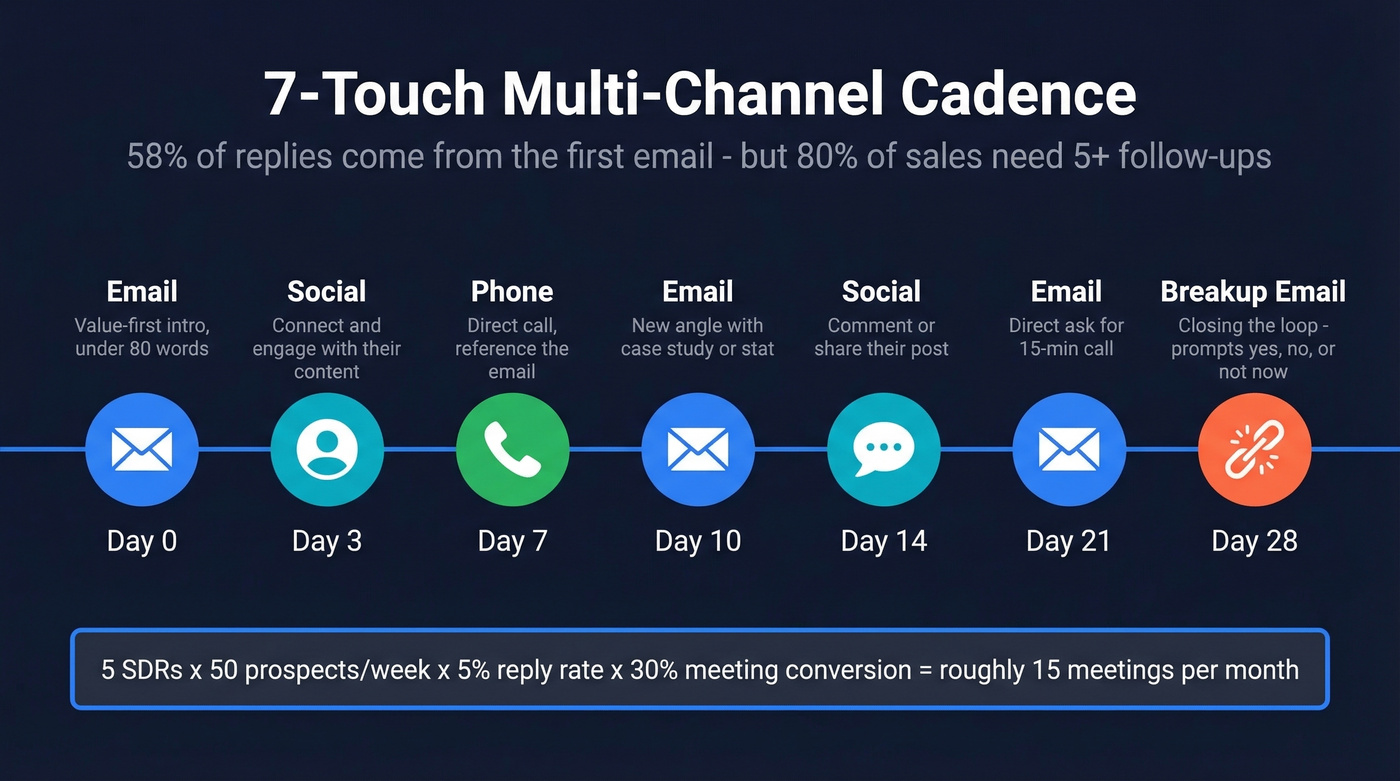
58% of all replies come from the first email in a sequence. Follow-ups contribute the remaining 42%. The sweet spot is 4-7 touchpoints, and 80% of sales require 5+ follow-ups to close - so quitting after two touches is the single most expensive mistake in outbound (use these sales follow-up templates to keep quality high across touches).
Timing rules: Tuesday and Wednesday drive peak reply rates. Minimum 3-day gap between touches, maximum 7 days to maintain connection without annoying the prospect.
Here's a 7-touch multi-channel template we've seen work across dozens of teams:
| Day | Channel | Purpose |
|---|---|---|
| 0 | Value-first intro (under 80 words) | |
| 3 | Social | Connect + engage with their content |
| 7 | Phone | Direct call, reference the email |
| 10 | New angle, case study or stat | |
| 14 | Social | Comment or share their post |
| 21 | Direct ask for 15-min call | |
| 28 | Breakup - "closing the loop" |
The breakup email on Day 28 isn't just politeness. It often prompts a "yes," "no," or "not now" - and all three are wins because they clean your pipeline.
What this looks like in practice: A 5-person SDR team running this cadence at 50 new prospects per rep per week - 250 total - with a 5% reply rate and 30% meeting conversion, books roughly 15 meetings per month. That's enough pipeline to keep a small AE team fed. Scale the inputs up or down, but the math holds.

You just read that CRM data decays 30% per year. Prospeo refreshes every 7 days - not 6 weeks like the industry average. With 98% email accuracy and 125M+ verified mobiles (30% pickup rate), your cadence actually connects. At $0.01 per email, bad data is no longer an excuse.
Stop burning touches on dead contacts. Fix your prospecting data today.
Five Mistakes That Kill Your Pipeline
Giving up too early. 43% of buyers who accept meetings say it's fine for sellers to contact them 5+ times. Most reps quit after 2 touches. That persistence gap is the single biggest source of lost pipeline.
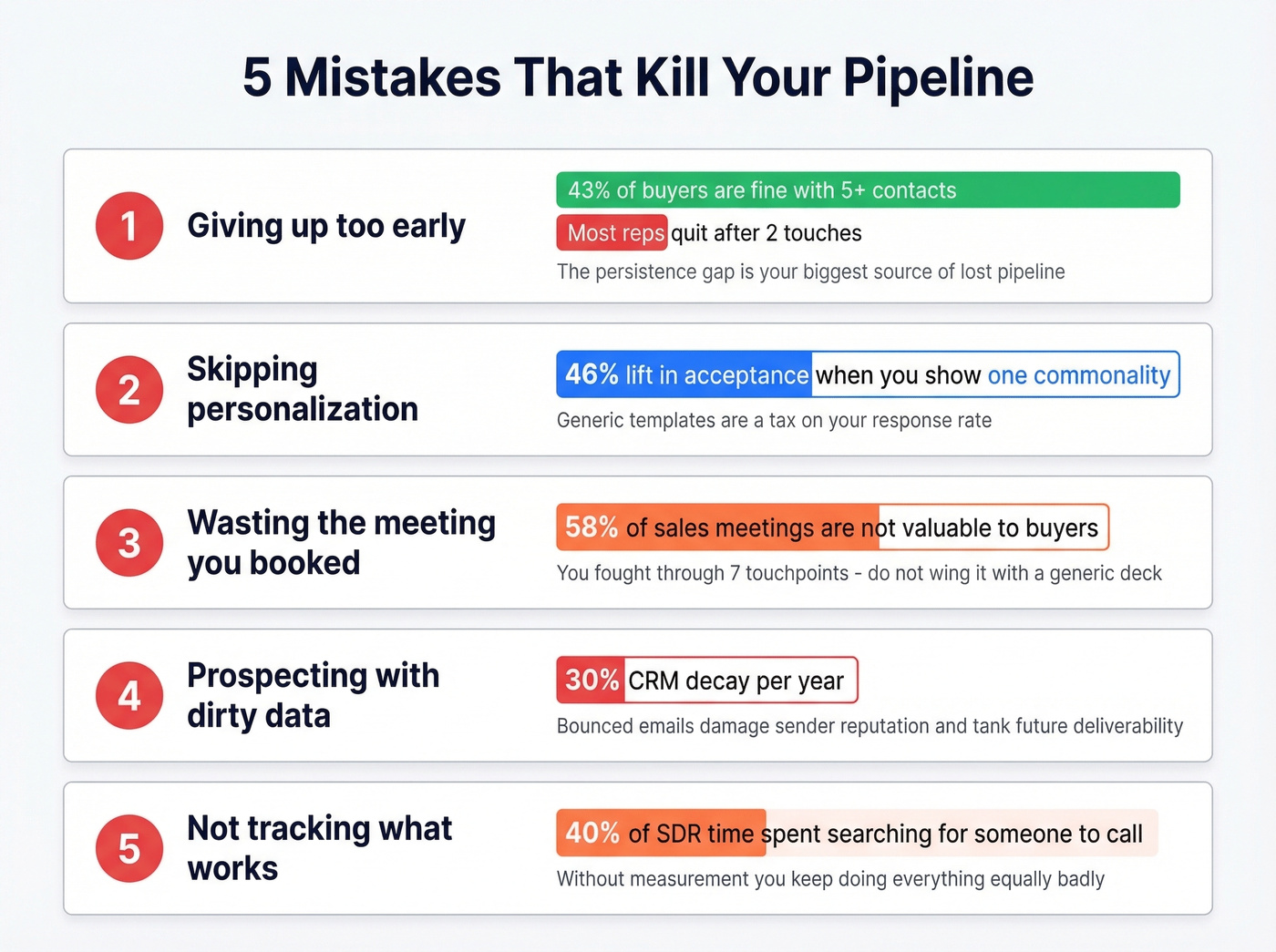
Skipping personalization. LinkedIn's InMail analysis shows a 46% lift in acceptance when the seller indicates at least one commonality - shared connections, same school, mutual interest. Generic templates are a tax on your response rate.
Wasting the meeting you booked. Buyers say 58% of sales meetings aren't valuable to them. If you fought through 7 touchpoints to get 30 minutes and then wing it with a generic deck, you've burned the opportunity and the relationship (use a tight product demo checklist to avoid this).
Prospecting with dirty data. When 30% of your CRM decays annually and you're not verifying before you send, you're torching deliverability. Bounced emails damage your sender reputation, which tanks deliverability for every future campaign. It compounds (see email bounce rate benchmarks and fixes).
Not tracking what works. SDRs spend up to 40% of their time searching for someone to call. Without measurement, you can't tell which channels, messages, or segments are actually producing pipeline - so you keep doing everything equally badly.
The Prospecting Tool Stack
You need three layers: a data provider for verified contacts, a sequencing tool for automated multi-channel follow-up, and a CRM to track it all. Everything else is optimization.
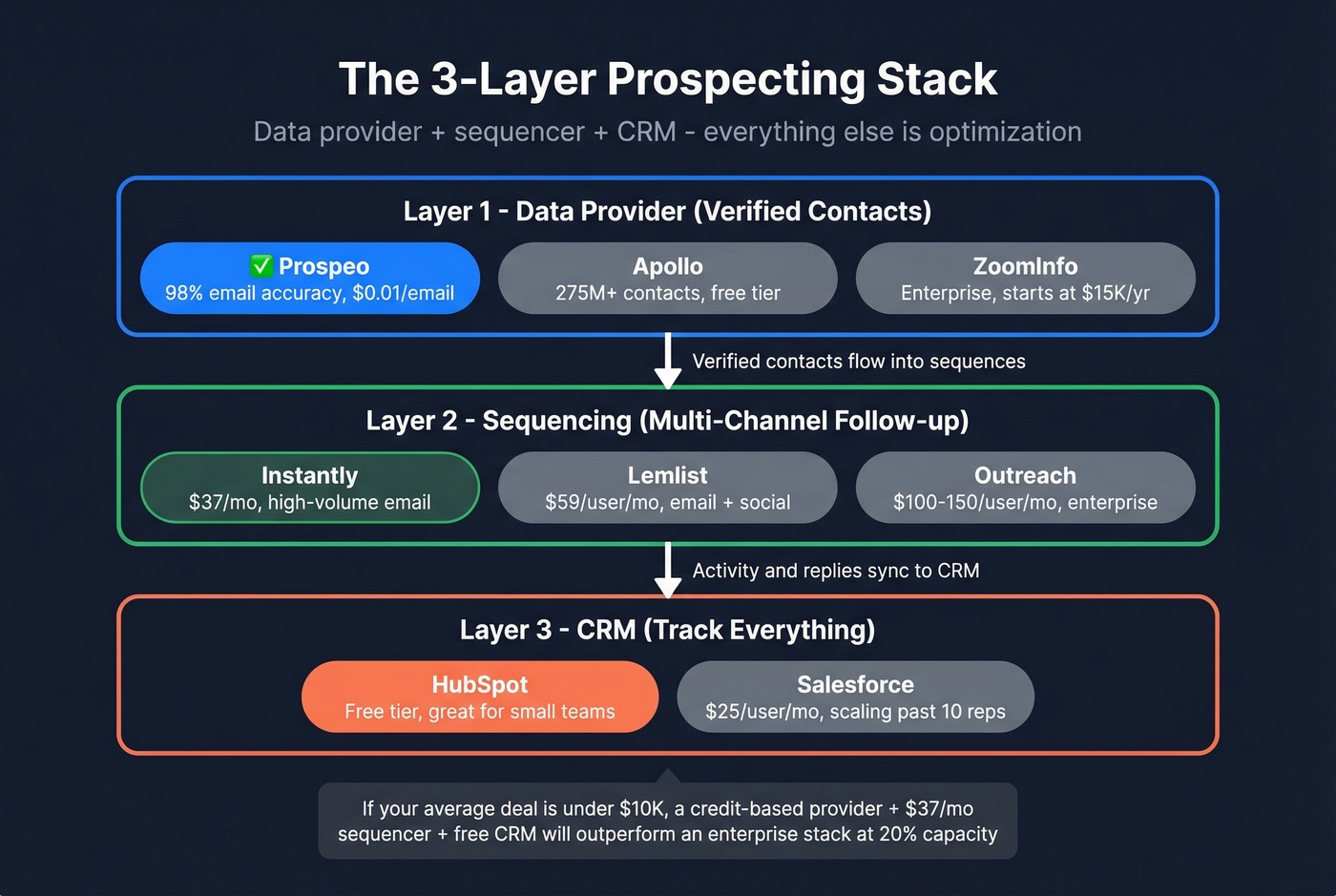
Real talk: if your average deal size is under $10K, you don't need a $15K/year data platform. A credit-based provider, a $37/month sequencer, and a free CRM will outperform an enterprise stack you're only using at 20% capacity (here are more SDR tools worth considering).
| Tool | Category | Best For | Starting Price |
|---|---|---|---|
| Apollo | Data + outreach | Zero-to-list speed | Free; $49/user/mo |
| ZoomInfo | Data provider | Enterprise (50+ reps) | ~$15K/yr |
| Clay | Enrichment | Custom list building | $149/mo (credits) |
| Lusha | Contact lookup | Quick phone grabs | Free; ~$49/mo |
| Instantly | Cold email | High-volume sequences | $37/mo |
| Lemlist | Multi-channel | Email + social sequences | ~$59/user/mo |
| Outreach | Enterprise seq. | Large sales orgs | ~$100-150/user/mo |
| HubSpot | CRM | Small teams starting out | Free; $15/user/mo |
| Salesforce | CRM | Scaling past 10 reps | $25/user/mo |
Data Providers
Prospeo is the data layer we'd start with for any team that cares about deliverability. The numbers: 98% email accuracy across 143M+ verified emails, 125M+ verified mobile numbers with a 30% pickup rate, and a 7-day data refresh cycle versus a six-week industry average. The platform covers 300M+ professional profiles with 30+ search filters including buyer intent powered by Bombora, technographics, job changes, and headcount growth signals. Pricing is credit-based at roughly $0.01 per email, with a free tier - no contracts, no sales calls required.
Meritt tripled their pipeline from $100K to $300K per week after switching, with bounce rates dropping from 35% to under 4%. Snyk's 50-person AE team cut bounce rates from 35-40% to under 5% and saw AE-sourced pipeline jump 180%.
Apollo is the obvious starting point if you need a database and basic outreach in one platform. Its 275M+ contact database and free tier make it the fastest path from zero to a working list, with Pro plans at $49/user/month. The tradeoff: data accuracy varies by market.
ZoomInfo is the enterprise default - massive US database, deep intent data, broad workflow features. But a basic package starts around $15K/year, and enterprise contracts easily exceed $40K. For teams under 50 reps, you're paying for modules you'll never activate. Skip this if your team is small and your deal sizes don't justify the spend.
Clay is for power users who want hyper-specific lists. The consensus on r/sales is that it's "LEGO pieces for data" - you chain enrichment sources together to build exactly the list you need. The learning curve is steep, but once configured, it's the most flexible enrichment workflow available. Starts at $149/month on credits.
Lusha is a quick-lookup utility for phone numbers. Good for one-off contact grabs, hit or miss depending on region. Free tier available, paid plans from ~$49/month.
Sequencing Tools
Instantly is the cold email leader for teams running volume. At $37/month, it's the most affordable way to manage multi-step email campaigns with deliverability guardrails built in. If cold email is your primary channel, start here.
Lemlist adds multi-channel capabilities at ~$59/user/month. Pricier per seat, but useful if you want social steps baked into your sequences. Outreach and Salesloft are enterprise-grade platforms typically priced in the $100-150/user/month range - overkill for teams under 20 reps, essential infrastructure above that.
CRMs
HubSpot has the best free CRM tier on the market. Start here if you're a small team. Salesforce is the scaling play once you're past 10 reps and need custom objects, advanced reporting, and deep integrations. Starts at $25/user/month, but real deployments run much higher.
That 5-rep SDR team booking 15 meetings a month? It only works if the emails land and the phone numbers connect. Prospeo delivers 300M+ profiles through 5-step verification - spam traps removed, catch-alls handled, honeypots filtered. Teams using Prospeo book 26% more meetings than ZoomInfo users.
Run the cadence above with data that actually picks up the phone.
AI in Lead Prospecting
More than 80% of B2B sales teams using AI report measurable revenue growth, compared to roughly two-thirds of teams still running manual workflows. The practical impact: AI-driven prospecting reclaims 4-7 hours per rep per week that used to disappear into list building and research.
The real shift is from automation to agentic workflows - systems that identify buying signals, enrich contacts, personalize messaging, and execute outreach without a rep manually triggering each step. Responding to buying signals within an hour makes teams 7x more likely to qualify the lead. For teams running outbound at scale, this speed advantage compounds quickly across hundreds of accounts (see best AI for automating sales follow-ups).
Look, AI won't fix bad data or a weak value prop. But layered on top of verified contacts and a solid cadence, it compresses the time between signal and outreach - and that compression is where deals are won.
Measuring Prospecting ROI
If you're not measuring, you're guessing.
| KPI | Formula | Good Range | Track |
|---|---|---|---|
| Reply rate | Replies / sent x 100 | 5-10% | Weekly |
| Meeting rate | Meetings / replies x 100 | 20-40% | Weekly |
| Cost per lead | Total cost / qualified leads | <$20 SMB; <$100 ent. | Monthly |
| Conversion rate | Customers / prospects x 100 | 2-5% (cold) | Monthly |
| Pipeline velocity | Opps x deal size x win rate / cycle | Varies | Monthly |
Let's break this down with a real scenario. Say you're spending $500/month on data tools and a rep allocates 40% of their time to prospecting - roughly $3,000/month in loaded salary cost. That's $3,500/month total. Generate 250 qualified leads and your cost per lead is $14. The average B2B close rate runs about 29% with sales cycles of 1-3 months, so you can project downstream revenue from there.
Track reply rate and meeting rate weekly - they're your leading indicators. Cost per lead and conversion rate are monthly reviews. Pipeline velocity ties everything together and tells you whether your prospecting machine is accelerating or stalling. Every prospect you convert into a meeting should be traceable back to the channel and cadence step that generated it (use funnel metrics to standardize reporting).
Lead Prospecting FAQ
What is lead prospecting?
Lead prospecting is the outbound process of identifying, qualifying, and reaching out to potential buyers who fit your ideal customer profile. Unlike inbound lead generation - which attracts interest through content and ads - prospecting requires reps to actively research accounts, verify contact data, and initiate multi-channel outreach to start conversations with decision-makers.
How is it different from lead generation?
Lead generation attracts inbound interest through ads, content, and events. Prospecting is outbound - reps actively identifying and contacting potential buyers. Generation fills the top of funnel; prospecting qualifies and engages specific targets. Most high-performing teams run both in parallel.
How many touchpoints to book a meeting?
The sweet spot is 4-7 touchpoints across multiple channels. 43% of buyers who accept meetings say it's fine for sellers to contact them 5+ times. Most reps give up after 2 touches - that persistence gap is the biggest reason pipelines stall.
What's a good cold email reply rate in 2026?
The average is 3.43%. Top-quartile senders hit 5.5%+, and elite performers exceed 10%. If you're consistently below 3%, audit data quality first, then revisit email copy second.
What tools do I actually need?
Three: a data provider with verified emails and direct dials, a sequencing tool for automated multi-channel follow-ups, and a CRM to track pipeline. Everything else is optimization on top of that foundation.