

What Does "Cadence" Mean in Business? (And Is It Just Jargon?)
Someone in your last meeting said "what's our cadence on this?" and you nodded like you knew exactly what they meant. You're not alone - "cadence" has become one of those words that gets tossed around in standups, pipeline reviews, and Slack threads without anyone stopping to define it.
Here's the thing: it's a genuinely useful concept once you strip away the corporate gloss.
Quick version: In business, cadence comes down to "how often + in what rhythm" a recurring activity happens. If someone asks about the cadence, they're asking about frequency and whether there's a repeatable structure behind it. The three types you'll encounter most are meeting cadence, sales cadence, and agile/sprint cadence - each with concrete schedules you can steal below.
The Definition, Minus the Fluff
At its core, cadence is a regular, repeated pattern of rhythm applied to business activities. The word comes from music and speech, where it refers to the beat or measure of motion. In business, it describes the beat that holds a team, a process, or an outreach campaign together.
The word entered corporate vocabulary through IBM. Merriam-Webster traces the business usage to a 2003 article referencing "cadence of meetings" as IBM language. From there it spread to SaaS, sales, and agile - anywhere teams needed a word for "we do this thing repeatedly, on purpose, at a set rhythm." You'll also hear "operating cadence" at the executive level and "communication cadence" for how teams stay in sync across channels.
The distinction that matters: cadence isn't just frequency. Frequency tells you how often. Cadence implies rhythm, structure, and purpose. A weekly team sync with an agenda, a facilitator, and a clear outcome is a cadence. A recurring calendar invite that nobody prepares for is just a meeting that happens to repeat.
Cadence vs. Schedule vs. Frequency
These three words get used interchangeably, but they shouldn't.
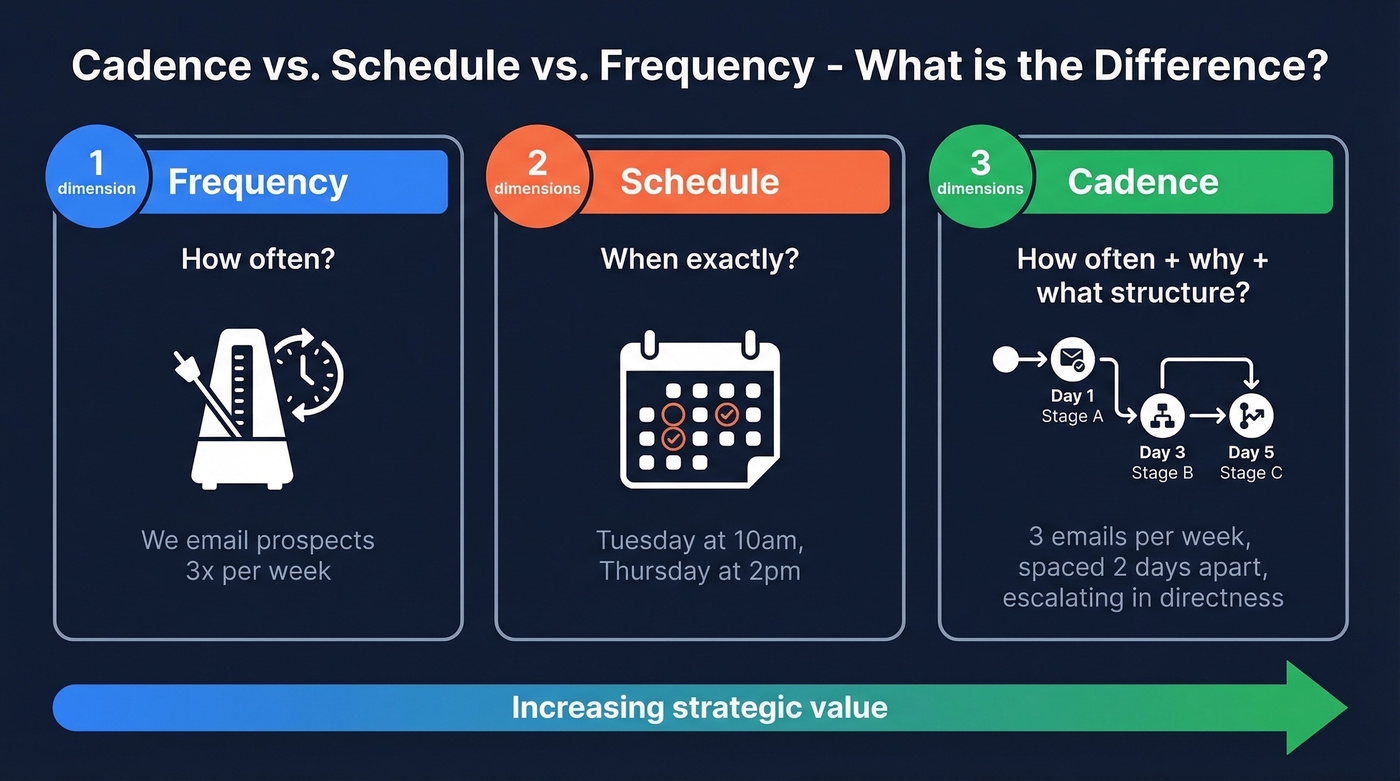
| Term | What it answers | Example |
|---|---|---|
| Frequency | How often? | "We email prospects 3x/week" |
| Schedule | When exactly? | "Tuesday at 10am, Thursday at 2pm" |
| Cadence | How often + why + what structure? | "3 emails/week, spaced 2 days apart, escalating in directness" |
Here's the contrarian take: the word "cadence" is overused, but the concept is underused. Most teams have recurring calendar invites, not actual cadences. They've nailed the frequency part but skipped the structure and purpose. If your Monday standup doesn't have a clear agenda and a measurable outcome, it isn't a cadence - it's a habit.

A 12-touch sales cadence means nothing if 30% of your emails bounce. Prospeo delivers 98% email accuracy with a 7-day data refresh cycle, so every step in your sequence reaches a real inbox. Snyk cut bounce rates from 35% to under 5% - turning their cadence from organized failure into 200+ opportunities per month.
Stop wasting cadence steps on dead emails. Verify before you send.
Types of Business Cadence
Meeting Cadence
A 22-person startup shared their real cadence on Reddit, and it's a useful template. Executive team meetings happen Mondays for one hour with 9 attendees to set the weekly agenda. A subset standup runs Tuesday through Friday for 30 minutes with 6 people covering daily learnings. A full-team all-hands lands on Wednesdays for one hour with all 22 people. The founder explicitly noted they "don't love" their cadence - which is actually the point. Cadences should be redesigned regularly.
For engineering teams, Zenhub recommends a more granular stack:
| Meeting | Duration | Frequency |
|---|---|---|
| Daily standup | 15 min | Daily |
| Sprint planning | 60-90 min | Per sprint |
| Retrospective | 45-60 min | Per sprint |
| Backlog refinement | 30-60 min | Weekly/biweekly |
| Weekly team sync | 30-45 min | Weekly |
| Quarterly strategy review | 60-90 min | Quarterly |
Zenhub's internal analysis found up to 20% faster issue resolution with daily standups. Our recommendation: start with weekly team syncs and biweekly 1:1s. Add daily standups only if your team ships in short cycles. Over-meeting kills more teams than under-meeting.
Sales Cadence
This is where we've spent the most time testing, and where cadence has the most measurable impact on revenue.
A sales cadence is a series of multi-channel touchpoints delivered to prospects in sequence, on a predetermined timeline. The benchmark is 8-12 touches over 2-4 weeks, spaced two to three days apart. By 2026, the vast majority of B2B sales buyer-seller interactions happen in digital channels, so your cadence is your sales process - not a supplement to it.
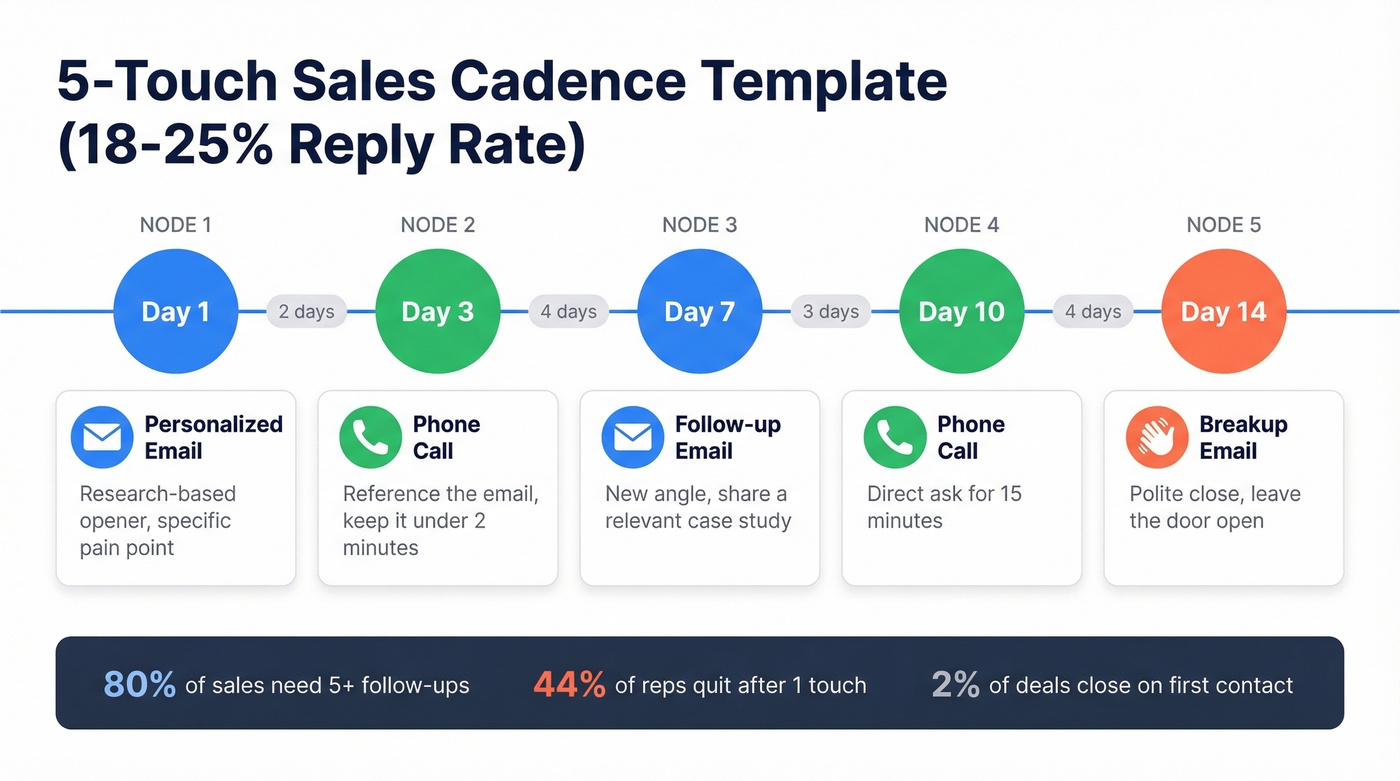
Here's a concrete 5-touch template that typically sees 18-25% reply rates for SaaS companies:
- Day 1: Personalized email
- Day 3: Phone call
- Day 7: Follow-up email (new angle)
- Day 10: Phone call
- Day 14: Breakup email
The persistence stats are striking. 80% of sales require five or more follow-ups, yet 44% of reps quit after just one. Only 2% of sales close on the first contact. Cadence exists to systematize the follow-up that most reps skip.
One AE on r/sales shared their results from a 21-step, 28-day cadence across calls, emails, and social touches. Out of 25 meetings booked that month, 24 came from calls, 1 from email, and zero from social. If one channel drives 96% of your results, your cadence should reflect that - don't run elaborate multi-channel sequences just because a playbook told you to.
The newer concept worth watching is intent-triggered cadences, where your first touch fires within 24 hours of a buyer showing intent signals on platforms like Bombora or 6sense. Instead of blasting a calendar-based sequence at cold prospects, you reach buyers when they're actively researching your category. Teams using this approach report a 2-3x lift in response rates, which makes sense given that buyers do roughly 68% of their research before ever speaking to sales.

But here's what nobody talks about enough: your cadence is only as good as your contact data. If a big chunk of your emails bounce, your 12-touch sequence is really an 8-touch sequence, and your sender reputation takes the hit. We've seen teams at Prospeo customers like Snyk cut bounce rates from 35-40% down to under 5% just by running contacts through verification before launching sequences. A cadence built on stale data is just organized failure.
If you want to tighten the follow-up part of your sequence, steal a few proven sales follow-up templates and adapt them to your product and ICP.
Agile and Sprint Cadence
In Scrum, cadence means fixed-length sprints running back-to-back with no gaps. Sprints are typically one to four weeks, and the key rule is consistency - keeping the same sprint length supports velocity measurement and forecasting. Change the sprint length and you break your metrics.
Kanban takes a different approach with a layered cadence stack:
| Cadence | Frequency | Purpose |
|---|---|---|
| Strategic review | Quarterly | Reassess strategic choices |
| Replenishment | Weekly | Control what enters workflow |
| Service delivery review | Weekly/biweekly | Assess outcomes via metrics |
| Delivery planning | Weekly/biweekly | Coordinate near-term work |
Kanban cadences prevent two failure modes simultaneously - ad-hoc chaos where decisions happen randomly, and decision stagnation where no clear forum exists so nothing gets decided. Cadence gives teams a rhythm for making decisions at the right altitude. This is also where strategic cadence lives: quarterly board reviews, annual planning cycles, and the executive operating rhythm that keeps leadership aligned with execution.
Skip this section if you're purely in sales or marketing - agile cadences are a different animal, and trying to force Scrum terminology onto a sales workflow creates more confusion than clarity.
How to Set Up a Cadence
Five steps. No over-engineering required.
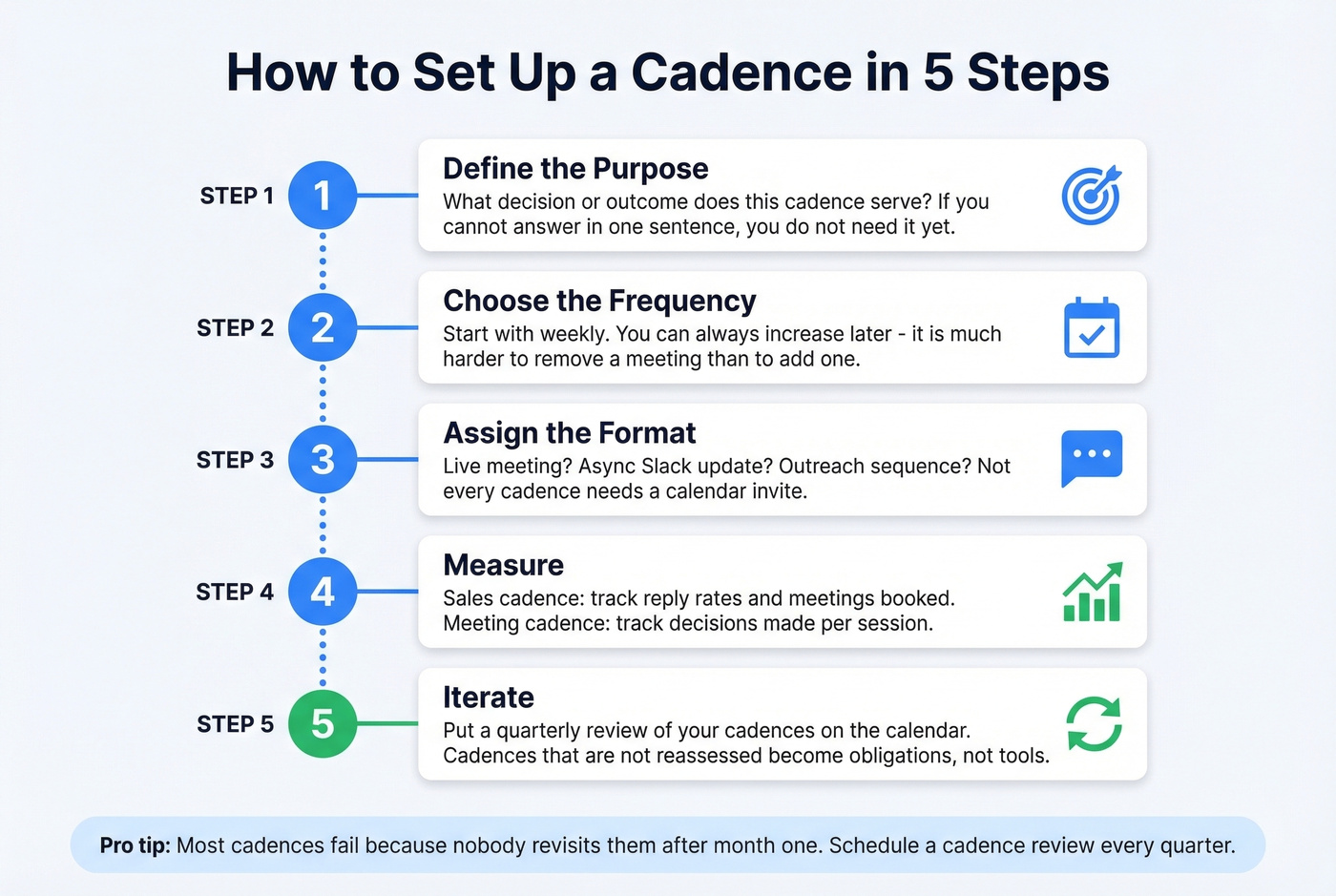
- Define the purpose. What decision or outcome does this cadence serve? If you can't answer that in one sentence, you don't need the cadence yet.
- Choose the frequency. Start simple. Weekly is almost always the right starting point. You can increase later - it's much harder to remove a meeting than to add one.
- Assign the format. Is this a live meeting, an async Slack update, or an outreach sequence? Not every cadence needs a calendar invite.
- Measure. Track whether the cadence produces the intended outcome. A sales cadence should track reply rates and meetings booked. A meeting cadence should track decisions made per session.
- Iterate. Cadences that aren't reassessed become obligations, not tools. That startup founder who "doesn't love" their meeting cadence? They're doing it right - the willingness to redesign is the whole point.
Let's be honest: most cadences fail not because they're poorly designed, but because nobody revisits them after the first month. Put a quarterly review of your cadences on the calendar. Yes, that's a cadence for reviewing your cadences. We know how it sounds, but it works.
If your cadence is email-heavy, it’s worth pressure-testing deliverability basics like sender reputation and your overall email deliverability before you scale volume.
Why Most Cadences Fail
Three failure modes show up repeatedly.
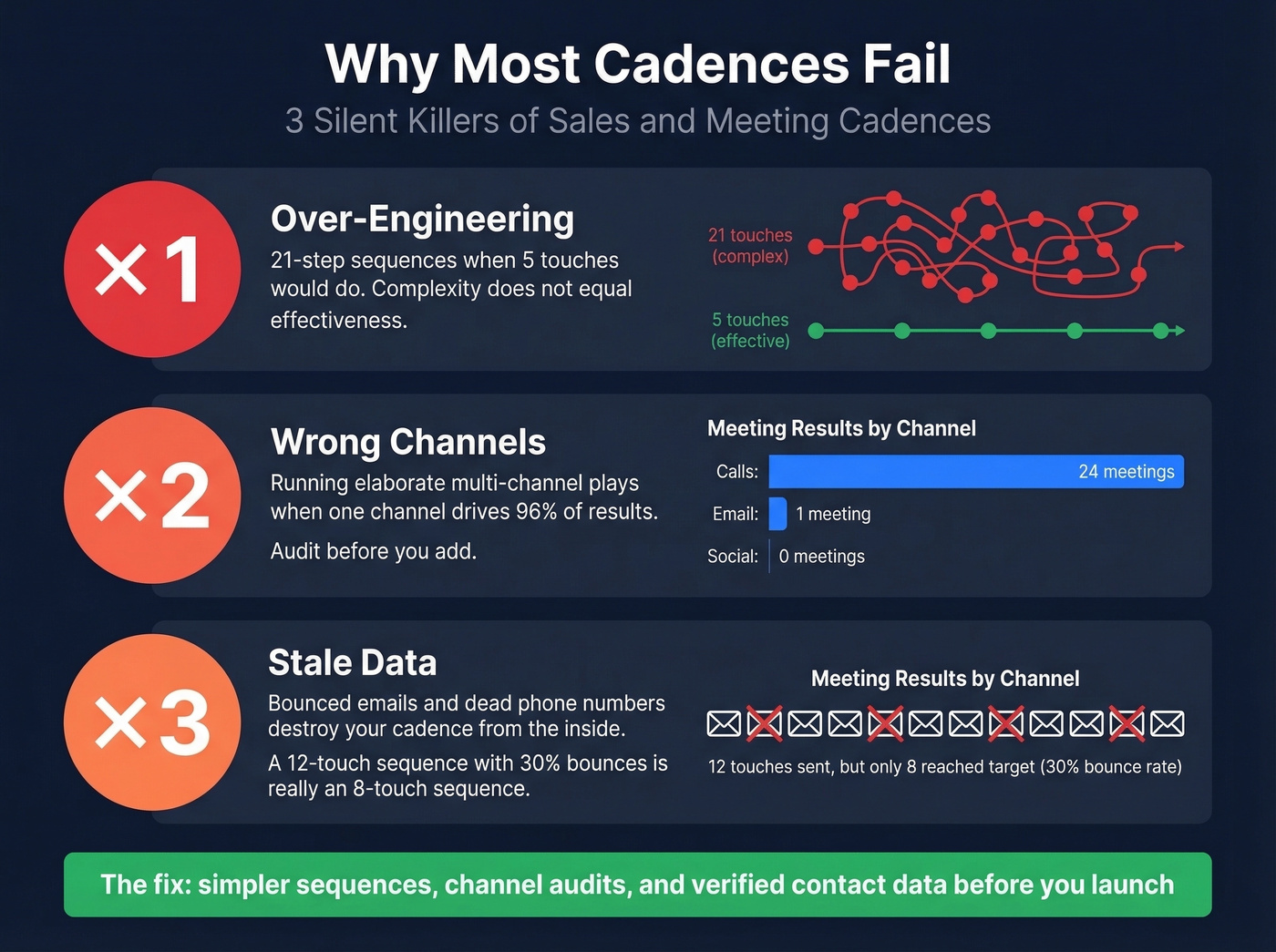
Over-engineering. 21-step sequences when 5 touches would do. Complexity doesn't equal effectiveness, and the consensus on r/sales backs this up - simpler cadences with better targeting consistently outperform elaborate ones with mediocre data.
Wrong channels. Running elaborate multi-channel cadences when one channel drives nearly all your results. That AE booking 24 out of 25 meetings from calls didn't need a LinkedIn drip. Audit your channel performance before adding steps.
Stale data. This one's a silent killer. Bounced emails and dead phone numbers destroy sales cadences from the inside out. According to Salesforce research, 77% of customers expect immediate interaction when they reach out - if your cadence can't deliver speed because half your contacts are invalid, you're already behind. Verify your list before launching any outreach cadence, full stop.
If bounces are a recurring problem, start by understanding your email bounce rate and then fix the root causes (not just the symptoms).
FAQ
What is cadence in business?
Cadence is a regular, repeating rhythm applied to a business activity - meetings, sales outreach, sprints, or communication. It goes beyond simple frequency by implying structure, purpose, and intentional design. The concept stays consistent across departments: it's the predictable beat that keeps teams aligned and processes moving forward.
How often should a sales cadence contact a prospect?
The standard benchmark is 8-12 touches over 2-4 weeks, spaced two to three days apart. Start with a 5-touch email-plus-call sequence and adjust based on reply rates. For enterprise accounts with deal sizes above $50K, stretch the timeline to 4-6 weeks with more research-heavy touches.
What tools help manage a sales cadence?
Outreach.io and Salesloft handle sequence automation with paid plans starting around $100/user/month. For the data layer underneath, Prospeo verifies emails at 98% accuracy and refreshes contact data every 7 days, so your touches actually reach real people. Free tier available with 75 email credits, no contracts required.
Can you have too many cadences?
Absolutely - cadence bloat is real. Every recurring commitment competes for the same finite attention. If your team runs daily standups, weekly syncs, biweekly retros, and monthly reviews, audit whether each one produces a unique decision or outcome. Cut any cadence where the answer is "we just share updates."
Intent-triggered cadences outperform calendar-based sequences by 2-3x. Prospeo tracks 15,000 buyer intent topics via Bombora, so your first touch fires when prospects are actively researching - not when your spreadsheet says it's time. Layer intent signals with 30+ filters to build cadences that reach the right person at the right moment.
Replace guesswork timing with real buyer intent signals.