

Call Shadowing: How to Do It Right in 2026 (+ Template)
A new rep at a Series A SaaS company described their onboarding on r/techsales as "sitting on Zoom for 6 hours a day on mute watching the senior reps do demos." They learned nothing - because they were never in the hot seat. The next week, they were expected to take live calls solo.
That's not call shadowing. That's expensive babysitting. The framework below turns shadowing from dead time into the fastest path to independent, competent reps - with a scorecard template you can copy today.
What You Need (Quick Version)
Call shadowing works when it has three things: a structured observation checklist, a mandatory debrief after every call, and measurable exit criteria for the next phase (reverse shadowing or nesting). Without those, it's just sitting on mute.
What Is Call Shadowing?
Call shadowing is a training method where a new hire listens to live calls handled by an experienced rep - silently, in real time - to absorb workflow, tone, objection handling, and product knowledge before taking calls independently. It applies to both sales teams and contact centers, though the call types differ. The framework below works for both with minor adjustments.
The confusion starts when people conflate shadowing with monitoring, nesting, and recording.
| Term | Who's involved | Trainee role | When used |
|---|---|---|---|
| Call shadowing | Trainee + experienced rep | Listens silently | Onboarding days 1-2 |
| Call monitoring | Manager + agent | Manager listens live, may use whisper/barge modes | Ongoing QA |
| Call nesting | Trainee + mentor | Trainee handles call, mentor assists | Post-shadowing days 3-10 |
| Call recording | System | N/A (async review) | Ongoing |
The listen/whisper/barge taxonomy matters too. Shadowing uses listen mode only - the trainee is purely observing. Barge mode lets a manager or mentor jump into the conversation when a rep needs immediate help.
Why Shadowing Matters for Ramp Time
SaaS average ramp time hit 5.7 months in 2025 - up 32% from 4.3 months in 2020. Twenty percent of new sales hires leave within the first 90 days, and the primary driver is poor onboarding. Replacing a failed hire costs roughly three times their base salary.
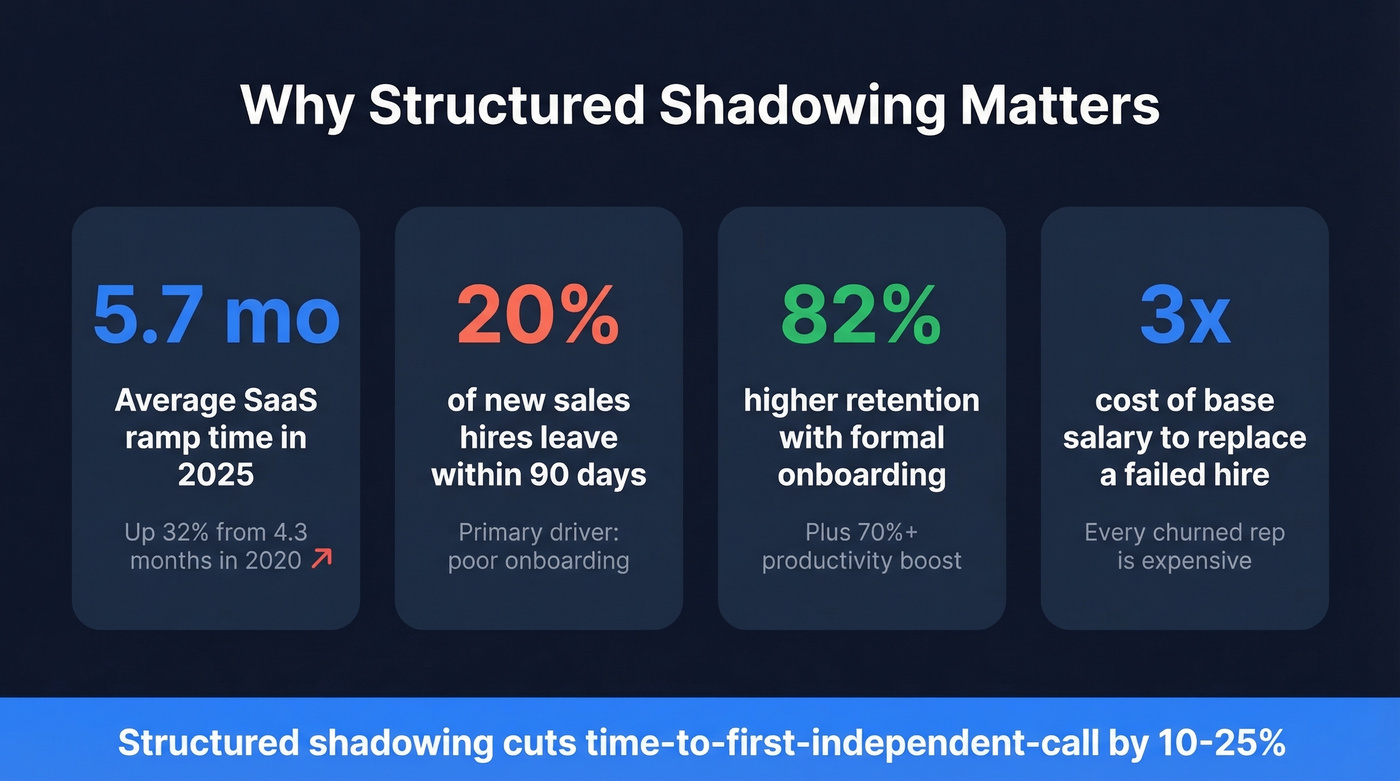
The flip side: organizations with formal onboarding programs boost retention by 82% and productivity by over 70%. Most contact center new hires don't reach full capacity for four to eight weeks. Structured shadowing compresses the early part of that window. We've seen teams cut time-to-first-independent-call by 10-25% when they move from passive observation to a phased program with real exit criteria.
Faster ramp means more revenue per rep per quarter. Lower attrition means you stop re-hiring the same seat every six months.
How to Structure a Shadowing Program
Most teams tell the new hire to "sit in on some calls" and hope osmosis does the work. Osmosis doesn't have a QA score.
Pre-Shadowing Prep
Before the first shadowed call, three things need to happen.
First, set specific observation goals. The trainee should know exactly what to watch for: discovery technique, objection handling, closing language, CRM workflow. Second, select mentors deliberately - pick reps who represent different call types and styles, not just whoever's available. Third, prepare an observation checklist so the trainee has something concrete to fill out during each call.
One detail that gets overlooked: verify that prospect contact data is current before the session. Stale numbers mean trainees shadow voicemails instead of real conversations. Prospeo's 7-day data refresh cycle and 125M+ verified mobiles help prevent that, so more of your shadowing time is spent on calls worth learning from.
The Phased Progression
Shadowing isn't a single phase - it's the first step in a four-phase ramp.
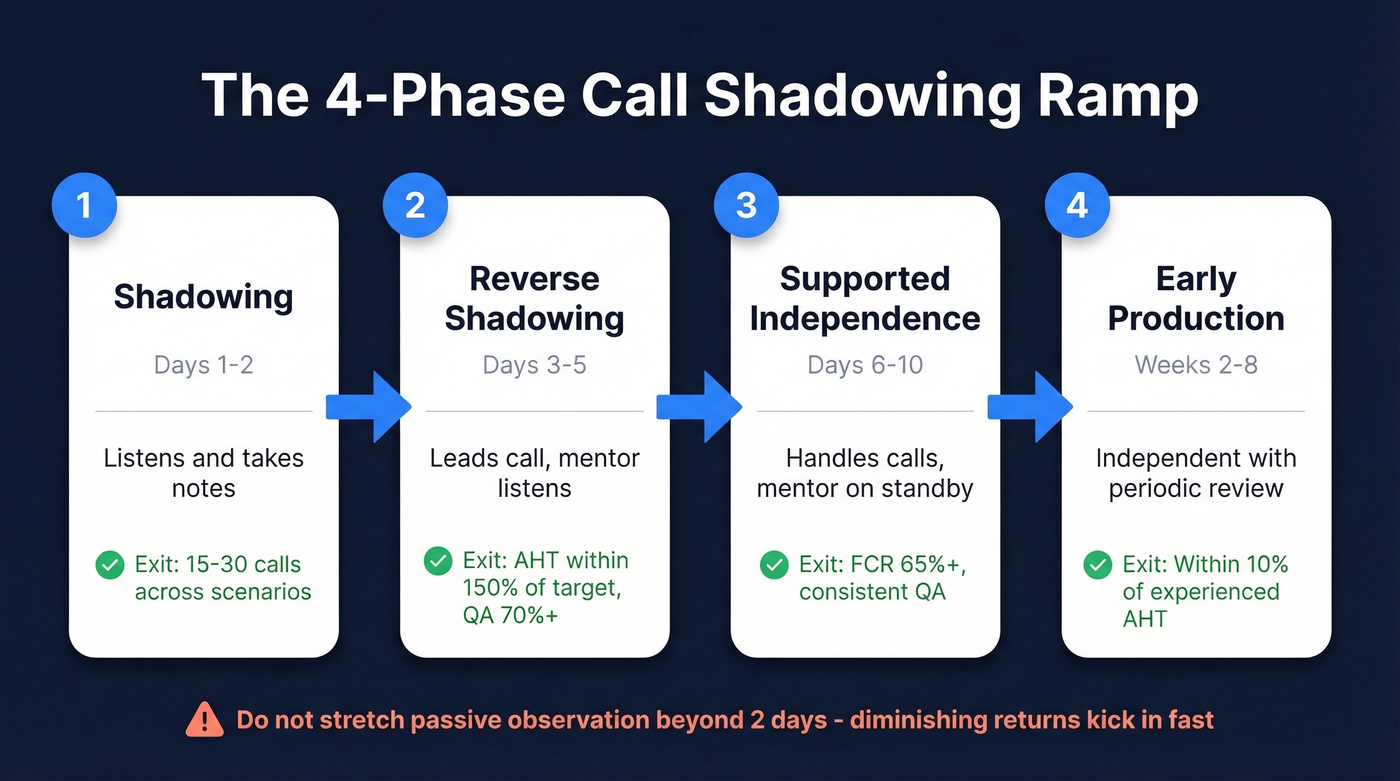
| Phase | Days | Trainee role | Exit criteria |
|---|---|---|---|
| Shadowing | 1-2 | Listens, takes notes | 15-30 calls across scenarios |
| Reverse shadowing | 3-5 | Leads call, mentor listens | AHT within 150% of target, QA 70%+ |
| Supported independence | 6-10 | Handles calls, mentor on standby | FCR 65%+, consistent QA scores |
| Early production | Weeks 2-8 | Independent with periodic review | Within 10% of experienced agent AHT |
The call mix during shadowing matters. Don't let a trainee shadow 15 discovery calls and nothing else. Build a rotation across discovery, objection-heavy conversations, pricing discussions, and escalations. Fifteen to thirty calls across these scenarios gives enough pattern recognition before the trainee takes the wheel.
Don't stretch passive observation beyond two days. Diminishing returns kick in fast.
The Debrief (Non-Negotiable)
Debrief immediately after every call. Not at the end of the day. Not in a weekly 1:1. Right after.
Three questions: What went well? What would you have done differently? What confused you? Five minutes. The mentor provides context on their decisions - why they pivoted, why they didn't push back on that objection, why they asked that specific question. This is where coaching actually happens, not in a scheduled review three days later when the details have faded.
We've watched teams skip debriefs because "there's another call in two minutes." That's how you get reps who shadowed 30 calls and can't articulate a single technique they learned. The debrief is where observation converts to understanding.

Your reps can't shadow calls that never connect. Stale phone numbers turn shadowing sessions into voicemail marathons. Prospeo's 125M+ verified mobile numbers refresh every 7 days - so when your new hire sits in, they're learning from real conversations, not dial tones.
Make every shadowing session count with numbers that actually pick up.
Observation Scorecard Template
Without a scorecard, shadowing evaluations become what one call center operations guide calls "vibe scoring" - a manager gives it a 75% because it felt okay. That's not coaching. That's guessing.
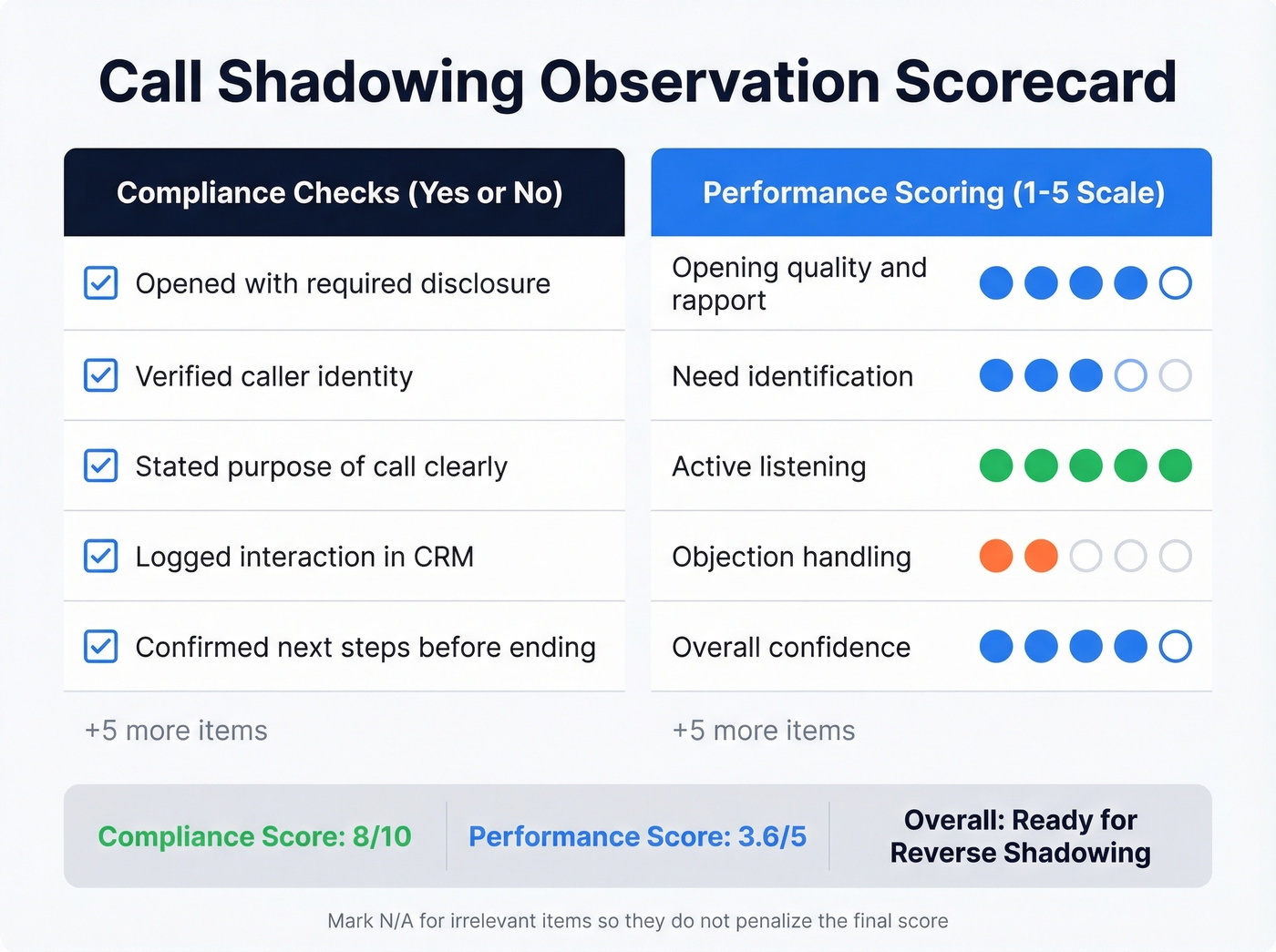
Here's a copy-paste-ready scorecard. Use the compliance section as yes/no checks and the performance section on a 1-5 scale. Mark "N/A" for irrelevant items so they don't penalize the final score.
Compliance Checks (Yes / No)
| # | Item |
|---|---|
| 1 | Opened with required disclosure ("this call may be recorded") |
| 2 | Verified caller identity / confirmed contact name |
| 3 | Stated purpose of the call clearly |
| 4 | Followed required compliance script |
| 5 | Logged interaction in CRM during or immediately after call |
| 6 | Confirmed next steps before ending |
| 7 | Sent follow-up email or task as promised |
| 8 | Stayed within approved messaging guidelines |
| 9 | Escalated appropriately when needed |
| 10 | Ended call professionally |
Performance Scoring (1-5 scale, or N/A)
| # | Item |
|---|---|
| 1 | Opening quality and rapport building |
| 2 | Problem / need identification |
| 3 | Active listening and clarifying questions |
| 4 | Product knowledge accuracy |
| 5 | Objection handling |
| 6 | Resolution clarity and next steps |
| 7 | Tone and professionalism |
| 8 | Pacing and call control |
| 9 | Personalization to prospect's situation |
| 10 | Overall confidence and composure |
The Call Centre Helper scorecard template is a solid free Excel version if you want a spreadsheet - three worksheets, no password, fully customizable. For ongoing monitoring, five calls per agent per month keeps quality visible without drowning managers in review time.
Five Common Mistakes
1. Passive observation with no goals. The Reddit anecdote says it all - six hours on mute learning nothing. Give trainees a written observation checklist before every session.
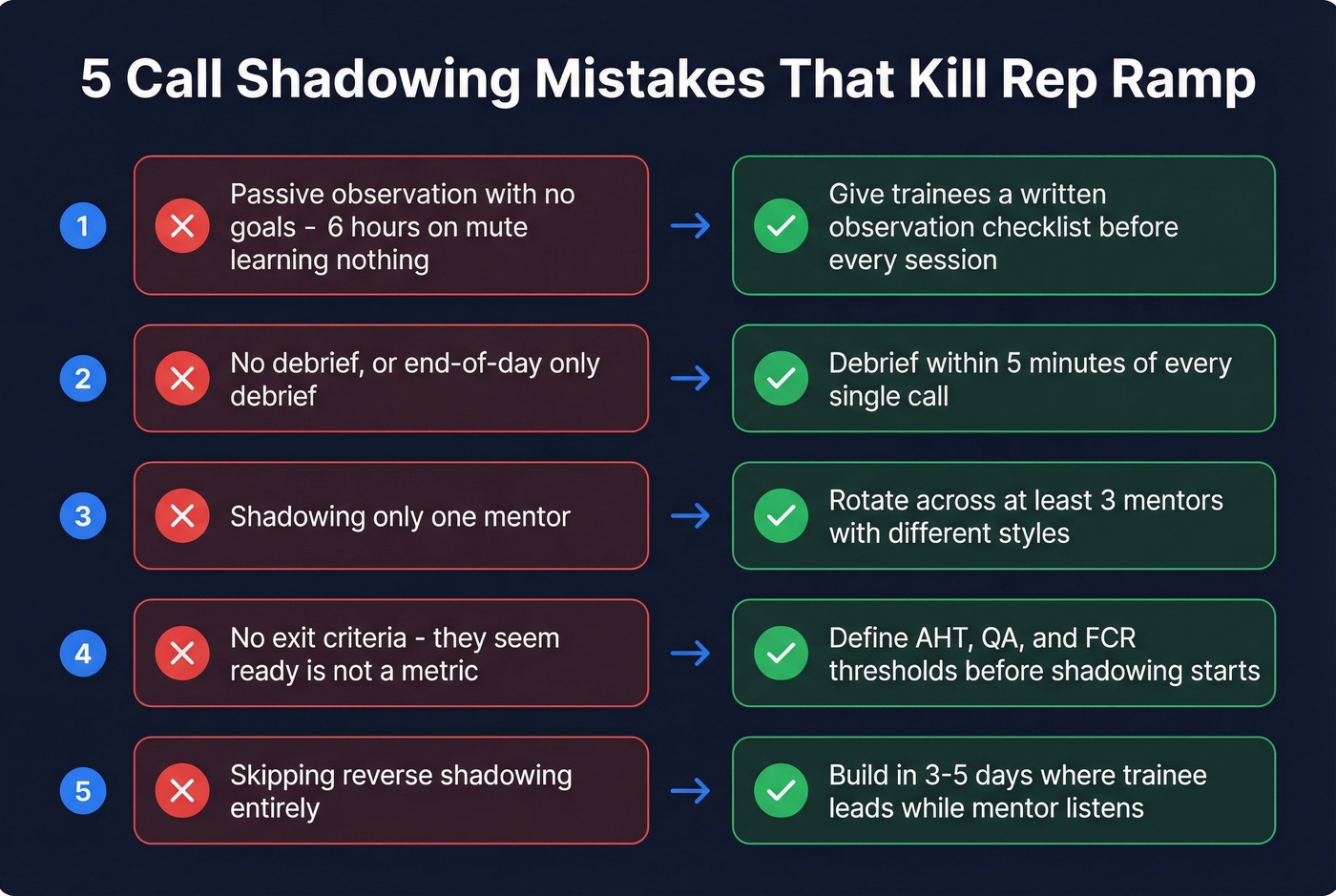
2. No debrief, or end-of-day-only debrief. Delayed feedback is ineffective feedback. Debrief within 5 minutes of every call.
3. Shadowing one mentor only. New hires absorb one person's habits - good and bad. Rotate across at least 3 mentors with different call styles and scenarios.
4. No exit criteria. "They seem ready" isn't a metric. Define AHT, QA, and FCR thresholds for reverse shadowing and nesting before shadowing starts. If the trainee can't hit them, they stay in nesting longer.
5. Skipping reverse shadowing entirely. Jumping from silent observation to fully independent live calls is a confidence killer and an error factory. Build in 3-5 days where the trainee leads calls while the mentor listens and can intervene - this is the ideal window for a sales manager to join live and evaluate readiness firsthand.
Remote Shadowing and Coaching
For distributed teams, the ability to listen in on sales calls remotely isn't optional. Whisper and barge modes are a major upgrade for coaching and intervention, especially when you can't sit next to someone in a bullpen. Live listen-in becomes the primary way managers stay connected to rep performance across time zones.
Let's be honest about the coaching capacity gap. A manager with 8 reps handling 20 calls per week each faces 160 calls - even at 2x playback speed, they're reviewing less than 10% of interactions. AI-assisted coaching tools are closing that gap, with real-time prompts reducing ramp times 30-50% in some orgs, but they complement structured shadowing rather than replacing it. Pairing these tools with scheduled listen-ins, async call reviews, and structured feedback loops gives distributed teams the same developmental rigor as co-located ones.
Skip this if you're under 10 reps with sub-$15k deal sizes: you don't need an enterprise CCaaS platform for shadowing. Aircall or Zoom Contact Center will do what most small teams need, and they're often cheaper than enterprise suites like Five9. Save the Five9 budget for when you actually have the call volume to justify it.
One practical note for Microsoft shops: Teams users have reported that the platform's two-active-call limit makes true shadowing difficult. Dedicated CCaaS platforms handle this natively.
| Platform | Starting price | Best for |
|---|---|---|
| Aircall | ~$30-$50/user/mo | Small sales teams |
| Dialpad | ~$80/user/mo | AI-enabled coaching |
| Five9 | ~$119/user/mo | Enterprise contact centers |
| Talkdesk | ~$85/user/mo | Mid-to-large centers |
| Zoom Contact Center | ~$69/user/mo | Existing Zoom shops |
Legal and Compliance
In the US, 38 states plus DC operate under one-party consent - your rep's knowledge counts. Twelve states require all-party consent. For cross-state calls, the strictest law applies: a rep in New York calling a prospect in California follows California's rules.
The safest universal approach: open every call with "this call may be recorded for training purposes." A customer who stays on the line has given implied consent. For international teams, GDPR treats call recording as data processing requiring active, informed consent. Canada's PIPEDA and Australia's state-level laws have similar requirements. Build the disclosure script into your call opening and train it during shadowing so it's muscle memory before reps go independent.
Before the Call - Data Quality
Here's a pattern we see constantly: a team invests in a structured shadowing program, pairs the new hire with their best closer, blocks the calendar - and the first three calls go to voicemail because the phone numbers are stale. A huge chunk of shadowing value evaporates when reps dial dead numbers.
With 125M+ verified mobile numbers, 98% email accuracy, and a 7-day data refresh cycle, Prospeo dramatically reduces stale contacts. Trainees observe real conversations with real prospects - not the sound of a disconnected line.
If you're building the call queue from scratch, start with an Ideal Customer Profile and a repeatable sales prospecting workflow.
Ramp time is 5.7 months and climbing. Every wasted shadowing day costs you pipeline. Prospeo gives your team 98% accurate emails and verified direct dials with a 30% pickup rate - so new reps observe live buyer conversations from day one, not empty connect attempts.
Cut ramp time by filling your call queue with verified contacts at $0.01 each.
FAQ
How long should call shadowing last?
Two days of structured observation, then three to five days of reverse shadowing where the trainee leads calls. Don't stretch passive listening beyond two days - diminishing returns hit fast, and reps learn by doing.
What's the difference between shadowing and nesting?
Shadowing means the trainee listens silently while an experienced rep handles calls. Nesting means the trainee handles calls while a mentor listens and can intervene. Nesting comes immediately after shadowing in a well-structured ramp program.
Do I need consent to shadow a call?
In 38 US states, one-party consent is sufficient - your rep's awareness counts. In 12 all-party states, disclose to the customer. Safest approach: open every call with "this call may be recorded for training purposes."
How many calls should a new rep shadow?
Fifteen to thirty calls across discovery, objection-heavy, pricing, and escalation scenarios. That gives enough pattern recognition before moving to reverse shadowing, where the trainee takes the lead.
How do I make sure shadowed calls reach real prospects?
Verify prospect contact data before each session using a provider with a weekly refresh cycle. Prospeo's 7-day refresh and 125M+ verified mobiles keep dial lists current so trainees observe live conversations, not voicemails.