

Callback Message Scripts: Voicemail, SMS & Email Templates That Get Replies
Eighty percent of sales calls go to voicemail. Cold call success rates hover around 2.3%. And yet callbacks remain one of the highest-converting paths to a live conversation - if you've got the right callback message script.
Bottomline Technologies learned this the hard way. Their team connected with prospects roughly 3% of the time - 97% hit voicemail. Before optimizing their scripts, they averaged one returned call per day. After two focused days of rework, that spiked to 27. Same reps, same list, completely different results.
A rep on r/sales shared a dead-simple voicemail script - vague, curiosity-driven, under 15 seconds - and reported 15 callbacks from 25-35 voicemails per week. Another rep in the same thread said they'd gotten one callback out of thousands of calls. The difference isn't luck. It's the script, the channel mix, and the data behind the dial.
What You Need (Quick Version)
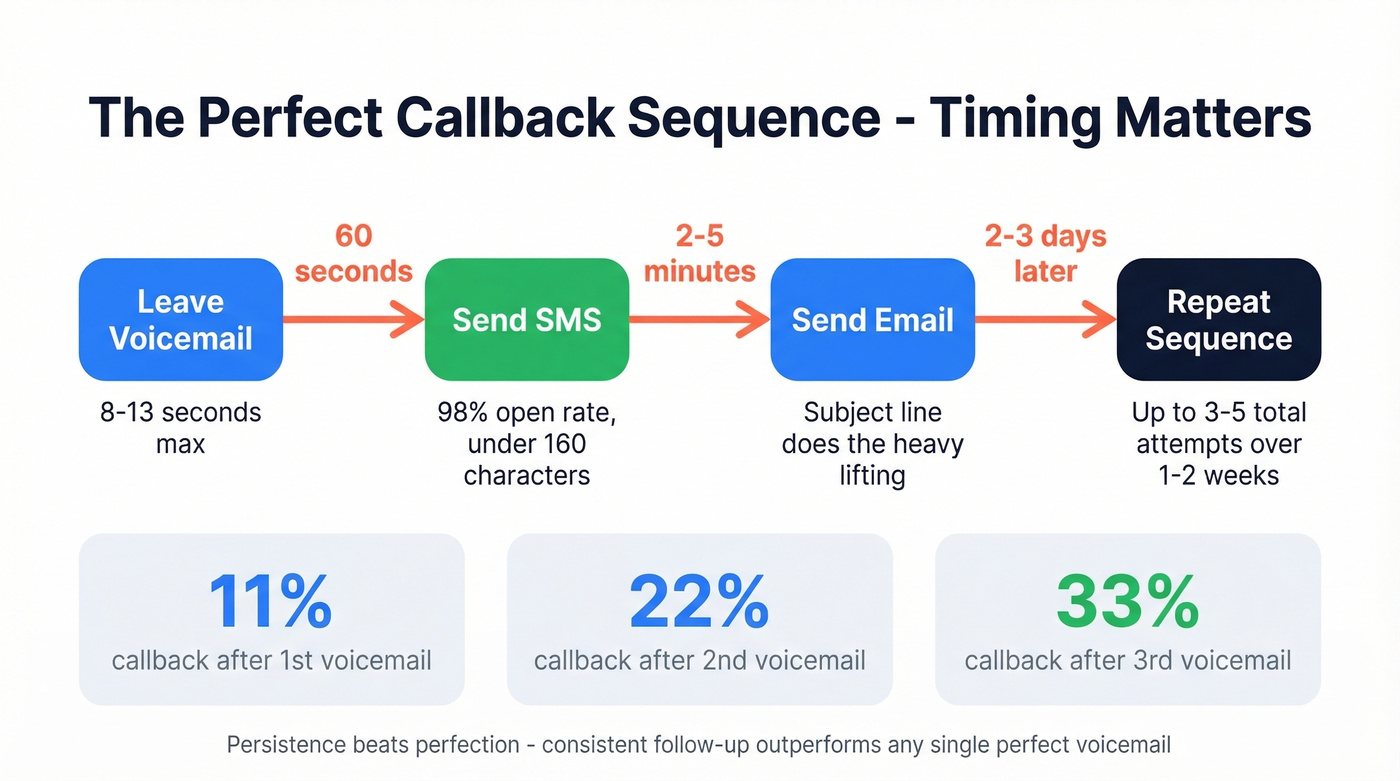
- Keep voicemails in the 8-13 second range. Most voicemails go unplayed for three days, and shorter messages are far more likely to get returned.
- Follow every voicemail with an SMS within 60 seconds. SMS has a 98% open rate and roughly 45% average response rate.
- Verify your numbers before you dial. Bad data kills callback rates before your script gets a chance.
The 5-Element Script Formula
Every callback voicemail needs exactly five things, and nothing more. Close CRM's framework nails this: your name, your company, why you're calling, your phone number, and a specific next step.
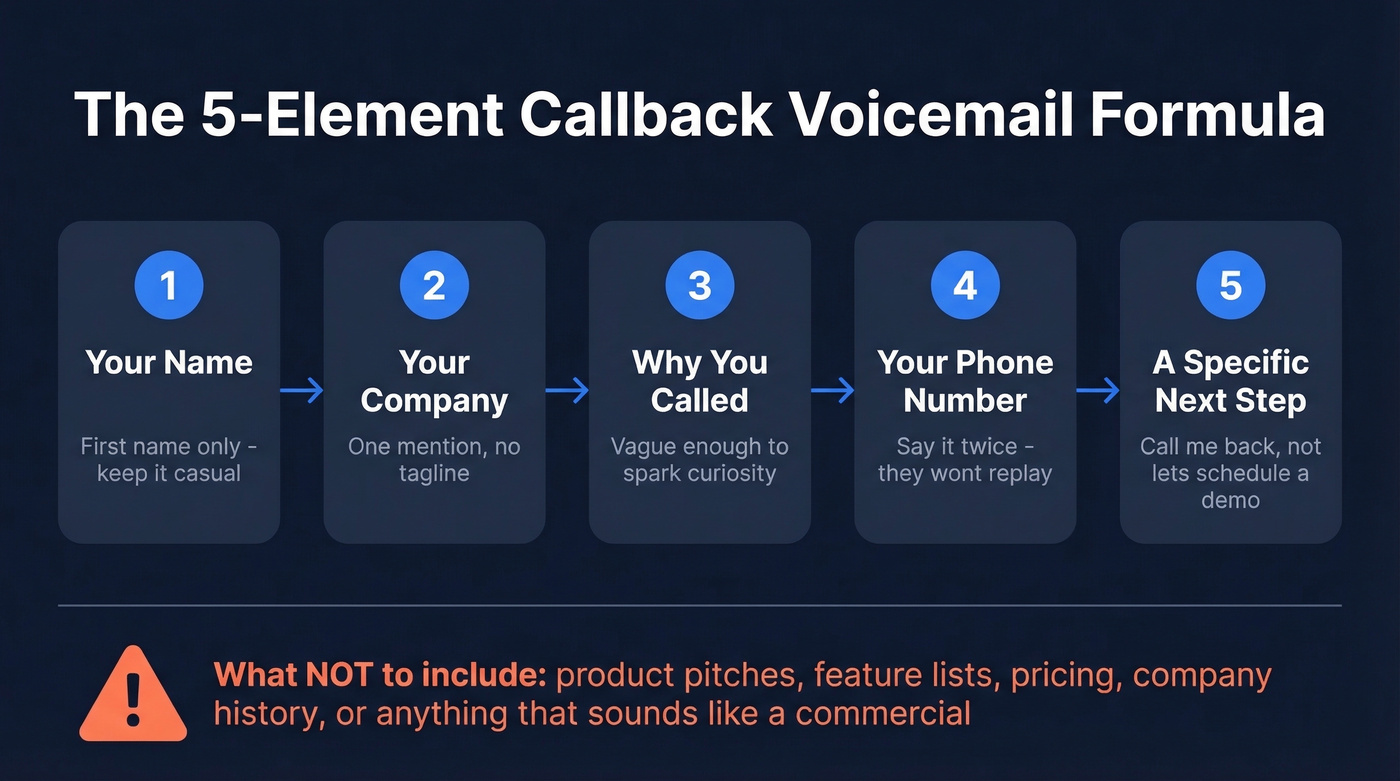
That's it. No product pitch. No feature dump. No "I'd love to find 15 minutes to show you how we help companies like yours..." - that's a commercial, and nobody calls back a commercial.
Keep it tight. Hang up. It takes an average of eight cold call attempts to reach a prospect - your voicemail needs to earn a shortcut through that gauntlet.
Voicemail Callback Scripts
1. The Curiosity Script (cold call)
"Hey [Name], it's [Your Name] with [Company], calling regarding your oversight of the [department] team. Give me a call back when you get a chance - [number]."
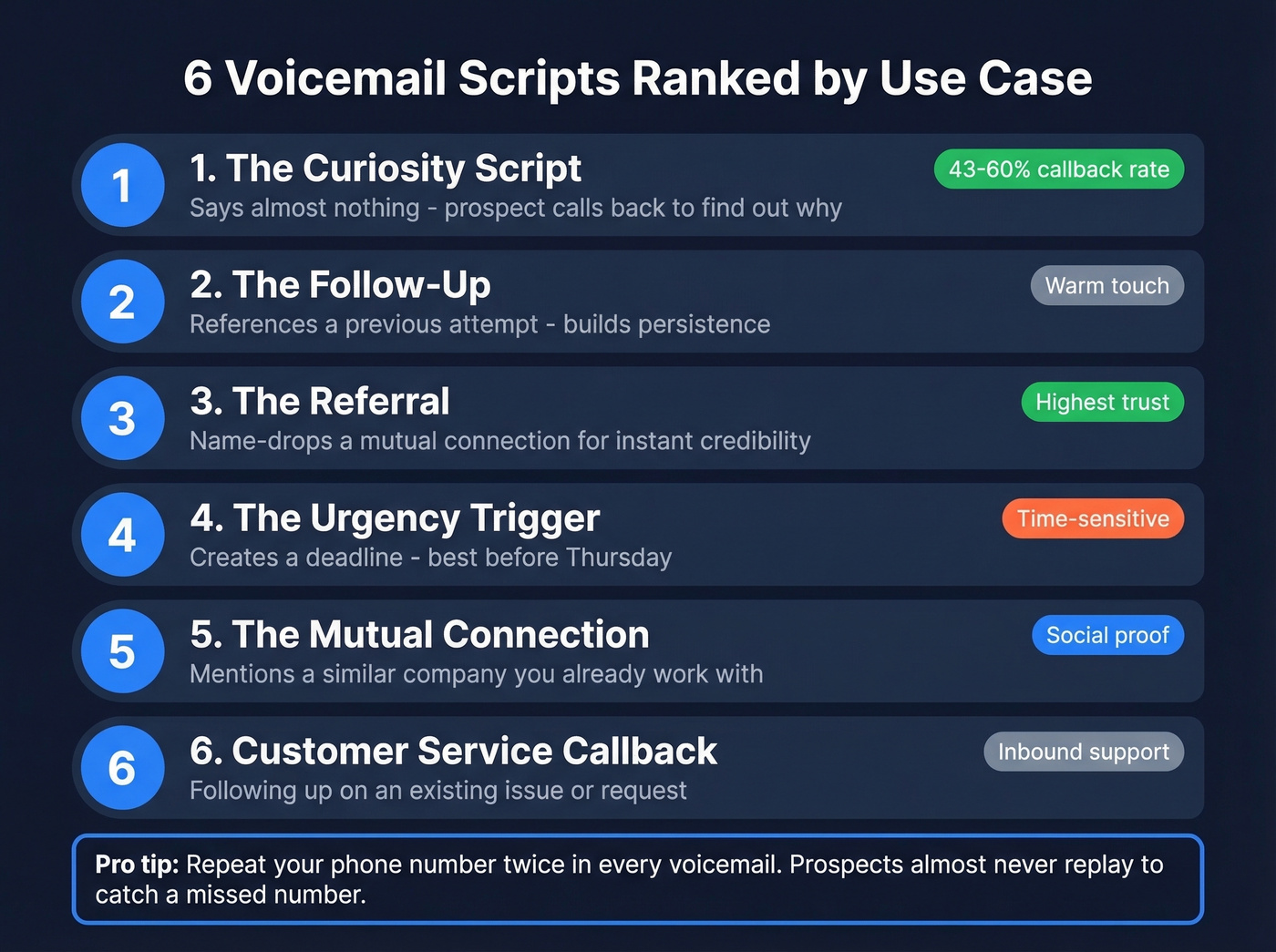
That Reddit post reported roughly 15 callbacks from 25-35 voicemails per week - a 43-60% callback rate depending on the week. It works because it says almost nothing. The prospect calls back to find out what it's about.
2. The Follow-Up
"Hi [Name], [Your Name] again. Calling back about the [topic] I mentioned. My number's [number] - that's [number]. Talk soon."
3. The Referral
"Hey [Name], [Referrer] suggested I reach out about [topic]. It's [Your Name] at [number]. Would love a quick call when you're free."
4. The Urgency Trigger
"Hi [Name], [Your Name] with [Company]. Something came up on our end that's relevant to your [specific initiative]. Call me at [number] - [number]. Best before Thursday."
5. The Mutual Connection
"Hey [Name], [Your Name] here. We work with [similar company] on [outcome]. Thought it'd be worth a quick conversation. [Number] - [number]."
6. Customer Service Callback
"Hi [Name], this is [Your Name] from [Company] following up on your recent [issue/request]. I've got an update for you - call me at [number] whenever's convenient."
These scripts repeat the phone number twice on purpose. Prospects rarely replay voicemails to catch a number they missed.
Pro tip: Some reps put their name at the end instead of the beginning. It forces the prospect to listen through the whole message before knowing who's calling, and curiosity compounds.
Delivery Tips
Speak at 120-150 words per minute. Faster than that and you sound desperate; slower and you sound like a robocall. Smile while recording - it genuinely changes your vocal tone, even over the phone. Stand up during voicemail drops. The energy difference is audible, and we've noticed it ourselves when coaching reps through call blocks.

No callback script saves a dead number. Prospeo gives you 125M+ verified mobile numbers with a 30% pickup rate - refreshed every 7 days, not 6 weeks. Teams using verified data double their callback rates before touching a single script.
Stop leaving voicemails on numbers that don't exist.
SMS Callback Templates
SMS has a 98% open rate and roughly 45% average response rate. Voicemails often sit untouched for days. Send your text within 60 seconds of leaving the voicemail.
1. Post-Voicemail (cold)
"Hi [Name], just left you a quick voicemail. Would love 5 min to discuss [topic]. When works best? - [Your Name], [Company]"
2. Inbound Follow-Up
"[Name], saw you checked out [resource/page]. Happy to walk through it live - want me to call you this afternoon?"
3. No-Show Recovery
"Hey [Name], looks like we missed each other. No worries - want to reschedule for later this week? Just reply with a time."
4. Re-Engagement
"Hi [Name], it's been a few weeks. Still exploring [solution area]? Happy to pick up where we left off. - [Your Name]"
Keep every SMS under 160 characters when possible. Include opt-out language for promotional messages - it's legally required in most jurisdictions. (If you're building a full outbound motion, pair this with sales prospecting techniques so your texts go to the right people.)
Email Callback Scripts
40-60% of customers expect responses within minutes, not hours. Your email should land within a few minutes of the voicemail. The subject line does the heavy lifting.
1. Subject: "Tried calling - quick question about [topic]"
"Hi [Name], just left a voicemail. I had a quick question about how your team handles [specific challenge]. Worth a 5-minute call? Here's my calendar link: [link]. - [Your Name]"
2. Subject: "[Company] + [Their Company] - follow-up"
"Hi [Name], tried reaching you about [topic]. [One sentence of value]. Happy to work around your schedule - reply with a time or grab a slot here: [link]."
Keep follow-up emails under three paragraphs. Skip this channel entirely if you don't have a verified email address - bounced follow-ups after a voicemail look sloppy and tank your domain reputation. If you need options, use these email subject line ideas and keep your follow-up tight with sales follow-up templates.
Mistakes That Kill Callback Rates
Look, most reps blame their script when the real problem is upstream.
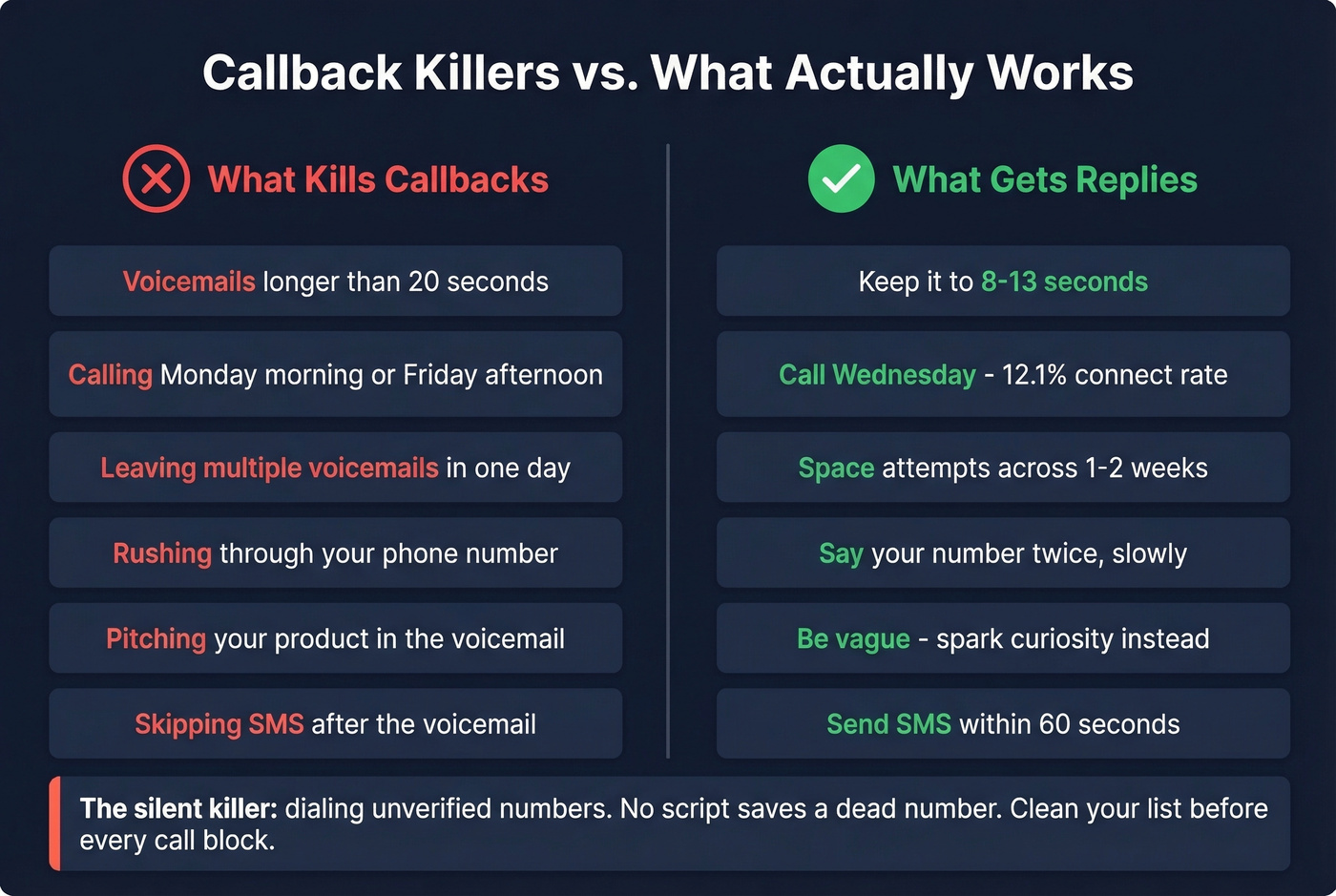
Talking longer than 20 seconds. Ten seconds is better. Twenty is the ceiling. Anything past that and you're pitching, not prompting.
Calling Monday morning or Friday afternoon. InsideSales/XANT's call analysis puts Wednesday as the best day, with a 12.1% connect rate.
Leaving more than one voicemail per day. Space them out. You're building familiarity, not stalking.
Rushing your phone number, pitching your product in the voicemail, skipping SMS after the voicemail - all common, all fixable. But the silent killer is calling unverified numbers. In our experience, we've seen teams double their callback rates just by cleaning their list before a call block. No script in the world saves a dead number. (If you're fixing upstream issues, start with data enrichment services and a clean sales prospecting database.)
Some teams track a simple persistence progression: roughly 11% callback after the first voicemail, 22% after the second, 33% after the third. The exact percentages vary, but the pattern holds - a tight message plus consistent follow-up beats a single "perfect" voicemail every time.
Tools to Scale Your Callbacks
Voicemail drop tools let you pre-record your best script and drop it in one click instead of performing it live 50 times a day - saving 60-90 minutes daily.
- Klenty - solid for multi-channel sequences, typically $50-$200/seat/month depending on plan and dialer features
- Kixie - strong dialer with CRM integrations, similar price range
- JustCall - good for distributed teams, comparable pricing depending on seats and calling features
If you're on HubSpot, confirm your voicemail drop tool integrates natively. Many don't. (If you're evaluating your stack, compare SDR tools and your contact management software before you commit.)
Data quality tools solve the upstream problem nobody talks about. Before you record your voicemail drop, verify your list. Prospeo's mobile database covers 125M+ verified numbers with a 30% pickup rate, refreshed every 7 days - so you're not dialing numbers that went stale last quarter.
Let's be honest: the best callback message script in the world is worthless if half your list is disconnected. Fix the data first, then worry about your delivery.
Bounced follow-up emails after a voicemail destroy your domain reputation. Prospeo's 98% email accuracy and 5-step verification mean every SMS, email, and voicemail in your callback sequence hits a real person - at roughly $0.01 per email.
Verify every contact before your next call block.
FAQ
How long should a callback voicemail be?
Eight to 13 seconds. Most voicemails go unplayed for three days, and shorter messages are significantly more likely to get returned. Never exceed 20 seconds - anything longer sounds like a pitch, not a person.
How many voicemails before giving up?
Three to five spread across one to two weeks. Never leave more than one per day. Teams consistently see better return rates after the second and third touch than after the first.
Is SMS better than voicemail for callbacks?
SMS has a 98% open rate and roughly 45% response rate, but the best approach combines both channels. Leave a voicemail, then send an SMS within 60 seconds. Together they outperform either channel alone by giving prospects two low-friction ways to respond.
What's the #1 reason callback scripts fail?
Bad data, not bad scripts. You can have the perfect 12-second voicemail, but if you're dialing a disconnected number, it never gets heard. Verify your numbers before every call block - weekly data refreshes catch job changes and number swaps that monthly or quarterly updates miss entirely.