

Challenger Sales Questions: 30+ Scripts by Stage
You read The Challenger Sale on a flight, highlighted half the book, and then froze on the very next discovery call. You're not alone. The book nails why Challenger works and gives you almost nothing in terms of exact words to say. Meanwhile, 38% of purchase attempts end in no decision - not a loss to a competitor, just a slow death by committee. Buyers spend only 17% of their total buying time meeting with all potential vendors combined. You get a sliver of their attention. The challenger sales questions below are designed to make that sliver count.
Here's the thing: most reps fail at Challenger not because they can't challenge, but because they challenge the wrong person. Nail the questions and the audience, or you're just being argumentative on a Zoom call.
Five Questions to Start With
You don't need 30 questions memorized. You need five and the judgment to deploy them.
- "How do you currently deal with [problem] within the context of your annual budget?" - Commercially Insightful Verifier. Opens the cost conversation without a yes/no trap.
- "What's your honest reaction - does this challenge how you've been thinking about it?" - Mobilizer Identification. Healthy skepticism means you've found someone who can drive change. Enthusiastic agreement with zero pushback? Probably a Talker.
- "What other internal stakeholders have you included to solve this problem?" - Buying Journey Verifier. Surfaces the real buying group before you waste a month selling to one person.
- "Most teams we talk to assume [common belief]. What we're seeing is [counterintuitive data point]. How does that land with your team?" - Reframe. This is the Challenger move.
- "Would you be willing to share your internal [metric/data] so we can model the impact together?" - Powerful Request. Tests whether your contact will act, not just talk.
Precision beats volume. Master these five before you add more.
Questions by Deal Stage
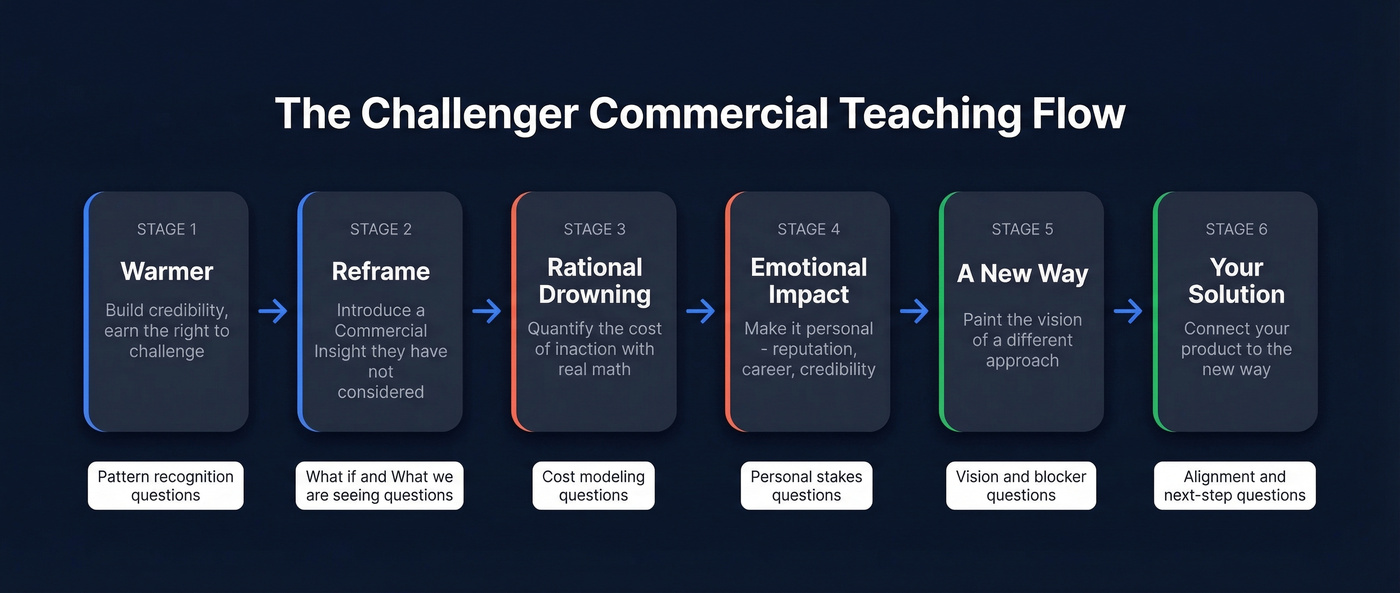
A common 6-stage Commercial Teaching flow runs: Warmer, Reframe, Rational Drowning, Emotional Impact, A New Way, Your Solution. Each stage has a job. Each question below does that job.
Warmer
Build credibility and earn the right to challenge. You're demonstrating homework, not interrogating.
- "We've been working with a lot of [industry] teams dealing with [trend]. How is that showing up for you?" - Signals pattern recognition across their peer group.
- "I noticed your team recently [hired for X role / launched Y initiative]. What's driving that shift?" - Shows you've researched them specifically.
- "What's the biggest priority your leadership team is pushing this quarter?"
- "How has [recent industry event or regulation] changed your approach?" - Positions you as someone tracking their world.
- "What's the one metric your team is most accountable for right now?" - Cuts through corporate speak to find the real pressure point.
Reframe
This is where Challenger earns its name. You're introducing a Commercial Insight - something the buyer hasn't considered. The language pattern from Map My Customers works well: "What may surprise you is..." or "For the longest time, teams have been told [X]. What we're actually seeing is [Y]."
- "Most companies in your space assume [common belief]. What we're finding is [counterintuitive data]. How does that compare to what you're seeing?" - The classic Challenger reframe.
- "What if the problem isn't [surface issue] but [deeper root cause]?" - Forces a level shift in thinking.
- "Teams we work with used to evaluate this based on [old criteria]. The ones getting better results shifted to [new criteria]. What's your current framework?" - Challenges their evaluation model directly.
- "What would change if [assumed constraint] turned out to be solvable?"
SaaS-specific reframe: "Most marketing teams measure automation success by emails sent. The teams pulling ahead measure by pipeline influenced per dollar spent. Which side of that are you on?" Concrete enough to land, provocative enough to stick.
Rational Drowning
Quantify the cost of inaction. Make the status quo feel expensive. Here's what a good Rational Drowning exchange actually sounds like:
Rep: "How much time does your team spend manually reconciling [data/process] per week?"
Prospect: "Probably 6-8 hours across the team."
Rep: "If we assume a loaded cost of about $100/hour, that's roughly $600-$800 a week - around $7K-$10K per quarter. Over a year, you're looking at roughly $30K-$40K spent on a process that doesn't move the needle. Has your CFO seen that number?"
The goal is to build the math with them, not lecture them. We've found that co-creating the cost model on the call - even roughly - lands harder than showing up with a polished spreadsheet they didn't help build. More questions for this stage:
- "What percentage of your [budget/pipeline/resources] goes toward fixing symptoms rather than the root cause?"
- "How many deals in your last pipeline review were stuck in 'pending decision'? What's the revenue sitting in that limbo?" - Use this alongside your pipeline review metrics.
- "If this problem continues at the current rate, what's the financial impact over 12 months?"
- "Every month this stays unresolved, you're incurring [estimated cost]. Over six months, that's [total]. Has leadership seen that number?"
Emotional Impact
Shift from the spreadsheet to the person. CEB/Gartner research found 53% of B2B buyer loyalty is driven by the sales experience itself - more than brand, product, service, or value combined. Deals close when someone's reputation is on the line, not when the ROI model is perfect.
Three questions. That's all you need here - don't overdo the emotional angle or it feels manipulative.
- "What happens to your team's credibility internally if this initiative doesn't deliver?"
- "What would it mean for you personally if this problem gets solved this year?"
- "If nothing changes, what does your next board review look like?"
A New Way
Paint the alternative. This isn't your product pitch - it's the vision of a different approach. The Teach-Tailor-Take Control model from Dixon and Adamson is doing its heaviest lifting right here: you've taught them something new, tailored it to their situation, and now you're taking control of what "good" looks like.
- "What if you could [desired outcome] without [current painful tradeoff]?" - Resets their expectations of what's possible.
- "The teams getting ahead here shifted from [old approach] to [new approach]. What would it take to test that internally?" - Makes the new way feel achievable.
- "If you had [specific capability], how would that change your planning for next quarter?"
- "What's stopping you from approaching this differently today?" - Surfaces the real blocker: budget, politics, inertia.
- "If we could prove this works in a 30-day pilot, who else would need to see the results?" - Bridges to the close while mapping the buying group.
Your Solution and Close
Now - and only now - connect your product to the new way you've established.
- "Based on what you've shared, here's how we'd solve [specific problem]. Does that align with what matters most?" - Ties back to their words, not your pitch deck.
- "What would need to be true for you to move forward this quarter?" - If you're tightening your close, pair this with a simple steps to close a sale checklist.
- "Who else on your team needs to see this before a decision gets made?"
Questions by Stakeholder Role
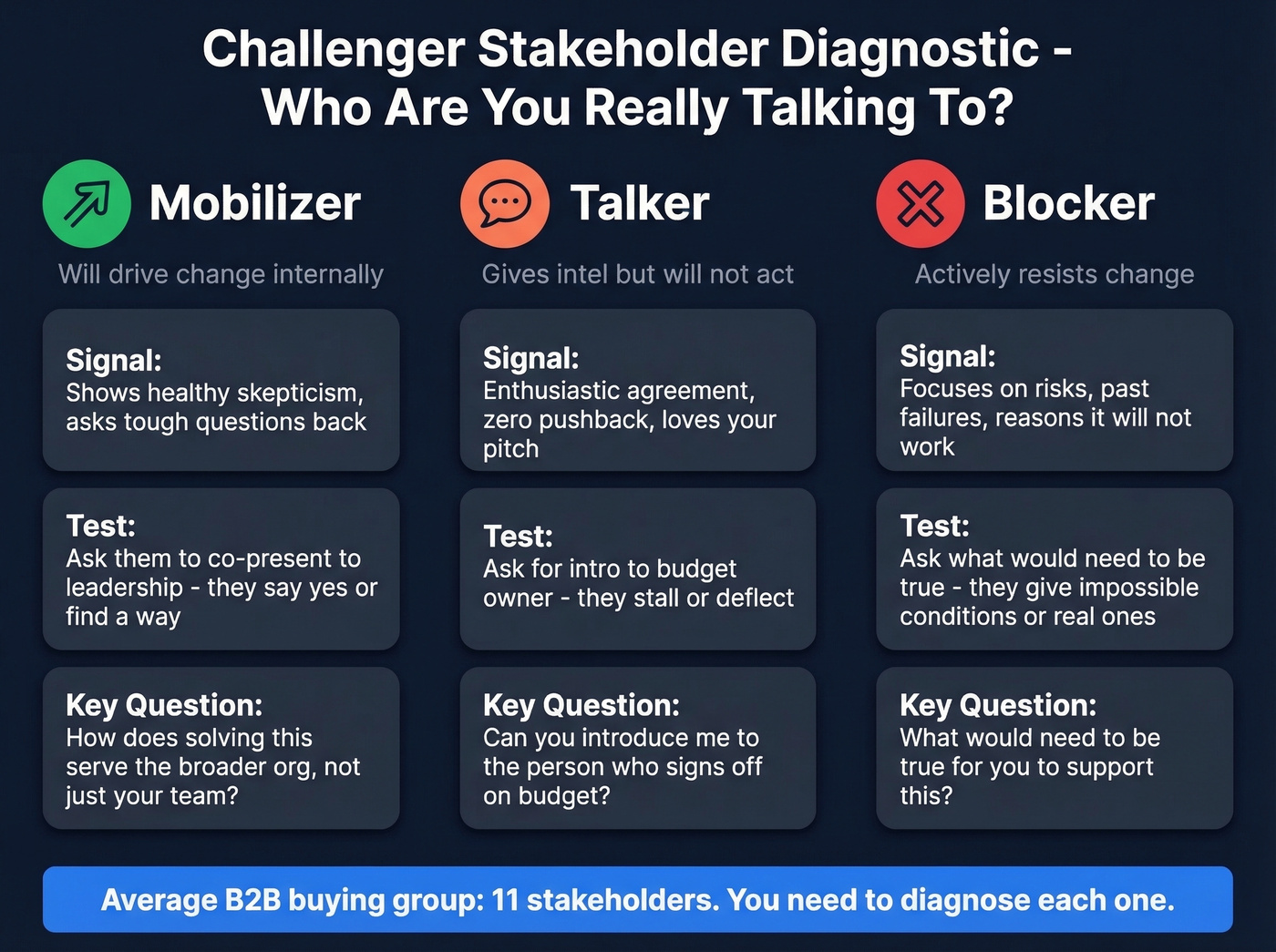
The Challenger Customer makes the case that the average B2B buying group runs around 11 stakeholders, sometimes up to 20. Asking the same questions to every persona wastes everyone's time. Worse, you can't tell a Mobilizer from a Talker until it's too late.
| Role | Question | Intent |
|---|---|---|
| Economic Buyer | "What's the cost of inaction over 12 months?" | Quantify urgency |
| Economic Buyer | "How does this rank against competing budget priorities?" | Surface real timeline |
| Technical Evaluator | "What would integration look like with your current stack?" | Uncover blockers early |
| Technical Evaluator | "What's failed in past implementations?" | Pre-empt objections |
| Champion / Mobilizer | "Who else needs convincing? What do they care about?" | Map the buying group |
| Champion / Mobilizer | "Would you co-present this to leadership?" | Tests commitment to act |
| Mobilizer Diagnostic | "How does solving this serve the broader org, not just your team?" | Greater-good orientation |
| Talker Diagnostic | "Can you introduce me to the budget owner?" | Tests willingness to act |
| Blocker Diagnostic | "What would need to be true for you to support this?" | Finds the unlock |
For Relationship Builders trying Challenger: You don't have to become a different person. Start with the Mobilizer Identification questions - they feel like genuine curiosity, not confrontation. Once you've found a Mobilizer, let them do the internal challenging while you arm them with the data.

Your Challenger reframe is useless if it lands in the wrong inbox. Prospeo gives you 98% accurate emails and 125M+ verified mobile numbers so your provocative questions reach actual decision-makers - not gatekeepers.
Stop challenging people who can't sign the check.
The 4 Question Types
Challenger Inc. breaks questions into four types. Each has a different job.
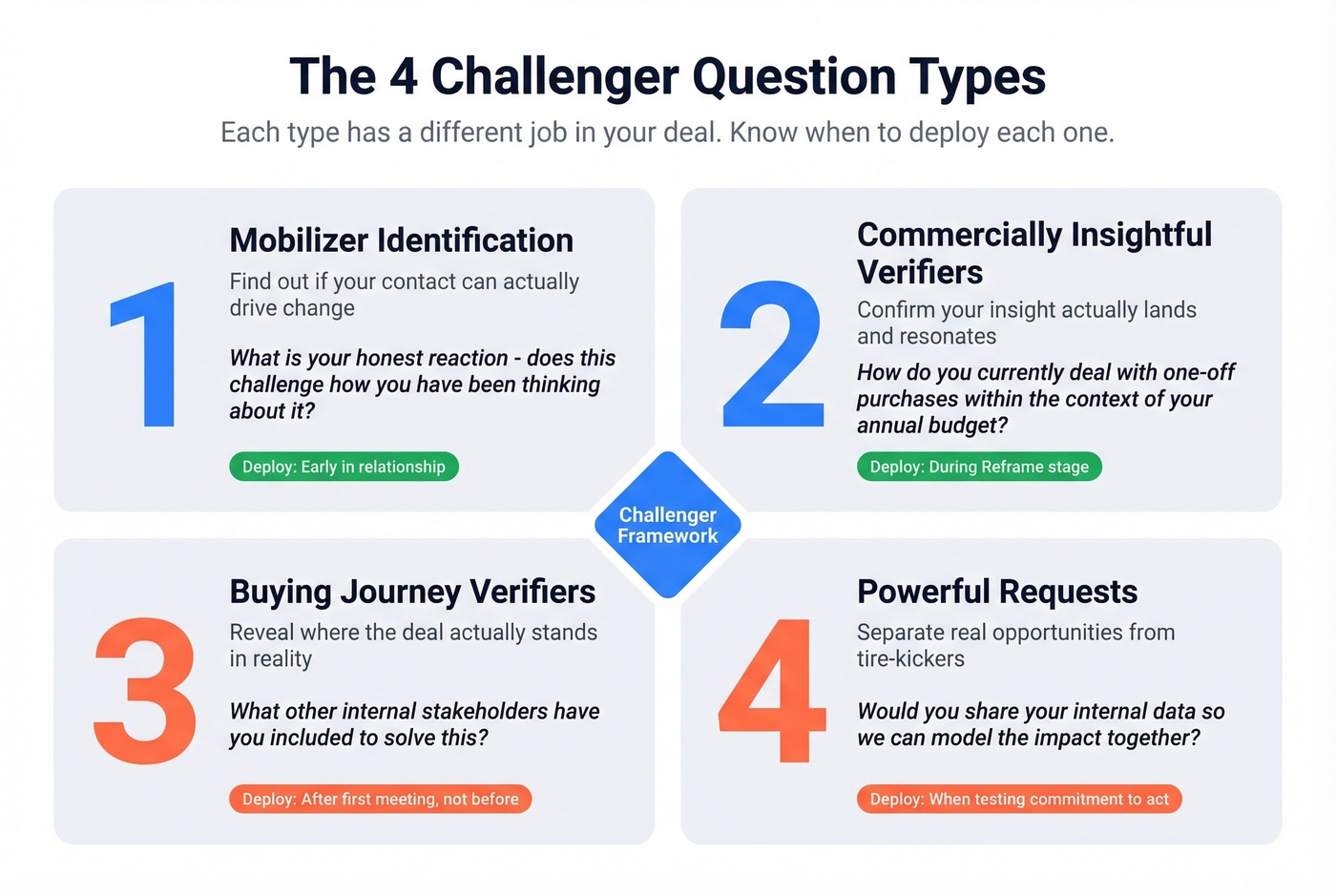
Mobilizer Identification finds out if your contact can actually drive change. Look for healthy skepticism and interest in the organization's greater good. Skip this if you already have confirmed executive sponsorship.
Commercially Insightful Verifiers confirm your insight lands. The classic Grainger example: instead of "Do you have issues with one-off purchases?", ask "How do you currently deal with one-off purchases within the context of your annual budget?" The assumptive, open framing surfaces real data.
Buying Journey Verifiers reveal where the deal actually stands. "What are you currently doing about this issue?" and "What other internal stakeholders have you included?" are the two workhorses. Don't deploy these in a first meeting - too transactional too early. If you want a broader bank of discovery questions, keep them separate from your Challenger reframe.
Powerful Requests separate real opportunities from tire-kickers. Ask for internal data, access to other stakeholders, or a co-presentation. Mobilizers provide it or help you get it. Talkers stall. That's the diagnostic.
Building the Insight Before the Call
Challenger questions only work when you've done the pre-work. Showing up with a generic or wrong reframe is worse than not challenging at all - we've watched reps lose credibility in under two minutes by leading with an "insight" the prospect debunked with a single sentence. You need a genuine Commercial Insight built from industry data, customer patterns, and the buying group's org structure.
If you're building this into a repeatable motion, document it as part of your sales process so new reps can execute it consistently.
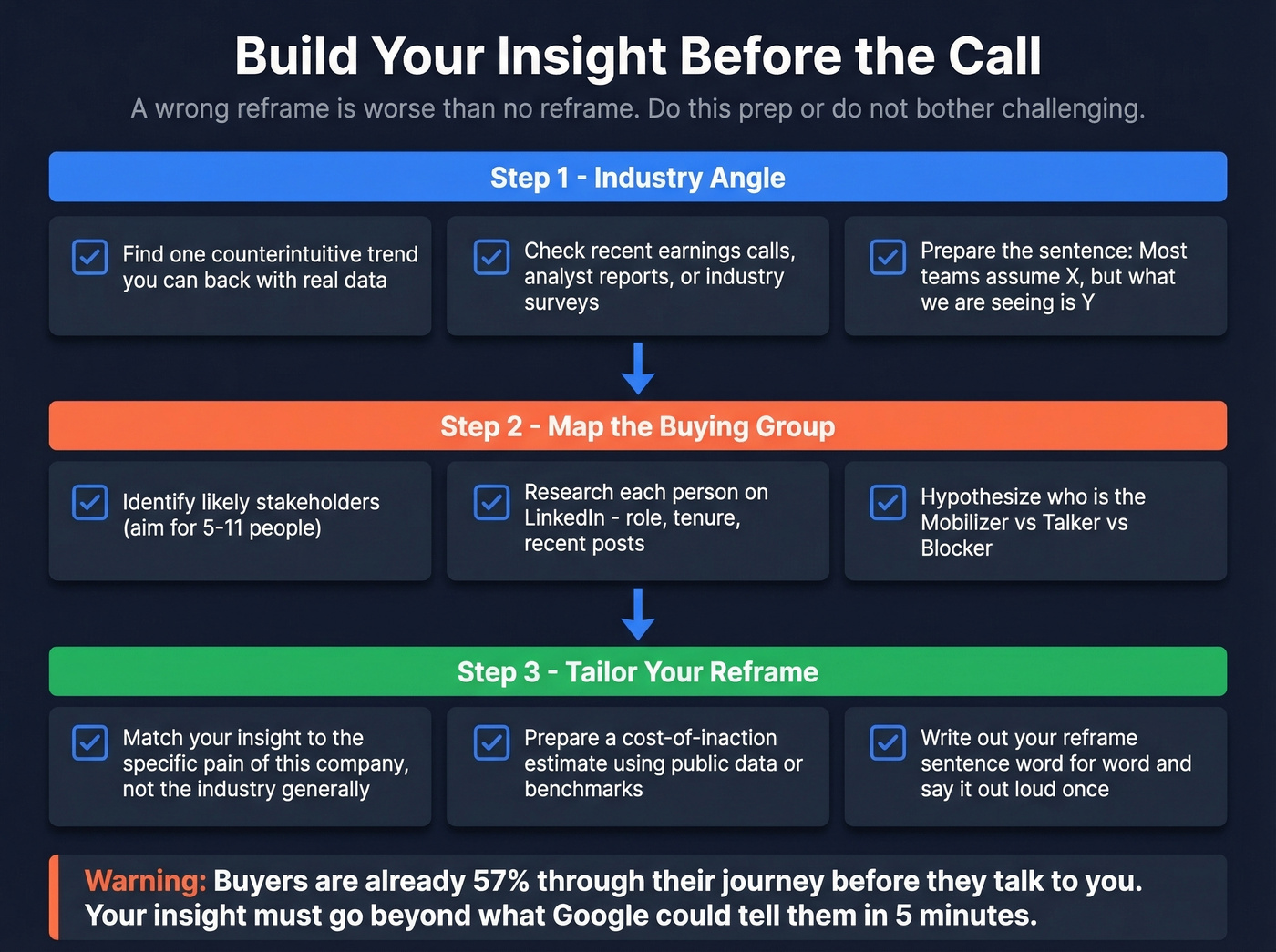
Start with the industry angle. What counterintuitive trend can you back with data? Then map the buying group. With around 11 stakeholders involved and buyers already 57% through their journey before they talk to you, you need verified data to reach the right people.
Prospeo's B2B database covers 300M+ professional profiles with 30+ search filters - job title, department, headcount growth, buyer intent - so you can map the actual buying group and reach them with 98% verified emails instead of guessing who filled out a form.

Mapping the buying group is step one of every Challenger deal. Prospeo's 30+ search filters - including department headcount, job changes, and buyer intent across 15,000 topics - surface every stakeholder before your first call.
Know the entire buying committee before you dial in.
When Challenger Questions Backfire
Challenger without genuine expertise is just arrogance.
Let's be honest about this. The consensus on r/sales is pretty blunt: reps who try to "teach" a VP about their own industry after skimming a blog post get eaten alive. Korn Ferry's research backs this up - 75% of buyers are open to engaging sellers earlier, if sellers bring genuine insights. The emphasis is on "genuine." Since 89% of business problems are identified without supplier input, your insight has to go beyond restating what the prospect already figured out on their own.
Practical guardrails: don't reframe in a market you're still learning. Don't challenge a C-suite buyer on their own industry unless your data is airtight. And if your contact pushes back hard on your insight, listen - they might be a Mobilizer testing you, not a Blocker shutting you down. When you don't have a genuinely compelling insight, fall back to SPIN-style discovery until you've earned the Challenger position.
If you're getting consistent pushback, it may be a messaging issue, not a methodology issue - run a quick sales communication audit before you rewrite your whole playbook.
Challenger vs. SPIN Selling
Neil Rackham's SPIN uncovers needs. Challenger reframes them. They're not competing frameworks - they're sequential.
| Dimension | SPIN Selling | Challenger |
|---|---|---|
| Best for | New markets, complex discovery | Known markets, insight-led deals |
| Question intent | Uncover latent needs | Reframe assumptions |
| When to use | First 90 days in a new market | When you can articulate a Commercial Insight without notes |
| Risk | Feels like an interrogation | Feels arrogant without expertise |
| Our call | Start here if you're new to the buyer's world | Switch once you have a genuine insight to lead with |
Companies with a defined sales process are 33% more likely to hit high-performance benchmarks. The methodology matters less than having one and executing it consistently.
The best reps don't memorize scripts. They internalize the intent behind each question type and adapt in real time - that's what separates a rep who uses challenger sales questions from one who just reads them off a cheat sheet.
FAQ
What are the best challenger sales questions to ask?
Start with five: a Commercially Insightful Verifier to open the cost conversation, a Mobilizer Identification question to test if your contact can drive change, a Buying Journey Verifier to surface the real buying group, a Reframe built on a genuine Commercial Insight, and a Powerful Request to separate real opportunities from tire-kickers. Master these before expanding.
What are the five Challenger rep profiles?
The original research across 6,000+ reps and 90 companies identified five profiles: Challenger (27%), Hard Worker (21%), Relationship Builder (21%), Lone Wolf (18%), and Problem Solver (14%). Nearly 40% of high performers were Challengers - a gap that widens dramatically in complex B2B selling, where star performers outperform average reps by almost 200%.
Can you combine Challenger and SPIN selling?
Yes, and most experienced reps do. SPIN's Situation-Problem-Implication-Need-Payoff framework is ideal when you're still learning a market or buyer segment. Once you've built genuine expertise and can deliver a Commercial Insight, shift to Challenger's Teach-Tailor-Take Control model. They're sequential, not contradictory.
How do you prepare for a Challenger conversation?
Build a Commercial Insight from industry data and customer patterns, then map the buying group's org chart. Verify contact data so you're reaching decision-makers directly - not gatekeepers or Talkers. Prepare your reframe language, anticipate pushback, and have your Powerful Request ready before the call.