

How Much to Charge for a Lead in 2026 (Real Data)
Most B2B leads cost $91-$982 depending on industry, with a lot of teams landing somewhere in the $200-$650 band once you factor in vertical and channel mix. If you need to figure out what to charge for a lead you're selling, start at 1-3% of the deal size it generates. If you're buying leads, your real CPL can be dramatically higher than reported when contact data bounces - verify before you spend.
We've all seen the moment: a freelancer freezes when a client asks "so what do you charge per lead?" and throws out a number pulled from thin air. Or the VP of Marketing reports 500 leads at $85 CPL while sales says only 40 were worth calling. The disconnect isn't about math. It's about definitions, data quality, and knowing what the market actually pays. Average CPL has held steady since 2023, decreasing by just 0.23%, so the benchmarks below are stable enough to plan around.
What "Cost Per Lead" Actually Means
CPL is your gross marketing spend divided by the number of new leads acquired. Simple math, slippery in practice.
Here's the thing: CPL isn't the same as customer acquisition cost (CAC). CPL is incurred regardless of outcome - you pay whether that lead buys or ghosts you. CAC includes the full cost of sales: the SDR's salary, the demo time, the contract negotiation. CPL gets you in the door; CAC covers the whole building.
And CPL is genuinely slippery because lead quality varies wildly. A "lead" could be a VP who filled out a demo request form, or it could be a bot that downloaded your whitepaper. Same CPL, completely different value. Every benchmark table you see - including the ones below - carries this caveat.
Average Cost Per Lead by Industry
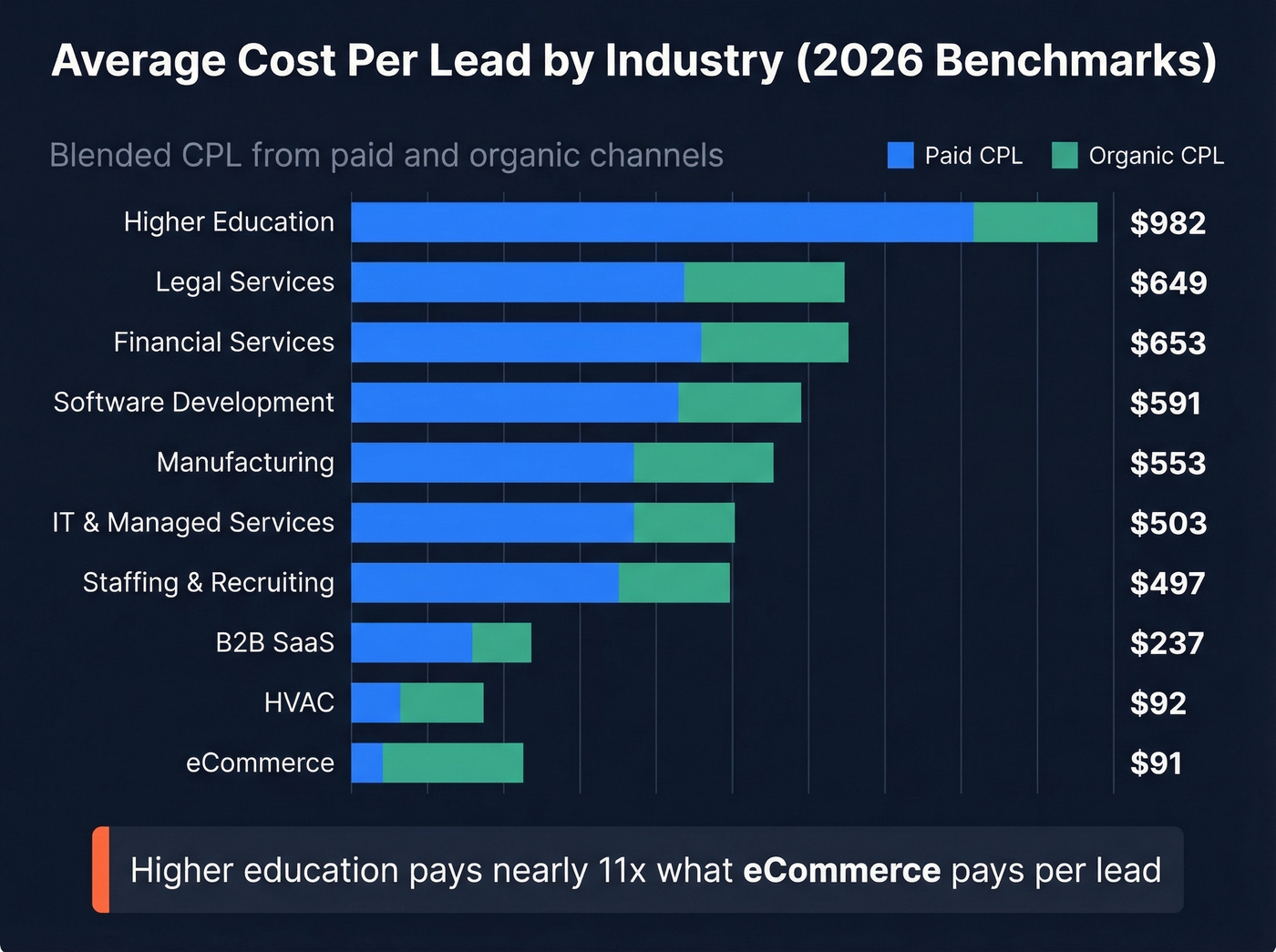
The most comprehensive dataset comes from First Page Sage's 30-industry report, based on data collected from January 2022 through June 2025. The table below uses their paid/organic/blended numbers, plus one additional Staffing & Recruiting benchmark from Sopro.
| Industry | Paid CPL | Organic CPL | Blended CPL |
|---|---|---|---|
| Higher Education | $1,261 | $705 | $982 |
| Legal Services | $784 | $516 | $649 |
| Financial Services | $761 | $555 | $653 |
| Software Development | $680 | $510 | $591 |
| Manufacturing | $691 | $415 | $553 |
| IT & Managed Services | $617 | $385 | $503 |
| B2B SaaS | $310 | $164 | $237 |
| HVAC | $115 | $69 | $92 |
| eCommerce | $98 | $83 | $91 |
Staffing & Recruiting: $497 average (low $476 / high $518).
Higher education pays nearly 11x what eCommerce pays per lead. That's not a rounding error - it reflects deal size, sales cycle complexity, and competitive intensity.
Organic CPL is consistently lower than paid CPL across every industry in these benchmarks. The catch: it takes 6-12 months of consistent content production before organic leads materialize at scale. That's why most teams still lean on paid channels, even though they're paying a premium for immediacy.
Cost Per Lead by Channel
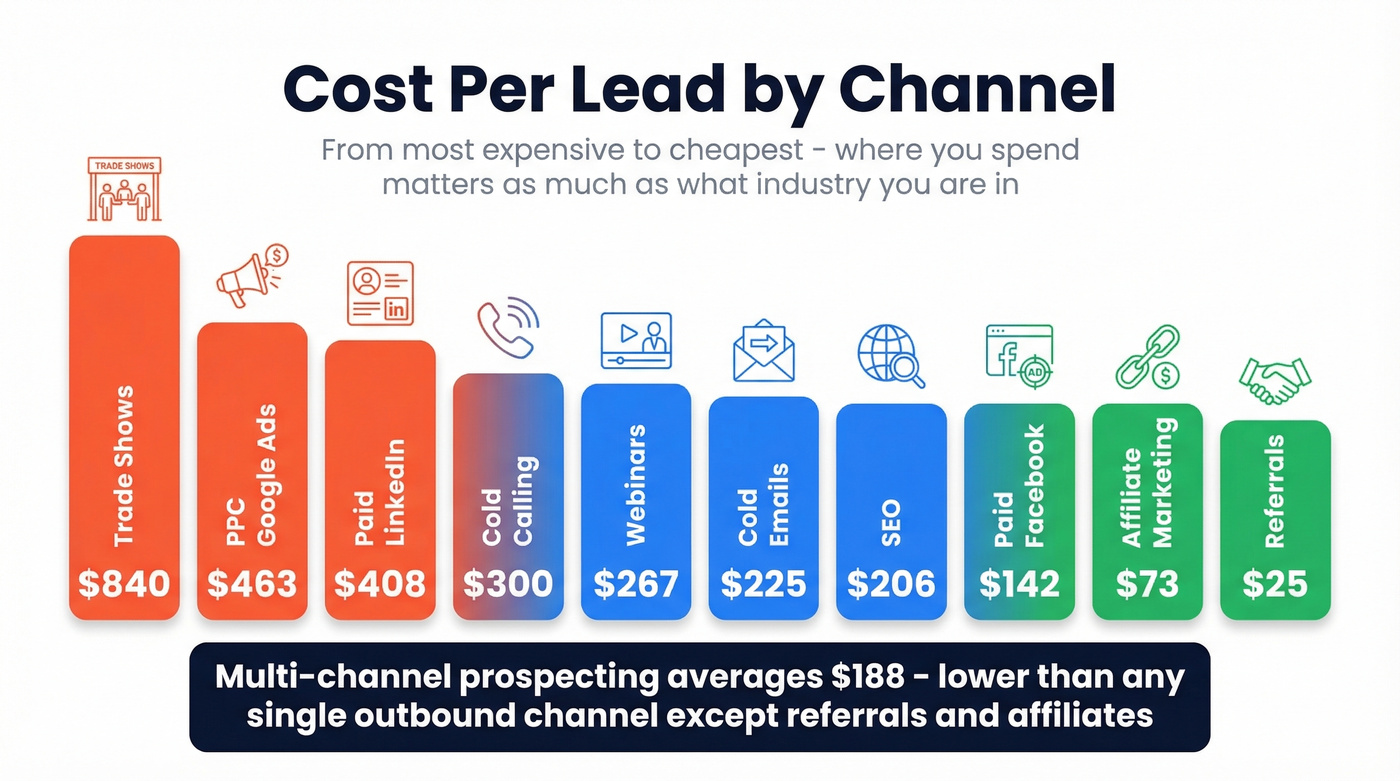
Where you generate leads matters as much as what industry you're in.
| Channel | Avg CPL |
|---|---|
| Trade shows / events | $840 |
| PPC (Google Ads) | $463 |
| Paid LinkedIn ads | $408 |
| Cold calling | $300 |
| Webinars | $267 |
| Cold emails | $225 |
| SEO | $206 |
| Paid Facebook ads | $142 |
| Affiliate marketing | $73 |
| Referrals | $25 |
Trade shows are the most expensive channel by a wide margin. Referrals are the cheapest by an even wider one. Multi-channel prospecting - combining two or more outbound channels - averages $188, lower than any single outbound channel except referrals and affiliates.
The takeaway isn't "stop going to trade shows." It's that channel mix directly determines your blended CPL, and most teams don't model this carefully enough. If 60% of your budget runs through PPC and paid LinkedIn ads, your blended CPL will skew expensive fast. Shift meaningful budget toward cold email and SEO, and you pull that number down - sometimes by 30% or more without sacrificing lead volume.
CPL by Company Size
Smaller companies pay less per lead. Companies with fewer than 50 employees average $146 per lead. Enterprise organizations (over $500M in revenue) average $429.
The gap reflects longer sales cycles, more stakeholders, and the premium that comes with targeting larger accounts. If you're an agency negotiating lead pricing with an enterprise client, these numbers give you real leverage - they're already expecting to pay more.
How to Calculate What to Charge for a Lead
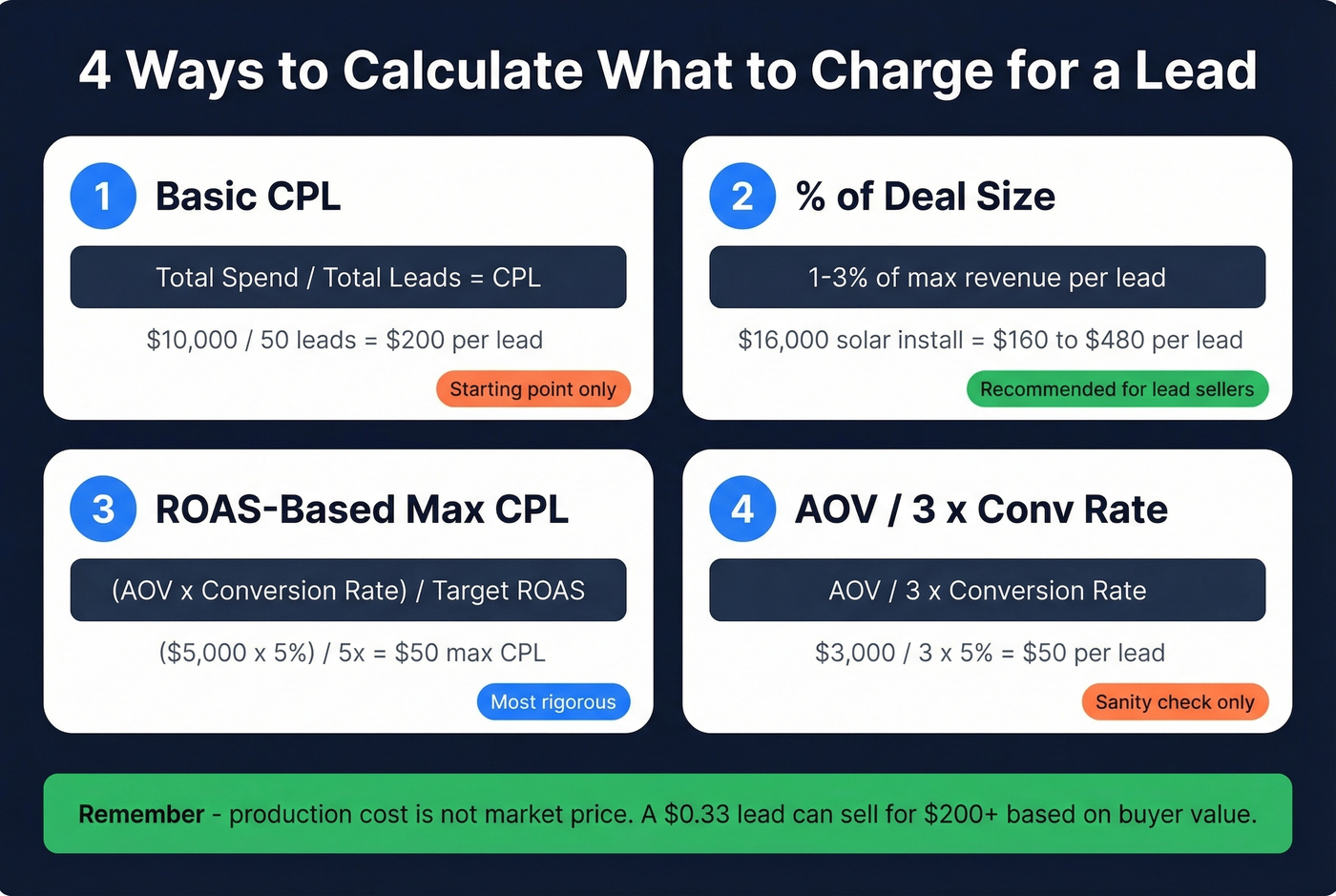
Four methods, from simple to sophisticated.
Method 1: Basic CPL
Total marketing spend / total leads generated. You spent $10,000 and got 50 leads? Your CPL is $200. This is the starting point, not the answer. (If you want the full breakdown, see how to calculate cost per lead.)
Method 2: Percentage of Deal Size
This is the most practical heuristic for lead sellers. Charge 1-3% of the maximum revenue a business makes from a lead. Solar installation generates $16,000 in revenue? Charge $160 (1%) to $480 (3%) per lead. The percentage scales with lead quality and exclusivity - shared leads sit at 1%, exclusive qualified leads push toward 3%.
This approach forms the backbone of most lead generation pricing in service industries, and it's the one we recommend starting with if you're new to selling leads.
Method 3: ROAS-Based Max CPL
Work backward from your target return. If average order value is $5,000, lead-to-customer conversion is 5%, and you want 5x ROAS, then revenue per lead is $250, and your max CPL is $50. More rigorous, but requires accurate conversion data that many teams don't have until they've been running campaigns for a few months.
Method 4: AOV / 3 x Conversion Rate
Some vendors use this formula. For a $3,000 AOV and 5% conversion, that's $1,000 / 3 = roughly $50 per lead. It's napkin math - the "divide by 3" factor isn't grounded in anything universal. Use it as a sanity check, not a pricing strategy.
One thing to remember: production cost isn't market price. A poster in r/LeadGeneration described their automated system producing leads at $0.33 each internally. That's their cost floor, not what they should charge. Market price is set by the value the lead creates for the buyer, not the cost of the email that delivered it.
If you're building lists to sell leads, it also helps to understand list building economics (and what accuracy actually costs).

Cold email CPL drops to $225 - but only if your contacts are real. Bad data inflates your true cost per lead by 20-35% through bounces alone. Prospeo delivers 98% verified emails at ~$0.01 each, so every dollar you spend on outreach actually reaches a buyer.
Stop paying for leads that bounce. Start with 75 free verified emails.
Why Qualified Leads Cost 3x More
The average lead-to-MQL conversion rate across all industries is 31%. That single number explains the massive premium on qualified leads.
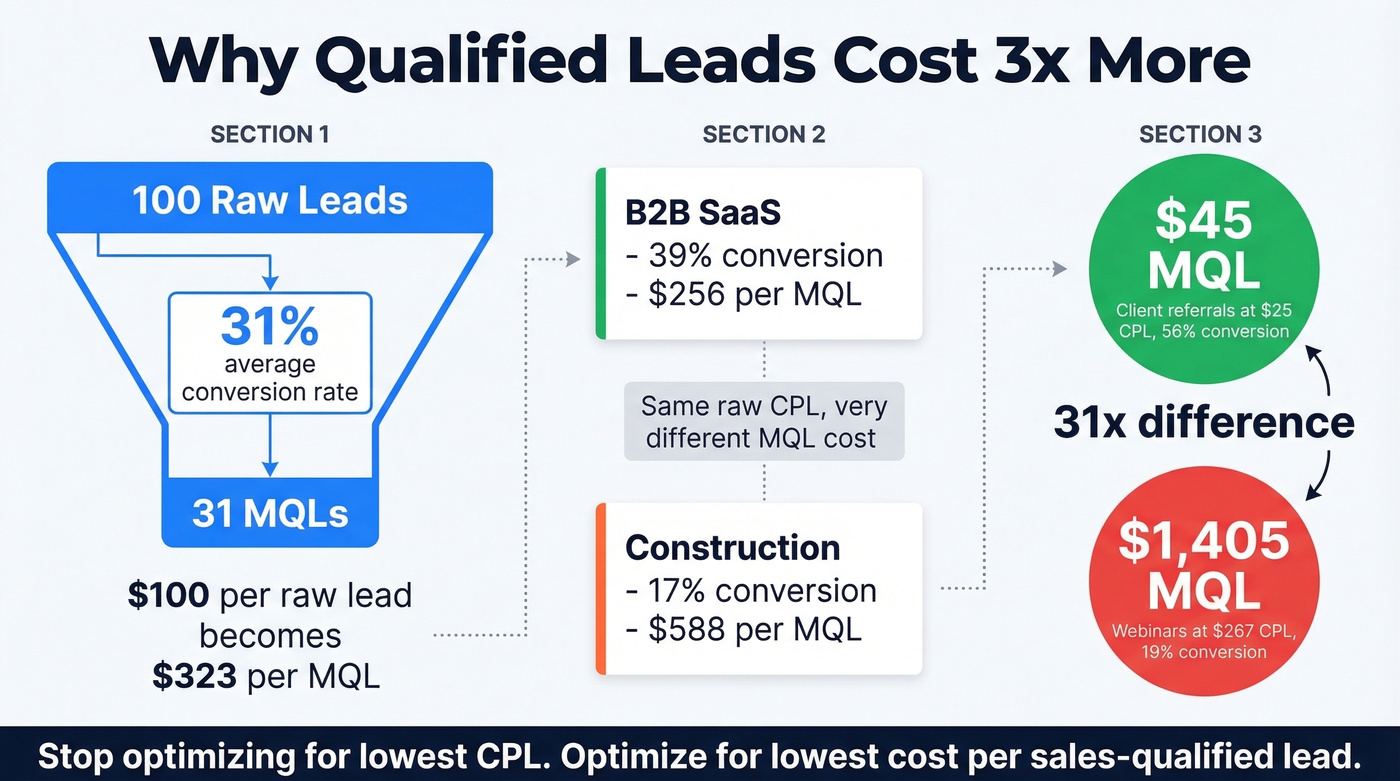
If a raw lead costs $100 and only 31% become marketing-qualified, the effective cost per MQL is $323. But that 31% average hides huge variation. B2B SaaS converts leads to MQLs at 39%, making the effective MQL cost $256. Construction converts at 17%, pushing MQL cost to $588.
Channel matters too. Client referrals convert at 56% - meaning a $25 referral lead produces an MQL at just $45. Webinars convert at 19%, so a $267 webinar lead actually costs $1,405 per MQL. That's a 31x difference in MQL cost between the cheapest and most expensive channel combinations.
Qualification mechanisms also drive this gap. Multi-step forms, lead scoring models, and intent-signal filtering all reduce raw volume while dramatically increasing the percentage that converts. A lead that's been scored against firmographic and behavioral criteria is worth 3-5x a raw form fill - and should be priced accordingly.
Let's be honest: a $200 lead converting at 15% is always cheaper per qualified outcome than a $50 lead converting at 2%. Stop optimizing for the lowest CPL. Optimize for the lowest cost per sales-qualified lead.
Lead Gen Pricing Models Compared
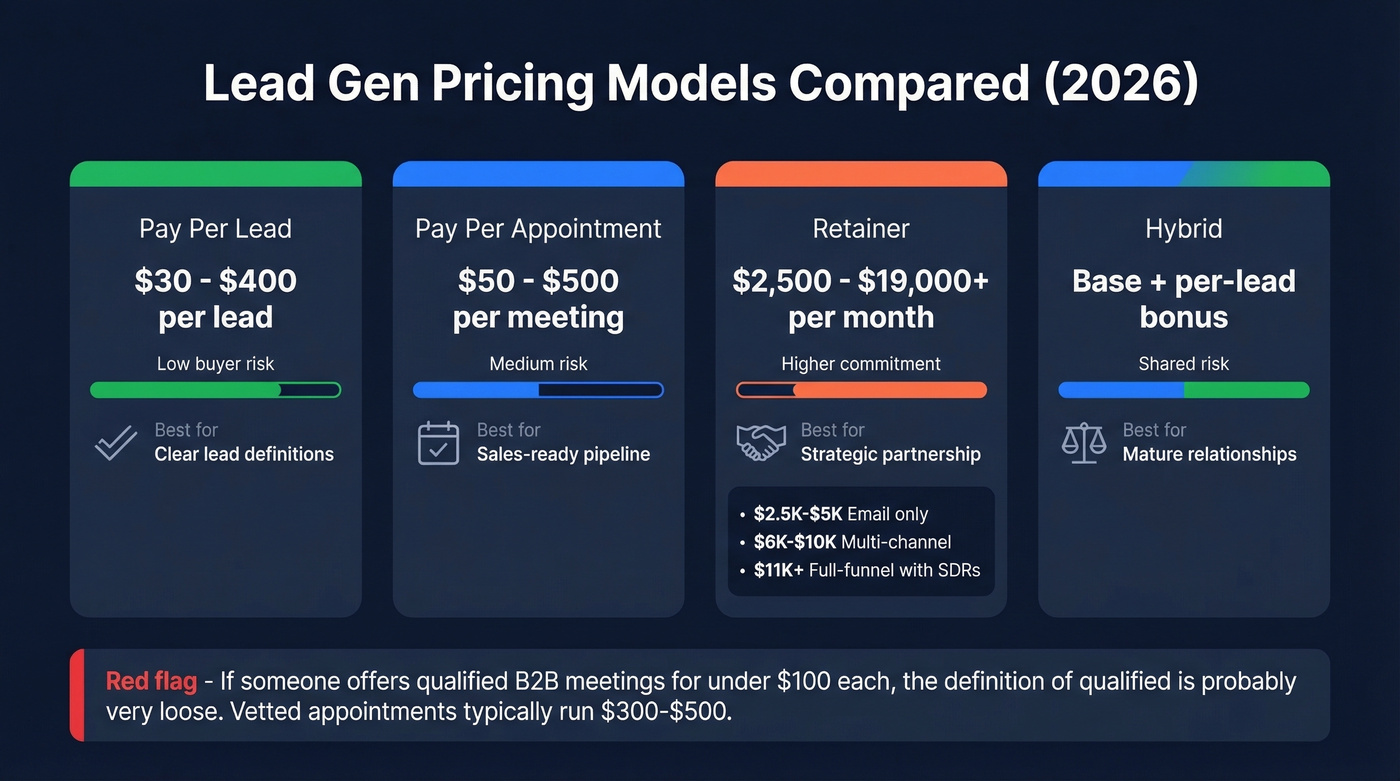
If you're buying or selling lead generation services, four models dominate in 2026. Your payment structure should reflect how much risk each side is willing to absorb.
Understanding the cold/warm/hot taxonomy helps explain why prices vary so much within each model. Cold outbound leads (first touch, no prior engagement) are the cheapest per unit but convert the worst. Warm leads - those who've engaged with content or attended a webinar - cost 2-3x more but convert at meaningfully higher rates. Hot leads (hand-raisers requesting demos or pricing) command premium pricing because they're closest to revenue.
| Model | Typical Range | Risk Profile | Best For |
|---|---|---|---|
| Pay-per-lead | $30-$400/lead | Low buyer risk | Clear lead definitions |
| Pay-per-appointment | $50-$500/meeting | Medium risk | Sales-ready pipeline |
| Retainer | $2,500-$19,000+/mo | Higher commitment | Strategic partnership |
| Hybrid | Base + per-lead bonus | Shared risk | Mature relationships |
The pay-per-lead model shifts nearly all risk to the provider - they only get paid when a qualifying lead is delivered. That's why clear definitions matter so much in these contracts.
Retainer contracts typically run three months to two years. At the low end ($2,500-$5,000/month), expect volume-led outbound - usually email-only with limited personalization. The $6,000-$10,000 range gets multi-channel execution. Premium retainers above $11,000/month include strategy, dedicated SDRs, and full-funnel reporting. For reference, Sopro starts at roughly $3,800/month.
A Reddit thread in r/LeadGeneration described a client offering $20 per qualified meeting targeting Amazon sellers. Walk away from that deal. Vetted B2B appointments typically run $300-$500. Anything below $100 means either the definition of "qualified" is loose or the provider is cutting corners. I've seen agencies quote $20/meeting and deliver nothing but no-shows.
Retainers reward effort. Pay-per-lead rewards outcomes. Pick based on risk tolerance, not budget. If you're comparing vendors, it helps to start with a shortlist of lead generation companies and how they structure deliverables.
Per-Lead Pricing vs. Flat Fee
The debate comes down to predictability versus performance alignment. Flat-fee retainers give you a fixed monthly cost and work well when you need consistent pipeline volume over time - but they don't penalize the provider for delivering low-quality leads. Per-lead pricing ties cost directly to output, which keeps providers accountable, but it can incentivize volume over quality if the lead definition isn't airtight.
For most teams, a hybrid approach works best: a modest base retainer to cover operational costs, plus a per-lead bonus that rewards the provider for hitting quality thresholds. This aligns incentives without creating the perverse dynamics of a pure pay-as-you-go arrangement.
Skip the pure pay-per-lead model if you can't define "qualified" in a single paragraph. Ambiguity in that definition will burn you within the first month.
The Hidden Cost: Bad Data
Your CPL is a lie if your data is bad. Let me show you the math that most CPL discussions skip entirely.
Cold emails average $225 per lead. But if 35% of your emails bounce, you're not reaching 35% of your list. Your effective CPL isn't $225 - it's $346. That's a 54% hidden tax on every lead you generate.
This isn't theoretical. Meritt, an outbound agency, was running a 35% bounce rate before switching their data source. After moving to Prospeo, bounce rates dropped below 4%, and their pipeline tripled from $100K to $300K per week. The CPL didn't change - the data quality did, and that changed everything downstream.
In our experience, teams that verify contact data before launching campaigns see 20-40% lower effective CPL. At scale, that's tens of thousands of dollars per quarter that you're either saving or lighting on fire. If you're sourcing contacts, compare options across B2B data providers and lead generation databases before you commit.

Whether you're selling leads at 1-3% of deal size or buying them at $200-$650 CPL, data quality determines your real ROI. Prospeo's 5-step verification and 7-day refresh cycle mean the contacts you're pricing, sourcing, or reselling actually connect to real decision-makers.
Verified data turns your CPL from a cost center into a revenue engine.
What to Demand in Your Contract
Whether you're buying or selling leads, get these in writing before signing anything:
- Qualified lead definition - specific criteria like title, company size, and engagement action
- Rejection and refund policy - credits, replacements, or refunds for leads that miss the definition
- Deliverability ownership - who handles domain warm-up, SPF/DKIM, and inbox placement (see AI email warmup)
- CRM field mapping - standardized fields flowing directly into your CRM
- Weekly optimization cadence - regular reporting with agreed-upon adjustment triggers
- Data source transparency - where contacts come from and how they're verified (especially if you buy lead lists)
Knowing what to charge for a lead is only half the equation. The other half is ensuring the leads you deliver - or receive - are actually reachable. Lock down definitions, verify data, and model your true cost per qualified outcome. That's how you build a lead pricing strategy that holds up under scrutiny.
FAQ
Is $20 per lead a good price?
For a raw contact name or email address, $20 is reasonable - even generous in some verticals. For a vetted, booked meeting with a decision-maker, $20 is insultingly low. Vetted B2B appointments typically run $300-$500. The gap between "a lead" and "a qualified meeting" is where most pricing disagreements happen. Define the deliverable precisely before agreeing on a number.
What's a good cost per lead for B2B SaaS?
The blended average sits between $188 and $237 depending on the source. Organic channels average $164; paid channels average $310. If your blended CPL is under $200, you're performing well relative to the market. Above $300 blended, audit your channel mix and conversion rates.
Should I pay per lead or use a retainer?
Pay-per-lead if you want lower risk and can define "qualified" precisely in writing - ambiguity in the definition will burn you. Retainer if you want a strategic partnership and higher-quality output over time. Hybrid models split the difference with a base retainer plus per-lead bonuses, aligning incentives for both sides.
How do I lower my cost per lead?
Three levers. First, shift spend toward lower-CPL channels like referrals ($25) and SEO ($206) - even a 10-15% reallocation moves the blended number. Second, improve lead-to-MQL conversion through better scoring and qualification so fewer raw leads are wasted. Third, verify contact data before launching campaigns. We've seen teams cut bounce-driven CPL inflation by 20-40% just by cleaning their lists, and that compounds with every campaign you send.